Jake Bengtson

4 Posts

Introducing Striim Labs: Where AI Research Meets Real-Time Data

AI research has a proliferation problem. AI and machine learning conferences such as NeurIPS stated that they’re overwhelmed with new paper submissions, with 21,575 papers submitted this year, up from under 10,000 in 2020.

At the crux of the issue is the questionable quality of the papers: whether written using AI tools or rushed through to publishing without robust reviews. In the noise, it’s increasingly difficult for practitioners to discern genuine innovation from “slop”, or to find applicable methodologies that might just be perfect for their use cases.

That’s why we’re launching Striim Labs.

We focus specifically on the intersection of AI/ML research and real-time data streaming: the part of the venn diagram where promising techniques meet production-grade, low-latency systems. Our team will wade through the deluge of research papers to find the most applicable examples for streaming machine learning use cases. We’ll even test them out to make sure they can perform as claimed.

Through exploring emerging techniques, collaborating with Striim customers on real scenarios, and building working prototypes, we want to bring about actionable templates (“prototypes”) that teams can replicate and deploy themselves. Every blueprint will be accessible to the public via GitHub repositories and deployment instructions, and maintain an open line of communication for feedback and collaboration.

What is Striim Labs?

Striim Labs is an applied AI research group we’re launching at Striim: a team dedicated to learning and experimentation at the intersection of AI and real-time data.

Striim Labs will draw on the collective knowledge and experience of a team of data scientists and experts in streaming machine learning. First and foremost, our work focuses on real-time, low-latency use cases that enterprise teams can actually use.

Striim Labs isn’t a purely academic exercise. Nor is it a Striim product demo disguised as thought leadership. It’s a genuine attempt to take promising techniques from recent research and stress-test them against the messiness of real-time data: schema drift, late-arriving events, volume spikes, and all the other things that break what worked in a notebook.

We’ll document what we find honestly, including what didn’t work, what we had to adapt, and where the gap between a paper’s benchmarks and streaming reality turned out to be wider than expected. That transparency is the point. If a technique falls apart under latency pressure, that’s a finding worth sharing too.

The result, we hope, will be a series of prototypes we’re referring to as “AI Prototypes” that practitioners: ML engineers, architects, and data scientists can experiment with themselves, as well as giving us feedback and suggestions from their own experiences.

What is an AI Prototype?

An AI prototype is a self-contained reproducible prototype that implements a technique or model from a recent research paper.

We’ll build our prototypes using open source tools and technologies (Kafka, Apache Spark, PyTorch, Docker, and others) with defined minimum acceptance criteria (precision, recall, latency).  Our starting point with each blueprint is always based in open source and framework-agnostic tooling, so anyone can run it (not just Striim customers, though we encourage them to check it out!). Each blueprint will live in a public GitHub repository with full deployment instructions. We’ll also publish our work via the Striim resources page and elsewhere, to make it more accessible.

Ultimately, our intention for each blueprint is first to validate a technique within a streaming context, then to integrate it into Striim’s platform natively, extending what Striim offers to our customers out of the box. But again, we stress that each blueprint will be available to everyone, not just Striim users.

What Makes Striim Labs Different?

Here are a few ways we aim to set Striim Labs apart from other data science initiatives.

  • Everything ships with code: Every applied blueprint we publish will feature code you can test, within its own GitHub repo. Not just theoretical whitepapers.
  • Every blueprint has defined, measurable acceptance criteria: We’ll test our models and share based on real results; not a vague promise that it works.
  • Open source first approach: You won’t need Striim’s platform or to be working within a particular cloud environment to learn from or run a blueprint.
  • Transparency about tradeoffs: We’ll be clear and open from the start about model failures and breakages, rather than just sharing polished results.
  • Clear path from prototype to production: Our prototypes will be designed to graduate from prototypes into systems we’ll build into Striim’s platform as native capabilities.

What’s next?

Our first area of focus will be a subject many real-time enterprises are interested in: anomaly detection. Anomaly detection has benefited from a rich body of recent research, but the gap between research papers and production results remains particularly wide. That makes it a great place for us to start, especially since it’s one of the most requested capabilities in a streaming context.

We’ll be launching a series of prototypes on anomaly detection, and our findings on anomaly detection models, in the near future.

Your Move: Get Involved

Striim Labs is designed to be an open, collaborative exercise. We welcome input, feedback, and ideas from practitioners wrestling with data science problems who are curious about the latest innovations in the market.  Here are a few ways you can take part:

  • Suggest papers, techniques, or focus areas you’d like us to text against real-time data.
  • Try our prototypes, and give us real feedback! Tell us where we can improve, and let us know what works and what breaks in your environment.
  • Share your work. We’d love to hear from you if you’re working on similar projects. Feel free to share your GitHub repos or related initiatives.

Where you can find us:

We’re excited to bring new insights, prototypes, and research to you in the following weeks. Thanks for being part of our journey.

When Does Data Become a Decision?

For years, the mantra was simple: “Land it in the warehouse and we’ll tidy later.” That logic shaped enterprise data strategy for decades. Get the data in, worry about modeling, quality, and compliance after the fact.

The problem is, these days “later” usually means “too late.” Fraud gets flagged after the money is gone. A patient finds out at the pharmacy that their prescription wasn’t approved. Shoppers abandon carts while teams run postmortems. By the time the data looks clean on a dashboard, the moment it could have made an impact has already passed.

At some point, you have to ask: If the decision window is now, why do we keep designing systems that only prepare data for later?

This was the crux of our recent webinar, Rethinking Real Time: What Today’s Streaming Leaders Know That Legacy Vendors Don’t. The takeaway: real-time everywhere is a red herring. What enterprises actually need is decision-time: data that’s contextual, governed, and ready at the exact moment it’s used.

Define latency by the decision, not the pipeline

We love to talk about “real-time” as if it were an absolute. But most of the time, leaders aren’t asking for millisecond pipelines; rather, they’re asking to support a decision inside a specific window of time. That window changes with the decision. So how do we design for that, and not for some vanity SLA?

For each decision, write down five things:

  • Decision: What call are we actually making?
  • Window: How long before the decision loses value? Seconds? Minutes? Hours?
  • Regret: Is it worse to be late, or to be wrong?
  • Context: What data contributes to the decision?
  • Fallback: If the window closes, then what?

Only after you do this does latency become a real requirement. Sub-second pipelines are premium features. You should only buy them where they change the outcome, not spray them everywhere.

Satyajit Roy, CTO of Retail Americas at TCS, expressed this sentiment perfectly during the webinar. 

Three latency bands that actually show up in practice

In reality, most enterprise decisions collapse into three bands.

  • Sub-second. This is the sharp end of the stick: decisions that have to happen in the flow of an interaction. Approve or block the card while the customer is still at the terminal. Gate a login before the session token issues. Adapt the price of an item while the shopper is on the checkout page. Miss this window, and the decision is irrelevant, because the interaction has already moved on. 
  • Seconds to minutes. These aren’t interactive, but they’re still urgent. Think of a pharmacy authorization that needs to be resolved before the patient arrives at the counter. Or shifting inventory between stores to cover a shortfall before the next wave of orders. Or nudging a contact center agent with a better offer while they’re still on the call. You’ve got a small buffer, but the decision still has an expiration date. 
  • Hours to days. The rest live here. Compliance reporting. Daily reconciliations. Executive dashboards. Forecast refreshes. They’re important, but the value doesn’t change if they show up at 9 a.m. sharp or sometime before lunch.

Keep it simple. You can think of latency in terms of these three bands, not an endless continuum where every microsecond counts. Most enterprises would be better off mapping decisions to these categories and budgeting accordingly, instead of obsessing over SLAs no one will remember.

From batch habits to in-stream intelligence

Once you know the window, the next question is harder: what actually flows through that window? 

Latency alone doesn’t guarantee the decision will be right. If the stream shows up incomplete, out of context, or ungoverned, the outcome is still wrong, just… faster. For instance, when an AI agent takes an action, the stream it sees is the truth, whether or not that truth is accurate, complete, or safe. 

This is why streaming can’t just be a simple transport layer anymore. It has to evolve into what I’d call a decision fabric: the place where enough context and controls exist to make an action defensible.

And if the stream is the decision fabric, then governance has to be woven into it. Masking sensitive fields, enforcing access rules, recording lineage, all of it has to happen in motion, before an agent takes an action. Otherwise, you’re just trusting the system to “do the right thing” (which is the opposite of governance).

Imagine a customer denied credit because the system acted on incomplete data, or a patient prescribed the wrong medication because the stream dropped a validation step. In these cases, governance is the difference between a system you can rely on and one you can’t.

Still, it has to be pragmatic. That’s the tradeoff enterprise leaders often face: how much assurance do you need, and what are you willing to pay for it? Governance that’s too heavy slows everything down. Governance that’s too light creates risk you can’t defend.

That balance—enough assurance without grinding the system to a halt—can’t be solved by policies alone. It has to be solved architecturally. And that’s exactly where the market is starting to split. Whit Walters, Field CTO at GigaOm, expressed this perfectly while explaining this year’s GigaOm Radar Report.

A true decision fabric doesn’t wait for a warehouse to catch up or a governance team to manually check the logs. It builds trust and context into the stream itself, so that when the model or agent makes a call, it’s acting on data you can stand behind.

AI is moving closer to the data

AI is dissolving the old division of labor. You can’t draw a clean line between “data platform” and “AI system” anymore. Once the stream itself becomes the place where context is added, governance is enforced, and meaning is made, the distinction stops being useful. Intelligence isn’t something you apply downstream. It’s becoming a property of the flow.

MCP is just one example of how the boundary has shifted. A function call like get_customer_summary is baked into the governed fabric. In-stream embeddings show the same move: they pin transactions to the context in which they actually occurred. Small models at the edge close the loop further still, letting decisions happen without exporting the data to an external endpoint for interpretation.

The irony is that many vendors still pitch “AI add-ons” as if the boundary exists. They talk about copilots bolted onto dashboards or AI assistants querying warehouses. Meanwhile, the real change is already happening under their feet, where the infrastructure itself is learning to think.

The way forward

Accountability is moving upstream. Systems no longer sit at the end of the pipeline, tallying what already happened. They’re embedded in the flow, making calls that shape outcomes in real time. That’s a very different burden than reconciling yesterday’s reports.

The trouble is, most enterprise architectures were designed for hindsight. They assume time to clean, model, and review before action. But once decisions are automated in motion, that buffer disappears. The moment the stream becomes the source of truth, the system inherits the responsibility of being right, right now.

That’s why the harder question isn’t “how fast can my pipeline run?” but “can I defend the decisions my systems are already making?”

This was the thread running through Rethinking Real Time: What Today’s Streaming Leaders Know That Legacy Vendors Don’t. If you didn’t catch it, the replay is worth a look. And if you’re ready to test your own stack against these realities, Striim is already working with enterprises to design for decision-time. Book a call with a Striim expert to find out more.

The Power of MCP: How Real-Time Context Unlocks Agentic AI for the Modern Enterprise 

It started with a tweet. In the afternoon of November 30, 2022, with just a few modest words, Sam Altman unleashed ChatGPT upon the world. Within hours, it was an internet sensation. Five days later, the platform reached 1 million users.

ChatGPT’s seminal moment wasn’t a singular case. Looking back, we know ChatGPT and its emergent rivals sparked the beginnings of the AI revolution. And today, it’s not just tech enthusiasts brimming with excitement for the promise of AI applications. It’s also enterprise leaders, bullish on the competitive advantages of leveraging real-time AI to better serve their customers, slash costs, and unlock new revenue opportunities.

But for AI to work for the modern enterprise, it can’t be isolated to a single LLM interface like ChatGPT, or a standalone application like Microsoft Copilot. It needs to be embedded, connected with the databases, tools, and systems that make AI’s outputs meaningful.

This is the promise of Agents enabled by Model Context Protocol (MCP). This article will explore how MCP’s technology, in tandem with real-time data contexts, can finally bring AI to enterprise operations.

The Evolution of AI: From LLMs to Autonomous Agents

In just a few short years, AI as we know it has dramatically evolved. While ChatGPT asserted itself as the LLM everyone knew and loved, other prominent AI interfaces joined the scene. Anthropic’s Claude, Google’s Bard (which later became Gemini), and another tool named Perplexity became our helpful desktop companions.

From the outset, conversational LLMs were both fun to use, and helpful for everyday tasks. But they weren’t considered sufficient for everyday work —not until late 2023 when their ability to handle complex tasks significantly improved.

Soon enough LLMs could generate not just text-based outputs, but images, videos, and even audio files. This led to an explosion of AI tools to assist writing, coding, and notetaking. Over time, AI evolved from simple task-takers to “agentic systems,” capable not only of answering instructions but acting autonomously, even using other tools themselves, to perform multi-step operations.

Fast forward to today, and many enterprises are still exploring how they can best leverage AI. Tools like conversational LLMs have proved extremely useful for ad-hoc tasks. Yet these tools are only so effective in isolation—siloed off from the data and contexts of the wider organization.

The next step: to embed AI tools in the enterprise by connecting them with the data, systems, and contexts they need to make an impact.

The Challenge of Connecting Agents to Systems and Tools

As agentic AI emerged, it became clear that context was critical to better outcomes. Yet connecting agents to relevant sources was difficult and time consuming, as developers struggled with a patchwork of custom-built integrations and hardcoded APIs.

For enterprises, building these interfaces between agents and databases has been slow and complex. Up to now, this has hindered their ability to test and iterate agentic systems across the business. Enterprises need a faster, more scalable way to connect sources and agents, without labor-intensive custom-coding for each application and database.

Enter Model Context Protocol (MCP), a new, standardized protocol enabling AI models to interface cleanly with external tools and data in a structured format.

Like the “USB-C” of AI, MCP offers a universal standard that makes it much faster and easier to connect agentic AI with tools and databases. Before MCP, bringing valuable context to agents at scale was insurmountable for enterprise companies. MCP promises to make this process fast and straightforward, finally enabling engineers to embed AI in the enterprise.

With MCP, developers can plug agents into a variety of tools and data sources, without having to individually code integrations or implement API calls. This is a gamechanger: not just for faster time-to-value when it comes to leveraging context-rich AI, but for building robust, agentic systems at scale.

In one test by Twilio, MCP sped up agentic performance by 20%, and increased task success rate from 92.3% to 100%. Another study found that MCP also reduced compute costs by up to 30%. The results are clear. MCP isn’t just an accelerator, but the new standard for enterprise AI.

A New Standard for Agentic Systems

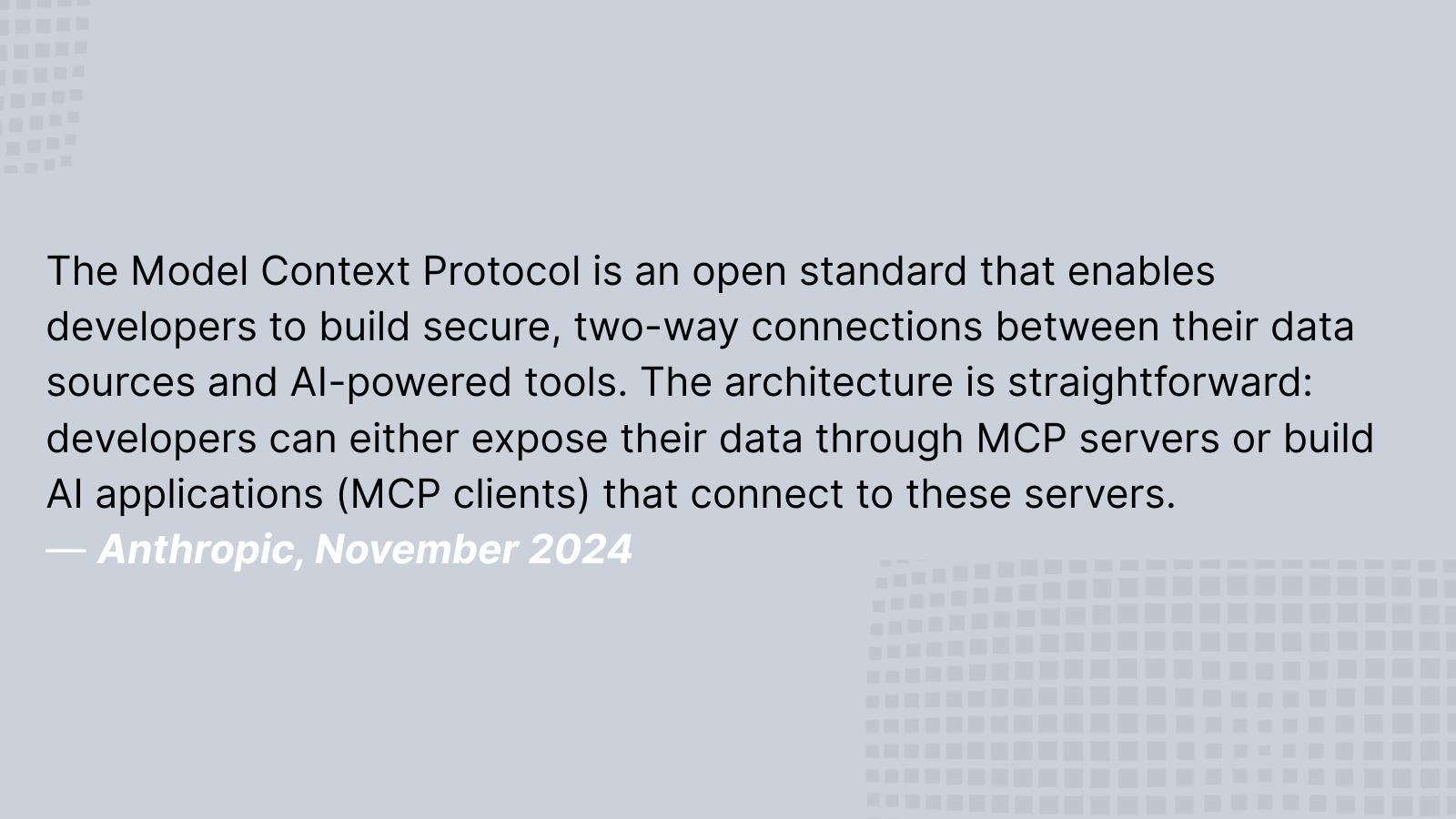
Invented by Anthropic, MCP is an open standard for managing and transferring context between AI models, tools, applications, and agents. It enables AI systems to remember, share, and reuse information across tools and environments by exchanging structured context in a consistent way.

MCP lets agentic systems learn and use context in powerful ways. The context, however, is still critically important. The better your data—its speed, quality, governance, and enrichment—the better context you can send to intelligent systems through MCP.

Striim’s Value: Delivering Real-Time Data Context

From simple interfaces, to tools, agents, and now embedded in enterprise infrastructure—generative AI has come a long way in just a few years. Today, MCP represents a huge opportunity for enterprises, but it calls for a new mandate: the need for a real-time, well-governed, AI-ready data access for agents without compromising production workloads, data sensitivity, or compliance.

Directly exposing production operational data stores to agents is a recipe for performance and governance headaches. High-frequency queries from AI workloads can create unpredictable spikes in load, impacting mission-critical transactions and degrading end-user experiences. It also increases the risk of compliance violations and accidental data exposure.

The safer and smarter approach is to continuously replicate operational data into secure zones that are purpose built to serve agents via MCP servers. These zones preserve production performance, enforce access policies, and ensure AI systems are working with fresh, well-governed data while allowing controlled write-back when needed, without ever touching the live systems that run the business.

That’s where integrative solutions like Striim come in. Sitting at the heart of this new architecture, Striim’s MCP AgentLink offers a continuous, real-time, cleansed, and protected operational replica in safe, compliant zones—giving agents fresh, accurate data without exposing production systems. With a growing number of operational databases such as Oracle, Azure PostgreSQL, Databricks, and Snowflake announcing support for MCP, Striim ensures these systems can feed governed, AI-ready context directly into MCP servers in real time.

Specifically Striim:

  • Replicates operational databases (e.g., Oracle, SQL Server, PostgreSQL, Salesforce) in real-time to read-only, agent-safe destinations, PostgreSQL clusters.
  • Processes and transforms streaming data to remove PII, enriches it with context, and prepares it for agentic consumption.
  • Routes agent-generated writes to a safe staging layer, validates them, and syncs them back to source systems through its stream processing engine.
  • Powers event processing to deliver decision-ready, well-structured event data where it’s needed most.

Simply put, Striim is the real-time, intelligent, and compliant middleware that bridges enterprise systems and MCP agent workloads. With Striim MCP AgentLink, enterprises can finally realize the promise of AI by connecting it with their existing tools and databases.

With Striim MCP AgentLink, enterprises can deliver AI-ready data from anywhere—instantly and without disruption. We’re not just moving data in real time—we’re delivering real-time context, so AI systems can act with full awareness of the business.

ALOK PAREEK
EVP of Products & Engineering, Striim

Powerful Use Cases for MCP-Empowered AI

The real value of MCP lies in its ability to transform business use cases and unlock new revenue streams. Let’s consider some powerful use cases that MCP could unlock for modern enterprises.

Autonomous Patient Support

Imagine healthcare agents assisting patients and clinicians. They could shed light on available healthcare options by instantly retrieving medical records, insurance coverage, and treatment guidelines from multiple secure systems.

Agents could query EHRs, insurance portals, and clinical knowledge bases in real time through MCP, without exposing sensitive patient data.

Personalized Financial Advisory

Agentic AI could be an ideal analyst tool for investment consultants. Connected to the right systems, they could deliver tailored investment and financial planning recommendations using a client’s up-to-date financial profile and market data.

Through MCP, analyst agents could secure client portfolios, transaction history, and live market trends to generate compliant, personalized advice.

Supply Chain Optimization

In manufacturing, AI systems could reduce operational complexity while drastically improving efficiency in the supply chain. Imagine agents that could dynamically adjust procurement, manufacturing, and logistics to maintain efficiency and meet demand.

Supply chain agents could orchestrate planning decisions using live inventory, shipping schedules, and product demand forecasts, accessed securely through MCP.

Personalized, Real-Time Marketing

AI agents have the potential not just to ideate hyper-targeted marketing campaigns, but to deliver them in real time. Pulling from recent purchases, loyalty status, and in-stock SKUs, agentic systems could instantly push a custom promotion to high-value customers visiting a product website or visiting a store.

To make this happen, the agent would use MCP to retrieve live behavioral data, customer segmentation data, and product availability to generate and deliver tailored campaigns in seconds.

The Future of Agentic Systems with Striim and MCP

The arrival of MCP represents another major step in the evolution of AI technology. The building blocks for autonomous, intelligent systems are coming together. Now is the time to connect them.

“Our customers are moving fast to build real-time, decision-ready AI into their operations,” …“By embedding governance, compliance, and safety directly into the data streams, we give them the confidence to scale MCP-powered AI without slowing down innovation.”

ALI KUTAY
CEO and Co-Founder, Striim

With Striim MCP AgentLink, enterprises can finally realize the promise of agentic AI at scale. They can connect agents with context from any and all of their sources and databases. They can send trusted, well-governed, decision-ready data to intelligent systems. And they can do it all at the scale and speed enterprises demand: in sub-second latency, so agents can make instant impact.

Book a demo today to see how Striim’s MCP AgentLink can bring real-time, governed context to your AI systems.

A Guide to Getting AI-Ready Part 1: Building a Modern AI stack

The AI era is upon us. For organizations at every level, it’s no longer a question of whether they should adopt an AI strategy, but how to do it. In the race for competitive advantage, building AI-enabled differentiation has become a board-level mandate. 

Getting AI-Ready

The pressure to adopt AI is mounting; the opportunities, immense. But to seize the opportunities of the new age, companies need to take steps to become AI-ready.

What it means to be “AI-ready”:

AI readiness is defined as an organization’s ability to successfully adopt and scale artificial intelligence by meeting two essential requirements: first, a modern data and compute infrastructure with the governance, tools, and architecture needed to support the full AI lifecycle; second, the organizational foundation—through upskilling, leadership alignment, and change management—to enable responsible and effective use of AI across teams. Without both, AI initiatives are likely to stall, remain siloed, or fail to generate meaningful business value.

For the purpose of this guide, we’ll explore the first part of AI-readiness: technology. We’ll uncover what’s required to build a “modern AI stack”—a layered, scalable, and modular stack that supports the full lifecycle of AI. Then in part 2, we’ll dive deeper into the data layer—argubaly the most critical element needed to power AI applications. 

But first, let’s begin by unpacking what an AI stack is, why it’s necessary, and what makes up its five core layers.

What is a Modern AI Stack?

A “modern AI stack” is a layered, flexible system designed to support the entire AI lifecycle—from collecting and transforming data, to training and serving models, to monitoring performance and ensuring compliance. 


Each layer plays a critical role, from real-time data infrastructure to machine learning operations and governance tools. Together, they form an interconnected foundation that enables scalable, trustworthy, and production-grade AI.

Let’s break down the five foundational layers of the stack and their key components.

The Five Layers of the Modern AI Stack

The Infrastructure Layer


The infrastructure layer is the foundation of any modern AI stack. It’s responsible for delivering the compute power, orchestration, and network performance required to support today’s most demanding AI workloads. It enables everything above it, from real-time data ingestion to model inference and autonomous decisioning. And it must be built with one assumption: change is constant. 

Flexibility, scalability are essential

The key considerations here are power, flexibility, and scalability. Start with power. AI workloads are compute-heavy and highly dynamic. Training large models, running inference at scale, and supporting agentic AI systems all demand significant, on-demand resources like GPUs and TPUs. This makes raw compute power a non-negotiable baseline.

Just as critical is flexibility. Data volumes surge. Inference demands spike. New models emerge quickly. A flexible infrastructure (cloud-native, containerized systems) lets teams adapt fast and offer the modularity and responsiveness required to stay agile.

Finally, infrastructure must scale seamlessly. Models evolve, pipelines shift, and teams experiment constantly. Scalable, composable infrastructure allows teams to retrain models, upgrade components, and roll out changes without risking production downtime or system instability.

Here’s a summary of what you need to know about the infrastructure layer.

  • What it is: This is the foundational layer of your entire stack— the compute, orchestration, and networking fabric that all other parts of the AI stack depend on.
  • Why it’s important: AI is computationally heavy, dynamic, and unpredictable. Your infrastructure needs to flex with it — scale up, scale down, distribute, and recover — seamlessly.
  • Core requirements: 
    • A cloud-native, modular architecture that’s designed to evolve with your business needs and technical demands.
    • Elastic compute with support for GPUs/TPUs to handle AI training and inference workloads.
    • Built-in support for agentic AI frameworks capable of multi-step, autonomous reasoning. 
    • Infrastructure resiliency, including zero-downtime upgrades and self-healing orchestration.

Data Layer


Data is the fuel. This layer governs how data is collected, moved, shaped, and stored—both in motion and at rest—ensuring it’s available when and where AI systems need it. Without high-quality, real-time data flowing through a reliable platform, even the most powerful models can’t perform.

That’s why getting real-time, AI-ready data into a reliable, central platform is so crucial. (We’ll cover more on this layer, and how to select a reliable data platform in Part 2 of this series). 

AI-ready data is timely, trusted, and accessible.

AI systems need constant access to the most current data to generate accurate and relevant outputs. Especially for real-time use cases such as models driving personalization, fraud detection, or operational intelligence. Even outside of these specific applications, fresh, real-time data is vital for all AI use cases. Stale data leads to inaccurate predictions, lost opportunities, or worse—unhappy customers. 

Just as important as timeliness is trust. You can’t rely on AI applications driven by unreliable data—data that’s either incomplete, inconsistent (not following standardized schemas), or inaccurate. This undermines outcomes, erodes confidence, and introduces risk. Robust, high-quality data is essential ensuring accurate, trustworthy AI outputs. 

Here’s a quick rundown of the key elements at the data layer. 

  • What it is: The system of record and real-time delivery that feeds data into your AI stack. It governs how data is captured, integrated, transformed, and stored across all environments. It ensures that data is available when and where AI systems need it.
  • Why it’s important: No matter how advanced the model, it’s worthless without relevant, real-time, high-quality data. An AI strategy lives or dies by the data that feeds it. 
  • Core requirements: 
    • Real-time data movement from operational systems, transformed mid-flight with Change Data Capture (CDC).
    • Open format support, capable of reading/writing in multiple formats to manage real-time integration across lakes, warehouses, and APIs.
    • Centralized, scalable storage that can manage raw and enriched data across hybrid environments.
    • Streamlined pipelines that enrich data in motion into AI-ready formats, such as vector embeddings for Retrieval-Augmented Generation (RAG), to power real-time intelligence.

AI/ML Layer


The AI/ML layer is where data is transformed into models that power intelligence—models that predict, classify, generate, or optimize. This is the engine of innovation within the AI stack, converting raw data inputs into actionable outcomes through structured experimentation and iterative refinement. 

Optimize your development environment—the training ground for AI

To build performant models, you need a development environment that can handle full-lifecycle model training at scale: from data preparation and model training to tuning, validation, and deployment. The flexibility and efficiency of your training environment determine how fast teams iterate, test new architectures, and deploy intelligent systems. 

Modern workloads demand support for both traditional ML and emerging LLMs. This includes building real-time vector embeddings, semantic representations that translate unstructured data like emails, documents, code, and tickets into usable inputs for generative and agentic systems. These embeddings provide context awareness and enable deeper reasoning, retrieval, and personalization capabilities.

Let’s summarize what to look out for:

  • What it is: This is where raw data is transformed into intelligence—where models are designed, trained, validated, and deployed to generate predictions, recommendations, or content. 
  • Why it’s important: This is where AI comes to life. Without this layer, there’s no intelligence — you have infrastructure without insight. The quality, speed, and reliability of your models depend on how effectively you manage the training and experimentation process. 
  • Core requirements: 
    • Full-lifecycle model development environments for traditional ML and modern LLMs.
    • Real-time vector embedding to support LLMs and agentic systems with semantic awareness.
    • Access to scalable compute infrastructure (e.g., GPUs, TPUs) for training complex models.
    • Integrated MLOps to streamline experimentation, deployment, and monitoring.

Inference and Decisioning Layer


The inference layer is where AI systems are put to work. This is where models are deployed to answer questions, make predictions, generate content, or trigger actions. It’s where AI begins to actively deliver business value through customer-facing experiences, operational automations, and data-driven decisions.

Empower models with real-time context 

AI must be responsive, contextual, and real-time. Especially in user-facing or operational settings—like chatbot interfaces, recommendation engines, or dynamic decisioning systems—context is everything. 

To deliver accurate, relevant results, inference pipelines should be tightly integrated with retrieval logic (like RAG) to ground outputs in real-world context. Vector databases play a critical role here, enabling semantic search alongside AI to surface the most relevant information, fast. The result: smarter, more reliable AI that adapts to the moment and drives better outcomes.

To sum up, here are the most important considerations for the inference layer:

  • What it is: This is the activation point — where trained models are deployed into production and begin interacting with real-world data and applications.
  • Why it’s important: Inference is where AI proves its worth. Whether it’s detecting fraud in real time, providing recommendations, or automating decisions, this is the layer that impacts customers and operations directly.
  • Core requirements: 
    • Model serving that hosts trained models for fast, scalable inference. 
    • The ability to embed AI directly into data streams for live decision-making.
    • RAG combines search (using vector databases) alongside AI to ground outputs in real-time context.
    • Flexible deployment interfaces (APIs, event-driven, etc.) that integrate easily into business workflows.

Governance Layer


AI is only as trustworthy as the data it’s built on. As AI scales, so do the risks. The governance layer exists to ensure your AI operates responsibly by securing sensitive data from the start, enforcing compliance, and maintaining trust across every stage of the AI lifecycle.

Observe, detect, protect

With the right governance in place, you can be confident that only clean, compliant data is entering your AI systems. Embed observability systems into your data streams to flag sensitive data early. Ideally, automated protection protocols will find and protect sensitive data before it moves downstream—masking or encrypting or tagging PII, PHI, or financial data to comply with regulatory standards. 

Effective governance extends to the behavior of the AI itself. Guardrails are needed not only for the data but for the models—monitoring for drift, hallucinations, and unintended outputs. Full traceability, explainability, and auditability must be built into the system, not bolted on after the fact.

To sum up governance:

  • What it is: This is your oversight and control center — it governs the flow of sensitive data, monitors AI performance and behavior, and ensures compliance with internal and external standards.
  • Why it’s important: You can’t operationalize AI without trust. Governance ensures your data is protected, your models are accountable, your systems are resilient in the face of scrutiny, drift, or regulation, your business is audit-ready.
  • Core requirements: 
    • Built-in observability that tracks performance, ensures data quality, and operational health.
    • Proactive detection of sensitive data (PII, financial, health) before it moves downstream.
    • Real-time classification and tagging to enforce policies automatically.
    • Full traceability and audit logs to meet internal standards and external regulations.
    • AI behavior monitoring to detect anomalies, reduce risk, and prevent unintended or non-compliant outputs.

The Foundation for AI Success

The AI era comes with a new set of demands—for speed, scale, intelligence, and trust.

While many organizations already have elements of a traditional tech stack in place: cloud infrastructure, data warehouses, ML tools, those are no longer enough. 

A modern AI stack stands apart because it’s designed from the ground up to: 

  • Operate in real time, ingesting, processing, and reacting to live data as it flows.
  • Scale elastically, handling unpredictable surges in compute demand from training, inference, and agentic workflows.
  • Enable AI-native capabilities like vector embeddings, RAG, autonomous agents that reason, plan, and act in complex environments.
  • Ensure trust and safety by embedding observability, compliance, and control at every layer. 

Without this layered, flexible, end-to-end foundation, AI initiatives will stall before they ever generate value. But with it, organizations are positioned to build smarter products, unlock new efficiencies, and deliver world-changing innovations. 

This is the moment to get your foundation right. To get AI-ready. 

That covers the five main layers in a modern AI-stack. In part 2, we’ll dive deeper into the data layer specifically, and outline how to attain AI-ready data. 

Back to top