Striim Sweeps 2019 Best Places to Work Awards

We are proud to announce that Striim has received two 2019 best places to work awards in the Bay Area by three highly regarded local publications: the San Francisco Business Times, the Silicon Valley Business Journal, and the Bay Area News Group (publisher of The Mercury News in San Jose). This is the third year in a row that Striim was among the top companies on both lists.

This past week, Striim ranked #1 in the Small Companies category of the Bay Area News Group’s Top Workplaces award. This is the second time in three years that Striim has received the top ranking.

In late April, the San Francisco Business Times and the Silicon Valley Business Journal recognized Striim as the #7 best place to work in the Bay Area, up 3 spots from its #10 ranking in 2018.

Striim is honored to consistently rank among the top 10, and even more so to achieve Bay Area News Groups #1 spot. These rankings are a reflection of Striim’s ability to attract amazing employees in the Silicon Valley, and showcase the positive experience of the Striim team members currently working at the company.

What’s great is that both awards were 100% driven by employee feedback. Employees were asked a number of multiple choice and open-ended questions pertaining to a variety of workplace considerations: culture, pay, benefits, work-life balance, team collaboration, etc. Striim employees ranked the company extremely high in all categories.

Striim does not take these 2019 best places to work awards lightly. As a tech startup, it’s difficult to attract and retain top talent that Silicon Valley. Striim, like many other small companies in the Valley, needs to compete with big tech organizations and well-funded start-ups alike.

Along with its own unique perks and offerings, Striim offers a close-knit environment that promotes respect, hard work, and collaboration. Also, every day, employees are given the opportunity to work on emerging technology that is changing the way enterprise companies interact and handle its data.

It’s our belief that this combination is why Striim has done so well with these best places to work awards over the years.

If you’re interested in learning more about why Striim has been recognized as one of the top 2019 best places to work in the Bay Area, please read our San Francisco Business Times/Silicon Valley Business Journal and Bay Area News Group Top Workplaces press releases. And please check our Careers page if you think Striim might be a fit for you!

Log-Based Change Data Capture: the Best Method for CDC

Change data capture, and in particular log-based change data capture, has become popular in the last two decades as organizations have discovered that sharing real-time transactional data from OLTP databases enables a wide variety of use-cases. The fast adoption of cloud solutions requires building real-time data pipelines from in-house databases, in order to ensure the cloud systems are continually up to date. Turning enterprise databases into a streaming source, without the constraints of batch windows, lays the foundation for today’s modern data architectures. In this blog post, I would like to discuss Striim’s CDC capabilities along with its unique features that enhance the change data capture, as well as its processing and delivery across a wide range of sources and targets.
Log-based Change Data CaptureLog-Based Change Data Capture

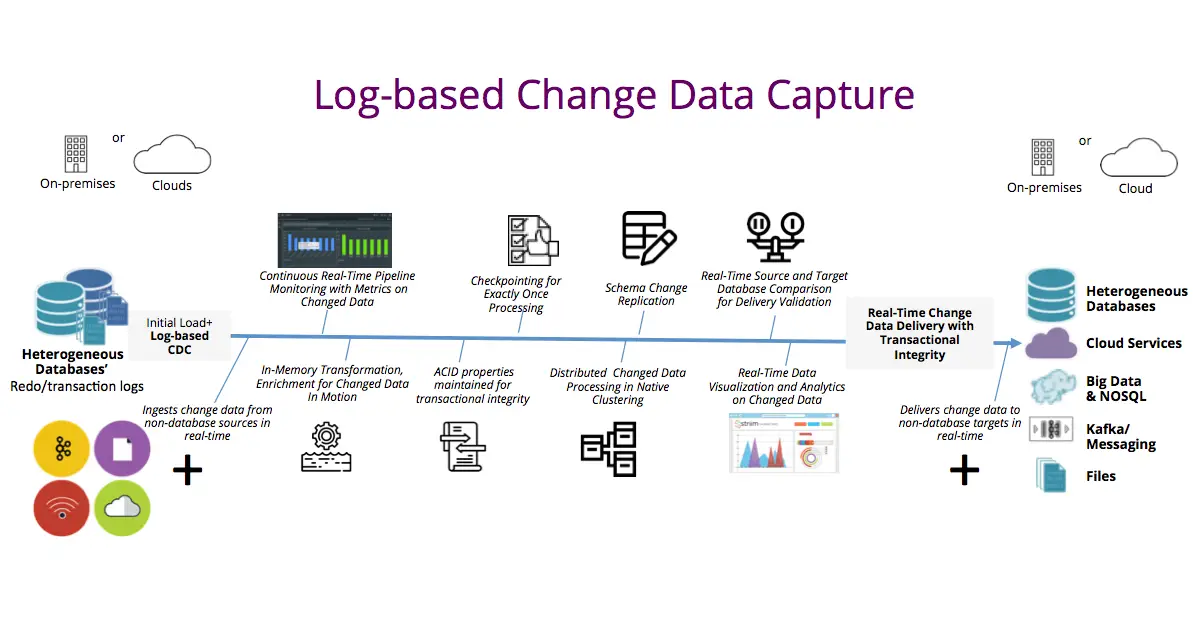
In our blog post about Change Data Capture, we explained why log-based change data capture is a better method to identify and capture change data. Striim uses the log-based CDC technique for the same reasons we stated in that post: Log-based CDC minimizes the overhead on the source systems, reducing the chances of performance degradation. In addition, it is non-intrusive. It does not require changes to the application, such as adding triggers to tables would do. It is a light-weight but also a highly-performant way to ingest change data. While Striim reads DML operations (INSERTS, UPDATES, DELETES) from the database logs, these systems continue to run with high-performance for their end users.

Striim’s strengths for real-time CDC are not limited to the ingestion point. Here are a few capabilities of the Striim platform that build on its real-time, log-based change data capture in enabling robust, end-to-end streaming data integration solutions:

Log-based CDC from heterogeneous databases for non-intrusive, low-impact real-time data ingestion

Striim uses log-based change data capture when ingesting from major enterprise databases including Oracle, HPE NonStop, MySQL, PostgreSQL, MongoDB, among others. It minimizes CPU overhead on sources, does not require application changes, and substantial management overhead to maintain the solution.

Ingestion from multiple, concurrent data sources to combine database transactions with semi-structured and unstructured data

Striim’s real-time data ingestion is not limited to databases and the CDC method. With Striim you can merge real-time transactional data from OLTP systems with real-time log data (i.e., machine data), messaging systems’ events, sensor data, NoSQL, and Hadoop data to obtain rich, comprehensive, and reliable information about your business.

End-to-end change data integration

Striim is designed from the ground-up to ingest, process, secure, scale, monitor, and deliver change data across a diverse set of sources and targets in real time. It does so by offering several robust capabilities out of the box:

  • Transaction integrity: When ingesting the change data from database logs, Striim moves committed transactions with the transactional context (i.e., ACID properties) maintained. Throughout the whole data movement, processing, and delivery steps, this transactional context is preserved so that users can create reliable replica databases, such as in the case of cloud bursting.
  • In-flight change data processing: Striim offers out-of-the-box transformers, and in-memory stream processing capabilities to filter, aggregate, mask, transform, and enrich change data while it is in motion. Using SQL-based continuous queries, Striim immediately turns change data into a consumable format for end users, without losing transactional context.
  • Built-in checkpointing for reliability: As the data moves and gets processed through the in-memory components of the Striim platform, every operation is recorded and tracked by the solution. If there is an outage, Striim can replay the transactions from where it was left off — without missing data or having duplicates.
  • Distributed processing in a clustered environment: Striim comes with a clustered environment for scalability and high availability. Without much effort, and using inexpensive hardware, you can scale out for very high data volumes with failover and recoverability assurances. With Striim, you don’t need to build your own clusters with third-party products.
  • Continuous monitoring of change data streams: Striim continuously tracks change data capture, movement, processing, and delivery processes, as well as the end-to-end integration solution via real-time dashboards. With Striim’s transparent pipelines, you have a clear view into the health of your integration solutions.
  • Schema change replication: When source Oracle database schema is modified and a DDL statement is created, Striim applies the schema change to the target system without pausing the processes.
  • Data delivery validation. For database sources and targets, Striim offers out-of-the-box data delivery verification. The platform continuously compares the source and target systems, as the data is moving, validating that the databases are consistent and all changed data has been applied to the target. In use cases, where data loss must be avoided, such as migration to a new cloud data store, this feature immensely minimizes migration risks.
  • Concurrent, real-time delivery to a wide range of targets: With the same software, Striim can deliver change data in real time not only to on-premise databases but also to databases running in the cloud, cloud services, messaging systems, files, IoT solutions, Hadoop and NoSQL environments. Striim’s integration applications can have multiple targets with concurrent real-time data delivery.
  • Pre-packaged applications for initial load and CDC: Striim comes with example integration applications that include initial load and CDC for PostgreSQL environments. These integration applications enable setting up data pipelines in seconds, and serve as a template for other CDC sources as well.

Turning Change Data to Time-Sensitive Insights

In addition to building real-time integration solutions for change data, Striim can perform streaming analytics with flexible time windows allowing you to gain immediate insights from your data in motion. For example, if you are moving financial transactions using Striim, you can build real-time dashboards that alert on potential fraud cases before Striim delivers the data to your analytics solution.

Log-based change data capture is the modern way to turn databases into streaming data sources. However, ingesting the change data is only the first of many concerns that integration solutions should address. You can learn more about Striim’s CDC offering by scheduling a demo with a Striim technologist or experience its enterprise-grade streaming integration solution first-hand by downloading a free trial.

 

Microsoft SQL Server CDC to Kafka

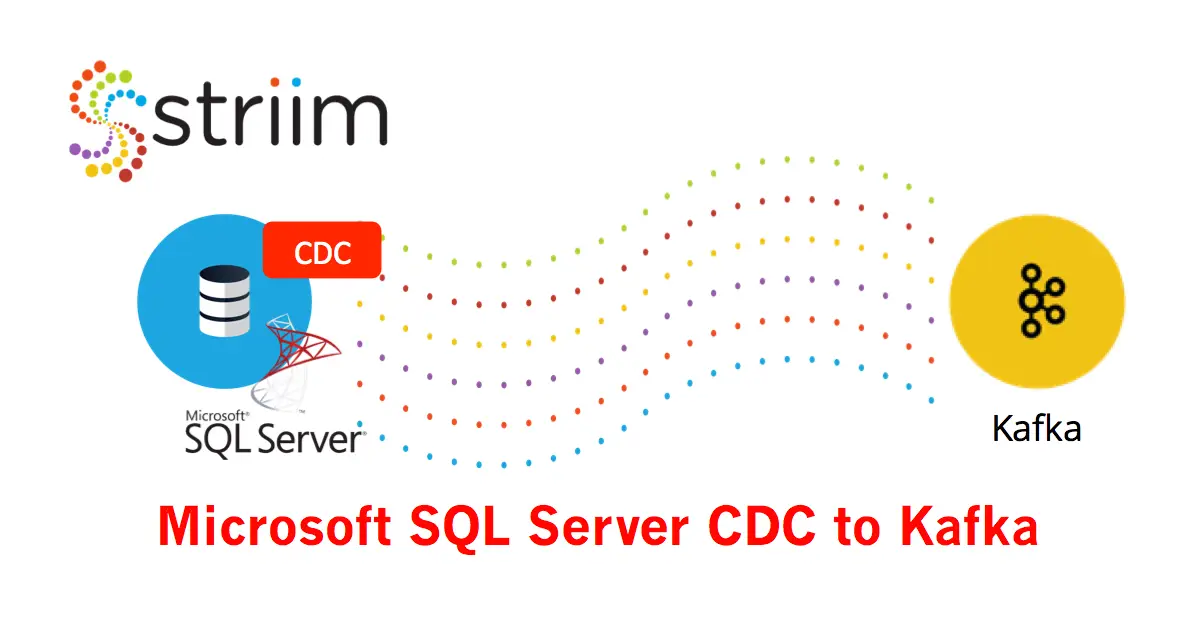
By delivering high volumes of data using Microsoft SQL Server CDC to Kafka, organizations gain visibility of their business and the vital context needed for timely operational decision making. Getting maximum value from Kafka solutions requires ingesting data from a wide variety of sources – in real time – and delivering it to users and applications that need it to take informed action to support the business.Microsoft SQL Server to Kafka

Traditional methods used to move data, such as ETL, are just not sufficient to support high-volume, high-velocity data environments. These approaches delay getting data to where it can be of real value to the organization. Moving all the data, regardless of relevance, to the target creates challenges in storing it and getting actionable data to the applications and users that need it. Microsoft SQL Server CDC to Kafka minimizes latency and prepares data so it is delivered in the correct format for different consumers to utilize.

In most cases, the data that resides in transactional databases like Microsoft SQL Server is the most valuable to the organization. The data is constantly changing reflecting every event or transaction that occurs.  Using non-intrusive, low-impact change data capture (CDC) the Striim platform moves and processes only the changed data. With Microsoft SQL Server CDC to Kafka users manage their data integration processes more efficiently and in real time. 

Using a drag-and-drop UI and pre-built wizards, Striim simplifies creating data flows for Microsoft SQL Server CDC to Kafka. Depending on the requirements of users, the data can either be delivered “as-is,” or in-flight processing can filter, transform, aggregate, mask, and enrich the data. This delivers the data in the format needed with all the relevant context to meet the needs of different Kafka consumers –with sub-second latency.

Striim is an end-to-end platform that delivers the security, recoverability, reliability (including exactly once processing), and scalability required by an enterprise-grade solution. Built-in monitoring also compares sources and targets and validates that all data has been delivered successfully. 

In addition to Microsoft SQL Server CDC to Kafka, Striim offers non-intrusive change data capture (CDC) solutions for a range of enterprise databases including Oracle, Microsoft SQL Server, PostgreSQL, MongoDB, HPE NonStop SQL/MX, HPE NonStop SQL/MP, HPE NonStop Enscribe, and MariaDB.

For more information about how to use Microsoft SQL Server CDC to Kafka to maintain real-time pipelines for continuous data movement, please visit our Change Data Capture solutions page.

If you would like a demo of how Microsoft SQL Server CDC to Kafka works and to talk to one of our technologists, please contact us to schedule a demo.

Real-Time Data Ingestion – What Is It and Why Does It Matter?


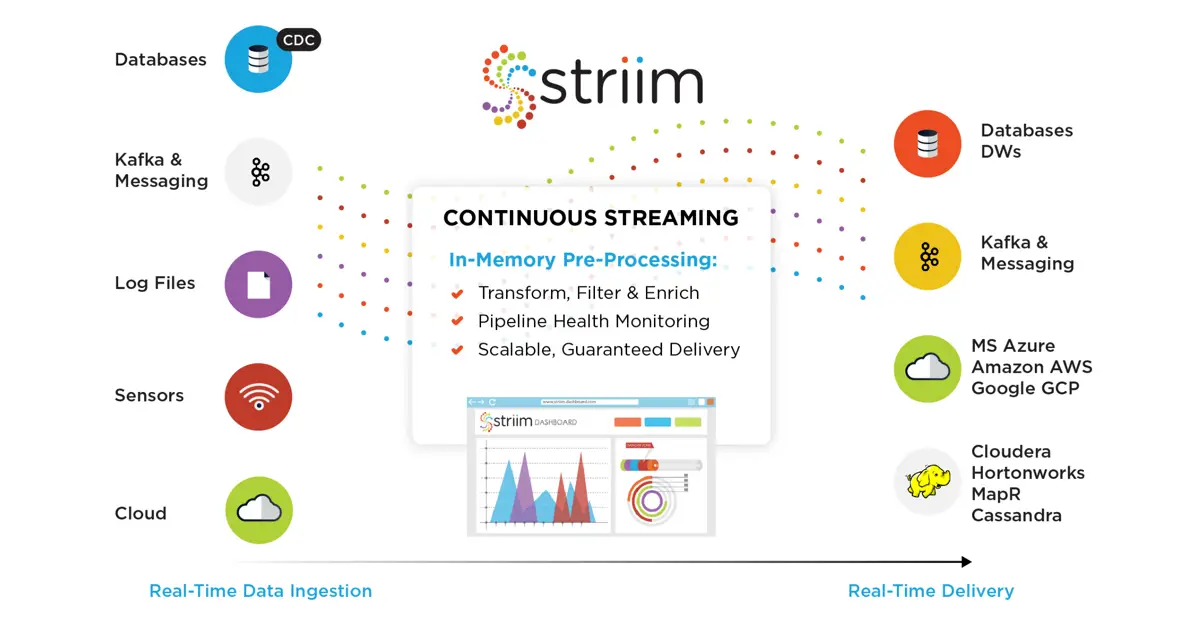
The integration and analysis of data from both on-premises and cloud environments give an organization a deeper understanding of the state of their business. Real-time data ingestion for analytical or transactional processing enables businesses to make timely operational decisions that are critical to the success of the organization – while the data is still current. real-time data ingestion diagram

Transactional and operational data contain valuable insights that drive informed and appropriate actions. Achieving visibility into business operations in real time allows organizations to identify and act on opportunities and address situations where improvements are needed. Real-time data ingestion to feed powerful analytics solutions demands the movement of high volumes of data from diverse sources without impacting source systems and with sub-second latency.

Using traditional batch methods to move the data introduces unwelcome delays. By the time the data is collected and delivered it is already out of date and cannot support real-time operational decision making. Real-time data ingestion is a critical step in the collection and delivery of volumes of high-velocity data – in a wide range of formats – in the timeframe necessary for organizations to optimize their value.

The Striim platform enables the continuous movement of structured, semi-structured, and unstructured data – extracting it from a wide range of sources and delivering it to cloud and on-premises endpoints – in real time and available immediately to users and applications.

The Striim platform supports real-time data ingestion from sources including databases, log files, sensors, and message queues and delivery to targets that include Big Data, Cloud, Transactional Databases, Files, and Messaging Systems. Using non-intrusive Change Data Capture (CDC) Striim reads new database transactions from source databases’ transaction or redo logs and moves only the changed data without impacting the database workload.

Real-time data ingestion is critical to accessing data that delivers significant value to a business. With clear visibility into the organization, based on data that is current and comprehensive, organizations can make more informed operational decisions faster.

To read more about real-time data ingestion, please visit our Real-Time Data Integration solutions page.

To have one of our experts guide you through a brief demo of our real-time data ingestion offering, please schedule a demo.

Back to top