Introducing Striim Labs: Where AI Research Meets Real-Time Data

AI research has a proliferation problem. AI and machine learning conferences such as NeurIPS stated that they’re overwhelmed with new paper submissions, with 21,575 papers submitted this year, up from under 10,000 in 2020.

At the crux of the issue is the questionable quality of the papers: whether written using AI tools or rushed through to publishing without robust reviews. In the noise, it’s increasingly difficult for practitioners to discern genuine innovation from “slop”, or to find applicable methodologies that might just be perfect for their use cases.

That’s why we’re launching Striim Labs.

We focus specifically on the intersection of AI/ML research and real-time data streaming: the part of the venn diagram where promising techniques meet production-grade, low-latency systems. Our team will wade through the deluge of research papers to find the most applicable examples for streaming machine learning use cases. We’ll even test them out to make sure they can perform as claimed.

Through exploring emerging techniques, collaborating with Striim customers on real scenarios, and building working prototypes, we want to bring about actionable templates (“prototypes”) that teams can replicate and deploy themselves. Every blueprint will be accessible to the public via GitHub repositories and deployment instructions, and maintain an open line of communication for feedback and collaboration.

What is Striim Labs?

Striim Labs is an applied AI research group we’re launching at Striim: a team dedicated to learning and experimentation at the intersection of AI and real-time data.

Striim Labs will draw on the collective knowledge and experience of a team of data scientists and experts in streaming machine learning. First and foremost, our work focuses on real-time, low-latency use cases that enterprise teams can actually use.

Striim Labs isn’t a purely academic exercise. Nor is it a Striim product demo disguised as thought leadership. It’s a genuine attempt to take promising techniques from recent research and stress-test them against the messiness of real-time data: schema drift, late-arriving events, volume spikes, and all the other things that break what worked in a notebook.

We’ll document what we find honestly, including what didn’t work, what we had to adapt, and where the gap between a paper’s benchmarks and streaming reality turned out to be wider than expected. That transparency is the point. If a technique falls apart under latency pressure, that’s a finding worth sharing too.

The result, we hope, will be a series of prototypes we’re referring to as “AI Prototypes” that practitioners: ML engineers, architects, and data scientists can experiment with themselves, as well as giving us feedback and suggestions from their own experiences.

What is an AI Prototype?

An AI prototype is a self-contained reproducible prototype that implements a technique or model from a recent research paper.

We’ll build our prototypes using open source tools and technologies (Kafka, Apache Spark, PyTorch, Docker, and others) with defined minimum acceptance criteria (precision, recall, latency).  Our starting point with each blueprint is always based in open source and framework-agnostic tooling, so anyone can run it (not just Striim customers, though we encourage them to check it out!). Each blueprint will live in a public GitHub repository with full deployment instructions. We’ll also publish our work via the Striim resources page and elsewhere, to make it more accessible.

Ultimately, our intention for each blueprint is first to validate a technique within a streaming context, then to integrate it into Striim’s platform natively, extending what Striim offers to our customers out of the box. But again, we stress that each blueprint will be available to everyone, not just Striim users.

What Makes Striim Labs Different?

Here are a few ways we aim to set Striim Labs apart from other data science initiatives.

  • Everything ships with code: Every applied blueprint we publish will feature code you can test, within its own GitHub repo. Not just theoretical whitepapers.
  • Every blueprint has defined, measurable acceptance criteria: We’ll test our models and share based on real results; not a vague promise that it works.
  • Open source first approach: You won’t need Striim’s platform or to be working within a particular cloud environment to learn from or run a blueprint.
  • Transparency about tradeoffs: We’ll be clear and open from the start about model failures and breakages, rather than just sharing polished results.
  • Clear path from prototype to production: Our prototypes will be designed to graduate from prototypes into systems we’ll build into Striim’s platform as native capabilities.

What’s next?

Our first area of focus will be a subject many real-time enterprises are interested in: anomaly detection. Anomaly detection has benefited from a rich body of recent research, but the gap between research papers and production results remains particularly wide. That makes it a great place for us to start, especially since it’s one of the most requested capabilities in a streaming context.

We’ll be launching a series of prototypes on anomaly detection, and our findings on anomaly detection models, in the near future.

Your Move: Get Involved

Striim Labs is designed to be an open, collaborative exercise. We welcome input, feedback, and ideas from practitioners wrestling with data science problems who are curious about the latest innovations in the market.  Here are a few ways you can take part:

  • Suggest papers, techniques, or focus areas you’d like us to text against real-time data.
  • Try our prototypes, and give us real feedback! Tell us where we can improve, and let us know what works and what breaks in your environment.
  • Share your work. We’d love to hear from you if you’re working on similar projects. Feel free to share your GitHub repos or related initiatives.

Where you can find us:

We’re excited to bring new insights, prototypes, and research to you in the following weeks. Thanks for being part of our journey.

Change Data Capture MongoDB: How It Works, Challenges & Tools

Developers love MongoDB for its speed and flexibility. But getting that fast-moving data out of MongoDB and into your data warehouse or analytics platform in real time is no mean feat.

Teams used to rely on batch ETL pipelines or constant database polling to sync their NoSQL data with downstream systems. But batch-based data ingestion can no longer keep pace with modern business demands. And each time you poll a database for changes, you burn valuable compute resources and degrade the performance of the very applications your customers rely on.

The solution is Change Data Capture (CDC). By capturing data changes the instant they occur, CDC eliminates the need for batch windows. But CDC in a NoSQL environment comes with its own unique set of rules.

In this guide, we’ll break down exactly how CDC works in MongoDB. We’ll explore the underlying mechanics—from the oplog to native Change Streams—and weigh the pros and cons of common implementation methods. We’ll also unpack the hidden challenges of schema evolution and system performance at scale, showing why the most effective approach treats CDC not just as a simple log reader, but as the foundation of modern, real-time data architecture.

What is Change Data Capture (CDC) in MongoDB?

Change Data Capture (CDC) is the process of identifying and capturing changes made to a database—specifically inserts, updates, and deletes—and instantly streaming those changes to downstream systems like data warehouses, data lakes, or event buses.

MongoDB is a NoSQL, document-oriented database designed for flexibility and horizontal scalability. Because it stores data in JSON-like documents rather than rigid tables, developers frequently use it to power fast-changing, high-velocity applications. However, this same unstructured flexibility makes syncing that raw data to structured downstream targets a complex task.

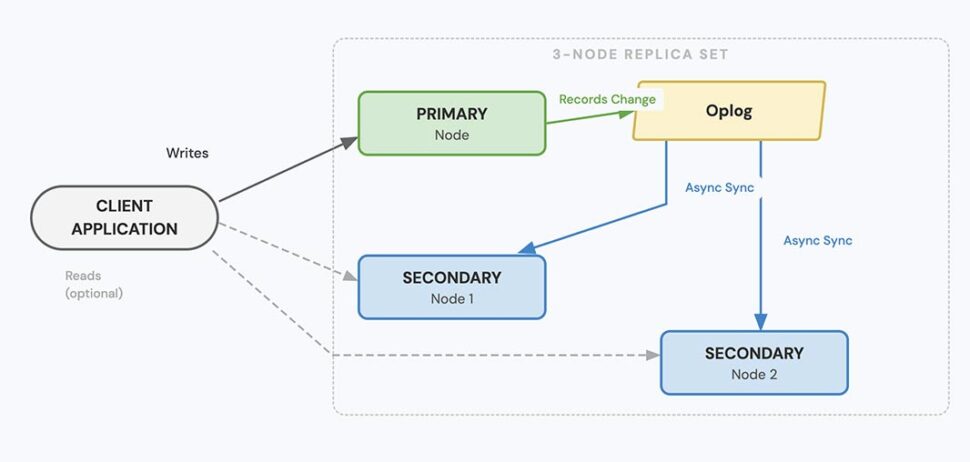
To facilitate real-time syncing, MongoDB relies on its Change Streams API. Change Streams provide a seamless, secure way to tap directly into the database’s internal operations log (the oplog). Instead of writing heavy, resource-intensive queries to periodically ask the database what changed, Change Streams allow your data pipelines to subscribe to the database’s activity. As soon as a document is inserted, updated, or deleted, the change is pushed out as a real-time event, providing the exact incremental data you need to power downstream analytics and event-driven architectures.

Why Do Teams Use CDC with MongoDB?

Batch ETL forces your analytics to constantly play catch-up, while continuous database polling degrades your primary database by stealing compute from customer-facing applications.

CDC solves both of these problems simultaneously. By capturing only the incremental changes (the exact inserts, updates, and deletes) directly from the database’s log, CDC avoids the performance overhead of polling and the massive data payloads of batch extraction.

When implemented correctly, streaming MongoDB CDC unlocks several key advantages:

  • Real-time data synchronization: Keep downstream systems—like Snowflake, BigQuery, or ADLS Gen2—perfectly mirrored with your operational MongoDB database, ensuring dashboards and reports always reflect the current state of the business.
  • Zero-impact performance: Because CDC reads from the oplog or Change Streams rather than querying the tables directly, it doesn’t compete with your application for database resources.
  • Support for event-driven architectures: CDC turns static database commits into actionable, real-time events. You can stream these changes to message brokers like Apache Kafka to trigger microservices, alerts, or automated workflows the second a customer updates their profile or places an order.
  • Improved pipeline efficiency and scalability: Moving kilobytes of changed data as it happens is vastly more efficient and cost-effective than moving gigabytes of data in nightly batch dumps.
  • AI and advanced analytics readiness: Fresh, accurate context is the prerequisite for reliable predictive models and Retrieval-Augmented Generation (RAG) applications. CDC ensures your AI systems are grounded in up-to-the-second reality.

While the benefits are clear, building robust CDC pipelines for MongoDB isn’t as simple as flipping a switch. Because MongoDB uses a flexible, dynamic schema, a single collection can contain documents with wildly different structures. Capturing those changes is only step one; transforming and flattening that nested, unstructured JSON into a format that a rigid, relational data warehouse can actually use introduces a level of complexity that traditional CDC tools often fail to handle.

We will explore these specific challenges—and how to overcome them—later in this guide. First, let’s look at the mechanics of how MongoDB actually captures these changes under the hood.

How MongoDB Implements Change Data Capture

To build resilient CDC infrastructure, you need to understand how MongoDB actually tracks and publishes data changes. Understanding the underlying architecture will help you make informed decisions about whether to build a custom solution, use open-source connectors, or adopt an enterprise platform like Striim.

MongoDB oplog vs. Change Streams

In MongoDB, CDC revolves around the oplog (operations log). The oplog is a special capped collection that keeps a rolling record of all operations that modify the data stored in your databases.

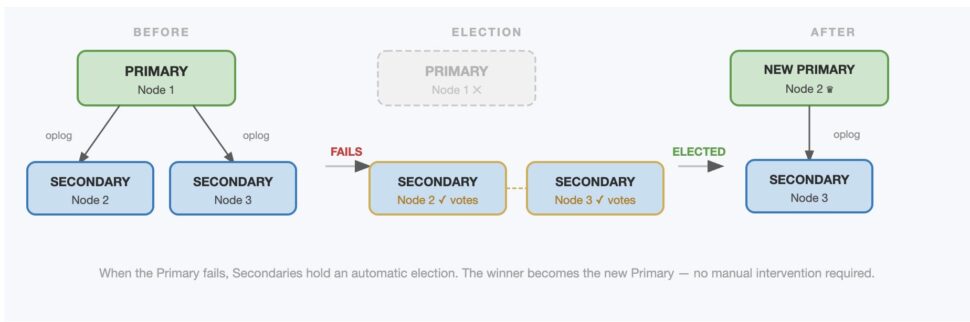
Historically, developers achieved CDC by directly “tailing” the oplog: writing scripts to constantly read this raw log. However, oplog tailing is notoriously brittle. It requires high-level administrative database privileges, exposes raw and sometimes cryptic internal formats, and breaks easily if there are elections or topology changes in the database cluster.

To solve this, MongoDB introduced Change Streams in version 3.6. Change Streams sit on top of the oplog. They act as a secure, user-friendly API that abstracts away the complexity of raw oplog tailing.

  • Oplog Tailing (Deprecated for most use cases): Requires full admin access, difficult to parse, doesn’t handle database elections well, and applies globally to the whole cluster.
  • Change Streams (Recommended): Uses standard Role-Based Access Control (RBAC), outputs clean and formatted JSON documents, gracefully handles cluster node elections, and can be scoped to a specific collection, database, or the entire deployment.

Key Components of Change Streams

When you subscribe to a Change Stream, MongoDB pushes out event documents. To manage this flow reliably, there are a few key concepts you must account for:

  • Event Types: Every change is categorized. The most common operations are insert, update, delete, and replace. The event document contains the payload (the data itself) as well as metadata about the operation.
  • Resume Tokens: This is the most critical component for fault tolerance. Every Change Stream event includes a unique _id known as a resume token. If your downstream consumer crashes or disconnects, it can present the last known resume token to MongoDB upon reconnection. MongoDB will automatically resume the stream from that exact point, ensuring exactly-once processing and zero data loss.
  • Filtering and Aggregation: Change Streams aren’t just firehoses. You can pass a MongoDB aggregation pipeline into the stream configuration to filter events before they ever leave the database. For example, you can configure the stream to only capture update events where a specific field (like order_status) is changed.

Requirements and Limitations

While Change Streams are powerful, they are not universally available or infinitely scalable. There are strict architectural requirements you must be aware of:

  • Topology Requirements: Change Streams only work on MongoDB Replica Sets or Sharded Clusters. Because they rely on the oplog (which is used for replication), they are completely unavailable on standalone MongoDB instances.
  • Oplog Sizing and Data Retention: The oplog is a “capped collection,” meaning it has a fixed maximum size. Once it fills up, it overwrites the oldest entries. If your CDC consumer goes offline for longer than your oplog’s retention window, the resume token will become invalid. You will lose the stream history and be forced to perform a massive, resource-intensive initial snapshot of the entire database to catch up.
  • Performance Impact: Change Streams execute on the database nodes themselves. Opening too many concurrent streams, or applying overly complex aggregation filters to those streams, will consume memory and CPU, potentially impacting the performance of your primary transactional workloads.

Understanding these mechanics makes one thing clear: capturing the data is only the beginning. Next, we’ll look at the different methods for actually moving that captured data into your target destinations.

Methods for Implementing CDC with MongoDB

When it comes to actually building pipelines to move CDC data out of MongoDB, you have several options. Each approach carries different trade-offs regarding architectural complexity, scalability, and how well it handles data transformation.

Native MongoDB Change Streams (Custom Code)

The most direct method is to write custom applications (using Node.js, Python, Java, etc.) that connect directly to the MongoDB Change Streams API.

  • The Pros: It’s highly customizable and requires no additional middleware. This is often the best choice for lightweight microservices—for example, a small app that listens for a new user registration and sends a welcome email.
  • The Limitations: You are entirely responsible for the infrastructure. Your developers must write the logic to store resume tokens safely, handle failure states, manage retries, and parse dynamic schema changes. If the application crashes and loses its resume token, you risk permanent data loss.

Kafka Connect MongoDB Source/Sink Connectors

For teams already invested in Apache Kafka, using the official MongoDB Kafka Connectors is a common approach. This method acts as a bridge, publishing Change Stream events directly into Kafka topics.

  • The Pros: Kafka provides excellent decoupling, fault tolerance, and buffering. If your downstream data warehouse goes offline, Kafka will hold the MongoDB events until the target system is ready to consume them again.
  • The Limitations: Kafka Connect introduces significant operational complexity. You have to manage Connect clusters, handle brittle JSON-to-Avro mappings, and deal with schema registries. Furthermore, Kafka Connect is primarily for routing. If you need to flatten nested MongoDB documents or mask sensitive PII before it lands in a data warehouse, you will have to stand up and maintain an entirely separate stream processing layer (like ksqlDB or Flink) or write custom Single Message Transforms (SMTs).

Third-Party Enterprise Platforms (Striim)

For high-volume, enterprise-grade pipelines, relying on custom code or piecing together open-source middleware often becomes an operational bottleneck. This is where platforms like Striim come in.

  • The Pros: Striim is a unified data integration and intelligence platform that connects directly to MongoDB (and MongoDB Atlas) out of the box. Unlike basic connectors, Striim allows you to perform in-flight transformations using a low-code UI or Streaming SQL. You can flatten nested JSON, filter records, enrich data, and mask PII before the data ever lands in your cloud data warehouse.
  • The Limitations: It introduces a new platform into your stack. However, because Striim is fully managed and multi-cloud native, it generally replaces multiple disparate tools (extractors, message buses, and transformation engines), ultimately reducing overall architectural complexity.

How to Choose the Right Approach

Choosing the right tool comes down to your primary use case. Use this simple framework to evaluate your needs:

  1. Complexity and Latency: Are you building a simple, single-purpose application trigger? Custom code via the native API might suffice.
  2. Existing Infrastructure: Do you have a dedicated engineering team already managing a massive, enterprise-wide Kafka deployment? Kafka Connect is a logical extension.
  3. Transformation, Scale, and Analytics: Do you need fault-tolerant, scalable pipelines that can seamlessly transform unstructured NoSQL data and deliver it securely to Snowflake, BigQuery, or ADLS Gen2 in sub-second latency? An enterprise platform like Striim is the clear choice.

Streaming MongoDB CDC Data: Key Destinations and Architecture Patterns

Capturing changes from MongoDB is only half the battle. Streaming CDC data isn’t useful unless it reliably reaches the systems where it actually drives business value. Depending on your goals—whether that’s powering BI dashboards, archiving raw events, or triggering automated workflows—the architectural pattern you choose matters.

Here is a look at the most common destinations for MongoDB CDC data and how modern teams are architecting those pipelines.

Data Warehouses (Snowflake, BigQuery, Redshift)

The most common use case for MongoDB CDC is feeding structured analytics platforms. Operational data from your application needs to be joined with marketing, sales, or financial data to generate comprehensive KPIs and executive dashboards.

The core challenge here is a structural mismatch. MongoDB outputs nested, schema-less JSON documents. Cloud data warehouses require rigid, tabular rows and columns.

The Striim Advantage: Instead of dumping raw JSON into a warehouse staging table and running heavy post-processing batch jobs (ELT), Striim allows you to perform in-flight transformation. You can seamlessly parse, flatten, and type-cast complex MongoDB arrays into SQL-friendly formats while the data is still in motion, delivering query-ready data directly to your warehouse with zero delay.

Data Lakes and Cloud Storage (ADLS Gen2, Amazon S3, GCS)

For organizations building a lakehouse architecture, or those that simply need a cost-effective way to archive raw historical data for machine learning model training, cloud object storage is the ideal target.

When streaming CDC to a data lake, the format you write the data in drastically impacts both your cloud storage costs and downstream query performance.

The Striim Advantage: Striim integrates natively with cloud object storage like Azure Data Lake Storage (ADLS) Gen2. More importantly, Striim can automatically convert your incoming MongoDB JSON streams into highly optimized, columnar formats like

Apache Parquet before writing them to the lake. This ensures your data is immediately partitioned, compressed, and ready for efficient querying by tools like Databricks or Azure Synapse.

Event-Driven Architectures (Apache Kafka, Event Hubs)

Many engineering teams don’t just want to analyze MongoDB data—they want to react to it. By streaming CDC events to a message broker or event bus, you can trigger downstream microservices. For example, a new document inserted into an orders collection in MongoDB can instantly trigger an inventory update service and a shipping notification service.

The Striim Advantage: Striim provides native integration with Kafka, Confluent, and Azure Event Hubs, allowing you to stream MongoDB changes to event buses without writing brittle glue code. Furthermore, Striim allows you to enrich the event data (e.g., joining the MongoDB order event with customer data from a separate SQL Server database) before publishing it to the topic, ensuring downstream consumers have the full context they need to act.

Real-Time Analytics Platforms and Dashboards

In use cases like fraud detection, dynamic pricing, or live operational dashboards, every millisecond counts. Data cannot wait in a queue or sit in a staging layer. It needs to flow from the application directly into an in-memory analytics engine or operational datastore. The Striim Advantage: Striim is engineered for high-velocity, sub-second latency. By processing, validating, and moving data entirely in-memory, Striim ensures that critical operational dashboards reflect the exact state of your MongoDB database in real time. There is no manual stitching required—just continuous, reliable intelligence delivered exactly when it is needed.

Common Challenges with MongoDB CDC (and How to Overcome Them)

While MongoDB CDC is powerful, rolling it out in a production environment is rarely straightforward. At enterprise scale, capturing the data is only a fraction of the battle. Transforming it, ensuring zero data loss, and keeping pipelines stable as the business changes are where most initiatives stall out. Here are the most common challenges teams face when implementing MongoDB CDC, along with practical strategies for overcoming them.

Schema Evolution in NoSQL Environments

MongoDB’s dynamic schema is a double-edged sword. It grants developers incredible agility, they can add new fields or change data types on the fly without running heavy database migrations. However, this creates chaos downstream. When a fast-moving engineering team pushes a new nested JSON array to production, downstream data warehouses expecting a flat, rigid table will instantly break, causing pipelines to fail and dashboards to go dark.

How to Overcome It: Build “defensive” CDC pipelines. First, define optional schemas for your target systems to accommodate structural shifts. Second, implement strict data validation steps within your CDC stream to catch and log schema drift before it corrupts your warehouse. While doing this manually requires constant maintenance, modern platforms like Striim offer automated schema tracking and in-flight transformation capabilities. Striim can detect a schema change in MongoDB, automatically adapt the payload, and even alter the downstream target table dynamically, keeping your data flowing without engineering intervention.

Handling Reordering, Retries, and Idempotency

In any distributed system, network hiccups happen every so often. A CDC consumer might crash, a target warehouse might temporarily refuse connections, or packets might arrive out of order. If your CDC pipeline simply retries a failed batch of insert events without context, you risk duplicating data and ruining the accuracy of your analytics.

How to Overcome It: Whether you are building a custom solution, using open-source tools, or leveraging an enterprise platform, design your downstream consumers to be idempotent. An idempotent system ensures that applying the same CDC event multiple times yields the same result as applying it once. Rely heavily on MongoDB’s resume tokens to maintain exact checkpoints, and test your replay logic early and often to guarantee exactly-once processing (E1P) during system failures.

Performance Impact and Scaling Considerations

Change Streams are highly efficient, but they still execute on your database nodes. If you configure poorly optimized filters, open dozens of concurrent streams, or subject the database to massive volumes of small, rapid-fire writes, you can severely impact your MongoDB replica performance. Consequently, your CDC consumer’s throughput will tank, introducing unacceptable latency into your “real-time” pipelines.

How to Overcome It: Monitor your replication lag closely. Set highly specific aggregation filters on your Change Streams so the database only publishes the exact events you need, dropping irrelevant noise before it hits the network. Furthermore, always load-test your pipelines with production-like data volumes. To avoid overloading MongoDB, many organizations use an enterprise CDC platform optimized for high-throughput routing. These platforms can ingest a single, consolidated stream from MongoDB, buffer it in-memory, and securely fan it out to multiple destinations in parallel without adding additional load to the source database.

Managing Snapshots and Initial Sync

By definition, CDC only captures changes from the moment you turn it on. If you spin up a new Change Stream today, it has no memory of the millions of documents inserted yesterday. To ensure your downstream systems have a complete, accurate dataset, you first have to perform a massive historical load (a snapshot), and then flawlessly cut over to the real-time stream without missing a single event or creating duplicates in the gap.

How to Overcome It: If you are building this manually, you must plan a staged migration. You will need to sync the historical data, record the exact oplog position or resume token at the start of that sync, and then initiate your CDC stream from that precise marker once the snapshot completes. Doing this with custom scripts is highly error-prone. The best practice is to use a tool that supports snapshotting and CDC within a single, unified pipeline. Platforms like Striim handle the initial historical extract and seamlessly transition into real-time CDC automatically, guaranteeing data consistency without requiring a manual, middle-of-the-night cutover.

Simplify MongoDB CDC with Striim

MongoDB Change Streams provide an excellent, raw mechanism for accessing real-time data changes. But as we’ve seen, raw access isn’t enough to power a modern enterprise architecture. Native APIs and open-source connectors don’t solve the hard problems: parsing nested JSON, handling dynamic schema evolution, delivering exactly-once processing, or providing multi-cloud enterprise observability.

That is where Striim excels.

Striim is not just a connector; it is a unified data integration and intelligence platform purpose-built to turn raw data streams into decision-ready assets. When you use Striim for MongoDB CDC, you eliminate the operational burden of DIY pipelines and gain:

  • Native support for MongoDB and MongoDB Atlas: Connect securely and reliably with out-of-the-box integrations.
  • Real-time, in-flight transformations: Flatten complex JSON arrays, enrich events, and mask sensitive data before it lands in your warehouse, reducing latency from hours to milliseconds.
  • Schema evolution and replay support: Automatically handle upstream schema drift and rely on enterprise-grade exactly-once processing (E1P) to guarantee zero data loss.
  • Low-code UI and enterprise observability: Build, monitor, and scale your streaming pipelines visually, without managing complex distributed infrastructure.
  • Destination flexibility: Seamlessly route your MongoDB data to Snowflake, Google BigQuery, ADLS Gen2, Apache Kafka, and more (or even write back to another MongoDB cluster)—simultaneously and with sub-second latency.

Stop wrestling with brittle batch pipelines and complex open-source middleware. Bring your data architecture into the real-time era. Get started with Striim for free or book a demo today. to see how Striim makes MongoDB CDC simple, scalable, and secure.

AI-Ready Data: What It Is and How to Build It

Enterprise leaders are pouring investments into large language models, agentic systems, and real-time prediction engines.

Yet, a staggering number of these initiatives stall before they ever reach production. Too often, AI outputs are a hallucinated mess, the context is too stale to provide value, and AI recommendations are unreliable. Our immediate instinct might be to blame the model, but the root cause is almost always the data and context feeding it.

“Clean data” was, for years, good enough for overnight batch reporting and static analytics. But the rules have changd. For modern AI workloads, clean data is just the baseline. Truly “AI-ready data” demands data architecture that provides fresh, continuously synchronized, securely governed, and machine-actionable data at enterprise scale.

If AI models are forced to rely on batch jobs, fragmented silos, or legacy ETL pipelines, they’re operating on a delayed version of reality. In this article, we’ll break down what it actually means to make your data AI-ready, how to evaluate your current infrastructure, and the practical steps required to build a real-time data foundation that delivers on the promise of enterprise AI.

Key Takeaways

  • AI-ready data is more than clean data. It requires real-time availability, consistent structure, strong in-flight governance, and continuous synchronization across systems to support modern AI workloads.
  • The model is only as good as the pipeline. Even the most advanced AI and machine learning initiatives will produce inaccurate, outdated, or unreliable outputs if the underlying data is stale, siloed, or poorly structured.
  • Architecture matters. Building an AI-ready foundation involves modernizing your infrastructure for real-time movement, enforcing quality and governance at every stage, and ensuring data is continuously optimized for AI consumption.

What is AI-Ready Data?

Most existing definitions of data readiness stop at data quality. Is the data accurate? Is it complete? But for modern artificial intelligence systems—especially large language models (LLMs) and agentic workflows—quality is only part of the equation.

AI-ready data is structured, contextual, and continuously updated. It’s structurally optimized for machine consumption the instant it’s created. To achieve true AI-readiness, your data architecture must deliver on four specific parameters:

  • Freshness: End-to-end pipeline latency must consistently remain under a targeted threshold (often sub-second to minutes, depending on the use case).
  • Consistency: Change data capture (CDC) based synchronization prevents drift between your operational systems and AI environments, ensuring that training and inference distributions perfectly align.
  • Governance-in-Motion: Lineage tracking, PII handling, and data policy enforcement are applied before the data lands in your AI application.
  • Machine-Actionability: Data features stable schemas, rich metadata, and clear semantics, making it directly consumable by models or AI agents without manual reconstruction.

Artificial intelligence systems rely entirely on recognizing patterns and acting on timeliness. Even minor delays or inconsistencies in your data pipelines can result in skewed predictions or entirely inaccurate outputs. AI doesn’t just need the right answer; it needs it right now. This requires a major shift from traditional batch processing to real-time data streaming and in-motion transformation.

Why Does AI-Ready Data Matter?

Even the most sophisticated LLM or machine learning model cannot mitgate for incomplete, stale, unstructured, or poorly governed data. If your data architecture wasn’t designed for the speed, scale, and structural demands of real-world AI, your models will underperform.

Here’s why building an AI-ready data foundation is the most critical step in your enterprise AI journey:

Improving Model Accuracy, Reliability, and Trust

Models require consistency. The data they use for training, historical analysis, inference, and real-time inputs must all share consistent distributions and structures. When operational systems drift from AI environments, models lose their accuracy. Furthermore, without clear data lineage, debugging a hallucinating model becomes nearly impossible. AI-ready data ensures that consistent structure and lineage are maintained, safeguarding model reliability and enterprise trust.

Powering Real-Time, Predictive, and Generative AI Use Cases

Use cases like fraud detection, dynamic supply troubleshooting, and Retrieval-Augmented Generation (RAG) are highly sensitive to latency. If an AI agent attempts to resolve a customer issue using inventory or behavioral data from yesterday’s batch run, the interaction fails. Real-time AI requires streaming pipelines, not batch processing. At Striim, we often see that enabling these advanced use cases demands enterprise-grade, continuous data movement that legacy systems cannot support.

Reducing Development Effort and Accelerating AI Time-to-Value

Data scientists and AI engineers spend an exorbitant amount of time debugging, cleaning, and reconstructing broken data flows. By the time the data is ready for the model, the project is already behind schedule. AI-ready data drastically reduces this rework. By utilizing in-motion data transformation, teams can filter, enrich, and format data while it is streaming, significantly reducing time-consuming post-processing and allowing teams to deploy models much faster.

Enabling Enterprise-Scale Adoption of AI Across the Business

For AI to move out of siloed experiments and into enterprise-wide production, the data foundation must be trusted by every department. When data is unified, governed, and standardized, organizations can create reusable data products. AI-ready foundations inherently support regulatory compliance, auditability, and standardized access, making AI viable, safe, and scalable across HR, finance, operations, and beyond.

Core Attributes of AI-Ready Data

Organizations might assume they already have “good data” because their BI dashboards are working fine for them. But AI introduces entirely new requirements around structure, speed, context, and control.

Think of the following attributes as a foundational framework. If any of these pillars are missing, your data isn’t truly AI-ready.

Machine-Actionable Structure, Semantics, and Metadata

First, the data must be practically useful for an algorithm without human intervention. This means stable, consistent schemas, explicitly defined semantics, and rich metadata. When data is properly structured and contextualized, it drastically reduces model errors and helps LLMs genuinely “understand” the context of the information they are processing.

High-Quality, Complete, and Consistent Datasets

While accuracy and completeness are foundational, they are not sufficient on their own. The true test for AI is consistency. If the data your model was trained on looks structurally different from the real-time data it evaluates in production, the model’s behavior becomes unpredictable. Maintaining consistency across both historical records and live, streaming data is crucial.

Continuously Updated and Optimized for Low-Latency Access

As the data ages, model accuracy decays. In other words: if an AI system is making decisions based on five-hour-old data, it’s making five-hour-old decisions. Achieving this attribute requires moving away from batch ETL in favor of streaming pipelines and Change Data Capture (CDC).

Governed, Lineage-Rich, and Compliant by Default

Lineage is crucial for model optimization. Knowing exactly where a piece of data came from, how it was transformed, and who touched it is essential for debugging model drift and satisfying strict regulatory audits. Data must carry its governance context along with it at all times.

Secure and Protected in Motion and at Rest

AI models can unintentionally expose vulnerabilities or leak sensitive information if they are fed unprotected data. True AI-readiness requires data-in-motion encryption and real-time validation techniques that strip or mask PII (Personally Identifiable Information) before the data ever reaches the AI pipeline.

How to Build an AI-Ready Data Foundation

Achieving an AI-ready state is an ongoing journey that requires an end-to-end architectural rethink.

Ideally, an AI-ready data flow looks like this: Source Systems → Real-Time Ingestion → In-Flight Enrichment & Transformation → Governance in Motion → Continuous AI Consumption. Here is the framework for building that foundation.

Modernize Ingestion with Real-Time Pipelines and CDC

The first step is moving your ingestion architecture from batch to real-time. AI and agentic workloads cannot wait for nightly syncs. A system that makes use of Change Data Capture (CDC) ensures that your AI models are continuously updated with the latest transactional changes with minimal impact on your source databases. This forms the foundation of a streaming-first architecture.

Unify and Synchronize Data Across Hybrid Systems

AI always needs a complete picture. That means eliminating data silos and presenting a single, synchronized source of truth across your entire environment. Because most enterprises operate in hybrid realities—relying heavily on legacy on-premise systems alongside modern cloud tools—continuously synchronizing these disparate environments with your cloud AI tools is essential.

Transform, Enrich, and Validate Data in Motion

Waiting to transform your data until after it lands in a data warehouse introduces unnecessary latency, leading to flawed inputs. Transforming data in-flight eliminates delay and prevents stale or inconsistent data from propagating. This includes joining streams, standardizing formats, and masking sensitive fields in real time as the data moves.

Implement Governance, Lineage, and Quality Controls

Governance cannot be bolted onto static datasets after the fact; it must be embedded directly into your real-time flows. Quality controls, such as continuous anomaly detection, schema validation, and lineage tracking, should be applied to the data while it is in motion, ensuring only trustworthy data reaches the model.

Prepare Pipelines for Continuous AI Consumption

Deploying an AI model is just the beginning. The systems feeding the model must remain continuously healthy. Your data pipelines must be engineered to support continuous, high-throughput updates to feed high-intensity scoring workloads and keep vector databases fresh for accurate Retrieval-Augmented Generation (RAG).

Common Challenges That Prevent Organizations From Achieving AI-Ready Data

Most organizations struggle to get AI into production. There are a number of reasons for this, but it often boils down to the fact that legacy data architecture wasn’t designed to handle AI’s demands for speed, scale, and structure.

Here are the most common hurdles standing in the way of AI readiness, and how robust, AI-first architectures overcome them.

Data Silos and Inconsistent Datasets Across Systems

When data is trapped in isolated operational systems, your models suffer context starvation, leading to conflicting outputs and hallucinations. Many organizations come to Striim specifically because they cannot keep their cloud AI environments in sync with critical, on-premise operational systems. The solution is to unify your data through real-time integration and enforce consistent schemas across boundaries: exactly what an enterprise-grade streaming platform enables.

Batch-Based Pipelines That Lead to Stale Data

Batch processing inherently leads to outdated and inconsistent inputs. If you are using nightly ETL runs to feed real-time or generative AI, your outputs will always lag behind reality. Moving from batch ETL to real-time streaming pipelines is the number one transformation Striim facilitates for our customers. While batch processes data in scheduled chunks, streaming processes data continuously, ensuring your AI models always operate on the freshest possible information.

Lack of Unified Data Models, Metadata, and Machine-Readable Structure

Inconsistent semantics confuse both predictive algorithms and generative models. If “Customer_ID” means one thing in your CRM and another in your billing system, the model’s outputs are more likely to break. Striim helps organizations standardize these schema structures during ingestion, applying transformations in motion so that downstream AI systems receive perfectly harmonized, machine-readable data.

Schema Drift, Data Quality Issues, and Missing Lineage

Change is the only constant for operational databases. When a column is added or a data type is altered, that schema drift can silently degrade downstream models and retrieval systems without triggering immediate alarms. Continuous validation is critical. Striim actively detects schema drift in real time, automatically adjusting or routing problematic records before they ever reach your AI pipelines or analytical systems.

Security, Governance, and Compliance Gaps in Fast-Moving Data Flows

When governance is discarded as an afterthought, organizations open themselves up to massive regulatory risks and operational failures. For example, feeding unmasked PII into a public LLM is a critical security violation. Striim solves this by applying real-time masking in-flight, ensuring that your data is fully secured and compliant before it reaches the AI consumption layer.

Architectural Limitations Around Latency, Throughput, and Scalability

Continuous scoring and retrieval-based AI systems require immense throughput. Insufficient performance makes AI practically unusable in customer-facing scenarios. Striim is frequently adopted because legacy integration platforms and traditional iPaaS solutions simply cannot handle the throughput or the sub-second latency requirements necessary to feed modern enterprise AI workloads at scale.

Tools and Tech That Enable AI-Ready Data Pipelines

Technology alone won’t make your data AI-ready, but adopting the right architectural components makes it possible to execute the strategies outlined above. To build a modern, AI-ready data stack, enterprises rely on a specific set of operational tools.

Real-Time Data Integration and Streaming Platforms

Transitioning from batch jobs to continuous pipelines requires a robust streaming foundation. Striim is one of the leading platforms enterprises use to build real-time data foundations for AI because it uniquely integrates legacy, on-premise, and multi-cloud systems in a continuous, highly reliable, and governed streaming manner.

Change Data Capture (CDC) for Continuous Synchronization

CDC is the mechanism that keeps downstream models continuously updated by reading changes directly from the database transaction logs, imposing minimal overhead on the source system. Many Striim customers rely on our enterprise-grade CDC to synchronize ERP systems, customer data platforms, and transactional databases with the cloud warehouses and vector databases used for RAG. Striim supports a massive array of operational databases, empowering teams to modernize their AI infrastructure without rewriting existing legacy systems.

Stream Processing Engines for In-Flight Transformation

Transforming data while it is still in motion improves freshness, reduces downstream storage costs, and eliminates post-processing delays. In-flight transformation via streaming SQL is one of Striim’s major differentiators, allowing data teams to join streams, filter anomalies, and standardize formats before the data lands.

Data Governance, Lineage, and Observability Tooling

You cannot trust an AI output if you cannot verify the pipeline that fed it. Observability tools provide visibility into data health and trustworthiness at every stage. Unlike older batch platforms, Striim offers built-in monitoring, schema tracking, continuous alerting, and detailed lineage visibility specifically designed for data in motion.

AI Data Systems Such as Feature Stores and Vector Databases

Feature stores and vector databases are the ultimate destinations for AI-ready data, accelerating model development and enabling powerful Retrieval-Augmented Generation workflows. However, these systems are only as good as the data flowing into them. Striim frequently pipelines data directly into leading vector databases—such as Pinecone, Weaviate, or cloud-native vector search offerings—ensuring that vector stores never become stale or misaligned with the business’s operational reality.

Build AI-Ready Data Foundations With Striim

Making your data AI-ready is no meant feat. It means transitioning from a paradigm of static, analytical data storage to a modern framework of operational, real-time data engineering. AI models do not fail in a vacuum; they fail when their underlying data pipelines cannot deliver fresh, synchronized, governed, and well-structured context.

Striim provides the real-time data foundation enterprises need to make their data truly AI-ready. By uniquely unifying real-time data ingestion, enterprise-grade CDC, streaming transformation, and governance in motion, Striim bridges the gap between your operational systems and your AI workloads. Whether you are modernizing legacy databases to feed cloud vector stores or ensuring continuous pipeline synchronization for high-intensity scoring, Striim ensures your AI systems are powered by the freshest, most trustworthy data possible.

Stop letting stale data stall your AI initiatives. Get started with Striim for free or book a demo today to see how we can build your AI-ready data foundation.

FAQs

How do I assess whether my current data architecture can support real-time AI workloads?

Start by measuring your end-to-end pipeline latency and dependency on batch processing. If your generative AI or scoring models rely on overnight ETL runs, your architecture cannot support real-time AI. Additionally, evaluate whether your systems can perform in-flight data masking, real-time schema drift detection, and continuous synchronization across both on-premise and cloud environments.

What’s the fastest way to modernize legacy data pipelines for AI without rewriting existing systems?

The most effective approach is utilizing Change Data Capture (CDC). CDC reads transaction logs directly from your legacy databases (like Oracle or mainframe systems) without impacting production performance. This allows you to stream changes instantly to modern cloud AI environments, modernizing your data flow without requiring a massive, risky “rip-and-replace” of your core operational systems.

How do I keep my vector database or feature store continuously updated for real-time AI applications?

You must replace batch-based ingestion with a continuous streaming architecture. Use a real-time integration platform to capture data changes from your operational systems and pipeline them directly into your vector database (such as Pinecone or Weaviate) in milliseconds. This ensures that the context your AI models retrieve is always perfectly aligned with the real-time state of your business.

What should I look for in a real-time data integration platform for AI?

Look for enterprise-grade CDC capabilities, proven sub-second latency at high scale (billions of events daily), and extensive hybrid cloud support. Crucially, the platform must offer in-flight transformation and governance-in-motion. This ensures you can clean, mask, and structure your data while it is streaming, rather than relying on delayed post-processing in a destination warehouse.

How can I reduce data pipeline latency to meet low-latency AI or LLM requirements?

The key is eliminating intermediate landing zones and batch processing steps. Instead of extracting data, loading it into a warehouse, and then transforming it (ELT), implement stream processing engines to filter, enrich, and format the data while it is in motion. This shifts data preparation from hours to milliseconds, keeping pace with low-latency LLM demands.

What are common integration patterns for connecting operational databases to cloud AI environments?

The most successful enterprise pattern is continuous replication via CDC feeding into a stream processing layer. This layer validates and transforms the operational data in real time. The cleaned, governed data is then routed to cloud AI destinations like feature stores, vector databases, or directly to LLM agents via protocols like the Model Context Protocol (MCP).

How do real-time data streams improve retrieval-augmented generation (RAG) accuracy?

RAG relies entirely on retrieving relevant context to ground an LLM’s response. If that context is stale, the LLM will hallucinate or provide outdated advice. Real-time data streams ensure that the vector database supplying that context reflects up-to-the-second reality, drastically reducing hallucination rates and making the generative outputs highly accurate and trustworthy.

Data Replication for Databricks: Strategies for Real-Time AI and Analytics

For years, enterprises relied on batch pipelines to move data from operational databases to analytical platforms overnight. That pace was sufficient for past use cases, but it can no longer keep up with real-time business demands. When your fraud detection models or personalized recommendation engines run on data that is six hours old, you’re just documenting the past, not predicting future outcomes.

To bring AI initiatives into production and make data truly useful, enterprises need continuous, reliable replication pipelines. Without them, data risks becoming stale, fragmented, and inconsistent, ultimately undermining the very AI and ML models Databricks was built to accelerate.

In this guide, we’ll explore what it takes to effectively replicate data into Databricks at scale. We’ll cover the modern approaches that are replacing legacy ETL, the challenges you can expect as you scale, and the best practices for ensuring your Databricks environment is fueled by fresh, trusted, and governed data.

Key Takeaways

  • Real-time data is a prerequisite for AI: Real-time data replication is crucial for maximizing your Databricks investment. Stale data directly undermines model accuracy and business outcomes.
  • Streaming beats batch for freshness: Change Data Capture (CDC)-based streaming replication offers significant advantages over traditional batch ETL for environments that require continuous, low-latency data.
  • Enterprise-grade solutions are mandatory at scale: Modern replication platforms must address critical operational challenges like schema drift, security compliance, and hybrid/multi-cloud complexity.
  • Optimization and governance matter: When selecting a replication strategy, prioritize Delta Lake optimization, robust pipeline monitoring, and built-in governance capabilities.
  • Purpose-built platforms bridge the gap: Solutions like Striim provide the real-time capabilities, mission-critical reliability, and enterprise features needed to power Databricks pipelines securely and efficiently.

What is Data Replication for Databricks?

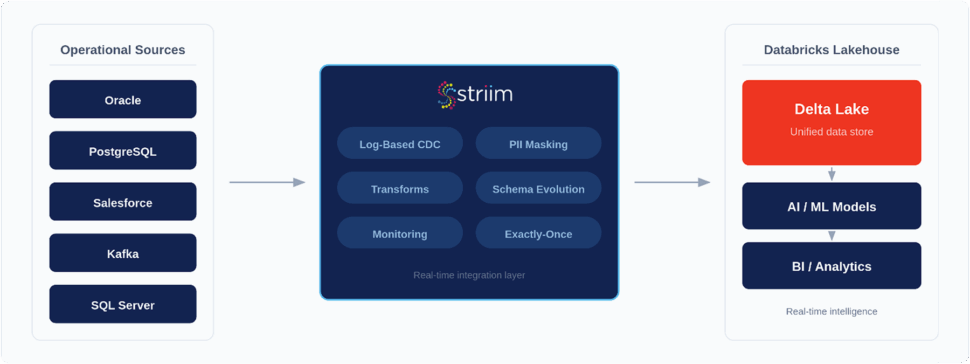
Data replication in the most basic sense is simply copying data from one system to another. But in the context of the Databricks Lakehouse, replication means something much more specific. It refers to the process of continuously capturing data from diverse operational sources—legacy databases, SaaS applications, messaging queues, and on-premise systems—and delivering it securely into Delta Lake.

Modern replication for Databricks isn’t just about moving bytes; it’s about ensuring data consistency, freshness, and reliability across complex hybrid and multi-cloud environments.

A true enterprise replication strategy accounts for the realities of modern data architectures. It handles automated schema evolution, ensuring that when an upstream operational database changes its schema, your Databricks pipeline adapts gracefully instead of breaking. It also optimizes the data in flight, formatting it perfectly for Delta Lake so it is immediately ready for both batch analytics and streaming AI workloads.

Key Use Cases for Data Replication into Databricks

Data replication should never be viewed simply as a “back-office IT task.” It is the circulatory system of your data strategy. When replication pipelines break or introduce high latency, the stakes are incredibly high: models fail, dashboards mislead, compliance is jeopardized, and revenue is lost.

Understanding your specific use case is the first step in determining the type of replication architecture you need.

Use Case

Business Impact

Why Replication Matters

AI & Machine Learning Higher predictive accuracy, automated decision-making. Models degrade quickly without fresh data. Replication feeds continuous, high-quality context to production AI.
Operational Analytics Faster time-to-insight, improved customer experiences. Ensures dashboards reflect current reality, allowing teams to act on supply chain or inventory issues instantly.
Cloud Modernization Reduced infrastructure costs, increased agility. Bridges legacy systems with Databricks, allowing for phased migrations without disrupting business operations.
Disaster Recovery Minimized downtime, regulatory compliance. Maintains a synchronized, highly available copy of mission-critical data in the cloud.

Powering AI And Machine Learning Models

AI and ML models are hungry for context, and that context has a strict expiration date. If you’re building a fraud detection algorithm, a personalized recommendation engine, or an agentic AI workflow, relying on stale data is a recipe for failure. Real-time data replication continuously feeds your Databricks environment with the freshest possible data. This ensures your training datasets remain relevant, your models maintain their accuracy, and your inference pipelines deliver reliable, profitable outcomes.

Real-Time Analytics And Operational Intelligence

Teams often rely on Databricks to power dashboards and customer insights that drive immediate action. For example, in retail, inventory optimization requires knowing exactly what is selling right now, not just what sold yesterday. In logistics, supply chain tracking requires real-time location and status updates. Continuous data replication ensures that business intelligence tools sitting on top of Databricks are reflecting operational reality the exact second a user looks at them.

Cloud Migration And Modernization Initiatives

Enterprises rarely move to the cloud in a single week. Modernization is a phased journey, often involving complex hybrid environments where legacy on-premise databases must coexist with Databricks for months or even years. Real-time replication acts as the bridge between these two worlds. It continuously synchronizes data from legacy systems to the cloud, minimizing downtime, reducing migration risk, and giving executives the confidence to modernize at their own pace.

Business Continuity And Disaster Recovery

If a primary operational system goes offline, the business needs a reliable backup. Data replication pipelines allow enterprises to maintain a continuously synchronized, high-fidelity copy of their mission-critical data within Databricks. Should an outage occur, this replicated data ensures business continuity, protects against catastrophic data loss, and helps organizations meet strict regulatory and compliance requirements.

Approaches and Strategies for Databricks Data Replication

Choosing data replication architecture means reviewing your specific business goals, latency requirements, data volume, and the complexity of your source systems. The wrong approach can lead to skyrocketing cloud compute costs or, conversely, data that is too stale to power your AI models.

Here are the primary strategies enterprises use to replicate data into Databricks, and how to determine which is right for your architecture.

Batch Replication vs. Real-Time Streaming

Historically, batch replication was the default integration strategy. It involves extracting and loading data in scheduled intervals—such as every few hours or overnight. Batch processing is relatively simple to set up and remains cost-effective for historical reporting use cases where immediate data freshness isn’t strictly required.

However, batch processing creates inherent latency. Real-time streaming, by contrast, establishes a continuous, always-on flow of data from your source systems directly into Databricks. For modern enterprises utilizing Databricks for machine learning, hyper-personalization, or operational analytics, streaming is no longer optional. It is the only way to ensure models and dashboards reflect the absolute current state of the business.

Change Data Capture (CDC) vs. Full Refresh Replication

How exactly do you extract the data from your source systems? A full refresh involves querying the entire dataset from a source and completely overwriting the target table in Databricks. While sometimes necessary for complete schema overhauls or syncing very small lookup tables, running full refreshes at an enterprise scale is resource-intensive, slow, and expensive.

Change Data Capture (CDC) is the modern standard for high-volume replication. Instead of running heavy queries against the database, log-based CDC reads the database’s transaction logs to identify and capture only the incremental changes (inserts, updates, deletes) as they happen. This drastically reduces the performance impact on source systems and delivers ultra-low latency. For Databricks environments where massive scale and continuous data freshness drive AI outcomes, CDC is the essential underlying technology.

One-Time Migration vs. Continuous Pipelines

It can be helpful to view replication as a lifecycle. A one-time migration is typically the first step. This is a bulk data movement designed to seed Databricks with historical data, often executed during initial cloud adoption or when modernizing legacy infrastructure.

But a migration is just a point-in-time event. To keep AI/ML models accurate and analytics dashboards relevant, that initial migration must seamlessly transition into a continuous replication pipeline. Continuous pipelines keep Databricks permanently synchronized with upstream operational systems over the long term, ensuring the lakehouse stays up to date.

Common Challenges of Replicating Data into Databricks

While continuous data replication has clear benefits, execution at an enterprise scale remains notoriously difficult. Data and technical leaders must be prepared to navigate several key hurdles when building pipelines into Databricks.

Handling Schema Drift And Complex Data Structures

Operational databases are not static. As businesses evolve, application developers constantly add new columns, modify data types, or drop fields to support new features. This phenomenon is known as schema drift.

If your replication infrastructure is rigid, an unexpected schema change in an upstream Oracle or Postgres database could instantly break the pipeline. This leads to missing data in Delta Lake, urgent alerts, and data engineers spending hours manually rebuilding jobs instead of focusing on high-value work. Managing complex, nested data structures and ensuring schema changes flow seamlessly into Databricks without manual intervention is one of the most persistent challenges teams face.

Managing Latency And Ensuring Data Freshness

The core value of Databricks for AI and operational analytics is the ability to act on current context. However, maintaining strict data freshness at scale is challenging.

Batch processing inherently leads to stale data. But even some streaming architectures, if poorly optimized or reliant on query-based extraction, can introduce unacceptable latency.

When a recommendation engine or fraud detection algorithm relies on data that is hours—or even minutes—old, it loses a great deal of value. The business risk of latency is direct and measurable: lost revenue, inaccurate automated decisions, and degraded customer experiences. Overcoming this requires true, low-latency streaming architectures capable of moving data in milliseconds.

Balancing Performance, Cost, And Scalability

Moving huge volumes of data is resource-intensive. If you utilize query-based extraction methods or run frequent full refreshes, you risk putting a heavy load on your production databases, potentially slowing down customer-facing applications.

Suboptimal ingestion into Databricks can also lead to infrastructure sprawl and cost creep. For example, continuously streaming data without properly managing file compaction can lead to the “small file problem” in Delta Lake, which degrades query performance and unnecessarily inflates cloud compute and storage bills. Scaling replication gracefully means balancing throughput with minimal impact on source systems and optimized delivery to the target.

Securing Sensitive Data During Replication

Enterprise pipelines frequently span on-premise systems, SaaS applications, and multiple cloud environments, exposing data in transit and leading to significant risks, if not protected sufficiently.

Organizations must strictly adhere to compliance frameworks like GDPR, HIPAA, and PCI-DSS. This means ensuring that sensitive information—such as Personally Identifiable Information (PII) or Protected Health Information (PHI)—is not exposed during the replication process. Implementing robust encryption in motion, enforcing fine-grained access controls, and maintaining comprehensive audit logs are critical, yet complex, requirements for any enterprise replication strategy.

Best Practices for Reliable, Scalable Databricks Replication

Building replication pipelines that can handle enterprise scale requires moving beyond basic data extraction. It requires a strategic approach to architecture, monitoring, and governance. Based on how leading organizations successfully feed their Databricks environments, here are the core best practices to follow.

Optimize For Delta Lake Performance

Simply dumping raw data into Databricks is not enough; the data must be formatted to utilize Delta Lake’s specific performance features.

To maximize query speed and minimize compute costs, replication pipelines should automatically handle file compaction to avoid the “small file problem.” Furthermore, your integration solution must support graceful schema evolution. When an upstream schema changes, the pipeline should automatically propagate those changes to the Delta tables without breaking the stream or requiring manual intervention. Delivering data that is pre-optimized for Delta Lake ensures that your downstream AI and BI workloads run efficiently and cost-effectively.

Monitor, Alert, And Recover From Failures Quickly

In a real-time environment, silent failures can be catastrophic. If a pipeline goes down and the data engineering team doesn’t know about it until a business user complains about a broken dashboard, trust in the data platform evaporates.

That’s why robust observability is non-negotiable. Your replication architecture must include built-in, real-time dashboards that track throughput, latency, and system health. You need proactive alerting mechanisms that notify teams the instant a pipeline degrades. Furthermore, the system must support automated recovery features—like exactly-once processing (E1P)—to ensure that if a failure does occur, data is not duplicated or lost when the pipeline restarts.

Plan For Hybrid And Multi-Cloud Environments

Few enterprises operate entirely within a single cloud or solely on-premise infrastructure. Your replication strategy must account for a heterogeneous data landscape.

Avoid point-to-point replication tools that only work for specific source-to-target combinations. Instead, adopt a unified integration platform with broad connector coverage. Your solution should seamlessly ingest data from legacy on-premise databases (like Oracle or SQL Server), SaaS applications (like Salesforce), and modern cloud infrastructure (like AWS, Azure, or Google Cloud) with consistent performance and low latency across the board.

Build Pipelines With Governance And Compliance In Mind

As data flows from operational systems into Databricks, maintaining strict governance is critical, especially when that data will eventually feed AI models.

Security and compliance cannot be afterthoughts bolted onto the end of a pipeline; they must be embedded directly into the data stream. Ensure your replication solution provides enterprise-grade encryption for data in motion. Implement fine-grained access controls to restrict who can build or view pipelines. Finally, maintain comprehensive lineage and auditability, so that when auditors ask exactly where a specific piece of data came from and how it arrived in Databricks, you have a definitive, verifiable answer.

How Striim Powers Real-Time Data Replication for Databricks

Overcoming these operational challenges requires more than just a pipleine; it requires robust, purpose-built architecture. As the world’s leading Unified Integration & Intelligence Platform, Striim enables enterprises to continuously feed Databricks with the fresh, secure, and highly optimized data required to drive AI and analytics into production.

Striim is proven at scale, routinely processing over 100 billion events daily with sub-second latency for global enterprises. Instead of wrestling with brittle code and siloed data, organizations use Striim to turn their data liabilities into high-velocity assets. By leveraging Striim for Databricks data replication, enterprises benefit from:

  • Real-time CDC and streaming ingestion: Low-impact, log-based CDC continuously captures changes from legacy databases, SaaS applications, and cloud sources, delivering data in milliseconds.
  • Optimized for Delta Lake: Striim natively formats data for Delta Lake performance, offering built-in support for automated schema evolution to ensure pipelines never break when upstream sources change.
  • Enterprise-grade reliability: Striim guarantees exactly-once processing (E1P) and provides high availability, alongside real-time monitoring and proactive alerting dashboards to eliminate silent failures.
  • Uncompromising security and compliance: Built-in governance features, including encryption in motion, fine-grained access control, and our Validata feature, ensure continuous pipeline trust and readiness for HIPAA, PCI, and GDPR audits.
  • Hybrid and multi-cloud mastery: With over 100+ out-of-the-box connectors, Striim effortlessly bridges legacy on-premise environments with modern cloud infrastructure, accelerating cloud modernization.

Ready to see how a real-time, governed data layer can accelerate your Databricks initiatives? Book a demo today to see Striim in action, or start a free trial to begin building your pipelines immediately.

FAQs

How do I choose the right data replication tool for Databricks?

Choosing the right tool will depend on your business requirements for latency, scale, and source complexity. If your goal is to power AI, ML, or operational analytics, you should choose a platform that supports log-based Change Data Capture (CDC) and continuous streaming. Avoid tools limited to batch scheduling, as they will inherently introduce data staleness and limit the ROI of your Databricks investment.

What features should I prioritize in a Databricks replication solution?

At an enterprise scale, your top priorities should be reliability and Databricks-specific optimization. Look for solutions that offer exactly-once processing (E1P) to prevent data duplication during outages, and automated schema evolution to gracefully handle changes in source databases. Additionally, prioritize built-in observability and strict security features like encryption in motion to satisfy compliance requirements.

Can data replication pipelines into Databricks support both analytics and AI/ML workloads?

Yes, absolutely. A modern replication pipeline feeds data directly into Delta Lake, creating a unified foundation. Because Delta Lake supports both batch and streaming queries concurrently, the exact same low-latency data stream can power real-time ML inference models while simultaneously updating operational BI dashboards without conflict.

What makes real-time replication different from traditional ETL for Databricks?

Traditional ETL relies on batch processing, where heavy queries extract large chunks of data at scheduled intervals, slowing down source systems and delivering stale data. Real-time replication, specifically through CDC, reads the database transaction logs to capture only incremental changes (inserts, updates, deletes) as they happen. This drastically reduces the load on production databases and delivers fresh data to Databricks in milliseconds.

How does Striim integrate with Databricks for continuous data replication?

Striim natively integrates with Databricks by continuously streaming CDC data directly into Delta tables. It automatically handles file compaction and schema drift on the fly, ensuring the data lands perfectly optimized for Delta Lake’s performance architecture. Furthermore, Striim embeds intelligence directly into the stream, ensuring data is validated, secure, and AI-ready the moment it arrives.

Is Striim for Databricks suitable for hybrid or multi-cloud environments?

Yes. Striim is purpose-built for complex, heterogeneous environments. With over 100+ pre-built connectors, it seamlessly captures data from legacy on-premise systems (like Oracle or mainframe) and streams it into Databricks hosted on AWS, Google Cloud, or Microsoft Azure with consistent, low-latency performance.

How quickly can I set up a replication pipeline into Databricks with Striim?

With Striim’s intuitive, drag-and-drop UI and pre-built connectors, enterprise teams can configure and deploy continuous data pipelines in a matter of minutes or hours, not months. The platform eliminates the need for manual, brittle coding, allowing data engineers to focus on high-value architectural work rather than pipeline maintenance.

Data Replication for SQL Server: Native Tools vs. Real-Time CDC

SQL Server has long been the reliable workhorse of enterprise IT. It stores the mission-critical data that keeps your business running. But in an era where data must be instantly available across cloud platforms, analytics engines, and AI models, it’s no longer strategically optimal to keep that data locked in a single database.

That’s where data replication comes in.

When you need to migrate workloads to the cloud, offload heavy reporting queries, or ensure high availability during an outage, replication is the engine that makes it happen. As data volumes scale and the architecture grows more complex, how you replicate matters just as much as why.

If you’re navigating the complexities of data replication for SQL Server, you’re likely facing a practical set of challenges: which native replication method should you use? How do you avoid crippling performance bottlenecks? And how do you reliably move SQL Server data to modern cloud platforms without taking your systems offline? In this guide, we’ll break down exactly how SQL Server replication works, explore the limitations of its native tools, and show you why modern, log-based Change Data Capture (CDC) is the fastest, safest path to modern database replication.

Key Takeaways

  • Replication is an enterprise enabler: SQL Server data replication underpins business continuity, advanced analytics, and cloud modernization strategies.
  • Native tools have trade-offs: SQL Server offers four built-in replication types (Snapshot, Transactional, Merge, and Peer-to-Peer), each with unique strengths and inherent limitations.
  • Scale breaks native approaches: Native replication introduces challenges—like latency, schema changes, limited cloud support, and complex monitoring—that compound at enterprise scale.
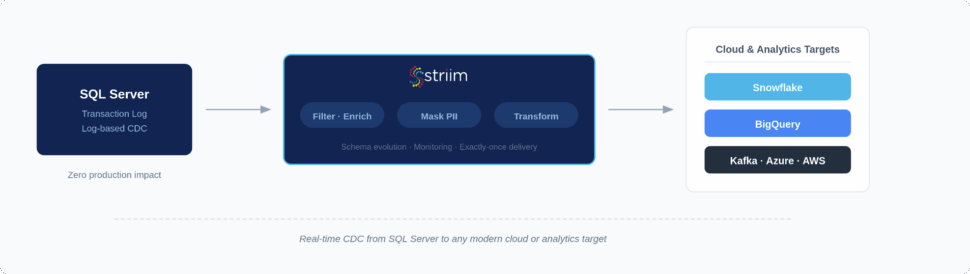
  • CDC is the modern standard for data replication: Log-based Change Data Capture (CDC) enables real-time, cloud-ready replication with far less overhead than traditional native methods.
  • Best practices mitigate risk: Success requires aligning your replication strategy with business outcomes, proactively monitoring pipeline health, securing endpoints, and planning migrations to minimize downtime.
  • Striim bridges the gap: Modern platforms like Striim extend replication beyond SQL Server’s native limits. With real-time CDC, diverse cloud-native targets, built-in monitoring, and enterprise-grade security, Striim reduces total cost of ownership (TCO) and accelerates modernization.

What Is Data Replication in SQL Server?

Data replication in SQL Server is the process of copying and distributing data and database objects from one database to another, and then synchronizing them to maintain consistency.

But when data leaders talk about “data replication for SQL Server,” they aren’t just talking about Microsoft’s built-in features. Today, the term encompasses both native SQL Server Replication and modern, third-party approaches like log-based Change Data Capture (CDC) streaming.

Whether you’re relying on the native tools out of the box or upgrading to a modern streaming platform, the underlying goal is the same. To move data securely and accurately where it needs to go to support high availability, operational performance, and advanced analytics.

How Data Replication Works for SQL Server

To appreciate why many enterprises are eventually forced to move toward modern CDC platforms, you first need a baseline understanding of how native SQL Server replication operates under the hood.

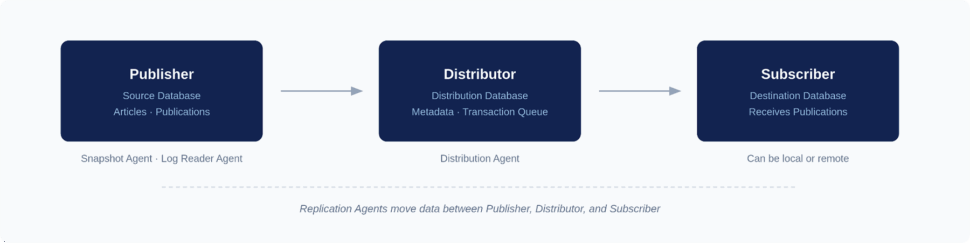
Native replication is built around a publishing industry metaphor: Publishers, Distributors, and Subscribers.

Here’s how the native workflow looks, broken down step-by-step:

Step 1: Define the Publisher and Articles to Replicate

The Publisher is your source database. You don’t have to replicate the entire database; instead, you start by defining “Articles”, i.e. the specific tables, views, or stored procedures you want to share. Grouping these articles together creates a “Publication.”

Step 2: Configure the Distributor to Manage Replication

The Distributor is the middleman. It stores the distribution database, which holds metadata, history data, and (in transactional replication) the actual transactions waiting to be moved. It acts as the routing engine, taking the load off the Publisher.

Step 3: Set up Subscribers to Receive Data

Subscribers are your destination databases. A Subscriber requests or receives the Publication from the Distributor. You can have multiple Subscribers receiving the same data, and they can be located on the same server or across the globe.

Step 4: Run Replication Agents to Move and Apply Changes

SQL Server relies on dedicated background programs called Replication Agents to do the heavy lifting. The Snapshot Agent creates the initial baseline of your data, the Log Reader Agent scans the transaction log for new changes, and the Distribution Agent moves those changes to the Subscribers.

Step 5: Monitor Replication Status and Performance

Once running, Database Administrators (DBAs) must continuously monitor the health of these agents. This involves tracking latency, checking for failed transactions, and ensuring the Distributor doesn’t become a bottleneck as transaction volumes spike.

Types of SQL Server Replication

SQL Server offers four primary native replication models, and choosing the right one is critical to the health of your infrastructure. Pick the wrong method, and you’ll quickly introduce crippling latency, data conflicts, or massive operational overhead.

Here is a breakdown of the four native types:

Type

How it works

Pros

Cons

Ideal scenarios

Notes/limits

Snapshot Copies the entire dataset at a specific moment in time. Simple to configure; no continuous overhead. Resource-intensive; data is instantly stale; high network cost. Small databases; read-only reporting; baseline syncing. Rarely used for continuous enterprise replication.
Transactional Reads the transaction log and streams inserts, updates, and deletes. Lower latency; highly consistent; supports high volumes. Schema changes can break pipelines; large transactions cause bottlenecks. Offloading read-heavy queries; populating data warehouses. The workhorse of native SQL Server replication.
 Merge Allows changes at both Publisher and Subscriber, merging them later. Supports offline work; allows multi-directional updates. High CPU usage; complex conflict resolution rules. Point-of-sale (POS) systems; mobile applications. Relies heavily on database triggers, increasing overhead.
Peer-to-Peer Multi-node transactional replication where all nodes read and write. Excellent high availability; scales read/write workloads globally. Extremely complex to manage; strict identical schema requirements. Distributed web applications requiring global read/write access. Requires SQL Server Enterprise Edition.

Snapshot Replication You can think of snapshot replication like taking a photograph of your database. It copies the entire dataset—schema and data—and drops it onto the Subscriber. It is straightforward, but it is heavy. Because it moves the whole dataset every time, it’s typically only used for very small databases, or as the initial step to seed a database before turning on another, more dynamic replication method.

Transactional Replication

This is the most common native approach. Instead of copying everything over and over, the Log Reader Agent scans the SQL Server transaction log and continuously moves individual inserts, updates, and deletes to the Subscriber. It’s designed for low-latency environments. However, it requires a pristine network connection, and any structural changes to your tables (DDL changes) can easily break the pipeline and force a painful restart.

Merge Replication

Merge replication allows both the Publisher and the Subscriber to make changes to the data independently. When the systems finally connect, they merge their updates. If two users change the same row, SQL Server uses predefined rules to resolve the conflict. It is highly flexible for offline scenarios—like remote retail stores or mobile apps—but it demands significant CPU resources and constant operational oversight to untangle inevitable data conflicts.

Peer-to-Peer Replication

Built on the foundation of transactional replication, peer-to-peer allows multiple SQL Server nodes to act as both Publishers and Subscribers simultaneously. It is designed to scale out read and write operations globally, offering excellent high availability. But it comes with a steep cost in complexity. Managing conflicts across a multi-node, active-active architecture requires intense DBA attention.

Common Use Cases for Data Replication in SQL Server

Why go through the effort of replicating data in the first place? In an enterprise environment, replication is the engine behind several mission-critical initiatives.

While native SQL Server tools can handle basic SQL-to-SQL setups, many of these use cases eventually push organizations toward modern, log-based CDC streaming platforms—especially when the destination is a cloud environment or a modern analytics engine.

Disaster Recovery and High Availability

When your primary system goes down, your business stops. Every minute of downtime costs revenue and erodes customer trust. Replication ensures that a standby database is always ready to take over. By keeping a secondary replica continuously synchronized, you can failover instantly during an outage, minimizing data loss and keeping mission-critical applications online.

Offload Reporting and Analytics Workloads

Running heavy analytical queries on your production SQL Server is a recipe for disaster. It drains compute resources, slows down operational performance, and frustrates your end-users. Replication solves this by moving operational data to a secondary system or a dedicated data warehouse. While native transactional replication can do this for SQL-to-SQL environments, modern CDC platforms excel here by streaming that data directly into platforms like Snowflake or BigQuery for real-time analytics.

Support Cloud Migration and Hybrid Architectures

Enterprises are rapidly migrating workloads to Azure, AWS, and Google Cloud. However, taking a massive production database offline for an extended migration window is rarely feasible. Replication bridges the gap. By continuously syncing your on-premises SQL Server to your new cloud environment, you can migrate seamlessly and perform a zero-downtime cutover. When you’re dealing with heterogeneous cloud targets, modern streaming platforms are the only viable path forward.

Enable Geo-Replication and Distributed Applications

If your users are in London, but your database is in New York, latency is somewhat inevitable. Replication allows you to distribute data geographically, placing read-replicas closer to the end-users. This drastically improves application response times and ensures a smooth, localized experience for a global user base.

Challenges with Native SQL Server Replication

Native SQL Server replication can work well for basic, homogenous environments. But as enterprise data architectures scale, these built-in tools often lead to significant risks. Here’s where native approaches typically fall short.

Latency and Performance Trade-Offs

In high-transaction environments, the Log Reader and Distribution Agents can quickly become bottlenecks. Wide Area Network (WAN) constraints or high-churn tables often lead to severe lag. DBAs are left constantly measuring “undistributed commands” and troubleshooting end-to-end latency. Furthermore, the cost of over-replication—replicating too many tables or unnecessary columns—severely taxes the source system’s CPU and memory.

Schema Changes and Conflict Resolution

Data structures are rarely static. With native transactional replication, executing Data Definition Language (DDL) changes—like adding a column or modifying a data type—can easily break the replication pipeline. Handling identity columns and strict Primary Key (PK) requirements also introduces friction. In the worst-case scenarios, a schema mismatch forces a complete reinitialization of the database, leading to hours of downtime. For Merge or Peer-to-Peer replication, designing and managing conflict resolution policies demands immense operational overhead.

Limited Hybrid and Cloud Support

Native replication was designed for SQL-to-SQL ecosystems. When you need to move data to heterogeneous targets—like Snowflake, BigQuery, Kafka, or a distinct cloud provider—native tools fall flat. Creating workarounds involves overcoming significant network hurdles, security complexities, and tooling gaps. Modern cloud architectures require platforms built specifically for cross-platform, multi-cloud topologies.

Complexity of Monitoring and Maintenance

Managing native replication requires a heavy administrative lift. Daily and weekly tasks include monitoring agent jobs, triaging cryptic error logs, and making tough calls on whether to reinitialize failing subscriptions. Because there is no unified observability layer, it is difficult to establish and adhere to clear Service Level Objectives (SLOs) around maximum lag or Mean Time to Recovery (MTTR).

Best Practices for SQL Server Data Replication

Whether you are trying to optimize your current native setup or transitioning to a modern streaming architecture, adhering to best practices is essential. These field-tested lessons reduce risk, improve reliability, and support broader modernization strategies.

Define Replication Strategy Based on Business Needs

Technology should always follow business drivers. Start by defining your required outcomes—whether that is high availability, offloading analytics, or executing a cloud migration—before selecting a data replication strategy. To reduce overhead and limit the blast radius of failures, strictly scope your replication down to the necessary tables, columns, and filters.

How Striim helps: Striim simplifies strategic planning by supporting log-based CDC for heterogeneous targets right out of the box. This makes it significantly easier to align your replication setup directly with your modernization and analytics goals, without being constrained by native SQL Server limits.

Monitor and Validate Replication Health

Replication blind spots are dangerous. It’s best to be proactive from the offset: tracking latency, backlog sizes, agent status, and errors. Set up proactive alerting thresholds and regularly validate data parity using row counts or checksums. Crucially, establish a clear incident response plan to reduce MTTR when replication inevitably hits a snag.

How Striim helps: Striim provides built-in dashboards and real-time monitoring capabilities. It gives you a unified view of pipeline health, making it far easier to detect issues early, troubleshoot efficiently, and ensure continuous data flow across SQL Server and your cloud systems.

Secure Replication Endpoints and Credentials

Data in motion is highly vulnerable. Secure your pipelines by enforcing least-privilege access, encrypting data in transit, and securing snapshot folders. Avoid common security pitfalls, like embedding plaintext credentials in agent jobs or deployment scripts. Always rotate secrets regularly and audit access to maintain compliance with mandates like SOX, HIPAA, and GDPR.

How Striim helps: Striim natively integrates with enterprise-grade security controls. With support for TLS encryption, Role-Based Access Control (RBAC), and comprehensive audit logs, Striim drastically reduces your manual security burden and compliance risk compared to piecing together native replication security.

Minimize Downtime During Migrations

When migrating databases, downtime is the enemy. A safe migration strategy involves seeding the target database via a backup and restore process, and then using replication to synchronize the ongoing deltas. Always run dry-run cutovers to test your process, and define strict rollback criteria before touching production. For large, high-churn tables, carefully plan for phased or parallel migrations to minimize impact. How Striim helps: Striim is built for zero-downtime migrations. By leveraging log-based CDC to capture and stream changes in real-time, Striim allows you to move SQL Server workloads to modern cloud targets continuously, ensuring you can modernize your infrastructure without ever disrupting live applications.

What Makes Striim the Data Replication Solution of Choice for SQL Server

Native SQL Server replication often creates pain around latency, schema changes, and cross-platform targets. To truly modernize, you need a platform built for the speed and scale of the cloud.

Striim is the enterprise-ready, log-based CDC platform designed to overcome the limitations of native replication. By unifying real-time data movement, in-flight transformation, and governance, Striim ensures your data gets where it needs to be—accurately, securely, and in sub-second latency.

Here is how Striim specifically solves SQL Server replication challenges (for deeper technical details, refer to our SQL Server documentation):

  • Log-based Change Data Capture (CDC) with minimal latency: Using our Microsoft SQL Server connector, Striim reads directly from the SQL Server transaction log, keeping your production databases unburdened while ensuring real-time data freshness for analytics, reporting, and operational decision-making.
  • Continuous replication to modern cloud platforms: Moving to Azure, AWS, GCP, Snowflake, Kafka, or BigQuery? Striim supports continuous replication to heterogeneous targets, accelerating cloud adoption and enabling multi-cloud strategies without friction.
  • Low-code interface with drag-and-drop pipeline design: Avoid complex scripting. Striim’s intuitive interface shortens project timelines and reduces engineering effort, helping your data teams deliver results in weeks instead of months.
  • Built-in monitoring dashboards and alerts: Stop flying blind. Striim lowers DBA overhead and improves reliability by actively monitoring pipeline health, surfacing errors, and catching latency issues before they impact the business.
  • Enterprise-grade security: Striim reduces compliance risk and ensures your replication meets regulatory standards (like HIPAA, SOX, and GDPR) with native TLS encryption, role-based access control, and comprehensive audit trails.
  • Schema evolution handling: Don’t let a simple DDL change break your pipeline. Striim seamlessly handles schema evolution, simplifying ongoing operations by avoiding painful database re-initializations and minimizing disruption.
  • Zero-downtime cloud migration workflows: Moving massive SQL Server databases to the cloud doesn’t have to require planned outages. Striim supports phased modernization without ever interrupting your live applications or customer experiences.
  • Horizontal scalability: Built to process over 100 billion events daily, Striim ensures your replication infrastructure easily keeps pace as data volumes and business demands grow.

FAQs

What are the biggest challenges with data replication for SQL Server in large enterprises?

The biggest challenges revolve around scale, system performance, and architectural rigidity. Native tools can heavily tax source databases, creating crippling latency during high-transaction periods. Furthermore, native methods struggle with Data Definition Language (DDL) changes, which frequently break pipelines, and lack native support for streaming data to modern, non-Microsoft cloud environments.

How does log-based CDC improve SQL Server replication compared to native methods?

Log-based CDC is drastically more efficient because it reads the database transaction log asynchronously, rather than running resource-heavy queries against the active tables. This prevents performance degradation on your primary SQL Server instance. It also provides sub-second latency and handles structural schema changes far more gracefully than native transactional replication.

Can SQL Server data replication support cloud migration without downtime?

Yes, but doing it safely requires modern CDC tools. You begin by executing an initial data load (seeding) to the new cloud target while the primary SQL Server remains online. Simultaneously, log-based CDC captures any changes happening in real time and streams those deltas to the cloud, allowing you to synchronize the systems and cut over with zero downtime.

What’s the difference between SQL Server replication and third-party replication tools like Striim?

SQL Server’s built-in replication is primarily designed for homogenous, SQL-to-SQL environments and relies heavily on complex agent management. Striim, conversely, is an enterprise-grade platform built for heterogeneous architectures. It captures data from SQL Server and streams it in real-time to almost any target—including Snowflake, Kafka, and BigQuery—while offering in-flight transformations and unified observability.

How do I monitor and troubleshoot SQL Server replication at scale?

At an enterprise scale, you must move away from manually checking agent logs. Best practices dictate establishing Service Level Objectives (SLOs) around acceptable lag and implementing centralized monitoring dashboards. Platforms like Striim automate this by providing real-time visibility into pipeline health, proactive alerting for bottlenecks, and automated error handling to reduce mean time to recovery (MTTR).

Is data replication for SQL Server secure enough for compliance-driven industries (HIPAA, SOX, GDPR)?

Native SQL Server replication can be secured, but it requires meticulous manual configuration to ensure snapshot folders and credentials aren’t exposed. For compliance-driven industries, utilizing a platform like Striim is far safer. It embeds security directly into the pipeline with end-to-end TLS encryption, role-based access control (RBAC), and rigorous audit trails that easily satisfy regulatory audits.

How do I choose the best data replication strategy for SQL Server in a hybrid cloud environment?

Always start by mapping your business requirements: acceptable latency, source system impact, and target destinations. If you are moving data across a hybrid cloud topology (e.g., from an on-premises SQL Server to a cloud data warehouse), native tools will likely introduce too much friction. In these scenarios, a modern log-based CDC and streaming strategy is the undisputed best practice.

What’s the ROI of using Striim for SQL Server data replication versus managing native replication in-house?

The ROI of Striim is driven by massive reductions in engineering and administrative overhead, as DBAs no longer spend hours troubleshooting broken native pipelines. It accelerates time-to-market for AI and analytics initiatives by delivering real-time, context-rich data continuously. Most importantly, it protects revenue by enabling zero-downtime migrations and guaranteeing high availability for mission-critical applications.

Ready to modernize your SQL Server data architecture? Don’t let legacy replication tools hold back your digital transformation. Integration isn’t just about moving data. It’s about breaking down silos and building a unified, intelligent architecture.

Curious to learn more? Book a demo today to explore how Striim helps enterprises break free from native limitations, operationalize AI, and power real-time intelligence—already in production at the world’s most advanced companies.

AI Data Governance: Moving from Static Policies to Real-Time Control

Data governance needs an update. Governing an AI model running at sub-second speeds using a monthly compliance checklist simply no longer works. It’s time to rethink how we govern and manage data in a streaming context and reinvent data governance for the AI era.

Yet, as many enterprises still rely on static, batch-based data governance to protect their most mission-critical systems. It’s a mismatch that creates an immediate ceiling on AI adoption. When governance tools can’t keep pace with the speed and scale of modern data pipelines, enterprises are left exposed to biased models, compliance breaches, and untrustworthy outputs.

AI data governance is the discipline of ensuring that AI systems are trained, deployed, and managed using high-quality, transparent, and compliant data. It shifts the focus from governing data after it lands in a warehouse, to governing data the instant it is born.

In this guide, we’ll explore what makes AI data governance distinct from traditional frameworks. We’ll break down the core components of an AI-ready strategy, identify the common pitfalls enterprises face, and show you how to embed governance directly into your data pipelines for real-time, continuous control.

What is AI Data Governance?

Traditional data governance was built for databases and dashboards. It asked: Is this data secure? Who has access to it? Is it formatted correctly?

AI data governance asks all of that, while tackling a much bigger question: Can an autonomous system trust this data to make a decision right now?

In this context, AI data governance is the discipline of managing data so it remains accurate, ethical, compliant, and traceable throughout the entire AI lifecycle. It builds on the foundation of traditional governance but introduces controls for the unique risks of machine learning and agentic AI: things like model bias, feature drift, and real-time data lineage for ML operations.

When you feed an AI model stale or ungoverned data, the consequences are not only bad decisions, but potentially disastrous outcomes for customers. AI data governance connects your data practices directly to business outcomes. It’s the necessary foundation for responsible AI, ensuring that your models are accurate, your operations remain compliant, and your customers can trust the results.

Why AI Data Governance Matters

It’s tempting to view data governance as a purely defensive play: a necessary hurdle to keep the legal team and regulators happy. But in the context of machine learning and agentic AI, governance has the potential to be an engine for growth. It can be the key to building AI systems that organizations and customers can actually trust.

Here’s why modernizing your governance framework is critical for the AI era:

Builds Trust and Confidence in AI Models

An AI model is only as effective as the data feeding it. If your pipelines are riddled with incomplete, inaccurate, or biased data, the model’s outputs will be unreliable. Consider a healthcare application using machine learning to assist with diagnoses: if it’s trained on partial patient records or missing demographic data, it could easily recommend incorrect treatments. Poor data governance doesn’t just result in a failed IT project; it actively erodes user trust and invites intense regulatory scrutiny.

Enables Regulatory Compliance and Risk Management

Data privacy laws like GDPR and CCPA are strictly enforced, and emerging frameworks like the EU AI Act are raising the stakes even higher. Compliance in an AI world requires more than just restricting access to sensitive information. Organizations must guarantee absolute traceability and auditability. If a regulator asks why a model made a specific decision, enterprises must be able to demonstrate the exact origin of the data and how it was used.

Improves Agility and Scalability for AI Initiatives

If your data science team has to manually reinvent compliance, security, and quality controls for every new ML experiment, innovation will grind to a halt. Conversely, well-governed data pipelines—especially those built on modern data streaming architectures—pave the way for efficient development. They enable teams to scale AI across departments and use cases safely, transforming governance from a bottleneck into a distinct competitive advantage.

Strengthens Transparency and Accountability

The era of “black box” AI is a massive liability for the modern enterprise. True transparency means having the ability to trace exactly how and why an AI model arrived at a specific conclusion. Strong governance—specifically robust lineage tracking—makes this explainability possible. By mapping the journey of your data, you ensure that you can explain AI outputs to internal stakeholders, customers, and auditors alike.

Key Components of an Effective AI Data Governance Framework

Effective governance doesn’t happen in a single tool or a siloed department; it requires multiple layers working together harmoniously. While specific frameworks will vary based on your industry and risk tolerance, the following elements form the necessary backbone of any AI-ready data governance strategy.

Data Quality and Integrity Controls

AI models are highly sensitive to the data they consume. They rely entirely on complete, consistent, and current information to make accurate predictions. Your framework must include rigorous, automated quality checks—such as strict validation rules, real-time anomaly detection, and continuous deduplication—to ensure flawed data never reaches your models.

Metadata Management and Lineage

If data is the fuel for your AI, metadata is the “data about the data” that gives your teams vital context. Alongside metadata, you need data lineage: a clear map revealing the origin, transformations, and movements of the data used to train and run your models. Continuous lineage tracking enables data teams to identify and correct errors rapidly. While achieving truly real-time lineage at an enterprise scale remains technically challenging, it is a non-negotiable capability for trustworthy AI.

Access, Privacy, and Security Policies

Foundational governance safeguards like role-based access control (RBAC), data masking, and encryption take on heightened importance in the AI era. Protecting personally identifiable information (PII) or regulated health data is critical, as AI models can inadvertently memorize and expose sensitive inputs. Leading platforms like Striim address this by enforcing these security and privacy controls dynamically across streaming data, ensuring that data is masked or redacted before it ever reaches an AI environment.

Monitoring, Observability, and Auditing

Governance is not a “set it and forget it” exercise. You need continuous monitoring to watch for compliance breaches, data drift, and unauthorized data movement. Real-time observability dashboards are vital here, acting as the operational control center that allows your engineering and governance teams to detect and remediate issues in near real time.

AI-Specific Governance: Models, Features, and Experiments

AI data governance must extend beyond the data pipelines to govern the machine learning artifacts themselves. This means managing the full ML lifecycle. Your framework needs to account for model versioning, feature store management, and experiment tracking to ensure that the AI application itself behaves reliably over time.

Automation and AI-Assisted Governance

Funnily enough, one of the best ways to govern AI is to leverage…AI. Machine learning—and AI-driven data governance methods—can strengthen your governance posture by automatically classifying sensitive data, detecting subtle anomalies, or predicting compliance risks before they materialize. Embedding this automation directly within your data pipelines significantly reduces manual intervention. However, using AI for governance introduces its own complexities. It requires thoughtful implementation to ensure you aren’t simply trading old failure modes for new ones.

Common Challenges in AI Data Governance

Implementing AI data governance across a sprawling, fast-moving enterprise data landscape is notoriously difficult. Because AI initiatives demand data at an unprecedented scale and speed, they act as a stress test for existing infrastructure.

Here’s a quick look at the friction points organizations encounter, and the business impact of failing to address them:

The Challenge

The Business Impact

Legacy, batch-based tools Stale data feeds, delayed insights, and inaccurate AI predictions.
Scattered, siloed data sources Inconsistent policy enforcement and major compliance blind spots.
Lack of real-time visibility Undetected data drift, prolonged errors, and regulatory fines.
Overly restrictive policies Bottlenecked AI innovation and frustrated data science teams.

Overcoming these hurdles requires understanding exactly where legacy systems fall short.

Managing Data Volume, Velocity, and Variety

AI devours huge volumes of data. Models aren’t just ingesting neat rows from a relational database; they are processing unstructured text, high-velocity sensor logs, and continuous streams from APIs. Static data governance tools were built for scheduled batch jobs. They simply break or lag when forced to govern continuous, high-speed ingestion, leaving a dangerous vulnerability window between when data is generated and when it is actually verified.

Breaking Down Data Silos and Tool Fragmentation

Governance becomes impossible when your data gets scattered across a dozen disconnected systems, multi-cloud environments, and fragmented point solutions. When policies are applied inconsistently across different silos, compliance gaps inevitably emerge. Unified data pipelines—supported by extensive data connectors like those enabled by Striim—are essential here. They allow organizations to standardize and enforce governance policies consistently as data moves, rather than trying to herd cats across isolated storage layers.

Maintaining Real-Time Visibility and Control

In the AI era, every delayed insight increases risk. If a pipeline begins ingesting biased data or exposing unmasked PII, you can’t afford to find out in tomorrow morning’s batch report. By then, the autonomous model will have already acted on it. Organizations need real-time dashboards, automated alerts, and continuous lineage tracking to identify and quarantine compliance breaches the second they occur.

Balancing Innovation With Risk Mitigation

This is the classic organizational tightrope. Lock down data access too tightly, and your data scientists will spend their days waiting for approvals, bringing AI experimentation to a grinding halt. Govern too loosely, and you expose the business to severe regulatory and reputational risk. The ultimate goal is to adopt dynamic governance models that enforce strict controls invisibly in the background, offering teams the flexibility to innovate at speed, with the guardrails to stay safe.

Best Practices for Implementing AI Data Governance

The challenges of AI data governance are significant but entirely solvable. The key is moving away from reactive, after-the-fact compliance and towards a proactive, continuous model.

Here are some practical steps organizations can take to build an AI-ready data governance framework:

Define a Governance Charter and Ownership Model

Governance requires clear accountability, it cannot solely be IT’s responsibility. Establish a formal charter that assigns specific roles, such as data owners, data stewards, and AI ethics leads. This ownership model ensures that someone is always accountable for the data feeding your models. Crucially, your charter should closely align with your company’s broader AI strategy and specific risk tolerance, ensuring that governance acts as a business enabler, not just a policing force.

Embed Governance Into Data Pipelines Early

The most effective way to reduce downstream risk is to “shift left” and apply governance as early in the data lifecycle as possible. Waiting to clean and validate data until it lands in a data warehouse is too late for real-time AI. Instead, embed governance directly into your data pipelines. Streaming data governance platforms like Striim enforce quality checks, masking, and validation in real-time, ensuring that AI models continuously work from the freshest, most accurate, and fully compliant data available.

Use Automation to Detect and Correct Issues Early

Manual governance simply cannot scale to meet the volume and velocity of AI data. To maintain consistency, lean into automation for proactive issue detection. Implement AI-assisted quality checks, automated data classification, and real-time anomaly alerts. However, remember that automation requires thoughtful implementation. If left unchecked, automated governance tools can inadvertently inherit bias or create new blind spots. Govern the tools that govern your AI.

Integrate Governance Across AI/ML and Analytics Platforms

Governance fails when it is siloed. Your framework must connect seamlessly with your broader AI and analytics ecosystem. This means utilizing shared metadata catalogs, API-based policy enforcement, and federated governance approaches that span your entire architecture. Ensure your governance strategy is fully compatible with modern data platforms like Databricks, Snowflake, and BigQuery so that policies remain consistent no matter where the data resides or is analyzed.

Continuously Measure and Mature Your Governance Framework

You can’t manage what you don’t measure. A successful AI data governance strategy requires continuous evaluation. Establish clear KPIs to track the health of your framework, such as data quality scores, lineage completeness, and incident response times. For the AI models specifically, rigorously track metrics like model drift detection rates, feature store staleness, and policy violation trends. Use these insights to iteratively refine and mature your approach over time.

How Striim Supports AI Data Governance

To safely deploy AI at enterprise scale, governance can no longer be an afterthought. It must be woven seamlessly into the fabric of your data architecture. Striim helps organizations operationalize AI data governance by making data real-time, observable, and compliant from the moment it leaves the source system to the moment it reaches your AI models, directly tackling these data governance challenges head-on.

Change Data Capture (CDC) for Continuous Data Integration

Striim utilizes non-intrusive Change Data Capture (CDC) to stream data the instant it changes. This continuous flow enables automated data quality checks and validation while data is still in motion. By enriching and cleansing data before it ever lands in an AI environment, Striim ensures your models are always working from the most current, continuously validated data available.

Real-Time Lineage and Monitoring

When an AI model makes a decision, you need to understand the “why” immediately. Striim provides end-to-end data lineage tracking and observability dashboards that allow teams to trace data from its source system directly to the AI model in real time. This complete visibility makes it possible to identify bottlenecks, detect feature drift, and correct errors instantly, even at massive enterprise scale.

Embedded Security and Compliance Controls

AI thrives on data, but regulated industries cannot afford to expose sensitive information to autonomous systems. Striim enforces encryption, role-based access controls, and dynamic data masking directly across your streaming pipelines. By redacting personally identifiable information (PII) before it enters your AI ecosystem, Striim helps you meet stringent HIPAA, SOC 2, and GDPR requirements without slowing down innovation.

Ready to build a real-time, governed data foundation for your AI initiatives? Try Striim for free or book a demo today to see how we help the world’s most advanced companies break down silos and power trustworthy AI and ML.

FAQs

How do you implement AI data governance in an existing data infrastructure?

Start by mapping the data flows that feed your most critical AI models to identify immediate compliance and quality gaps. Rather than ripping and replacing legacy systems, integrate a real-time streaming layer like Striim that sits between your source databases and AI platforms. This allows you to apply dynamic masking, quality checks, and lineage tracking to data in flight, layering modern governance over your existing infrastructure without disrupting operations.

What tools or platforms help automate AI data governance?

Modern data governance relies on unified integration platforms, active metadata catalogs, and specialized observability tools. Platforms like Striim automate governance by embedding validation rules and security protocols directly into continuous data pipelines. Additionally, AI-driven catalogs automatically classify sensitive data, while observability tools monitor for real-time feature drift, reducing the need for manual oversight.

How does real-time data integration improve AI governance and model performance?

Real-time integration ensures AI models are continuously fed fresh, validated data rather than relying on stale, day-old batches. This immediate ingestion window allows governance policies—like anomaly detection and PII masking—to be enforced the instant data is created. As a result, models make decisions based on the most accurate current context, drastically reducing the risk of hallucinations or biased outputs.

How can organizations measure the ROI of AI data governance?

ROI is measured through both risk mitigation and operational acceleration. Organizations should track metrics like the reduction in compliance incidents, the time saved on manual data preparation, and the decrease in time-to-deployment for new ML models. Industry studies show that organizations with strong data governance practices achieve up to 30% higher operational efficiency, proving that governed data directly accelerates AI time-to-value.

What’s the difference between AI governance and AI data governance?

AI governance is the overarching framework managing the ethical, legal, and operational risks of AI systems, including human oversight and model fairness. AI data governance is a highly specialized subset focused entirely on the data feeding those systems. While AI governance asks if a model’s decision is ethical, AI data governance ensures the data used to make that decision is accurate, traceable, and legally compliant.

What are the first steps to modernizing data pipelines for AI governance?

The first step is moving away from purely batch-based ETL processes that create dangerous blind spots between data creation and ingestion. Transition to a real-time, event-driven architecture using technologies like Change Data Capture (CDC). From there, establish clear data ownership protocols and define automated quality rules that must be met before any data is allowed to enter your AI environments.

How do real-time audits and lineage tracking support compliance in AI systems?

Regulatory frameworks like the EU AI Act demand rigorous explainability for high-risk AI models. Real-time lineage tracking provides a continuous, auditable trail showing exactly where training data originated, who accessed it, and how it was transformed. If regulators or internal stakeholders question an AI output, this instant auditability proves that no unmasked sensitive data was used in the decision-making process.

Can AI be used to improve data governance itself?

Yes, “AI for governance” is a rapidly growing practice where machine learning models are deployed to manage data hygiene at scale. AI can automatically scan petabytes of data to classify sensitive information, predict potential compliance breaches, and flag subtle anomalies in real time. For example, an AI agent can proactively identify when customer address formats drift from the standard, correcting the error before it corrupts a downstream predictive model.

How does AI data governance support generative AI initiatives?

Generative AI (GenAI) and LLMs are notorious for confidently hallucinating when fed poor or out-of-context data. Governance supports GenAI—particularly in Retrieval-Augmented Generation (RAG) architectures—by ensuring the vector databases feeding the LLM only contain highly accurate, securely curated information. By strictly governing this context window, enterprises prevent their GenAI chatbots from accidentally exposing internal IP or generating legally perilous responses.

What should companies look for in a real-time AI data governance solution?

A robust solution must offer continuous data ingestion paired with in-flight transformation capabilities. Look for built-in observability that provides end-to-end lineage, and dynamic security features like automated data masking and role-based access controls. Finally, the platform must be highly scalable and capable of processing billions of events daily with sub-second latency, ensuring governance never becomes a bottleneck for AI performance.

Data Replication for MongoDB: Guide to Real-Time CDC

If your application goes down, your customers go elsewhere. That’s the harsh reality for enterprise companies operating at a global scale. In distributed architectures, relying on a single database node leads to a single point of failure. You need continuous, reliable copies of your data distributed across servers to ensure high availability, disaster recovery, and low-latency access for users around the world.

MongoDB is a leading NoSQL database because it makes data replication central to its architecture. It handles the basics of keeping multiple copies of your data for durability natively. But for modern enterprises, simply having a backup copy of your operational data is no longer sufficient.

As they scale, enterprises need continuous, decision-ready data streams. They need to feed cloud data warehouses, power real-time analytics, and supply AI agents with fresh context. While MongoDB’s native replication is a strong foundation for operational health, it wasn’t designed to deliver data in motion across your entire enterprise ecosystem.

In this guide, we will explore the core modes of MongoDB data replication, the limitations of relying solely on native tools at the enterprise level, and how Change Data Capture (CDC) turns your operational data into a continuous, real-time asset. (If you’re looking for a broader industry overview across multiple databases, check out our guide to modern database replication).

What is Data Replication in MongoDB?

Data replication is the process of keeping multiple, synchronized copies of your data across different servers or environments. In distributed systems, this is a foundational requirement. If your infrastructure relies on a single database server, a hardware failure or network outage will take your entire application offline. MongoDB, as a leading NoSQL database built for scale and flexibility, makes replication a central pillar of its architecture. Rather than treating replication as an afterthought or a bolt-on feature, MongoDB natively distributes copies of your data across multiple nodes. This ensures that if the primary node goes down, a secondary node is standing by, holding an identical copy of the data, ready to take over. It provides the durability and availability required to keep modern applications running smoothly.

Why Data Replication Matters for Enterprises

While basic replication is helpful for any MongoDB user, the stakes are exponentially higher in enterprise environments. A minute of downtime for a small startup might be an inconvenience; for a global enterprise, it means lost revenue, damaged brand reputation, and potential compliance violations.

For enterprises, replicating MongoDB data is a business-critical operation that drives continuity, intelligence, and customer satisfaction.

Business Continuity and Disaster Recovery

Data center outages, natural disasters, and unexpected server crashes are inevitable. When they happen, enterprises must ensure minimal disruption, making proactive infrastructure planning a top enterprise risk management trend. By replicating MongoDB data across different physical locations or cloud regions, you create a robust disaster recovery strategy. If a primary node fails, automated failover mechanisms promote a secondary node to take its place, ensuring your applications stay online and your data remains intact.

Real-Time Analytics and Faster Decision-Making

Operational data is most valuable the instant it’s created. However, running heavy analytics queries directly on your primary operational database can degrade performance and slow down your application. Replication solves this by moving a continuous copy of your operational data into dedicated analytics systems or cloud data warehouses. This reduces the latency between a transaction occurring and a business leader gaining insights from it, enabling faster, more accurate decision-making and powering true real-time analytics.

Supporting Global Scale and Customer Experience

Modern enterprises serve global user bases that demand instantaneous interactions. If a user in Tokyo has to query a database located in New York, anything other than low latency will degrade their experience. By replicating MongoDB data to regions closer to your users, you enable faster local read operations. This ensures that regardless of where your customers are located, they receive the high-speed, low-latency experience they expect from a top-tier brand.

The Two Primary Modes of MongoDB Replication

When architecting a MongoDB deployment, database administrators and data architects have two core architectural choices for managing scale and redundancy. (While we focus on MongoDB’s native tools here, there are several broader data replication strategies you can deploy across a sprawling enterprise stack).

Replica Sets

A replica set is the foundation of MongoDB’s replication strategy. It relies on a “leader-follower” model: a group of MongoDB instances that maintain the same data set.

In a standard configuration, one node is designated as the Primary (leader), which receives all write operations from the application. The other nodes act as Secondaries (followers). The secondaries continuously replicate the primary’s oplog (operations log) and apply the changes to their own data sets, ensuring they stay synchronized.

If the primary node crashes or becomes unavailable due to a network partition, the replica set automatically holds an election. The remaining secondary nodes vote to promote one of themselves to become the new primary, resulting in automatic failover without manual intervention.


Sharding

As your application grows, you may reach a point where a single server (or replica set) can no longer handle the sheer volume of read/write throughput or store the massive amount of data required. This is where sharding comes in.

While replica sets are primarily about durability and availability, sharding is about scaling writes and storage capacity. Sharding distributes your data horizontally across multiple independent machines.

However, sharding and replication are not mutually exclusive—in fact, they work together. In a production MongoDB sharded cluster, each individual shard is deployed as its own replica set. This guarantees that not only is your data distributed for high performance, but each distributed chunk of data is also highly available and protected against server failure.

Replica Sets vs. Sharding: Key Differences

To clarify when to rely on each architectural component, here is a quick breakdown of their core differences:

Feature

Replica Sets

Sharding

Primary Purpose High availability, data durability, and disaster recovery. Horizontal scaling for massive data volume and high write throughput.
Scaling Type Scales reads (by directing read operations to secondary nodes). Scales writes and storage (by distributing data across multiple servers).
Complexity Moderate. Easier to set up and manage. High. Requires config servers, query routers (mongos), and careful shard key selection.
Complexity Cannot scale write operations beyond the capacity of the single primary node. Complex to maintain, and choosing the wrong shard key can lead to uneven data distribution (hotspots).

Challenges with Native MongoDB Replication

While replica sets and sharding are powerful tools for keeping your database online, they were designed specifically for operational durability. But as your data strategy matures, keeping the database alive becomes the baseline, not the end destination.

Today’s businesses need more than just identical copies of a database sitting on a secondary server. When evaluating data replication software, enterprises must look for tools capable of pushing data into analytics platforms, personalized marketing engines, compliance systems, and AI models.

When organizations try to use native MongoDB replication to power these broader enterprise initiatives, they quickly run into roadblocks.

Replication Lag and Performance Bottlenecks

Under heavy write loads or network strain, secondary nodes can struggle to apply oplog changes as fast as the primary node generates them. This creates replication lag. If your global applications are directing read traffic to these secondary nodes, users may experience stale data. In an enterprise context—like a financial trading app or a live inventory system—even a few seconds of latency can quietly break enterprise AI at scale and lead to costly customer experience errors.

Cross-Region and Multi-Cloud Limitations

Modern enterprises rarely operate in a single, homogenous environment. You might have MongoDB running on-premises while your analytics team relies on Snowflake in AWS, or you might be migrating from MongoDB Atlas to Google Cloud. Native MongoDB replication is designed to work within the MongoDB ecosystem. It struggles to support the complex, hybrid, or multi-cloud replication pipelines that enterprises rely on to prevent vendor lock-in and optimize infrastructure costs.

Complexity in Scaling and Managing Clusters

Managing a globally distributed replica set or a massive sharded cluster introduces significant operational headaches. Database administrators (DBAs) must constantly monitor oplog sizing, balance shards to avoid data “hotspots,” and oversee election protocols during failovers. As your data footprint grows, the operational overhead of managing these native replication mechanics becomes a drain on engineering resources.

Gaps in Analytics, Transformation, and Observability

Perhaps the most significant limitation: native replication is not streaming analytics. Replicating data to a secondary MongoDB node simply gives you another MongoDB node.

Native replication does not allow you to filter out Personally Identifiable Information (PII) before the data lands in a new region for compliance. It doesn’t transform JSON documents into a relational format for your data warehouse. And it doesn’t offer the enterprise-grade observability required to track data lineage or monitor pipeline health. To truly activate your data, you need capabilities that go far beyond what native MongoDB replication provides.

Real-Time Change Data Capture (CDC) for MongoDB

To bridge the gap between operational durability and enterprise-wide data activation, modern organizations are turning to streaming solutions.

At a high level, log-based Change Data Capture (CDC) is a data integration methodology that identifies and captures changes made to a database in real time. For MongoDB, CDC tools listen directly to the operations log (oplog): the very same log MongoDB uses for its native replica sets. As soon as a document is inserted, updated, or deleted in your primary database, CDC captures that exact event.

This shift in methodology changes the entire paradigm of data replication. Instead of just maintaining a static backup on a secondary server, CDC turns your operational database into a live data producer. It empowers organizations to route streams of change events into analytical platforms, cloud data warehouses, or message brokers like Kafka the instant they happen.

By adopting CDC, stakeholders no longer view data replication as a mandatory IT checkbox for disaster recovery. Instead, it becomes a unified foundation for customer experience, product innovation, and measurable revenue impact.

Real-Time CDC vs. Batch-Based Replication

Historically, moving data out of an operational database for analytics or replication meant relying on batch processing (traditional ETL). A script would run periodically—perhaps every few hours or overnight—taking a snapshot of the database and moving it to a warehouse.

Batch replication is fundamentally flawed for modern enterprises. Periodic data dumps introduce hours of latency, meaning your analytics and AI models are always looking at the past.

Furthermore, running heavy batch queries against your operational database can severely degrade performance, sometimes requiring “maintenance windows” or risking application downtime.

CDC eliminates these risks. Because it reads directly from the oplog rather than querying the database engine itself, CDC has virtually zero impact on your primary database’s performance. It is continuous, low-latency, and highly efficient. Here is how the two approaches compare:

Feature

Batch-Based Replication (ETL)

Real-Time CDC

Data Freshness (Latency) High (Hours to days). Data reflects a historical snapshot. Low (Sub-second). Data reflects the current operational state immediately.
Performance Impact High. Large, resource-intensive queries can degrade primary database performance. Minimal. Reads seamlessly from the oplog, preventing strain on production systems.
Operation Type Periodic bulk dumps or scheduled snapshots. Continuous, event-driven streaming of document-level changes (inserts, updates, deletes).
Ideal Use Cases End-of-month reporting, historical trend analysis. Real-time analytics, continuous AI context, live personalization, and zero-downtime migrations.


Use Cases for MongoDB Data Replication with CDC

For today’s data-driven enterprises, robust data replication is far more than a “nice to have”. By pairing MongoDB with an enterprise-grade CDC streaming platform like Striim, organizations unlock powerful use cases that natively replicate systems simply cannot support.

Zero-Downtime Cloud Migration

Moving large MongoDB workloads from on-premises servers to the cloud—or migrating between different cloud providers—often requires taking applications offline. For a global enterprise, even planned downtime is costly.

Real-time CDC replication eliminates this hurdle. Striim continuously streams oplog changes during the migration process, seamlessly syncing the source and target databases. This means your applications stay live and operational while the migration happens in the background. Once the target is fully synchronized, you simply execute a cutover with zero downtime and zero data loss.

Real-Time Analytics and AI Pipelines

To make accurate decisions or feed context to generative AI applications, businesses need data that is milliseconds old, not days old.

With CDC, you can replicate MongoDB data and feed it into downstream systems like Snowflake, Google BigQuery, Databricks, or Kafka in real time. But the true value lies in what happens in transit. Striim doesn’t just move the data; it transforms and enriches it in-flight. You can flatten complex JSON documents, join data streams, or generate vector embeddings on the fly, ensuring your data is instantly analytics- and AI-ready the moment it lands. Enterprises gain actionable insights seconds after events occur.

Global Applications with Low-Latency Data Access

Customer experience is intrinsically linked to speed. When users interact with a global application, they expect instantaneous responses regardless of their geographic location.

Native MongoDB replication can struggle with cross-region lag, especially over unreliable network connections. Striim helps solve this by optimizing real-time replication pipelines across distributed regions and hybrid clouds. By actively streaming fresh data to localized read-replicas or regional data centers with sub-second latency, you ensure a frictionless, high-speed experience for your end users globally.

Regulatory Compliance and Disaster Recovery

Strict data sovereignty laws, such as GDPR in Europe or state-specific regulations in the US, mandate exactly where and how customer data is stored.

Striim enables intelligent replication into compliant environments. Utilizing features like in-stream masking and filtering, you can ensure Personally Identifiable Information (PII) is obfuscated or removed before it ever crosses regional borders. Additionally, if disaster strikes, Striim’s continuous CDC replication ensures your standby systems possess the exact, up-to-the-second state of your primary database. Failover happens with minimal disruption, high auditability, and zero lost data.

Extend MongoDB Replication with Striim

MongoDB’s native replication is incredibly powerful for foundational operational health. It ensures your database stays online and your transactions are safe. But as enterprise data architectures evolve, keeping the database alive is only half the battle.

To truly activate your data—powering real-time analytics, executing zero-downtime migrations, maintaining global compliance, and feeding next-generation AI agents—real-time CDC is the proven path forward.

Striim is the world’s leading Unified Integration & Intelligence Platform, designed to pick up where native replication leaves off. With Striim, enterprises gain:

  • Log-based CDC: Seamless, zero-impact capture of inserts, updates, and deletes directly from MongoDB’s oplog.
  • Diverse Targets: Replicate your MongoDB data anywhere via our dedicated MongoDB connector—including Snowflake, BigQuery, Databricks, Kafka, and a wide array of other databases.
  • In-Flight Transformation: Filter, join, mask, and convert complex JSON formats on the fly before they reach your target destination.
  • Cross-Cloud Architecture: Build resilient, multi-directional replication pipelines that span hybrid and multi-cloud environments.
  • Enterprise-Grade Observability: Maintain total control with exactly-once processing (E1P), latency metrics, automated recovery, and real-time monitoring dashboards.

Stop settling for static backups and start building a real-time data foundation. Book a demo today to see how Striim can modernize your MongoDB replication, or get started for free to test your first pipeline.

FAQs

What are the key challenges enterprises face with MongoDB replication at scale?

As data volumes grow, natively scaling MongoDB clusters becomes operationally complex. Enterprises often run into replication lag under heavy write loads, which causes stale data for downstream applications. Additionally, native tools struggle with cross-cloud replication and lack the built-in transformation capabilities needed to feed modern cloud data warehouses effectively.

How does Change Data Capture (CDC) improve MongoDB replication compared to native tools?

Native replication is primarily designed for high availability and disaster recovery strictly within the database ecosystem. Log-based CDC, on the other hand, reads directly from the MongoDB oplog to capture document-level changes in real time. This allows enterprises to stream data to diverse, external targets—like Snowflake or Kafka—without impacting the primary database’s performance.

What’s the best way to replicate MongoDB data into a cloud data warehouse or lakehouse?

The most efficient approach is using a real-time streaming platform equipped with log-based CDC. Instead of relying on periodic batch ETL jobs that introduce hours of latency, CDC continuously streams changes as they happen. Tools like Striim also allow you to flatten complex JSON documents in-flight, ensuring the data is relational and query-ready the moment it lands in platforms like BigQuery or Databricks.

How can organizations ensure low-latency replication across multiple regions or cloud providers?

While native MongoDB replica sets can span regions, they can suffer from network strain and lag in complex hybrid environments. By leveraging a unified integration platform, enterprises can optimize real-time replication pipelines across distributed architectures. This approach actively pushes fresh data to regional read-replicas or secondary clouds with sub-second latency, ensuring global users experience instantaneous performance.

What features should enterprises look for in a MongoDB data replication solution?

When evaluating replication software, prioritize log-based CDC to minimize source database impact and guarantee low latency. The solution must offer in-flight data transformation (like filtering, masking, and JSON flattening) to prepare data for analytics instantly. Finally, demand enterprise-grade observability—including exactly-once processing (E1P) guarantees and real-time latency monitoring—to ensure data integrity at scale.

How does Striim’s approach to MongoDB replication differ from other third-party tools?

Striim combines continuous CDC with a powerful, in-memory streaming SQL engine, meaning data isn’t just moved, it’s intelligently transformed in-flight. Recent industry studies show that 61% of leaders cite a lack of integration between systems as a major blocker to AI adoption. Striim solves this by enabling complex joins, PII masking, and vector embedding generation before the data reaches its target, providing an enterprise-ready architecture that scales horizontally to process billions of events daily.

Can Striim support compliance and security requirements when replicating MongoDB data?

Absolutely. Striim supports teams to meet compliance regulations like GDPR or HIPAA by applying in-stream data masking and filtering. This means sensitive Personally Identifiable Information (PII) can be obfuscated or entirely removed from the data pipeline before it is stored in a secondary region or cloud. Furthermore, Striim’s comprehensive auditability and secure connections ensure your data movement remains fully governed.

Data Driven Strategy: Make Smarter, Faster Business Decisions

Every enterprise has more data than it knows what to do with: from customer transactions, supply chain signals, to operational logs and market indicators. The raw material for better decisions is already there. But most of it arrives too late to matter.

This article breaks down what a data-driven strategy actually requires: the core components, the technologies that power it, the challenges you’ll face, and a practical game plan for making it work.

Whether you’re building from scratch or modernizing what you already have, the goal is the same: decisions that are smarter, faster, and backed by data you can trust.

What’s at the Heart of a Data-Driven Strategy?

A data-driven strategy is the systematic practice of using quantitative evidence—rather than assumptions—to guide business planning and execution. But it’s not simply “use more data.” It’s an operating model that touches people, process, and technology across the enterprise.

At its core, a data-driven strategy has six essential components.

Data Collection and Integration

You can’t act on data you can’t access. The foundation of any data-driven strategy is the ability to collect data from every relevant source—operational databases, SaaS applications, IoT devices, third-party feeds—and integrate it into a unified view. When data lives in disconnected systems, decisions are based on incomplete pictures.

The most effective enterprises stream data continuously, so information becomes available to decision-makers reflects what’s happening now, not what happened hours or days ago.

Data Governance and Quality Management

More data doesn’t always mean better decisions. Especially if the data is inconsistent, duplicated, or unreliable. Robust data governance defines who owns the data, how it’s validated, and what standards it must meet before it informs a decision.

Strong governance also means clear lineage: knowing where every data point originated, how it was transformed, and who accessed it. Without this, you’re building strategy on a foundation you can’t verify.

Data Storage and Accessibility

Siloed data is a liability that holds back even the best data strategies. Enterprises need storage architectures that make data accessible across departments without compromising security or performance.

Modern approaches—cloud data warehouses, data lakes, and data lakehouses—offer the scalability and flexibility to store structured and unstructured data at scale. But accessibility is just as important as storage. If your marketing team can’t query the same customer data your operations team relies on, alignment breaks down.

Analysis and Insight Generation

Raw data becomes useful when it’s transformed and understood. This component covers everything from basic reporting and dashboarding to advanced analytics, machine learning, and predictive modeling.

The key distinction: analysis should be oriented toward action, not just understanding. The question isn’t just “what happened?” It’s “what should we do next?”

Operationalization of Insights

Operationalization means embedding data-driven decision-making into daily workflows: automating alerts, feeding models into production systems, and building processes where teams act on data as a default, not an exception.

This is where many enterprises stall. They invest in analytics but fail to close the loop between insight and execution. The most effective strategies treat operationalization as a first-class requirement.

Measurement and Optimization

A data-driven strategy is a process of constant iteration. You need clear KPIs, feedback loops, and the discipline to measure whether data-informed decisions are actually producing better outcomes than the old way.

Continuous measurement also means continuous refinement. As your data infrastructure matures and your teams get sharper, the strategy itself should evolve, expanding into new use cases, incorporating new data sources, and raising the bar on what “data-driven” means for your enterprise.

Why Go Data-Driven with Decisions?

Data-driven decision making has been proven to deliver better outcomes and stronger revenue. Enterprises that ground decisions in evidence rather than intuition alone gain tangible advantages across every part of the organization: from the C-suite to front-line operations.

According to IBM’s 2025 CEO Study, executives are increasingly prioritizing data-informed strategies to supercharge growth in volatile markets.

Here’s what changes when data drives the strategy:

  • Improved operational efficiency. When you can see where time, money, and resources are being wasted—in real time—you can cut waste before it compounds. Data exposes bottlenecks that intuition misses.
  • Faster decision-making across departments. Teams spend less time debating assumptions and more time acting on evidence. When everyone works from the same trusted data, alignment happens faster.
  • Reduced risk through predictive analytics. Instead of reacting to problems after they surface, data-driven enterprises anticipate them. Fraud detection, equipment maintenance, supply chain disruptions—predictive models turn lagging indicators into leading ones.
  • Better customer experiences via personalization. Customers expect relevance. Data-driven strategies enable enterprises to tailor offers, communications, and services based on actual behavior, not broad segments.
  • Increased cross-functional alignment. A shared data foundation eliminates the “different numbers in different meetings” problem. When finance, marketing, and operations reference the same datasets, the enterprise moves as one.
  • Enhanced agility in responding to market trends. Markets shift fast. Enterprises that monitor real-time signals can adjust pricing, inventory, and go-to-market strategies in hours instead of weeks.

The bottom line: data-driven enterprises build an organizational muscle that compounds over time, where better data leads to better outcomes, which generates more data, which leads to even better decisions.

Real-World Wins with Data-Driven Strategies

Data-driven strategies are applicable across a range of industries and functions. From logistics, retail, healthcare, and beyond, enterprises are using real-time data to solve problems that once seemed intractable. Here are four examples that illustrate the breadth of what’s possible.

UPS: AI-Powered Risk Scoring for Smarter Deliveries

United Parcel Service (UPS), with over $91 billion in revenue and 5.7 billion packages delivered annually, uses real-time data to protect both its operations and its merchants. By streaming high-velocity data into Google BigQuery and Vertex AI, UPS built its AI-Powered Delivery Defense™ system—a real-time risk scoring engine that evaluates address confidence and flags risky deliveries before they happen.

The result: reduced fraudulent claims, better merchant protection, and delivery decisions powered by live behavioral data rather than stale batch reports. For UPS, a data-driven strategy isn’t a planning exercise. It’s an operational advantage embedded into every package.

Morrisons: Real-Time Shelf Management at Scale

Morrisons, a leading UK supermarket chain with over 500 stores, faced a familiar retail challenge: batch-based data systems couldn’t keep up with the pace of in-store operations. Shelf availability suffered. Decisions about replenishment lagged behind actual sales activity.

By implementing real-time data streaming from its Retail Management System and Warehouse Management System into Google BigQuery, Morrisons transformed its operations. Within two minutes of a sale, the data was available for analysis. This enabled AI-driven shelf replenishment, reduced waste, and gave teams—from store colleagues to senior leaders—the real-time visibility they needed to act decisively.

Macy’s: Unified Inventory for Omnichannel Retail

Macy’s, one of America’s largest retailers, struggled with fragmented data spread across mainframes, Oracle databases, and disconnected systems. As a result, the company faced inventory discrepancies between online and in-store channels, high costs, and a disjointed customer experience, especially during peak events like Black Friday.

By replicating data from legacy systems to Google Cloud Platform in real time, Macy’s created a single, reliable source of truth for inventory. Real-time synchronization eliminated costly out-of-stock situations, reduced surpluses, and gave teams the unified visibility needed to deliver a seamless omnichannel experience.

Tech That Powers Data-Driven Strategies

A data-driven strategy is only as strong as the technology underneath it. The right stack makes data accessible, actionable, and timely across the enterprise.

Big Data and Analytics Platforms

Platforms like Apache Spark, Databricks, Snowflake, and Google BigQuery provide the compute power to run large-scale analytics, machine learning workflows, and interactive dashboards. These systems are designed for volume: handling terabytes or petabytes of data without compromising query performance.

The shift toward cloud-native analytics platforms has also lowered the barrier to entry. Teams that once needed dedicated infrastructure can now spin up analytical workloads on demand, scaling compute independently from storage.

Cloud Infrastructure and Data Lakes

Cloud providers—AWS, Microsoft Azure, and Google Cloud Platform—offer the scalable storage and compute that underpin modern data strategies. Services like Amazon S3, Azure Data Lake, and Google Cloud Storage give enterprises flexible, cost-effective ways to store both structured and unstructured data.

Data lakes and data lakehouses combine the best of both worlds: the flexibility of a data lake with the governance and query performance of a data warehouse. For enterprises managing diverse data types—from transaction logs to unstructured documents—this flexibility is essential.

AI and ML Tools and Frameworks

Frameworks like TensorFlow, PyTorch, and managed platforms like AWS SageMaker and DataRobot make it possible to build, train, and deploy machine learning models at scale. Enterprises use these for forecasting, personalization, anomaly detection, and increasingly, real-time decision support.

But models are only as effective as the data they consume. Stale or inconsistent inputs produce unreliable outputs. The most effective AI strategies pair powerful modeling frameworks with infrastructure that delivers fresh, governed data streams, so models train on accurate information and infer on current conditions.

Business Intelligence and Visualization Tools

Tools like Tableau, Power BI, Looker, and Qlik turn raw data into visual dashboards and reports that inform day-to-day decision-making. They’re the interface where data strategy meets business users, helping teams track KPIs, identify trends, and surface anomalies without writing SQL.

The best BI implementations connect directly to live or near-live data sources, so dashboards reflect current reality rather than yesterday’s snapshot.

Real-Time Data Integration and Streaming

This is where the gap between “having data” and “using data” gets closed. Real-time data integration continuously moves and processes data across systems as events happen.

Change Data Capture (CDC) is a core technique: it reads a database’s transaction log and streams every insert, update, and delete to target systems in real time. Think of it as a live feed of everything happening in your source systems, delivered the instant it occurs.

Striim’s platform is purpose-built for this. It provides non-intrusive CDC, low-latency streaming, in-flight transformation, and AI-ready pipelines that deliver data to hundreds of supported sources and targets—including Snowflake, Databricks, and Google BigQuery—continuously and at scale. For enterprises building data-driven strategies on real-time foundations, this layer is what makes speed and freshness possible.

Tackling Challenges in Data Strategies

Adopting a data-driven strategy is an ongoing process fraught with challenges. Enterprise teams consistently run into two categories of challenges: keeping data trustworthy and keeping data safe.

Maintaining Data Quality

Poor data quality has the potential to erode trust. When dashboards show conflicting numbers or models make predictions based on stale inputs, teams revert to gut instinct. The whole strategy unravels.

Common culprits include inconsistent formats across source systems, duplicate records, undocumented transformations, and the inevitable schema changes that come with evolving applications. Addressing these requires automated governance: validation rules applied continuously, lineage tracking from source to destination, and anomaly detection that catches quality issues before they reach decision-makers.

Data quality is a cultural challenge as much as a technological one. Enterprises that succeed assign clear ownership: someone accountable for each dataset’s accuracy and completeness. Without ownership, data quality degrades by default.

Staying Secure and Private

Every data-driven initiative expands the attack surface. More integrations mean more access points. More analytics users mean more potential exposure. And regulations like GDPR, HIPAA, and SOC 2 prioritize compliance over your timeline.

The most effective approach builds security and privacy into the data pipeline itself, not as an afterthought. That means detecting and masking sensitive data in motion, before it reaches analytics platforms or AI models. It means enforcing access controls consistently across every environment, whether on-premises or in the cloud.

For enterprises operating under strict regulatory requirements, continuous data verification and audit-ready lineage are non-negotiable. Your data strategy must account for these from day one, not bolt them on after the first compliance review.

Crafting Your Data-Driven Business Game Plan

Even the best strategy is useless without robust execution. Here’s how to turn data-driven ambition into operational reality.

Start by Managing Real-Time Data Effectively

The foundation of any data-driven game plan is getting the right data to the right place at the right time. For most enterprises, this means moving beyond scheduled batch processes toward continuous data integration.

Change Data Capture (CDC) is a practical starting point. Non-intrusive CDC reads changes directly from database transaction logs and streams them to target systems without impacting source performance. This ensures your analytical platforms and AI models always reflect current operational reality, not a snapshot from last night’s ETL run.

Striim’s platform makes this accessible at enterprise scale, providing real-time data streaming with in-flight transformation so data arrives at its destination already cleansed, enriched, and ready for analysis. The impact is immediate: fraud detection systems catch issues as they happen, inventory updates propagate in seconds, and customer-facing systems reflect the latest information.

Analyze Your Data to Uncover Actionable Insights

With reliable, real-time data in place, the next step is turning that data into decisions. This is where artificial intelligence (AI) and machine learning (ML) shift from buzzwords to practical instruments.

Predictive analytics can forecast demand, flag equipment failures before they happen, and identify customers likely to churn, all based on patterns in your streaming data. Anomaly detection surfaces the unexpected: a sudden spike in transactions, an unusual drop in sensor readings, a deviation from normal supply chain patterns.

The key is that analysis must be continuous, not episodic. When your data arrives in real time, your analytics should operate in real time too. Platforms like Databricks and BigQuery—fed by streaming pipelines—make it possible to run complex analytical workloads on live data without waiting for batch windows. Striim transforms raw, streaming data into AI-ready inputs, enabling real-time model monitoring and predictive analytics that keep pace with the operation itself.

Apply Insights Directly to Strategic Initiatives

The final step—and the one where most enterprises stall—is closing the gap between insight and action. It’s not enough to know that a customer segment is underperforming or that a supply chain route is inefficient. The insight has to reach the team or system that can act on it.

Consider how UPS applies real-time risk assessments to delivery routing decisions. Data flows from operational systems into AI models, the models score each delivery for risk, and the result feeds directly back into operational workflows—without a human having to pull a report and interpret it.

Striim’s low-code and no-code interface supports this kind of operationalization by enabling business users and data teams to create and modify data pipelines without deep technical expertise. This accelerates time-to-value and supports data democratization—ensuring that insights don’t stay locked in the data engineering team but flow to the people who can act on them.

Why a Unified Data Platform Is a Game Changer

Enterprises that try to build a data-driven strategy on top of fragmented infrastructure eventually hit a ceiling. Point solutions for ingestion, transformation, governance, and delivery create integration overhead that slows everything down. A unified platform changes the equation.

Enhance Business Agility

When your data infrastructure operates as a single, connected system, you can respond to market changes in hours instead of weeks. New data sources can be integrated without rebuilding pipelines. New analytical workloads can tap into existing streams without duplicating infrastructure.

American Airlines demonstrated this when it deployed a real-time data hub to support its TechOps operations. By streaming data from MongoDB into a centralized platform, the airline gave maintenance crews and business teams instant access to aircraft telemetry and operational data, and went from concept to production at global scale in just 12 weeks.

Break Down Silos and Improve Collaboration

Data silos are one of the most persistent obstacles to a data-driven strategy. When marketing, finance, and operations each maintain their own data stores, the enterprise can’t align on a single version of truth.

A unified platform eliminates this by making data accessible across teams through consistent pipelines and shared governance. Marketing can work with the same customer data that operations uses for fulfillment. Finance can reconcile numbers against the same source systems that feed the executive dashboard.

Data democratization isn’t about giving everyone unrestricted access. It’s about ensuring that every team works from the same trusted, governed data.

Ensure Scalability and Business Continuity

A data-driven strategy has to scale alongside the enterprise. As data volumes grow, as new cloud environments come online, and as AI workloads increase in complexity, the underlying platform needs to handle the load without manual intervention.

Hybrid and multi-cloud architectures provide the flexibility to deploy where it makes sense: on-premises for sensitive workloads, in the cloud for elastic compute, across multiple clouds for resilience. Features like Active-Active failover ensure business continuity even during infrastructure disruptions.

The enterprises that scale their data infrastructure ahead of demand are the ones best positioned to capitalize on new opportunities as they emerge.

What’s Next for Data-Driven Strategies?

The foundations of data-driven strategy—collection, integration, analysis, action—aren’t changing. But the tools, techniques, and expectations around them are evolving fast.

Generative AI for real-time decision support. Large language models and generative AI are moving beyond content creation into operational decision-making. Enterprises are beginning to deploy AI agents that reason over live data, generate recommendations, and take autonomous action—but only when the underlying data is fresh, governed, and trustworthy.

Stricter global data privacy regulations. GDPR was just the beginning. New state-level privacy laws in the U.S., evolving EU regulations, and emerging global frameworks are raising the bar for how enterprises collect, store, and process data. Baking compliance into your data pipelines—rather than auditing after the fact—is becoming essential.

AI governance and responsible AI frameworks. As AI plays a larger role in strategic decisions, enterprises face growing pressure to explain how those decisions are made. Transparency, auditability, and ethical guardrails are shifting from nice-to-haves to requirements.

Edge computing for real-time processing. Not all data can—or should—travel to a central cloud before it’s useful. Edge computing pushes processing closer to the source, enabling real-time decisions at the point of data creation. For industries like manufacturing, logistics, and IoT-heavy operations, this is a major step forward.

Composable data infrastructure. The era of monolithic data platforms is giving way to composable architectures—modular, interoperable components that enterprises can assemble and reconfigure as needs evolve. The most effective data-driven strategies will be built on infrastructure that adapts, not infrastructure that locks you in.

Unlock the Power of Data-Driven Strategies with Striim

Building a data-driven strategy is a commitment to making decisions grounded in evidence, executed with speed, and refined through continuous measurement. It requires the right culture, the right processes, and critically, the right technology.

Striim supports this at every stage. From real-time Change Data Capture that keeps your cloud targets continuously synchronized, to in-flight transformation that delivers decision-ready data to platforms like Snowflake, Databricks, and BigQuery, to AI-powered governance that detects and protects sensitive data before it enters the stream—Striim provides the real-time data integration layer that makes data-driven strategy operational.

Enterprises like UPS, CVS Health, Morrisons, Macy’s, and American Airlines already rely on Striim to power their data-driven operations. The question isn’t whether your enterprise needs a real-time data foundation. It’s how quickly you can build one.

Book a demo to see how Striim can accelerate your data-driven strategy—or start a free trial to explore the platform on your own terms.

Change Data Capture Postgres: Real-Time Integration Guide

Modern systems don’t break because data is wrong. They break because data is late.

When a transaction commits in PostgreSQL, something downstream depends on it. A fraud detection model. A real-time dashboard. A supply chain optimizer. An AI agent making autonomous decisions. If that change takes hours to propagate, the business operates on stale context.

For most enterprise companies, the answer is still “too long.” Batch pipelines run overnight. Analysts reconcile yesterday’s numbers against this morning’s reports. By the time the data lands, the moment it mattered most has already passed. When your fraud model runs on data that’s six hours old, you aren’t preventing fraud. You’re just documenting it.

Change Data Capture (CDC) changes the paradigm. Rather than waiting for a nightly batch job to catch up, CDC reads a database’s transaction log—the record of every insert, update, and delete—and streams those changes to downstream systems the instant they occur.

For PostgreSQL, one of the most widely adopted relational databases for mission-critical workloads, CDC is essential infrastructure.

This guide covers how CDC works in PostgreSQL, the implementation methods available, real-world enterprise use cases, and the technical challenges you should plan for.

Whether you’re evaluating logical decoding, trigger-based approaches, or a fully managed integration platform, you’ll find actionable guidance to help you move from batch to real-time.

Change Data Capture in PostgreSQL 101

Change Data Capture identifies row-level changes—insert, update, and delete operations—and delivers those changes to downstream systems in real time.

In PostgreSQL, CDC typically works by reading the Write-Ahead Log (WAL). The WAL is PostgreSQL’s transaction log. Every committed change is recorded there before being applied to the database tables. By reading the WAL, CDC tools can stream changes efficiently without re-querying entire tables or impacting application workloads. This approach:

  • Minimizes load on production systems
  • Eliminates full-table batch scans
  • Delivers near real-time propagation
  • Enables continuous synchronization across systems

For modern enterprises, especially those running PostgreSQL in hybrid or multi-cloud environments—or migrating to AlloyDB—this is essential.

In PostgreSQL environments, this matters for a specific reason: Postgres is increasingly the database of choice for mission-critical applications. Companies like Apple, Instagram, Spotify, and Twitch rely on PostgreSQL to power massive production workloads. When data in those systems changes, the rest of the enterprise needs to know immediately.

CDC in PostgreSQL breaks down data silos by enabling real-time integration across hybrid and multi-cloud environments. It keeps analytical systems, cloud data warehouses, and AI pipelines in perfect sync with live application data.

Without it, you’re making decisions on stale information, and in domains like dynamic pricing, supply chain logistics, or personalized marketing, stale data is costly.

Key Features and How CDC Is Used in PostgreSQL

PostgreSQL CDC captures row-level changes and propagates them with sub-second latency. Here’s what that enables in practice:

  • Real-time data propagation. Changes are delivered as they occur, closing the gap between when data is written and when it becomes actionable for downstream consumers.
  • Low-impact processing. By reading the database’s Write-Ahead Log (WAL) rather than querying production tables directly, CDC minimizes the performance impact on the source database.
  • Broad integration support. A single PostgreSQL source can simultaneously feed cloud warehouses (Snowflake, BigQuery), lakehouses (Databricks), and streaming platforms (Apache Kafka).

When enterprises move from batch processing to PostgreSQL CDC, they typically apply it to three core areas:

  1. Modernizing ETL/ELT pipelines. CDC replaces the heavy “extract” phase of traditional ETL with a continuous, low-impact feed of changes, enabling real-time transformation and loading. Instead of waiting on nightly jobs, data moves as it’s created, reducing latency and infrastructure strain.
  2. Real-time analytics and warehousing. CDC keeps dashboards and reporting systems in sync without running resource-heavy full table scans or waiting for batch windows. Analytics environments stay current, which improves decision-making and operational visibility.
  3. Event-driven architectures. CDC turns database commits into actionable events. You can trigger downstream workflows like order fulfillment, inventory alerts, fraud checks, or customer notifications without building custom polling logic into your applications.
  4. AI adoption. With real-time data flowing through CDC, organizations can operationalize AI more effectively. Machine learning models, anomaly detection systems, fraud scoring engines, and predictive forecasting tools can operate on continuously updated data rather than stale snapshots. This enables faster decisions, higher model accuracy, and intelligent automation embedded directly into business processes.

Real-World Examples of CDC in PostgreSQL

CDC is not a conceptual architecture pattern reserved for whiteboard discussions. It is production infrastructure used by enterprises in high-risk, high-volume environments where data latency directly impacts revenue, compliance, and customer trust.

How Financial Services Use CDC for Fraud Detection

In financial services, latency is risk. The time between when a transaction is committed and when it is analyzed determines the potential financial and reputational impact. Batch processes that execute hourly or nightly create exposure windows that fraudsters can exploit.

With PostgreSQL-based CDC, transaction data is streamed immediately after commit into fraud detection systems. Instead of waiting for scheduled extracts, scoring models receive events in near real time, enabling institutions to detect anomalies as they occur and intervene before funds are transferred or losses escalate.

CDC also plays a critical role beyond fraud detection. Financial institutions operate under strict regulatory requirements that demand accurate, timely reporting and clear audit trails. Because CDC captures ordered, transaction-level changes directly from the database log, it provides a reliable record of data movement and system state over time. This strengthens internal controls and supports compliance with regulatory frameworks such as SOX and PCI DSS.

In environments where milliseconds matter and oversight is non-negotiable, PostgreSQL CDC becomes foundational, not optional.

Improving Manufacturing and Supply Chains with CDC

Manufacturing and logistics environments depend on precise coordination across systems, facilities, and partners. When inventory counts, production metrics, or shipment statuses fall out of sync—even briefly—the impact cascades quickly: missed deliveries, excess working capital tied up in stock, delayed production runs, and strained supplier relationships.

PostgreSQL CDC enables real-time operational visibility by streaming changes from production databases as soon as they are committed. Inventory updates propagate immediately to planning and ERP systems. Equipment readings and production metrics surface in monitoring dashboards without delay. Shipment status changes synchronize across distribution and customer-facing platforms in near real time.

This continuous flow of operational data reduces reconciliation cycles and shortens response times when disruptions occur. Instead of reacting at the end of a shift or after a nightly batch run, teams can intervene the moment anomalies appear.

As a result, teams can achieve fewer bottlenecks, more accurate inventory positioning, improved service levels, and stronger resilience across the supply chain. According to Deloitte’s 2025 Manufacturing Outlook, real-time data visibility is no longer a competitive differentiator—it is a baseline requirement for operational resilience in modern manufacturing environments.

Using CDC to Supercharge AI and ML

CDC and AI are tightly coupled at the systems level because machine learning pipelines are only as good as the freshness and integrity of the data they consume. A model can be well-architected and properly trained, but if inference runs against stale features, performance degrades. Feature drift accelerates, predictions lose calibration, recommendation relevance drops, and anomaly detection shifts from proactive to post-incident analysis.

When PostgreSQL is the system of record for transactional workloads, Change Data Capture provides a log-based, commit-ordered stream of row-level mutations directly from the WAL. Instead of relying on periodic snapshots or bulk extracts, every insert, update, and delete is propagated downstream in near real time. This allows feature stores, streaming processors, and model inference services to consume a continuously synchronized representation of operational state.

From an architectural perspective, CDC enables:

  • Low-latency feature pipelines. Transactional updates are transformed into feature vectors as they occur, keeping online and offline feature stores aligned and reducing training-serving skew.
  • Continuous inference. Models score events or entities immediately after state transitions, rather than waiting for batch windows.
  • Incremental retraining workflows. Data drift detection and model retraining pipelines can trigger automatically based on streaming deltas instead of scheduled jobs.

This foundation unlocks several high-impact use cases:

  • Predictive maintenance. Operational metrics, maintenance logs, and device telemetry updates flow into forecasting models as state changes occur. Risk scoring and failure probability calculations are recomputed continuously, enabling condition-based interventions instead of fixed maintenance intervals.
  • Dynamic pricing. Pricing engines respond to live transaction streams, inventory adjustments, and demand fluctuations. Instead of recalculating prices from prior-day aggregates, models adapt in near real time, improving margin optimization and market responsiveness.
  • Anomaly detection at scale. Fraud signals, transaction irregularities, healthcare metrics, or infrastructure deviations are evaluated against streaming baselines. Detection models operate on current behavioral patterns, reducing false positives and shrinking mean time to detection.

Beyond traditional ML, CDC is increasingly foundational for agent-driven architectures. Autonomous AI agents depend on accurate, synchronized context to execute decisions safely.

Whether the agent is approving a transaction, escalating a fraud alert, adjusting supply chain workflows, or personalizing a customer interaction, it must reason over the current state of the system. Streaming PostgreSQL changes into vector pipelines, retrieval layers, and orchestration frameworks ensures that agents act on authoritative data rather than lagging replicas.

By propagating committed database changes directly into feature engineering layers, inference services, and agent runtimes, CDC aligns operational systems with AI systems at the data plane. The result is tighter feedback loops, reduced model drift, and intelligent systems that operate on real-time truth rather than delayed approximations.

CDC Implementation Methods for PostgreSQL

PostgreSQL provides multiple ways to implement Change Data Capture (CDC). The right approach depends on performance requirements, operational tolerance, architectural complexity, and how much engineering ownership teams are prepared to assume.

Broadly, CDC in PostgreSQL is implemented using:

  • Logical decoding (native WAL-based capture)
  • Trigger-based CDC
  • Third-party platforms that leverage logical decoding

Each option comes with trade-offs in scalability, maintainability, and operational overhead.

Logical Decoding: The Native Approach

Logical decoding is PostgreSQL’s built-in mechanism for streaming row-level changes. It works by reading from the Write-Ahead Log (WAL) — the transaction log that records every committed INSERT, UPDATE, and DELETE before those changes are written to the actual data files.

Instead of polling tables or adding write-time triggers, logical decoding converts WAL entries into structured change events that downstream systems can consume.

To enable logical decoding, PostgreSQL requires:

  • wal_level = logical
  • Configured replication slots
  • A logical replication output plugin

How It Works Under the Hood

Replication slots

Replication slots track how far a consumer has progressed through the WAL stream. PostgreSQL retains WAL segments needed by each slot until the consumer confirms they’ve been processed. This ensures changes are not lost — even if the downstream system disconnects temporarily.

However, replication slots must be monitored. If a consumer becomes unavailable or falls too far behind, WAL files continue accumulating. Without safeguards, this can consume disk space and eventually affect database availability. PostgreSQL 13 introduced max_slot_wal_keep_size to help limit retained WAL per slot, but monitoring replication lag remains essential.

Output plugins

Output plugins define how decoded changes are formatted. Common options include:

  • pgoutput — PostgreSQL’s native logical replication plugin
  • wal2json — a widely used plugin that formats changes as JSON

Logical decoding captures row-level DML operations (INSERT, UPDATE, DELETE). It does not automatically provide a standardized stream of DDL events (such as ALTER TABLE), so schema changes must be managed carefully.

Why Logical Decoding Scales

Because logical decoding reads directly from the WAL instead of executing SELECT queries:

  • It avoids full-table scans
  • It does not introduce table locks
  • It minimizes interference with transactional workloads

For high-volume production systems, this makes it significantly more efficient than polling or trigger-based alternatives.

That said, logical decoding introduces operational responsibility. Replication slot monitoring, WAL retention management, failover planning, and schema evolution handling all become part of your production posture.

Trigger-Based CDC: Custom but Costly

Trigger-based CDC uses PostgreSQL triggers to capture changes at write time. When a row is inserted, updated, or deleted, a trigger fires and typically writes the change into a separate audit or changelog table. Downstream systems then read from that table.

This approach offers flexibility but comes with trade-offs.

Benefits

  • Fine-grained control over what gets captured
  • Works on older PostgreSQL versions that predate logical replication
  • Allows embedded transformation logic during the write operation

Drawbacks

  • Performance overhead. Triggers execute synchronously inside transactions, adding latency to every write.
  • Scalability limits. High-throughput systems can experience measurable degradation.
  • Maintenance burden. Changelog tables must be pruned, indexed, and monitored to prevent growth and bloat.
  • Operational complexity. Managing triggers across large schemas becomes difficult and error-prone.

Trigger-based CDC is typically reserved for low-volume systems or legacy environments where logical decoding is not an option.

Third-Party Platforms: Moving from Build to Buy

Logical decoding provides the raw change stream. Running it reliably at scale is a separate challenge. Production-grade CDC requires:

  • Monitoring replication slot lag
  • Managing WAL retention
  • Handling schema changes
  • Coordinating consumer failover
  • Delivering to multiple downstream systems
  • Centralized visibility and alerting

Open-source tools such as Debezium build on logical decoding and publish changes into Kafka. They are powerful and widely used, but they require Kafka infrastructure, configuration management, and operational ownership.

Striim for PostgreSQL CDC: Enterprise-Grade Change Data Capture with Schema Evolution

Capturing changes from PostgreSQL is only half the battle. Running CDC reliably at scale — across cloud-managed services, hybrid deployments, and evolving schemas — requires more than basic replication. Striim’s PostgreSQL change capture capabilities are built to handle these challenges for production environments.

Striim reads change data from PostgreSQL using logical decoding, providing real-time, WAL-based capture without polling or heavy load on production systems. In Striim’s architecture, CDC pipelines typically consist of an initial load (snapshot) followed by continuous change capture using CDC readers.

Broad Support for PostgreSQL and PostgreSQL-Compatible Services

Striim supports real-time CDC from an extensive set of PostgreSQL environments, including:

  • Self-managed PostgreSQL (9.4 and later)
  • Amazon Aurora with PostgreSQL compatibility
  • Amazon RDS for PostgreSQL
  • Azure Database for PostgreSQL
  • Azure Database for PostgreSQL – Flexible Server
  • Google Cloud SQL for PostgreSQL
  • Google AlloyDB for PostgreSQL

This means you can standardize CDC across on-premises and cloud platforms without changing tools, processes, or integration logic.

For detailed setup and prerequisites for reading from PostgreSQL, see the official Striim PostgreSQL Reader documentation.

WAL-Based Logical Decoding for Real-Time Capture

Striim leverages PostgreSQL’s native logical replication framework. Change events are extracted directly from the Write-Ahead Log (WAL) — the same transaction log PostgreSQL uses for replication — and streamed into Striim CDC pipelines. This ensures:

  • Capture of row-level DML operations (INSERT, UPDATE, DELETE)
  • Ordered, commit-consistent change events
  • Minimal impact on production workloads (no table scans or polling)
  • Near real-time delivery for downstream systems

Because Striim uses replication slots, change data is retained until it has been successfully consumed, protecting against temporary downstream outages and ensuring no data is lost.

Initial Load + Continuous CDC

Many CDC use cases require building an initial consistent snapshot before streaming new changes. Striim supports this pattern by combining:

  1. Database Reader for an initial point-in-time load
  2. PostgreSQL CDC Reader for continuous WAL-based change capture

This dual-phase approach avoids downtime and ensures a consistent starting state before real-time replication begins.

Built-In Schema Evolution (DDL) Support

One of the most common causes of pipeline failures in CDC is schema change. Native PostgreSQL logical decoding captures DML, but schema changes like adding or dropping columns don’t appear in the WAL stream in a simple “event” format.

Striim addresses this with automated schema evolution. When source schemas change, Striim detects those changes and adapts the CDC pipeline accordingly. This reduces the need for manual updates and prevents silent errors or pipeline breakage due to schema drift. Automatic schema evolution is especially valuable in agile environments with frequent development cycles or ongoing database enhancements.

In-Motion Processing with Streaming SQL

Striim’s CDC capabilities are more than just change capture. Its Streaming SQL engine lets you apply logic in real time while data flows through the pipeline, including:

This in-flight processing ensures downstream systems receive data that is not only fresh, but also clean, compliant, and ready for analytics or operational use.

Production Observability and Control

Running CDC at scale requires visibility and control. Striim provides:

  • Visualization dashboards for pipeline health and status
  • Replication lag and throughput monitoring
  • Alerts for failures or lag spikes
  • Centralized management across all CDC streams

This turns PostgreSQL CDC from a low-level technical task into a manageable, observable data service suitable for enterprise environments.

Powering Agentic AI with Striim and Postgres

Agentic AI systems don’t just analyze data, they act on it. But autonomous agents are only as effective as the data they act on. If they operate on stale or inconsistent inputs, decisions degrade quickly. Striim connects real-time PostgreSQL CDC directly to AI-driven pipelines, ensuring agents operate on live, commit-consistent data streamed from the WAL. Every insert, update, and delete becomes part of a continuously synchronized context layer for inference and decision-making. Striim also embeds AI capabilities directly into streaming pipelines through built-in agents:

  • Sherlock AI for sensitive data discovery
  • Sentinel AI for real-time protection and masking
  • Euclid for vector embeddings and semantic enrichment
  • Foreseer for anomaly detection and forecasting

This allows enterprises to classify, enrich, secure, and score data in motion — before it reaches downstream systems or AI services. By combining real-time CDC, in-flight processing, schema evolution handling, and AI agents within a single platform, Striim enables organizations to move from passive analytics to production-ready, agentic AI systems that operate on trusted, real-time data.

Frequently Asked Questions

What is Change Data Capture (CDC) in PostgreSQL?

Change Data Capture (CDC) in PostgreSQL is the process of capturing row-level changes — INSERT, UPDATE, and DELETE operations — and streaming those changes to downstream systems in near real time.

In modern PostgreSQL environments, CDC is typically implemented using logical decoding, which reads changes directly from the Write-Ahead Log (WAL). This allows systems to process incremental updates without scanning entire tables or relying on batch jobs.

How does PostgreSQL logical decoding work?

Logical decoding reads committed changes from the WAL and converts them into structured change events. It uses:

  • Replication slots to track consumer progress and prevent data loss
  • Output plugins (such as pgoutput or wal2json) to format change events

This approach avoids table polling and minimizes impact on transactional workloads, making it suitable for high-throughput production systems when properly monitored.

What are the main ways to implement CDC in PostgreSQL?

There are three common approaches:

  1. Logical decoding (native WAL-based capture)
  2. Trigger-based CDC, where database triggers write changes to audit tables
  3. CDC platforms that build on logical decoding and provide additional monitoring, transformation, and management capabilities

Logical decoding is the modern standard for scalable CDC implementations.

Does CDC affect PostgreSQL performance?

Yes, CDC introduces overhead — but the impact depends on how it’s implemented.

Logical decoding consumes CPU and I/O resources to read and decode WAL entries, but it does not add locks to tables or require full-table scans. Trigger-based approaches, by contrast, add overhead directly to write transactions.

Proper configuration, infrastructure sizing, and replication lag monitoring are essential to maintaining performance stability.

Can CDC handle schema changes in PostgreSQL?

Schema changes — such as adding columns or modifying data types — are a common operational challenge.

PostgreSQL logical decoding captures row-level DML events but does not automatically standardize DDL changes for downstream systems. As a result, native CDC implementations often require manual updates when schemas evolve.

Enterprise platforms such as Striim provide automated schema evolution handling, allowing pipelines to adapt to source changes without breaking or requiring downtime.

How does Striim capture CDC from PostgreSQL?

Striim captures PostgreSQL changes using native logical decoding. It reads directly from the WAL via replication slots and streams ordered, commit-consistent change events in real time.

Striim supports CDC from:

  • Self-managed PostgreSQL
  • Amazon RDS and Aurora PostgreSQL
  • Azure Database for PostgreSQL
  • Google Cloud SQL for PostgreSQL
  • Google AlloyDB for PostgreSQL

This enables consistent CDC across hybrid and multi-cloud environments.

Can Striim write to PostgreSQL and AlloyDB?

Yes. Striim can write to both PostgreSQL and PostgreSQL-compatible systems, including Google AlloyDB.

This supports use cases such as:

  • PostgreSQL-to-PostgreSQL replication
  • Migration from PostgreSQL to AlloyDB
  • Continuous synchronization across environments
  • Hybrid and multi-cloud architectures

Striim supports DML replication and handles schema evolution during streaming, making it suitable for production-grade database modernization.

Can Striim perform an initial load and continuous CDC?

Yes. Striim supports a two-phase approach:

  1. An initial bulk snapshot of source tables
  2. Seamless transition into continuous WAL-based change streaming

This allows organizations to migrate or synchronize databases without downtime while maintaining transactional consistency.

Why would a company choose Striim instead of managing logical decoding directly?

Native logical decoding is powerful, but running it reliably at scale requires:

  • Monitoring replication slot lag
  • Managing WAL retention
  • Handling schema drift
  • Building monitoring and alerting systems
  • Coordinating failover and recovery

Striim builds on PostgreSQL’s native capabilities while abstracting operational complexity. It provides centralized monitoring, in-stream transformations, automated schema handling, and enterprise-grade reliability — reducing operational risk and accelerating time to production.

Unlock the Full Potential of CDC in PostgreSQL with Striim

PostgreSQL CDC is the foundational infrastructure for any enterprise that needs its analytical, operational, and AI systems to reflect reality—not yesterday’s static snapshot. From native logical decoding to fully managed platforms, the implementation path you choose determines how much value you extract and how much engineering effort you waste.

The core takeaway: CDC isn’t just about data replication. It’s about making PostgreSQL data instantly useful across every system that depends on it.

Striim makes this straightforward. With real-time CDC from PostgreSQL, in-stream transformations via Streaming SQL, automated schema evolution, and built-in continuous data validation, Striim delivers enterprise-grade intelligence without the burden of a DIY approach. Our Active-Active architecture ensures zero downtime, guaranteeing that your data flows reliably at scale.

Whether you’re streaming PostgreSQL changes to Snowflake, feeding real-time context into Databricks, or powering autonomous AI agents with Model Context Protocol (MCP), Striim provides the processing engine and operational reliability to do it flawlessly.

Ready to see it in action? Book a demo to explore how Striim handles PostgreSQL CDC in production, or start a free trial and build your first real-time pipeline today.

Back to top