A Guide to Better Data Pipelines: Tools, Types & Real-Time Use Cases

Not all data pipelines are created equal. Brittle, rigid, and too slow for the pace of modern business—too many legacy data pipelines are holding organizations back from delivering true business impact.

Yet, data pipelines are the backbone of the modern enterprise. It’s time to move beyond ad-hoc batch processes and consider the best ways to design and build data pipelines optimized for low-latency, mission-critical reliability, and scalable operations.

This article provides a clear, practical guide to modern data pipelines. We’ll explore what they are, why they matter, and how they function in the real world—from powering real-time analytics and enabling seamless cloud migrations to feeding continuous, decision-ready data to enterprise AI applications.

Most importantly, you’ll leave with a clear build sequence, the key design decisions you need to make, and an understanding of what “good” looks like at each stage of the journey. Next, we’ll walk through a repeatable build process, including source identification, ingestion method selection (CDC vs APIs vs batch), your transformation approach (streaming ETL vs ELT), and continuous monitoring.

What are Data Pipelines?

Data pipelines are essentially automated processes that extract data from various sources, transform it into a usable format, and load it into a destination like a cloud data warehouse or data lake. You can think of them as the circulatory system for your enterprise data.

However, it’s critical to distinguish between simple data movement and robust data pipeline design. Simple data movement might involve a custom script copying a table from a database to a CSV file every night. It moves the data, but it lacks the robustness required for enterprise operations.

Modern data pipeline design encompasses much more than just moving bits and bytes. It involves ensuring reliability (handling network failures or schema changes automatically), observability (alerting when a pipeline breaks and exactly why), transformations (cleaning, joining, and enriching data in-flight), and governance (ensuring data security and compliance).

For example, a modern, real-time pipeline might keep a target like Snowflake or Google BigQuery continuously updated from a legacy transactional system like Oracle or SQL Server using Change Data Capture (CDC). This ensures that your analytics and downstream apps always see fresh operational changes the instant they happen.

Real-World Use Cases for Data Pipelines

The architectural benefits of robust data pipelines are clear, but how do they translate into tangible business value? Different outcomes require different pipeline architectures: namely, batch processing, stream processing, or CDC-based replication. Let’s look at a few concrete examples:

  • Cloud Migration and Replication: Enterprises moving off legacy infrastructure use pipelines to continuously sync on-premises databases to cloud targets with minimal disruption. By using log-based CDC, you can achieve zero-downtime migrations and keep hybrid environments perfectly in sync. (Requires: CDC-based replication)
  • Customer 360 and Personalization: A retailer can ingest data from their e-commerce platform, point-of-sale systems, and CRM. By transforming and joining this data in-flight, they create a unified customer profile, enabling hyper-personalized marketing delivered the moment a customer interacts with the brand. (Requires: Streaming pipelines)
  • Fraud and Security Monitoring: Financial institutions rely on sub-second data pipelines to analyze transaction streams in real time. By continuously monitoring for anomalous patterns, they can flag and block fraudulent transactions before they settle. (Requires: Streaming pipelines)
  • Operational Alerting and Real-Time Analytics: Manufacturing companies collect sensor telemetry from the factory floor. By analyzing this data as it flows, they can detect equipment anomalies and trigger predictive maintenance alerts, minimizing costly downtime. (Requires: Streaming pipelines)

To support these outcomes, enterprise pipelines typically fall into one of three categories:

  • Batch pipelines: Best for high-volume, historical analysis where latency is not a primary concern (e.g., end-of-month financial reporting).
  • Streaming pipelines: Essential when data must be processed, enriched, and acted upon immediately (e.g., real-time fraud detection or personalization).
  • CDC-based replication: The ideal approach for operational replication, keeping analytical systems seamlessly synchronized with transactional databases so dashboards always reflect the current state of the business.

How to Build a Data Pipeline

Building a data pipeline shouldn’t be a purely theoretical exercise. Whether you are building a simple batch export or a complex, real-time streaming architecture, taking a strategic, methodical approach is the best way to ensure reliability and scale for the long term.

Here’s a step-by-step guide to designing and constructing an enterprise-grade data pipeline.

1. Define Goals & Success Metrics

Before writing any code or selecting tools, define the business outcome and the required Service Level Agreement (SLA). “What good looks like” depends entirely on the use case.

Best Practice: Force the pipeline design decision early based on latency requirements. For example, if the goal is real-time fraud detection, the pipeline requires sub-second latency and continuous ingestion—pointing you immediately toward a streaming architecture. Conversely, if the goal is end-of-day financial reporting, the pipeline can tolerate batch processing, allowing you to optimize for throughput and compute costs rather than speed.

2. Identify Sources and Destinations

Map out exactly where the data lives and where it needs to go. Modern enterprises rarely have just one source. You might be pulling from relational databases (Oracle, PostgreSQL), NoSQL stores (MongoDB), SaaS applications (Salesforce), or flat files.

Best Practice: “Good” source identification includes auditing the source system’s limitations. Can the legacy database handle the load of frequent API polling? If not, you must consider low-impact methods like log-based CDC. Define your destination (e.g., Snowflake, BigQuery, Kafka) based on how downstream consumers (analysts or AI applications) need to access the data.

3. Choose a Replication Method and Handle Schema Changes

Arguably the most critical technical decision in your pipeline build: decide how data will move. It could be via API polling, batch extracts, or Change Data Capture (CDC).

Best Practice: For operational databases, log-based CDC is the gold standard. Instead of querying the database and degrading performance, CDC reads the transaction logs, capturing inserts, updates, and deletes with sub-second latency and minimal overhead. Crucially, consider how the pipeline handles schema changes (e.g., a column is added to the source database). A brittle pipeline will break; a robust pipeline uses automated schema evolution to detect the change and seamlessly propagate it to the target without downtime.

4. Determine Your Transformation Strategy (ETL vs. ELT)

Raw data is rarely ready for analytics or AI. It needs to be filtered, masked, joined, and aggregated. You must decide where this happens. In traditional ETL (Extract, Transform, Load), transformation happens in a middle tier before reaching the destination. In modern ELT (Extract, Load, Transform), raw data is loaded into the cloud data warehouse, and transformations are handled there using cloud compute.

Best Practice: For real-time use cases, streaming ETL is often the superior approach. By transforming data in-flight (e.g., masking PII or filtering out irrelevant events before it hits the warehouse), you reduce cloud storage and compute costs while ensuring the data landing in your destination is immediately decision-ready.

5. Monitor, Govern, and Iterate

In an enterprise context, data infrastructure is usually a mid to long term project. Day-two operations are what separate successful data teams from those drowning in technical debt.

Best Practice: Implement continuous monitoring for latency, throughput, and error rates. “Good” governance looks like this:

  • Continuously: Monitor data flow and set up automated alerts for pipeline failures or latency spikes.
  • Weekly: Review alert logs to identify transient errors or performance bottlenecks.
  • Monthly: Run a reliability review. Assess how the pipeline handled any schema changes, evaluate mean time to recovery (MTTR) for any failures, and review cloud compute costs.
  • Iteratively: Revisit the pipeline design whenever source systems upgrade, SLAs tighten, or downstream consumers change their requirements.

Common Challenges in Data Pipelines

Even the best-designed pipelines can encounter difficulties. Understanding the common pitfalls can help you build more resilient systems and choose the right tools to overcome them.

Latency and Data Freshness

Modern businesses demand real-time insights, but batch pipelines deliver stale data. This is one of the most common challenges, where the delay between an event happening and the data being available for analysis is too long. Striim solves this with log-based CDC, enabling continuous, sub-second data synchronization that keeps downstream analytics and applications perfectly current.

Poor Data Quality and Schema Drift

Poor data quality can corrupt analytics, break applications, and erode trust. A related challenge is schema drift, where changes in the source data structure (like a new column) cause downstream processes to fail. Striim addresses this head-on with in-pipeline data validation and schema evolution capabilities, which automatically detect and propagate source schema changes to the target, ensuring pipeline resilience.

Pipeline Complexity and Tool Sprawl

Many data teams are forced to stitch together a complex web of single-purpose tools for ingestion, transformation, and monitoring. This “tool sprawl” increases complexity, raises costs, and makes pipelines brittle and hard to manage. Striim unifies the entire pipeline into a single, integrated platform, reducing operational burden and simplifying the data stack.

Monitoring, Observability, and Alerting

When a pipeline fails, how quickly will you know? Without real-time visibility, troubleshooting becomes a painful, reactive exercise. Modern pipelines require built-in observability. Striim provides comprehensive health dashboards, detailed logs, and proactive alerting, giving teams the tools they need to monitor performance and recover from errors quickly.

Governance and Compliance

Meeting regulations like GDPR and HIPAA requires strict control over who can access data and how it’s handled. This is challenging in complex pipelines where data moves across multiple systems. Striim helps enforce governance with features to mask sensitive data in-flight, create detailed audit trails, and manage access controls, ensuring compliance is built into your data operations.

Data Lakes vs. Data Warehouses for Data Pipelines

Choosing where you store data is just as important as deciding how it gets there. The storage destination—typically a data lake or a data warehouse—will shape your pipeline’s design, cost, and capabilities. Understanding the differences is key to building an effective data architecture. Caption: Data lakes and data warehouses serve different purposes; lakes store raw data for exploration, while warehouses store structured data for analysis.
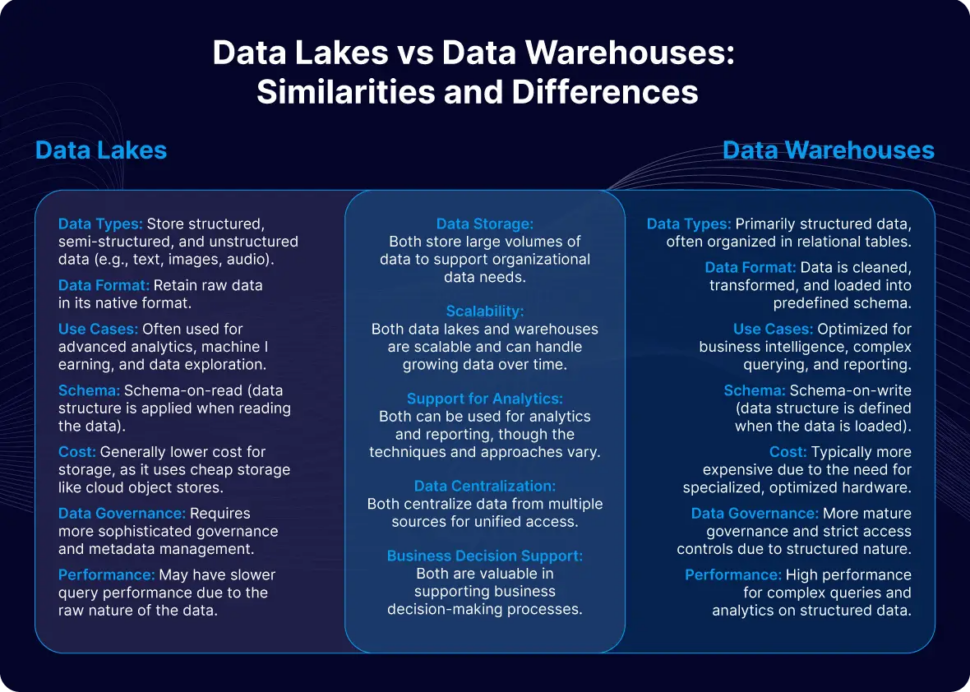
Data lakes and data warehouses serve different purposes; lakes store raw data for exploration, while warehouses store structured data for analysis.

Differences in Storage Format and Schema

The fundamental difference lies in how they handle data structure. A data warehouse stores data in a highly structured, predefined format (schema-on-write). Data is cleaned and modeled before being loaded, making it optimized for fast, reliable business intelligence and reporting.

A data lake, by contrast, is a vast repository that stores raw data in its native format, structured or unstructured (schema-on-read). The structure is applied when the data is pulled for analysis, offering immense flexibility for data science, machine learning, and exploratory analytics where the questions aren’t yet known.

Choosing the Right Architecture for Your Pipeline

It’s not necessarily a binary choice between one or the other; many modern architectures use both.

  • Use a data warehouse when your pipeline’s primary goal is to power standardized BI dashboards and reports with consistent, high-quality data.
  • Use a data lake when you need to store massive volumes of diverse data for future, undefined use cases, or to train machine learning models that require access to raw, unprocessed information.

A unified platform like Striim supports this hybrid reality. You can build a single data pipeline that delivers raw, real-time data to a data lake for archival and exploration, while simultaneously delivering structured, transformed data to a data warehouse to power critical business analytics.

Choosing Tools and Tech to Power Your Data Pipelines

The data ecosystem is crowded. Every tool claims to be “real-time” or “modern,” but few offer true end-to-end data management capabilities. Navigating this landscape requires understanding the different categories of tools and where they fit.

Popular Open-Source and Cloud-Native Tools

The modern data stack is filled with powerful, specialized tools. Apache Kafka is the de facto standard for streaming data pipelines, but it requires significant expertise to manage. Airflow is a popular choice for orchestrating complex batch workflows. Fivetran excels at simple, batch-based data ingestion (ELT), and dbt has become the go-to for performing transformations inside the data warehouse. While each is strong in its niche, they often need to be stitched together, creating the tool sprawl and complexity discussed earlier.

Real-Time CDC and Stream Processing

This is where Striim occupies a unique position. It is not just another workflow tool or a simple data mover; it is a unified, real-time integration platform. By combining enterprise-grade, log-based Change Data Capture (CDC) for ingestion, a powerful SQL-based stream processing engine for in-flight transformation, and seamless delivery to dozens of targets, Striim replaces the need for multiple disparate tools. It provides a single, cohesive solution for building, managing, and monitoring real-time data pipelines from end to end.

Why Choose Striim for Your Data Pipelines?

Striim delivers real-time data through Change Data Capture (CDC), ensuring sub-second latency from source to target. But it’s about more than just speed. It’s a complete, unified platform designed to solve the most complex data integration challenges without requiring you to stitch together a fragmented web of point solutions.

From a tactical perspective, Striim maps perfectly to the modern pipeline build sequence. It handles non-intrusive ingestion via log-based CDC, executes in-flight transformations using a robust SQL-based streaming ETL engine, and provides continuous monitoring and automated schema evolution before delivering data to major cloud targets. Instead of juggling separate tools for extraction, processing, and loading, Striim unifies the entire lifecycle. Global enterprises trust Striim to power their mission-critical data pipelines because of its:

  • Built-in, SQL-based Stream Processing: Filter, transform, and enrich data in-flight using a familiar SQL-based language.
  • Low-Code/No-Code Flow Designer: Accelerate development with a drag-and-drop UI and automated data pipelines, while still offering extensibility for complex scenarios.
  • Multi-Cloud Delivery: Seamlessly move data between on-premises systems and any major cloud platform.
  • Enterprise-Grade Reliability: Ensure data integrity with built-in failover, recovery, and exactly-once processing guarantees.

Ready to stop wrestling with brittle pipelines and start building real-time data solutions? Book a demo with one of our experts or start your free trial today to discover Striim for yourself.

FAQs

Why are data pipelines important for cloud migration?

Cloud migrations often stall or fail due to extensive downtime and data inconsistencies between legacy and new systems. Real-time data pipelines solve this by continuously replicating data from on-premises systems to the cloud without interrupting operational workloads. By using log-based Change Data Capture (CDC), a pipeline can sync a legacy database to a modern target like Snowflake, achieving a zero-downtime migration while keeping hybrid environments in perfect sync.

When should you use change data capture (CDC) instead of API polling or scheduled extracts?

You should use CDC whenever you need sub-second latency and cannot afford to impact the performance of your source databases. API polling and batch extracts place a heavy query load on operational systems and only capture data at scheduled intervals. CDC, conversely, reads database transaction logs invisibly, capturing inserts, updates, and deletes exactly as they happen, making it the only reliable choice for real-time analytics and operational alerting.

How do you handle schema changes without breaking downstream dashboards or apps?

Brittle pipelines break whenever a source database adds or drops a column, leading to missing data, failed loads, and corrupted downstream dashboards. To handle this gracefully, modern pipelines must employ automated schema evolution. This capability detects DDL (Data Definition Language) changes at the source in real-time and automatically propagates those changes to the target data warehouse, eliminating hours of manual pipeline repairs.

What are the main 3 stages in a data pipeline?

The three foundational stages of a data pipeline are ingestion (Extract), processing (Transform), and delivery (Load). Ingestion securely captures data from source systems, ideally through real-time methods like CDC. Processing cleanses, filters, joins, and enriches the data—often in-flight via streaming ETL—so it is formatted for business use. Finally, delivery routes the decision-ready data into a target destination, such as a cloud data warehouse, a data lake, or directly into an AI application.

What should you validate in-flight to prevent bad data from reaching your warehouse?

Validating data in-flight is critical to maintaining a single source of truth and preventing costly downstream errors. You should check for schema conformity, null values in primary keys, and formatting anomalies (like an incorrectly formatted email address). Additionally, AI-native pipelines should govern sensitive data on the fly, instantly masking Personally Identifiable Information (PII) before it lands in the warehouse to ensure analytics and AI models are built on safe, trusted data.

What are some key barriers to building a data pipeline?

The most common barriers are legacy system constraints, deeply ingrained data silos, and a lack of specialized engineering talent. Legacy databases often lack modern APIs and crash under the weight of heavy batch extraction queries. Furthermore, orchestrating different point tools for ingestion, transformation, and monitoring creates a fragmented architecture that is difficult to scale—requiring unified platforms to simplify the process and guarantee reliable data delivery.

What Is a Data Strategy? Components, Tips, and Use Cases for the Age of AI

The pressure to deliver value from data is on. Across every industry, the volume of data is exploding while the window for making critical decisions is shrinking. This pressure, intensified by the rise of artificial intelligence, has catalyzed business leaders to rethink their data strategy. Increasingly, they’re seeing legacy data architectures, once a source of strength, have become a significant obstacle to growth.

The traditional approach—relying on siloed systems and periodic, batch processing for business intelligence—no longer suffices. An AI model that needs to detect fraud or optimize a customer experience in milliseconds can’t wait for a weekly report.

This gap between the potential use of data and outdated data infrastructure risks putting the business at a competitive disadvantage, slowing down innovation and hindering AI-readiness.

That’s why having a coherent “data strategy” has become critical. But the term is often misunderstood. It’s not just a technical roadmap or an investment in new dashboards; it’s a blueprint that aligns your data initiatives with your core business goals.

This article will break down what a modern data strategy entails, helping you build a practical plan for a faster, more intelligent future.

What is a Data Strategy?

A data strategy is a cohesive plan that defines how you will capture, store, manage, share, and use your data to achieve your business objectives. 

It’s not just a technical document or a roadmap written by your CDO. A strong data strategy connects your data-related activities directly to measurable outcomes, like increasing revenue, improving operational efficiency, or creating better customer experiences.

Historically, data was used for periodic business intelligence—essentially a rear-view mirror look at what had already happened. Now, the focus has shifted to the future: a continuous flow of data insights that enables agile, forward-looking decision-making. In this environment, a robust data strategy has become essential. Without it, you simply cannot implement advanced, real-time data use cases like personalization or predictive analytics.

However, creating and executing a successful data strategy is fraught with challenges. Many companies struggle with:

  • Data silos: Information trapped in disconnected systems across different departments.
  • Outdated data infrastructure: Legacy, batch-based infrastructure that introduces costly delays.
  • Data volume and diversity: The sheer scale and variety of data from countless sources, from IoT sensors to customer applications.
  • Data governance and security: Ensuring data is accurate, compliant, and secure without creating bottlenecks.

Why You Need a Data Strategy (Even If You Think You Have One)

You might think you already have a data strategy. You’ve invested in dashboards, built reporting tools, or set up data pipelines. But without a central strategy, these efforts are at risk of becoming fragmented, reactive, or built on outdated assumptions. 

Today’s data landscape has fundamentally changed. The rise of AI, exploding data volumes, and the demand for real-time responsiveness require a more integrated, forward-looking approach. 

In other words, you’re not building a data strategy for now; you’re building for five years from now when real-time, AI-powered applications will be the expected norm from your customers. 

A modern data strategy brings clarity to your vision for data in a few key ways:

  • Faster, more confident decision-making by dramatically reducing data latency.
  • A unified view of the business that breaks down silos and creates a single source of truth.
  • AI and machine learning readiness powered by clean, timely, and trustworthy data.
  • Streamlined compliance and security with governance embedded directly into data flows.
  • Improved customer experiences through real-time personalization and responsiveness.

Without a strong strategy, you’ll run the risk of slow insights, duplicated efforts, and shadow IT processes. More importantly, you miss critical opportunities that depend on real-time action.

What to Build: The Key Components of a Data Strategy

While every company’s data strategy will look different, the most effective plans share common traits. Think of these as the essential pillars that provide the structure for execution and growth.

  • Data Architecture and Infrastructure: This is the foundation of your strategy. It defines the systems, tools, and technologies you will use to store, move, and process data. This includes your databases, data warehouses, data lakes, and the pipelines that connect them.
  • Data Governance and Security: These are the policies, rules, and standards that ensure your data is accurate, consistent, and secure. It answers critical questions: Who owns the data? Who can access it? How is it protected?
  • Data Integration and Interoperability: This component focuses on breaking down silos. It outlines how you will connect disparate data sources—from legacy systems to modern cloud apps—to create a unified view and enable seamless data flow.
  • Analytics and Insight Delivery: Data is only valuable if it leads to action. This part of your strategy defines how you will analyze data and deliver data insights to decision-makers, whether through dashboards, reports, or directly into AI-powered applications.
  • People and Process Enablement: Technology alone isn’t enough. This component addresses the human side of your data strategy, including upskilling your teams, fostering a thriving data culture, and defining the processes for data management.
  • Performance and Success Metrics: To ensure your strategy is delivering value, you must define how you will measure success. This involves setting clear KPIs that align with your business objectives, such as reducing data latency, improving decision speed, or increasing revenue from data-driven products.

How to Build it: The Core Pillars of a Future-Ready Data Strategy

The components represent what you need to build, but the pillars below illustrate how you need to think. They are the principles that ensure your data strategy is not only relevant today but resilient and adaptable for the future.

Strategic Alignment: Drive Tangible Business Value

Think of this pillar like a “so what” test for your data. Your data initiatives should tie directly to business outcomes. Instead of collecting data for its own sake, every project should answer the question: “How will this help us drive revenue, reduce costs, or improve our customer experience?” This alignment ensures that your investments in data return measurable returns.

Unified Data Ecosystems: Break Down Data Silos

A fragmented data landscape leads to a fragmented view of your business. The goal is to create a unified ecosystem where data flows seamlessly between systems. This doesn’t necessarily mean storing everything in one place, but it does require a real-time integration layer that connects your databases, cloud applications, and analytics tools into a cohesive whole.

AI and ML Readiness: Fuel Intelligent Operations with High-Quality Data

AI and machine learning models are only as strong as the data they’re fed. A future-ready strategy prioritizes the delivery of clean, timely, and well-structured data to power these intelligent systems. This means moving beyond slow, batch-based processes and architecting for data quality, ensuring a continuous flow of reliable data that can fuel real-time use cases.

Robust Governance and Trust: Balance Innovation with Security

Data governance isn’t a roadblock; it’s an enabler of trust. A modern approach embeds security, compliance, and ethical considerations directly into your data pipelines. By automating data governance, you can empower your teams to innovate with confidence, knowing that robust guardrails are in place to protect sensitive information and ensure regulatory compliance.

Data Culture and Literacy: Empower All Teams with Accessible Data

The most powerful data strategy is one that is embraced by all business units, not just the data team. This requires a cultural shift toward democratizing data, making it accessible and understandable for employees across all functions. Investing in data literacy programs and self-service analytics tools empowers your entire organization to make smarter, data-informed decisions.

How to Activate Your Data Strategy (Tips and Best Practices)

Creating the data strategy is the (relatively) easy part. The real work, and subsequent value, comes when you put it into practice. But activating your data strategy is no easy feat. Companies often get stalled at this stage by data access delays, persistent silos, and difficulty getting buy-in from stakeholders.

Here are some best practices to help you move from blueprint to real-world impact.

Break Down Data Silos with Real-Time Integration

Integration isn’t just about connecting systems—it’s about letting them communicate continuously. Use real-time data integration to ensure that when data is updated in one system (like a CRM), it’s instantly available and reflected in others (like your analytics platform or marketing automation tool). This creates a single, consistent view of your operations.

Architect for Continuous Data Flow and Scalability

Remember: Your data strategy isn’t for now, it’s for (at least) five years from now. Instead of relying on brittle, point-to-point connections that break under pressure, look to build scalable pipelines that can handle growing data volumes and support new use cases without constant re-engineering. Think of it as building a connected data superhighway, not a series of country roads.

Prioritize Seamless Connectivity Across Systems

Your data strategy should make it easy to connect new tools and data sources. By using a flexible integration platform with a wide range of pre-built connectors, you can reduce the timelines and effort involved in bringing new data online, allowing your teams to focus on building a strategic asset, not on building custom code.

Define KPIs That Reflect Real-Time Value

Measure what matters. While historical data analysis is important, focus on analytics that track real-time performance, such as customer engagement in the last hour, current inventory levels, or the immediate success of a marketing campaign. This shifts the focus from “what happened?” to “what is happening right now?” to influence current business decisions.

Apply Real-Time Data to Drive Tangible Business Outcomes

The ultimate goal is to use fresh data to make an impact, so your data strategy reflects your wider business strategy. You can start small, perhaps with just one high-value use case or business process, such as dynamic pricing in e-commerce, fraud detection in financial services, or predictive maintenance in manufacturing. A successful pilot project can demonstrate the power of real-time data and build momentum for broader adoption across the organization.

How Continuous Data Intelligence is Reshaping Strategic Possibilities

A strong data strategy doesn’t just improve current processes. It unlocks entirely new strategic possibilities. When you move from batch-based data collection to continuous, real-time intelligence, you fundamentally change how your business can innovate, and what you can deliver for your customers.

Immediate data availability transforms raw data into actionable, AI-ready insights the moment it’s created. This is the engine behind the next generation of intelligent applications. Consider its potential impact across different industries:

  • Dynamic Pricing in E-commerce: Instead of setting prices based on historical sales data, you can adjust them in real time based on current demand, competitor pricing, and even local weather patterns, maximizing revenue and inventory turnover.
  • Fraud Detection in Financial Services: By analyzing transaction data as it happens, you can identify and block fraudulent activity in milliseconds, protecting your customers and your bottom line before the damage is done.
  • Predictive Maintenance in Manufacturing: IoT sensors on machinery can stream operational data continuously. By analyzing this data in real time, you can predict equipment failures before they occur, scheduling maintenance proactively to avoid costly downtime.

Build Smarter, Faster, Real-Time Data Strategies with Striim

Activating a modern data strategy requires a platform built for real-time intelligence at scale. Striim helps leading organizations turn their strategic vision into an operational reality.

With Striim, you can:

  • Process data continuously and in-flight to reduce latency and power instant insights.
  • Integrate data seamlessly with 100+ out-of-the-box connectors for clouds, databases, applications, and more.
  • Build flexible, low-latency pipelines with streaming SQL for powerful and resilient data transformation.
  • Scale with confidence on an enterprise-grade, distributed architecture designed for high availability.
  • Maintain full control of your data with no vendor lock-in and complete cloud optionality.


Ready to put your data strategy in motion? Book a demo with our team or start your free trial today.

Top Confluent Alternatives

Confluent

Confluent has established itself as a prominent name in the world of real-time data. Built by the original creators of Apache Kafka, Confluent provides a data streaming platform designed to help businesses harness the continuous flow of information from their applications, websites, and systems.

The primary appeal of Confluent lies in its promise to tame the complexity of Apache Kafka. Raw Kafka is a powerful, open-source technology, but it demands deep technical expertise to deploy effectively.

While Confluent provides a path to adopting data streaming, it is not a one-size-fits-all solution. Many organizations find that the operational overhead, opaque pricing models, and a fragmented ecosystem of necessary add-ons create significant challenges down the line. As the need for real-time data becomes more critical, businesses are increasingly looking for more user-friendly and cost-effective alternatives for their enterprise.

Where Confluent Falls Short as a Data Streaming Solution

Despite its market position, Confluent’s platform presents several challenges that can hinder an organization’s ability to implement a truly seamless and cost-effective data streaming strategy. These shortcomings often lead businesses to seek out more integrated and transparent alternatives.

  • Requires deep Kafka expertise and complex setup: Operating and scaling Confluent, particularly in on-premise or non-cloud-native environments, demands significant technical know-how of Kafka’s intricate architecture.
  • Lacks native CDC and advanced transformation capabilities: Users must integrate separate tools like Debezium for Change Data Capture (CDC) and Apache Flink for complex transformations, which increases latency, cost, and operational overhead.
  • Opaque, usage-based pricing can drive up costs: The resource-based pricing model often leads to unexpectedly high costs, especially for high-throughput workloads or use cases requiring long-term data retention.
  • Limited out-of-the-box observability: Confluent’s built-in monitoring features are minimal. Achieving real-time, end-to-end visibility across data pipelines requires custom development or dedicated, third-party observability tools.
  • Connector access may be restricted or costly: Many essential connectors for popular enterprise systems are gated behind premium tiers, making full integration more difficult and expensive to achieve.

Alternative Solutions to Confluent for Data Streaming

Striim

Striim

Striim is a unified, real-time data integration and streaming platform that offers an all-in-one alternative to the fragmented Confluent ecosystem. Recognized on platforms like Gartner Peer Insights, businesses choose Striim to simplify the creation of smart data pipelines. It enables them to stream, process, and deliver data from enterprise databases, cloud applications, and log files to virtually any target in real time. This allows for rapid development of real-time analytics, AI and ML applications, and cloud integration initiatives without the steep learning curve of raw Kafka.

Ready to see Striim in action? Book a demo or start a free trial.

Striim’s Pros and Cons

Pros:

  • All-in-One Platform: Combines data integration, streaming, and processing in a single solution.
  • Native, Low-Impact CDC: Built-in Change Data Capture from enterprise databases without requiring third-party tools.
  • Powerful In-Flight Processing: Enables complex transformations and enrichments on data in motion—before it lands in its destination.
  • Performance and Scale: Engineered for high-throughput, low-latency workloads.
  • Broad Connectivity: Offers hundreds of pre-built connectors for a wide range of data sources and targets.
  • Enterprise-Ready: Includes built-in high availability, security, and governance features.
  • Hybrid/Multi-Cloud Native: Deploys consistently across on-premises, cloud, and edge environments.

Cons:

  • Advanced Feature Learning Curve: While the platform is overwhelmingly user-friendly, mastering its most advanced transformation and deployment capabilities requires some learning. To help, Striim offers an expansive academy where users can get to grips with the platform and its core capabilities, with videos, quizzes, and interactive learning modules. 
  • Not a pure message broker: While Striims powers real-time streaming to and from Kafka, its primary focus is on end-to-end integration and processing data, not just queuing like raw Kafka.

Top Features of Striim

  • Built-in Change Data Capture (CDC): Enables real-time data replication from enterprise databases without third-party tools—unlike Confluent’s reliance on Debezium.
  • Prebuilt connectors for enterprise and cloud systems: Simplifies integration with databases, warehouses, cloud storage, and messaging platforms—reducing setup time and complexity.
  • Hybrid and multi-cloud support: Deploys easily across on-prem, cloud, or edge environments, making it ideal for organizations with complex infrastructure.
  • Intuitive UI and visual pipeline designer: Lowers the barrier to entry for data teams by eliminating the need to manage Kafka internals directly.
  • Sub-second latency with built-in monitoring: Ensures fast, reliable data delivery with end-to-end visibility—no need to stitch together external monitoring tools.

Striim: A Unified Platform for Real-Time Data Integration

  • Confluent relies on third-party tools like Debezium for CDC, adding setup time and operational overhead. Striim includes native CDC connectors as part of an all-in-one platform, making it faster and easier to stream data from enterprise databases.
  • Kafka-based pipelines often require custom code or external systems for transformation and filtering. Striim handles in-flight transformations natively, enabling real-time processing without added complexity.
  • Achieving reliable, lossless delivery in Confluent often demands deep tuning and custom monitoring. Striim offers built-in delivery guarantees, observability, and alerting, giving teams end-to-end visibility and control from a single interface.

How Striim Simplifies Deployment Across Multi-Cloud Environments

  • Deploying and managing Confluent outside of Confluent Cloud can be resource-intensive and complex. Striim is designed for multi-cloud environments, offering a consistent, low-overhead experience everywhere.
  • Confluent often demands deep Kafka expertise to manage topics, brokers, and schema registries. Striim offers a visual UI, integrated monitoring, and fewer moving parts, so data teams can move faster without needing deep knowledge of Kafka.
  • Many key Confluent connectors are gated behind premium tiers or require manual setup. Striim includes a wide range of prebuilt, production-ready connectors, accelerating integration with critical systems.
For a deeper dive into modern data integration, download the eBook: How to Choose the Right CDC Solution.

Kafka

Apache Kafka

Apache Kafka is the open-source distributed event streaming platform that Confluent is built upon. It is a mature, highly scalable, and durable publish-subscribe messaging system. Businesses choose raw Apache Kafka when they have deep engineering expertise and require maximum control over their infrastructure. You can find community and professional reviews on sites like G2.

Pros and Cons

  • Pros: Highly scalable and fault-tolerant, massive open-source community, unparalleled performance for high-throughput scenarios, and complete vendor neutrality.
  • Cons: Extremely complex to set up, manage, and scale without a dedicated team; lacks built-in tools for management, monitoring, and security; requires integrating other systems for schema management and connectors.

Top Features

  • High-throughput, low-latency message delivery.
  • Durable and replicated storage of event streams.
  • A rich ecosystem of client libraries for various programming languages.
  • Scalable, distributed architecture that can handle trillions of events per day.
  • The Kafka Connect framework for building and running reusable connectors.

Redpanda

Redpanda

Redpanda is a modern streaming data platform that is API-compatible with Kafka. It positions itself as a simpler, more performant, and more cost-effective alternative by being written in C++ and engineered to be self-sufficient without requiring Zookeeper. Small and medium-sized businesses opt for Redpanda to get Kafka-like capabilities with lower operational overhead, reduced latency, and a smaller resource footprint. This makes it suitable for both performance-critical applications and resource-constrained environments. See user reviews on TrustRadius.

Pros and Cons

  • Pros: Kafka API compatibility, no Zookeeper dependency simplifies architecture, lower tail latencies, and improved resource efficiency.
  • Cons: Redpanda’s ecosystem is young compared to Kafka, some advanced Kafka features may not be fully mature, and being a commercial open-source product, some features are enterprise-only.

Top Features

  • A single-binary deployment model for simplicity.
  • Built-in schema registry and HTTP proxy.
  • Data-oriented architecture optimized for modern hardware (NVMe, multi-core CPUs).
  • Tiered storage for cost-effective, long-term data retention.
  • High performance with a thread-per-core model.

Amazon MSK

Amazon MSK (Managed Streaming for Apache Kafka)

Amazon MSK is a fully managed AWS service that makes it easy to build and run applications that use Apache Kafka to process streaming data. It manages the provisioning, configuration, and maintenance of Kafka clusters, including handling tasks like patching and failure recovery. Businesses choose MSK to offload the operational burden of managing Kafka to AWS, allowing them to focus on application development while leveraging deep integration with other AWS services.

Pros and Cons

  • Pros: Fully managed by AWS, simplified cluster provisioning and scaling, seamless integration with the AWS ecosystem (S3, Lambda, Kinesis), and enterprise-grade security features.
  • Cons: Can lead to cloud vendor lock-in with AWS, pricing can be complex to predict and potentially high, and offers less control over the underlying Kafka configuration compared to a self-managed setup.

Top Features

  • Automated provisioning and management of Apache Kafka clusters.
  • Multi-AZ replication for high availability.
  • Integration with AWS Identity and Access Management (IAM) for security.
  • Built-in monitoring via Amazon CloudWatch.
  • Serverless tier (MSK Serverless) that automatically provisions and scales resources.

Google Cloud Pub/Sub

Google Cloud Pub/Sub

Google Cloud Pub/Sub is a serverless, global messaging service. It allows for simple and reliable communication between independent applications. Pub/Sub is known for asynchronous workflows and event-driven architectures within the Google Cloud ecosystem. It excels at decoupling services and ingesting event data at scale.

Pros and Cons

  • Pros: Fully serverless architecture, scales automatically, provides global message delivery, and integrates deeply with Google Cloud services.
  • Cons: It is not Kafka-compatible, which can be a hurdle for teams with existing Kafka tools. It also locks into Google Cloud’s ecosystem.

Top Features

  • Push and pull message delivery.
  • At-least-once delivery guarantee.
  • Filtering messages based on attributes.
  • Global availability with low latency.
  • Integration with IAM and other Google Cloud security services.

Azure Event Hubs

Azure Event Hubs

Azure Event Hubs is a big data streaming platform and event ingestion service. Managed by Microsoft Azure, it can stream millions of events per second. Companies invested in the Azure ecosystem leverage Event Hubs to build real-time analytics pipelines, especially for application telemetry and device data from IoT.

Pros and Cons

  • Pros: Massively scalable, integrates with the Azure stack, and offers a Kafka-compatible API endpoint.
  • Cons: Primarily designed for ingestion; complex processing often requires other Azure services. It also results in Azure vendor lock-in.

Top Features

  • A premium tier offering a Kafka-compatible endpoint.
  • Dynamic scaling with Auto-inflate.
  • Capture events directly to Azure Blob Storage or Data Lake Storage.
  • Geo-disaster recovery.
  • Secure access through Azure Active Directory and Managed Service Identity.

Other Popular Confluent Alternatives

Aiven

Aiven

Aiven provides managed services for popular open-source data technologies, including a robust Apache Kafka offering. Businesses use Aiven to deploy production-grade fully-managed Kafka clusters on their preferred cloud provider (AWS, GCP, Azure) without handling the operational overhead. It’s ideal for teams who want a reliable, hosted Kafka solution with strong support.

Pros and Cons

  • Pros: Multi-cloud portability, fully managed service, and bundles other tools like PostgreSQL and OpenSearch.
  • Cons: Can be more costly than self-management and offers less granular control over Kafka configurations.

Tibco Messaging

Tibco Messaging

TIBCO Messaging offers a suite of high-performance messaging products for enterprise-level data distribution. It’s chosen by large organizations, often with existing TIBCO investments, for its mission-critical reliability and performance in complex systems. It is not a pure Kafka solution but can integrate with it.

Pros and Cons

  • Pros: Enterprise-grade security and reliability, part of a broad integration ecosystem, and includes strong commercial support.
  • Cons: Complex, can be expensive, and represents a more traditional approach to messaging compared to cloud-native platforms.

Strimzi

Strimzi

Strimzi is an open-source project that simplifies running Apache Kafka on Kubernetes. It uses Kubernetes Operators to automate the deployment, management, and configuration of a Kafka cluster. Strimzi is for organizations committed to a cloud-native, Kubernetes-first strategy that want to manage Kafka declaratively.

Pros and Cons

  • Pros: Kubernetes-native automation, strong community support, and simplifies Kafka operations on K8s.
  • Cons: Requires significant Kubernetes expertise and is a self-managed solution, meaning you are responsible for the underlying infrastructure.

Choosing the Right Streaming Platform 

The data streaming landscape is diverse with a host of powerful alternatives to Confluent. The right choice will depend on your organization’s goals, existing infrastructure, and technical expertise. Cloud-native platforms like Pub/Sub and Event Hubs offer simplicity at the cost of vendor lock-in. While managed Kafka providers like Aiven and Amazon MSK reduce operational burden, but can limit control. Modern challengers like Redpanda and WarpStream promise a more efficient Kafka experience.

For organizations seeking to move beyond simply managing a message broker, a unified platform is often the most direct path to value. Instead of stitching together separate tools for ingestion, transformation, and monitoring, an all-in-one solution like Striim accelerates the delivery of real-time, actionable insights, so you can act on your data the instant it’s born.

Ready to see how a unified approach can simplify your data architecture? Book a personalized demo of Striim today.

Retrieval as a Tool, Not a Destination – with Clare from AWS

In this episode of What’s New in Data, we’re joined by Clare from AWS to dig into the evolving role of retrieval in modern AI systems. Clare unpacks why retrieval shouldn’t just be thought of as a technique to get documents — it’s a strategic tool that can unlock smarter, more adaptive agents. We also explore how AWS is thinking about orchestration, what actually counts as “reasoning,” and why the real power lies in combining structured memory with real-time context. If you’re building with agents, this one’s packed with insight.

Get started with Strands Agents: https://github.com/strands-agents

Follow Clare on LinkedIn

2025 GigaOm Radar for Streaming Data Platforms

As real-time data becomes foundational to modern analytics and AI, organizations need streaming data platforms that go beyond basic ingestion—they must be intelligent, scalable, and ready for edge and enterprise deployment.

In this complimentary copy of the 2025 GigaOm Radar for Streaming Data Platforms, you’ll discover why Striim is proudly named a Leader and Outperformer. Uncover:

  • The key selection criteria used—including performance, SQL usability, data quality, edge-readiness, and ML integration.
  • How GigaOm evaluates innovation and execution with an emphasis on real-time analytics and architectural flexibility.
  • Why Striim stands out for its vector embeddings, real-time ML, and hybrid deployment flexibility.
Back to top