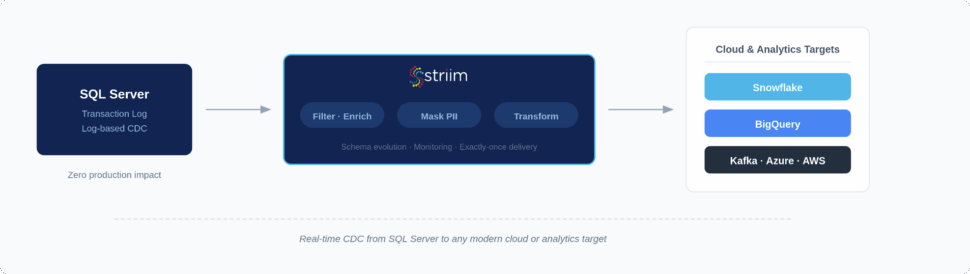
SQL Server to BigQuery: Real-Time Replication Guide

SQL Server has developed a reputation as the backbone of enterprise operational data. But when it comes to analytics, operational systems weren’t designed for complex queries or transformations. To build advanced analytics and AI applications, enterprises are increasingly turning to Google BigQuery.

Ripping and replacing your legacy operational databases isn’t just risky; it’s highly disruptive. Instead of migrating away from SQL Server entirely, data leaders increasingly want ongoing, continuous integration between their operational stores and their cloud analytics environments.

The future of analytics and machine learning hinges on fresh, low-latency data. If your BigQuery dashboards and AI models rely on data that was batched overnight, you aren’t making proactive decisions, you’re just documenting history. To power modern, event-driven applications, enterprises need real-time, cloud-native pipelines.

This guide covers the why, the how, and the essential best practices of replicating data from SQL Server to BigQuery without disrupting your production systems.

Key Takeaways

  • Integrate, don’t just migrate: Enterprises choose to integrate SQL Server with BigQuery to extend the life of their operational systems while unlocking cloud-scale analytics, AI, and machine learning.
  • Real-time is the modern standard: While there are multiple ways to move data into BigQuery—from manual exports to scheduled ETL—real-time replication using Change Data Capture (CDC) is the most effective approach for enterprises demanding low latency and high resilience.
  • Architecture matters: Following established best practices and leveraging enterprise-grade platforms ensures your SQL Server to BigQuery pipelines remain reliable, secure, and scalable as your data volumes grow.

Why Integrate SQL Server with BigQuery

Modernizing your enterprise data architecture doesn’t have to mean tearing down the foundation. For many organizations, SQL Server is deeply embedded in daily operations, powering ERPs, CRMs, and custom applications consistently for years.

Integrating SQL Server with BigQuery is an ideal way to extend the life and value of your database while simultaneously unlocking BigQuery’s massive scale for analytics, AI, and machine learning.
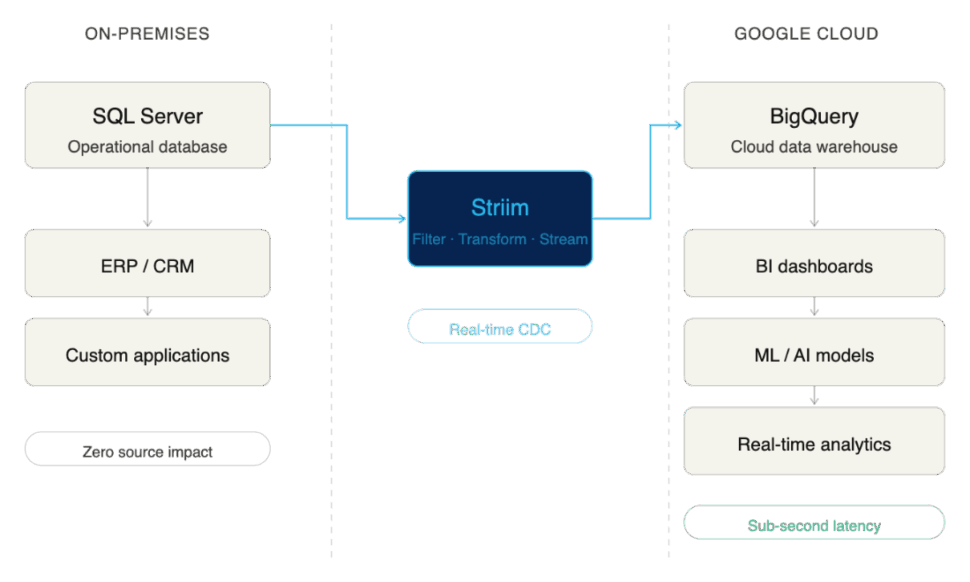
Here are the primary business drivers compelling enterprises to integrate SQL Server with BigQuery:

Unlock Real-Time Analytics Without Replacing SQL Server

Migrating away from a legacy operational database is often a multi-year, high-risk endeavor. By choosing integration over migration, enterprises get the “reward” of modern analytics in a fraction of the time, without disrupting the business. You land with the best of both worlds: the operational stability of SQL Server and the elastic, real-time analytical power of BigQuery.

Support Business Intelligence and Machine Learning in BigQuery

SQL Server is adept at handling high-volume transactional workloads (OLTP). However, it wasn’t built to train AI models or run complex, historical business intelligence queries (OLAP) without severe performance degradation. BigQuery is purpose-built for this exact scale. By replicating your SQL Server data to BigQuery, you give your data science and BI teams the context-rich, unified environment they need to do their best work without bogging down your production databases.

Reduce Reliance on Batch ETL Jobs

Historically, moving data from SQL Server to a data warehouse meant relying on scheduled, batch ETL (Extract, Transform, Load) jobs that ran overnight. But a fast-paced enterprise can’t rely on stale data. Integrating these systems modernizes your pipeline, allowing you to move away from rigid batch windows and toward continuous, real-time data flows.

Common Approaches to SQL Server-BigQuery Integration

Moving data from SQL Server to BigQuery is not a one-size-fits-all endeavor. The method you choose fundamentally impacts the freshness of your data, the strain on your source systems, and the ongoing operational overhead for your data engineering team.

While there are multiple ways to connect the two systems, they generally fall into three categories. Here is a quick comparison:

Integration Method Integration Method Integration Method Integration Method Integration Method Integration Method Integration Method
Batch / Manual Days / Hours Low High (Manual intervention) Very Low Low upfront, high hidden costs Poor. Best for one-off ad-hoc exports.
ETL / ELT Hours / Minutes Medium Medium (Managing schedules/scripts) Medium Moderate Fair. Good for legacy reporting, bad for real-time AI.
Real-Time CDC Sub-second Medium to High (Depending on tool) Low (Fully automated, continuous) Very High Highly efficient at scale Excellent. The gold standard for modern data architectures.

Let’s break down these approaches and explore their pros and cons.

Batch Exports and Manual Jobs

The most basic method of integration is the manual export. This usually involves running a query on SQL Server, dumping the results into a flat file (like a CSV or JSON), moving that file to Google Cloud Storage, and finally loading it into BigQuery using the bq command-line tool or console.

  • Pros: It’s incredibly simple to understand and requires virtually no specialized infrastructure.
  • Cons: Painfully slow, highly prone to human error, and completely unscalable for enterprise workloads. This method can’t handle schema changes, and by the time the data lands in BigQuery, it is already stale.

ETL and ELT Pipelines

Extract, Transform, Load (ETL) and Extract, Load, Transform (ELT) have been the industry standard for decades. Using custom scripts or platforms like Google Cloud Data Fusion or SQL Server Integration Services (SSIS), data engineers automate the extraction of data from SQL Server, apply necessary transformations, and load it into BigQuery.

  • Pros: Highly automated and capable of handling complex data transformations before or after the data hits BigQuery.
  • Cons: ETL and ELT pipelines traditionally run on schedules (e.g., nightly or hourly). These frequent, heavy queries can put significant performance strain on the source SQL Server database. More importantly, because they rely on batch windows, they cannot deliver the true real-time data required for modern, event-driven business operations.

Real-Time Replication with Change Data Capture (CDC)

For modern enterprises, real-time replication powered by Change Data Capture (CDC) has emerged as the clear gold standard.

Instead of querying the database directly for changes, CDC works by reading SQL Server’s transaction logs. As inserts, updates, and deletes happen in the source system, CDC captures those discrete events and streams them continuously into BigQuery.

  • Pros: CDC delivers sub-second latency, ensuring BigQuery is an always-accurate reflection of your operational data. Because it reads logs rather than querying tables, it exerts almost zero impact on SQL Server’s production performance. It is continuous, resilient, and built to scale alongside your business.
  • Cons: Building a CDC pipeline from scratch is highly complex and requires deep engineering expertise to maintain transaction consistency and handle schema evolution. (This is why enterprises typically rely on purpose-built CDC integration platforms rather than DIY solutions).

Challenges of SQL Server to BigQuery Replication

While continuous CDC replication is the gold standard, executing it across enterprise environments comes with its own set of complexities.

Here are some of the primary challenges enterprises face when connecting SQL Server to BigQuery, and the risks associated with failing to address them.

Managing Schema and Data Type Differences

SQL Server and Google BigQuery use fundamentally different architectures and data types. For example, SQL Server’s DATETIME2 or UNIQUEIDENTIFIER types do not have exact 1:1 equivalents in BigQuery without transformation.

If your replication method doesn’t carefully map and convert these schema differences on the fly, you risk severe business consequences. Data can be truncated, rounding errors can occur in financial figures, or records might be rejected by BigQuery entirely. Furthermore, when upstream SQL Server schemas change (e.g., a developer adds a new column to a production table), fragile pipelines break, causing damaging downtime.

Handling High-Volume Transactions at Scale

Enterprise operational databases process millions of rows an hour, often experiencing massive spikes in volume during peak business hours.

Your replication pipeline must be able to handle this throughput using high parallelism without overwhelming the network or suffocating BigQuery’s ingestion APIs. If your architecture bottlenecks during a traffic spike, latency increases exponentially. What should have been real-time analytics suddenly becomes hours old, resulting in stale insights exactly when the business needs them most.

Ensuring Consistency and Accuracy Across Systems

Yes, replication is about moving new data (INSERT statements). But beyond that, to maintain an accurate analytical environment, your pipeline must capture and precisely replicate every UPDATE and DELETE exactly as they occurred in the source database.

Transaction boundaries must be respected so that partial transactions aren’t analyzed before they are complete. If your pipeline drops events, applies them out of order, or fails to properly hard-delete removed records, your target database will drift from your source. Enterprises require exact match confidence between SQL Server and BigQuery; without it, analytical models fail and compliance audits become a nightmare.

Balancing Latency, Performance, and Cost

Achieving true, sub-second latency is immensely powerful, but if managed poorly, it can cause your cloud costs to spiral. For example, streaming every single micro-transaction individually into BigQuery can trigger higher ingestion fees compared to micro-batching.

Enterprises need to balance speed with efficiency. They need the flexibility to stream critical operational events in real-time, while smartly batching less time-sensitive data to optimize Google Cloud costs.

Because of the deep complexity of schema evolution, transaction consistency, and cost-optimization at scale, relying on basic scripts or generic ETL tools often leads to failure. Not every tool is built to solve these specific challenges, which is why enterprises must carefully evaluate their replication architecture.

Best Practices for Enterprise-Grade Replication

Building a custom DIY pipeline might work for a single, low-volume table. But enterprise replication is a different beast entirely. Many organizations learn the hard way that missing key architectural elements leads to failed projects, spiraling cloud costs, or broken dashboards.

To ensure success, your replication strategy should be built on proven best practices. These also serve as excellent criteria when evaluating an enterprise-grade integration platform.

Start With Initial Load, Then Enable Continuous Replication

The standard architectural pattern for replication requires two phases: first, you must perform a bulk initial load of all historical data. Once the target table is seeded, the pipeline must seamlessly transition to CDC to keep the target synced with new transactions. Doing this manually is notoriously difficult and often results in downtime or lost data during the cutover.

  • How Striim helps: Striim supports this exact pattern out of the box. It handles the heavy lifting of the one-time historical load and seamlessly transitions into real-time CDC replication, ensuring zero downtime and zero data loss.

Design for High Availability and Failover

Enterprises cannot afford replication downtime. If a network connection blips or a server restarts, your pipeline shouldn’t crash and require a data engineer to manually intervene at 2:00 AM. Your architecture requires built-in fault tolerance, strict checkpoints, and automated retries to keep pipelines inherently resilient.

  • How Striim helps: Striim pipelines are architected for high availability. With features like exactly-once processing (E1P) and automatic state recovery, Striim ensures your pipelines meet rigorous business continuity needs without requiring custom engineering.

Secure Pipelines to Meet Compliance Standards

Moving operational data means you are inevitably moving sensitive information. Whether it’s PII, financial records, or healthcare data, regulatory expectations like HIPAA, GDPR, and SOC2 are non-negotiable. Your replication architecture must guarantee end-to-end encryption, granular access controls, and strict auditability.

  • How Striim helps: Striim provides enterprise-grade security features by default, so compliance isn’t an afterthought. Data is encrypted in flight, and built-in governance features ensure that sensitive customer data can be detected and masked before it ever enters BigQuery.

Monitor, Alert, and Tune for Performance

“Set and forget” is a dangerous mentality for enterprise data infrastructure. To guarantee service-level agreements (SLAs) and maintain operational efficiency, you need continuous observability. This means actively tracking metrics, retaining logs, and configuring alerts so your team is proactively notified of latency spikes or throughput drops.

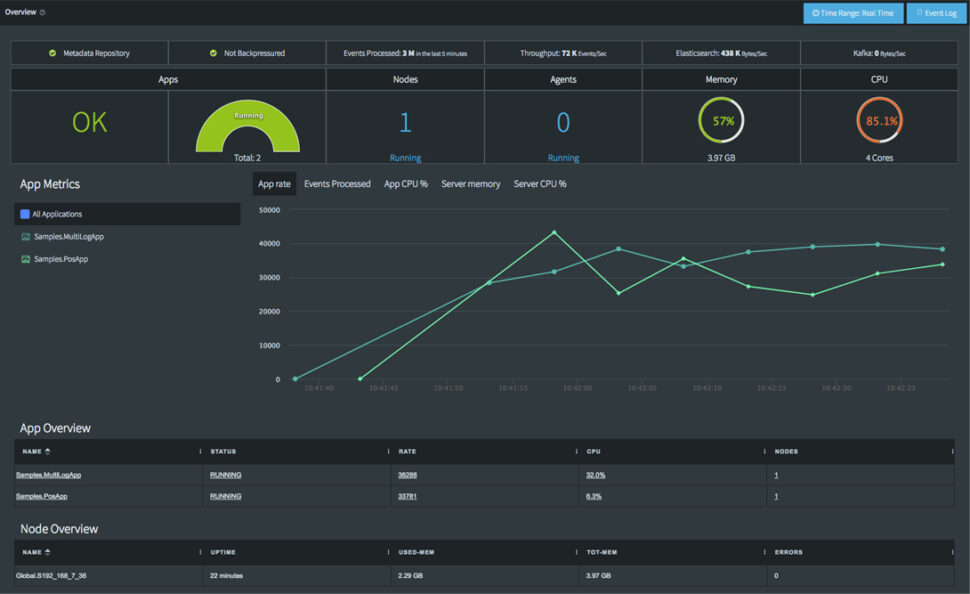
  • How Striim helps: Striim features a comprehensive, real-time monitoring dashboard. It makes it effortless for engineering teams to track pipeline health, monitor sub-second latency, and visualize throughput in one centralized place.

Optimize BigQuery Usage for Cost Efficiency

Real-time replication is valuable, but inefficient streaming can drive up BigQuery compute and ingestion costs unnecessarily. To maintain cost efficiency, data engineering teams should leverage BigQuery best practices like table partitioning and clustering, while intelligently tuning batch sizes based on the urgency of the data.

  • How Striim helps: Striim’s pre-built BigQuery writer includes highly configurable write strategies. Teams can easily toggle between continuous streaming and micro-batching, helping enterprises perfectly balance high-performance requirements with cloud cost efficiency.

Why Enterprises Choose Striim for SQL Server to BigQuery Integration

Striim is purpose-built to solve the complexities of enterprise data integration. By leveraging Striim, organizations can reliably replicate SQL Server data into Google BigQuery in real time, securely, and at scale. This allows data leaders to confidently modernize their analytics stack without disrupting the critical operational systems their business relies on.

Striim delivers on this promise through a robust, enterprise-grade feature set:

  • Log-Based CDC for SQL Server: Striim reads directly from SQL Server transaction logs, capturing inserts, updates, and deletes with sub-second latency while exerting virtually zero impact on your production database performance.
  • Configurable BigQuery Writer: Optimize for both speed and cost. Striim’s pre-built BigQuery target allows teams to configure precise batching or streaming modes, ensuring efficient resource utilization in Google Cloud.
  • Inherent High Availability: Designed for mission-critical workloads, Striim includes automated failover, exactly-once processing (E1P), and state recovery to ensure absolute business continuity during replication.
  • Enterprise-Grade Security: Compliance is built-in, not bolted on. Striim ensures data is protected with end-to-end encryption, granular role-based access controls, and features designed to meet strict HIPAA, GDPR, and SOC2 standards.
  • Comprehensive Real-Time Monitoring: Data engineering teams are empowered by unified dashboards that track replication health, monitor latency metrics, aggregate logs, and trigger alerts to ensure you consistently meet stringent internal SLAs.
  • Accessible Yet Advanced Configuration: Striim pairs a rapid, no-code, drag-and-drop user interface for quick pipeline creation with advanced, code-level configuration options to solve the most complex enterprise data transformation use cases.

Ready to break down your data silos? Try Striim for free or book a demo today to see real-time replication in action.

FAQs

What are the cost considerations when replicating SQL Server data into BigQuery?

The primary costs involve the compute resources required for extraction (usually minimal with log-based CDC) and the ingestion/storage fees on the BigQuery side. Streaming data record-by-record into BigQuery can trigger higher streaming insert fees. To optimize costs, enterprises should use a replication tool that allows for intelligent micro-batching and leverages BigQuery partitioning strategies.

How do enterprises keep replication secure and compliant?

To maintain compliance with frameworks like SOC2 or HIPAA, enterprises must ensure data is encrypted both in transit and at rest during the replication process. It is also critical to use platforms that offer role-based access control (RBAC) and data masking capabilities, ensuring sensitive PII is obscured before it ever lands in the cloud data warehouse.

How does replication impact day-to-day operations in SQL Server?

If you use traditional query-based ETL methods, replication can cause significant performance degradation on the SQL Server, slowing down the applications that rely on it. However, modern Change Data Capture (CDC) replication reads the database’s transaction logs rather than querying the tables directly. This approach exerts virtually zero impact on the source database, keeping day-to-day operations running smoothly.

What is the best way to scale SQL Server to BigQuery replication as data volumes grow?

The most effective way to scale is by utilizing a distributed, cloud-native integration platform designed for high parallelism. As transaction volumes from SQL Server spike, the replication architecture must be able to dynamically allocate compute resources to process the stream without bottlenecking. Ensuring your target writer is optimized for BigQuery’s bulk ingestion APIs is also crucial for handling massive growth.

How do I replicate SQL Server to BigQuery using Striim?

Replicating data with Striim is designed to be straightforward. You start by configuring SQL Server as your source using Striim’s CDC reader, which manages the initial historical load. Next, you select BigQuery as your target, mapping your schemas and applying any necessary in-flight transformations via the drag-and-drop UI. Finally, you deploy the pipeline, and Striim seamlessly transitions from the initial load into continuous, real-time replication.

What makes Striim different from other SQL Server to BigQuery replication tools?

Unlike basic data movement scripts or legacy batch ETL tools, Striim is a unified integration and intelligence platform built specifically for real-time, enterprise-grade workloads. It goes beyond simple replication by offering in-flight data processing, exactly-once processing (E1P) guarantees, and built-in AI governance capabilities. This ensures data isn’t just moved, but arrives in BigQuery validated, secure, and ready for immediate analytical use.

How can I test Striim for SQL Server to BigQuery replication before rolling it out company-wide?

The best approach is to start with a targeted pilot project. Identify a single, high-value SQL Server database and set up a Striim pipeline to replicate a subset of non-sensitive data into a sandbox BigQuery environment. You can leverage Striim’s free trial to validate the sub-second latency, test the monitoring dashboards, and confirm the platform meets your specific enterprise requirements before a full-scale rollout.

Real-Time Data: What It Is, Why It Matters, and How to Architect It

Most enterprise data is stale before anyone acts on it. Batch pipelines run overnight, dump the information into a warehouse, and teams analyze it the next day. That approach was perfectly fine when business moved at the speed of weekly reports. Today, it’s no longer enough.

When your customer profile updates after the buyer has left your site, you’ve missed the window for personalization. When your fraud detection runs on data that’s six hours old, you aren’t preventing fraud. You’re just documenting it. Legacy batch workflows and siloed systems trap your most valuable assets in the past, leaving you to react to history rather than shape the present.

Real-time data is no longer a luxury. It’s a foundational requirement for scaling AI, meeting modern customer expectations, and driving agile operations. With cloud adoption accelerating, IoT networks expanding, and AI systems demanding massive volumes of fresh context to function properly, the pressure to modernize is intense.

The market has already recognized this reality. According to McKinsey, 92% of business leaders plan to increase investment in real-time data analytics in the near future. The mandate is clear: enterprises must move from historical reporting to instant intelligence.

To help you navigate this transition, we’ll break down exactly what real-time data is, how modern streaming architectures work, and what you need to look for when evaluating a platform to power it.

What Is Real-Time Data?

At its core, real-time data is information that is captured, processed, and made available for action within milliseconds or seconds of being generated.

But “fast” is only half the equation. The true definition of real-time data hinges on its actionability. It’s the difference between reading a report about a spike in fraudulent transactions from yesterday, and automatically blocking a fraudulent transaction the moment a credit card is swiped. Real-time data is the foundational fuel for live decision-making, automated operations, and in-the-moment personalization at enterprise scale.

To understand how this data flows through an organization, it can be helpful to distinguish between two common types:

  • Event data: These are discrete, specific actions or state changes. Examples include a customer placing an order, a database record being updated, or a user clicking “Add to Cart.”
  • Stream data: This is a continuous, unending flow of information. Examples include IoT sensor readings from a jet engine, ongoing server log outputs, or live financial market tickers.

Capitalizing on both event and stream data requires a shift away from traditional request-response setups toward an event-driven architecture. Instead of downstream systems (like analytics dashboards, machine learning models, or operational applications) constantly asking your database, “anything new here?”, event-driven architectures automatically push the data forward the instant an event occurs.

Common Misconceptions About Real-Time Data

Because “real-time” is a highly sought-after capability, the term has been heavily diluted in the market. Many legacy architectures have been rebranded as real-time, but under the hood, they fail to deliver true immediacy.

Let’s clear up a few common misconceptions:

  • Scheduled batch jobs running every 5–15 minutes: Shrinking your batch window is not the same as streaming. Micro-batching might feel faster for daily reporting, but 15 minutes is still a lifetime when you are trying to power dynamic pricing, live customer support agents, or fraud detection.
  • Polling-based updates labeled as “event-driven”: If your architecture relies on constantly querying a source database to check for new records, it’s inherently delayed. Worse still, polling puts a massive, unnecessary compute strain on your source systems.
  • CDC-only pipelines with no transformation guarantees: Change Data Capture (CDC) is a powerful way to ingest data, but simply moving raw database logs from Point A to Point B isn’t enough. If your pipeline lacks the ability to filter, enrich, and transform that data in motion, you’re not delivering decision-ready context, you’re just shifting the processing bottleneck to your target data warehouse.

If your data is delayed, duplicated, or depends on polling, your system isn’t real-time. It’s just fast batch.

Why Real-Time Data Matters

Today, enterprises are moving beyond batch processing because the window to act on data has vanished. Users, customers, and automated systems don’t wait for nightly ETL jobs to finish. They demand immediacy.

Real-time data powers much more than a faster BI dashboard. It is the connective tissue for smarter AI, frictionless customer experiences, and instant operational decisions.

For executive leadership, this is no longer just a data engineering concern—it is a strategic capability. Real-time data accelerates time-to-decision, slashes operational risk, and serves as the non-negotiable foundation for AI and automation at scale.

Here is how real-time data translates into tangible business benefits:

Use Case

Business Benefit

Fraud detection in financial apps Stop threats before they cause financial damage, rather than tracking losses post-incident.
Live personalization in retail Improve conversion rates and Customer Lifetime Value (CLTV) by recommending products while the buyer is actively browsing.
Real-time supply chain tracking Optimize logistics, dynamically reroute shipments, and reduce costly downtime.
AI model feedback loops Improve model accuracy and reduce drift instantly by feeding AI fresh, context-rich data streams.
Predictive maintenance for IoT Minimize equipment failures by detecting anomalies in sensor data before a breakdown occurs.

How Modern Real-Time Data Architectures Work

Understanding the value of real-time data is one thing; but architecting a system to deliver it is no mean feat. At its best, real-time architectures  function a bit like an intelligent nervous system, capturing changes instantly, processing them in motion, and routing the exact right context to the systems that need it.

To see how this works in practice, let’s walk through the lifecycle of a real-time data pipeline, from the moment an event occurs to the moment it drives a business outcome.

Data Ingestion and Change Data Capture (CDC)

The first step is capturing the data the instant it is created. In legacy batch systems, this usually meant running heavy queries against operational databases, which drained compute resources and slowed down applications.

Ideally this is avoided through the use of Change Data Capture (CDC). CDC is a non-intrusive method that reads a database’s transaction logs silently in the background. Whether a customer updates their address or a new order is placed, CDC captures that exact change in milliseconds without impacting the performance of your source systems (like Oracle, PostgreSQL, or SQL Server).

Beyond databases, a robust ingestion layer also continuously streams event data from APIs, application logs, and IoT sensors across complex hybrid and multi-cloud environments.

In-Stream Processing, Transformation, and Enrichment

Ingesting data in real time is useless if data is simply dumped, raw and unformatted into a data warehouse. To make data decision-ready, it must be processed in motion.

Instead of waiting for data to land before cleaning it, modern stream processing engines allow you to filter, aggregate, and enrich the data while it is still in the pipeline. For example, a streaming pipeline can instantly join a live transaction event with historical customer data to provide full context to a fraud detection model.

This layer is also critical for enterprise security and governance. With in-stream processing, you can detect and mask sensitive Personally Identifiable Information (PII) before it ever reaches a downstream analytics tool, ensuring strict compliance with regulations like GDPR or HIPAA without slowing down the pipeline.

Delivery to Analytics, AI/ML, and Operational Systems

Once the data is captured, cleaned, and enriched, it must be delivered to its final destination, often simultaneously to multiple targets.

A modern architecture routes this continuous flow of high-quality data into cloud data warehouses and data lakes (such as Snowflake, Databricks, or Google BigQuery) for immediate analytics. Simultaneously, it can feed directly into live operational applications, BI dashboards, or machine learning models, creating the real-time feedback loops required for agentic AI and automated decision-making.

Key Components of a Real-Time Data Architecture

Real-time data systems rely on multiple interconnected layers to function reliably. Because these architectures demand constant uptime, high throughput, and fault tolerance, they can be incredibly complex to build and maintain from scratch. Attempting to stitch together open-source tools for each layer often results in a fragile “Franken-stack” that requires a dedicated team just to keep it running.

Effective architecture streamlines these layers into an integrated approach. Here are some of the foundational components that make it work:

Source Systems and Connectors

Your architecture is only as good as its ability to integrate with where your data lives. This requires robust, pre-built connectors that can ingest data continuously from a wide variety of sources, including:

  • Operational databases (Oracle, PostgreSQL, SQL Server, MySQL)
  • Message queues (Apache Kafka, RabbitMQ)
  • Cloud services and enterprise applications (Salesforce, SAP)
  • IoT devices and edge sensors

Crucially, these connectors must support hybrid and multi-cloud ingestion. A modern pipeline needs to be able to seamlessly read a transaction from an on-prem Oracle database, process it, and securely deliver it to Snowflake in AWS, without missing a beat.

Stream Processing Engines and Frameworks

This is the brain of the operation, where raw streams are transformed into valuable insights. Advanced stream processing relies on core concepts like:

  • Event time vs. processing time: Understanding whether an event is processed based on when it actually occurred in the real world versus when it hit the system.
  • Windowing: Grouping continuous streams of data into logical time buckets (e.g., aggregating all clicks in a 5-minute window).
  • Exactly-once semantics (E1P): Guaranteeing that no matter what happens (e.g., a network failure), every single event is processed once and only once—preventing data duplication or loss.

While frameworks like Apache Flink or Kafka Streams are powerful, they often require writing complex custom code in Java or Scala. Striim takes a more approachable, developer-friendly route: offering integrated processing with a familiar streaming SQL interface. This allows data engineers to build and deploy complex transformations in minutes, completely bypassing the need for highly specialized, custom-coded pipelines.

Targets: Data Warehouses, Data Lakes, and Applications

Once processed, data needs to land where it can drive value. High-performance connectors must instantly route data to popular analytical destinations like Snowflake, Databricks, and Google BigQuery.

But real-time architecture isn’t just about feeding analytics. It’s also about reverse-engineering that value back into operations. By streaming enriched data into operational databases (like PostgreSQL) or directly into applications, you enable real-time alerts, instant UX updates, and the continuous feedback loops necessary to keep AI models accurate and relevant.

Supporting Tools: Monitoring, Governance, and Compliance

In a real-time environment, you cannot afford to find out about a broken pipeline tomorrow. You need comprehensive supporting tools to track data flow health, pipeline performance, and schema evolution (e.g., what happens if a column name changes in the source database?).

Governance is essential, especially for ML and AI pipelines consuming sensitive customer data.

This is why patching together separate tools is risky. Striim mitigates this by offering a unified platform with native connectors, in-flight transformation logic, and enterprise-grade observability built directly into the system. You get continuous visibility, access control, and audit logging out of the box, ensuring your pipelines remain performant, secure, and compliant.

Challenges of Working with Real-Time Data

Real-time data promises unparalleled speed and agility, but executing it well requires careful planning and the right tooling. Moving data in milliseconds across distributed systems introduces a host of engineering hurdles that batch processing simply doesn’t face.

Let’s look at the most common challenges teams encounter, and what it takes to overcome them.

Latency, Consistency, and Fault Tolerance

When building streaming pipelines, terms like “speed” aren’t specific enough. Teams must manage three distinct metrics:

  • Processing latency: How fast the engine executes transformations.
  • End-to-end latency: The total time it takes a record to travel from the source database to the target application.
  • Throughput: The volume of data the system can handle over a given time period.

Ensuring high throughput with low end-to-end latency is difficult, especially when you factor in the need for consistency. When networks partition or target systems experience downtime, how do you prevent data loss or duplication? Striim addresses this through a fault-tolerant architecture that relies on automated checkpointing and robust retry mechanisms, ensuring exactly-once processing (E1P) even during system failures.

Data Quality, Governance, and Observability

A broken pipeline will trigger an alert, but a functioning pipeline that silently delivers bad data has the potential to quietly destroy your analytics applications and AI models.

Real-time data is highly susceptible to issues like schema drift (e.g., an upstream developer drops a column from an Oracle database), duplicate events, and missing context. Ensuring data contracts are upheld in motion is critical. Striim’s comprehensive observability features, including inline validation and rich data lineage, act as an active governance layer. They help you troubleshoot bottlenecks, validate payloads, and prevent bad data from propagating downstream.

Integration Complexity and Operational Overhead

The biggest hidden cost of a real-time initiative is the DIY “Franken-stack.” Piecing together standalone open-source tools for CDC, message brokering, stream processing, and data delivery (e.g., Debezium + Kafka + Flink + Airflow) creates massive operational overhead.

These fragmented architectures demand highly specialized engineering talent just to keep the lights on. Striim drastically reduces this integration burden through an all-in-one platform approach. By providing pre-built templates, an intuitive UI-based configuration, and automated recovery, Striim ensures your engineers spend their time building high-value business use cases, rather than babysitting infrastructure.

Best Practice Tips to Maximize the Value of Real-Time Data

Transitioning from batch to streaming is a significant architectural shift. Unfortunately, many data teams struggle to scale their real-time efforts due to poor upfront planning, tool sprawl, and a lack of clear business goals.

Drawing from our experience deploying Striim across Fortune 500 companies, here are three proven best practices to ensure your real-time initiatives deliver maximum value without overwhelming your engineering teams.

Start with High-Impact Use Cases

When adopting real-time data, it’s tempting to try and migrate every historical batch job at once. Don’t boil the ocean. Instead, identify workflows that genuinely require and benefit from sub-second updates—such as fraud alerts, live customer journeys, or continuous AI pipelines.

Start by implementing one critical, high-visibility pipeline. For example, leading retailers like Macy’s rely on Striim to process high-volume transaction data in real time, dramatically optimizing inventory management and customer experiences. By proving value quickly on a targeted use case, you build organizational trust and momentum for broader adoption.

Design for Scale and Resilience Early

A pipeline that works perfectly for 1,000 events per second might completely collapse at 100,000. When architecting your system, plan for high event volume, failover, and schema evolution from day one.

Relying on manual load balancing or bespoke scripts for recovery will inevitably lead to downtime. Instead, lean on a platform with built-in scalability and automated retry logic. Striim is designed to handle bursty, unpredictable workloads dynamically, automatically managing load distribution and micro-batching where appropriate so your system remains resilient even under massive traffic spikes.

Use a Unified Real-Time Data Platform

The instinct for many engineering teams is to build their own streaming stack using a collection of specialized open-source tools—for instance, combining Debezium for CDC, Kafka for message brokering, Flink for transformation, and Airflow for orchestration.

While these are powerful tools individually, stitching them together creates a fragile infrastructure with massive maintenance overhead and painstakingly slow time to value. A unified real-time data platform like Striim eliminates this complexity. By consolidating ingestion, transformation, and delivery into a single, cohesive environment, you drastically reduce your integration burden, ensure consistent governance, and benefit from built-in monitoring—allowing your team to focus on building high-value products, not maintaining data plumbing.

How to Evaluate a Real-Time Data Platform

To evaluate a real-time data platform, you must rigorously assess its ability to provide true sub-second latency, native CDC, in-stream transformation capabilities, multi-cloud flexibility, and built-in enterprise governance.

The data tooling landscape is crowded, and many vendors have simply rebranded legacy or micro-batch workflows as “real-time.” Selecting the wrong architecture introduces massive hidden risks: delayed insights, operational outages, eroded data quality, and mounting integration overhead.

To separate the platforms built for true streaming from optimized batch in disguise, use these buyer questions to guide your evaluation:

Performance, Scalability, and Latency Guarantees

Can your existing platform maintain consistent sub-second latency and high throughput under unpredictable, bursty workloads?

Many retrofitted systems degrade under heavy load or force your teams to batch data to stabilize performance, breaking the real-time promise entirely. Your platform must handle high volumes gracefully. For example, Striim’s architecture consistently delivers predictable latency, achieving sub-2-second end-to-end delivery even at massive enterprise scales of 160 GB per hour.

Stream-First Architecture and CDC Support

Is the system truly event-driven, or does it rely on polling or micro-batching under the hood?

A true real-time architecture begins with native CDC ingestion, not staged pipelines or scheduled extraction jobs. You need a platform that reads transaction logs directly. Look for a solution that can capture changes from mission-critical systems like Oracle, SQL Server, and PostgreSQL while they are in motion, with absolutely zero disruption or compute strain on the source databases.

Built-In Transformation and SQL-Based Analytics

Can your team enrich and transform data as it flows, or are you forced to stitch together standalone tools like Flink, dbt, and Airflow?

Batch-based post-processing is too late for modern use cases like live personalization or fraud detection. In-stream transformation is a strict requirement. To avoid heavy engineering overhead, prioritize platforms like Striim that leverage a familiar, SQL-based interface. This allows teams to filter, mask, and enrich data in motion without writing bespoke, complex Java or Scala code.

Cloud-Native, Hybrid, and Multi-Cloud Support

Does the platform adapt to your existing architecture, or does it force a rip-and-replace migration?

A modern real-time data platform should provide seamless data movement across cloud and on-prem systems. This is especially critical for enterprise teams operating across global regions or undergoing gradual cloud modernizations. Striim deployments natively span AWS, Azure, GCP, and hybrid environments, ensuring data flows without any tradeoffs in latency or system resilience.

Monitoring, Security, and Compliance Readiness

Does your stack provide continuous visibility and control?

Without comprehensive observability, silent failures, undetected data loss, and compliance gaps are inevitable. DIY data stacks rarely include built-in governance features, which introduces massive audit risks and model drift for AI applications. Effective real-time platforms must provide real-time observability, granular role-based access control (RBAC), in-flight encryption, and audit logging—features that are non-negotiable for industries like financial services and healthcare.

Why Leading Companies Choose Striim

Real-time data is the baseline for the next generation of enterprise AI and operational agility. However, achieving it shouldn’t require your engineering teams to manage fragile, disjointed infrastructure.

Striim is the only unified Integration and Intelligence platform that offers real-time ingestion, processing, transformation, and delivery in a single, cohesive environment. Built as a streaming-first architecture, Striim eliminates the complexity of DIY data pipelines by providing sub-second CDC, intuitive SQL-based transformation logic, cloud-native scale, and enterprise-grade observability straight out of the box.

Leading enterprises rely on Striim to turn their data from a historical record into a live, competitive advantage. Companies like American Airlines and UPS Capital use Striim to power their most critical operations, reducing latency from hours to milliseconds, optimizing logistics, and unlocking entirely new revenue streams.

Ready to see the difference a unified real-time data platform can make for your architecture?

Get started for free or book a demo today to explore Striim with one of our streaming data experts.

Data Modernization Tools: Top Platforms for Real‑Time Data

The enterprise AI landscape has moved into execution mode. Today, data leaders face urgent board-level pressure to deliver measurable AI outcomes, and to do it fast.

But there remains a fundamental disconnect. For all their ambition, enterprise leaders cannot power modern, agentic AI systems with batch-processed data that’s hours or even days old. Legacy pipelines and fragmented data silos aren’t just an IT inconvenience; they are actively bottlenecking advanced analytics and AI initiatives. Models trained on stale, unvalidated data provide unreliable insights at best, and financially damaging outcomes at worst.

Turning data from a static liability into a dynamic asset requires platform modernization: a shift in approach to how data is moved, validated, and stored. This requires systems capable of capturing data the instant it’s born, processing it mid-flight, and landing it safely in modern cloud environments.

In this guide, we break down the leading data modernization tools into two core categories: platforms that move and validate data (such as Striim, Oracle GoldenGate, and Confluent) and platforms that store and manage data (such as Databricks, Snowflake, and BigQuery). We will compare their features, pricing models, and ideal use cases to help you build a real-time data foundation you can trust.

Key Takeaways

  • Data modernization tools fall into two main categories: platforms that move and validate data (e.g., Striim, Confluent, Fivetran HVR) and platforms that store and manage data (e.g., Databricks, Snowflake, BigQuery).
  • The most effective modernization strategies pair a real-time data movement and validation layer with modern cloud storage so analytics, AI, and reporting are continuously fed with accurate, up-to-date data.
  • When evaluating tools, it’s critical to look beyond basic migration. Prioritize real-time capabilities (CDC), breadth of connectors, in-flight governance and validation, scalability, and total cost of ownership.
  • Striim stands out by combining high-performance CDC, streaming, and Validata-powered data validation to ensure that data arriving at your destination is both sub-second fast and completely trustworthy.
  • Choosing the right mix of data movement and storage tools helps organizations modernize faster, reduce risk from data drift, and unlock high-impact agentic AI use cases.

What are Data Modernization Tools?

Data modernization tools are the foundational infrastructure used to move an enterprise from legacy, batch-based data processing to unified, real-time data architectures. They act as the bridge between siloed operational databases and modern cloud platforms.

Instead of relying on nightly ETL (Extract, Transform, Load) batch jobs that leave your analytics and AI models running on yesterday’s information, modern tools continuously capture, process, and deliver data the instant it is born.

Broadly, these tools fall into two distinct but complementary categories:

  1. Data Movement and Validation (The Pipeline): Platforms like Striim, Confluent, and Oracle GoldenGate capture data at the source, transform it mid-flight, and validate its accuracy before it ever lands in a database.
  2. Data Storage and Management (The Destination): Platforms like Databricks, Snowflake, and Google BigQuery provide the highly scalable, cloud-native environments where data is stored, queried, and used to power machine learning models.

Benefits of Data Modernization Tools

Legacy batch pipelines create data latency measured in hours or days. This is no longer acceptable when modern fraud detection, dynamic pricing, and agentic AI models require sub-second freshness and guaranteed consistency.

Here’s what enterprise-grade data modernization platforms deliver:

1. Breaking Down Data Silos

When internal teams isolate data sources, critical business decisions get stalled. Data modernization tools democratize data management by unifying disparate systems. Using Change Data Capture (CDC) and streaming architecture, these platforms break down data silos and make real-time intelligence accessible across the entire enterprise.

2. Powering Agentic AI and Machine Learning

You can’t build autonomous, agentic AI systems based on stale data. To be effective, AI needs real-time context. Modernization platforms feed your LLMs, feature stores, and vector databases with continuous, fresh data. This is what allows enterprises to move their AI initiatives out of the pilot phase and into production-grade execution.

3. Unlocking Sub-Second, Operational Decisions

Eliminate the latency of batch processing. Event-driven architectures support sub-second data freshness for dynamic pricing engines, real-time recommendation systems, and operational ML models. This enables your business to capitalize on fleeting market opportunities and respond to customer behavior in the moment.

4. Ensuring In-Flight Governance and Compliance

Modern tools don’t just move data; they ensure it’s trustworthy and can be put to good use the moment it’s born. Enterprise-grade platforms implement data validation at scale, providing row-level reconciliation, drift detection, and automated quality checks mid-flight. This prevents costly downstream failures while ensuring your data pipelines comply with SOC 2, GDPR, and HIPAA frameworks.

Top 5 Data Modernization Tools for Data Integration and Streaming

If you’re modernizing your data architecture, your first priority is the pipeline: extracting data from legacy systems and delivering it to cloud destinations without introducing latency or corruption.

The following five platforms represent the leading solutions for real-time data movement, change data capture, and in-flight processing.

1. Striim

Striim is a unified integration and intelligence platform that connects clouds, data, and applications through real-time data streaming. Designed to process over 100 billion events daily with sub-second latency, Striim embeds intelligence directly into the data pipeline, allowing organizations to operationalize AI at enterprise scale.

Key Products and Features

  • Real-Time Change Data Capture (CDC): Captures database changes the instant they occur and streams them to target destinations, maintaining continuous synchronization with exactly-once processing (E1P) and zero impact on source systems.
  • Validata (Continuous Data Validation): Embeds trust into high-velocity data flows. Validata compares datasets at scale with minimal database load, identifying discrepancies and ensuring data accuracy for compliance-heavy operations (HIPAA, PCI) and model training.
  • In-Flight Stream Processing: Provides in-memory, SQL-based transformations, allowing users to filter, enrich, and format data while it is in motion.
  • AI-Native Functionality: Embeds intelligence directly into the stream. Striim enables AI agents to generate vector embeddings, detect anomalies in real time, and govern sensitive data before it reaches the destination.
  • 150+ Pre-Built Connectors: Seamlessly integrates legacy databases, modern cloud data warehouses, and messaging systems out of the box.

Key Use Cases

  • Agentic AI & ML Data Foundations: Provides continuous, cleansed replicas of data in safe, compliant zones so AI models and intelligent agents get fresh context without exposing production systems.
  • Real-Time Fraud Detection: Analyzes high-velocity transactional data from multiple sources to identify suspicious patterns and trigger instant alerts before financial loss occurs.
  • Zero-Downtime Cloud Migration: Striim’s CDC and Validata combination provides end-to-end visibility into data accuracy during system transitions, enabling seamless cutovers to modern cloud infrastructure.

Pricing Striim scales from free experimentation to mission-critical enterprise deployments:

  • Striim Developer (Free): For learning and prototypes. Includes up to 25M events/month and trial access to connectors.
  • Striim Community (Free, Serverless): A no-cost sandbox to validate early PoCs.
  • Serverless Striim Cloud: Fully managed SaaS with elastic scale. Usage-based pricing on metered credits.
  • Dedicated Cloud / Striim Platform: Custom pricing for private cloud or self-hosted deployments requiring maximum control.

Who It’s Ideal For Striim is built for enterprise organizations (Healthcare, Financial Services, Retail, Telecommunications) that require sub-second data delivery, robust compliance, and embedded data validation to power operational efficiency and real-time AI initiatives. Pros

  • Unmatched Speed: True sub-second, real-time data processing for time-critical applications.
  • Built-in Trust: The Validata feature ensures data integrity and audit readiness natively within the pipeline.
  • AI-Ready: Goes beyond basic ETL by generating vector embeddings and governing data mid-flight.
  • Ease of Use: Intuitive, SQL-based interface and automated schema evolution speed up deployment.

Cons

  • Learning Curve: While SQL-based, mastering advanced stream processing architectures can take time.
  • Enterprise Focus: Built for enterprise scale: Striim may not be an ideal fit with mid-sized or small companies.

2. Oracle GoldenGate

Oracle GoldenGate is a legacy giant in the data replication space. It’s a data comparison and verification tool that identifies discrepancies between source and target datasets, heavily optimized for the Oracle ecosystem.

Key Products and Features

  • GoldenGate Core Platform: Enables unidirectional and bidirectional replication with support for complex topologies.
  • Oracle Cloud Infrastructure (OCI) GoldenGate: A fully managed, cloud-based service for orchestrating replication tasks.
  • Oracle GoldenGate Veridata: Compares source and target datasets to identify discrepancies concurrently with data replication.

Key Use Cases

  • Disaster Recovery: Maintains synchronized copies of critical data across locations for business continuity.
  • Zero Downtime Migration: Facilitates slow, gradual cutovers between legacy systems and new databases without disrupting business operations.

Pricing

  • Pricing varies heavily by region and deployment. OCI lists GoldenGate at approximately $1.3441 per OCPU hour, but enterprise agreements are notoriously complex.

Who It’s Ideal For Large enterprises already deeply entrenched in the Oracle ecosystem that need high-fidelity replication across mission-critical, traditional databases. Pros

  • Reliability: Highly stable in large scale production environments.
  • Oracle Native: Strong performance when replicating from Oracle to Oracle.

Cons

  • Cost and Complexity: Expensive licensing models and massive resource consumption.
  • Steep Learning Curve: Requires highly specialized, hard-to-find technical expertise to configure, tune, and maintain.

3. Qlik (Talend / Qlik Replicate)

Following its acquisition of Talend, Qlik has positioned itself as a broad data integration and analytics platform. It offers a wide suite of tools for data movement, governance, and business intelligence dashboards.

Key Products and Features

  • Qlik Replicate: Provides real-time synchronization using log-based CDC for operational data movement.
  • Talend Data Fabric: Unifies, integrates, and governs disparate data environments.
  • Qlik Cloud Analytics: AI-powered dashboards and visualizations for business users.

Key Use Cases

  • Data Pipeline Automation: Automates the lifecycle of data mart creation.
  • Multi-Cloud Data Movement: Facilitates data transfer between SaaS applications, legacy systems, and modern lakehouses.

Pricing

  • Qlik operates on complex, tiered pricing. Cloud Analytics starts at $200/month for small teams, scaling to custom enterprise pricing. Data integration features (Qlik Replicate/Talend) require custom enterprise quoting.

Who It’s Ideal For Medium-to-large enterprises looking for an all-in-one suite that handles both the data engineering pipeline (Talend) and the front-end business intelligence visualizations (Qlik Analytics). Pros

  • Broad Ecosystem: Offers everything from pipeline creation to front-end dashboarding.
  • Connectivity: Strong library of supported endpoints for both legacy and cloud systems.

Cons

  • Fragmented Experience: Integrating the legacy Qlik and Talend products can be challenging.
  • Dated Interface: Users frequently report that the Java-based UI feels outdated and cumbersome for everyday workflows.

4. Fivetran HVR

While Fivetran is known for its simple, batch-based SaaS product, Fivetran HVR (High-Volume Replicator) is its self-hosted, enterprise-grade offering. HVR uses CDC technology to streamline high-volume replication for complex data architectures.

Key Products and Features

  • Log-Based CDC: Captures and replicates database changes for high-volume environments.
  • Distributed Architecture: Supports complex remote or local capture options.
  • Fivetran Dashboard Integration: Attempts to bring Fivetran’s classic ease-of-use to the HVR infrastructure.

Key Use Cases

  • Database Consolidation: Keeping geographically distributed databases synchronized.
  • Large-Scale Migrations: Moving massive on-premises workloads to cloud environments like AWS or Azure.

Pricing

  • Usage-Based (MAR): Fivetran relies on a Monthly Active Rows (MAR) pricing model. You are charged based on the number of unique rows inserted, updated, or deleted.

Who It’s Ideal For Large enterprises with strict compliance requirements that demand a self-hosted replication environment, and teams already comfortable with Fivetran’s broader ecosystem. Pros

  • High Throughput: Capable of handling large data loads.
  • Customizable: Granular control over data integration topologies.

Cons

  • Unpredictable Costs: The MAR pricing model can lead to massive, unexpected bills, especially during required historical re-syncs or when data volumes spike.
  • Complexity: Significantly more difficult to deploy and manage than standard Fivetran.

5. Confluent

Built by the original creators of Apache Kafka, Confluent is a cloud-native data streaming platform. It acts as a central nervous system for enterprise data, enabling teams to build highly scalable, event-driven architectures.

Key Products and Features

  • Confluent Cloud: A fully managed, cloud-native Apache Kafka service.
  • Confluent Platform: A self-managed distribution of Kafka for on-premises environments.
  • Apache Flink Integration: Enables real-time stream processing and data transformation.

Key Use Cases

  • Event-Driven Microservices: Building scalable, fault-tolerant messaging between application services.
  • Legacy System Decoupling: Acting as an intermediary data access layer between mainframes and modern apps.

Pricing

  • Confluent Cloud utilizes a highly granular usage-based model involving eCKU-hours (compute), data transfer fees, and storage costs. Basic tiers start nominally free but scale aggressively into custom Enterprise pricing based on throughput.

Who It’s Ideal For Engineering-heavy organizations building complex, custom microservices architectures that have the technical talent required to manage Kafka-based ecosystems. Pros

  • Kafka: A widely popular solution for managed Apache Kafka.
  • Scale: Capable of handling high throughput for global applications.

Cons

  • Heavy Engineering Lift: Kafka concepts (topics, partitions, offsets) are notoriously difficult to master. It requires specialized engineering talent to maintain.
  • Runaway Costs: The granular pricing model (charging for compute, storage, and networking separately) frequently leads to unpredictable and high infrastructure bills at scale.

Top 4 Data Modernization Tools for Storing Data

While pipeline tools extract and move your data, you need a highly scalable destination to query it, build reports, and train models. The following four tools represent the leading solutions for storing and managing data in the cloud. However, it is vital to remember: these platforms are only as powerful as the data feeding them. To unlock real-time analytics and AI, organizations must pair these storage destinations with a high-speed pipeline like Striim.

1. Databricks

Databricks pioneered the “lakehouse” architecture, bringing the reliability of a data warehouse to the massive scalability of a data lake. Built natively around Apache Spark, it is highly favored by data science and machine learning teams.

Key Products and Features

  • Data Intelligence Platform: Unifies data warehousing and AI workloads on a single platform.
  • Delta Lake: An open-source storage layer that brings ACID transactions and reliability to data lakes.
  • Unity Catalog: Centralized data governance and security across all data and AI assets.
  • MLflow: End-to-end machine learning lifecycle management, from experimentation to model deployment.

Key Use Cases

  • AI and Machine Learning: Building, training, and deploying production-quality ML models.
  • Data Engineering: Managing complex ETL/ELT pipelines at a massive scale.

Pricing

  • Databricks charges based on “Databricks Units” (DBUs)—a measure of processing capability per hour. Rates vary heavily by tier, cloud provider, and compute type (e.g., standard vs. photon-enabled), plus your underlying cloud infrastructure costs.

Pros

  • Unified Lakehouse: Eliminates the need to maintain separate data lakes and warehouses.
  • Native AI/ML: Unmatched tooling for data scientists building complex machine learning models.

Cons

  • Cost Management: Granular DBU pricing combined with underlying cloud costs can easily spiral out of control without strict governance.
  • Steep Learning Curve: Demands strong Spark and data engineering expertise to optimize properly.

2. Snowflake

Snowflake revolutionized the industry with its cloud-native architecture that separated compute from storage. This meant organizations could scale their processing power up or down instantly without worrying about storage limits.

Key Products and Features

  • The Data Cloud: A fully managed, serverless infrastructure requiring near-zero manual maintenance.
  • Snowpark: Allows developers to execute non-SQL code (Python, Java, Scala) natively within Snowflake.
  • Snowflake Cortex: Managed, AI-powered functions to bring LLMs directly to your enterprise data.
  • Zero-Copy Cloning: Share live data across teams and external partners without actually moving or duplicating it.

Key Use Cases

  • Analytics and BI: High-speed SQL querying for enterprise reporting dashboards.
  • Data Monetization: Sharing live data securely with partners via the Snowflake Marketplace.

Pricing

  • Snowflake uses a consumption-based model based on “Credits” for compute (ranging from ~$2.00 to $4.00+ per credit based on your edition) and a flat fee for storage (typically around $23 per TB/month).

Pros

  • Zero Operational Overhead: Fully managed; no indexes to build, no hardware to provision.
  • Concurrency: Automatically scales to handle thousands of concurrent queries without performance degradation.

Cons

  • Batch-Oriented Ingestion: While tools like Snowpipe exist, Snowflake is not inherently designed for native, sub-second streaming ingestion without external CDC tools.
  • Runaway Compute Costs: If virtual warehouses are left running or queries are poorly optimized, credit consumption can skyrocket.

3. Google BigQuery

Google BigQuery is a fully managed, serverless enterprise data warehouse. It allows organizations to run lightning-fast SQL queries across petabytes of data, seamlessly integrated with Google’s broader AI ecosystem.

Key Products and Features

  • Serverless Architecture: Decoupled storage and compute that scales automatically without infrastructure management.
  • BigQuery ML: Train and execute machine learning models using standard SQL commands directly where the data lives.
  • Gemini Integration: AI-powered agents to assist with pipeline building, natural language querying, and semantic search.

Key Use Cases

  • Petabyte-Scale Analytics: Rapid querying of massive datasets for enterprise BI.
  • Democratized Data Science: Allowing analysts who only know SQL to build and deploy ML models.

Pricing

  • On-Demand: You are charged for the bytes scanned by your queries (approx. $6.25 per TiB).
  • Capacity (Slot-Hour): Pre-purchased virtual CPUs for predictable workloads. Storage is billed separately (approx. $0.02 per GB/month for active storage).

Pros

  • Massive Scalability: Seamlessly handles petabytes of data without any cluster provisioning.
  • Ecosystem Synergy: Perfect integration with Google Cloud tools like Looker and Vertex AI.

Cons

  • Pricing Complexity: The “bytes scanned” model means a poorly written query on a massive table can cost hundreds of dollars instantly.
  • Schema Tuning Required: Requires careful partitioning and clustering to keep query costs low.

4. Microsoft Azure (Data Ecosystem)

For enterprises deeply invested in the Microsoft stack, modernizing often means moving legacy SQL Server integration workflows into the cloud via Azure Data Factory (ADF) and landing them in Azure Synapse Analytics or Microsoft Fabric.

Key Products and Features

  • Azure Data Factory: A fully managed, serverless data integration service with a visual drag-and-drop pipeline builder.
  • SSIS Migration: Native execution of existing SQL Server Integration Services (SSIS) packages in the cloud.
  • Azure Synapse Analytics: An enterprise analytics service that brings together data integration, enterprise data warehousing, and big data analytics.

Key Use Cases

  • Hybrid Cloud Integration: Connecting on-premises SQL databases with cloud SaaS applications.
  • Legacy Modernization: Moving off on-premises SSIS infrastructure to a managed cloud environment.

Pricing

  • Azure Data Factory utilizes a highly complex, consumption-based pricing model factoring in pipeline orchestration runs, data movement (DIU-hours), and transformation compute (vCore-hours).

Pros

  • Visual Interface: Excellent low-code/no-code pipeline builder for citizen integrators.
  • Microsoft Synergy: Unbeatable integration for teams migrating from on-premises SQL Server.

Cons

  • Limited Real-Time: ADF is primarily a batch orchestration tool. Achieving true real-time streaming requires stringing together additional services (like Azure Event Hubs and Stream Analytics).
  • Billing Complexity: Because costs are spread across pipeline runs, data movement, and compute, predicting the final monthly bill is notoriously difficult.

Choosing the Right Data Modernization Tool

Modernizing your data stack is not just about moving information into the cloud. It is about ensuring that data arrives accurately, in real time, and in a form your teams can trust to power agentic AI and mission-critical workloads.

The storage platforms outlined above—Databricks, Snowflake, BigQuery, and Azure—are incredible analytical engines. But they cannot function effectively on stale data.

If your priority is to feed these modern destinations reliably, quickly, and securely, Striim is the most complete pipeline option. Striim’s combination of high-performance CDC, sub-second stream processing, and Validata for continuous reconciliation gives you end-to-end control over both data movement and data quality. This means you can modernize faster while actively reducing the risk of broken pipelines, silent data drift, and compliance failures.

For organizations that want to modernize with confidence and bring their enterprise into the AI era, Striim provides the trusted, real-time foundation you need.

Book a Demo Today to See Striim in Action

FAQs About Data Modernization Tools

  1. What are data modernization tools, and why do they matter? Data modernization tools replace legacy, batch-based systems with cloud-native architectures. They handle real-time data movement, validation, governance, and storage, allowing you to power analytics and AI without undertaking a complete infrastructure rebuild.
  2. How do data streaming tools differ from data storage tools? Movement tools (like Striim) extract and validate data mid-flight the moment it is created. Storage tools (like Snowflake or Databricks) act as the highly scalable destination where that data is kept, queried, and analyzed. A modern stack requires both.
  3. What should I look for when evaluating data modernization tools? Look beyond basic cloud migration. Prioritize true real-time capabilities (log-based CDC), a wide breadth of pre-built connectors, in-flight data validation to guarantee trust, and an architecture that scales without hidden operational costs.
  4. How do data modernization tools support AI and advanced analytics? Agentic AI and ML models cannot survive on batch data from yesterday. Modernization tools automate the ingestion, transformation, and validation of data in real time, ensuring your AI systems are reasoning with accurate, current context.
  5. Where does Striim fit in a data modernization strategy? Striim is the intelligent bridge between your legacy systems and your modern cloud destinations. By delivering sub-second CDC, mid-flight transformations, and continuous Validata checks, Striim ensures your analytics and AI tools are always fed with fresh, fully compliant data.

MongoDB to Databricks: Methods, Use Cases & Best Practices

If your modern applications run on MongoDB, you’re sitting on a goldmine of operational data. As a leading NoSQL database, MongoDB is an unparalleled platform for handling the rich, semi-structured, high-velocity data generated by web apps, microservices, and IoT devices.

But operational data is only half the equation. To turn those raw application events into predictive models, executive dashboards, and agentic AI, that data needs to land in a modern data lakehouse. That is where Databricks comes in.

The challenge is getting data from MongoDB into Databricks without breaking your architecture, ballooning your compute costs, or serving your data science teams stale information.

For modern use cases—like dynamic pricing, in-the-moment fraud detection, or real-time customer personalization—a nightly batch export isn’t fast enough. To power effective AI and actionable analytics, you need to ingest MongoDB data into Databricks in real time.

If you’re a data leader or architect tasked with connecting these two powerful platforms, you likely have some immediate questions: Should we use native Spark connectors or a third-party CDC tool? How do we handle MongoDB’s schema drift when writing to structured Delta tables? How do we scale this without creating a maintenance nightmare?

This guide will answer those questions. We’ll break down exactly how to architect a reliable, low-latency pipeline between MongoDB and Databricks.

What you’ll learn in this article:

  • A comprehensive trade-offs matrix comparing batch, native connectors, and streaming methods.
  • A selection flowchart to help you choose the right integration path for your architecture.
  • A POC checklist for evaluating pipeline solutions.
  • A step-by-step rollout plan for taking your MongoDB-to-Databricks pipeline into production.

Why Move Data from MongoDB to Databricks?

MongoDB is the operational engine of the modern enterprise. It excels at capturing the high-volume, flexible document data your applications generate: from e-commerce transactions and user sessions to IoT telemetry and microservice logs.

Yet MongoDB is optimized for transactional (OLTP) workloads, not heavy analytical processing. If you want to run complex aggregations across years of historical data, train machine learning models, or build agentic AI systems, you need a unified lakehouse architecture. Databricks provides exactly that. By pairing MongoDB’s rich operational data with Databricks’ advanced analytics and AI capabilities, you bridge the gap between where data is created and where it becomes intelligent.

When you ingest MongoDB data into Databricks continuously, you unlock critical business outcomes:

  • Faster Decision-Making: Live operational data feeds real-time executive dashboards, allowing leaders to pivot strategies based on what is happening right now, not what happened yesterday.
  • Reduced Risk: Security and fraud models can analyze transactions and detect anomalies in the moment, flagging suspicious activity before the damage is done.
  • Improved Customer Satisfaction: Fresh data powers hyper-personalized experiences, in-the-moment recommendation engines, and dynamic pricing that responds to live user behavior.
  • More Efficient Operations: Supply chain and logistics teams can optimize routing, inventory, and resource allocation based on up-to-the-minute telemetry.

The Metrics That Matter To actually achieve these outcomes, “fast enough” isn’t a strategy. Your integration pipeline needs to hit specific, measurable targets. When evaluating your MongoDB to Databricks architecture, aim for the following SLAs:

  • Latency & Freshness SLA: Sub-second to low-single-digit seconds from a MongoDB commit to visibility in a Databricks Delta table.
  • Model Feature Lag: Under 5 seconds for real-time inference workloads (crucial for fraud detection and dynamic pricing).
  • Dashboard Staleness: Near-zero, ensuring operational reporting reflects the current, trusted state of the business.
  • Cost per GB Ingested: Optimized to minimize compute overhead on your source MongoDB cluster while avoiding unnecessary Databricks SQL warehouse costs for minor updates.

Common Use Cases for MongoDB to Databricks Integration

When you successfully stream MongoDB data into Databricks, you move beyond a static repository towards an active, decision-ready layer of your AI architecture.

Here is how data teams are leveraging this integration in production today:

Feeding Feature Stores for Machine Learning Models

Machine learning models are hungry for fresh, relevant context. For dynamic pricing models or recommendation engines, historical batch data isn’t enough; the model needs to know what the user is doing right now. By streaming MongoDB application events directly into Databricks Feature Store, data scientists can ensure their real-time inference models are always calculating probabilities based on the freshest possible behavioral context.

Real-Time Fraud Detection and Anomaly Detection

In the financial and e-commerce sectors, milliseconds matter. If a fraudulent transaction is committed to a MongoDB database, it needs to be analyzed immediately. By mirroring MongoDB changes into Databricks in real time, security models can evaluate transactions against historical baselines on the fly, triggering alerts or blocking actions before the user session ends.

Customer Personalization and Recommendation Engines

Modern consumers expect hyper-personalized experiences. If a user adds an item to their cart (recorded in MongoDB), the application should instantly recommend complementary products. By routing that cart update through Databricks, where complex recommendation algorithms reside, businesses can serve tailored content and offers while the customer is still active on the site, directly driving revenue.

Operational Reporting and Dashboards

Executive dashboards shouldn’t wait hours or days for updates. Supply chain managers, logistics coordinators, and financial officers need a single source of truth that reflects the current reality of the business. Streaming MongoDB operational data into Databricks SQL allows teams to query massive datasets with sub-second latency, ensuring that BI tools like Tableau or PowerBI always display up-to-the-minute metrics.

Methods for Moving MongoDB Data into Databricks

There is no single “right” way to connect MongoDB and Databricks; the best method depends entirely on your SLA requirements, budget, and engineering bandwidth.

Broadly speaking, teams choose from three architectural patterns. Here is a quick summary of how they stack up:

Integration Method

Speed / Data Freshness

Pipeline Complexity

Scalability

Infrastructure Cost

AI/ML Readiness

Batch / File-Based Low (Hours/Days) Low Medium High (Compute spikes) Poor
Native Spark Connectors Medium (Minutes) Medium Low (Impacts source DB) Medium Fair
Streaming CDC High (Sub-second) High (if DIY) / Low (with managed platform) High Low (Continuous, optimized) Excellent

Let’s break down how each of these methods works in practice.

Batch Exports and File-Based Ingestion

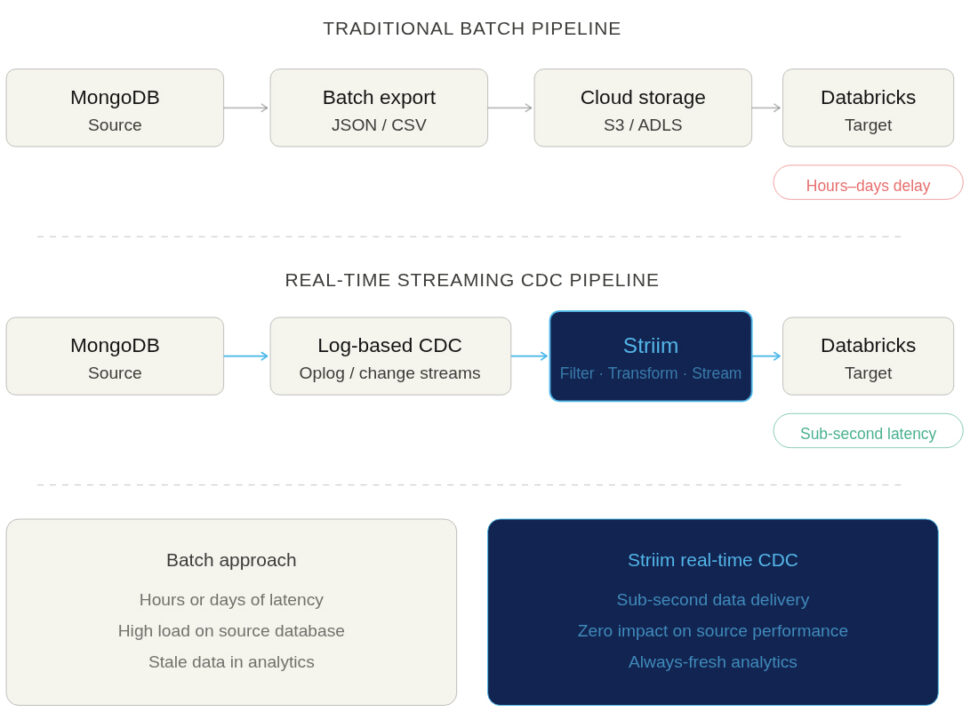
This is the traditional, manual approach to data integration. A scheduled job (often a cron job or an orchestration tool like Airflow) runs a script to export MongoDB collections into flat files—typically JSON or CSV formats. These files are then uploaded to cloud object storage (like AWS S3, Azure Data Lake, or Google Cloud Storage), where Databricks can ingest them.

  • The Pros: This approach is conceptually simple and requires very little initial engineering effort.
  • The Cons: Batched jobs are notoriously slow. By the time your data lands in Databricks, it is already stale. Furthermore, running massive query exports puts heavy, periodic strain on your MongoDB operational database.

It’s worth noting that Databricks Auto Loader can partially ease the pain of file-based ingestion by automatically detecting new files and handling schema evolution as the files arrive. However, Auto Loader can only process files after they are exported; your data freshness remains entirely bound by your batch schedule.

Native Spark/MongoDB Connectors

For teams already heavily invested in the Databricks ecosystem, a common approach is to use the official MongoDB Spark Connector. This allows a Databricks cluster to connect directly to your MongoDB instance and read collections straight into Spark DataFrames.

  • The Pros: It provides direct access to the source data and natively handles MongoDB’s semi-structured BSON/JSON formats.
  • The Cons: This method is not optimized for continuous, real-time updates. Polling a live database for changes requires running frequent, heavy Spark jobs. Worse, aggressive polling can directly degrade the performance of your production MongoDB cluster, leading to slow application response times for your end users.
  • The Verdict: It requires careful cluster tuning and significant maintenance overhead to manage incremental loads effectively at scale.

Streaming Approaches and Change Data Capture (CDC)

If your goal is to power real-time AI, ML, or operational analytics, Change Data Capture (CDC) is the gold standard. Instead of querying the database for data, CDC methods passively tap into MongoDB’s oplog (operations log) or change streams. They capture every insert, update, and delete exactly as it happens and stream those events continuously into Databricks.

  • Why it matters for AI/ML: Predictive models and real-time dashboards degrade rapidly if their underlying data isn’t fresh. Streaming CDC ensures that Databricks always reflects the exact, current state of your operational applications.
  • The Complexity Warning: While the architectural concept is elegant, building a CDC pipeline yourself is incredibly complex. Not all CDC tools or open-source frameworks gracefully handle MongoDB’s schema drift, maintain strict event ordering, or execute the necessary retries if a network failure occurs. Doing this reliably requires enterprise-grade stream processing.

Challenges of Integrating MongoDB with Databricks

Connecting an operational NoSQL database to an analytical Lakehouse represents a paradigm shift in how data is structured and processed. While pulling a small, one-off snapshot might seem trivial, the underlying challenges are severely magnified when you scale up to millions of daily events.

Before building your pipeline, your data engineering team must be prepared to tackle the following hurdles.

Latency and Stale Data in Batch Pipelines

The most immediate challenge is the inherent delay in traditional ETL. Delays between a MongoDB update and its visibility in Databricks actively undermine the effectiveness of your downstream analytics and ML workloads. If an e-commerce platform relies on a nightly batch load to update its recommendation engine, the model will suggest products based on yesterday’s browsing session—completely missing the user’s current intent. For high-stakes use cases like fraud detection, a multi-hour delay renders the data practically useless.

Handling Schema Drift and Complex JSON Structures

MongoDB’s greatest strength for developers—its flexible, schema-less document model—is often a data engineer’s biggest headache. Applications can add new fields, change data types, or deeply nest JSON arrays at will, without ever running a database migration. However, when landing this data into Databricks, you are moving it into structured Delta tables. If your integration pipeline cannot automatically adapt to evolving document structures (schema drift), your downstream pipelines will break, requiring manual intervention and causing significant downtime.

Ensuring Data Consistency and Integrity at Scale

Moving data from Point A to Point B is easy. Moving it exactly once, in the correct order, while processing thousands of transactions per second, is incredibly difficult. Network partitions, brief database outages, or cluster restarts are inevitable in distributed systems. If your pipeline cannot guarantee exactly-once processing (E1P), you risk creating duplicate events or missing critical updates entirely. In financial reporting or inventory management, a single dropped or duplicated event can break the integrity of the entire dataset.

Managing Infrastructure and Operational Overhead

Many teams attempt to solve the streaming challenge by stitching together open-source tools, for example, deploying Debezium for CDC, Apache Kafka for the message broker, and Spark Structured Streaming to land the data. The operational overhead of this DIY approach is massive. Data engineers end up spending their cycles maintaining connectors, scaling clusters, and troubleshooting complex failures rather than building valuable data products.

Challenge Area

The Operational Reality

Connector Maintenance Open-source connectors frequently break when MongoDB or Databricks release version updates.
Cluster Scaling Managing Kafka and Spark clusters requires dedicated DevOps resources to monitor memory, CPU, and partition rebalancing.
Observability Tracking exactly where an event failed (was it in the CDC layer, the broker, or the writer?) requires building custom monitoring dashboards.
Error Recovery Restarting a failed streaming job without duplicating data requires complex checkpointing mechanisms that are notoriously hard to configure.

Best Practices for Powering Databricks with Live MongoDB Data

Building a resilient, real-time pipeline between MongoDB and Databricks is entirely achievable. However, the most successful enterprise teams don’t reinvent the wheel; they rely on architectural lessons from the trenches.

While you can technically build these best practices into a custom pipeline, doing so requires significant engineering effort. That is why leading organizations turn to enterprise-grade platforms like Striim to bake these capabilities directly into their infrastructure.

Here are some best practices to ensure a production-ready integration.

Start With An Initial Snapshot, Then Stream Changes

To build an accurate analytical model in Databricks, you cannot just start streaming today’s changes; you need the historical baseline. The best practice is to perform an initial full load (a snapshot) of your MongoDB collections, and then seamlessly transition into capturing continuous changes (CDC).

Coordinating this manually is difficult. If you start CDC too early, you create duplicates; if you start it too late, you miss events. Platforms like Striim automate this end-to-end. Striim handles the initial snapshot and automatically switches to CDC exactly where the snapshot left off, ensuring your Databricks environment has a complete, gap-free, and duplicate-free history.

Transform And Enrich Data In Motion For Databricks Readiness

MongoDB stores data in flexible BSON/JSON documents, but Databricks performs best when querying highly structured, columnar formats like Parquet via Delta tables. Pre-formatting this data before it lands in Databricks reduces your cloud compute costs and drastically simplifies the work for your downstream analytics engineers.

While you can achieve this with custom Spark code running in Databricks, performing transformations mid-flight is much more efficient. Striim offers built-in stream processing (using Streaming SQL), allowing you to filter out PII, flatten nested JSON arrays, and enrich records in real time, so the data lands in Databricks perfectly structured and ready for immediate querying.

Monitor Pipelines For Latency, Lag, And Data Quality

Observability is non-negotiable. When you are feeding live data to an AI agent or a fraud detection model, you must know immediately if the pipeline lags or if data quality drops. Data teams need comprehensive dashboards and alerting to ensure their pipelines are keeping up with business SLAs.

Building this level of monitoring from scratch across multiple open-source tools is a heavy lift. Striim provides end-to-end visibility out of the box. Data teams can monitor throughput, quickly detect lag, identify schema drift, and catch pipeline failures before they impact downstream analytics.

Optimize Delta Table Writes To Avoid Small-File Issues

One of the biggest pitfalls of streaming data into a lakehouse is the “small file problem.” If you write every single MongoDB change to Databricks as an individual file, it will severely degrade query performance and bloat your storage metadata.

To ensure optimal performance, take a strategic approach to batching and partitioning your writes into Databricks. These optimizations are incredibly complex to tune manually in DIY pipelines. Striim handles write optimization automatically, smartly batching micro-transactions into efficiently sized Parquet files for Delta Lake, helping your team avoid costly performance bottlenecks without lifting a finger.

Simplify MongoDB to Databricks Integration with Striim

Striim is the critical bridge between MongoDB’s rich operational data and the Databricks Lakehouse. It ensures that your analytics and AI/ML workloads run on live, trusted, and production-ready data, rather than stale batch exports.

While DIY methods and native connectors exist, they often force you to choose between data freshness, cluster performance, and engineering overhead. Striim uniquely combines real-time Change Data Capture (CDC), in-flight transformation, and enterprise reliability into a single, unified platform. Built to handle massive scale—processing over 100 billion events daily for leading enterprises—Striim turns complex streaming architecture into a seamless, managed experience.

With Striim, data teams can leverage:

  • Real-time Change Data Capture (CDC): Passively read from MongoDB oplogs or change streams with zero impact on source database performance.
  • Built-in Stream Processing: Use SQL to filter, enrich, and format data (e.g., flattening complex JSON to Parquet) before it ever lands in Databricks.
  • Exactly-Once Processing (E1P): Guarantee data consistency in Databricks without duplicates or dropped records.
  • Automated Snapshot + CDC: Execute a seamless full historical load that instantly transitions into continuous replication.
  • End-to-End Observability: Out-of-the-box dashboards to monitor throughput, latency, and pipeline health.
  • Fault Tolerance: Automated checkpointing allows your pipelines to recover seamlessly from network failures.
  • Secure Connectivity: Safely integrate both MongoDB Atlas and self-hosted/on-prem deployments.
  • Optimized Delta Lake Writes: Automatically batch and partition writes to Databricks to ensure maximum query performance and scalable storage.

Ready to stop managing pipelines and start building AI? Try Striim for free or book a demo with our engineering team today.

FAQs

What is the best way to keep MongoDB data in sync with Databricks in real time?

The most effective method is log-based Change Data Capture (CDC). Instead of running heavy batch queries that degrade database performance, CDC passively reads MongoDB’s oplog or change streams. This allows platforms like Striim to capture inserts, updates, and deletes continuously, syncing them to Databricks with sub-second latency.

How do you handle schema drift when moving data from MongoDB to Databricks?

MongoDB’s flexible document model means fields can change without warning, which often breaks structured Databricks Delta tables. To handle this, your pipeline must detect changes in motion. Enterprise streaming platforms automatically identify schema drift mid-flight and elegantly evolve the target Delta table schema without requiring pipeline downtime or manual engineering intervention.

Why is streaming integration better than batch exports for AI and machine learning use cases?

AI and ML models rely on fresh context to make accurate predictions. If an e-commerce dynamic pricing model is fed via a nightly batch export, it will price items based on yesterday’s demand, losing revenue. Streaming integration ensures that Databricks Feature Stores are updated in milliseconds, allowing models to infer intent and execute decisions based on what a user is doing right now.

How do I choose between native connectors and third-party platforms for MongoDB to Databricks integration?

Native Spark connectors are useful for occasional, developer-led ad-hoc queries or small batch loads. However, if you poll them frequently for real-time updates, you risk severely straining your MongoDB cluster. Third-party CDC platforms like Striim are purpose-built for continuous, low-impact streaming at enterprise scale, offering built-in observability and automated recovery that native connectors lack.

Can Striim integrate both MongoDB Atlas and on-prem MongoDB with Databricks?

Yes. Striim provides secure, native connectivity for both fully managed MongoDB Atlas environments and self-hosted or on-premises MongoDB deployments. This ensures that no matter where your operational data lives, it can be securely unified into your Databricks Lakehouse without creating infrastructure silos.

What are the costs and ROI benefits of using a platform like Striim for MongoDB to Databricks pipelines?

Striim dramatically reduces compute overhead by eliminating heavy batch polling on MongoDB and optimizing writes to avoid Databricks SQL warehouse spikes. The true ROI, however, comes from engineering velocity. By eliminating the need to build, maintain, and troubleshoot complex Kafka/Spark streaming architectures, data engineers can refocus their time on building revenue-generating AI products.

How do you ensure data quality when streaming from MongoDB to Databricks?

Data quality must be enforced before the data lands in your lakehouse. Using in-flight transformations, you can validate data types, filter out malformed events, and mask PII in real time. Furthermore, utilizing a platform that guarantees exactly-once processing (E1P) ensures that network hiccups don’t result in duplicated or dropped records in Databricks.

Can MongoDB to Databricks pipelines support both historical and real-time data?

Yes, a production-grade pipeline should handle both seamlessly. The best practice is to execute an automated snapshot (a full load of historical MongoDB data) and then immediately transition into continuous CDC. Striim automates this hand-off, ensuring Databricks starts with a complete baseline and stays perfectly synchronized moving forward.

What security considerations are important when integrating MongoDB and Databricks?

When moving operational data, protecting Personally Identifiable Information (PII) is paramount. Data should never be exposed in transit. Using stream processing, teams can detect and redact sensitive customer fields (like credit card numbers or SSNs) mid-flight, ensuring that your Databricks environment remains compliant with HIPAA, PCI, and GDPR regulations.

How does Striim compare to DIY pipelines built with Spark or Kafka for MongoDB to Databricks integration?

Building a DIY pipeline requires stitching together and maintaining multiple distributed systems (e.g., Debezium, Kafka, ZooKeeper, and Spark). This creates a fragile architecture that is difficult to monitor and scale. Striim replaces this complexity with a single, fully managed platform that offers sub-second latency, drag-and-drop transformations, and out-of-the-box observability—drastically lowering total cost of ownership.

Introducing Striim Labs: Where AI Research Meets Real-Time Data

AI research has a proliferation problem. AI and machine learning conferences such as NeurIPS stated that they’re overwhelmed with new paper submissions, with 21,575 papers submitted this year, up from under 10,000 in 2020.

At the crux of the issue is the questionable quality of the papers: whether written using AI tools or rushed through to publishing without robust reviews. In the noise, it’s increasingly difficult for practitioners to discern genuine innovation from “slop”, or to find applicable methodologies that might just be perfect for their use cases.

That’s why we’re launching Striim Labs.

We focus specifically on the intersection of AI/ML research and real-time data streaming: the part of the venn diagram where promising techniques meet production-grade, low-latency systems. Our team will wade through the deluge of research papers to find the most applicable examples for streaming machine learning use cases. We’ll even test them out to make sure they can perform as claimed.

Through exploring emerging techniques, collaborating with Striim customers on real scenarios, and building working prototypes, we want to bring about actionable templates (“prototypes”) that teams can replicate and deploy themselves. Every blueprint will be accessible to the public via GitHub repositories and deployment instructions, and maintain an open line of communication for feedback and collaboration.

What is Striim Labs?

Striim Labs is an applied AI research group we’re launching at Striim: a team dedicated to learning and experimentation at the intersection of AI and real-time data.

Striim Labs will draw on the collective knowledge and experience of a team of data scientists and experts in streaming machine learning. First and foremost, our work focuses on real-time, low-latency use cases that enterprise teams can actually use.

Striim Labs isn’t a purely academic exercise. Nor is it a Striim product demo disguised as thought leadership. It’s a genuine attempt to take promising techniques from recent research and stress-test them against the messiness of real-time data: schema drift, late-arriving events, volume spikes, and all the other things that break what worked in a notebook.

We’ll document what we find honestly, including what didn’t work, what we had to adapt, and where the gap between a paper’s benchmarks and streaming reality turned out to be wider than expected. That transparency is the point. If a technique falls apart under latency pressure, that’s a finding worth sharing too.

The result, we hope, will be a series of prototypes we’re referring to as “AI Prototypes” that practitioners: ML engineers, architects, and data scientists can experiment with themselves, as well as giving us feedback and suggestions from their own experiences.

What is an AI Prototype?

An AI prototype is a self-contained reproducible prototype that implements a technique or model from a recent research paper.

We’ll build our prototypes using open source tools and technologies (Kafka, Apache Spark, PyTorch, Docker, and others) with defined minimum acceptance criteria (precision, recall, latency).  Our starting point with each blueprint is always based in open source and framework-agnostic tooling, so anyone can run it (not just Striim customers, though we encourage them to check it out!). Each blueprint will live in a public GitHub repository with full deployment instructions. We’ll also publish our work via the Striim resources page and elsewhere, to make it more accessible.

Ultimately, our intention for each blueprint is first to validate a technique within a streaming context, then to integrate it into Striim’s platform natively, extending what Striim offers to our customers out of the box. But again, we stress that each blueprint will be available to everyone, not just Striim users.

What Makes Striim Labs Different?

Here are a few ways we aim to set Striim Labs apart from other data science initiatives.

  • Everything ships with code: Every applied blueprint we publish will feature code you can test, within its own GitHub repo. Not just theoretical whitepapers.
  • Every blueprint has defined, measurable acceptance criteria: We’ll test our models and share based on real results; not a vague promise that it works.
  • Open source first approach: You won’t need Striim’s platform or to be working within a particular cloud environment to learn from or run a blueprint.
  • Transparency about tradeoffs: We’ll be clear and open from the start about model failures and breakages, rather than just sharing polished results.
  • Clear path from prototype to production: Our prototypes will be designed to graduate from prototypes into systems we’ll build into Striim’s platform as native capabilities.

What’s next?

Our first area of focus will be a subject many real-time enterprises are interested in: anomaly detection. Anomaly detection has benefited from a rich body of recent research, but the gap between research papers and production results remains particularly wide. That makes it a great place for us to start, especially since it’s one of the most requested capabilities in a streaming context.

We’ll be launching a series of prototypes on anomaly detection, and our findings on anomaly detection models, in the near future.

Your Move: Get Involved

Striim Labs is designed to be an open, collaborative exercise. We welcome input, feedback, and ideas from practitioners wrestling with data science problems who are curious about the latest innovations in the market.  Here are a few ways you can take part:

  • Suggest papers, techniques, or focus areas you’d like us to text against real-time data.
  • Try our prototypes, and give us real feedback! Tell us where we can improve, and let us know what works and what breaks in your environment.
  • Share your work. We’d love to hear from you if you’re working on similar projects. Feel free to share your GitHub repos or related initiatives.

Where you can find us:

We’re excited to bring new insights, prototypes, and research to you in the following weeks. Thanks for being part of our journey.

Change Data Capture MongoDB: How It Works, Challenges & Tools

Developers love MongoDB for its speed and flexibility. But getting that fast-moving data out of MongoDB and into your data warehouse or analytics platform in real time is no mean feat.

Teams used to rely on batch ETL pipelines or constant database polling to sync their NoSQL data with downstream systems. But batch-based data ingestion can no longer keep pace with modern business demands. And each time you poll a database for changes, you burn valuable compute resources and degrade the performance of the very applications your customers rely on.

The solution is Change Data Capture (CDC). By capturing data changes the instant they occur, CDC eliminates the need for batch windows. But CDC in a NoSQL environment comes with its own unique set of rules.

In this guide, we’ll break down exactly how CDC works in MongoDB. We’ll explore the underlying mechanics—from the oplog to native Change Streams—and weigh the pros and cons of common implementation methods. We’ll also unpack the hidden challenges of schema evolution and system performance at scale, showing why the most effective approach treats CDC not just as a simple log reader, but as the foundation of modern, real-time data architecture.

What is Change Data Capture (CDC) in MongoDB?

Change Data Capture (CDC) is the process of identifying and capturing changes made to a database—specifically inserts, updates, and deletes—and instantly streaming those changes to downstream systems like data warehouses, data lakes, or event buses.

MongoDB is a NoSQL, document-oriented database designed for flexibility and horizontal scalability. Because it stores data in JSON-like documents rather than rigid tables, developers frequently use it to power fast-changing, high-velocity applications. However, this same unstructured flexibility makes syncing that raw data to structured downstream targets a complex task.

To facilitate real-time syncing, MongoDB relies on its Change Streams API. Change Streams provide a seamless, secure way to tap directly into the database’s internal operations log (the oplog). Instead of writing heavy, resource-intensive queries to periodically ask the database what changed, Change Streams allow your data pipelines to subscribe to the database’s activity. As soon as a document is inserted, updated, or deleted, the change is pushed out as a real-time event, providing the exact incremental data you need to power downstream analytics and event-driven architectures.

Why Do Teams Use CDC with MongoDB?

Batch ETL forces your analytics to constantly play catch-up, while continuous database polling degrades your primary database by stealing compute from customer-facing applications.

CDC solves both of these problems simultaneously. By capturing only the incremental changes (the exact inserts, updates, and deletes) directly from the database’s log, CDC avoids the performance overhead of polling and the massive data payloads of batch extraction.

When implemented correctly, streaming MongoDB CDC unlocks several key advantages:

  • Real-time data synchronization: Keep downstream systems—like Snowflake, BigQuery, or ADLS Gen2—perfectly mirrored with your operational MongoDB database, ensuring dashboards and reports always reflect the current state of the business.
  • Zero-impact performance: Because CDC reads from the oplog or Change Streams rather than querying the tables directly, it doesn’t compete with your application for database resources.
  • Support for event-driven architectures: CDC turns static database commits into actionable, real-time events. You can stream these changes to message brokers like Apache Kafka to trigger microservices, alerts, or automated workflows the second a customer updates their profile or places an order.
  • Improved pipeline efficiency and scalability: Moving kilobytes of changed data as it happens is vastly more efficient and cost-effective than moving gigabytes of data in nightly batch dumps.
  • AI and advanced analytics readiness: Fresh, accurate context is the prerequisite for reliable predictive models and Retrieval-Augmented Generation (RAG) applications. CDC ensures your AI systems are grounded in up-to-the-second reality.

While the benefits are clear, building robust CDC pipelines for MongoDB isn’t as simple as flipping a switch. Because MongoDB uses a flexible, dynamic schema, a single collection can contain documents with wildly different structures. Capturing those changes is only step one; transforming and flattening that nested, unstructured JSON into a format that a rigid, relational data warehouse can actually use introduces a level of complexity that traditional CDC tools often fail to handle.

We will explore these specific challenges—and how to overcome them—later in this guide. First, let’s look at the mechanics of how MongoDB actually captures these changes under the hood.

How MongoDB Implements Change Data Capture

To build resilient CDC infrastructure, you need to understand how MongoDB actually tracks and publishes data changes. Understanding the underlying architecture will help you make informed decisions about whether to build a custom solution, use open-source connectors, or adopt an enterprise platform like Striim.

MongoDB oplog vs. Change Streams

In MongoDB, CDC revolves around the oplog (operations log). The oplog is a special capped collection that keeps a rolling record of all operations that modify the data stored in your databases.

Historically, developers achieved CDC by directly “tailing” the oplog: writing scripts to constantly read this raw log. However, oplog tailing is notoriously brittle. It requires high-level administrative database privileges, exposes raw and sometimes cryptic internal formats, and breaks easily if there are elections or topology changes in the database cluster.

To solve this, MongoDB introduced Change Streams in version 3.6. Change Streams sit on top of the oplog. They act as a secure, user-friendly API that abstracts away the complexity of raw oplog tailing.

  • Oplog Tailing (Deprecated for most use cases): Requires full admin access, difficult to parse, doesn’t handle database elections well, and applies globally to the whole cluster.
  • Change Streams (Recommended): Uses standard Role-Based Access Control (RBAC), outputs clean and formatted JSON documents, gracefully handles cluster node elections, and can be scoped to a specific collection, database, or the entire deployment.

Key Components of Change Streams

When you subscribe to a Change Stream, MongoDB pushes out event documents. To manage this flow reliably, there are a few key concepts you must account for:

  • Event Types: Every change is categorized. The most common operations are insert, update, delete, and replace. The event document contains the payload (the data itself) as well as metadata about the operation.
  • Resume Tokens: This is the most critical component for fault tolerance. Every Change Stream event includes a unique _id known as a resume token. If your downstream consumer crashes or disconnects, it can present the last known resume token to MongoDB upon reconnection. MongoDB will automatically resume the stream from that exact point, ensuring exactly-once processing and zero data loss.
  • Filtering and Aggregation: Change Streams aren’t just firehoses. You can pass a MongoDB aggregation pipeline into the stream configuration to filter events before they ever leave the database. For example, you can configure the stream to only capture update events where a specific field (like order_status) is changed.

Requirements and Limitations

While Change Streams are powerful, they are not universally available or infinitely scalable. There are strict architectural requirements you must be aware of:

  • Topology Requirements: Change Streams only work on MongoDB Replica Sets or Sharded Clusters. Because they rely on the oplog (which is used for replication), they are completely unavailable on standalone MongoDB instances.
  • Oplog Sizing and Data Retention: The oplog is a “capped collection,” meaning it has a fixed maximum size. Once it fills up, it overwrites the oldest entries. If your CDC consumer goes offline for longer than your oplog’s retention window, the resume token will become invalid. You will lose the stream history and be forced to perform a massive, resource-intensive initial snapshot of the entire database to catch up.
  • Performance Impact: Change Streams execute on the database nodes themselves. Opening too many concurrent streams, or applying overly complex aggregation filters to those streams, will consume memory and CPU, potentially impacting the performance of your primary transactional workloads.

Understanding these mechanics makes one thing clear: capturing the data is only the beginning. Next, we’ll look at the different methods for actually moving that captured data into your target destinations.

Methods for Implementing CDC with MongoDB

When it comes to actually building pipelines to move CDC data out of MongoDB, you have several options. Each approach carries different trade-offs regarding architectural complexity, scalability, and how well it handles data transformation.

Native MongoDB Change Streams (Custom Code)

The most direct method is to write custom applications (using Node.js, Python, Java, etc.) that connect directly to the MongoDB Change Streams API.

  • The Pros: It’s highly customizable and requires no additional middleware. This is often the best choice for lightweight microservices—for example, a small app that listens for a new user registration and sends a welcome email.
  • The Limitations: You are entirely responsible for the infrastructure. Your developers must write the logic to store resume tokens safely, handle failure states, manage retries, and parse dynamic schema changes. If the application crashes and loses its resume token, you risk permanent data loss.

Kafka Connect MongoDB Source/Sink Connectors

For teams already invested in Apache Kafka, using the official MongoDB Kafka Connectors is a common approach. This method acts as a bridge, publishing Change Stream events directly into Kafka topics.

  • The Pros: Kafka provides excellent decoupling, fault tolerance, and buffering. If your downstream data warehouse goes offline, Kafka will hold the MongoDB events until the target system is ready to consume them again.
  • The Limitations: Kafka Connect introduces significant operational complexity. You have to manage Connect clusters, handle brittle JSON-to-Avro mappings, and deal with schema registries. Furthermore, Kafka Connect is primarily for routing. If you need to flatten nested MongoDB documents or mask sensitive PII before it lands in a data warehouse, you will have to stand up and maintain an entirely separate stream processing layer (like ksqlDB or Flink) or write custom Single Message Transforms (SMTs).

Third-Party Enterprise Platforms (Striim)

For high-volume, enterprise-grade pipelines, relying on custom code or piecing together open-source middleware often becomes an operational bottleneck. This is where platforms like Striim come in.

  • The Pros: Striim is a unified data integration and intelligence platform that connects directly to MongoDB (and MongoDB Atlas) out of the box. Unlike basic connectors, Striim allows you to perform in-flight transformations using a low-code UI or Streaming SQL. You can flatten nested JSON, filter records, enrich data, and mask PII before the data ever lands in your cloud data warehouse.
  • The Limitations: It introduces a new platform into your stack. However, because Striim is fully managed and multi-cloud native, it generally replaces multiple disparate tools (extractors, message buses, and transformation engines), ultimately reducing overall architectural complexity.

How to Choose the Right Approach

Choosing the right tool comes down to your primary use case. Use this simple framework to evaluate your needs:

  1. Complexity and Latency: Are you building a simple, single-purpose application trigger? Custom code via the native API might suffice.
  2. Existing Infrastructure: Do you have a dedicated engineering team already managing a massive, enterprise-wide Kafka deployment? Kafka Connect is a logical extension.
  3. Transformation, Scale, and Analytics: Do you need fault-tolerant, scalable pipelines that can seamlessly transform unstructured NoSQL data and deliver it securely to Snowflake, BigQuery, or ADLS Gen2 in sub-second latency? An enterprise platform like Striim is the clear choice.

Streaming MongoDB CDC Data: Key Destinations and Architecture Patterns

Capturing changes from MongoDB is only half the battle. Streaming CDC data isn’t useful unless it reliably reaches the systems where it actually drives business value. Depending on your goals—whether that’s powering BI dashboards, archiving raw events, or triggering automated workflows—the architectural pattern you choose matters.

Here is a look at the most common destinations for MongoDB CDC data and how modern teams are architecting those pipelines.

Data Warehouses (Snowflake, BigQuery, Redshift)

The most common use case for MongoDB CDC is feeding structured analytics platforms. Operational data from your application needs to be joined with marketing, sales, or financial data to generate comprehensive KPIs and executive dashboards.

The core challenge here is a structural mismatch. MongoDB outputs nested, schema-less JSON documents. Cloud data warehouses require rigid, tabular rows and columns.

The Striim Advantage: Instead of dumping raw JSON into a warehouse staging table and running heavy post-processing batch jobs (ELT), Striim allows you to perform in-flight transformation. You can seamlessly parse, flatten, and type-cast complex MongoDB arrays into SQL-friendly formats while the data is still in motion, delivering query-ready data directly to your warehouse with zero delay.

Data Lakes and Cloud Storage (ADLS Gen2, Amazon S3, GCS)

For organizations building a lakehouse architecture, or those that simply need a cost-effective way to archive raw historical data for machine learning model training, cloud object storage is the ideal target.

When streaming CDC to a data lake, the format you write the data in drastically impacts both your cloud storage costs and downstream query performance.

The Striim Advantage: Striim integrates natively with cloud object storage like Azure Data Lake Storage (ADLS) Gen2. More importantly, Striim can automatically convert your incoming MongoDB JSON streams into highly optimized, columnar formats like

Apache Parquet before writing them to the lake. This ensures your data is immediately partitioned, compressed, and ready for efficient querying by tools like Databricks or Azure Synapse.

Event-Driven Architectures (Apache Kafka, Event Hubs)

Many engineering teams don’t just want to analyze MongoDB data—they want to react to it. By streaming CDC events to a message broker or event bus, you can trigger downstream microservices. For example, a new document inserted into an orders collection in MongoDB can instantly trigger an inventory update service and a shipping notification service.

The Striim Advantage: Striim provides native integration with Kafka, Confluent, and Azure Event Hubs, allowing you to stream MongoDB changes to event buses without writing brittle glue code. Furthermore, Striim allows you to enrich the event data (e.g., joining the MongoDB order event with customer data from a separate SQL Server database) before publishing it to the topic, ensuring downstream consumers have the full context they need to act.

Real-Time Analytics Platforms and Dashboards

In use cases like fraud detection, dynamic pricing, or live operational dashboards, every millisecond counts. Data cannot wait in a queue or sit in a staging layer. It needs to flow from the application directly into an in-memory analytics engine or operational datastore. The Striim Advantage: Striim is engineered for high-velocity, sub-second latency. By processing, validating, and moving data entirely in-memory, Striim ensures that critical operational dashboards reflect the exact state of your MongoDB database in real time. There is no manual stitching required—just continuous, reliable intelligence delivered exactly when it is needed.

Common Challenges with MongoDB CDC (and How to Overcome Them)

While MongoDB CDC is powerful, rolling it out in a production environment is rarely straightforward. At enterprise scale, capturing the data is only a fraction of the battle. Transforming it, ensuring zero data loss, and keeping pipelines stable as the business changes are where most initiatives stall out. Here are the most common challenges teams face when implementing MongoDB CDC, along with practical strategies for overcoming them.

Schema Evolution in NoSQL Environments

MongoDB’s dynamic schema is a double-edged sword. It grants developers incredible agility, they can add new fields or change data types on the fly without running heavy database migrations. However, this creates chaos downstream. When a fast-moving engineering team pushes a new nested JSON array to production, downstream data warehouses expecting a flat, rigid table will instantly break, causing pipelines to fail and dashboards to go dark.

How to Overcome It: Build “defensive” CDC pipelines. First, define optional schemas for your target systems to accommodate structural shifts. Second, implement strict data validation steps within your CDC stream to catch and log schema drift before it corrupts your warehouse. While doing this manually requires constant maintenance, modern platforms like Striim offer automated schema tracking and in-flight transformation capabilities. Striim can detect a schema change in MongoDB, automatically adapt the payload, and even alter the downstream target table dynamically, keeping your data flowing without engineering intervention.

Handling Reordering, Retries, and Idempotency

In any distributed system, network hiccups happen every so often. A CDC consumer might crash, a target warehouse might temporarily refuse connections, or packets might arrive out of order. If your CDC pipeline simply retries a failed batch of insert events without context, you risk duplicating data and ruining the accuracy of your analytics.

How to Overcome It: Whether you are building a custom solution, using open-source tools, or leveraging an enterprise platform, design your downstream consumers to be idempotent. An idempotent system ensures that applying the same CDC event multiple times yields the same result as applying it once. Rely heavily on MongoDB’s resume tokens to maintain exact checkpoints, and test your replay logic early and often to guarantee exactly-once processing (E1P) during system failures.

Performance Impact and Scaling Considerations

Change Streams are highly efficient, but they still execute on your database nodes. If you configure poorly optimized filters, open dozens of concurrent streams, or subject the database to massive volumes of small, rapid-fire writes, you can severely impact your MongoDB replica performance. Consequently, your CDC consumer’s throughput will tank, introducing unacceptable latency into your “real-time” pipelines.

How to Overcome It: Monitor your replication lag closely. Set highly specific aggregation filters on your Change Streams so the database only publishes the exact events you need, dropping irrelevant noise before it hits the network. Furthermore, always load-test your pipelines with production-like data volumes. To avoid overloading MongoDB, many organizations use an enterprise CDC platform optimized for high-throughput routing. These platforms can ingest a single, consolidated stream from MongoDB, buffer it in-memory, and securely fan it out to multiple destinations in parallel without adding additional load to the source database.

Managing Snapshots and Initial Sync

By definition, CDC only captures changes from the moment you turn it on. If you spin up a new Change Stream today, it has no memory of the millions of documents inserted yesterday. To ensure your downstream systems have a complete, accurate dataset, you first have to perform a massive historical load (a snapshot), and then flawlessly cut over to the real-time stream without missing a single event or creating duplicates in the gap.

How to Overcome It: If you are building this manually, you must plan a staged migration. You will need to sync the historical data, record the exact oplog position or resume token at the start of that sync, and then initiate your CDC stream from that precise marker once the snapshot completes. Doing this with custom scripts is highly error-prone. The best practice is to use a tool that supports snapshotting and CDC within a single, unified pipeline. Platforms like Striim handle the initial historical extract and seamlessly transition into real-time CDC automatically, guaranteeing data consistency without requiring a manual, middle-of-the-night cutover.

Simplify MongoDB CDC with Striim

MongoDB Change Streams provide an excellent, raw mechanism for accessing real-time data changes. But as we’ve seen, raw access isn’t enough to power a modern enterprise architecture. Native APIs and open-source connectors don’t solve the hard problems: parsing nested JSON, handling dynamic schema evolution, delivering exactly-once processing, or providing multi-cloud enterprise observability.

That is where Striim excels.

Striim is not just a connector; it is a unified data integration and intelligence platform purpose-built to turn raw data streams into decision-ready assets. When you use Striim for MongoDB CDC, you eliminate the operational burden of DIY pipelines and gain:

  • Native support for MongoDB and MongoDB Atlas: Connect securely and reliably with out-of-the-box integrations.
  • Real-time, in-flight transformations: Flatten complex JSON arrays, enrich events, and mask sensitive data before it lands in your warehouse, reducing latency from hours to milliseconds.
  • Schema evolution and replay support: Automatically handle upstream schema drift and rely on enterprise-grade exactly-once processing (E1P) to guarantee zero data loss.
  • Low-code UI and enterprise observability: Build, monitor, and scale your streaming pipelines visually, without managing complex distributed infrastructure.
  • Destination flexibility: Seamlessly route your MongoDB data to Snowflake, Google BigQuery, ADLS Gen2, Apache Kafka, and more (or even write back to another MongoDB cluster)—simultaneously and with sub-second latency.

Stop wrestling with brittle batch pipelines and complex open-source middleware. Bring your data architecture into the real-time era. Get started with Striim for free or book a demo today. to see how Striim makes MongoDB CDC simple, scalable, and secure.

AI-Ready Data: What It Is and How to Build It

Enterprise leaders are pouring investments into large language models, agentic systems, and real-time prediction engines.

Yet, a staggering number of these initiatives stall before they ever reach production. Too often, AI outputs are a hallucinated mess, the context is too stale to provide value, and AI recommendations are unreliable. Our immediate instinct might be to blame the model, but the root cause is almost always the data and context feeding it.

“Clean data” was, for years, good enough for overnight batch reporting and static analytics. But the rules have changd. For modern AI workloads, clean data is just the baseline. Truly “AI-ready data” demands data architecture that provides fresh, continuously synchronized, securely governed, and machine-actionable data at enterprise scale.

If AI models are forced to rely on batch jobs, fragmented silos, or legacy ETL pipelines, they’re operating on a delayed version of reality. In this article, we’ll break down what it actually means to make your data AI-ready, how to evaluate your current infrastructure, and the practical steps required to build a real-time data foundation that delivers on the promise of enterprise AI.

Key Takeaways

  • AI-ready data is more than clean data. It requires real-time availability, consistent structure, strong in-flight governance, and continuous synchronization across systems to support modern AI workloads.
  • The model is only as good as the pipeline. Even the most advanced AI and machine learning initiatives will produce inaccurate, outdated, or unreliable outputs if the underlying data is stale, siloed, or poorly structured.
  • Architecture matters. Building an AI-ready foundation involves modernizing your infrastructure for real-time movement, enforcing quality and governance at every stage, and ensuring data is continuously optimized for AI consumption.

What is AI-Ready Data?

Most existing definitions of data readiness stop at data quality. Is the data accurate? Is it complete? But for modern artificial intelligence systems—especially large language models (LLMs) and agentic workflows—quality is only part of the equation.

AI-ready data is structured, contextual, and continuously updated. It’s structurally optimized for machine consumption the instant it’s created. To achieve true AI-readiness, your data architecture must deliver on four specific parameters:

  • Freshness: End-to-end pipeline latency must consistently remain under a targeted threshold (often sub-second to minutes, depending on the use case).
  • Consistency: Change data capture (CDC) based synchronization prevents drift between your operational systems and AI environments, ensuring that training and inference distributions perfectly align.
  • Governance-in-Motion: Lineage tracking, PII handling, and data policy enforcement are applied before the data lands in your AI application.
  • Machine-Actionability: Data features stable schemas, rich metadata, and clear semantics, making it directly consumable by models or AI agents without manual reconstruction.

Artificial intelligence systems rely entirely on recognizing patterns and acting on timeliness. Even minor delays or inconsistencies in your data pipelines can result in skewed predictions or entirely inaccurate outputs. AI doesn’t just need the right answer; it needs it right now. This requires a major shift from traditional batch processing to real-time data streaming and in-motion transformation.

Why Does AI-Ready Data Matter?

Even the most sophisticated LLM or machine learning model cannot mitgate for incomplete, stale, unstructured, or poorly governed data. If your data architecture wasn’t designed for the speed, scale, and structural demands of real-world AI, your models will underperform.

Here’s why building an AI-ready data foundation is the most critical step in your enterprise AI journey:

Improving Model Accuracy, Reliability, and Trust

Models require consistency. The data they use for training, historical analysis, inference, and real-time inputs must all share consistent distributions and structures. When operational systems drift from AI environments, models lose their accuracy. Furthermore, without clear data lineage, debugging a hallucinating model becomes nearly impossible. AI-ready data ensures that consistent structure and lineage are maintained, safeguarding model reliability and enterprise trust.

Powering Real-Time, Predictive, and Generative AI Use Cases

Use cases like fraud detection, dynamic supply troubleshooting, and Retrieval-Augmented Generation (RAG) are highly sensitive to latency. If an AI agent attempts to resolve a customer issue using inventory or behavioral data from yesterday’s batch run, the interaction fails. Real-time AI requires streaming pipelines, not batch processing. At Striim, we often see that enabling these advanced use cases demands enterprise-grade, continuous data movement that legacy systems cannot support.

Reducing Development Effort and Accelerating AI Time-to-Value

Data scientists and AI engineers spend an exorbitant amount of time debugging, cleaning, and reconstructing broken data flows. By the time the data is ready for the model, the project is already behind schedule. AI-ready data drastically reduces this rework. By utilizing in-motion data transformation, teams can filter, enrich, and format data while it is streaming, significantly reducing time-consuming post-processing and allowing teams to deploy models much faster.

Enabling Enterprise-Scale Adoption of AI Across the Business

For AI to move out of siloed experiments and into enterprise-wide production, the data foundation must be trusted by every department. When data is unified, governed, and standardized, organizations can create reusable data products. AI-ready foundations inherently support regulatory compliance, auditability, and standardized access, making AI viable, safe, and scalable across HR, finance, operations, and beyond.

Core Attributes of AI-Ready Data

Organizations might assume they already have “good data” because their BI dashboards are working fine for them. But AI introduces entirely new requirements around structure, speed, context, and control.

Think of the following attributes as a foundational framework. If any of these pillars are missing, your data isn’t truly AI-ready.

Machine-Actionable Structure, Semantics, and Metadata

First, the data must be practically useful for an algorithm without human intervention. This means stable, consistent schemas, explicitly defined semantics, and rich metadata. When data is properly structured and contextualized, it drastically reduces model errors and helps LLMs genuinely “understand” the context of the information they are processing.

High-Quality, Complete, and Consistent Datasets

While accuracy and completeness are foundational, they are not sufficient on their own. The true test for AI is consistency. If the data your model was trained on looks structurally different from the real-time data it evaluates in production, the model’s behavior becomes unpredictable. Maintaining consistency across both historical records and live, streaming data is crucial.

Continuously Updated and Optimized for Low-Latency Access

As the data ages, model accuracy decays. In other words: if an AI system is making decisions based on five-hour-old data, it’s making five-hour-old decisions. Achieving this attribute requires moving away from batch ETL in favor of streaming pipelines and Change Data Capture (CDC).

Governed, Lineage-Rich, and Compliant by Default

Lineage is crucial for model optimization. Knowing exactly where a piece of data came from, how it was transformed, and who touched it is essential for debugging model drift and satisfying strict regulatory audits. Data must carry its governance context along with it at all times.

Secure and Protected in Motion and at Rest

AI models can unintentionally expose vulnerabilities or leak sensitive information if they are fed unprotected data. True AI-readiness requires data-in-motion encryption and real-time validation techniques that strip or mask PII (Personally Identifiable Information) before the data ever reaches the AI pipeline.

How to Build an AI-Ready Data Foundation

Achieving an AI-ready state is an ongoing journey that requires an end-to-end architectural rethink.

Ideally, an AI-ready data flow looks like this: Source Systems → Real-Time Ingestion → In-Flight Enrichment & Transformation → Governance in Motion → Continuous AI Consumption. Here is the framework for building that foundation.

Modernize Ingestion with Real-Time Pipelines and CDC

The first step is moving your ingestion architecture from batch to real-time. AI and agentic workloads cannot wait for nightly syncs. A system that makes use of Change Data Capture (CDC) ensures that your AI models are continuously updated with the latest transactional changes with minimal impact on your source databases. This forms the foundation of a streaming-first architecture.

Unify and Synchronize Data Across Hybrid Systems

AI always needs a complete picture. That means eliminating data silos and presenting a single, synchronized source of truth across your entire environment. Because most enterprises operate in hybrid realities—relying heavily on legacy on-premise systems alongside modern cloud tools—continuously synchronizing these disparate environments with your cloud AI tools is essential.

Transform, Enrich, and Validate Data in Motion

Waiting to transform your data until after it lands in a data warehouse introduces unnecessary latency, leading to flawed inputs. Transforming data in-flight eliminates delay and prevents stale or inconsistent data from propagating. This includes joining streams, standardizing formats, and masking sensitive fields in real time as the data moves.

Implement Governance, Lineage, and Quality Controls

Governance cannot be bolted onto static datasets after the fact; it must be embedded directly into your real-time flows. Quality controls, such as continuous anomaly detection, schema validation, and lineage tracking, should be applied to the data while it is in motion, ensuring only trustworthy data reaches the model.

Prepare Pipelines for Continuous AI Consumption

Deploying an AI model is just the beginning. The systems feeding the model must remain continuously healthy. Your data pipelines must be engineered to support continuous, high-throughput updates to feed high-intensity scoring workloads and keep vector databases fresh for accurate Retrieval-Augmented Generation (RAG).

Common Challenges That Prevent Organizations From Achieving AI-Ready Data

Most organizations struggle to get AI into production. There are a number of reasons for this, but it often boils down to the fact that legacy data architecture wasn’t designed to handle AI’s demands for speed, scale, and structure.

Here are the most common hurdles standing in the way of AI readiness, and how robust, AI-first architectures overcome them.

Data Silos and Inconsistent Datasets Across Systems

When data is trapped in isolated operational systems, your models suffer context starvation, leading to conflicting outputs and hallucinations. Many organizations come to Striim specifically because they cannot keep their cloud AI environments in sync with critical, on-premise operational systems. The solution is to unify your data through real-time integration and enforce consistent schemas across boundaries: exactly what an enterprise-grade streaming platform enables.

Batch-Based Pipelines That Lead to Stale Data

Batch processing inherently leads to outdated and inconsistent inputs. If you are using nightly ETL runs to feed real-time or generative AI, your outputs will always lag behind reality. Moving from batch ETL to real-time streaming pipelines is the number one transformation Striim facilitates for our customers. While batch processes data in scheduled chunks, streaming processes data continuously, ensuring your AI models always operate on the freshest possible information.

Lack of Unified Data Models, Metadata, and Machine-Readable Structure

Inconsistent semantics confuse both predictive algorithms and generative models. If “Customer_ID” means one thing in your CRM and another in your billing system, the model’s outputs are more likely to break. Striim helps organizations standardize these schema structures during ingestion, applying transformations in motion so that downstream AI systems receive perfectly harmonized, machine-readable data.

Schema Drift, Data Quality Issues, and Missing Lineage

Change is the only constant for operational databases. When a column is added or a data type is altered, that schema drift can silently degrade downstream models and retrieval systems without triggering immediate alarms. Continuous validation is critical. Striim actively detects schema drift in real time, automatically adjusting or routing problematic records before they ever reach your AI pipelines or analytical systems.

Security, Governance, and Compliance Gaps in Fast-Moving Data Flows

When governance is discarded as an afterthought, organizations open themselves up to massive regulatory risks and operational failures. For example, feeding unmasked PII into a public LLM is a critical security violation. Striim solves this by applying real-time masking in-flight, ensuring that your data is fully secured and compliant before it reaches the AI consumption layer.

Architectural Limitations Around Latency, Throughput, and Scalability

Continuous scoring and retrieval-based AI systems require immense throughput. Insufficient performance makes AI practically unusable in customer-facing scenarios. Striim is frequently adopted because legacy integration platforms and traditional iPaaS solutions simply cannot handle the throughput or the sub-second latency requirements necessary to feed modern enterprise AI workloads at scale.

Tools and Tech That Enable AI-Ready Data Pipelines

Technology alone won’t make your data AI-ready, but adopting the right architectural components makes it possible to execute the strategies outlined above. To build a modern, AI-ready data stack, enterprises rely on a specific set of operational tools.

Real-Time Data Integration and Streaming Platforms

Transitioning from batch jobs to continuous pipelines requires a robust streaming foundation. Striim is one of the leading platforms enterprises use to build real-time data foundations for AI because it uniquely integrates legacy, on-premise, and multi-cloud systems in a continuous, highly reliable, and governed streaming manner.

Change Data Capture (CDC) for Continuous Synchronization

CDC is the mechanism that keeps downstream models continuously updated by reading changes directly from the database transaction logs, imposing minimal overhead on the source system. Many Striim customers rely on our enterprise-grade CDC to synchronize ERP systems, customer data platforms, and transactional databases with the cloud warehouses and vector databases used for RAG. Striim supports a massive array of operational databases, empowering teams to modernize their AI infrastructure without rewriting existing legacy systems.

Stream Processing Engines for In-Flight Transformation

Transforming data while it is still in motion improves freshness, reduces downstream storage costs, and eliminates post-processing delays. In-flight transformation via streaming SQL is one of Striim’s major differentiators, allowing data teams to join streams, filter anomalies, and standardize formats before the data lands.

Data Governance, Lineage, and Observability Tooling

You cannot trust an AI output if you cannot verify the pipeline that fed it. Observability tools provide visibility into data health and trustworthiness at every stage. Unlike older batch platforms, Striim offers built-in monitoring, schema tracking, continuous alerting, and detailed lineage visibility specifically designed for data in motion.

AI Data Systems Such as Feature Stores and Vector Databases

Feature stores and vector databases are the ultimate destinations for AI-ready data, accelerating model development and enabling powerful Retrieval-Augmented Generation workflows. However, these systems are only as good as the data flowing into them. Striim frequently pipelines data directly into leading vector databases—such as Pinecone, Weaviate, or cloud-native vector search offerings—ensuring that vector stores never become stale or misaligned with the business’s operational reality.

Build AI-Ready Data Foundations With Striim

Making your data AI-ready is no meant feat. It means transitioning from a paradigm of static, analytical data storage to a modern framework of operational, real-time data engineering. AI models do not fail in a vacuum; they fail when their underlying data pipelines cannot deliver fresh, synchronized, governed, and well-structured context.

Striim provides the real-time data foundation enterprises need to make their data truly AI-ready. By uniquely unifying real-time data ingestion, enterprise-grade CDC, streaming transformation, and governance in motion, Striim bridges the gap between your operational systems and your AI workloads. Whether you are modernizing legacy databases to feed cloud vector stores or ensuring continuous pipeline synchronization for high-intensity scoring, Striim ensures your AI systems are powered by the freshest, most trustworthy data possible.

Stop letting stale data stall your AI initiatives. Get started with Striim for free or book a demo today to see how we can build your AI-ready data foundation.

FAQs

How do I assess whether my current data architecture can support real-time AI workloads?

Start by measuring your end-to-end pipeline latency and dependency on batch processing. If your generative AI or scoring models rely on overnight ETL runs, your architecture cannot support real-time AI. Additionally, evaluate whether your systems can perform in-flight data masking, real-time schema drift detection, and continuous synchronization across both on-premise and cloud environments.

What’s the fastest way to modernize legacy data pipelines for AI without rewriting existing systems?

The most effective approach is utilizing Change Data Capture (CDC). CDC reads transaction logs directly from your legacy databases (like Oracle or mainframe systems) without impacting production performance. This allows you to stream changes instantly to modern cloud AI environments, modernizing your data flow without requiring a massive, risky “rip-and-replace” of your core operational systems.

How do I keep my vector database or feature store continuously updated for real-time AI applications?

You must replace batch-based ingestion with a continuous streaming architecture. Use a real-time integration platform to capture data changes from your operational systems and pipeline them directly into your vector database (such as Pinecone or Weaviate) in milliseconds. This ensures that the context your AI models retrieve is always perfectly aligned with the real-time state of your business.

What should I look for in a real-time data integration platform for AI?

Look for enterprise-grade CDC capabilities, proven sub-second latency at high scale (billions of events daily), and extensive hybrid cloud support. Crucially, the platform must offer in-flight transformation and governance-in-motion. This ensures you can clean, mask, and structure your data while it is streaming, rather than relying on delayed post-processing in a destination warehouse.

How can I reduce data pipeline latency to meet low-latency AI or LLM requirements?

The key is eliminating intermediate landing zones and batch processing steps. Instead of extracting data, loading it into a warehouse, and then transforming it (ELT), implement stream processing engines to filter, enrich, and format the data while it is in motion. This shifts data preparation from hours to milliseconds, keeping pace with low-latency LLM demands.

What are common integration patterns for connecting operational databases to cloud AI environments?

The most successful enterprise pattern is continuous replication via CDC feeding into a stream processing layer. This layer validates and transforms the operational data in real time. The cleaned, governed data is then routed to cloud AI destinations like feature stores, vector databases, or directly to LLM agents via protocols like the Model Context Protocol (MCP).

How do real-time data streams improve retrieval-augmented generation (RAG) accuracy?

RAG relies entirely on retrieving relevant context to ground an LLM’s response. If that context is stale, the LLM will hallucinate or provide outdated advice. Real-time data streams ensure that the vector database supplying that context reflects up-to-the-second reality, drastically reducing hallucination rates and making the generative outputs highly accurate and trustworthy.

Data Replication for Databricks: Strategies for Real-Time AI and Analytics

For years, enterprises relied on batch pipelines to move data from operational databases to analytical platforms overnight. That pace was sufficient for past use cases, but it can no longer keep up with real-time business demands. When your fraud detection models or personalized recommendation engines run on data that is six hours old, you’re just documenting the past, not predicting future outcomes.

To bring AI initiatives into production and make data truly useful, enterprises need continuous, reliable replication pipelines. Without them, data risks becoming stale, fragmented, and inconsistent, ultimately undermining the very AI and ML models Databricks was built to accelerate.

In this guide, we’ll explore what it takes to effectively replicate data into Databricks at scale. We’ll cover the modern approaches that are replacing legacy ETL, the challenges you can expect as you scale, and the best practices for ensuring your Databricks environment is fueled by fresh, trusted, and governed data.

Key Takeaways

  • Real-time data is a prerequisite for AI: Real-time data replication is crucial for maximizing your Databricks investment. Stale data directly undermines model accuracy and business outcomes.
  • Streaming beats batch for freshness: Change Data Capture (CDC)-based streaming replication offers significant advantages over traditional batch ETL for environments that require continuous, low-latency data.
  • Enterprise-grade solutions are mandatory at scale: Modern replication platforms must address critical operational challenges like schema drift, security compliance, and hybrid/multi-cloud complexity.
  • Optimization and governance matter: When selecting a replication strategy, prioritize Delta Lake optimization, robust pipeline monitoring, and built-in governance capabilities.
  • Purpose-built platforms bridge the gap: Solutions like Striim provide the real-time capabilities, mission-critical reliability, and enterprise features needed to power Databricks pipelines securely and efficiently.

What is Data Replication for Databricks?

Data replication in the most basic sense is simply copying data from one system to another. But in the context of the Databricks Lakehouse, replication means something much more specific. It refers to the process of continuously capturing data from diverse operational sources—legacy databases, SaaS applications, messaging queues, and on-premise systems—and delivering it securely into Delta Lake.

Modern replication for Databricks isn’t just about moving bytes; it’s about ensuring data consistency, freshness, and reliability across complex hybrid and multi-cloud environments.

A true enterprise replication strategy accounts for the realities of modern data architectures. It handles automated schema evolution, ensuring that when an upstream operational database changes its schema, your Databricks pipeline adapts gracefully instead of breaking. It also optimizes the data in flight, formatting it perfectly for Delta Lake so it is immediately ready for both batch analytics and streaming AI workloads.

Key Use Cases for Data Replication into Databricks

Data replication should never be viewed simply as a “back-office IT task.” It is the circulatory system of your data strategy. When replication pipelines break or introduce high latency, the stakes are incredibly high: models fail, dashboards mislead, compliance is jeopardized, and revenue is lost.

Understanding your specific use case is the first step in determining the type of replication architecture you need.

Use Case

Business Impact

Why Replication Matters

AI & Machine Learning Higher predictive accuracy, automated decision-making. Models degrade quickly without fresh data. Replication feeds continuous, high-quality context to production AI.
Operational Analytics Faster time-to-insight, improved customer experiences. Ensures dashboards reflect current reality, allowing teams to act on supply chain or inventory issues instantly.
Cloud Modernization Reduced infrastructure costs, increased agility. Bridges legacy systems with Databricks, allowing for phased migrations without disrupting business operations.
Disaster Recovery Minimized downtime, regulatory compliance. Maintains a synchronized, highly available copy of mission-critical data in the cloud.

Powering AI And Machine Learning Models

AI and ML models are hungry for context, and that context has a strict expiration date. If you’re building a fraud detection algorithm, a personalized recommendation engine, or an agentic AI workflow, relying on stale data is a recipe for failure. Real-time data replication continuously feeds your Databricks environment with the freshest possible data. This ensures your training datasets remain relevant, your models maintain their accuracy, and your inference pipelines deliver reliable, profitable outcomes.

Real-Time Analytics And Operational Intelligence

Teams often rely on Databricks to power dashboards and customer insights that drive immediate action. For example, in retail, inventory optimization requires knowing exactly what is selling right now, not just what sold yesterday. In logistics, supply chain tracking requires real-time location and status updates. Continuous data replication ensures that business intelligence tools sitting on top of Databricks are reflecting operational reality the exact second a user looks at them.

Cloud Migration And Modernization Initiatives

Enterprises rarely move to the cloud in a single week. Modernization is a phased journey, often involving complex hybrid environments where legacy on-premise databases must coexist with Databricks for months or even years. Real-time replication acts as the bridge between these two worlds. It continuously synchronizes data from legacy systems to the cloud, minimizing downtime, reducing migration risk, and giving executives the confidence to modernize at their own pace.

Business Continuity And Disaster Recovery

If a primary operational system goes offline, the business needs a reliable backup. Data replication pipelines allow enterprises to maintain a continuously synchronized, high-fidelity copy of their mission-critical data within Databricks. Should an outage occur, this replicated data ensures business continuity, protects against catastrophic data loss, and helps organizations meet strict regulatory and compliance requirements.

Approaches and Strategies for Databricks Data Replication

Choosing data replication architecture means reviewing your specific business goals, latency requirements, data volume, and the complexity of your source systems. The wrong approach can lead to skyrocketing cloud compute costs or, conversely, data that is too stale to power your AI models.

Here are the primary strategies enterprises use to replicate data into Databricks, and how to determine which is right for your architecture.

Batch Replication vs. Real-Time Streaming

Historically, batch replication was the default integration strategy. It involves extracting and loading data in scheduled intervals—such as every few hours or overnight. Batch processing is relatively simple to set up and remains cost-effective for historical reporting use cases where immediate data freshness isn’t strictly required.

However, batch processing creates inherent latency. Real-time streaming, by contrast, establishes a continuous, always-on flow of data from your source systems directly into Databricks. For modern enterprises utilizing Databricks for machine learning, hyper-personalization, or operational analytics, streaming is no longer optional. It is the only way to ensure models and dashboards reflect the absolute current state of the business.

Change Data Capture (CDC) vs. Full Refresh Replication

How exactly do you extract the data from your source systems? A full refresh involves querying the entire dataset from a source and completely overwriting the target table in Databricks. While sometimes necessary for complete schema overhauls or syncing very small lookup tables, running full refreshes at an enterprise scale is resource-intensive, slow, and expensive.

Change Data Capture (CDC) is the modern standard for high-volume replication. Instead of running heavy queries against the database, log-based CDC reads the database’s transaction logs to identify and capture only the incremental changes (inserts, updates, deletes) as they happen. This drastically reduces the performance impact on source systems and delivers ultra-low latency. For Databricks environments where massive scale and continuous data freshness drive AI outcomes, CDC is the essential underlying technology.

One-Time Migration vs. Continuous Pipelines

It can be helpful to view replication as a lifecycle. A one-time migration is typically the first step. This is a bulk data movement designed to seed Databricks with historical data, often executed during initial cloud adoption or when modernizing legacy infrastructure.

But a migration is just a point-in-time event. To keep AI/ML models accurate and analytics dashboards relevant, that initial migration must seamlessly transition into a continuous replication pipeline. Continuous pipelines keep Databricks permanently synchronized with upstream operational systems over the long term, ensuring the lakehouse stays up to date.

Common Challenges of Replicating Data into Databricks

While continuous data replication has clear benefits, execution at an enterprise scale remains notoriously difficult. Data and technical leaders must be prepared to navigate several key hurdles when building pipelines into Databricks.

Handling Schema Drift And Complex Data Structures

Operational databases are not static. As businesses evolve, application developers constantly add new columns, modify data types, or drop fields to support new features. This phenomenon is known as schema drift.

If your replication infrastructure is rigid, an unexpected schema change in an upstream Oracle or Postgres database could instantly break the pipeline. This leads to missing data in Delta Lake, urgent alerts, and data engineers spending hours manually rebuilding jobs instead of focusing on high-value work. Managing complex, nested data structures and ensuring schema changes flow seamlessly into Databricks without manual intervention is one of the most persistent challenges teams face.

Managing Latency And Ensuring Data Freshness

The core value of Databricks for AI and operational analytics is the ability to act on current context. However, maintaining strict data freshness at scale is challenging.

Batch processing inherently leads to stale data. But even some streaming architectures, if poorly optimized or reliant on query-based extraction, can introduce unacceptable latency.

When a recommendation engine or fraud detection algorithm relies on data that is hours—or even minutes—old, it loses a great deal of value. The business risk of latency is direct and measurable: lost revenue, inaccurate automated decisions, and degraded customer experiences. Overcoming this requires true, low-latency streaming architectures capable of moving data in milliseconds.

Balancing Performance, Cost, And Scalability

Moving huge volumes of data is resource-intensive. If you utilize query-based extraction methods or run frequent full refreshes, you risk putting a heavy load on your production databases, potentially slowing down customer-facing applications.

Suboptimal ingestion into Databricks can also lead to infrastructure sprawl and cost creep. For example, continuously streaming data without properly managing file compaction can lead to the “small file problem” in Delta Lake, which degrades query performance and unnecessarily inflates cloud compute and storage bills. Scaling replication gracefully means balancing throughput with minimal impact on source systems and optimized delivery to the target.

Securing Sensitive Data During Replication

Enterprise pipelines frequently span on-premise systems, SaaS applications, and multiple cloud environments, exposing data in transit and leading to significant risks, if not protected sufficiently.

Organizations must strictly adhere to compliance frameworks like GDPR, HIPAA, and PCI-DSS. This means ensuring that sensitive information—such as Personally Identifiable Information (PII) or Protected Health Information (PHI)—is not exposed during the replication process. Implementing robust encryption in motion, enforcing fine-grained access controls, and maintaining comprehensive audit logs are critical, yet complex, requirements for any enterprise replication strategy.

Best Practices for Reliable, Scalable Databricks Replication

Building replication pipelines that can handle enterprise scale requires moving beyond basic data extraction. It requires a strategic approach to architecture, monitoring, and governance. Based on how leading organizations successfully feed their Databricks environments, here are the core best practices to follow.

Optimize For Delta Lake Performance

Simply dumping raw data into Databricks is not enough; the data must be formatted to utilize Delta Lake’s specific performance features.

To maximize query speed and minimize compute costs, replication pipelines should automatically handle file compaction to avoid the “small file problem.” Furthermore, your integration solution must support graceful schema evolution. When an upstream schema changes, the pipeline should automatically propagate those changes to the Delta tables without breaking the stream or requiring manual intervention. Delivering data that is pre-optimized for Delta Lake ensures that your downstream AI and BI workloads run efficiently and cost-effectively.

Monitor, Alert, And Recover From Failures Quickly

In a real-time environment, silent failures can be catastrophic. If a pipeline goes down and the data engineering team doesn’t know about it until a business user complains about a broken dashboard, trust in the data platform evaporates.

That’s why robust observability is non-negotiable. Your replication architecture must include built-in, real-time dashboards that track throughput, latency, and system health. You need proactive alerting mechanisms that notify teams the instant a pipeline degrades. Furthermore, the system must support automated recovery features—like exactly-once processing (E1P)—to ensure that if a failure does occur, data is not duplicated or lost when the pipeline restarts.

Plan For Hybrid And Multi-Cloud Environments

Few enterprises operate entirely within a single cloud or solely on-premise infrastructure. Your replication strategy must account for a heterogeneous data landscape.

Avoid point-to-point replication tools that only work for specific source-to-target combinations. Instead, adopt a unified integration platform with broad connector coverage. Your solution should seamlessly ingest data from legacy on-premise databases (like Oracle or SQL Server), SaaS applications (like Salesforce), and modern cloud infrastructure (like AWS, Azure, or Google Cloud) with consistent performance and low latency across the board.

Build Pipelines With Governance And Compliance In Mind

As data flows from operational systems into Databricks, maintaining strict governance is critical, especially when that data will eventually feed AI models.

Security and compliance cannot be afterthoughts bolted onto the end of a pipeline; they must be embedded directly into the data stream. Ensure your replication solution provides enterprise-grade encryption for data in motion. Implement fine-grained access controls to restrict who can build or view pipelines. Finally, maintain comprehensive lineage and auditability, so that when auditors ask exactly where a specific piece of data came from and how it arrived in Databricks, you have a definitive, verifiable answer.

How Striim Powers Real-Time Data Replication for Databricks

Overcoming these operational challenges requires more than just a pipleine; it requires robust, purpose-built architecture. As the world’s leading Unified Integration & Intelligence Platform, Striim enables enterprises to continuously feed Databricks with the fresh, secure, and highly optimized data required to drive AI and analytics into production.

Striim is proven at scale, routinely processing over 100 billion events daily with sub-second latency for global enterprises. Instead of wrestling with brittle code and siloed data, organizations use Striim to turn their data liabilities into high-velocity assets. By leveraging Striim for Databricks data replication, enterprises benefit from:

  • Real-time CDC and streaming ingestion: Low-impact, log-based CDC continuously captures changes from legacy databases, SaaS applications, and cloud sources, delivering data in milliseconds.
  • Optimized for Delta Lake: Striim natively formats data for Delta Lake performance, offering built-in support for automated schema evolution to ensure pipelines never break when upstream sources change.
  • Enterprise-grade reliability: Striim guarantees exactly-once processing (E1P) and provides high availability, alongside real-time monitoring and proactive alerting dashboards to eliminate silent failures.
  • Uncompromising security and compliance: Built-in governance features, including encryption in motion, fine-grained access control, and our Validata feature, ensure continuous pipeline trust and readiness for HIPAA, PCI, and GDPR audits.
  • Hybrid and multi-cloud mastery: With over 100+ out-of-the-box connectors, Striim effortlessly bridges legacy on-premise environments with modern cloud infrastructure, accelerating cloud modernization.

Ready to see how a real-time, governed data layer can accelerate your Databricks initiatives? Book a demo today to see Striim in action, or start a free trial to begin building your pipelines immediately.

FAQs

How do I choose the right data replication tool for Databricks?

Choosing the right tool will depend on your business requirements for latency, scale, and source complexity. If your goal is to power AI, ML, or operational analytics, you should choose a platform that supports log-based Change Data Capture (CDC) and continuous streaming. Avoid tools limited to batch scheduling, as they will inherently introduce data staleness and limit the ROI of your Databricks investment.

What features should I prioritize in a Databricks replication solution?

At an enterprise scale, your top priorities should be reliability and Databricks-specific optimization. Look for solutions that offer exactly-once processing (E1P) to prevent data duplication during outages, and automated schema evolution to gracefully handle changes in source databases. Additionally, prioritize built-in observability and strict security features like encryption in motion to satisfy compliance requirements.

Can data replication pipelines into Databricks support both analytics and AI/ML workloads?

Yes, absolutely. A modern replication pipeline feeds data directly into Delta Lake, creating a unified foundation. Because Delta Lake supports both batch and streaming queries concurrently, the exact same low-latency data stream can power real-time ML inference models while simultaneously updating operational BI dashboards without conflict.

What makes real-time replication different from traditional ETL for Databricks?

Traditional ETL relies on batch processing, where heavy queries extract large chunks of data at scheduled intervals, slowing down source systems and delivering stale data. Real-time replication, specifically through CDC, reads the database transaction logs to capture only incremental changes (inserts, updates, deletes) as they happen. This drastically reduces the load on production databases and delivers fresh data to Databricks in milliseconds.

How does Striim integrate with Databricks for continuous data replication?

Striim natively integrates with Databricks by continuously streaming CDC data directly into Delta tables. It automatically handles file compaction and schema drift on the fly, ensuring the data lands perfectly optimized for Delta Lake’s performance architecture. Furthermore, Striim embeds intelligence directly into the stream, ensuring data is validated, secure, and AI-ready the moment it arrives.

Is Striim for Databricks suitable for hybrid or multi-cloud environments?

Yes. Striim is purpose-built for complex, heterogeneous environments. With over 100+ pre-built connectors, it seamlessly captures data from legacy on-premise systems (like Oracle or mainframe) and streams it into Databricks hosted on AWS, Google Cloud, or Microsoft Azure with consistent, low-latency performance.

How quickly can I set up a replication pipeline into Databricks with Striim?

With Striim’s intuitive, drag-and-drop UI and pre-built connectors, enterprise teams can configure and deploy continuous data pipelines in a matter of minutes or hours, not months. The platform eliminates the need for manual, brittle coding, allowing data engineers to focus on high-value architectural work rather than pipeline maintenance.

Data Replication for SQL Server: Native Tools vs. Real-Time CDC

SQL Server has long been the reliable workhorse of enterprise IT. It stores the mission-critical data that keeps your business running. But in an era where data must be instantly available across cloud platforms, analytics engines, and AI models, it’s no longer strategically optimal to keep that data locked in a single database.

That’s where data replication comes in.

When you need to migrate workloads to the cloud, offload heavy reporting queries, or ensure high availability during an outage, replication is the engine that makes it happen. As data volumes scale and the architecture grows more complex, how you replicate matters just as much as why.

If you’re navigating the complexities of data replication for SQL Server, you’re likely facing a practical set of challenges: which native replication method should you use? How do you avoid crippling performance bottlenecks? And how do you reliably move SQL Server data to modern cloud platforms without taking your systems offline? In this guide, we’ll break down exactly how SQL Server replication works, explore the limitations of its native tools, and show you why modern, log-based Change Data Capture (CDC) is the fastest, safest path to modern database replication.

Key Takeaways

  • Replication is an enterprise enabler: SQL Server data replication underpins business continuity, advanced analytics, and cloud modernization strategies.
  • Native tools have trade-offs: SQL Server offers four built-in replication types (Snapshot, Transactional, Merge, and Peer-to-Peer), each with unique strengths and inherent limitations.
  • Scale breaks native approaches: Native replication introduces challenges—like latency, schema changes, limited cloud support, and complex monitoring—that compound at enterprise scale.
  • CDC is the modern standard for data replication: Log-based Change Data Capture (CDC) enables real-time, cloud-ready replication with far less overhead than traditional native methods.
  • Best practices mitigate risk: Success requires aligning your replication strategy with business outcomes, proactively monitoring pipeline health, securing endpoints, and planning migrations to minimize downtime.
  • Striim bridges the gap: Modern platforms like Striim extend replication beyond SQL Server’s native limits. With real-time CDC, diverse cloud-native targets, built-in monitoring, and enterprise-grade security, Striim reduces total cost of ownership (TCO) and accelerates modernization.

What Is Data Replication in SQL Server?

Data replication in SQL Server is the process of copying and distributing data and database objects from one database to another, and then synchronizing them to maintain consistency.

But when data leaders talk about “data replication for SQL Server,” they aren’t just talking about Microsoft’s built-in features. Today, the term encompasses both native SQL Server Replication and modern, third-party approaches like log-based Change Data Capture (CDC) streaming.

Whether you’re relying on the native tools out of the box or upgrading to a modern streaming platform, the underlying goal is the same. To move data securely and accurately where it needs to go to support high availability, operational performance, and advanced analytics.

How Data Replication Works for SQL Server

To appreciate why many enterprises are eventually forced to move toward modern CDC platforms, you first need a baseline understanding of how native SQL Server replication operates under the hood.

Native replication is built around a publishing industry metaphor: Publishers, Distributors, and Subscribers.

Here’s how the native workflow looks, broken down step-by-step:

Step 1: Define the Publisher and Articles to Replicate

The Publisher is your source database. You don’t have to replicate the entire database; instead, you start by defining “Articles”, i.e. the specific tables, views, or stored procedures you want to share. Grouping these articles together creates a “Publication.”

Step 2: Configure the Distributor to Manage Replication

The Distributor is the middleman. It stores the distribution database, which holds metadata, history data, and (in transactional replication) the actual transactions waiting to be moved. It acts as the routing engine, taking the load off the Publisher.

Step 3: Set up Subscribers to Receive Data

Subscribers are your destination databases. A Subscriber requests or receives the Publication from the Distributor. You can have multiple Subscribers receiving the same data, and they can be located on the same server or across the globe.

Step 4: Run Replication Agents to Move and Apply Changes

SQL Server relies on dedicated background programs called Replication Agents to do the heavy lifting. The Snapshot Agent creates the initial baseline of your data, the Log Reader Agent scans the transaction log for new changes, and the Distribution Agent moves those changes to the Subscribers.

Step 5: Monitor Replication Status and Performance

Once running, Database Administrators (DBAs) must continuously monitor the health of these agents. This involves tracking latency, checking for failed transactions, and ensuring the Distributor doesn’t become a bottleneck as transaction volumes spike.

Types of SQL Server Replication

SQL Server offers four primary native replication models, and choosing the right one is critical to the health of your infrastructure. Pick the wrong method, and you’ll quickly introduce crippling latency, data conflicts, or massive operational overhead.

Here is a breakdown of the four native types:

Type

How it works

Pros

Cons

Ideal scenarios

Notes/limits

Snapshot Copies the entire dataset at a specific moment in time. Simple to configure; no continuous overhead. Resource-intensive; data is instantly stale; high network cost. Small databases; read-only reporting; baseline syncing. Rarely used for continuous enterprise replication.
Transactional Reads the transaction log and streams inserts, updates, and deletes. Lower latency; highly consistent; supports high volumes. Schema changes can break pipelines; large transactions cause bottlenecks. Offloading read-heavy queries; populating data warehouses. The workhorse of native SQL Server replication.
 Merge Allows changes at both Publisher and Subscriber, merging them later. Supports offline work; allows multi-directional updates. High CPU usage; complex conflict resolution rules. Point-of-sale (POS) systems; mobile applications. Relies heavily on database triggers, increasing overhead.
Peer-to-Peer Multi-node transactional replication where all nodes read and write. Excellent high availability; scales read/write workloads globally. Extremely complex to manage; strict identical schema requirements. Distributed web applications requiring global read/write access. Requires SQL Server Enterprise Edition.

Snapshot Replication You can think of snapshot replication like taking a photograph of your database. It copies the entire dataset—schema and data—and drops it onto the Subscriber. It is straightforward, but it is heavy. Because it moves the whole dataset every time, it’s typically only used for very small databases, or as the initial step to seed a database before turning on another, more dynamic replication method.

Transactional Replication

This is the most common native approach. Instead of copying everything over and over, the Log Reader Agent scans the SQL Server transaction log and continuously moves individual inserts, updates, and deletes to the Subscriber. It’s designed for low-latency environments. However, it requires a pristine network connection, and any structural changes to your tables (DDL changes) can easily break the pipeline and force a painful restart.

Merge Replication

Merge replication allows both the Publisher and the Subscriber to make changes to the data independently. When the systems finally connect, they merge their updates. If two users change the same row, SQL Server uses predefined rules to resolve the conflict. It is highly flexible for offline scenarios—like remote retail stores or mobile apps—but it demands significant CPU resources and constant operational oversight to untangle inevitable data conflicts.

Peer-to-Peer Replication

Built on the foundation of transactional replication, peer-to-peer allows multiple SQL Server nodes to act as both Publishers and Subscribers simultaneously. It is designed to scale out read and write operations globally, offering excellent high availability. But it comes with a steep cost in complexity. Managing conflicts across a multi-node, active-active architecture requires intense DBA attention.

Common Use Cases for Data Replication in SQL Server

Why go through the effort of replicating data in the first place? In an enterprise environment, replication is the engine behind several mission-critical initiatives.

While native SQL Server tools can handle basic SQL-to-SQL setups, many of these use cases eventually push organizations toward modern, log-based CDC streaming platforms—especially when the destination is a cloud environment or a modern analytics engine.

Disaster Recovery and High Availability

When your primary system goes down, your business stops. Every minute of downtime costs revenue and erodes customer trust. Replication ensures that a standby database is always ready to take over. By keeping a secondary replica continuously synchronized, you can failover instantly during an outage, minimizing data loss and keeping mission-critical applications online.

Offload Reporting and Analytics Workloads

Running heavy analytical queries on your production SQL Server is a recipe for disaster. It drains compute resources, slows down operational performance, and frustrates your end-users. Replication solves this by moving operational data to a secondary system or a dedicated data warehouse. While native transactional replication can do this for SQL-to-SQL environments, modern CDC platforms excel here by streaming that data directly into platforms like Snowflake or BigQuery for real-time analytics.

Support Cloud Migration and Hybrid Architectures

Enterprises are rapidly migrating workloads to Azure, AWS, and Google Cloud. However, taking a massive production database offline for an extended migration window is rarely feasible. Replication bridges the gap. By continuously syncing your on-premises SQL Server to your new cloud environment, you can migrate seamlessly and perform a zero-downtime cutover. When you’re dealing with heterogeneous cloud targets, modern streaming platforms are the only viable path forward.

Enable Geo-Replication and Distributed Applications

If your users are in London, but your database is in New York, latency is somewhat inevitable. Replication allows you to distribute data geographically, placing read-replicas closer to the end-users. This drastically improves application response times and ensures a smooth, localized experience for a global user base.

Challenges with Native SQL Server Replication

Native SQL Server replication can work well for basic, homogenous environments. But as enterprise data architectures scale, these built-in tools often lead to significant risks. Here’s where native approaches typically fall short.

Latency and Performance Trade-Offs

In high-transaction environments, the Log Reader and Distribution Agents can quickly become bottlenecks. Wide Area Network (WAN) constraints or high-churn tables often lead to severe lag. DBAs are left constantly measuring “undistributed commands” and troubleshooting end-to-end latency. Furthermore, the cost of over-replication—replicating too many tables or unnecessary columns—severely taxes the source system’s CPU and memory.

Schema Changes and Conflict Resolution

Data structures are rarely static. With native transactional replication, executing Data Definition Language (DDL) changes—like adding a column or modifying a data type—can easily break the replication pipeline. Handling identity columns and strict Primary Key (PK) requirements also introduces friction. In the worst-case scenarios, a schema mismatch forces a complete reinitialization of the database, leading to hours of downtime. For Merge or Peer-to-Peer replication, designing and managing conflict resolution policies demands immense operational overhead.

Limited Hybrid and Cloud Support

Native replication was designed for SQL-to-SQL ecosystems. When you need to move data to heterogeneous targets—like Snowflake, BigQuery, Kafka, or a distinct cloud provider—native tools fall flat. Creating workarounds involves overcoming significant network hurdles, security complexities, and tooling gaps. Modern cloud architectures require platforms built specifically for cross-platform, multi-cloud topologies.

Complexity of Monitoring and Maintenance

Managing native replication requires a heavy administrative lift. Daily and weekly tasks include monitoring agent jobs, triaging cryptic error logs, and making tough calls on whether to reinitialize failing subscriptions. Because there is no unified observability layer, it is difficult to establish and adhere to clear Service Level Objectives (SLOs) around maximum lag or Mean Time to Recovery (MTTR).

Best Practices for SQL Server Data Replication

Whether you are trying to optimize your current native setup or transitioning to a modern streaming architecture, adhering to best practices is essential. These field-tested lessons reduce risk, improve reliability, and support broader modernization strategies.

Define Replication Strategy Based on Business Needs

Technology should always follow business drivers. Start by defining your required outcomes—whether that is high availability, offloading analytics, or executing a cloud migration—before selecting a data replication strategy. To reduce overhead and limit the blast radius of failures, strictly scope your replication down to the necessary tables, columns, and filters.

How Striim helps: Striim simplifies strategic planning by supporting log-based CDC for heterogeneous targets right out of the box. This makes it significantly easier to align your replication setup directly with your modernization and analytics goals, without being constrained by native SQL Server limits.

Monitor and Validate Replication Health

Replication blind spots are dangerous. It’s best to be proactive from the offset: tracking latency, backlog sizes, agent status, and errors. Set up proactive alerting thresholds and regularly validate data parity using row counts or checksums. Crucially, establish a clear incident response plan to reduce MTTR when replication inevitably hits a snag.

How Striim helps: Striim provides built-in dashboards and real-time monitoring capabilities. It gives you a unified view of pipeline health, making it far easier to detect issues early, troubleshoot efficiently, and ensure continuous data flow across SQL Server and your cloud systems.

Secure Replication Endpoints and Credentials

Data in motion is highly vulnerable. Secure your pipelines by enforcing least-privilege access, encrypting data in transit, and securing snapshot folders. Avoid common security pitfalls, like embedding plaintext credentials in agent jobs or deployment scripts. Always rotate secrets regularly and audit access to maintain compliance with mandates like SOX, HIPAA, and GDPR.

How Striim helps: Striim natively integrates with enterprise-grade security controls. With support for TLS encryption, Role-Based Access Control (RBAC), and comprehensive audit logs, Striim drastically reduces your manual security burden and compliance risk compared to piecing together native replication security.

Minimize Downtime During Migrations

When migrating databases, downtime is the enemy. A safe migration strategy involves seeding the target database via a backup and restore process, and then using replication to synchronize the ongoing deltas. Always run dry-run cutovers to test your process, and define strict rollback criteria before touching production. For large, high-churn tables, carefully plan for phased or parallel migrations to minimize impact. How Striim helps: Striim is built for zero-downtime migrations. By leveraging log-based CDC to capture and stream changes in real-time, Striim allows you to move SQL Server workloads to modern cloud targets continuously, ensuring you can modernize your infrastructure without ever disrupting live applications.

What Makes Striim the Data Replication Solution of Choice for SQL Server

Native SQL Server replication often creates pain around latency, schema changes, and cross-platform targets. To truly modernize, you need a platform built for the speed and scale of the cloud.

Striim is the enterprise-ready, log-based CDC platform designed to overcome the limitations of native replication. By unifying real-time data movement, in-flight transformation, and governance, Striim ensures your data gets where it needs to be—accurately, securely, and in sub-second latency.

Here is how Striim specifically solves SQL Server replication challenges (for deeper technical details, refer to our SQL Server documentation):

  • Log-based Change Data Capture (CDC) with minimal latency: Using our Microsoft SQL Server connector, Striim reads directly from the SQL Server transaction log, keeping your production databases unburdened while ensuring real-time data freshness for analytics, reporting, and operational decision-making.
  • Continuous replication to modern cloud platforms: Moving to Azure, AWS, GCP, Snowflake, Kafka, or BigQuery? Striim supports continuous replication to heterogeneous targets, accelerating cloud adoption and enabling multi-cloud strategies without friction.
  • Low-code interface with drag-and-drop pipeline design: Avoid complex scripting. Striim’s intuitive interface shortens project timelines and reduces engineering effort, helping your data teams deliver results in weeks instead of months.
  • Built-in monitoring dashboards and alerts: Stop flying blind. Striim lowers DBA overhead and improves reliability by actively monitoring pipeline health, surfacing errors, and catching latency issues before they impact the business.
  • Enterprise-grade security: Striim reduces compliance risk and ensures your replication meets regulatory standards (like HIPAA, SOX, and GDPR) with native TLS encryption, role-based access control, and comprehensive audit trails.
  • Schema evolution handling: Don’t let a simple DDL change break your pipeline. Striim seamlessly handles schema evolution, simplifying ongoing operations by avoiding painful database re-initializations and minimizing disruption.
  • Zero-downtime cloud migration workflows: Moving massive SQL Server databases to the cloud doesn’t have to require planned outages. Striim supports phased modernization without ever interrupting your live applications or customer experiences.
  • Horizontal scalability: Built to process over 100 billion events daily, Striim ensures your replication infrastructure easily keeps pace as data volumes and business demands grow.

FAQs

What are the biggest challenges with data replication for SQL Server in large enterprises?

The biggest challenges revolve around scale, system performance, and architectural rigidity. Native tools can heavily tax source databases, creating crippling latency during high-transaction periods. Furthermore, native methods struggle with Data Definition Language (DDL) changes, which frequently break pipelines, and lack native support for streaming data to modern, non-Microsoft cloud environments.

How does log-based CDC improve SQL Server replication compared to native methods?

Log-based CDC is drastically more efficient because it reads the database transaction log asynchronously, rather than running resource-heavy queries against the active tables. This prevents performance degradation on your primary SQL Server instance. It also provides sub-second latency and handles structural schema changes far more gracefully than native transactional replication.

Can SQL Server data replication support cloud migration without downtime?

Yes, but doing it safely requires modern CDC tools. You begin by executing an initial data load (seeding) to the new cloud target while the primary SQL Server remains online. Simultaneously, log-based CDC captures any changes happening in real time and streams those deltas to the cloud, allowing you to synchronize the systems and cut over with zero downtime.

What’s the difference between SQL Server replication and third-party replication tools like Striim?

SQL Server’s built-in replication is primarily designed for homogenous, SQL-to-SQL environments and relies heavily on complex agent management. Striim, conversely, is an enterprise-grade platform built for heterogeneous architectures. It captures data from SQL Server and streams it in real-time to almost any target—including Snowflake, Kafka, and BigQuery—while offering in-flight transformations and unified observability.

How do I monitor and troubleshoot SQL Server replication at scale?

At an enterprise scale, you must move away from manually checking agent logs. Best practices dictate establishing Service Level Objectives (SLOs) around acceptable lag and implementing centralized monitoring dashboards. Platforms like Striim automate this by providing real-time visibility into pipeline health, proactive alerting for bottlenecks, and automated error handling to reduce mean time to recovery (MTTR).

Is data replication for SQL Server secure enough for compliance-driven industries (HIPAA, SOX, GDPR)?

Native SQL Server replication can be secured, but it requires meticulous manual configuration to ensure snapshot folders and credentials aren’t exposed. For compliance-driven industries, utilizing a platform like Striim is far safer. It embeds security directly into the pipeline with end-to-end TLS encryption, role-based access control (RBAC), and rigorous audit trails that easily satisfy regulatory audits.

How do I choose the best data replication strategy for SQL Server in a hybrid cloud environment?

Always start by mapping your business requirements: acceptable latency, source system impact, and target destinations. If you are moving data across a hybrid cloud topology (e.g., from an on-premises SQL Server to a cloud data warehouse), native tools will likely introduce too much friction. In these scenarios, a modern log-based CDC and streaming strategy is the undisputed best practice.

What’s the ROI of using Striim for SQL Server data replication versus managing native replication in-house?

The ROI of Striim is driven by massive reductions in engineering and administrative overhead, as DBAs no longer spend hours troubleshooting broken native pipelines. It accelerates time-to-market for AI and analytics initiatives by delivering real-time, context-rich data continuously. Most importantly, it protects revenue by enabling zero-downtime migrations and guaranteeing high availability for mission-critical applications.

Ready to modernize your SQL Server data architecture? Don’t let legacy replication tools hold back your digital transformation. Integration isn’t just about moving data. It’s about breaking down silos and building a unified, intelligent architecture.

Curious to learn more? Book a demo today to explore how Striim helps enterprises break free from native limitations, operationalize AI, and power real-time intelligence—already in production at the world’s most advanced companies.

AI Data Governance: Moving from Static Policies to Real-Time Control

Data governance needs an update. Governing an AI model running at sub-second speeds using a monthly compliance checklist simply no longer works. It’s time to rethink how we govern and manage data in a streaming context and reinvent data governance for the AI era.

Yet, as many enterprises still rely on static, batch-based data governance to protect their most mission-critical systems. It’s a mismatch that creates an immediate ceiling on AI adoption. When governance tools can’t keep pace with the speed and scale of modern data pipelines, enterprises are left exposed to biased models, compliance breaches, and untrustworthy outputs.

AI data governance is the discipline of ensuring that AI systems are trained, deployed, and managed using high-quality, transparent, and compliant data. It shifts the focus from governing data after it lands in a warehouse, to governing data the instant it is born.

In this guide, we’ll explore what makes AI data governance distinct from traditional frameworks. We’ll break down the core components of an AI-ready strategy, identify the common pitfalls enterprises face, and show you how to embed governance directly into your data pipelines for real-time, continuous control.

What is AI Data Governance?

Traditional data governance was built for databases and dashboards. It asked: Is this data secure? Who has access to it? Is it formatted correctly?

AI data governance asks all of that, while tackling a much bigger question: Can an autonomous system trust this data to make a decision right now?

In this context, AI data governance is the discipline of managing data so it remains accurate, ethical, compliant, and traceable throughout the entire AI lifecycle. It builds on the foundation of traditional governance but introduces controls for the unique risks of machine learning and agentic AI: things like model bias, feature drift, and real-time data lineage for ML operations.

When you feed an AI model stale or ungoverned data, the consequences are not only bad decisions, but potentially disastrous outcomes for customers. AI data governance connects your data practices directly to business outcomes. It’s the necessary foundation for responsible AI, ensuring that your models are accurate, your operations remain compliant, and your customers can trust the results.

Why AI Data Governance Matters

It’s tempting to view data governance as a purely defensive play: a necessary hurdle to keep the legal team and regulators happy. But in the context of machine learning and agentic AI, governance has the potential to be an engine for growth. It can be the key to building AI systems that organizations and customers can actually trust.

Here’s why modernizing your governance framework is critical for the AI era:

Builds Trust and Confidence in AI Models

An AI model is only as effective as the data feeding it. If your pipelines are riddled with incomplete, inaccurate, or biased data, the model’s outputs will be unreliable. Consider a healthcare application using machine learning to assist with diagnoses: if it’s trained on partial patient records or missing demographic data, it could easily recommend incorrect treatments. Poor data governance doesn’t just result in a failed IT project; it actively erodes user trust and invites intense regulatory scrutiny.

Enables Regulatory Compliance and Risk Management

Data privacy laws like GDPR and CCPA are strictly enforced, and emerging frameworks like the EU AI Act are raising the stakes even higher. Compliance in an AI world requires more than just restricting access to sensitive information. Organizations must guarantee absolute traceability and auditability. If a regulator asks why a model made a specific decision, enterprises must be able to demonstrate the exact origin of the data and how it was used.

Improves Agility and Scalability for AI Initiatives

If your data science team has to manually reinvent compliance, security, and quality controls for every new ML experiment, innovation will grind to a halt. Conversely, well-governed data pipelines—especially those built on modern data streaming architectures—pave the way for efficient development. They enable teams to scale AI across departments and use cases safely, transforming governance from a bottleneck into a distinct competitive advantage.

Strengthens Transparency and Accountability

The era of “black box” AI is a massive liability for the modern enterprise. True transparency means having the ability to trace exactly how and why an AI model arrived at a specific conclusion. Strong governance—specifically robust lineage tracking—makes this explainability possible. By mapping the journey of your data, you ensure that you can explain AI outputs to internal stakeholders, customers, and auditors alike.

Key Components of an Effective AI Data Governance Framework

Effective governance doesn’t happen in a single tool or a siloed department; it requires multiple layers working together harmoniously. While specific frameworks will vary based on your industry and risk tolerance, the following elements form the necessary backbone of any AI-ready data governance strategy.

Data Quality and Integrity Controls

AI models are highly sensitive to the data they consume. They rely entirely on complete, consistent, and current information to make accurate predictions. Your framework must include rigorous, automated quality checks—such as strict validation rules, real-time anomaly detection, and continuous deduplication—to ensure flawed data never reaches your models.

Metadata Management and Lineage

If data is the fuel for your AI, metadata is the “data about the data” that gives your teams vital context. Alongside metadata, you need data lineage: a clear map revealing the origin, transformations, and movements of the data used to train and run your models. Continuous lineage tracking enables data teams to identify and correct errors rapidly. While achieving truly real-time lineage at an enterprise scale remains technically challenging, it is a non-negotiable capability for trustworthy AI.

Access, Privacy, and Security Policies

Foundational governance safeguards like role-based access control (RBAC), data masking, and encryption take on heightened importance in the AI era. Protecting personally identifiable information (PII) or regulated health data is critical, as AI models can inadvertently memorize and expose sensitive inputs. Leading platforms like Striim address this by enforcing these security and privacy controls dynamically across streaming data, ensuring that data is masked or redacted before it ever reaches an AI environment.

Monitoring, Observability, and Auditing

Governance is not a “set it and forget it” exercise. You need continuous monitoring to watch for compliance breaches, data drift, and unauthorized data movement. Real-time observability dashboards are vital here, acting as the operational control center that allows your engineering and governance teams to detect and remediate issues in near real time.

AI-Specific Governance: Models, Features, and Experiments

AI data governance must extend beyond the data pipelines to govern the machine learning artifacts themselves. This means managing the full ML lifecycle. Your framework needs to account for model versioning, feature store management, and experiment tracking to ensure that the AI application itself behaves reliably over time.

Automation and AI-Assisted Governance

Funnily enough, one of the best ways to govern AI is to leverage…AI. Machine learning—and AI-driven data governance methods—can strengthen your governance posture by automatically classifying sensitive data, detecting subtle anomalies, or predicting compliance risks before they materialize. Embedding this automation directly within your data pipelines significantly reduces manual intervention. However, using AI for governance introduces its own complexities. It requires thoughtful implementation to ensure you aren’t simply trading old failure modes for new ones.

Common Challenges in AI Data Governance

Implementing AI data governance across a sprawling, fast-moving enterprise data landscape is notoriously difficult. Because AI initiatives demand data at an unprecedented scale and speed, they act as a stress test for existing infrastructure.

Here’s a quick look at the friction points organizations encounter, and the business impact of failing to address them:

The Challenge

The Business Impact

Legacy, batch-based tools Stale data feeds, delayed insights, and inaccurate AI predictions.
Scattered, siloed data sources Inconsistent policy enforcement and major compliance blind spots.
Lack of real-time visibility Undetected data drift, prolonged errors, and regulatory fines.
Overly restrictive policies Bottlenecked AI innovation and frustrated data science teams.

Overcoming these hurdles requires understanding exactly where legacy systems fall short.

Managing Data Volume, Velocity, and Variety

AI devours huge volumes of data. Models aren’t just ingesting neat rows from a relational database; they are processing unstructured text, high-velocity sensor logs, and continuous streams from APIs. Static data governance tools were built for scheduled batch jobs. They simply break or lag when forced to govern continuous, high-speed ingestion, leaving a dangerous vulnerability window between when data is generated and when it is actually verified.

Breaking Down Data Silos and Tool Fragmentation

Governance becomes impossible when your data gets scattered across a dozen disconnected systems, multi-cloud environments, and fragmented point solutions. When policies are applied inconsistently across different silos, compliance gaps inevitably emerge. Unified data pipelines—supported by extensive data connectors like those enabled by Striim—are essential here. They allow organizations to standardize and enforce governance policies consistently as data moves, rather than trying to herd cats across isolated storage layers.

Maintaining Real-Time Visibility and Control

In the AI era, every delayed insight increases risk. If a pipeline begins ingesting biased data or exposing unmasked PII, you can’t afford to find out in tomorrow morning’s batch report. By then, the autonomous model will have already acted on it. Organizations need real-time dashboards, automated alerts, and continuous lineage tracking to identify and quarantine compliance breaches the second they occur.

Balancing Innovation With Risk Mitigation

This is the classic organizational tightrope. Lock down data access too tightly, and your data scientists will spend their days waiting for approvals, bringing AI experimentation to a grinding halt. Govern too loosely, and you expose the business to severe regulatory and reputational risk. The ultimate goal is to adopt dynamic governance models that enforce strict controls invisibly in the background, offering teams the flexibility to innovate at speed, with the guardrails to stay safe.

Best Practices for Implementing AI Data Governance

The challenges of AI data governance are significant but entirely solvable. The key is moving away from reactive, after-the-fact compliance and towards a proactive, continuous model.

Here are some practical steps organizations can take to build an AI-ready data governance framework:

Define a Governance Charter and Ownership Model

Governance requires clear accountability, it cannot solely be IT’s responsibility. Establish a formal charter that assigns specific roles, such as data owners, data stewards, and AI ethics leads. This ownership model ensures that someone is always accountable for the data feeding your models. Crucially, your charter should closely align with your company’s broader AI strategy and specific risk tolerance, ensuring that governance acts as a business enabler, not just a policing force.

Embed Governance Into Data Pipelines Early

The most effective way to reduce downstream risk is to “shift left” and apply governance as early in the data lifecycle as possible. Waiting to clean and validate data until it lands in a data warehouse is too late for real-time AI. Instead, embed governance directly into your data pipelines. Streaming data governance platforms like Striim enforce quality checks, masking, and validation in real-time, ensuring that AI models continuously work from the freshest, most accurate, and fully compliant data available.

Use Automation to Detect and Correct Issues Early

Manual governance simply cannot scale to meet the volume and velocity of AI data. To maintain consistency, lean into automation for proactive issue detection. Implement AI-assisted quality checks, automated data classification, and real-time anomaly alerts. However, remember that automation requires thoughtful implementation. If left unchecked, automated governance tools can inadvertently inherit bias or create new blind spots. Govern the tools that govern your AI.

Integrate Governance Across AI/ML and Analytics Platforms

Governance fails when it is siloed. Your framework must connect seamlessly with your broader AI and analytics ecosystem. This means utilizing shared metadata catalogs, API-based policy enforcement, and federated governance approaches that span your entire architecture. Ensure your governance strategy is fully compatible with modern data platforms like Databricks, Snowflake, and BigQuery so that policies remain consistent no matter where the data resides or is analyzed.

Continuously Measure and Mature Your Governance Framework

You can’t manage what you don’t measure. A successful AI data governance strategy requires continuous evaluation. Establish clear KPIs to track the health of your framework, such as data quality scores, lineage completeness, and incident response times. For the AI models specifically, rigorously track metrics like model drift detection rates, feature store staleness, and policy violation trends. Use these insights to iteratively refine and mature your approach over time.

How Striim Supports AI Data Governance

To safely deploy AI at enterprise scale, governance can no longer be an afterthought. It must be woven seamlessly into the fabric of your data architecture. Striim helps organizations operationalize AI data governance by making data real-time, observable, and compliant from the moment it leaves the source system to the moment it reaches your AI models, directly tackling these data governance challenges head-on.

Change Data Capture (CDC) for Continuous Data Integration

Striim utilizes non-intrusive Change Data Capture (CDC) to stream data the instant it changes. This continuous flow enables automated data quality checks and validation while data is still in motion. By enriching and cleansing data before it ever lands in an AI environment, Striim ensures your models are always working from the most current, continuously validated data available.

Real-Time Lineage and Monitoring

When an AI model makes a decision, you need to understand the “why” immediately. Striim provides end-to-end data lineage tracking and observability dashboards that allow teams to trace data from its source system directly to the AI model in real time. This complete visibility makes it possible to identify bottlenecks, detect feature drift, and correct errors instantly, even at massive enterprise scale.

Embedded Security and Compliance Controls

AI thrives on data, but regulated industries cannot afford to expose sensitive information to autonomous systems. Striim enforces encryption, role-based access controls, and dynamic data masking directly across your streaming pipelines. By redacting personally identifiable information (PII) before it enters your AI ecosystem, Striim helps you meet stringent HIPAA, SOC 2, and GDPR requirements without slowing down innovation.

Ready to build a real-time, governed data foundation for your AI initiatives? Try Striim for free or book a demo today to see how we help the world’s most advanced companies break down silos and power trustworthy AI and ML.

FAQs

How do you implement AI data governance in an existing data infrastructure?

Start by mapping the data flows that feed your most critical AI models to identify immediate compliance and quality gaps. Rather than ripping and replacing legacy systems, integrate a real-time streaming layer like Striim that sits between your source databases and AI platforms. This allows you to apply dynamic masking, quality checks, and lineage tracking to data in flight, layering modern governance over your existing infrastructure without disrupting operations.

What tools or platforms help automate AI data governance?

Modern data governance relies on unified integration platforms, active metadata catalogs, and specialized observability tools. Platforms like Striim automate governance by embedding validation rules and security protocols directly into continuous data pipelines. Additionally, AI-driven catalogs automatically classify sensitive data, while observability tools monitor for real-time feature drift, reducing the need for manual oversight.

How does real-time data integration improve AI governance and model performance?

Real-time integration ensures AI models are continuously fed fresh, validated data rather than relying on stale, day-old batches. This immediate ingestion window allows governance policies—like anomaly detection and PII masking—to be enforced the instant data is created. As a result, models make decisions based on the most accurate current context, drastically reducing the risk of hallucinations or biased outputs.

How can organizations measure the ROI of AI data governance?

ROI is measured through both risk mitigation and operational acceleration. Organizations should track metrics like the reduction in compliance incidents, the time saved on manual data preparation, and the decrease in time-to-deployment for new ML models. Industry studies show that organizations with strong data governance practices achieve up to 30% higher operational efficiency, proving that governed data directly accelerates AI time-to-value.

What’s the difference between AI governance and AI data governance?

AI governance is the overarching framework managing the ethical, legal, and operational risks of AI systems, including human oversight and model fairness. AI data governance is a highly specialized subset focused entirely on the data feeding those systems. While AI governance asks if a model’s decision is ethical, AI data governance ensures the data used to make that decision is accurate, traceable, and legally compliant.

What are the first steps to modernizing data pipelines for AI governance?

The first step is moving away from purely batch-based ETL processes that create dangerous blind spots between data creation and ingestion. Transition to a real-time, event-driven architecture using technologies like Change Data Capture (CDC). From there, establish clear data ownership protocols and define automated quality rules that must be met before any data is allowed to enter your AI environments.

How do real-time audits and lineage tracking support compliance in AI systems?

Regulatory frameworks like the EU AI Act demand rigorous explainability for high-risk AI models. Real-time lineage tracking provides a continuous, auditable trail showing exactly where training data originated, who accessed it, and how it was transformed. If regulators or internal stakeholders question an AI output, this instant auditability proves that no unmasked sensitive data was used in the decision-making process.

Can AI be used to improve data governance itself?

Yes, “AI for governance” is a rapidly growing practice where machine learning models are deployed to manage data hygiene at scale. AI can automatically scan petabytes of data to classify sensitive information, predict potential compliance breaches, and flag subtle anomalies in real time. For example, an AI agent can proactively identify when customer address formats drift from the standard, correcting the error before it corrupts a downstream predictive model.

How does AI data governance support generative AI initiatives?

Generative AI (GenAI) and LLMs are notorious for confidently hallucinating when fed poor or out-of-context data. Governance supports GenAI—particularly in Retrieval-Augmented Generation (RAG) architectures—by ensuring the vector databases feeding the LLM only contain highly accurate, securely curated information. By strictly governing this context window, enterprises prevent their GenAI chatbots from accidentally exposing internal IP or generating legally perilous responses.

What should companies look for in a real-time AI data governance solution?

A robust solution must offer continuous data ingestion paired with in-flight transformation capabilities. Look for built-in observability that provides end-to-end lineage, and dynamic security features like automated data masking and role-based access controls. Finally, the platform must be highly scalable and capable of processing billions of events daily with sub-second latency, ensuring governance never becomes a bottleneck for AI performance.

Back to top