Accelerating SQL Server Data Replication with SQL2Fabric-X

Striim augments SQL2Fabric – Mirroring to additionally replicate real-time data to Azure Databricks and Microsoft Fabric Data Warehouse

For years, SQL Server has been a cornerstone for enterprise data management, but moving that data in real time to modern cloud platforms has often been complex, slow, and operationally intrusive.

But real-time data movement for replication, mirroring, or analytics shouldn’t be a bottleneck—it should be an enabler. That’s why we’re excited to announce the general availability of SQL2Fabric-X, a purpose-built managed service designed to simplify and accelerate SQL Server data replication into the Microsoft ecosystem for delivering AI and BI solutions.

With SQL2Fabric-X, organizations can seamlessly replicate their SQL Server databases and tables to Microsoft Fabric Mirrored database, Microsoft Fabric Data Warehouse, and Azure Databricks. This means data teams can shift from batch-oriented processes to real-time insights, enabling more agile decision-making and unlocking new state-of-the-art AI and analytics use cases.

Transforming How Businesses Move and Use SQL Server Data

Data is only as valuable as the speed at which it can be accessed, analyzed, and acted upon. Historically, organizations have struggled with managing ETL pipelines that introduce complexity, latency, operational overhead, and the risk of data inconsistency. SQL2Fabric-X eliminates these challenges by offering the highest performance, lowest-latency streaming approach that aligns with modern cloud-first strategies.

With this launch, businesses no longer have to choose between flexibility and simplicity. SQL2Fabric-X provides:

  • Near Real-Time Replication – Keep data fresh across cloud environments, eliminating reliance on outdated snapshots and batch processing.
  • Operational Resilience – Automated failover and consistency mechanisms ensure high availability and accuracy, reducing downtime risks.
  • Broad Workload Compatibility – Replicate data to Microsoft Fabric Mirrored database, Fabric Data Warehouse, and/or Azure Databricks to support analytics, reporting, and AI-driven workloads.
  • Optimized Performance – Designed for high-throughput workloads, reducing the time it takes to move and process data for business-critical applications.

“At Ignite in Nov 2024, we jointly announced our strategic partnership on Open mirroring with Microsoft by launching a public preview of a simple low cost, low latency solution to mirror on premise SQL Server data,”  said Alok Pareek, co-founder and EVP of Products at Engineering at Striim. “ We were the first partner to announce that, and now we are delighted to offer broader, flexible capabilities in this GA service with great feedback from early customers who expressed an interest in unlocking on-premise SQL Server data for Azure Databricks in addition to Mirroring.”

Make Smarter, Faster Decisions with SQL2Fabric-X

SQL2Fabric-X isn’t just about moving data—it’s about removing friction in decision-making. By enabling real-time, event-driven pipelines, companies in all industries can shift from reactive analytics to proactive intelligence, ensuring that operational and analytical systems are always working with the freshest insights.

Take customer 360 initiatives as an example: Instead of waiting for daily ETL jobs to update customer data, businesses can have real-time visibility into purchases, support interactions, and engagement, making personalization and service improvements instantaneous. Similarly, finance and operations teams can leverage real-time reporting, ensuring that inventory levels, pricing models, and risk assessments are dynamically adjusted to current market conditions.

The Next Step in Microsoft Fabric’s Evolution

SQL2Fabric-X is a strategic enabler for Microsoft Fabric customers. By offering direct, native integration, it expands the capabilities of Microsoft Fabric, allowing organizations to maximize their investment in Microsoft’s ecosystem while reducing data silos and improving accessibility.

For organizations looking to take the next step, SQL2Fabric-X is now generally available with a 30-day free trial. For those attending the Microsoft Fabric Community Conference in Las Vegas from March 31–April 2, visit Striim at booth #312 to see SQL2Fabric-X in action and discuss how real-time data streaming can accelerate your cloud strategy.

Protect Hackable Data, Protect Revenue: The Business Case for AI-Driven Sensitive Data Security

Organizations face a vast challenge: To protect sensitive data from breaches, cyber threats, and compliance failures. With increasing regulatory pressure and ever-evolving cyberattacks, securing hackable data isn’t about just mitigating risk—it’s integral to protect not only trust, but revenue. 

The great news is that we don’t have to rely on yesterday’s tools anymore. AI-driven sensitive data security brings a proactive approach to the table. Here’s why your business can’t afford to miss out on leveraging it, and how it can drive better business outcomes.

Why Leverage AI-Driven Sensitive Data Security?

Protecting hackable data with AI-driven sensitive data security empowers your business to: 

Reduce Risk & Prevent Costly Breaches

The main reason for enacting security is to reduce risk, and AI-driven hackable data security is not an exception. Cyberattacks and data breaches extend beyond an IT issue—they are business risks with far-reaching financial and reputational consequences.

AI-driven security solutions continuously monitor data flows, detect anomalies in real time, and respond proactively to threats before they escalate. By leveraging AI for security, organizations can:

  • Identify and neutralize risks faster than traditional security approaches
  • Reduce human error and eliminate vulnerabilities before they are exploited
  • Protect sensitive customer and business data from unauthorized access

By doing so, your business is able to maintain trust, and therefore, customers. 

Build Customer Trust & Strengthen Brand Reputation

At its core, data security is about trust. Customers expect businesses to protect their personal and financial information, and any lapse will erode confidence and loyalty. AI-driven security frameworks help organizations:

  • Ensure end-to-end encryption and real-time monitoring for sensitive data
  • Proactively secure customer interactions, transactions, and records
  • Demonstrate a commitment to data privacy, reinforcing brand credibility

Accelerate AI & Data-Driven Innovation Without Risk

Innovation requires data, and using AI, analytics, and automation requires security measures that don’t impede on progress. The best way to accelerate AI innovation and slash the risk associated with leveragint this data is by using AI-driven sensitive data security. 

By doing so, your business is equipped to: 

  • Enable secure data sharing and collaboration without exposing sensitive information
  • Maintain full data utility for AI and analytics while applying intelligent access controls
  • Prevent security concerns from becoming a bottleneck to digital transformation

Support Compliance & Dynamically Adapt to Evolving Regulations

With data privacy laws like GDPR, CCPA, and industry-specific regulations evolving rapidly, businesses are tasked with maintaining compliance without manual overhead. AI-powered security solutions can help your business on their journey towards compliance by:

  • Automating monitoring and reporting
  • Dynamically adjust security policies based on new regulatory requirements

Reduce Security Costs & Boost Operational Efficiency

Traditional security models rely on costly manual oversight, rule-based monitoring, and static policies that are now outdated. AI-driven security optimizes operational efficiency by:

  • Reducing false positives and minimizing manual investigation efforts
  • Automating threat detection and response to lower security management costs
  • Enhancing security posture without increasing overhead or complexity

Meet Sentinel and Sherlock: Your Data Governance AI Agents 

With Striim 5.0, you’re invited to meet Sentinel and Sherlock, Striim’s AI agents which redefine real-time data governance by effectively integrating advanced AI capabilities into your data pipelines. These intelligent agents enact robust security and never sacrifice your system performance.

Sherlock AI: Proactive Source-Level Protection

  • Early Identification: Sherlock detects sensitive data at the point of origin, even within third-party or SaaS-managed databases, before it enters your pipeline.

  • Eliminate Preemptive Risk: Sherlock finds and flags sensitive information before it’s in motion, reducing exposure risks from the outset.
  • Holistic Coverage: Operates flawlessly across SaaS, cloud, and external systems, providing complete visibility into your data environment.
  • Efficient Scanning: Uses lightweight processes that avoid impacting database performance.
  • Automated Categorization: Instantly classifies financial, healthcare, and personal identity information, delivering real-time insights into data security.
  • Quality Oversight: Monitors data integrity continuously, alerting teams when sensitive data appears where it shouldn’t.

Sentinel AI: Dynamic In-Motion Defense

  • Real-Time Protection: Surveils and secures hackable data as it traverses your systems, ensuring constant vigilance.
  • Precision Detection: Identifies hackable data, including Personally Identifiable Information (PII) anywhere within a record—even if it’s incorrectly labeled—surpassing the limitations of traditional rule-based methods.

  • Exposure Mitigation: Blocks unauthorized data transfers when moving information from internal systems to external analytics or sharing platforms.
  • Compliance Support: Supports over 25 sensitive data types across multiple regions—including the USA, Canada, the UK, and India—to support various regulatory needs.
  • Automated Response: Implements policy-driven actions such as encryption and various forms of masking (partial, full, regex-based) without manual intervention.
  • Seamless Integration: Offers a plug-and-play user experience that allows for swift integration into existing data pipelines.
  • Regulatory Alignment: Assists organizations in navigating compliance requirements such as GDPR, CCPA, HIPAA, and beyond.

Bring Your Business into the 21st Century with AI-Driven Sensitive Data Security

AI-driven sensitive data security isn’t just a defensive measure, it’s a competitive advantage. By integrating intelligent security solutions, businesses can protect their revenue, build customer trust, and accelerate innovation without compromise. As threats evolve, companies that embrace AI-powered security will be better positioned to thrive in the data-driven future.

Is your organization ready to secure its sensitive data with AI-driven protection? Get a demo to learn more about how Striim can help. 

Building for Scale: AWS’s Marc Brooker on Distributed SQL

Get More Insights In Your Inbox

In this episode of What’s New in Data, AWS VP and Distinguished Engineer Marc Brooker joins us to break down DSQL, Amazon’s latest innovation in serverless, distributed databases. We discuss how DSQL balances consistency, availability, and scalability—without the headaches of traditional relational databases. Tune in to hear how this new approach simplifies architecture, eliminates operational pain points, and sets a new standard for high-performance cloud databases.

Follow Marc on: X, Bluesky, LinkedIn, or his blog for more insights on distributed systems, databases, and the future of cloud computing.

Seamless Database Migration and Replication to AWS Aurora PostgreSQL with Striim

AWS PostgreSQL, a managed database service, provides a robust platform for enterprises to modernize their data infrastructure. However, the challenge lies in migrating and replicating data seamlessly while ensuring minimal downtime and maintaining transactional consistency. Striim, a leader in real-time data integration, offers a comprehensive solution to address these challenges.

Why Migrate to AWS PostgreSQL?

AWS PostgreSQL, including Amazon RDS for PostgreSQL and Amazon Aurora PostgreSQL, provides a managed, scalable, and secure environment for enterprise-grade applications. Some key benefits include:

  • Scalability & High Availability: Elastic scaling and automated failover mechanisms ensure business continuity.
  • Performance Optimization: Support for parallel queries, enhanced indexing, and optimized storage for large datasets.
  • Security & Compliance: Built-in encryption, IAM authentication, and compliance with industry standards like GDPR and HIPAA.
  • Fully Managed Service: Automated backups, patching, and monitoring reduce operational overhead.

Challenges of Database Migration and Replication

Migrating a database from on-premises or another cloud provider to AWS PostgreSQL involves several complexities:

  • Downtime Risks: Traditional migration methods often require extended downtime, impacting business operations.
  • Data Consistency: Ensuring data integrity during migration and replication is critical for transactional consistency.
  • Schema Evolution: Differences in data structures and evolving schemas can lead to errors if not handled properly.
  • Real-Time Synchronization: Businesses need up-to-date data without disruptions, making real-time replication essential.

How Striim Enables Seamless Migration and Replication

Striim provides an enterprise-grade, cloud-native platform for real-time data integration, featuring change data capture (CDC), continuous replication, and zero-downtime migration. Here’s how Striim simplifies the process:

1. Change Data Capture (CDC) for Minimal Downtime

Striim’s CDC technology captures changes from source databases in real time, allowing continuous data movement without disrupting ongoing operations. This ensures:

  • Zero Downtime Migration: Keeps source and target databases in sync during the transition.
  • Transactional Integrity: Guarantees consistency, preserving primary keys, foreign keys, and dependencies.

2. Real-Time Data Replication for Always-Current Data

With Striim, businesses can continuously replicate data from on-premises databases or cloud platforms to AWS PostgreSQL with sub-second latency. This supports:

  • Hybrid and Multi-Cloud Strategies: Ensures real-time data synchronization across diverse environments.
  • Disaster Recovery & High Availability: Replicating to standby instances enhances resilience.

3. Schema Evolution and Automated Transformation

Striim dynamically handles schema changes and applies transformations, including:

  • Automated Data Mapping: Adapts source schema to target PostgreSQL schema seamlessly.
  • Pre-Built Connectors: Supports heterogeneous environments such as Oracle, SQL Server, MySQL, and NoSQL databases.

4. Secure, Scalable, and Fully Managed Solution

Striim is designed to meet enterprise security and scalability requirements:

  • Encryption & Access Control: Secure data movement with TLS encryption and role-based access control.
  • Scalable Architecture: Distributes workloads efficiently to handle large-scale data replication.
  • Monitoring & Alerts: Provides real-time dashboards and alerts for tracking pipeline health.

Use Case: Large-Scale Enterprise Migration to AWS PostgreSQL

A leading financial services company needed to migrate its mission-critical Oracle database to AWS PostgreSQL without disrupting ongoing transactions. By leveraging Striim’s CDC-based replication, they achieved:

  • Zero downtime migration, allowing continuous business operations.
  • End-to-end encryption, ensuring regulatory compliance.
  • Automated schema conversion, simplifying PostgreSQL adoption.
  • Real-time failover, enhancing disaster recovery and availability.

Conclusion

Migrating and replicating databases to AWS PostgreSQL doesn’t have to be complex or disruptive. With Striim’s real-time data integration platform, businesses can achieve a seamless transition with zero downtime, data consistency, and operational resilience. Whether modernizing data infrastructure, enabling hybrid cloud strategies, or ensuring high availability, Striim provides the tools to accelerate your cloud journey.

Get Started Today

Ready to migrate or replicate your database to AWS PostgreSQL? Schedule a demo with Striim to see real-time data integration in action.

Scaling Strategic Governance of AI-Driven Data Across Your Organization

Join us to explore how addressing ethical considerations like bias and fairness can enhance your company’s reputation, while robust privacy measures help ensure regulatory compliance. Our expert panel will discuss strategies to improve transparency in AI processes, enabling informed decision-making, and how collaboration across industries can strengthen governance frameworks.

Key takeaways:

  • Ethical AI: How to mitigate bias and fairness issues to improve brand perception and public trust.
  • Privacy & Compliance: How to implement privacy measures that align with regulations and reduce legal risks.
  • Transparency: How clear communication about AI systems enhances decision-making and business agility.
  • Security: How to safeguard sensitive information to build customer trust and ensure business continuity.
  • Adaptability: How flexible governance frameworks enable businesses to stay ahead of emerging technologies.

Don’t miss this opportunity to discover how business leaders, data professionals, and strategists can build a comprehensive governance framework for AI-driven data and elevate their data strategy to drive business success.

What are Preview Application Connectors?

What are Preview Adapters?

A preview adapter is an adapter that is available for early prototyping by users for functional testing of their use cases. Preview adapters have a subset of functionality of generally available adapters, and should not be used for production or business-critical workloads, or for performance testing and benchmarking. Striim may choose to make the preview connectors generally available at a future point in time. Striim does not offer guarantees that the generally available version of a preview adapter will retain the functionality, performance or architecture of the preview connector.

Why Preview Adapters?

These adapters facilitate trying out Striim’s upcoming adapters (with initially restricted functionality) to test basic scenarios before using the subsequent GA versions of these adapters for production usage.

Where can I try the Preview adapters?

We have made Preview adapters available using the Striim Developer Edition so that developers and data engineers can try these out quickly in their sandbox environments. Explore our Preview Adapters by signing up for free on Striim’s Developer Edition with 14-day trial for each adapter.

How can I identify Preview adapters?

Look out for the icon on the adapter logo –
Examples –

How can I try the Preview adapters?

After you have signed-in to the  Striim Developer Edition, use the Flow Designer to create an app. Drag-drop the source and target components from the panel to create your App and modify the connection properties and table details. Details in this doc. Check this video for reference.

Which adapters are available in the Preview?

CRM and Customer Service (8)
Salesforce Marketing Cloud, ActiveCampaign, Acumatica, Pipedrive, SugarCRM, Freshdesk, Veeva Vault, Odoo

Marketing & Related tools (17)
Gmail, Google Search, Google Campaign Manager 360, Google Ad Manager, LinkedIn Company Pages, LinkedIn Ads, Facebook Ads, Facebook Pages, Meta for Business, Act-On, Mailchimp, Pinterest Ads, Snapchat Ads, X(Twitter) Ads, SendGrid, WordPress, Marketo

Analytics and BI (4)
Adobe Analytics, Tableau, Google Analytics, YouTube Analytics

IT tools, Workflow, and Communications (24)
Google Drive, Microsoft Excel, Microsoft Excel Online, Microsoft Project, Office 365, Microsoft SharePoint, Azure DevOps, Microsoft Dynamics 365, Microsoft OneDrive, Microsoft Advertising
Microsoft Bing Search, Microsoft Dataverse, Dropbox, Box, Asana, Airtable, Monday.com, Smartsheet, Trello, Twilio, Kintone, Paymo, SurveyMonkey, Splunk

Human Resources and People Management (4)
BambooHR, Workday, Epicor Kinetic, Certinia

Financial Accounting and Payments (9)
QuickBooks Online, Sage 50 Accounts, SageIntacct, NetSuite, Exact Online, Xero, Zuora
Oracle Fusion Cloud Financials, Square

E-commerce and Logistics (6)
Amazon Marketplace, Adobe Commerce, BigCommerce, eBay, Shopify, WooCommerce

What are the differences between Preview and Generally Available (GA) adapters?

The common differences between the class of adapters is as follows:

Feature Supported in GA Adapters Supported in Preview Adapters
Objects Standard Objects
Custom Objects
Authentication Basic Authentication
OAuth Authentication
Custom Authentication Methods
Building Applications Using wizards
Flow Designer
Striim TQL
Operations Automated mode
Initial Load
Continuous replication using incremental loading
Schema Handling Initial Schema Creation
Runtime Resilience / Recovery
Parallel Execution
Metrics
Governance Connection Profiles
Sherlock AI
Sentinel AI
Customer Support Contractual SLAs

You can also check it in our documentation here.

How do I request an adapter?

Use this form to request ‌a new adapter – https://go2.striim.com/request-connector

Real-Time Streaming Sentiment Analysis with Striim, OpenAI, and LangChain

In this post, we’ll walk through how to build a real-time AI-powered sentiment analysis pipeline using Striim, OpenAI, and LangChain with a simple, high performance pipeline.
Real-time sentiment analysis is essential for applications such as monitoring and responding to customer feedback, detecting market sentiment shifts, and automating responses in conversational AI. However, implementing it often requires setting up Kafka and Spark clusters, infrastructure, message brokers, third-party data integration tools, and complex event processing frameworks, which add significant overhead, operational costs, and engineering complexity. Similarly, traditional machine learning approaches require large labeled datasets, manual feature engineering, and frequent model retraining, making them difficult to implement in real-time environments.

Striim eliminates these challenges by providing a fully integrated streaming, transformation, and AI processing platform that ingests, processes, and analyzes sentiment in real-time with minimal setup.

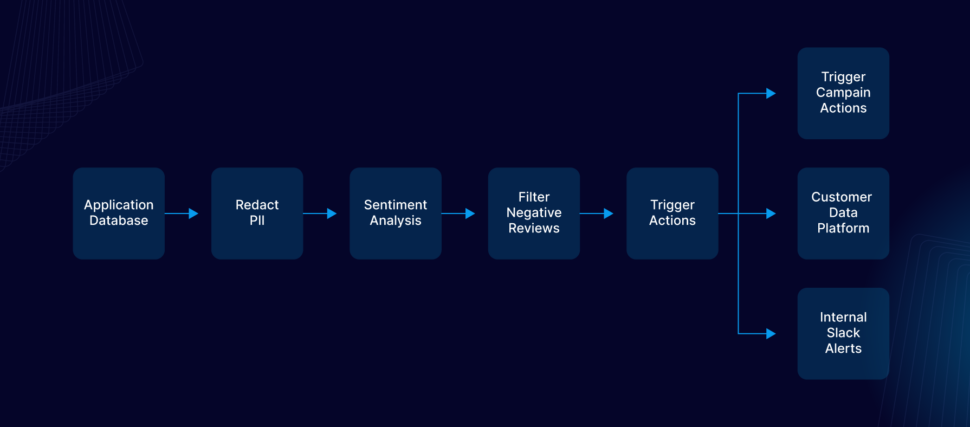
We’ll walk you through the design covering the following,

  1. Building the AI Agent using Striim’s open processor
  2. Using Change Data Capture (CDC) technology to capture the review contents in real time using Striim Oracle CDC Reader.
  3. Group the negative reviews in Striim partitioned windows
  4. Generate real time notifications using Striim Alert manager if the number of negative reviews exceeds the threshold values and transform them into actions for the business.
Why Sentiment Analysis using Foundation Models? How is it different from traditional Machine Learning Based Approaches?

Sentiment analysis has traditionally relied on supervised machine learning models trained on labeled datasets, where each text sample is explicitly categorized as positive, negative, or neutral. These models typically require significant pre-processing, feature engineering, and domain-specific training to perform effectively. However, foundation models, such as large language models (LLMs), simplify sentiment analysis by leveraging their vast pretraining on diverse text corpora.

One of the key differentiators of foundation models is their unsupervised learning approach. Unlike traditional models that require labeled sentiment datasets, foundation models learn patterns, relationships, and contextual meanings from large-scale, unstructured text data without explicit supervision. This enables them to generalize sentiment understanding across multiple domains without additional training.

Why Real-Time Streaming Instead of Batch Jobs?

Real-time sentiment analysis enables businesses to make swift, data-driven decisions by transforming customer feedback, social media discussions, and other textual data into actionable insights as they occur. Unlike batch-based analysis, which processes data in scheduled intervals, real-time analysis ensures that organizations can respond immediately when sentiment changes.

  • Instant Decision-Making – Businesses can act on customer feedback, social media trends, and emerging issues in the moment, rather than waiting for delayed batch processing. This allows proactive engagement rather than reactive damage control.
  • Crisis Management – In cases of negative publicity, brand reputation issues, or product complaints, real-time sentiment analysis enables companies to intervene quickly, mitigating risks before they escalate.
  • Enhanced Customer Experience – Organizations can integrate real-time sentiment analysis with tools like Slack, Salesforce, and Microsoft Dynamics, allowing automated alerts and instant responses to customer feedback. This improves customer satisfaction and fosters stronger relationships.
  • Competitive Advantage – Companies that react faster to market sentiment gain a strategic edge over competitors who rely on delayed batch analysis, enabling them to pivot business strategies and marketing efforts in real time.
  • Dynamic Trend Monitoring – Social media sentiment and public opinion shift rapidly. Real-time analysis ensures businesses stay updated on trending topics, emerging concerns, and viral events, helping them adjust messaging and engagement strategies on the fly.
  • Fraud and Risk Detection – In industries like finance and cybersecurity, real-time sentiment analysis can detect anomalies and suspicious activities (e.g., sudden spikes in negative sentiment around a stock or service) and trigger automated responses to mitigate risks proactively.

By integrating real-time sentiment analysis into business communication and CRM platforms like Slack, Salesforce, and Microsoft Dynamics, organizations can automate workflows, trigger alerts, and enable teams to respond instantly to sentiment shifts—leading to smarter decision-making, better customer experiences, and greater operational efficiency.

Problem statements

A centralized Oracle database is used by the feedback systems.

The business analytics team has been collecting the feedback in batches, manually process and coming up with insights to improve the customer experience at the stores with negative feedback. 

  1. Real-time data synchronization : The submitted feedback must be captured in real-time without impacting the performance of the centralised Oracle database
  2. Real-time analysis of the feedback : The captured feedback must be immediately analysed to figure out the sentiment.
  3. Real-time windowing and notification : The negative feedback should be grouped by stores, notifications should be generated upon hitting threshold and sent to the external system for converting the data to action.

Solution

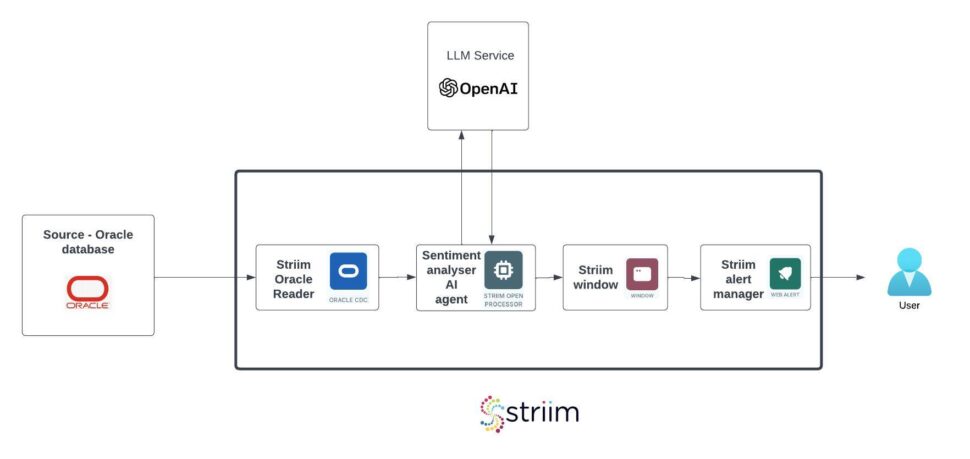
Striim has all the necessary features for the use case and the problem statements described.

  1. Reader : Capture real-time changes from Oracle database.
  2. Open processor : Extended program used to analyse the real time events carrying the content of the feedback using AI.
  3. Continuous query : Filter the negative review and send downstream
  4. Partitioned window : Group the negative reviews for each store and send downstream upon hitting threshold.
  5. Alert subscription : Send web alert notification to the user whenever the partitioned window sends down an event.
Step by step instructions

Set up Striim Developer 5.0

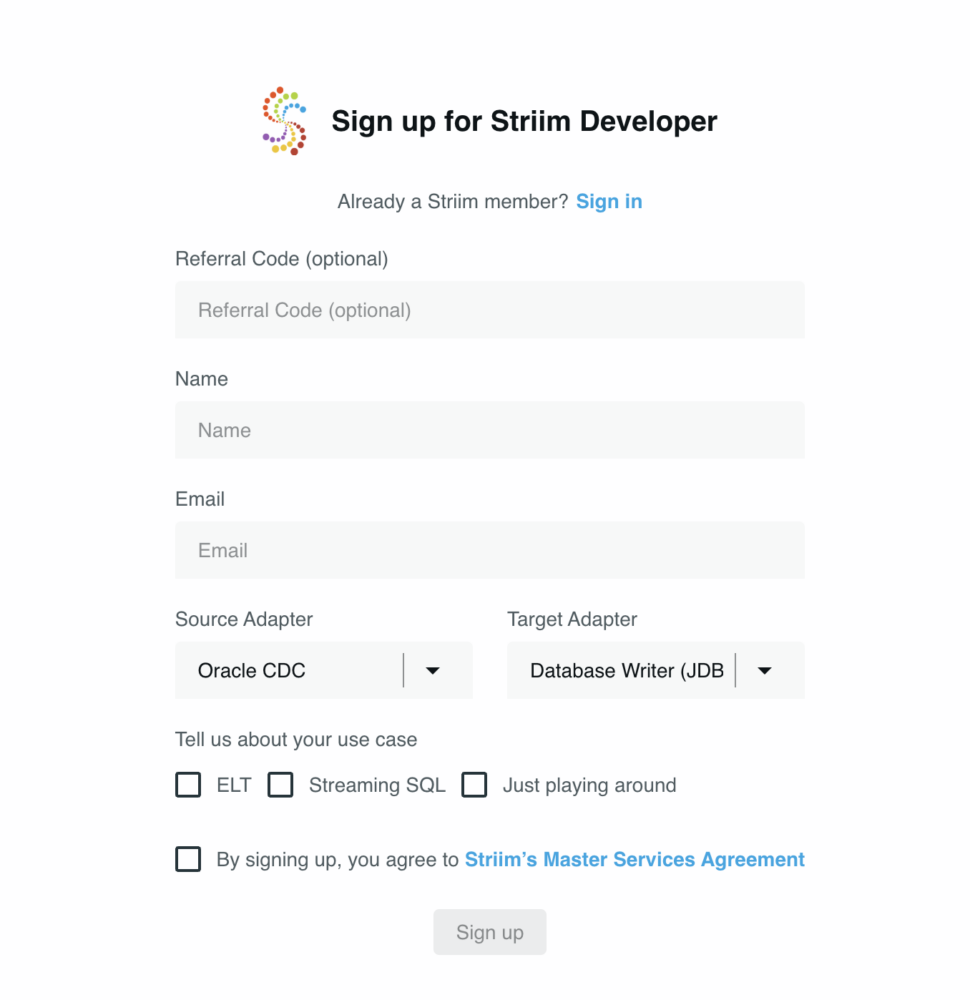
  1. Sign up for Striim developer edition for free at https://signup-developer.striim.com/.
  2. Select Oracle CDC as the source and Database Writer as the target in the sign-up form.
Prepare the table in Oracle

A simple table is created in the Oracle database and is used for the demo :

				
					CREATE TABLE STORE_REVIEWS(
REVIEW_ID VARCHAR(1024),
STORE_ID VARCHAR(1024),
REVIEW_CONTENT varchar(1024))


Create the Striim application

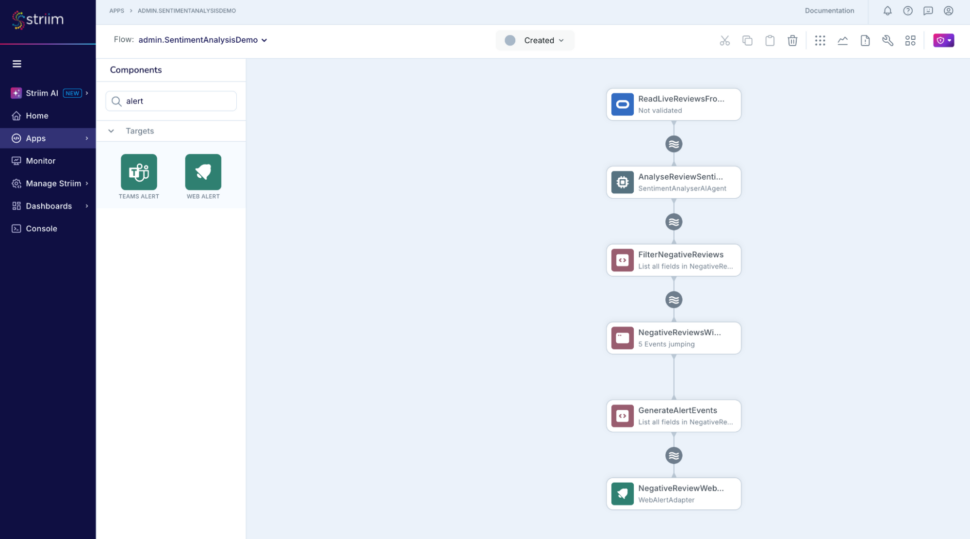
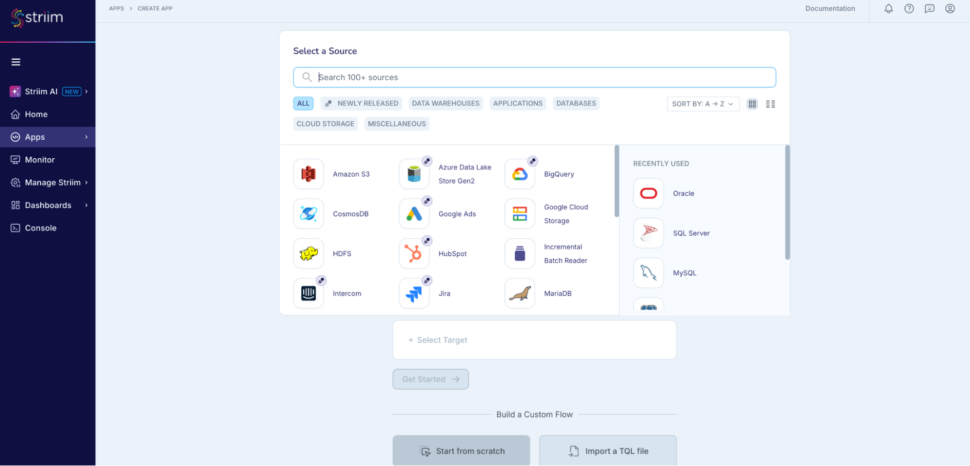
Step 1: Go to Apps -> Create An App -> Start from scratch -> name the app
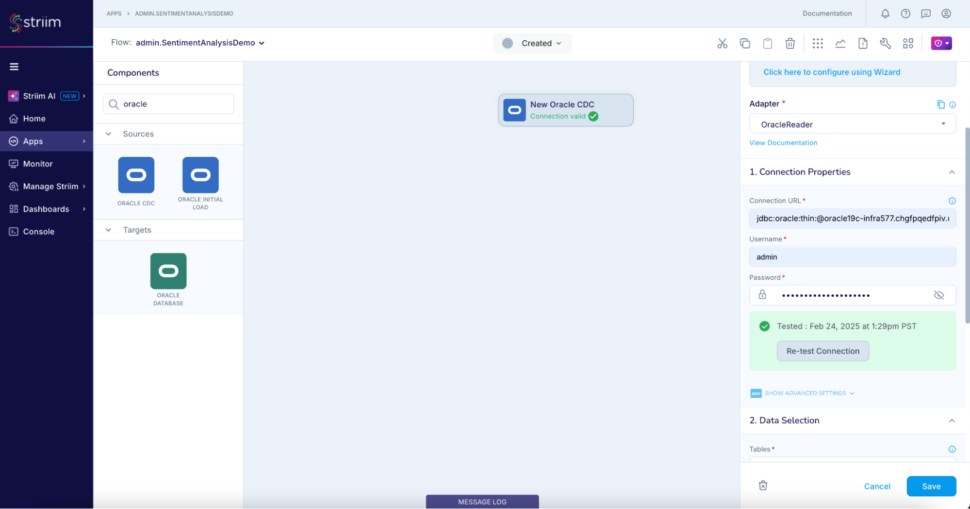
Step 2: Add an Oracle CDC reader to read the live reviews from the oracle database
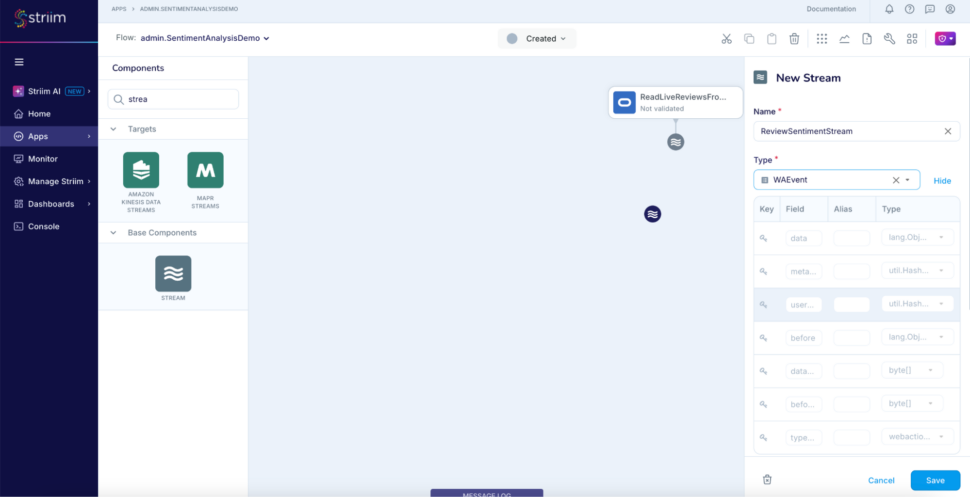
Step 3: Add another stream to use as output for the analyser AI agent
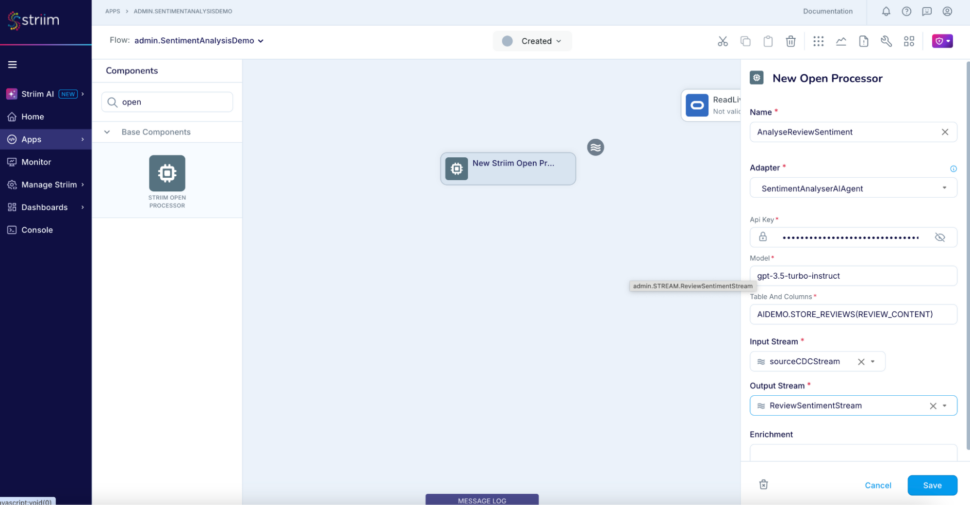
Step 4: Add an open processor  using SentimentAnalyser AIAgent to analyse the sentiment of the value of column REVIEW_CONTENT

				
					code here;


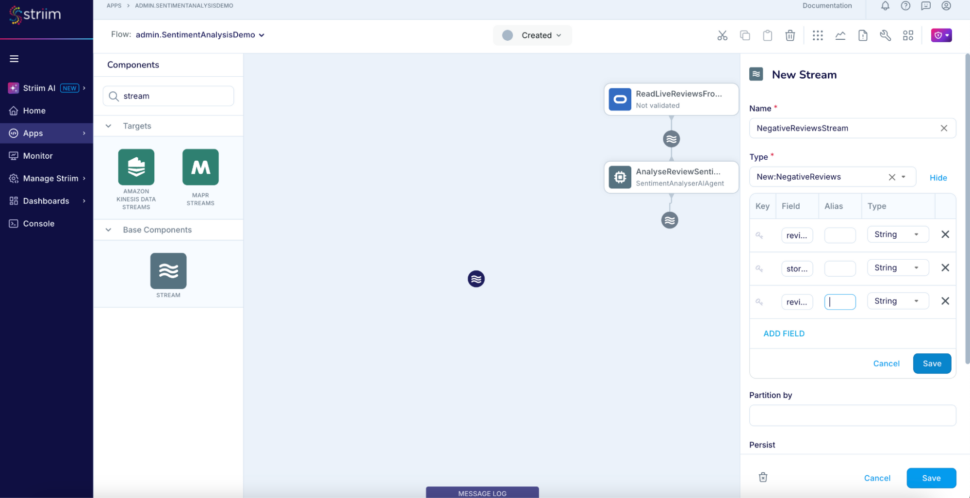
Step 5: Add another stream named NegativeReviewsStream to use a typed stream as output for the Continuous Query component which filters the negative reviews. Add a new type while defining the stream with three fields review_id. store_id, review_sentiment.
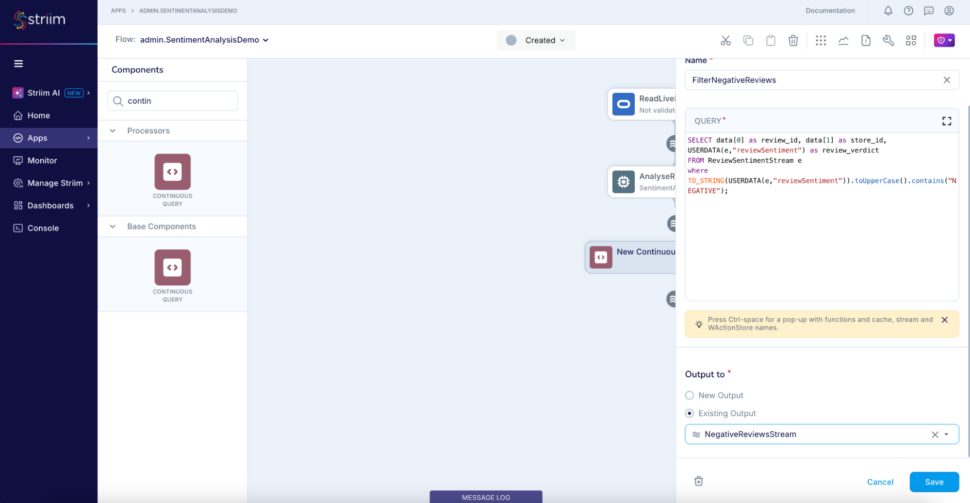
Step 6: Add a CQ that takes input from the ReviewSentimentStream, filters and outputs only the negative reviews to the stream we just created – NegativeReviewsStream.

				
					SELECT data[0] as review_id, data[1] as store_id, USERDATA(e,"reviewSentiment") as review_verdict
FROM ReviewSentimentStream e
where TO_STRING(USERDATA(e,"reviewSentiment")).toUpperCase().contains("NEGATIVE")


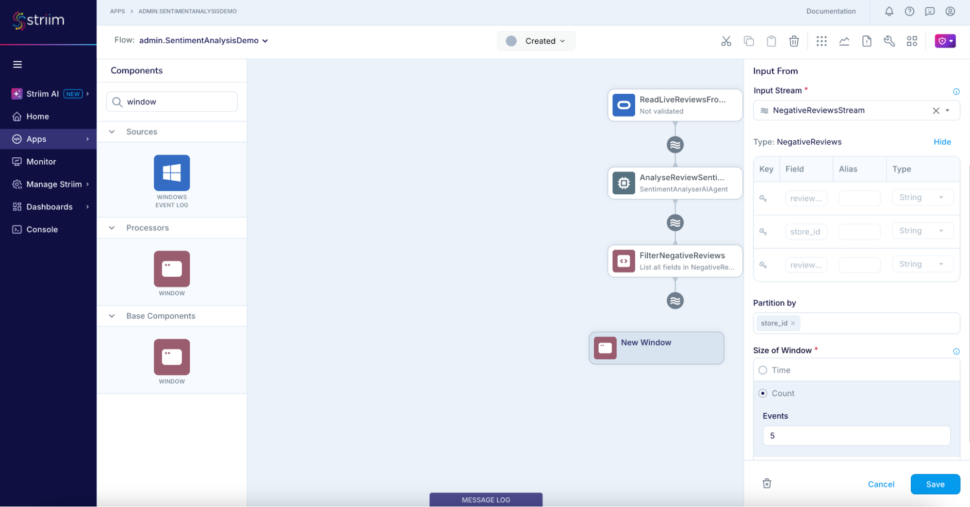
Step 7: Add a jumping window to partition the negative reviews based on the store_id which will be consumed downstream for generating the alert below.
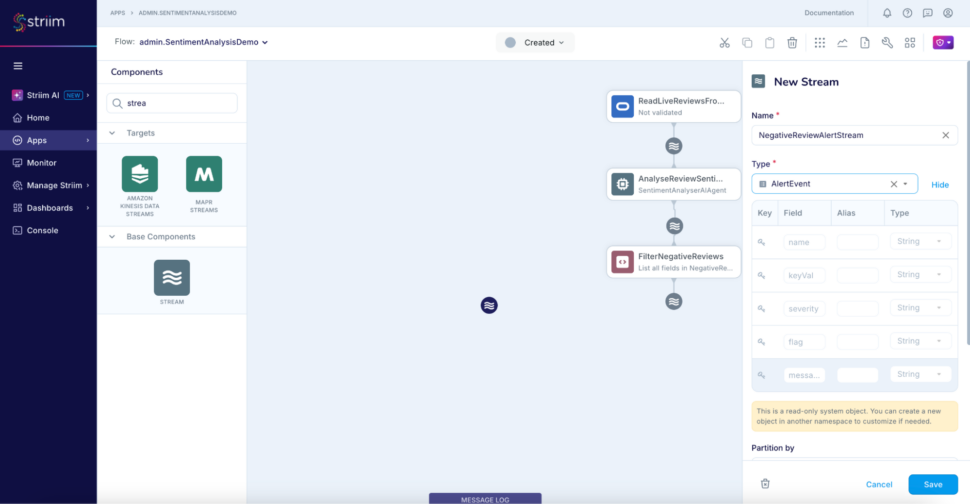
Step 8: Add another stream NegativeReviewAlertStream of type AlertEvent to use for the alert subscription.
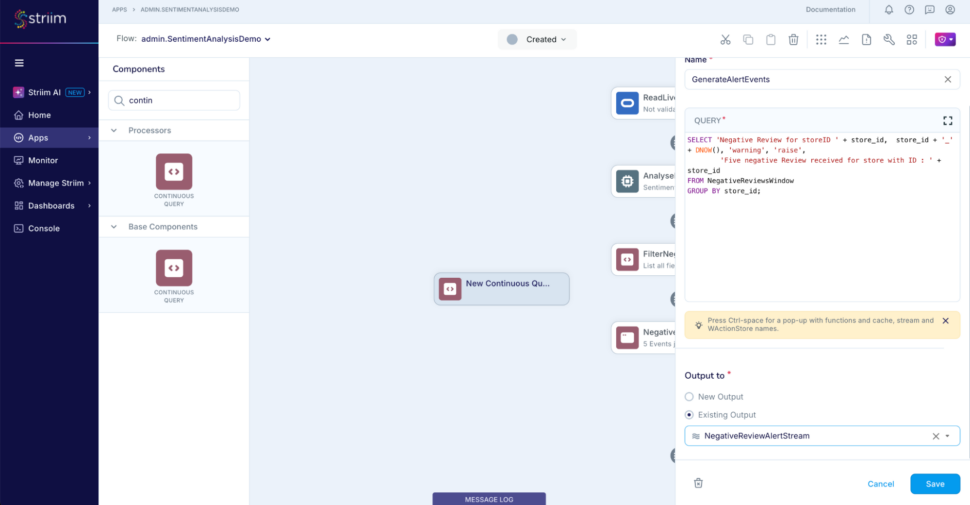
Step 9: Add the final CQ to construct the alerts whenever the window releases an event

				
					SELECT 'Negative Review for storeID ' + store_id,  store_id + '_' + DNOW(), 'warning', 'raise',
        'Five negative Review received for store with ID : ' + store_id
FROM NegativeReviewsWindow
GROUP BY store_id


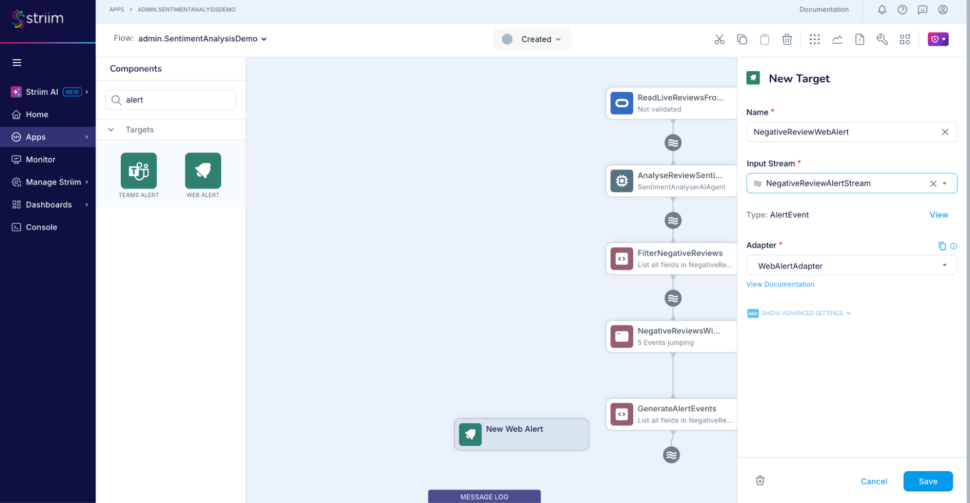
Step 10: Add a web alert subscription and use the stream NegativeReviewAlertStream as input
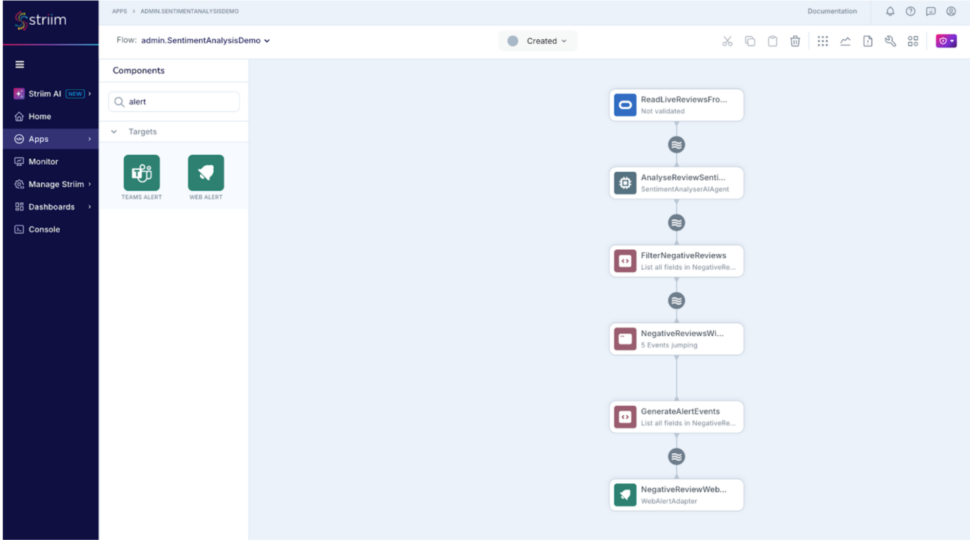
Finally the application should look like this :
(please note that you can alternatively import this TQL and modify the connection details and credentials as necessary as well : RealtimeSentimentAnalysisDemo.tql
Run the Streaming application with AI Agent

Following DMLs are used for demonstration purposes : 

				
					-- A positive review for store 1	
INSERT INTO STORE_REVIEWS values(1001,'0e26a9e92e4036bfaa68eb2040a8ec97','Great in-store customer service and helpful staff. Found exactly what I was looking for!');
-- A neutral review for store 1
INSERT INTO STORE_REVIEWS values(1002,'0e26a9e92e4036bfaa68eb2040a8ec97','The store was fine, but nothing stood out. Average shopping experience.');
-- A negative reviews for store 2
INSERT INTO STORE_REVIEWS values(1003, 'ed85bf829a36c67042503ffd9b6ab475', 'The store is understaffed. The products are not organised well.')
-- 5 negative reviews for store 1
INSERT INTO STORE_REVIEWS values(1004,'0e26a9e92e4036bfaa68eb2040a8ec97','The store was messy and disorganized. Hard to find what I needed.');
INSERT INTO STORE_REVIEWS values(1005,'0e26a9e92e4036bfaa68eb2040a8ec97','Terrible experience, long lines, and the staff was rude. Wont be coming back.');
INSERT INTO STORE_REVIEWS values(1006,'0e26a9e92e4036bfaa68eb2040a8ec97',' waited too long to check out, and the cashier was unhelpful.');
INSERT INTO STORE_REVIEWS values(1007,'0e26a9e92e4036bfaa68eb2040a8ec97','The store was out of stock for many items. Very frustrating.');
INSERT INTO STORE_REVIEWS values(1008,'0e26a9e92e4036bfaa68eb2040a8ec97','The return policy is terrible, and I had to wait forever to get help.');


A combination of 5 reviews are generated for one store in this example, this would mean that the AI agent would categorise these and the jumping window will release an event downstream for the store and the web alert adapter would publish a web alert.

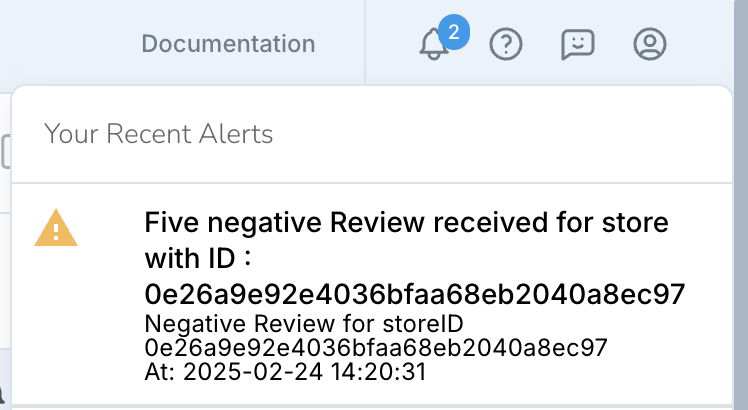
The can also be configured as a slack or a teams alert using Striim’s other alert subscription components. More here – https://www.striim.com/docs/platform/en/configuring-alerts.html

There we go! Data to decisions and AI in real-time.

SentimentAnalyser AI Agent Implementation

Please follow the instructions in Striim docs to build and load the open processor – https://www.striim.com/docs/platform/en/using-striim-open-processors.html

Download the java class SentimentAnalyserAIAgent from this location and the modified pom.xml file from this location.

Conclusion

Experience the power of real-time sentiment analysis with Striim. Get a demo or start your free trial today to see how you can convert real time data to decision coupled with AI techniques to deliver better, faster, and more responsive customer experiences.

Why Real-Time Data Will Define 2025

AI adoption is accelerating, but most enterprises are still stuck with outdated data management. The organizations that win in 2025 won’t be the ones with the biggest AI models—they’ll be the ones with real-time, AI-ready data infrastructures that enable continuous learning, adaptive decision-making, and assist regulatory compliance at scale.

What’s changing? The shift to always-on data pipelines, AI governance built for real-time, and architectures that unify multi-cloud complexity. Here’s what’s coming next (and why the winners are already making moves today).

1. Real-Time Data is the Baseline

For decades, businesses have treated data latency as a tolerable issue. That era is over. The shift from batch to real-time data pipelines is an existential requirement for AI-driven businesses.

Static AI models trained on stale data will deliver poor outcomes. Whether it’s anomaly detection, predictive analytics, or AI-powered decision-making, AI needs live data streams to work effectively. This is why companies are abandoning traditional ETL in favor of Change Data Capture (CDC) and event-driven architectures.

Events (deposits and withdrawals) are captured and streamed in real time using change data capture.

At Striim, we’re seeing enterprises move to always-on data pipelines that integrate with AI applications in real time. AI-driven decision-making needs millisecond-level freshness, not insights delayed by hours or days. If your AI isn’t reacting in real time, it’s already obsolete.

2. AI Governance Requires Detecting and Classifying PII in Flight

The last 18 months have seen a surge in AI regulatory frameworks, and enterprises must navigate a new reality where AI decisions will be scrutinized at every level. Enterprises must also solve practical problems to ensure AI models don’t have access to customer PII.

The problem? Most companies still operate with outdated data governance policies that aren’t built for AI. If your governance model doesn’t account for real-time data flows and LLM models, you have some catching up to do.The solution is a continuous compliance approach, where security, governance, and access controls happen dynamically. 

We see organizations implementing real-time data lineage tracking, automatic PII detection, and encryption at the ingestion layer—not as an afterthought, but as an integral part of the data pipeline. By combining AI-ready data lakes with fine-grained, real-time access controls, enterprises can work towards compliance without sacrificing speed. 

Microsoft Fabric, for example, enables governance at scale, making it easier to enforce real-time security policies across AI applications.

3. Hybrid and Multi-Cloud is the Default… But That’s Not Enough

For years, technical leaders have debated cloud vs. on-prem. The reality is, in 2025, every company is multi-cloud by default—whether they planned to be or not. SaaS sprawl, vendor lock-in concerns, and performance optimization mean enterprises now run workloads across AWS, Azure, GCP, and private clouds.

The challenge now isn’t deciding where to store data—it’s ensuring seamless real-time movement between these environments. This is why we’re seeing rapid adoption of cross-cloud data fabrics, where organizations treat data infrastructure as a fluid, event-driven system rather than a collection of disconnected storage silos.

With Microsoft Fabric’s OneLake and Striim’s real-time CDC technology, enterprises can create a single, AI-powered data layer that unifies ingestion, transformation, and analytics regardless of where the data originates.

4. Build AI for Business Outcomes, Not the Hype

AI adoption is often driven by technology-first thinking, where enterprises chase the latest model instead of solving real problems. In 2025, this approach will fail.

The shift is towards AI that drives measurable business impact, rather than AI that exists for its own sake. That means:

  • AI must be deeply embedded in real-time business processes, not just dashboards.
  • Models must be continuously trained on the freshest, most relevant data, not just historical snapshots.
  • AI applications must be iterative and adaptable, evolving alongside changing business needs.

Organizations truly succeeding with AI are integrating  into live decision-making loops, where insights automatically trigger actions. For example, streaming fraud detection models in financial services do more than just identify risks—they initiate automated responses in real time.

The companies that win with AI will be the ones that build adaptive, event-driven architectures that continuously improve with every data point that enters the system.

5. Retrieval-Augmented Generation (RAG) Will Separate AI Winners from the Rest

Most AI models today generate insights based on publicly available data or predefined training sets. This is no longer good enough. The next phase of enterprise AI is RAG (Retrieval-Augmented Generation): models dynamically pull in real-time enterprise data before generating responses.

RAG introduces a  fundamental shift in how AI interacts with business operations. Instead of relying on static knowledge, RAG-based systems connect directly to live operational databases, SaaS applications, and event streams to produce context-aware, business-specific insights.

In my opinion, the impact of RAG will be widespread and profound, resulting in:

  • AI-generated insights grounded in real business reality instead of generic knowledge.
  • Enterprises maintaining tight control over their proprietary data and reduce compliance risks.

AI is moving from being a static analysis tool to a real-time decision-making engine. And as AI moves into mission-critical workflows, RAG becomes a requirement rather than an option.

The Road Ahead: Real-Time AI is the Only AI That Matters

We are at the tipping point where real-time data infrastructure and AI are converging. The companies that recognize this will redefine industries, while those that cling to legacy architectures will fall behind.

2025 will belong to organizations that build real-time, AI-ready infrastructures that continuously adapt, govern, and act on data the moment it is created.

At Striim, we’re enabling this shift by helping enterprises move beyond batch processing and into the world of always-on, real-time AI pipelines. Microsoft Fabric is accelerating this movement, providing a unified foundation for real-time analytics, governance, and AI integration.

If you want to see these trends in action, check out our recent webinar, Data and AI Trends 2025. And if you’re heading to FabCon in Las Vegas March 31-April 2, don’t miss our session on Real-Time Data for Real-Time AI—where we’ll show how enterprises are making real-time AI a reality today.

Simplify User Access with SSO Support for On-Premise Striim

In the latest Striim 5.0 release, we are excited to introduce a highly anticipated feature: Single Sign-On (SSO) support for on-premise Striim. This new capability empowers users to access Striim seamlessly using their existing corporate credentials, streamlining the login process and enhancing security. Let’s dive into what this feature does, how to use it, and how Striim adds value to your business.

What Does SSO Support Do?

Traditionally, users needed to manage multiple sets of credentials, such as usernames and passwords, for each enterprise application, including Striim. With the introduction of SSO support, Striim now integrates with popular identity providers such as Microsoft Entra ID (formerly Azure AD) and Okta, enabling customers to use a single set of login credentials across multiple enterprise systems.

SSO utilizes the SAML 2.0 protocol, allowing Striim users to log in without having to remember separate usernames and passwords for each application. By eliminating this friction, the user experience becomes more streamlined and secure.

How Do You Use It?

Striim offers two methods for setting up SSO:

  1. Identity Provider (IDP) Initiated Login: In this method, the user launches Striim from the Azure AD App Gallery. They are automatically federated through the Identity Provider (IDP), completing the login process.
  2. Service Provider (SP) Initiated Login: Here, the user starts the login process directly within Striim. Striim redirects them to Azure Entra or Okta (the IDP), where they authenticate, and then they are returned to Striim.

These two options give flexibility in how users can access Striim, ensuring that the setup aligns with your enterprise’s workflow.

Want to dive deeper? Check out the doc and explore more.

How Does Striim Add Value?

The addition of SSO support provides numerous advantages for both users and businesses:

  • Enhanced Security and Compliance: With SSO and Multi-Factor Authentication (MFA) support via Entra or Okta, Striim meets enterprise information security requirements for authentication and authorization. This helps businesses maintain compliance with security standards while reducing the risk of password-related breaches.
  • Simplified User Management: Striim users can now be managed directly through their Entra or Okta dashboards, making it easier for IT teams to control access and permissions, just like they do with other enterprise software. This centralization simplifies administration and improves user access management.

Transform Your Business with SSO Support for On-Premise Striim – Try It Today!

Striim 5.0’s SSO feature brings a new level of convenience and security to your enterprise applications. By allowing your users to access Striim with their existing credentials from Microsoft Entra ID or Okta, you can streamline workflows, improve security, and reduce administrative overhead. Ready to power your business with real-time data? Try Striim today with a free trial or book a demo to see it in action.

Start Your Free Trial | Schedule a Demo

Elevate Your Data Security with Customer Managed Key Encryption – Discover Striim Shield

As businesses embrace digital transformation, safeguarding sensitive information is critical. Striim 5.0 brings a powerful new feature: Striim Shield, that enables customers to take control of their data encryption through Customer Managed Keys. This innovative feature empowers organizations to securely manage their data before it flows further downstream while ensuring compliance with business policies and industry regulations. Let’s explore what Striim Shield can do for you and how it adds value to your business.

What Does Striim Shield Do?

Striim Shield allows users to encrypt specific data fields using keys provided by the customer through Google KMS (Key Management Service). This encryption ensures that sensitive data is securely stored in external targets, while customers maintain control over the encryption keys used. The keys are refreshed regularly (every few days), ensuring that your data stays secure over time. Striim does not manage these keys, giving customers the autonomy to handle their encryption requirements.

How Do You Use Striim Shield?

Users only have to specify the field to be encrypted and link Shield with their Google KMS.  Shield uses Google Tink, an open-source encryption library developed by Google Cloud, for envelope encryption operations. The data encryption key is encrypted in-memory with the customer’s Google KMS key and published along with the encrypted data.   

Google KMS manages the key operations to ensure that different keys are used during the encryption. There are two modes for key refresh:

  • Time-based refresh (set to refresh every 1 day by default)
  • Event-based refresh (refreshes after a set number of events)

To decrypt the data, customers must use their Google KMS keys that they provided during the encryption by Shield. Customers can encrypt the  encrypted message using Striim Shield, or they can do it outside of Striim using Google Tink. 

Want to dive deeper? Check out the doc and explore more.

How Does Striim Add Value?

  • Striim Shield delivers several key advantages for businesses: Data Control: Customers retain full control of their data encryption and encrypted data, ensuring sensitive information is protected according to their business needs or regulatory requirements.
  • Built for Longevity: Google Tink, maintained by Google Cloud, ensures that Striim Shield is always up to date, backward-compatible, and built to last.
  • Security and Transparency: Striim does not create, store or manage encryption keys, guaranteeing that customers maintain full control over the encryption and their sensitive data.
  • Granular Encryption: You can encrypt selected columns or fields, enabling more precise control over which data is encrypted before being written to the target. 
  • Collaboration with Security: Share datasets with internal or external teams without compromising sensitive data, using encryption to manage access to critical fields.

Transform Your Business with Striim Shield – Try It Today!

Striim 5.0’s Striim Shield gives your organization a robust, secure way to manage data encryption while fostering collaboration and ensuring compliance. Ready to power your business with real-time data? Try Striim today with a free trial or book a demo to see it in action.

Start Your Free Trial | Schedule a Demo

Back to top