Enabling Seamless Cloud Migration and Real-Time Data Integration for a Nonprofit Educational Healthcare Organization with Striim

A nonprofit educational healthcare organization is faced with the challenge of modernizing its critical systems while ensuring uninterrupted access to essential services. With Striim’s real-time data integration solution, the institution successfully transitioned to a cloud infrastructure, maintaining seamless operations and paving the way for future advancements.

About the Nonprofit Educational Healthcare Organization

This nonprofit educational healthcare organization is committed to providing students with the knowledge and skills needed to succeed in the medical field. Serving thousands of students, it offers a variety of programs designed to prepare individuals for careers in allied health. The institution prioritizes student success by delivering high-quality education, supported by a robust infrastructure that ensures access to essential resources and services. Through its mission-driven approach, the institution plays a vital role in meeting the growing demand for healthcare professionals.

Challenge

This non-profit educational healthcare organization is navigating a dual challenge: migrating its core Student Information System (SIS) to a modern Azure SQL Server infrastructure while maintaining seamless data integration with their on-premise SQL Server databases. With student data central to daily operations and long-term outcomes, real-time data replication between the cloud and legacy systems ensures continuity and accessibility across platforms.

However, while the SIS migration was a significant step forward, the institution’s on-premise SQL Server systems remained vital. These legacy systems were deeply embedded into the institution’s infrastructure, supporting critical applications for student services. The challenge was not just migrating to the cloud but ensuring that the on-premise systems, still housing essential services, could continue to operate seamlessly and in real time with the cloud-based SIS.

This setup presented several technical hurdles. The reliance on SQL-based integrations had already caused performance bottlenecks, particularly around the API-driven data capture required for student inquiries and real-time updates. 

Without a solution to ensure uninterrupted access to both systems, the institution risked compromising student satisfaction, potentially leading to operational delays, downtime, and an overall negative student experience. Thus, the migration needed to ensure minimal disruption while maintaining the integrity and availability of critical data.

Solution 

In response to this challenge, the institution sought a partner that could help them achieve their dual goals: enabling cloud migration while supporting continued access to legacy on-premise systems. After evaluating various options, they selected Striim for its real-time data integration and streaming capabilities.

Striim’s solution was particularly suited to address the institution’s unique needs. Through Striim’s platform, real-time data capture and integration between the cloud-based Azure SQL Server and on-premise SQL Server systems were facilitated with minimal latency, ensuring that both systems remained in sync at all times. This was crucial for guaranteeing uninterrupted access to student records, class schedules, and other key services.

A key component of the solution was Striim’s in-memory processing capability. By leveraging this technology, Striim was able to efficiently capture, process, and transform data in real-time, reducing the reliance on custom-built integration solutions. This not only reduced the institution’s costs but also simplified the entire process, minimizing the need for ongoing development and maintenance efforts. With Striim, the organization could confidently migrate its SIS to the cloud while maintaining seamless data flow between the cloud and legacy on-premise systems.

Moreover, the integration allowed the institution to maintain critical student-facing applications, such as portals for class registration and transcript requests, without experiencing downtime. This real-time synchronization provided a stable environment that improved the student experience during a period of significant technological transition.

Results 

The partnership between Striim and the nonprofit educational healthcare organization resulted in several tangible benefits that went beyond ensuring a smooth cloud migration. Striim’s real-time data integration not only ensured operational continuity but also created opportunities for future growth, enhancing the institution’s ability to leverage data for more advanced use cases.

Real-Time Data Access:
Striim’s platform enabled immediate access to student, faculty, scheduling information, eliminating delays that had previously hindered the institution’s ability to serve its students. This real-time access provided more responsive services, allowing students to receive up-to-date information at any time, enhancing their overall experience.

Improved Response Time:
The seamless integration of real-time data also improved the institution’s ability to respond quickly to inquiries from prospective students. As a result, response times to student inquiries were significantly shortened. This quicker response fostered better communication between prospective students and admissions staff, creating a more positive experience for applicants.

Increased Conversion Rates:
The operational efficiency gained through Striim’s data integration helped the institution streamline its processes, and can result in improved conversion rates for prospective students. With faster access to accurate, up-to-date information, administrative staff were better equipped to assist prospective students in their decision-making process, ultimately increasing enrollment rates.

Seamless Integration of Systems:
Striim’s real-time data streaming and in-memory processing ensured that critical systems across both the cloud and on-premise environments remained fully synchronized. This seamless integration was particularly important for student-facing and administrative functions. By maintaining up-to-date, synchronized data, the institution ensured that students and staff had continuous access to the information they needed without disruption.

Foundation for Future Initiatives:
Perhaps most importantly, the nonprofit educational healthcare organization’s new cloud-based infrastructure, empowered by Striim’s real-time data integration, provided a strong foundation for future innovations. With the flexibility of real-time data streaming and a scalable cloud environment, the institution is now well-positioned to explore advanced analytics and AI-driven insights. This can lead to further improvements in student services, operational efficiencies, and decision-making.


Optimizing Sales Strategies: Harnessing AI and Go-to-Market Data with Everett Berry from Clay

Everett Berry returns to the show with a treasure trove of insights on reshaping sales strategies through cutting-edge go-to-market data and AI advancements. Discover how Everett’s journey from prior roles to his pivotal role at Clay has equipped him to tackle the challenges of cleaning and enriching go-to-market data. He unveils how Clay’s innovative tools enhance data accuracy and coverage, empowering businesses to streamline their revenue operations by effectively leveraging both internal and third-party data. If you’re eager to work smarter and optimize your sales and marketing strategies, this episode promises invaluable lessons from a seasoned expert.


As AI technology rapidly evolves, Everett and John explore its transformative potential in sales operations and revenue processes. We dissect the interplay between AI agents and human interactions, the integration of customer data platforms with CRMs, and the blurred boundaries between RevOps and data teams. Imagine a future where AI agents autonomously manage data tasks, reshaping organizational structures and emphasizing collaboration between data and go-to-market teams. This episode is a must for those keeping pace with the swift evolution of sales technology, offering a glimpse into the future of autonomous data management and its implications for business success.

From Apache Kafka to PostgreSQL, PostgreSQL maturity, and building on PostgreSQL with Gwen Shapira

What does it take to go from leading Kafka development at Confluent to becoming a key figure in the PostgreSQL world? Join us as we talk with Gwen Shapira, co-founder and chief product officer at Nile, about her transition from cloud-native technologies to the vibrant PostgreSQL community. Gwen shares her journey, including the shift from conferences like O’Reilly Strata to PostgresConf and JavaScript events, and how the Postgres community is evolving with tools like Discord that keep it both grounded and dynamic.

We dive into the latest developments in PostgreSQL, like hypothetical indexes that enable performance tuning without affecting live environments, and the growing importance of SSL for secure database connections in cloud settings. Plus, we explore the potential of integrating PostgreSQL with Apache Arrow and Parquet, signaling new possibilities for data processing and storage.

At the intersection of AI and PostgreSQL, we examine how companies are using vector embeddings in Postgres to meet modern AI demands, balancing specialized vector stores with integrated solutions. Gwen also shares insights from her work at Nile, highlighting how PostgreSQL’s flexibility supports SaaS applications across diverse customer needs, making it a top choice for enterprises of all sizes.

Follow Gwen on:

Nile Blog: https://www.thenile.dev/blog
X (Twitter): https://x.com/gwenshap
LinkedIn: https://www.linkedin.com/in/gwenshapira/
Nile Discord: https://t.co/kxPgnbSyud

Morrisons Updates Data Infrastructure to Drive Real-Time Insights and Improve Customer Experience

Morrisons, a leading UK-based supermarket chain, is modernizing its data infrastructure to support real-time insights and operational efficiency. By embracing advanced data integration capabilities, Morrisons is transitioning to a more agile, data-driven approach. This shift allows the company to optimize processes, enhance decision-making, and ultimately improve the overall customer experience across its stores and online platforms.

About Morrisons

Morrisons is one of the UK’s largest supermarket chains, with over 100 years of experience in the food retail industry. Proudly based in Yorkshire, it serves customers across the UK through a network of nearly 500 conveniently located supermarkets and various online home delivery channels. With a commitment to quality, Morrisons sources fresh produce directly from over 2,700 farmers and growers, ensuring customers receive the best products. Dedicated to sustainability and community engagement, Morrisons continually invests in innovative solutions to enhance operations and improve the shopping experience.

Challenge 

Morrisons set out to modernize its data infrastructure to achieve five key goals:

  1. Elevating Customer Experience: Creating a better shopping experience for customers.
  2. Loading to Google Cloud: Transitioning to Google Cloud and leveraging Looker for enhanced reporting capabilities.
  3. Accessing Real-Time Data: Shifting from batch processing to real-time data access, enabling faster decision-making and improved operational efficiency.
  4. Enhancing Picking Efficiency: Morrisons sought to streamline their online picking process by improving stock visibility across depots and warehouses. 
  5. Improving On-Shelf Availability: Ensuring products are consistently in stock and accessible to customers.

To meet these goals, the team needed to move away from their legacy Oracle Exadata data warehouse and strategically align on Google Cloud. This involved transitioning their data to Google BigQuery as the new centralized data warehouse, which required not only propagating data but also ensuring real-time access for better decision-making and operational efficiency. Moreover, prior to this transition, Morrisons never had a centralized repository of real-time data, and only ever had batch snapshots delivered from its disparate systems.

“Retail is real-time. We have our online shop open 24/7, and we have products moving around our distribution network every minute of every day. It’s really important that we have a real-time view of how our business is operating,” shares Peter Laflin, Chief Data Officer at Morrisons. 

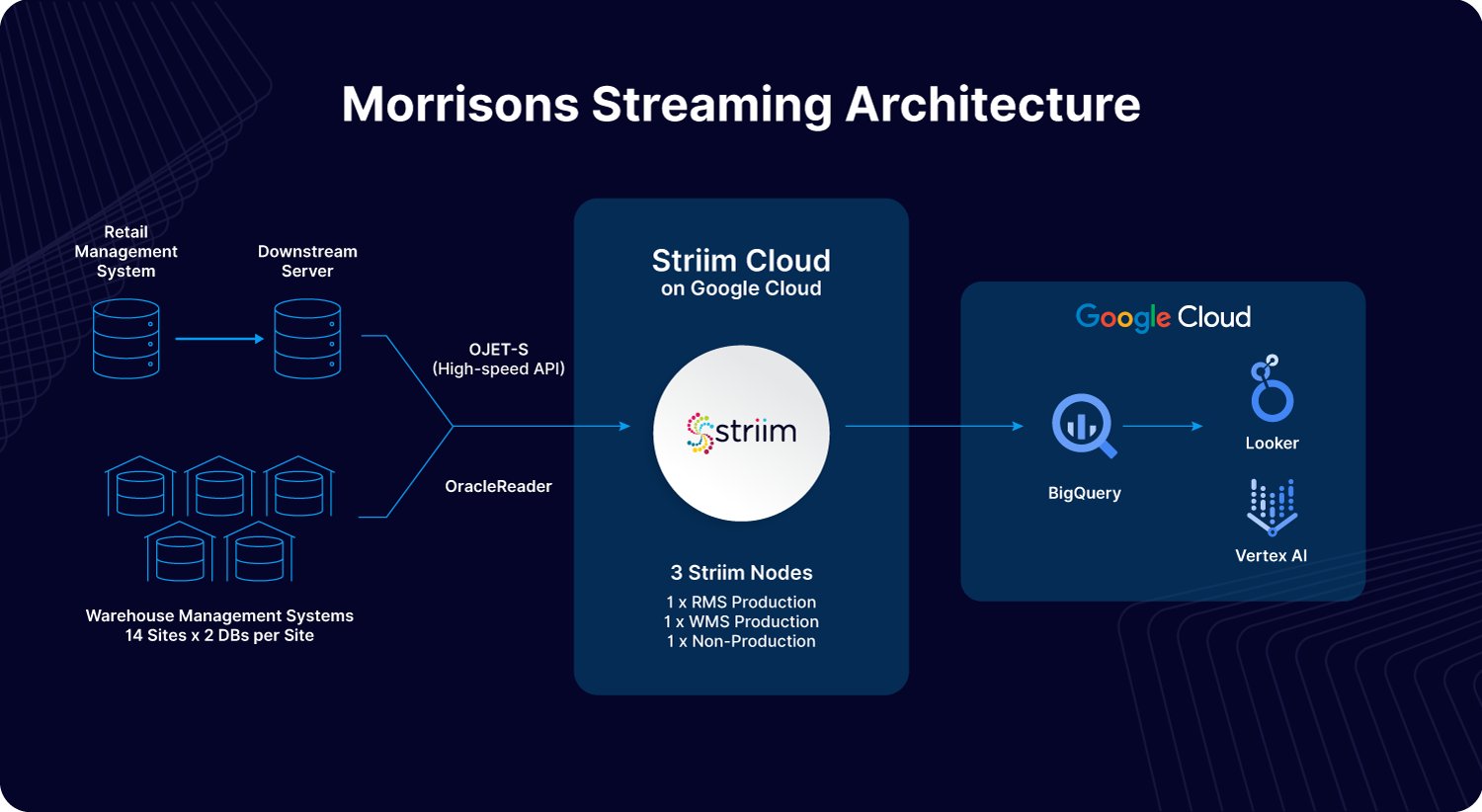
In order to accomplish this, Morrisons needed a tool that could connect their separate systems and seamlessly move data into Google Cloud. Striim was selected to ingest critical datasets, including the Retail Management System (RMS), which holds vast store transaction data and key reference tables, and the Warehouse Management Systems (WMS), which oversee operations across 14 distribution depots. The integration of these systems into BigQuery in real time provided critical visibility into product availability, stock levels, and core business metrics such as waste and shrinkage. Most importantly, Morrisons needed this mission-critical data delivered in real time. 

“We’ve moved from a world where we have batch-processing to a world where, within two minutes, we know what we sold and where we sold it,” shares Laflin. “That empowers senior leaders, colleagues in stores, colleagues across our logistics and manufacturing sites to understand where we are as a business right now. Real-time data is not a nice to have, real-time data is an absolute essential to run a business the scale and size of ours.” 

Morrisons sought to move away from their existing analytics suite and leverage Google Looker for their reporting and analytics needs. This meant they had to regenerate all existing reports that previously ran on the Exadata platform, aligning them with the new Google Cloud infrastructure. Striim played a critical role in centralizing their data in BigQuery and delivering it in real time, enabling Morrisons to power their reporting with fresh insights. This transformation is key to achieving their goal of a more agile, data-driven operation and supporting future business initiatives.

Solution 

Morrisons now leverages Striim to connect disparate systems and ingest critical datasets from their Oracle databases into Google Cloud, using BigQuery as their new centralized data warehouse. They required a solution that could seamlessly load data from multiple sources while providing real-time access through BigQuery, and Striim provides this. 

Striim plays a pivotal role in ingesting two core databases: the Retail Management System (RMS) and the Warehouse Management System (WMS). The RMS, a vast dataset containing store transaction tables and key reference data, requires efficient data transfer to minimize latency, and Striim ensures that this high volume of data is processed seamlessly.

Striim also ingests data from all 14 distribution depots, which are connected through 28 sources in the WMS. This integration provides real-time visibility into stock levels, enabling ‘live-pick’ decision-making by revealing what stock is available, where it is located, and at what time. Backed by real-time intelligence, this capability accelerates business processes that were previously reliant on periodic batch updates. As a result, Morrisons can optimize the replenishment process and ensure that shelves remain well-stocked, ultimately improving overall efficiency and increasing customer satisfaction.

Striim’s real-time data delivery powers Morrisons’ reporting transformation as they rebuild all reporting within Google Looker. By centralizing and accelerating the flow of data into BigQuery in real time, Striim enables faster, actionable insights that drive operational excellence and future business initiatives. “My team felt that Striim was the only tool that could deliver the requirements that we have,” shares Laflin.

Outcome 

By leveraging Striim to transition from batch processing to real-time data access, Morrisons has significantly enhanced their ability to track and manage three critical key performance indicators (KPIs): availability, waste, and shrinkage. With access to faster, real-time insights, executives can more effectively identify risks and implement strategies to mitigate them, ultimately leading to improved operational decision-making and better performance across the organization. This shift allows Morrisons to optimize their processes and drive positive outcomes related to these key metrics.

“Without Striim, we couldn’t create the real-time data that we then use to run the business,” shares Laflin. “It’s a very fundamental part of our architecture.”

The move towards real-time data has allowed Morrisons to identify that their shelf availability has notably improved, ensuring that products are consistently in stock and accessible to customers. Best-ever on-shelf availability in December 2024 boosted customer satisfaction, marking a significant milestone for Morrisons. As a result, they are beginning to uncover the full range of benefits that this transformation can bring, including enhanced inventory management and reduced waste.

From the customer perspective, better shelf availability translates into happier shoppers, as they can find the products they want when they visit stores. This improvement not only fosters customer loyalty but also positions Morrisons to compete more effectively in the marketplace, ultimately driving growth and enhancing overall customer satisfaction.


View Case Study

Striim’s Multi-Node Deployments: Ensuring Scalability, High Availability, and Disaster Recovery

In today’s enterprise landscape, ensuring high availability, scalability, and disaster recovery is paramount for businesses relying on continuous data flow and analytics. Striim, a leading platform for real-time data integration and streaming analytics, offers multi-node deployments that significantly enhance redundancy while delivering enterprise-grade capabilities for mission-critical workloads. This blog explores how Striim’s multi-node architecture supports these objectives, providing enterprises with a robust solution for high availability, scalability, and disaster recovery both as a fully managed cloud service, or platform that can be deployed in your private cloud and on-premises environments.

Multi-Node Deployments

This blog explores how Striim’s multi-node architecture supports these objectives, providing enterprises with a robust solution for high availability, scalability, and disaster recovery.

Multi-Node Architecture: A Foundation for Enterprise Resilience

At the heart of Striim’s mission-critical platform is its multi-node architecture. Multi-node deployments allow Striim to operate across several interconnected servers or nodes, each handling data processing, streaming, and analytics in tandem. This distributed architecture introduces redundancy, ensuring that even if one node fails, other nodes can continue operations seamlessly. This approach is essential for disaster recovery, high availability, and fault tolerance.

Multi-Node Architecture

1. Increasing Redundancy and Supporting Scalability

Redundancy is vital in distributed systems because it ensures that multiple copies of data and processing capabilities exist across nodes. Striim’s multi-node deployment increases redundancy by replicating workloads and data across several nodes. This means that in the event of a failure, another node can immediately take over, minimizing downtime and preventing data loss.

Additionally, Striim supports horizontal scalability. As data volumes grow—whether due to business expansion, increasing IoT devices, or heightened customer interactions—additional nodes can be added to the cluster to distribute the processing load. This ensures that the system can handle increasing demand without performance degradation, maintaining the ability to process millions of events per second across a distributed cluster.

2. High Availability Through Node Redundancy and Failover Mechanisms

For business-critical workloads, any downtime or data loss can have serious consequences. Striim addresses this concern by delivering high availability (HA) through node redundancy and automatic failover mechanisms. In a multi-node deployment, each node holds redundant copies of data and processing logic, ensuring that if one node fails, another can take over instantly without interrupting data flow.

Striim’s built-in failover automatically shifts workloads from a failed node to a functioning one, maintaining continuous service for real-time applications. This is critical for systems that demand high uptime, such as financial transactions, customer-facing dashboards, or logistics monitoring. Furthermore, Striim guarantees exactly-once processing, ensuring data integrity during node transitions and preventing duplicate or missed data events.

To provide a simple, declarative construct for node management and failover, Striim offers Deployment Groups which represent a group of one or more nodes with its own application and resource configurations. You can deploy Striim Apps to a Deployment Group, and that Deployment Group governs the runtime and resilience of the application. 

High Availability Through Node Redundancy and Failover Mechanisms

3. Disaster Recovery with Multi-Region and Cross-Cloud Support

In addition to failover, Striim’s multi-node deployment enhances disaster recovery (DR) by replicating data and services across geographically distributed nodes or across clouds. Enterprises can configure active-active or active-passive DR setups to quickly recover from catastrophic failures. By distributing nodes across multiple regions or clouds, Striim ensures that if one region experiences an outage, another can take over seamlessly, ensuring business continuity.

Striim’s cross-cloud capabilities offer additional flexibility, allowing organizations to distribute their infrastructure across different cloud providers. This architecture ensures resilience even in the face of regional outages, ensuring rapid recovery and reducing the risk of data loss. Additionally, Striim’s Change Data Capture (CDC) ensures that data is continuously synchronized between nodes, keeping all data consistent and up-to-date across the entire system.

Integrating Multi-Node Capabilities with In-Memory Technology

To provide real-time data streaming and analytics efficiently, Striim relies heavily on in-memory technology. Striim’s architecture allows for data to be cached in an in-memory data grid, enabling rapid data access without the latency of disk I/O. However, ensuring all nodes can process this data without time-consuming remote calls requires a tightly integrated design.

Striim’s multi-node deployment ensures that all system components—data streaming, in-memory storage, and real-time analytics—operate in the same memory space. This eliminates the need for costly remote calls, allowing for rapid joins and analytics on streaming data. By leveraging in-memory processing across a distributed cluster, Striim ensures that the system remains both highly performant and scalable, even under high data loads.

Security Across Nodes and Clusters

As enterprises scale their data processing across multiple nodes and regions, maintaining security becomes increasingly important. Striim addresses this need by employing a holistic, role-based security model that spans the entire architecture. Whether it’s securing individual data streams, protecting sensitive data in motion, or managing access to management dashboards, Striim provides comprehensive security across all nodes and processes in both Striim Cloud and Striim’s on-premise Striim Platform.

This centralized approach to security simplifies the task of managing access controls, especially in distributed systems where data and processes are spread across multiple locations. Striim’s role-based model ensures that all security policies are consistently applied across the entire system, reducing the risk of vulnerabilities while maintaining compliance with industry regulations.

Conclusion: Simplifying Enterprise-Grade Data Streaming

Striim’s multi-node deployments provide enterprises with a powerful, scalable, and resilient platform for real-time data streaming and analytics. By increasing redundancy, ensuring high availability through failover mechanisms, and supporting disaster recovery with multi-region and cross-cloud configurations, Striim enables businesses to maintain continuous operations even in the face of unexpected failures.

With Striim, enterprises can focus on deriving insights from their data without the need to invest in complex infrastructures or develop intricate disaster recovery strategies. Striim’s platform takes care of the complexities of distributed processing, in-memory analytics, and security, ensuring that business-critical workloads run smoothly and efficiently at scale.

By offering a unified solution for real-time data integration and streaming analytics, Striim empowers businesses to meet the demands of today’s data-driven world while maintaining the resilience and agility necessary to thrive in a competitive environment.


What is a Data Pipeline (and 7 Must-Have Features of Modern Data Pipelines)


Every second, customer interactions, operational databases, and SaaS applications generate massive volumes of information.

It’s not collecting the data that’s the key challenge. It’s the task of connecting data with the systems and people who need it most. When engineering teams have to manually stitch together fragmented data from across the business, reports get delayed, analytics fall out of sync, and AI initiatives fail before they even make it to production.

To make data useful the instant it’s born, enterprises often rely on automated data pipelines. At the scale that modern businesses operate, a data pipeline acts as the circulatory system of the organization. It continuously pumps vital, enriched information from isolated systems into the cloud data warehouses, lakehouses, and AI applications that drive strategic decisions.

In this guide to data pipelines, we’ll break down exactly what a data pipeline is, explore the core components of its architecture, and explain why moving from traditional batch processing to real-time streaming is essential for any modern data strategy.

What is a Data Pipeline?

A data pipeline is a set of automated processes that extract data from various sources, transform it into a usable format, and load it into a destination for storage, analytics, or machine learning. By eliminating manual data extraction, data pipelines ensure that information flows securely and consistently from where it’s generated to where it is needed.

Why are Data Pipelines Important?

Data pipelines are significant because they bridge the critical gap between raw data generation and actionable business value. Without them, data engineers are forced to spend countless hours manually extracting, cleaning, and loading data. This reliance on manual intervention creates brittle workflows, delays reporting, and leaves decision-makers relying on stale dashboards.

A robust data pipeline automates this entire lifecycle. By ensuring that business leaders, data scientists, and operational systems have immediate, reliable access to trustworthy data, pipelines accelerate time-to-market and enable real-time customer personalization. More importantly, they provide the sturdy, continuous data foundation required for enterprise AI initiatives. When data flows freely, securely, and automatically, the entire organization is empowered to move faster and make better decisions.

The Core Components of Data Pipeline Architecture

To understand how a data pipeline delivers this enterprise-wide value, it’s helpful to look under the hood. While every organization’s infrastructure is unique to their specific tech stack, modern data pipeline architecture relies on three core components: ingestion, transformation, and storage.

Data Ingestion (The Source)

This is where the pipeline begins. Data ingestion involves securely extracting data from its origin point. In a modern enterprise, data rarely lives in just one place. A pipeline must be capable of pulling information from a vast array of sources, including SaaS applications (like Salesforce), relational databases (such as MySQL or PostgreSQL), and real-time event streams via Webhooks or message brokers. A high-performing ingestion layer handles massive volumes of data seamlessly, without bottlenecking or impacting the performance of the critical source systems generating the data.

Data Transformation (The Process)

Raw data is rarely ready in its original state to be used, whether for analysis or to power systems downstream. It’s often messy, duplicated, incomplete, or formatted incorrectly. The data transformation stage acts as the processing engine of the pipeline, systematically cleaning, deduplicating, filtering, and formatting the data. This step is absolutely critical; without it, downstream analytics and AI models will produce inaccurate insights based on flawed inputs. “Clean” analytics require rigorous, in-flight transformations to ensure data quality, structure, and compliance before it ever reaches the warehouse.

Data Storage (The Destination)

The final stage of the architecture involves delivering the processed, enriched data to a target system where it can be queried, analyzed, or fed directly into machine learning models. Modern data destinations typically include cloud data warehouses like Snowflake, lakehouses like Databricks, or highly scalable cloud storage solutions like Amazon S3. The choice of destination is crucial, as it often dictates the pipeline’s overall structure and processing paradigm, ensuring the data lands in a format optimized for the business’s specific AI and analytics workloads.

Types of Data Pipelines

Not all data pipelines operate the same way. The architecture you choose dictates how fast your data moves and how it’s processed along the way. Understanding the differences between these types is critical for choosing a solution that meets your business’s need for speed and scalability.

Batch Processing vs. Stream Processing

Historically, data pipelines relied heavily on batch processing. In a batch pipeline, data is collected over a period of time and moved in large, scheduled chunks, often overnight. While batch processing works fine for historical reporting where latency isn’t a problem, it leaves your data fundamentally stale. If you’re trying to power an AI agent, personalize a customer’s retail experience, or catch fraudulent transactions as they happen, yesterday’s data just won’t cut it.

That’s where stream processing comes in. Streaming pipelines process data continuously, the instant it’s born. Instead of waiting for a scheduled window, data flows in real time, unlocking immediate business intelligence and ensuring high availability for critical applications.

A highly efficient, enterprise-grade variant of stream processing is Change Data Capture (CDC). Instead of routinely scanning an entire database to see what changed—which puts a massive, degrading load on your source systems—Striim’s modern data pipelines utilize CDC to listen directly to the database’s transaction logs. It instantly captures only the specific inserts, updates, or deletes and streams them downstream in milliseconds. This makes your data pipelines incredibly efficient and resource-friendly, directly driving business value by ensuring your decision-makers and AI models are continuously fueled with fresh, decision-ready data.

ETL vs. ELT

Another way to categorize pipelines is by when the data transformation happens.

ETL (Extract, Transform, Load) is the traditional approach. Here, data is extracted from the source, transformed in a middle-tier processing engine, and then loaded into the destination. This is highly valuable when you need to rigorously cleanse, filter, or mask sensitive data before it ever reaches your data warehouse or AI model.

ELT (Extract, Load, Transform) flips the script. In an ELT pipeline, raw data is extracted and loaded directly into the destination system as quickly as possible. The transformations happen after the data has landed. This approach has become incredibly popular because it leverages the massive, scalable compute power of modern cloud data warehouses like Snowflake or BigQuery to handle the heavy lifting of transformation. Understanding ETL vs. ELT differences helps engineering teams decide whether they need in-flight processing for strict compliance or post-load processing for raw speed.

Use Cases of Data Pipelines and Real World Examples

Connecting data from point A to point B may sound like a purely technical exercise. But in practice, modern data pipelines drive some of the most critical, revenue-generating functions in the enterprise. Here is how companies are putting data pipelines to work in the real world:

1. Omnichannel Retail and Inventory Syncing

For retail giants, a delay of even a few minutes in inventory updates can lead to overselling, stockouts, and frustrated customers. Using real-time streaming data pipelines, companies like Macy’s capture millions of transactions and inventory changes from their operational databases and stream them to their analytics platforms in milliseconds. This continuous flow of data enables perfectly synced omnichannel experiences, ensuring that the sweater a customer sees online is actually available in their local store.

2. Real-Time Fraud Detection

In the financial services sector, the delay associated with batch processing is a fundamental liability. Fraud detection models require instant context to be effective. A streaming data pipeline continuously feeds transactional data into machine learning models the moment a card is swiped. This allows automated systems to flag, isolate, and block suspicious activity in sub-second latency, stopping fraud before the transaction even completes.

3. Powering Agentic AI and RAG Architectures

As enterprises move beyond simple chatbots into autonomous, “agentic” AI, these systems require a continuous feed of accurate, real-time context. Data pipelines serve as the crucial infrastructure here, actively pumping fresh enterprise data into vector databases to support Retrieval-Augmented Generation (RAG). By feeding AI models with up-to-the-millisecond data, companies ensure their AI agents make decisions based on the current state of the business, rather than hallucinating based on stale information.

7 Must-Have Features of Modern Data Pipelines

To create an effective modern data pipeline, incorporating these seven key features is essential. Though not an exhaustive list, these elements are crucial for helping your team make faster and more informed business decisions.

1. Real-Time Data Processing and Analytics

The number one requirement of a successful data pipeline is its ability to load, transform, and analyze data in near real time. This enables business to quickly act on insights. To begin, it’s essential that data is ingested without delay from multiple sources. These sources may range from databases, IoT devices, messaging systems, and log files. For databases, log-based Change Data Capture (CDC) is the gold standard for producing a stream of real-time data.

Real-time, continuous data processing is superior to batch-based processing because the latter takes hours or even days to extract and transfer information. Because of this significant processing delay, businesses are unable to make timely decisions, as data is outdated by the time it’s finally transferred to the target. This can result in major consequences. For example, a lucrative social media trend may rise, peak, and fade before a company can spot it, or a security threat might be spotted too late, allowing malicious actors to execute on their plans.

Real-time data pipelines equip business leaders with the knowledge necessary to make data-fueled decisions. Whether you’re in the healthcare industry or logistics, being data-driven is equally important. Here’s an example: Suppose your fleet management business uses batch processing to analyze vehicle data. The delay between data collection and processing means you only see updates every few hours, leading to slow responses to issues like engine failures or route inefficiencies. With real-time data processing, you can monitor vehicle performance and receive instant alerts, allowing for immediate action and improving overall fleet efficiency.

2. Scalable Cloud-Based Architecture

Modern data pipelines rely on scalable, cloud-based architecture to handle varying workloads efficiently. Unlike traditional pipelines, which struggle with parallel processing and fixed resources, cloud-based pipelines leverage the flexibility of the cloud to automatically scale compute and storage resources up or down based on demand.

In this architecture, compute resources are distributed across independent clusters, which can grow both in number and size quickly and infinitely while maintaining access to a shared dataset. This setup allows for predictable data processing times as additional resources can be provisioned instantly to accommodate spikes in data volume.

Cloud-based data pipelines offer agility and elasticity, enabling businesses to adapt to trends without extensive planning. For example, a company anticipating a summer sales surge can rapidly increase processing power to handle the increased data load, ensuring timely insights and operational efficiency. Without such elasticity, businesses would struggle to respond swiftly to changing trends and data demands.

3. Fault-Tolerant Architecture

It’s possible for data pipeline failure to occur while information is in transit. Thankfully, modern pipelines are designed to mitigate these risks and ensure high reliability. Today’s data pipelines feature a distributed architecture that offers immediate failover and robust alerts for node, application, and service failures. Because of this, we consider fault-tolerant architecture a must-have.

In a fault-tolerant setup, if one node fails, another node within the cluster seamlessly takes over, ensuring continuous operation without major disruptions. This distributed approach enhances the overall reliability and availability of data pipelines, minimizing the impact on mission-critical processes.

4. Exactly-Once Processing (E1P)

Data loss and duplication are critical issues in data pipelines that need to be addressed for reliable data processing. Modern pipelines incorporate Exactly-Once Processing (E1P) to ensure data integrity. This involves advanced checkpointing mechanisms that precisely track the status of events as they move through the pipeline.

Checkpointing records the processing progress and coordinates with data replay features from many data sources, enabling the pipeline to rewind and resume from the correct point in case of failures. For sources without native data replay capabilities, persistent messaging systems within the pipeline facilitate data replay and checkpointing, ensuring each event is processed exactly once. This technical approach is essential for maintaining data consistency and accuracy across the pipeline.

5. Self-Service Management

Modern data pipelines facilitate seamless integration between a wide range of tools, including data integration platforms, data warehouses, data lakes, and programming languages. This interconnected approach enables teams to create, manage, and automate data pipelines with ease and minimal intervention.

In contrast, traditional data pipelines often require significant manual effort to integrate various external tools for data ingestion, transfer, and analysis. This complexity can lead to bottlenecks when building the pipelines, as well as extended maintenance time. Additionally, legacy systems frequently struggle with diverse data types, such as structured, semi-structured, and unstructured data.

Contemporary pipelines simplify data management by supporting a wide array of data formats and automating many processes. This reduces the need for extensive in-house resources and enables businesses to more effectively leverage data with less effort.

6. Capable of Processing High Volumes of Data in Various Formats

It’s predicted that the world will generate 181 zettabytes of data by 2025. To get a better understanding of how tremendous that is, consider this: one zettabyte alone is equal to about 1 trillion gigabytes.

Since unstructured and semi-structured data account for 80% of the data collected by companies, modern data pipelines need to be capable of efficiently processing these diverse data types. This includes handling semi-structured formats such as JSON, HTML, and XML, as well as unstructured data like log files, sensor data, and weather data.

A robust big data pipeline must be adept at moving and unifying data from various sources, including applications, sensors, databases, and log files. The pipeline should support near-real-time processing, which involves standardizing, cleaning, enriching, filtering, and aggregating data. This ensures that disparate data sources are integrated and transformed into a cohesive format for accurate analysis and actionable insights.

7. Prioritizes Efficient Data Pipeline Development

Modern data pipelines are crafted with DataOps principles, which integrate diverse technologies and processes to accelerate development and delivery cycles. DataOps focuses on automating the entire lifecycle of data pipelines, ensuring timely data delivery to stakeholders.

By streamlining pipeline development and deployment, organizations can more easily adapt to new data sources and scale their pipelines as needed. Testing becomes more straightforward as pipelines are developed in the cloud, allowing engineers to quickly create test scenarios that mirror existing environments. This allows thorough testing and adjustments before final deployment, optimizing the efficiency of data pipeline development.

Why Your Business Needs a Modern Data Pipeline

In today’s digital economy, failing to connect your data is just as dangerous as failing to collect it. The primary threat to enterprise agility is the persistence of data silos—isolated pockets of information trapped across disparate departments, legacy systems, and disconnected SaaS applications. When data isn’t universally accessible, it isn’t truly useful. Silos stall critical business decisions, fracture the customer experience, and prevent leadership from seeing a unified picture of company performance.

Modern data pipelines are the antidote to data silos. By continuously extracting and unifying information from across the tech stack, pipelines democratize data access, ensuring that every department—from sales to supply chain—operates from the same single source of truth.

Furthermore, you simply can’t have AI without a steady stream of data. While 78% of companies have implemented some form of AI, a recent BCG Global report noted that only 26% are driving tangible value from it. The blocker isn’t the AI models themselves; it’s the lack of fresh, contextual data feeding them. Data pipelines empower machine learning and agentic AI by providing a continuous, reliable, and governed stream of enterprise context, shifting AI from an experimental novelty into a production-grade business driver.

Gain a Competitive Edge with Striim

Data pipelines are crucial for moving, transforming, and storing data, helping organizations gain key insights. Modernizing these pipelines is essential to handle increasing data complexity and size, ultimately enabling faster and better decision-making.

Striim provides a robust streaming data pipeline solution with integration across hundreds of sources and targets, including databases, message queues, log files, data lakes, and IoT. Plus, our platform features scalable in-memory streaming SQL for real-time data processing and analysis. Schedule a demo for a personalized walkthrough to experience Striim.

FAQs

What is the difference between a data pipeline and a data warehouse?

A data pipeline is the automated transportation system that moves and processes data, whereas a data warehouse is the final storage destination where that data lands. Think of the pipeline as the plumbing infrastructure that filters and pumps water, and the data warehouse as the reservoir where the clean water is stored for future use. You need the pipeline to ensure the data warehouse is constantly fueled with accurate, up-to-date information.

Do I need a data pipeline for small data sets?

Yes, even organizations dealing with smaller data volumes benefit immensely from data pipelines. Manual data extraction and manipulation—such as routinely exporting CSVs from a SaaS app to build a weekly spreadsheet—is highly error-prone and wastes valuable employee time. A simple pipeline automates these repetitive tasks, ensuring your data is always perfectly synced, formatted, and ready for analysis, regardless of its size.

Is a data pipeline the same as an API?

No, they are different but complementary technologies. An API (Application Programming Interface) is essentially a doorway that allows two distinct software applications to communicate and share data with each other. A data pipeline, on the other hand, is a broader automated workflow that often uses APIs to extract data from multiple sources, runs that data through complex transformations, and loads it into a centralized database for analytics.

Shifting Data Quality Left, New O’Reilly Book, and Data Contracts with Chad Sanderson & Mark Freeman

Join us as we catch up with Chad Sanderson and Mark Freeman from Gable, live from Big Data London. Discover Chad’s insights from his well-attended talk and why the data scene in London has everyone buzzing. We’re diving deep into the concept of shifting data quality left, ensuring upstream data producers are as invested in data governance, privacy, and quality as their downstream counterparts. Chad and Mark also give us a sneak peek into their upcoming O’Reilly book on Data Contracts, complete with the charming Algerian racer lizard as its symbolic mascot.

In this engaging conversation, Chad and Mark offer practical advice for data operators ready to embark on the journey of data contracts. They emphasize the importance of starting small and nurturing a strong cultural initiative to ensure success. Listen as they share strategies on engaging leadership and fostering a collaborative environment, providing a framework not just for implementation but also for securing leadership buy-in. This episode is packed with expert advice and real-world experiences that are a must-listen for anyone in the data field.

John Kutay chimes in with examples of innovative data operators such as George Tedstone deploying Data Contracts at National Grid. Data Contracts and shifting data quality left will certainly be an area that many data teams prioritize as their workloads become increasingly operational.

Download a preview of “Data Contracts”: https://www.gable.ai/data-contracts-book
Learn more about Gable: https://www.gable.ai/
Follow Chad Sanderson on LinkedIn: https://www.linkedin.com/in/chad-sanderson/
Follow Mark Freeman on LinkedIn: https://www.linkedin.com/in/mafreeman2/ 

Joe Reis at Big Data LDN

Join us as we sit down with Joe Reis, live at Big Data LDN (London) 2024. Joe shares his partnership with DeepLearning.ai and AWS through his new course on Data Engineering. Joe’s new course promises to elevate your data skills with hands-on exercises that marry foundational knowledge with cutting-edge practices. We dive into how this course complements his seminal book, “Fundamentals of Data Engineering,” and why certification is valuable for those looking for foundational, hands-on knowledge to be a data practitioner.

But that’s not all; we also dissect the hurdles of adopting modern data architectures like data mesh in traditionally siloed companies. Using Conway’s Law as a lens, Joe discuss why businesses struggle to transition from outdated infrastructures to decentralized systems and how cross-disciplinary skills—a concept inspired by mixed martial arts—are crucial in this endeavor as he cleverly calls it ‘Mixed Model Arts’.

Check out Joe’s Work:

Fundamentals of Data Engineering book on Amazon: https://a.co/d/8yvabfO
New Coursera courses by Joe Reis:
https://www.coursera.org/instructor/j…

What’s New In Data is a data thought leadership series hosted by John Kutay who leads data and products at Striim. What’s New In Data hosts industry practitioners to discuss latest trends, common patterns for real world data patterns, and analytics success stories.

Back to top