Operationalizing AI with Striim: From Cloud Migration to Agentic Intelligence

Artificial Intelligence (AI) has shifted from hype to mandate.

In 2023, enterprises were experimenting with pilots. By 2024, AI spending had surged sixfold to $13.8 billion. In 2025, AI is no longer optional—it’s a board-level directive. Yet despite the urgency, 74% of companies still struggle to achieve and scale value from AI. Most face the same blockers: fragmented data across legacy and cloud systems, stale insights arriving hours too late, and a lack of governed, trusted data streams that AI can safely use in real time.

This is where Striim comes in.

Striim powers real-time intelligence for enterprise AI, providing the intelligent data infrastructure and event-driven streaming needed to operationalize AI at scale. Unlike batch ETL tools, open-source DIY stacks, or ingestion-only SaaS vendors, Striim delivers sub-second, governed data streams that are AI-ready from day one.

And crucially: Striim’s process is not just part of the AI journey—it is the AI journey. We meet enterprises where they are, guiding them through the four stages to operationalize AI:

Let’s walk through each stage and see how industry leaders are already using Striim to move from AI ambition to execution.

Stage 1: Cloud Migration & Adoption

For agentic AI to deliver to its full potential, it needs to live where innovation happens: the cloud. But moving massive volumes of critical data from legacy, on-premise systems is a high-stakes operation where downtime isn’t an option and data integrity is crucial.

The Challenges of Moving to the Cloud

Data Downtime: Enterprises cannot risk downtime, where even minutes of missing data could break AI responses and lead to poor outcomes for customers, partners, and the bottom line.

Data Inconsistency: Nor can enterprises afford data inconsistency during cutovers. Data cleaning or reformatting on arrival can be costly, inefficient and disruptive to AI systems.

Complex Integrations: Stitching together legacy systems, cloud platforms, and modern AI applications often requires brittle, custom-built pipelines that can’t support AI at scale.

How Striim Delivers Best-In-Class Cloud Migration

With industry-leading change data capture (CDC), in-stream transformations, and sub-second latency, Striim is best-in-class when it comes to getting enterprise data from legacy systems into AI-ready cloud environments.

Striim’s fast, low-risk cloud migration lets enterprises focus on what they do best: innovating for their customers and delivering value.

Migrating to the Cloud with Striim Gives You:

  • Lower migration and modernization risk through resilience and governance.
  • Faster innovation and AI adoption with real-time, cloud-ready data.
  • New revenue streams via AI-driven products.
  • Strengthened compliance with governed data.
  • Enhanced competitive edge with faster AI deployment cycles.
Curious to see a real-world example of cloud migration with Striim? Read Kramp’s story

Stage 2: Data & Platform Modernization

With data now in the cloud, the next critical step is modernizing the underlying platform to make that data useful for AI. The goal is to create a unified architecture, like a data lakehouse, that acts as a single source of truth.

The Challenges of Fragmented, Legacy Systems

Data Silos: For enterprises, data is scattered across disconnected systems and siloed teams. This holds companies back from getting the unified view required for advanced analytics and AI.

Data Fragmentation: Even when accessible, data is often fragmented across different formats and structures.

Legacy Systems: Rigid legacy systems can’t support the low-latency, high-volume data streams essential for real-time AI and analytics, creating a bottleneck for innovation.

How Striim Delivers a Modern, AI-Ready Data Foundation

With continuous ingestion from every source, automated schema handling, and in-stream transformations, Striim ensures data is always AI-ready. The platform’s elastic scaling and interoperability with open data formats provide a truly future-proof data foundation.

With Striim, enterprises can stop wrestling with fragmented data and start building next-generation AI applications.

Modernizing with Striim Brings:

  • Improved accuracy and effectiveness of AI models.
  • Unlocked value from fragmented and legacy data.
  • A solid foundation for new AI-driven initiatives.
  • Reduced compliance and operational risk with governed streams.
  • Lowered operational cost by consolidating platforms and silos.
Want to learn more about a real modernization success with Striim? Read Morrisons’ story

Stage 3: Analytics

AI and agentic systems need fresh, real-time data. By the time information arrives in hourly or daily batches, it’s already stale, and the window of opportunity for your AI to act has closed.

The Challenges of Stale Data

Delayed Insights: Traditional analytics rely on batch processing, meaning insights are generated from data that is hours, or even days, old. This prevents AI models from acting on what is happening in the business right now.

Missed Opportunities: The lag between when an event occurs and when it is analyzed results in missed opportunities. Businesses cannot instantly respond to changes in customer behavior, market shifts, or operational issues, limiting their agility.

Reactive Decision-Making: Batch analytics forces organizations into a reactive posture, where they can only look back at what has already occurred. This limits the ability of AI to be truly predictive and respond to live events as they unfold.

How Striim Delivers Real-Time Analytics

With ultra-low latency in-stream processing, advanced streaming analytics, and built-in anomaly detection, Striim delivers sub-second insights directly from the data stream. The platform provides full pipeline observability and feeds context-rich, governed streams into AI systems for instant action.

With Striim, enterprises can stop making decisions based on stale data and start acting on live intelligence.

Analytics with Striim Delivers:

  • Improved operational efficiency through faster actions.
  • Competitive advantage via instant responses to market and customer shifts.
  • Reduced risk with real-time anomaly detection and intervention.
  • Enhanced customer experiences with adaptive, AI-driven services.
  • Continuous innovation through live insights.
Curious to learn what Analytics with Striim looks like in action? Read Clover’s story

Stage 4: Agentic AI

AI and agentic systems have the potential to transform virtually every industry. But to be in a position to benefit from AI, enterprises need a governed, trusted, real-time data foundation, as well as the means to make this data available to agents in a safe, non-disruptive environment.

The Challenges of Running AI on a Shaky Data Foundation

Production Data Risk: Granting AI agents direct access to live production databases and systems creates significant security and operational risks.

Lack of Trust & Verifiability: Without a governed, verifiable, and continuously validated data source, enterprises cannot trust AI agents to make autonomous decisions.

Data Governance & Compliance: Deploying autonomous agents that interact with sensitive enterprise data creates major governance and compliance hurdles. It becomes incredibly complex to ensure adherence to regulations like GDPR, HIPAA, and the EU AI Act when agents have direct access to production data.

How Striim Enables Safe, Scalable, Intelligent AI

Striim’s platform was built to solve the core challenge of trust and safety in agentic AI.

Striim embeds a suite of AI agents directly into the data stream to make data safe, intelligent, and AI-ready. Governance agents like Sherlock AI & Sentinel AI automatically discover and mask sensitive data, Euclid prepares data for RAG architectures by transforming it into vector embeddings, and Foreseer detects and predicts anomalies directly in the data stream.

With MCP AgentLink, continuous, real-time, cleansed, and protected data replicas give agents access to fresh, accurate data without exposing production systems. This means enterprises can leverage MCP-ready, event-driven architectures and take full advantage of autonomous, agentic systems.

With Striim, enterprises can move from AI ambition to execution, deploying agents with confidence. They have the power to scale intelligent operations safely, knowing that their data is governed, their production systems are protected, and their AI-driven outcomes are built on a foundation of trust.

Agentic AI with Striim Delivers:

  • Faster AI operationalization with trusted, compliant pipelines.
  • Strengthened compliance with GDPR, HIPAA, and the EU AI Act.
  • Enterprise-wide trust in AI-driven outcomes.
  • Reduced compliance costs by automating data governance.
  • Accelerated ROI with production-grade, scalable AI deployments.
Curious to see real-time AI in action? Read UPS’ story

Take the next step towards AI readiness, with Striim

The four stages—Cloud Migration, Data Modernization, Analytics, and Agentic AI—represent critical steps on this path. Striim provides the unified platform to navigate each stage, transforming fragmented, risky data operations into a secure, real-time engine for innovation.

The age of AI is not just coming; it’s already here. With the right data infrastructure, your enterprise won’t just be ready for it—you’ll be leading the charge.

Ready to take the next step?  Try Striim for free or book a demo to see how you can activate your data for AI.

Data Governance Strategy 2025: Build a Modern Framework

Pressure to deliver with data is mounting from all sides. Regulatory demands are intensifying, data volumes are growing at an unprecedented scale, and enterprises need trusted, real-time insights to have any hope of powering effective AI use cases. In this environment, stale data isn’t just useless—it’s a liability.

You’re here because you already know data governance is critical. The challenge isn’t knowing you need governance; it’s to build a modern strategy that is both actionable and directly aligned with driving business priorities. Legacy governance models, built for the era of slow, periodic batch processing, are no longer sufficient for today’s modern demands. In this new normal, data governance can no longer be an afterthought; it must operate at the speed of your data, and act as an enabler rather than a hindrance to your business goals.

This guide is designed to be a practical, comprehensive resource. We will provide a clear blueprint for building or modernizing a data governance strategy that enables real-time execution, ensures continuous compliance, and delivers measurable outcomes for your enterprise.

What is a Data Governance Strategy?

Your data governance strategy is the high-level plan that defines how your organization manages its data assets. It’s a formal framework of policies, standards, and processes that ensures data is available, usable, consistent, and secure across the entire enterprise. As industry analysts at Gartner note, it’s a foundational discipline for enabling digital business. Think of it as the constitution for your data: it sets the laws and principles, while day-to-day governance activities are the enforcement of those laws.

But a robust strategy goes beyond just rules and compliance. In an era where real-time data fuels AI models and instant business decisions, governance is fundamentally about enabling trust and speed. It’s the critical function that ensures the data flowing into your analytics platforms and machine learning models is reliable, accurate, and delivered without delay. Without this strategic oversight, you’re risking more than compliance penalties. You’re risking the foundations on which your most valuable data applications are built.

A successful strategy must also be adaptable, designed to support the dynamic needs of the business. It should provide a clear framework for managing data in complex scenarios like cloud migrations, enabling self-service analytics for business users, and preparing trusted datasets for AI/ML development—all without creating bottlenecks.

How data governance differs from data management and compliance:


Data Governance

Oversight & Control


Goal:

Strategic oversight and setting the rules for data usage across the organization.


Example:

Defining policies for who can access customer PII and under what circumstances.


Data Management
Execution & Implementation
Goal:

The operational process of storing, protecting, and processing data according to established rules.

Example:

Implementing access control systems that enforce PII policies in practice.


Compliance
Adherence & Reporting
Goal:

Ensuring data handling meets external regulations and internal policies through monitoring.

Example:

Auditing access logs to prove PII policy compliance for GDPR requirements.

Why a Strong Data Governance Strategy Matters

As data grows in strategic importance, governing that data properly is paramount to achieving sustainable growth. Without a deliberate plan for how data is managed, protected, and used, you are actively undermining your ability to operate with speed and trust. A strong strategy is what separates organizations that are truly data-driven from those that are merely data-rich.

Untrusted Data Puts Business Outcomes at Risk

When data quality is inconsistent and its lineage is unknown, trust evaporates. Business leaders hesitate to make decisions, analysts waste cycles trying to validate data instead of finding insights, and—most critically—AI and machine learning models produce unreliable or biased results. Strong data foundations are the key to unlocking business growth, and the result of poor governance is a crisis of confidence in the data itself—a crisis that is incredibly difficult to reverse.

Compliance Requirements are Increasing in Scale and Complexity

Regulatory compliance is only getting more complex. With regulations like GDPR, CCPA, and industry-specific rules like HIPAA in healthcare setting a high bar for data privacy and protection, the financial and reputational risks of non-compliance are severe. A comprehensive governance strategy provides a systematic, defensible framework for meeting these obligations, ensuring that policies are not just written down but consistently enforced across all systems, even as data moves and transforms.

Real-Time Access Demands Real-Time Governance

The shift to real-time analytics and operational AI means that decisions are being made in milliseconds. In this environment, traditional, after-the-fact governance is obsolete. If your business operates in real time, your governance must too. This requires embedding policy enforcement, quality checks, and security controls directly into your data pipelines, ensuring that data is governed in-motion. Without it, you are forced to choose between speed and safety—a compromise enterprises cannot afford to make as they move beyond legacy detection methods.

Core Components of a Modern Data Governance Strategy

While every organization’s data governance program will vary based on its unique needs and maturity, all successful governance frameworks are built on a set of foundational components. These pillars come together to form a cohesive system for managing data as a strategic asset, turning abstract policies into tangible controls.

Policies, Standards, and Rule Enforcement

This is the legislative branch of your governance strategy. Policies are high-level principles that define what you want to achieve (e.g., “All sensitive customer data must be protected”). Standards provide the specific, measurable criteria for how to meet those policies (e.g., “All PII must be encrypted with AES-256”). Rule enforcement is the technical implementation that ensures these standards are met, ideally automated directly within your data pipelines.

Roles and Responsibilities

Governance is a team sport. A successful strategy clearly defines who is accountable for what. This includes roles like Data Owners (business leaders accountable for a specific data domain), Data Stewards (subject matter experts responsible for day-to-day data quality and definitions), and a Data Governance Council (a cross-functional group that provides oversight and resolves issues). Clearly defined roles prevent confusion and ensure accountability.

Metadata and Lineage Tracking

You can’t govern what you don’t understand. Metadata is “data about your data”—it describes the origin, format, and business context of your data assets. Lineage provides a complete audit trail, showing where data came from, how it has been transformed, and where it is going. Together, they are essential for impact analysis (e.g., “If we change this field, what reports will break?”), root cause analysis, and building trust in your data.

Access Control and Data Security

This component ensures that only authorized individuals can access specific data, and only for legitimate purposes. It involves implementing robust security measures like role-based access control (RBAC), data masking for sensitive fields, and encryption for data both in-motion and at-rest. In a robust strategy, these controls must be dynamic and capable of being enforced in real-time as data streams across the enterprise.

Data Quality Monitoring and Remediation

This is the component that ensures data is fit for its intended purpose. It involves establishing metrics to measure data quality dimensions (like data accuracy, completeness, and timeliness), continuously monitoring data streams against these metrics, and having clear processes for fixing issues when they are found. Proactive data monitoring prevents bad data from becoming an issue downstream, where they end up corrupting analytics and undermining the efficacy of AI models.

How to Build a Data Governance Strategy

Knowing you need a data governance strategy is one thing; building one is another. If you’re facing scattered governance efforts and aren’t sure where to start, this section provides a step-by-step guide to move from tactical fixes and resolve data governance challenges with a strategic, scalable program that has stakeholder alignment and delivers measurable results.

1. Define Business Objectives and Compliance Requirements

Your governance strategy should not exist in a vacuum. Start by tying it directly to business outcomes. Interview key stakeholders to understand their goals. What critical business processes depend on data? What are the top priorities for the next 12-18 months (e.g., launching a new AI-powered product, improving customer experience, entering a new market)? At the same time, work with legal and compliance teams to document all regulatory requirements your organization must adhere to. This ensures your strategy is not just technically sound, but business-relevant from day one.

2. Assess Current Data Environment and Maturity

Before you can chart a path forward with your data, you need to know its current state. Conduct an honest assessment of your data, including an inventory of critical data assets, where they live, and an evaluation of existing governance practices. Here’s a simple model to help you benchmark your organization.

Maturity Level Description
Level 1: Unaware No formal governance exists. Data management is chaotic and ad-hoc.
Level 2: Reactive Basic governance practices are in place, but they are localized and primarily reactive to problems as they arise.
Level 3: Proactive An enterprise-wide governance program is established with defined policies, roles, and standards.
Level 4: Managed Governance is automated and continuously monitored. KPIs are used to measure effectiveness and drive improvement.

3. Choose a Governance Model

A one-size-fits-all approach doesn’t exist. Based on your organization’s culture and needs, select an evolving data governance operating model that defines how decisions will be made. A centralized model places authority in a single corporate body, which can be effective for consistency but may be slow. A decentralized model gives autonomy to individual business units, which fosters agility but can lead to silos. Many large enterprises opt for a hybrid or federated model—which combines a central governing body with decentralized data stewards—often as part of a data mesh architecture.

4. Create a Phased Roadmap With Clear Milestones

Trying to govern everything at once is a recipe for failure. Start with a pilot project focused on a single, high-impact data domain (e.g., customer data). Use this pilot to prove the value of your governance framework, refine your processes, and build momentum. Your roadmap should outline clear, achievable milestones for the first 6, 12, and 18 months, showing a clear path from your current state to your target maturity level.

5. Establish KPIs to Track Success

To maintain executive buy-in and demonstrate value, you must measure what matters. Establish key performance indicators (KPIs) that are directly linked to your initial business objectives. These shouldn’t be purely technical metrics. Instead, focus on KPIs that resonate with the business, such as:

  • Reduction in time spent by data scientists on data preparation.
  • Decrease in the number of compliance-related data incidents.
  • Improvement in a “data trust score” surveyed from business users.
  • Faster time-to-insight for key analytics.

Tools & Tech to Support Data Governance

A strategy without the right technology is just a document. To make governance operational, you need a stack of tools that can automate enforcement, provide visibility, and enable collaboration across your data ecosystem. Effective governance requires a combination of solutions that work together to manage metadata, quality, access, and the data pipelines themselves.

Metadata Catalogs and Lineage Tools

These are the central nervous system of your governance program. A data catalog serves as an intelligent inventory of all your data assets, making data discoverable and providing rich context about its meaning and quality. Data lineage tools are crucial for visualizing the flow of data from source to destination, which is essential for impact analysis, regulatory reporting, and debugging new data quality issues.

Data Quality and Observability Platforms

These platforms are your first line of defense against bad data. They automate the process of monitoring data for anomalies, validating it against predefined rules, and alerting teams to issues in real time. Modern data observability extends this by providing deeper insights into the health of your data pipelines, helping you proactively detect and resolve problems like schema drift or freshness delays before they impact downstream consumers.

Integration and Streaming Solutions

Your data integration layer is a critical control point for governance. Modern streaming data integration platforms allow you to embed governance directly into your data pipelines. This means you can enforce quality rules, mask sensitive information, and enrich data in-flight, ensuring that data is compliant and analysis-ready before it lands in a data lake or warehouse. This is a fundamental shift from older, batch-based approaches where governance was often an afterthought.

Access Control and Identity Management Systems

These systems are the gatekeepers for your data. Identity and Access Management (IAM) platforms control who can access which systems, while more granular access control tools manage permissions at the data level (e.g., which users or roles can see specific tables, columns, or rows). These tools are critical for enforcing the principle of least privilege, preventing data breaches, and ensuring that sensitive data is only accessed by those with a legitimate need.

Where Striim Fits In Your Governance Strategy

A modern data governance strategy requires real-time execution, and that means embedding governance directly into the data pipelines that power your enterprise. Governance can no longer be a reactive, after-the-fact process; it must be an intrinsic part of how data moves, is processed, and delivered. This is precisely where Striim’s unified data integration and streaming platform provides a critical advantage, with data streaming capabilities that help tackle these challenges.

Striim is built from the ground up to support real-time, governed data movement at enterprise scale. By making the data pipeline the central point of enforcement, Striim enables you to:

  • Enforce Policies in Real Time: Transform, mask, and enrich data in-flight, before it ever reaches its destination. This ensures that quality and security policies are applied consistently as data is created, not days or weeks later.
  • Guarantee Data Quality at the Source: Validate and cleanse data the moment it’s captured from your source systems. By embedding quality checks directly into the stream, you prevent bad data from ever propagating across your organization, protecting the integrity of your analytics and AI models.
  • Provide Auditable Lineage for Streaming Data: Maintain a clear, continuous line of sight into your data’s journey. Striim provides detailed, real-time lineage, so you always know the origin, transformations, and destination of your data, which is essential for compliance and building trust.
  • Securely Move Data to AI and Analytics Platforms: Deliver governed, trusted, and AI-ready data to any cloud or on-premises destination. Striim’s ability to handle sensitive data securely ensures that your most advanced analytics initiatives are built on a foundation of compliant, high-integrity data.

Governance isn’t a bolt-on feature—it’s a fundamental requirement for any data-driven enterprise. With Striim, you embed that governance into the very fabric of your data infrastructure, turning your data pipelines into active agents of trust, security, and compliance, including the use of AI agents for data governance.

Ready to build a governance strategy that operates at the speed of your business? Try Striim for free or book a demo with one of our data experts today.

The Power of MCP: How Real-Time Context Unlocks Agentic AI for the Modern Enterprise 

It started with a tweet. In the afternoon of November 30, 2022, with just a few modest words, Sam Altman unleashed ChatGPT upon the world. Within hours, it was an internet sensation. Five days later, the platform reached 1 million users.

ChatGPT’s seminal moment wasn’t a singular case. Looking back, we know ChatGPT and its emergent rivals sparked the beginnings of the AI revolution. And today, it’s not just tech enthusiasts brimming with excitement for the promise of AI applications. It’s also enterprise leaders, bullish on the competitive advantages of leveraging real-time AI to better serve their customers, slash costs, and unlock new revenue opportunities.

But for AI to work for the modern enterprise, it can’t be isolated to a single LLM interface like ChatGPT, or a standalone application like Microsoft Copilot. It needs to be embedded, connected with the databases, tools, and systems that make AI’s outputs meaningful.

This is the promise of Agents enabled by Model Context Protocol (MCP). This article will explore how MCP’s technology, in tandem with real-time data contexts, can finally bring AI to enterprise operations.

The Evolution of AI: From LLMs to Autonomous Agents

In just a few short years, AI as we know it has dramatically evolved. While ChatGPT asserted itself as the LLM everyone knew and loved, other prominent AI interfaces joined the scene. Anthropic’s Claude, Google’s Bard (which later became Gemini), and another tool named Perplexity became our helpful desktop companions.

From the outset, conversational LLMs were both fun to use, and helpful for everyday tasks. But they weren’t considered sufficient for everyday work —not until late 2023 when their ability to handle complex tasks significantly improved.

Soon enough LLMs could generate not just text-based outputs, but images, videos, and even audio files. This led to an explosion of AI tools to assist writing, coding, and notetaking. Over time, AI evolved from simple task-takers to “agentic systems,” capable not only of answering instructions but acting autonomously, even using other tools themselves, to perform multi-step operations.

Fast forward to today, and many enterprises are still exploring how they can best leverage AI. Tools like conversational LLMs have proved extremely useful for ad-hoc tasks. Yet these tools are only so effective in isolation—siloed off from the data and contexts of the wider organization.

The next step: to embed AI tools in the enterprise by connecting them with the data, systems, and contexts they need to make an impact.

The Challenge of Connecting Agents to Systems and Tools

As agentic AI emerged, it became clear that context was critical to better outcomes. Yet connecting agents to relevant sources was difficult and time consuming, as developers struggled with a patchwork of custom-built integrations and hardcoded APIs.

For enterprises, building these interfaces between agents and databases has been slow and complex. Up to now, this has hindered their ability to test and iterate agentic systems across the business. Enterprises need a faster, more scalable way to connect sources and agents, without labor-intensive custom-coding for each application and database.

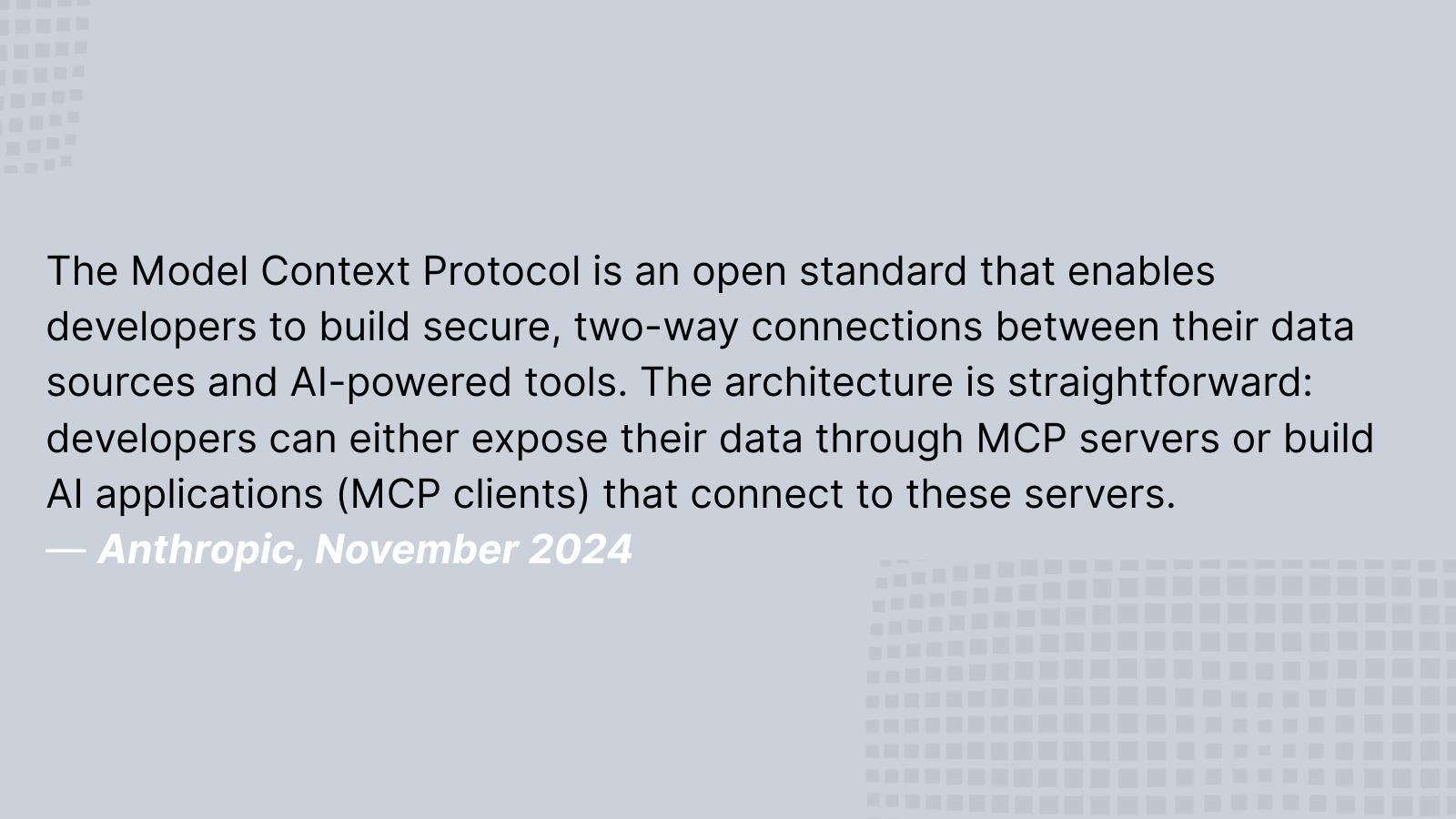
Enter Model Context Protocol (MCP), a new, standardized protocol enabling AI models to interface cleanly with external tools and data in a structured format.

Like the “USB-C” of AI, MCP offers a universal standard that makes it much faster and easier to connect agentic AI with tools and databases. Before MCP, bringing valuable context to agents at scale was insurmountable for enterprise companies. MCP promises to make this process fast and straightforward, finally enabling engineers to embed AI in the enterprise.

With MCP, developers can plug agents into a variety of tools and data sources, without having to individually code integrations or implement API calls. This is a gamechanger: not just for faster time-to-value when it comes to leveraging context-rich AI, but for building robust, agentic systems at scale.

In one test by Twilio, MCP sped up agentic performance by 20%, and increased task success rate from 92.3% to 100%. Another study found that MCP also reduced compute costs by up to 30%. The results are clear. MCP isn’t just an accelerator, but the new standard for enterprise AI.

A New Standard for Agentic Systems

Invented by Anthropic, MCP is an open standard for managing and transferring context between AI models, tools, applications, and agents. It enables AI systems to remember, share, and reuse information across tools and environments by exchanging structured context in a consistent way.

MCP lets agentic systems learn and use context in powerful ways. The context, however, is still critically important. The better your data—its speed, quality, governance, and enrichment—the better context you can send to intelligent systems through MCP.

Striim’s Value: Delivering Real-Time Data Context

From simple interfaces, to tools, agents, and now embedded in enterprise infrastructure—generative AI has come a long way in just a few years. Today, MCP represents a huge opportunity for enterprises, but it calls for a new mandate: the need for a real-time, well-governed, AI-ready data access for agents without compromising production workloads, data sensitivity, or compliance.

Directly exposing production operational data stores to agents is a recipe for performance and governance headaches. High-frequency queries from AI workloads can create unpredictable spikes in load, impacting mission-critical transactions and degrading end-user experiences. It also increases the risk of compliance violations and accidental data exposure.

The safer and smarter approach is to continuously replicate operational data into secure zones that are purpose built to serve agents via MCP servers. These zones preserve production performance, enforce access policies, and ensure AI systems are working with fresh, well-governed data while allowing controlled write-back when needed, without ever touching the live systems that run the business.

That’s where integrative solutions like Striim come in. Sitting at the heart of this new architecture, Striim’s MCP AgentLink offers a continuous, real-time, cleansed, and protected operational replica in safe, compliant zones—giving agents fresh, accurate data without exposing production systems. With a growing number of operational databases such as Oracle, Azure PostgreSQL, Databricks, and Snowflake announcing support for MCP, Striim ensures these systems can feed governed, AI-ready context directly into MCP servers in real time.

Specifically Striim:

  • Replicates operational databases (e.g., Oracle, SQL Server, PostgreSQL, Salesforce) in real-time to read-only, agent-safe destinations, PostgreSQL clusters.
  • Processes and transforms streaming data to remove PII, enriches it with context, and prepares it for agentic consumption.
  • Routes agent-generated writes to a safe staging layer, validates them, and syncs them back to source systems through its stream processing engine.
  • Powers event processing to deliver decision-ready, well-structured event data where it’s needed most.

Simply put, Striim is the real-time, intelligent, and compliant middleware that bridges enterprise systems and MCP agent workloads. With Striim MCP AgentLink, enterprises can finally realize the promise of AI by connecting it with their existing tools and databases.

With Striim MCP AgentLink, enterprises can deliver AI-ready data from anywhere—instantly and without disruption. We’re not just moving data in real time—we’re delivering real-time context, so AI systems can act with full awareness of the business.

ALOK PAREEK
EVP of Products & Engineering, Striim

Powerful Use Cases for MCP-Empowered AI

The real value of MCP lies in its ability to transform business use cases and unlock new revenue streams. Let’s consider some powerful use cases that MCP could unlock for modern enterprises.

Autonomous Patient Support

Imagine healthcare agents assisting patients and clinicians. They could shed light on available healthcare options by instantly retrieving medical records, insurance coverage, and treatment guidelines from multiple secure systems.

Agents could query EHRs, insurance portals, and clinical knowledge bases in real time through MCP, without exposing sensitive patient data.

Personalized Financial Advisory

Agentic AI could be an ideal analyst tool for investment consultants. Connected to the right systems, they could deliver tailored investment and financial planning recommendations using a client’s up-to-date financial profile and market data.

Through MCP, analyst agents could secure client portfolios, transaction history, and live market trends to generate compliant, personalized advice.

Supply Chain Optimization

In manufacturing, AI systems could reduce operational complexity while drastically improving efficiency in the supply chain. Imagine agents that could dynamically adjust procurement, manufacturing, and logistics to maintain efficiency and meet demand.

Supply chain agents could orchestrate planning decisions using live inventory, shipping schedules, and product demand forecasts, accessed securely through MCP.

Personalized, Real-Time Marketing

AI agents have the potential not just to ideate hyper-targeted marketing campaigns, but to deliver them in real time. Pulling from recent purchases, loyalty status, and in-stock SKUs, agentic systems could instantly push a custom promotion to high-value customers visiting a product website or visiting a store.

To make this happen, the agent would use MCP to retrieve live behavioral data, customer segmentation data, and product availability to generate and deliver tailored campaigns in seconds.

The Future of Agentic Systems with Striim and MCP

The arrival of MCP represents another major step in the evolution of AI technology. The building blocks for autonomous, intelligent systems are coming together. Now is the time to connect them.

“Our customers are moving fast to build real-time, decision-ready AI into their operations,” …“By embedding governance, compliance, and safety directly into the data streams, we give them the confidence to scale MCP-powered AI without slowing down innovation.”

ALI KUTAY
CEO and Co-Founder, Striim

With Striim MCP AgentLink, enterprises can finally realize the promise of agentic AI at scale. They can connect agents with context from any and all of their sources and databases. They can send trusted, well-governed, decision-ready data to intelligent systems. And they can do it all at the scale and speed enterprises demand: in sub-second latency, so agents can make instant impact.

Book a demo today to see how Striim’s MCP AgentLink can bring real-time, governed context to your AI systems.

Back to top