Dmitriy Rudakov

5 Posts

Streaming Analytics: What It Is and How It Works

Is your business running in “real-time”? Many think they do, but if you look under the hood, you might find that your “live” data is already a few minutes or even hours old.

In fact, many teams are still wrestling with batch processes or have plastered a “speed layer” onto an old system. You’re likely collecting massive amounts of data from logs, sensors, and customer interactions, but unless you’re delivering data in real time, you can’t act on it fast enough to make a difference.

Streaming analytics brings data into the “now.” It’s a fundamental shift that helps you move from just reporting on what happened yesterday to responding to what’s happening in the moment. In a world driven by intelligent systems and real-time customer expectations, “good enough” real-time just doesn’t cut it anymore. Done right, streaming analytics becomes a strategic enabler that can give your organization a competitive advantage.

This guide breaks down what streaming analytics is, why it matters, and how it impacts your business. We’ll cover the common challenges, the key features to look for in a platform, and how solutions like Striim make it all possible.

Streaming Analytics vs. Data Analytics

Streaming analytics and data analytics are both powerful tools for extracting insights from data, but they differ in how they process and analyze information.

Streaming analytics refers to the real-time processing and analysis of data as it is generated. It focuses on analyzing continuous streams of data from sources like IoT devices, social media feeds, sensors, or transaction logs. The goal is to derive actionable insights or trigger immediate actions while the data is still in motion. Use streaming analytics when you need to act on data immediately, such as for fraud detection, monitoring IoT devices, or providing real-time recommendations.

Data analytics is the broader field of analyzing data to uncover patterns, trends, and insights. It typically involves working with static or historical datasets that are stored in databases or data warehouses. The analysis can be descriptive, diagnostic, predictive, or prescriptive, depending on the goal. Use data analytics when you need to analyze trends, make strategic decisions, or work with large historical datasets.

What Is Streaming Analytics?

Streaming analytics is the process of continuously capturing, processing, and analyzing data while it’s still moving. There’s no waiting for it to be stored in a database or for a batch job to run. It’s built for situations where every second counts and latency directly impacts your bottom line.

This stands apart from traditional BI dashboards that show snapshots of data, or event streaming platforms that just move data from point A to point B without transforming or analyzing it. Streaming analytics works with data from IoT sensors, application logs, financial transactions, and website activity. It can even handle unstructured data like chat logs, giving you a complete view of your business.

Streaming Analytics vs. Event Streaming

Event streaming focuses on the continuous movement of data from one system to another, acting as a pipeline to transport raw events without analyzing them. In contrast, streaming analytics goes a step further by also processing, analyzing, and deriving actionable insights from the data in real time, enabling immediate decision-making and responses.

Harness IoT and Data Analytics for Strategic Business Growth

How can IoT and data analytics help drive innovation? Explore real-world use cases like:

• Predictive maintenance, real-time monitoring, and efficient supply chain management in manufacturing
• Smart city initiatives that optimize resource management, track employee productivity, and enhance public safety
• Remote patient monitoring, predictive diagnostics, and personalized treatment plan

Investigate more possibilities for strategic business growth in this article.

Why Streaming Analytics Matters Today

The speed of business today demands faster decisions and immediate actions. Streaming analytics allows you to act in the moment, turning it from a nice-to-have feature into a competitive necessity. It solves some of the biggest headaches that slow organizations down.

Latency Is the New Bottleneck in AI

Your AI and intelligent systems are only as good as the data they receive. When you feed them stale information from batch jobs, their performance suffers. Streaming analytics gives your models a constant flow of fresh data, helping you generate insights and make predictions that are relevant right now, not based on what happened yesterday.

Micro-Batch Is Not Real-Time

In situations like fraud detection or supply chain management, waiting for the next batch cycle means you’ve already missed your chance to act. If a fraudulent purchase gets approved because your system was waiting for its next five-minute update, that’s real money lost. The opportunity cost of these small delays adds up quickly.

Fragmented Data Kills Operational Agility

When your data is trapped in different silos across on-premise and cloud systems, it’s nearly impossible to get a clear picture of your operations. Streaming analytics breaks down these walls. It lets you analyze data from multiple systems in real time without having to move it all to one central location first. This gives your teams the agility to respond to changes as they happen.

Discover how streaming analytics transforms raw, real-time data into actionable insights, enabling faster decisions and competitive agility. Read an In-Depth Guide to Real-Time Analytics.

How Streaming Analytics Works
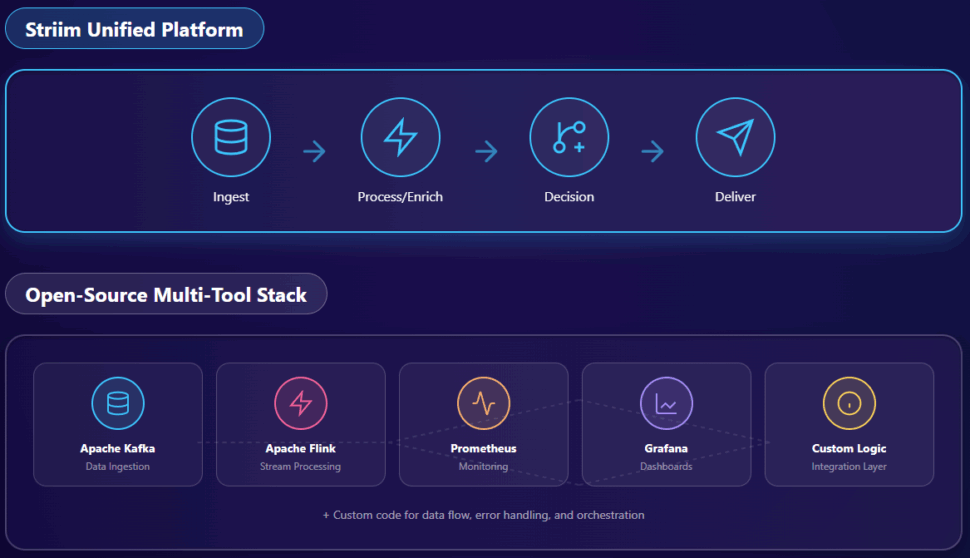
diagram contrasting Striim’s unified workflow (ingest → process/enrich → decision → deliver) with a typical open-source multi-tool stack (Kafka + Flink + separate monitoring)

Streaming analytics might sound complicated, but it follows a simple flow: ingest, process, enrich, and act. A unified platform simplifies this process, unlike fragmented approaches that require you to piece together multiple tools.

Ingest Data Continuously from Live Sources

First, you need to capture data the moment it’s created. This includes changes from databases (using Change Data Capture (CDC)), sensor readings, application logs, and more. This process needs to be fast and reliable, without slowing down your source systems. Using a platform with a wide range of connectors and strong CDC capabilities is key.

Process and Transform Data in Motion

As data flows into your pipeline, it’s filtered, transformed, or joined with other streams. This is where raw data starts to become useful. For example, you can take a customer’s website click and instantly enrich it with their purchase history from another database—all while the data is still moving.

Enrich and Apply Real-Time Logic

Next, you can apply business rules or run the data through machine learning models directly in stream. This lets you do things like score a transaction for fraud risk or spot unusual patterns in sensor data. You could even have a single stream that checks a purchase for fraud while also seeing if the customer qualifies for a special offer, all in a fraction of a second.

Deliver to Targets and Visualize Insights

Finally, the processed insights are sent where they need to go. This might be a cloud data warehouse like Snowflake, a BI tool, or a real-time dashboard. The key is to deliver the information with sub-second latency so your teams and automated systems can take immediate action.

Real-Time Data Movement and Stream Processing: 6 Best Practices 

Gain essential strategies for building reliable, scalable real-time data pipelines, emphasizing streaming-first integration, low-latency processing, and continuous data validation to enable actionable insights and operational efficiency. Read the full blog post to learn more.

Challenges in Implementing Streaming Analytics (and How to Solve Them)

While the value of streaming analytics is clear, getting it right can be challenging. Many teams struggle with the steep learning curve of open-source tools or get locked into a single cloud ecosystem. A unified platform like Striim is designed to help you sidestep these common pitfalls.

Open-source streaming stacks (Kafka/Flink/etc.): Steep learning curve, no native CDC, requires multiple tools for ingestion, processing, and monitoring.

Cloud-native tools: Strong within a single cloud but poor hybrid/multi-cloud support; risk of vendor lock-in.

Point solutions: Handle ingestion only; no in-flight transformation or decisioning.

Data Drift, Schema Evolution, and Quality Issues

Data formats and schemas can change without warning, breaking your pipelines and corrupting your analytics. With open-source tools, this often requires manual code fixes and redeployments. Striim, on the other hand, automatically detects these changes, adjusts the pipeline on the fly, and provides dashboards to help you monitor data quality.

Out-of-Order Events and Latency Spikes

Events don’t always arrive in the right order, which can throw off your analytics and trigger false alerts. Building custom logic to handle this is complicated and can break easily. Striim’s processing engine automatically handles event ordering and timing, ensuring your insights are accurate and delivered with consistent, sub-second latency.

Operational Complexity and Skill Gaps

Many streaming analytics projects fail because they require a team of experts specializing in complex systems like Kafka or Flink. Striim’s all-in-one platform makes it easier for everyone. Its low-code, SQL-based interface allows both developers and analysts to build powerful streaming pipelines without needing a PhD in distributed systems.

The Cost of False Real-Time

“Almost real-time” isn’t enough when every second matters. In some industries, a small delay in detecting fraud can result in a big financial loss. The hidden lags in micro-batch systems can have serious consequences. Striim processes data in memory to deliver true, sub-second performance across all your environments, so you can act instantly.

Striim Real-Time Analytics Quick Start

This tutorial provides a step-by-step guide to using Striim’s platform for creating real-time analytics applications. Learn how to process streaming data, build dashboards, and gain actionable insights with ease.

Must-Have Features in a Streaming Analytics Platform

Not all streaming platforms are created equal. To get the most out of your real-time data, you need a solution that does more than just move it from one place to another. Here are the features to look for.

Native Support for Real-Time Data Ingestion (including CDC)

Your platform should be able to pull in high volumes of data from all your sources—from databases and applications to IoT. It needs to offer log-based CDC to integrate with your operational databases in real time and low-impact integration with operational databases. Striim excels here with its CDC engine and support for hybrid environments.

In-Flight Data Processing and Transformation

Look for the ability to filter, join, and enrich data streams as they flow. A platform with powerful, SQL-based tools for transforming data in motion will help you turn raw information into valuable insights much faster. Look for SQL support, stateful processing, and real-time business logic. Striim’s real-time SQL (TQL) and CEP engine stands out here.

Real-Time Analytics and Decisioning Capabilities

The platform should be able to trigger alerts, update dashboards, or call other applications based on patterns it detects in the data. This includes handling everything from anomaly detection to complex fraud rules without any delay, as with Striim’s real-time alerting and monitoring workflows.

Enterprise-Grade Scale, Reliability, and Observability

You need a platform that can grow with your data volumes, support mission-critical workloads without fail, and deliver consistent sub-second latency. Strong observability tools are also essential for debugging and monitoring pipelines. With Striim, you get a distributed architecture with built-in pipeline monitoring.

Seamless Integration with Modern Data Infrastructure

A future-proof platform needs to connect easily with your existing data warehouses, like Snowflake and BigQuery, as well as messaging systems like Kafka. It must also support hybrid and multi-cloud environments, giving you the freedom to deploy your data wherever you want. Striim’s pre-built connectors and flexible deployment model stand out here.

Integrate both real-time and historical data in your ecosystem

While fresh, real-time data is crucial, ideally your platform of choice can also utilize historic data, especially for training AI and ML models. While many tools can handle either real-time updates or ingest historic data alone, the best solutions will be able to handle (and integrate) both for a rich, unified data set.

Why Choose Striim for Streaming Analytics

Trying to build a streaming analytics solution often leads to a messy collection of tools, frustrating latency issues, and complex integrations. Striim simplifies everything by combining ingestion, transformation, decisioning, and delivery into a single platform built for today’s hybrid-cloud world. The result is faster AI-driven insights, lower engineering overhead, and reliable real-time streaming at scale.

Capability Striim Open-Source Stack Cloud-Native ELT Legacy CDC
Real-Time True in-memory streaming, <1s latency Multi-tool, latency varies Often micro-batch CDC only, no transformation
CDC Native, hybrid/on-prem/cloud Requires add-on (Debezium) Limited, reloads common Yes, no enrichment
Transformation In-flight SQL + CEP Requires Flink/Spark Post-load only Not supported
Schema Evolution Auto-detect & adapt mid-stream Manual fix & redeploy Delayed handling Manual
Hybrid/Multi-Cloud Built-in, consistent SLAs Complex setup Single-cloud focus On-prem only
Ease of Use Low-code, intuitive interface High technical barrier Simple for cloud DBs DBA-focused
AI/ML AI-ready feature streams Custom to build Limited Not supported
Security Compliant with SOC 2, GDPR, HIPAA, and other major security benchmarks. Liable to security breaches and vulnerabilities. Limited Vulnerable

While there are many options out there, Striim is the leading platform that provides a complete, unified solution for streaming analytics, while other approaches only solve part of the puzzle.

Ready to stop reporting on the past and start acting in the present? Start a free trial of Striim or book a demo to see streaming analytics in action.

FAQs About Streaming Analytics

Deploying streaming analytics in hybrid or multi-cloud environments requires distributed data ingestion tools like change data capture (CDC) to collect real-time data from diverse sources without impacting performance. Regional processing nodes and edge computing reduce latency by pre-processing data closer to its source, while containerized microservices and auto-scaling ensure scalability for fluctuating workloads.

Security and compliance demand end-to-end encryption, role-based access control (RBAC), and local processing of sensitive data to meet regulations. Unified monitoring tools provide real-time observability for seamless management.

To avoid vendor lock-in, cloud-agnostic tools and open APIs ensure interoperability, while redundant nodes, multi-region replication, and self-healing pipelines enhance resilience. These adjustments enable real-time insights, scalability, and compliance across distributed systems.

Scaling streaming analytics requires in-memory processing to avoid disk I/O delays, ensuring faster throughput and lower latency. Horizontal scaling adds nodes to distribute workloads, while data partitioning and dynamic load balancing evenly distribute streams and prevent bottlenecks.

To reduce strain, stream compression minimizes bandwidth usage, and pre-aggregation at the source limits data volume. Backpressure management techniques, like buffering, maintain stability during spikes. Optimized query execution and auto-scaling dynamically adjust resources, while fault tolerance mechanisms like checkpointing ensure quick recovery from failures. These strategies enable high performance and reliability at massive scale.

Scaling streaming analytics for massive data volumes requires in-memory processing to eliminate disk I/O delays and ensure low-latency performance. Horizontal scaling adds nodes to handle growing workloads, while data partitioning and dynamic load balancing evenly distribute streams to prevent bottlenecks.

Stream compression reduces bandwidth usage, and pre-aggregation at the source minimizes the data entering the pipeline. Backpressure management, like buffering, maintains stability during spikes, while optimized query execution ensures efficient processing. Continuous monitoring and auto-scaling dynamically adjust resources, and fault tolerance mechanisms like checkpointing ensure quick recovery from failures. These strategies enable reliable, high-performance streaming at scale.

Maintaining data quality in distributed pipelines starts with real-time validation, including schema checks, anomaly detection, and automated quality controls to ensure data integrity. Data lineage tracking provides transparency, helping teams trace and resolve issues quickly, while schema evolution tools adapt to structural changes without breaking pipelines.

For consistency, event ordering and deduplication are managed using watermarking and time-windowing techniques. Fault-tolerant architectures with checkpointing and replay capabilities ensure recovery without data loss. Global data catalogs and metadata tools unify data views across environments, while real-time observability frameworks monitor performance and flag issues early. These practices ensure reliable, high-quality data for real-time decisions.

Streaming analytics supports compliance in regulated industries by embedding security, governance, and monitoring directly into the data pipeline, ensuring adherence to regulations without compromising speed. End-to-end encryption protects data both in transit and at rest, safeguarding sensitive information while maintaining low-latency processing.

Role-based access control (RBAC) and multi-factor authentication (MFA) ensure that only authorized users can access data, meeting strict access control requirements. Additionally, real-time data lineage tracking provides full visibility into how data is collected, processed, and used, which simplifies audits and ensures compliance with regulations like GDPR or HIPAA.

To address data residency requirements, streaming platforms can process sensitive data locally within specific regions while still integrating with global systems. Automated policy enforcement ensures that compliance rules, such as data retention limits or anonymization, are applied consistently across the pipeline.

Finally, real-time monitoring and alerting detect and address potential compliance violations immediately, preventing issues before they escalate. By integrating these compliance measures into the streaming architecture, organizations can meet regulatory requirements while maintaining the sub-second latency needed for real-time decision-making.

Unified streaming platforms have higher upfront costs due to licensing but offer an all-in-one solution with built-in ingestion, processing, monitoring, and visualization. This simplifies deployment, reduces maintenance, and lowers total cost of ownership (TCO) over time.

Open-source stacks like Kafka and Flink are free upfront but require significant engineering resources to integrate, configure, and maintain. Teams must manually handle challenges like schema evolution and fault tolerance, increasing complexity and operational overhead. Scaling to enterprise-grade performance often demands costly infrastructure and expertise.

Unified platforms are ideal for faster time-to-value and simplified management, while open-source stacks suit organizations with deep technical expertise and tight budgets. The choice depends on prioritizing upfront savings versus long-term efficiency.

Managing event ordering in large-scale streaming systems requires watermarking to track stream progress and time-windowing to handle late-arriving events without losing accuracy. Real-time observability tools are critical for detecting anomalies like out-of-sequence events or latency spikes, with metrics such as event lag and throughput offering early warnings.

To resolve issues, replay mechanisms can reprocess streams, while deduplication logic eliminates duplicates caused by retries. Distributed tracing provides visibility into event flow, helping pinpoint problem areas. Fault-tolerant architectures with checkpointing ensure recovery without disrupting event order. These practices ensure accurate, reliable processing at scale.

Change Data Capture (CDC) is a cornerstone of streaming analytics for operational databases, as it enables real-time data ingestion by capturing and streaming changes—such as inserts, updates, and deletes—directly from the database. This allows organizations to process and analyze data as it is generated, without waiting for batch jobs or manual exports.

CDC minimizes the impact on source systems by using log-based methods to track changes, ensuring that operational databases remain performant while still providing fresh data for analytics. It also supports low-latency pipelines, enabling real-time use cases like fraud detection, personalized recommendations, and operational monitoring.

Additionally, CDC ensures data consistency by maintaining the order of changes and handling schema evolution automatically, which is critical for accurate analytics. By integrating seamlessly with streaming platforms, CDC allows organizations to unify data from multiple operational systems into a single pipeline, breaking down silos and enabling cross-system insights.

In short, CDC bridges the gap between operational databases and real-time analytics, providing the foundation for actionable insights and faster decision-making.

To future-proof a streaming analytics system, use schema evolution tools that automatically adapt to changes like added or removed fields, ensuring pipelines remain functional. Schema registries help manage versions and maintain compatibility across components, while data abstraction layers decouple schemas from processing logic, reducing the impact of changes.

For new data sources, adopt modular architectures with pre-built connectors and APIs to simplify integration. At the ingestion stage, apply data validation and transformation to ensure new sources align with expected formats. Real-time monitoring tools can flag issues early, allowing teams to address problems quickly. These strategies create a flexible, resilient system that evolves with your data needs.

Micro-batch processing is a good choice when real-time insights are not critical, and slight delays in data processing are acceptable. It works well for use cases like periodic reporting, refreshing dashboards every few minutes, or syncing data between systems where sub-second latency isn’t required.

It’s also suitable for organizations with limited infrastructure or technical expertise, as micro-batch systems are often simpler to implement and maintain compared to true streaming analytics. Additionally, for workloads with predictable, low-frequency data updates, micro-batching can be more cost-effective by reducing the need for always-on processing.

However, it’s important to evaluate the trade-offs, as micro-batch processing may miss opportunities in scenarios like fraud detection or real-time personalization, where immediate action is essential.

Deploying streaming analytics in hybrid or multi-cloud environments requires distributed data ingestion tools like change data capture (CDC) to collect real-time data from diverse sources without impacting performance. Regional processing nodes and edge computing reduce latency by pre-processing data closer to its source, while containerized microservices and auto-scaling ensure scalability for fluctuating workloads.

Security and compliance demand end-to-end encryption, role-based access control (RBAC), and local processing of sensitive data to meet regulations. Unified monitoring tools provide real-time observability for seamless management.

To avoid vendor lock-in, cloud-agnostic tools and open APIs ensure interoperability, while redundant nodes, multi-region replication, and self-healing pipelines enhance resilience. These adjustments enable real-time insights, scalability, and compliance across distributed systems.

Scaling streaming analytics requires in-memory processing to avoid disk I/O delays, ensuring faster throughput and lower latency. Horizontal scaling adds nodes to distribute workloads, while data partitioning and dynamic load balancing evenly distribute streams and prevent bottlenecks.

To reduce strain, stream compression minimizes bandwidth usage, and pre-aggregation at the source limits data volume. Backpressure management techniques, like buffering, maintain stability during spikes. Optimized query execution and auto-scaling dynamically adjust resources, while fault tolerance mechanisms like checkpointing ensure quick recovery from failures. These strategies enable high performance and reliability at massive scale.

Scaling streaming analytics for massive data volumes requires in-memory processing to eliminate disk I/O delays and ensure low-latency performance. Horizontal scaling adds nodes to handle growing workloads, while data partitioning and dynamic load balancing evenly distribute streams to prevent bottlenecks.

Stream compression reduces bandwidth usage, and pre-aggregation at the source minimizes the data entering the pipeline. Backpressure management, like buffering, maintains stability during spikes, while optimized query execution ensures efficient processing. Continuous monitoring and auto-scaling dynamically adjust resources, and fault tolerance mechanisms like checkpointing ensure quick recovery from failures. These strategies enable reliable, high-performance streaming at scale.

Maintaining data quality in distributed pipelines starts with real-time validation, including schema checks, anomaly detection, and automated quality controls to ensure data integrity. Data lineage tracking provides transparency, helping teams trace and resolve issues quickly, while schema evolution tools adapt to structural changes without breaking pipelines.

For consistency, event ordering and deduplication are managed using watermarking and time-windowing techniques. Fault-tolerant architectures with checkpointing and replay capabilities ensure recovery without data loss. Global data catalogs and metadata tools unify data views across environments, while real-time observability frameworks monitor performance and flag issues early. These practices ensure reliable, high-quality data for real-time decisions.

Streaming analytics supports compliance in regulated industries by embedding security, governance, and monitoring directly into the data pipeline, ensuring adherence to regulations without compromising speed. End-to-end encryption protects data both in transit and at rest, safeguarding sensitive information while maintaining low-latency processing.

Role-based access control (RBAC) and multi-factor authentication (MFA) ensure that only authorized users can access data, meeting strict access control requirements. Additionally, real-time data lineage tracking provides full visibility into how data is collected, processed, and used, which simplifies audits and ensures compliance with regulations like GDPR or HIPAA.

To address data residency requirements, streaming platforms can process sensitive data locally within specific regions while still integrating with global systems. Automated policy enforcement ensures that compliance rules, such as data retention limits or anonymization, are applied consistently across the pipeline.

Finally, real-time monitoring and alerting detect and address potential compliance violations immediately, preventing issues before they escalate. By integrating these compliance measures into the streaming architecture, organizations can meet regulatory requirements while maintaining the sub-second latency needed for real-time decision-making.

Unified streaming platforms have higher upfront costs due to licensing but offer an all-in-one solution with built-in ingestion, processing, monitoring, and visualization. This simplifies deployment, reduces maintenance, and lowers total cost of ownership (TCO) over time.

Open-source stacks like Kafka and Flink are free upfront but require significant engineering resources to integrate, configure, and maintain. Teams must manually handle challenges like schema evolution and fault tolerance, increasing complexity and operational overhead. Scaling to enterprise-grade performance often demands costly infrastructure and expertise.

Unified platforms are ideal for faster time-to-value and simplified management, while open-source stacks suit organizations with deep technical expertise and tight budgets. The choice depends on prioritizing upfront savings versus long-term efficiency.

Managing event ordering in large-scale streaming systems requires watermarking to track stream progress and time-windowing to handle late-arriving events without losing accuracy. Real-time observability tools are critical for detecting anomalies like out-of-sequence events or latency spikes, with metrics such as event lag and throughput offering early warnings.

To resolve issues, replay mechanisms can reprocess streams, while deduplication logic eliminates duplicates caused by retries. Distributed tracing provides visibility into event flow, helping pinpoint problem areas. Fault-tolerant architectures with checkpointing ensure recovery without disrupting event order. These practices ensure accurate, reliable processing at scale.

Change Data Capture (CDC) is a cornerstone of streaming analytics for operational databases, as it enables real-time data ingestion by capturing and streaming changes—such as inserts, updates, and deletes—directly from the database. This allows organizations to process and analyze data as it is generated, without waiting for batch jobs or manual exports.

CDC minimizes the impact on source systems by using log-based methods to track changes, ensuring that operational databases remain performant while still providing fresh data for analytics. It also supports low-latency pipelines, enabling real-time use cases like fraud detection, personalized recommendations, and operational monitoring.

Additionally, CDC ensures data consistency by maintaining the order of changes and handling schema evolution automatically, which is critical for accurate analytics. By integrating seamlessly with streaming platforms, CDC allows organizations to unify data from multiple operational systems into a single pipeline, breaking down silos and enabling cross-system insights.

In short, CDC bridges the gap between operational databases and real-time analytics, providing the foundation for actionable insights and faster decision-making.

To future-proof a streaming analytics system, use schema evolution tools that automatically adapt to changes like added or removed fields, ensuring pipelines remain functional. Schema registries help manage versions and maintain compatibility across components, while data abstraction layers decouple schemas from processing logic, reducing the impact of changes.

For new data sources, adopt modular architectures with pre-built connectors and APIs to simplify integration. At the ingestion stage, apply data validation and transformation to ensure new sources align with expected formats. Real-time monitoring tools can flag issues early, allowing teams to address problems quickly. These strategies create a flexible, resilient system that evolves with your data needs.

Micro-batch processing is a good choice when real-time insights are not critical, and slight delays in data processing are acceptable. It works well for use cases like periodic reporting, refreshing dashboards every few minutes, or syncing data between systems where sub-second latency isn’t required.

It’s also suitable for organizations with limited infrastructure or technical expertise, as micro-batch systems are often simpler to implement and maintain compared to true streaming analytics. Additionally, for workloads with predictable, low-frequency data updates, micro-batching can be more cost-effective by reducing the need for always-on processing.

However, it’s important to evaluate the trade-offs, as micro-batch processing may miss opportunities in scenarios like fraud detection or real-time personalization, where immediate action is essential.

Data Pipeline Architecture: Key Patterns and Best Practices

If your dashboards are broken, your analytics keep timing out, and your data engineers wind up spending more time fixing broken data pipelines than building new features, you’re not alone.

You’re likely dealing with more data, from more sources, and more real-time business demands than ever before. And in the face of overwhelming demand, getting pipeline architecture right has become more urgent than ever.

Optimal pipeline architecture can unlock a data team’s ability to detect anomalies, deliver excellent customer experiences, and optimize operations in the moment. It relies on a continuous, real-time flow of reliable data. On the flip side, slow, unreliable, or costly data pipelines are no longer just technical challenges for data engineers. They directly translate to missed business opportunities and increased risk.

This guide demystifies modern data pipeline architecture. We’ll break down the core components, explore common architectural patterns, and walk through the use cases that demand a new approach.

By the end, you’ll have a clear framework for designing and building the resilient, scalable, and cost-efficient data pipelines your business needs to thrive—and understand how modern tools like Striim are purpose-built to simplify and accelerate the entire process.

What is Data Pipeline Architecture?

At its core, data pipeline architecture refers to the design and structure of how data is collected, moved, transformed, and delivered from various sources to a final destination. Think of it as the digital circulatory system for your organization’s data.

But a modern pipeline is much more than a simple conveyor belt for data. It’s about moving data with speed, reliability, and intelligence. The critical distinction today is the evolution from slow, periodic batch processing (think nightly ETL jobs) to dynamic, streaming architectures that handle data in near real-time. This shift is fundamental. Where batch ETL answers the question, “What happened yesterday?”, streaming pipelines answer, “What is happening right now?” This enables businesses to be proactive rather than reactive—a key competitive advantage and a necessity in the age of AI.

Core Components of a Data Pipeline Architecture

This evolution sets the stage for a deeper conversation about the building blocks and patterns that define a robust, future-proof data pipeline architecture.

Core Components of a Data Pipeline Architecture

Every data pipeline—whether batch, stream processing, or hybrid—is constructed from the same set of fundamental building blocks. Understanding these components is the first step toward designing, troubleshooting, and scaling your infrastructure for effective data management.

Data Ingestion

This is the starting point where the pipeline collects raw data from its data sources. These sources can be incredibly diverse, ranging from structured databases (like Oracle or PostgreSQL), SaaS applications (like Salesforce), and event streams (like the open source solution, Apache Kafka) to IoT sensors and log files. The key challenge is to capture data reliably and efficiently, often in real time and without impacting the performance of the source systems.

Processing/Transformation

Once ingested, raw data is rarely in the perfect format for downstream analysis or applications. The processing workflow is where data is cleaned, normalized, enriched, aggregated, and transformed for its intended use. Data transformation could involve filtering out irrelevant fields, joining data from multiple sources, converting data types, or running complex business logic. In modern streaming pipelines, this transformation happens in-flight to ensure a continuous flow of data.

Data Storage/Destinations

After processing, the data is delivered to its destination. This could be a cloud data warehouse like Snowflake or BigQuery for analytics, a data lake like Databricks for AI or Machine Learning modeling, a relational database for operational use, or another messaging system for further downstream processing. The choice of destination depends entirely on the use case and the types of data involved.

Orchestration and Monitoring

A pipeline isn’t a “set it and forget it” system. Orchestration is the management layer that schedules, coordinates, and manages the data flows. It ensures that tasks run in the correct order and handles dependencies and error recovery. Monitoring provides visibility into the pipeline’s health, tracking metrics like data volume, latency, and error rates to ensure the system is performing as expected.

Data Governance & Security

This component encompasses the policies and procedures that ensure data is handled securely, accurately, and in compliance with regulations like GDPR or CCPA. It involves managing access controls, masking and encrypting data in transit and at rest, tracking data lineage, and ensuring strong data quality. In modern data architecture, these rules are embedded directly into the pipeline itself.

Common Data Pipeline Architecture Patterns

While the components are the building blocks, architectural patterns are the blueprints. Choosing the right pattern is critical and depends entirely on your specific requirements for latency, scalability, data volume, complexity, and cost. Here are some of the most common pipeline blueprints used today.

Lambda Architecture

A popular but complex pattern, Lambda architecture attempts to provide a balance between real-time speed and batch-processing reliability. It does this by running parallel data flows: a “hot path” (speed layer) for real-time streaming data and a “cold path” (batch layer) for comprehensive, historical batch processing. The results are then merged in a serving layer.

  • Best for: Use cases that need both low-latency, real-time views and highly accurate, comprehensive historical reporting.
  • Challenge: It introduces significant complexity, requiring teams to maintain two separate codebases and processing systems, which can be costly and difficult to manage.

Kappa Architecture

Kappa architecture emerged as a simpler alternative to Lambda. It eliminates the batch layer entirely and handles all processing—both real-time and historical—through a single streaming pipeline. Historical analysis is achieved by reprocessing the stream from the beginning.

  • Best for: Scenarios where most data processing can be handled in real time and the logic doesn’t require a separate batch system. It’s ideal for event-driven systems.
  • Challenge: Reprocessing large historical datasets can be computationally expensive and slow, making it less suitable for use cases requiring frequent, large-scale historical analysis.

Event-Driven Architectures

This pattern decouples data producers from data consumers using an event-based model. Systems communicate by producing and consuming events (e.g., “customer_created,” “order_placed”) via a central messaging platform like Kafka. Each microservice can process these events independently, creating a highly scalable and resilient system.

  • Best for: Complex, distributed systems where agility and scalability are paramount. It’s the foundation for many modern cloud-native applications.
  • Challenge: Can lead to complex data consistency and management challenges across dozens or even hundreds of independent services.

Hybrid and CDC-First Architectures

This pragmatic approach acknowledges that most enterprises live in a hybrid world, with data in both legacy on-premises systems and modern cloud platforms. A Change Data Capture (CDC)-first architecture focuses on efficiently capturing granular changes (inserts, updates, deletes) from source databases in real time. This data can then feed both streaming analytics applications and batch-based data warehouses simultaneously.

  • Best for: Organizations modernizing their infrastructure, migrating to the cloud, or needing to sync data between operational and analytical systems with minimal latency and no downtime.
  • Challenge: Requires specialized tools that can handle low-impact CDC from a wide variety of database sources.

Use Cases that Demand a Modern Data Pipeline Architecture

Architectural theory is important, but its true value is proven in real-world application. A modern data pipeline isn’t a technical nice-to-have; it’s a strategic enabler. Here are five use cases where a low-latency, streaming architecture proves essential.

Real-Time Fraud Detection

When it comes to detecting and preventing fraud, every second counts. Batch-based systems that analyze transactions hours after they occur are often too slow to prevent losses. A modern, streaming pipeline architecture with Change Data Capture (CDC) is ideal, allowing organizations to intercept and analyze transaction data the moment it’s created.

  • With Striim: Businesses can achieve sub-second latency, enabling continuous fraud monitoring models to block suspicious activity before it impacts customers or revenue.

Cloud Migration and Modernization

Migrating from legacy, on-premises databases to the cloud is a high-stakes project. A CDC-first pipeline architecture allows for zero-downtime migrations by keeping on-prem and cloud systems perfectly in sync during the transition. This phased approach de-risks the process and ensures business continuity.

  • With Striim: Companies can seamlessly replicate data from legacy systems to cloud targets, supporting phased migrations across complex hybrid environments without interrupting critical operations.

Personalized Customer Experiences

Today’s consumers expect experiences that not only respond to their behaviors, but predict them. Whether it’s an e-commerce site offering a relevant promotion or a media app suggesting the next video, personalization and predictive experiences demand fresh data. Real-time pipelines deliver a continuous stream of user interaction data to marketing and analytics platforms, powering in-the-moment decisions.

  • With Striim: Organizations can rapidly deliver enriched customer data to platforms like Snowflake, Databricks, or Kafka, enabling dynamic user segmentation and immediate, personalized engagement.

Edge-to-Cloud IoT Analytics

From factory floors to smart grids, IoT devices generate a relentless stream of data. A scalable, noise-tolerant pipeline is essential for ingesting this high-frequency data, filtering it at the source (the “edge”), and delivering only the most valuable information to cloud analytics platforms.

  • With Striim: Teams can deploy lightweight edge processing to filter and aggregate IoT data locally, reducing network traffic and ensuring that cloud destinations receive clean, relevant data for real-time monitoring and analysis.

Operational Dashboards and Alerts

Business leaders and operations teams can’t afford to make decisions based on stale data. When dashboards lag by hours or even just minutes, those insights are already history. Streaming pipelines reduce this data lag from hours to seconds, ensuring that operational dashboards, KPI reports, and automated alerts reflect the true, current state of the business.

  • With Striim: By delivering data with sub-second latency, Striim ensures that operational intelligence platforms are always up-to-date, closing the gap between event and insight.

AI-Powered Automation and Generative AI

Whether you’re building a predictive model to forecast inventory or an AI application to power a customer service chatbot, the quality and timeliness of your data is paramount. For LLMs, architectures like Retrieval-Augmented Generation (RAG) depend on feeding the model with real-time, contextual data from your enterprise systems. A streaming data pipeline is the only way to ensure the AI has access to the most current information, preventing it from giving stale or irrelevant answers.

  • With Striim: You can feed your AI models and vector databases with a continuous stream of fresh, transformed data from across your business in real time, ensuring your AI applications are always operating with the most accurate and up-to-date context.

Best Practices for Building a Future-Proof Data Pipeline Architecture

Building a robust data pipeline requires a futuristic mindset. In a sense, you’re not just building for today—you’re building for months or years from now, when your use cases, data volumes, and the decision making that relies on your data pipelines will have evolved. Adopting the following best practices will help you avoid getting stuck in endless rebuild projects, and design a smarter, more sustainable data architecture.

Align Architecture to Business SLAs and Latency Goals

Never build in a vacuum. The most important question to ask is: “What business outcome does this pipeline drive, and what are its latency requirements?” The answer will determine your architecture. A pipeline for real-time fraud detection has sub-second requirements, while one for weekly reporting does not. Aligning your technical design with stakeholders and business Service Level Agreements (SLAs) ensures you don’t over-engineer a solution or, worse, under-deliver on critical needs.

Embrace Schema Evolution and Change Data

Change is the only constant. Source systems will be updated, fields will be added, and data types will be altered. A future-proof architecture anticipates this. Use tools and patterns (like CDC) built not only to handle but to thrive on constant change and propagate changes downstream without breaking the pipeline. This builds resilience, enhances data integration, and dramatically reduces long-term maintenance overhead.

Reduce Tool Sprawl by Consolidating the Stack

Many organizations suffer from “tool sprawl”—a complex, brittle collection of disparate point solutions for ingestion, transformation, and delivery. This increases cost, complexity, and points of failure. Seek to consolidate your stack with a unified platform that can handle multiple functions within a single, coherent framework. This simplifies development, monitoring, and data governance.

Prioritize Observability, Data Governance, and Security

Observability, governance, and security are not afterthoughts; they should be core design principles. Build pipelines with observability in mind from day one, ensuring you have clear visibility into data lineage, performance metrics, and error logs. Embed security and governance rules directly into your data flows to ensure compliance and protect sensitive data without creating bottlenecks.

Avoid Overengineering and Focus on Use Case Fit

It can be tempting to build complex, all-encompassing data architecture from the start. A more effective approach is to start with the specific use case and choose the simplest architecture that meets its needs. A Kappa architecture might be perfect for one project, while a simple batch ETL process is sufficient for another. Focus on delivering value quickly and let the architecture evolve as business requirements grow.

Power Your Data Pipeline Architecture with Striim

Designing a modern data pipeline requires the right strategy, the right patterns, and the right platform. Striim is purpose-built to solve the challenges of real-time data, providing a unified, scalable platform that simplifies the entire data pipeline lifecycle. By consolidating the stack, Striim helps you reduce complexity, lower costs, and accelerate time to insight.

With Striim, you can:

  • Ingest data in real-time from dozens of sources, including databases via low-impact CDC, cloud applications, and streaming platforms.
  • Process and transform data in-flight using a familiar SQL-based language to clean, enrich, and reshape data as it moves.
  • Deliver data with sub-second latency to leading cloud data warehouses, data lakes, and messaging systems.
  • Build resilient, scalable pipelines on an enterprise-grade platform designed for mission-critical workloads.

Ready to stop fixing broken pipelines and start building for the future? Book a Demo with Our Team or Start Your Free Trial Today


What is a Data Pipeline (and 7 Must-Have Features of Modern Data Pipelines)


Every second, customer interactions, operational databases, and SaaS applications generate massive volumes of information.

It’s not collecting the data that’s the key challenge. It’s the task of connecting data with the systems and people who need it most. When engineering teams have to manually stitch together fragmented data from across the business, reports get delayed, analytics fall out of sync, and AI initiatives fail before they even make it to production.

To make data useful the instant it’s born, enterprises often rely on automated data pipelines. At the scale that modern businesses operate, a data pipeline acts as the circulatory system of the organization. It continuously pumps vital, enriched information from isolated systems into the cloud data warehouses, lakehouses, and AI applications that drive strategic decisions.

In this guide to data pipelines, we’ll break down exactly what a data pipeline is, explore the core components of its architecture, and explain why moving from traditional batch processing to real-time streaming is essential for any modern data strategy.

What is a Data Pipeline?

A data pipeline is a set of automated processes that extract data from various sources, transform it into a usable format, and load it into a destination for storage, analytics, or machine learning. By eliminating manual data extraction, data pipelines ensure that information flows securely and consistently from where it’s generated to where it is needed.

Why are Data Pipelines Important?

Data pipelines are significant because they bridge the critical gap between raw data generation and actionable business value. Without them, data engineers are forced to spend countless hours manually extracting, cleaning, and loading data. This reliance on manual intervention creates brittle workflows, delays reporting, and leaves decision-makers relying on stale dashboards.

A robust data pipeline automates this entire lifecycle. By ensuring that business leaders, data scientists, and operational systems have immediate, reliable access to trustworthy data, pipelines accelerate time-to-market and enable real-time customer personalization. More importantly, they provide the sturdy, continuous data foundation required for enterprise AI initiatives. When data flows freely, securely, and automatically, the entire organization is empowered to move faster and make better decisions.

The Core Components of Data Pipeline Architecture

To understand how a data pipeline delivers this enterprise-wide value, it’s helpful to look under the hood. While every organization’s infrastructure is unique to their specific tech stack, modern data pipeline architecture relies on three core components: ingestion, transformation, and storage.

Data Ingestion (The Source)

This is where the pipeline begins. Data ingestion involves securely extracting data from its origin point. In a modern enterprise, data rarely lives in just one place. A pipeline must be capable of pulling information from a vast array of sources, including SaaS applications (like Salesforce), relational databases (such as MySQL or PostgreSQL), and real-time event streams via Webhooks or message brokers. A high-performing ingestion layer handles massive volumes of data seamlessly, without bottlenecking or impacting the performance of the critical source systems generating the data.

Data Transformation (The Process)

Raw data is rarely ready in its original state to be used, whether for analysis or to power systems downstream. It’s often messy, duplicated, incomplete, or formatted incorrectly. The data transformation stage acts as the processing engine of the pipeline, systematically cleaning, deduplicating, filtering, and formatting the data. This step is absolutely critical; without it, downstream analytics and AI models will produce inaccurate insights based on flawed inputs. “Clean” analytics require rigorous, in-flight transformations to ensure data quality, structure, and compliance before it ever reaches the warehouse.

Data Storage (The Destination)

The final stage of the architecture involves delivering the processed, enriched data to a target system where it can be queried, analyzed, or fed directly into machine learning models. Modern data destinations typically include cloud data warehouses like Snowflake, lakehouses like Databricks, or highly scalable cloud storage solutions like Amazon S3. The choice of destination is crucial, as it often dictates the pipeline’s overall structure and processing paradigm, ensuring the data lands in a format optimized for the business’s specific AI and analytics workloads.

Types of Data Pipelines

Not all data pipelines operate the same way. The architecture you choose dictates how fast your data moves and how it’s processed along the way. Understanding the differences between these types is critical for choosing a solution that meets your business’s need for speed and scalability.

Batch Processing vs. Stream Processing

Historically, data pipelines relied heavily on batch processing. In a batch pipeline, data is collected over a period of time and moved in large, scheduled chunks, often overnight. While batch processing works fine for historical reporting where latency isn’t a problem, it leaves your data fundamentally stale. If you’re trying to power an AI agent, personalize a customer’s retail experience, or catch fraudulent transactions as they happen, yesterday’s data just won’t cut it.

That’s where stream processing comes in. Streaming pipelines process data continuously, the instant it’s born. Instead of waiting for a scheduled window, data flows in real time, unlocking immediate business intelligence and ensuring high availability for critical applications.

A highly efficient, enterprise-grade variant of stream processing is Change Data Capture (CDC). Instead of routinely scanning an entire database to see what changed—which puts a massive, degrading load on your source systems—Striim’s modern data pipelines utilize CDC to listen directly to the database’s transaction logs. It instantly captures only the specific inserts, updates, or deletes and streams them downstream in milliseconds. This makes your data pipelines incredibly efficient and resource-friendly, directly driving business value by ensuring your decision-makers and AI models are continuously fueled with fresh, decision-ready data.

ETL vs. ELT

Another way to categorize pipelines is by when the data transformation happens.

ETL (Extract, Transform, Load) is the traditional approach. Here, data is extracted from the source, transformed in a middle-tier processing engine, and then loaded into the destination. This is highly valuable when you need to rigorously cleanse, filter, or mask sensitive data before it ever reaches your data warehouse or AI model.

ELT (Extract, Load, Transform) flips the script. In an ELT pipeline, raw data is extracted and loaded directly into the destination system as quickly as possible. The transformations happen after the data has landed. This approach has become incredibly popular because it leverages the massive, scalable compute power of modern cloud data warehouses like Snowflake or BigQuery to handle the heavy lifting of transformation. Understanding ETL vs. ELT differences helps engineering teams decide whether they need in-flight processing for strict compliance or post-load processing for raw speed.

Use Cases of Data Pipelines and Real World Examples

Connecting data from point A to point B may sound like a purely technical exercise. But in practice, modern data pipelines drive some of the most critical, revenue-generating functions in the enterprise. Here is how companies are putting data pipelines to work in the real world:

1. Omnichannel Retail and Inventory Syncing

For retail giants, a delay of even a few minutes in inventory updates can lead to overselling, stockouts, and frustrated customers. Using real-time streaming data pipelines, companies like Macy’s capture millions of transactions and inventory changes from their operational databases and stream them to their analytics platforms in milliseconds. This continuous flow of data enables perfectly synced omnichannel experiences, ensuring that the sweater a customer sees online is actually available in their local store.

2. Real-Time Fraud Detection

In the financial services sector, the delay associated with batch processing is a fundamental liability. Fraud detection models require instant context to be effective. A streaming data pipeline continuously feeds transactional data into machine learning models the moment a card is swiped. This allows automated systems to flag, isolate, and block suspicious activity in sub-second latency, stopping fraud before the transaction even completes.

3. Powering Agentic AI and RAG Architectures

As enterprises move beyond simple chatbots into autonomous, “agentic” AI, these systems require a continuous feed of accurate, real-time context. Data pipelines serve as the crucial infrastructure here, actively pumping fresh enterprise data into vector databases to support Retrieval-Augmented Generation (RAG). By feeding AI models with up-to-the-millisecond data, companies ensure their AI agents make decisions based on the current state of the business, rather than hallucinating based on stale information.

7 Must-Have Features of Modern Data Pipelines

To create an effective modern data pipeline, incorporating these seven key features is essential. Though not an exhaustive list, these elements are crucial for helping your team make faster and more informed business decisions.

1. Real-Time Data Processing and Analytics

The number one requirement of a successful data pipeline is its ability to load, transform, and analyze data in near real time. This enables business to quickly act on insights. To begin, it’s essential that data is ingested without delay from multiple sources. These sources may range from databases, IoT devices, messaging systems, and log files. For databases, log-based Change Data Capture (CDC) is the gold standard for producing a stream of real-time data.

Real-time, continuous data processing is superior to batch-based processing because the latter takes hours or even days to extract and transfer information. Because of this significant processing delay, businesses are unable to make timely decisions, as data is outdated by the time it’s finally transferred to the target. This can result in major consequences. For example, a lucrative social media trend may rise, peak, and fade before a company can spot it, or a security threat might be spotted too late, allowing malicious actors to execute on their plans.

Real-time data pipelines equip business leaders with the knowledge necessary to make data-fueled decisions. Whether you’re in the healthcare industry or logistics, being data-driven is equally important. Here’s an example: Suppose your fleet management business uses batch processing to analyze vehicle data. The delay between data collection and processing means you only see updates every few hours, leading to slow responses to issues like engine failures or route inefficiencies. With real-time data processing, you can monitor vehicle performance and receive instant alerts, allowing for immediate action and improving overall fleet efficiency.

2. Scalable Cloud-Based Architecture

Modern data pipelines rely on scalable, cloud-based architecture to handle varying workloads efficiently. Unlike traditional pipelines, which struggle with parallel processing and fixed resources, cloud-based pipelines leverage the flexibility of the cloud to automatically scale compute and storage resources up or down based on demand.

In this architecture, compute resources are distributed across independent clusters, which can grow both in number and size quickly and infinitely while maintaining access to a shared dataset. This setup allows for predictable data processing times as additional resources can be provisioned instantly to accommodate spikes in data volume.

Cloud-based data pipelines offer agility and elasticity, enabling businesses to adapt to trends without extensive planning. For example, a company anticipating a summer sales surge can rapidly increase processing power to handle the increased data load, ensuring timely insights and operational efficiency. Without such elasticity, businesses would struggle to respond swiftly to changing trends and data demands.

3. Fault-Tolerant Architecture

It’s possible for data pipeline failure to occur while information is in transit. Thankfully, modern pipelines are designed to mitigate these risks and ensure high reliability. Today’s data pipelines feature a distributed architecture that offers immediate failover and robust alerts for node, application, and service failures. Because of this, we consider fault-tolerant architecture a must-have.

In a fault-tolerant setup, if one node fails, another node within the cluster seamlessly takes over, ensuring continuous operation without major disruptions. This distributed approach enhances the overall reliability and availability of data pipelines, minimizing the impact on mission-critical processes.

4. Exactly-Once Processing (E1P)

Data loss and duplication are critical issues in data pipelines that need to be addressed for reliable data processing. Modern pipelines incorporate Exactly-Once Processing (E1P) to ensure data integrity. This involves advanced checkpointing mechanisms that precisely track the status of events as they move through the pipeline.

Checkpointing records the processing progress and coordinates with data replay features from many data sources, enabling the pipeline to rewind and resume from the correct point in case of failures. For sources without native data replay capabilities, persistent messaging systems within the pipeline facilitate data replay and checkpointing, ensuring each event is processed exactly once. This technical approach is essential for maintaining data consistency and accuracy across the pipeline.

5. Self-Service Management

Modern data pipelines facilitate seamless integration between a wide range of tools, including data integration platforms, data warehouses, data lakes, and programming languages. This interconnected approach enables teams to create, manage, and automate data pipelines with ease and minimal intervention.

In contrast, traditional data pipelines often require significant manual effort to integrate various external tools for data ingestion, transfer, and analysis. This complexity can lead to bottlenecks when building the pipelines, as well as extended maintenance time. Additionally, legacy systems frequently struggle with diverse data types, such as structured, semi-structured, and unstructured data.

Contemporary pipelines simplify data management by supporting a wide array of data formats and automating many processes. This reduces the need for extensive in-house resources and enables businesses to more effectively leverage data with less effort.

6. Capable of Processing High Volumes of Data in Various Formats

It’s predicted that the world will generate 181 zettabytes of data by 2025. To get a better understanding of how tremendous that is, consider this: one zettabyte alone is equal to about 1 trillion gigabytes.

Since unstructured and semi-structured data account for 80% of the data collected by companies, modern data pipelines need to be capable of efficiently processing these diverse data types. This includes handling semi-structured formats such as JSON, HTML, and XML, as well as unstructured data like log files, sensor data, and weather data.

A robust big data pipeline must be adept at moving and unifying data from various sources, including applications, sensors, databases, and log files. The pipeline should support near-real-time processing, which involves standardizing, cleaning, enriching, filtering, and aggregating data. This ensures that disparate data sources are integrated and transformed into a cohesive format for accurate analysis and actionable insights.

7. Prioritizes Efficient Data Pipeline Development

Modern data pipelines are crafted with DataOps principles, which integrate diverse technologies and processes to accelerate development and delivery cycles. DataOps focuses on automating the entire lifecycle of data pipelines, ensuring timely data delivery to stakeholders.

By streamlining pipeline development and deployment, organizations can more easily adapt to new data sources and scale their pipelines as needed. Testing becomes more straightforward as pipelines are developed in the cloud, allowing engineers to quickly create test scenarios that mirror existing environments. This allows thorough testing and adjustments before final deployment, optimizing the efficiency of data pipeline development.

Why Your Business Needs a Modern Data Pipeline

In today’s digital economy, failing to connect your data is just as dangerous as failing to collect it. The primary threat to enterprise agility is the persistence of data silos—isolated pockets of information trapped across disparate departments, legacy systems, and disconnected SaaS applications. When data isn’t universally accessible, it isn’t truly useful. Silos stall critical business decisions, fracture the customer experience, and prevent leadership from seeing a unified picture of company performance.

Modern data pipelines are the antidote to data silos. By continuously extracting and unifying information from across the tech stack, pipelines democratize data access, ensuring that every department—from sales to supply chain—operates from the same single source of truth.

Furthermore, you simply can’t have AI without a steady stream of data. While 78% of companies have implemented some form of AI, a recent BCG Global report noted that only 26% are driving tangible value from it. The blocker isn’t the AI models themselves; it’s the lack of fresh, contextual data feeding them. Data pipelines empower machine learning and agentic AI by providing a continuous, reliable, and governed stream of enterprise context, shifting AI from an experimental novelty into a production-grade business driver.

Gain a Competitive Edge with Striim

Data pipelines are crucial for moving, transforming, and storing data, helping organizations gain key insights. Modernizing these pipelines is essential to handle increasing data complexity and size, ultimately enabling faster and better decision-making.

Striim provides a robust streaming data pipeline solution with integration across hundreds of sources and targets, including databases, message queues, log files, data lakes, and IoT. Plus, our platform features scalable in-memory streaming SQL for real-time data processing and analysis. Schedule a demo for a personalized walkthrough to experience Striim.

FAQs

What is the difference between a data pipeline and a data warehouse?

A data pipeline is the automated transportation system that moves and processes data, whereas a data warehouse is the final storage destination where that data lands. Think of the pipeline as the plumbing infrastructure that filters and pumps water, and the data warehouse as the reservoir where the clean water is stored for future use. You need the pipeline to ensure the data warehouse is constantly fueled with accurate, up-to-date information.

Do I need a data pipeline for small data sets?

Yes, even organizations dealing with smaller data volumes benefit immensely from data pipelines. Manual data extraction and manipulation—such as routinely exporting CSVs from a SaaS app to build a weekly spreadsheet—is highly error-prone and wastes valuable employee time. A simple pipeline automates these repetitive tasks, ensuring your data is always perfectly synced, formatted, and ready for analysis, regardless of its size.

Is a data pipeline the same as an API?

No, they are different but complementary technologies. An API (Application Programming Interface) is essentially a doorway that allows two distinct software applications to communicate and share data with each other. A data pipeline, on the other hand, is a broader automated workflow that often uses APIs to extract data from multiple sources, runs that data through complex transformations, and loads it into a centralized database for analytics.

Training and Calling SGDClassifier with Striim for Financial Fraud Detection

In today’s fast-paced financial landscape, detecting transaction fraud is essential for protecting institutions and their customers. This article explores how to leverage Striim and SGDClassifier to create a robust fraud detection system that utilizes real-time data streaming and machine learning.

Problem

Transaction fraud detection is a critical responsibility for the IT teams of financial institutions. According to the 2024 Global Financial Crime Report from Nasdaq, an estimated $485.6 billion was lost to fraud scams and bank fraud schemes globally in 2023.

AI and ML help detect fraud, while real-time streaming frameworks like Striim play a key role in delivering financial data to reference and train classification models, enhancing customer protection.

Solution

In this article, I will demonstrate how to use Striim to perform key tasks for fraud detection with machine learning:

  • Ingest data using a Change Data Capture (CDC) reader in real time, call the model and deliver alerts to a target such as Email, Slack, Teams or any other target supported by Striim
  • Train the model using Striim Initial load app and re-train the model if its accuracy score decreases by using automation via REST APIs

Fraud Detection Approach

In typical credit card transactions, a financial institution’s data science team uses supervised learning to label data records as either fraudulent or legitimate. By carefully analyzing the data, engineers can extract key features that define a fraudulent user profile and behavior, such as personal information, number of orders, order content, payment history, geolocation, and network activity.

For this example, I’m using a dataset from Kaggle, which contains credit card transactions collected from EU retailers approximately 10 years ago. The dataset is already labeled with two classes representing fraudulent and normal transactions. Although the dataset is imbalanced, it serves well for this demonstration. Key fields include purchase value, age, browser type, source, and the class parameter, which indicates normal versus fraudulent transactions.

Picking Classification Model

There are many possibilities for classification using ML. In this example, I evaluated logistic regression and SGDClassifier: https://scikit-learn.org/stable/modules/generated/sklearn.linear_model.SGDClassifier.html. The main difference is that SGDClassifier uses stochastic gradient descent optimization whereas logistic regression uses the logistic function to model binary classification. Many experts consider SGD to be a more optimal approach for larger datasets, which is why it was selected for this application.

Accuracy Measurement

The accuracy score is a metric that measures how often a model correctly predicts the desired outcome. It is calculated by dividing the total number of correct predictions by the total number of predictions. In an ideal scenario, the best possible accuracy is 100% (or 1). However, due to the challenges of obtaining and diagnosing a high-quality dataset, data scientists typically aim for an accuracy greater than 90% (or 0.9).

Training Step

Striim provides the ability to read historical data from various sources including databases, messaging systems, files, and more. In this case, we have historical data stored in the MySQL database, which is a highly popular data source in the FinTech industry. Here’s what architecture with real-time data streaming augmented with training of the ML model looks like:

You can achieve this in Striim with an Initial Load application that has a Database reader pointed to the transactions table in MySQL and file target. With Striim’s flexible adapters, data can be loaded virtually from any database of choice and loaded into a local file system, ADLS, S3 or GCS.

Once the data load is completed, the application will change its status from RUNNING to COMPLETED. A script, or in this case, a PS made Open Processor (OP), can capture the status change and call the training Python script.

Additionally, I added a step with CQ (Continuous Query) that allows data scientists to add any transformation to the data in order to prepare the form satisfactory for the training process. This step can be easily implemented using Striim’s Flow Designer, which features a drag and drop interface along with the ability to code data modifications using a combination of SQL-like language and utility function calls.

Training and Calling SDGClassifier with Striim for Financial Fraud Detection

Model Reference Step

Once the model is trained, we can deploy it in a real-time data CDC application that streams user financial transactions from an operational database. The application calls the model’s predict method, and if fraud is detected, it generates and sends an alert. Additionally, it will check the model accuracy and, if needed, initiate the retraining step described above.

Training and Calling SDGClassifier with Striim for Financial Fraud Detection

Model Reference App Structure

Flow begins with Striim’s CDC reader that streams financial transactions directly from database binary log. It then invokes our classification model that was trained in the previous step via a REST CALL. In this case, I am using an OP that executes REST POST calls containing parsed transaction values needed for predictions. The model service returns the prediction to be parsed by a query. If fraud is detected, it generates an alert. At the same time, if the model accuracy dips below 90 percent, the Application Manager function can restart a training application called IL MySQL App using an internal management REST API.

Final Thoughts on Leveraging SGDClassifier and Striim for Financial Fraud Detection

This example illustrates how a real-world data streaming application can detect fraud by interacting with a classification model. The application sends alerts when fraud is detected using various Striim alert adapters, including email, web, Slack, or database. Furthermore, if the model’s quality deteriorates, it can retain the model for further evaluation.

For reference TQL sources:


Real-Time Anomaly Detection in Trading Data Using Striim and One Class SVM

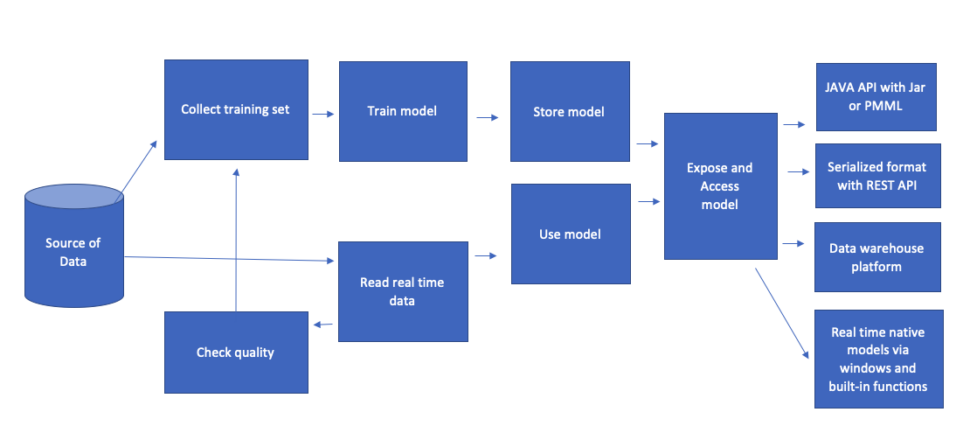
In today’s fast-paced financial markets, detecting anomalies in trading data is crucial for preventing fraudulent activities and ensuring compliance with regulatory standards. By leveraging advanced machine learning (ML) techniques, businesses can enhance their anomaly detection capabilities, leading to more robust and secure operations. In this blog, we’ll explore how to use Striim’s Change Data Capture, Stream Processing, and extensibility features to integrate an anomaly detection model built with a third-party machine learning library. We’ll use Striim’s data proximity to ensure tight integration with models, avoiding data latency and accuracy issues. For this demonstration, we’ll perform analytics using simulated day trading data, store the model in a standard Python serialization format, expose it via a REST API, and use it in Tungsten Query Language (TQL), Striim’s SQL-like language for developers to build applications.  

What is Anomaly Detection?

Anomalies are events that deviate significantly from the normal behavior in the data. Anomaly detection is an unsupervised technique used to identify these events. Anomalies can be broadly classified into three categories:

  • Outliers: Short-term patterns that appear in a non-systematic way.
  • Changes: Systematic or sudden changes from the previous normal behavior.
  • Drifts: Slow, unidirectional long-term changes in the data.

Case Study with Anti-Money Laundering App

A few years ago, Striim was hired by a financial institution to implement an app to track trader activity and detect fraud via Anti-Money Laundering (AML) rules. Recently, we extended this app by integrating an anomaly detection ML model.

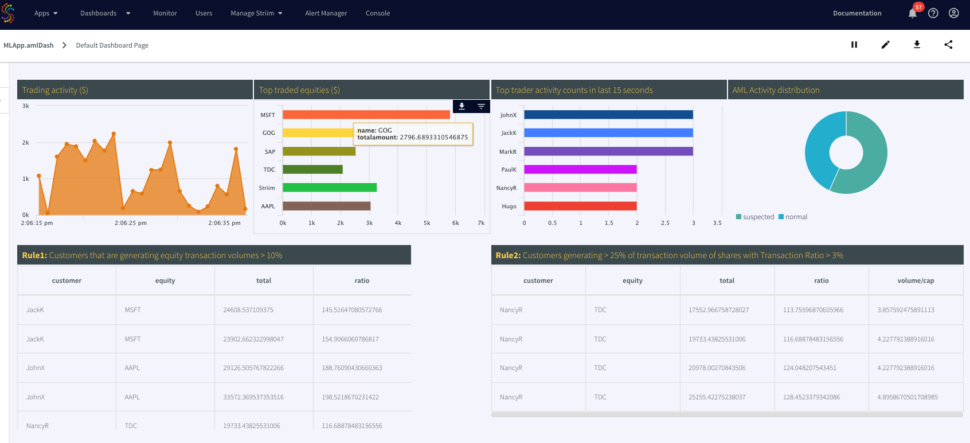
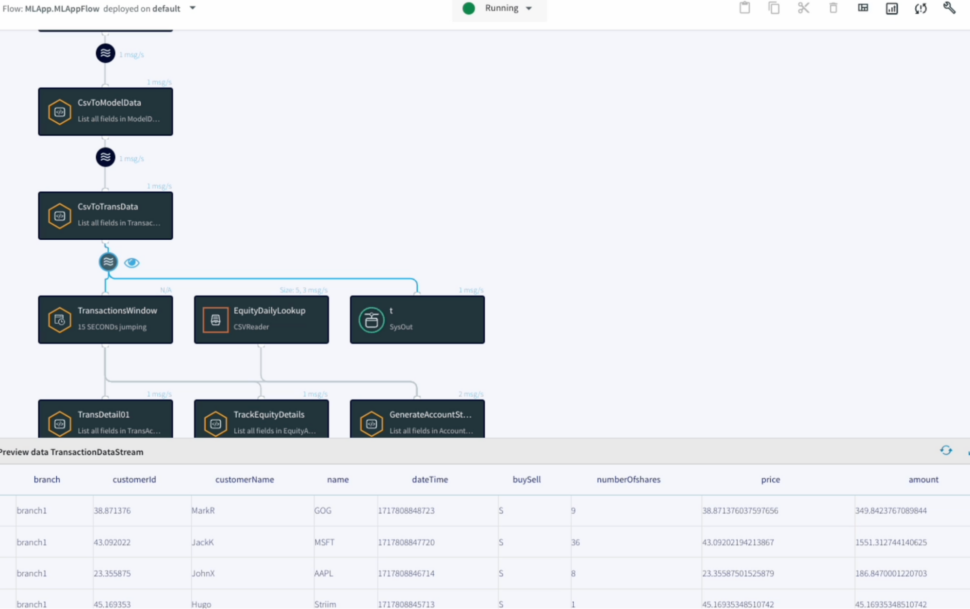
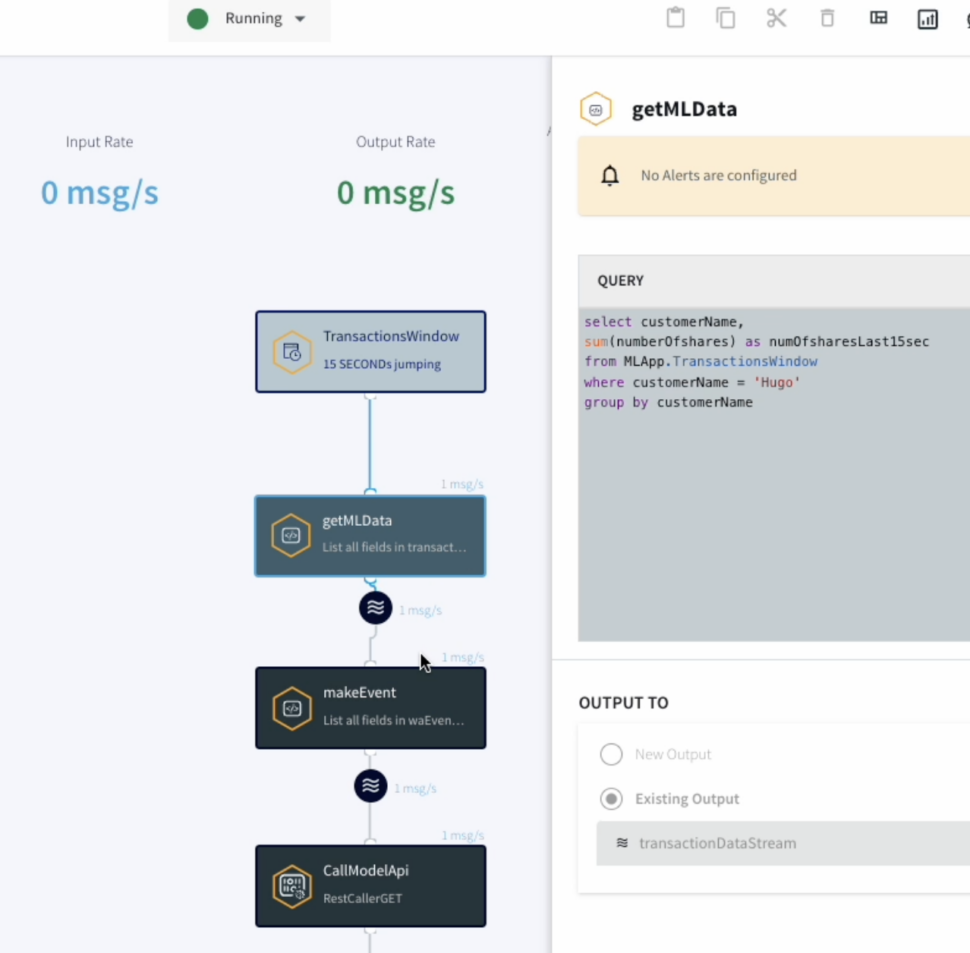
The app collects trading data from an operational database, uses caches to enrich incoming events, and applies Striim’s continuous queries (CQs) and in-memory time series windows to analyze the received information. The app implements several AML rules and, once the data is processed, it is stored in final EDW targets and presented in Striim’s real-time streaming dashboards.

Trading data passed to Transaction window

ML Integration and Usage Patterns with Striim Pipelines

Integrating machine learning models with Striim pipelines allows us to enhance our analytics capabilities. In this example, we’ll use the sklearn Python library to train a model with day trading activity data.

Solution

Train the model

  1. Use sklearn python library to train a model with a collected IL data based on day trading activity of a selected stock broker. The application collects and sums trading activities for a selected person for a period of time via a time window
  2. Pick One Class SVM. One Class Classification (OCC) aims to differentiate samples of one particular class by learning from single class samples during training. It is one of the most commonly used approaches to solve Anomaly Detection, a subfield of machine learning that deals with identifying anomalous cases which the model has never seen before.
  3. Train the model: OneClassSVM(gamma=’auto’).fit(X) where X is a set of training data

Use the model 

  1. Store data via JobLib dump format providing the most efficient way to save files to disk
  2. Build a function to call model in real time via predict(K) and expose it via REST API using Flask library as an example but service can be hosted on any WSGI web server app
  3. API output comes as simple JSON string:  
    • {“anomaly”:”-1″,”inputParam”:”80″} if an anomaly is detected.
    • {“anomaly”:”1″,”inputParam”:”44″} if the behavior is normal.
  4. Access the model API via Rest API Caller OP PS built module

By integrating external ML models with Striim, you can create powerful, real-time anomaly detection systems that enhance your business operations and security measures. This approach ensures that you can quickly identify and react to unusual patterns in your data, maintaining the integrity and reliability of your systems. Ready to see how Striim can transform your data analytics and anomaly detection processes? Sign up for a free trial today and experience the power of real-time data integration and machine learning firsthand.

Back to top