Real-Time Analytics: Upleveling the Modern Customer Experience

Customer expectations have evolved beyond simply receiving timely responses. Consumers now expect personalized experiences that make every interaction with a brand feel personal and relevant. 

To meet these rising expectations, businesses are investing in real-time customer analytics—a strategic approach that enables them to understand, predict, and respond to customer behavior as it happens. In fact, according to a Gartner survey, nearly 80% of companies are increasing their investments in customer experience initiatives to stay competitive in the digital age. The result? An enhanced customer experience that drives loyalty, revenue growth, and sustainable success.

The Importance of Delivering Instant, Personalized Experiences

Generic messaging isn’t appealing to today’s customers — they expect more. They want to feel understood, valued, and personally connected to brands. Imagine visiting a website that recognizes your unique preferences and offers suggestions that truly resonate with your lifestyle. Instead of encountering one-size-fits-all content, the experience adapts to you—highlighting products that complement your previous choices or even tailoring messages to suit your local context and current environment.

This personalized touch transforms the way you interact with a brand. It creates a sense of ease and relevance, making you feel like the brand truly “gets” you. When every interaction feels thoughtfully designed around your needs, it not only enhances your shopping journey but also builds trust and fosters loyalty. In a world where time is precious and options are abundant, these tailored experiences become the key to turning a casual browser into a dedicated customer.

Now, let’s dive into how real-time data and analytics tie in. 

How Real-Time Data Directly Contributes to Customer Experience 

Real-time analytics is only as effective as the data it relies on. To truly transform customer interactions, brands must harness up-to-the-minute information that reflects every nuance of customer behavior. Without this dynamic input, any attempt at personalization risks being outdated by the time it reaches the customer. Real-time data empowers companies to analyze interactions across various channels—whether online or in-store—and immediately adjust the experience to meet individual needs. This agility can be the difference between a one-size-fits-all approach and a truly engaging, bespoke customer journey.

This instant personalization is built on a well-structured data strategy that combines three key types of data:

  • First-Party Data: This is data directly collected from your owned channels, such as your website and mobile apps.
  • Second-Party Data: Sourced from trusted partners who share insights from their interactions with customers, this data helps broaden your understanding while reinforcing direct customer feedback.
  • Third-Party Data: Acquired from data aggregators, this information can enrich your insights, offering a broader market perspective. However, it must be used judiciously, especially in light of evolving privacy regulations.

By integrating these diverse data sources, companies can transform raw information into actionable insights. Every customer touchpoint—be it browsing a website, receiving an email, or visiting a store—can be optimized in real time, ensuring that each interaction is as engaging and relevant as possible.

Yet, while the benefits of real-time data are clear, many companies still struggle with the necessary infrastructure. Legacy systems, siloed databases, and outdated analytics tools often impede the swift collection, processing, and application of data. 

Without a modern, agile data infrastructure, even the best personalization strategies can falter, resulting in delayed interactions and missed opportunities to connect with customers when it matters most. To fully leverage real-time data for a superior customer experience, businesses must invest in robust, scalable systems that can keep pace with the rapid flow of information in today’s digital landscape.

Enhancing the Entire Customer Journey

A holistic view of the customer journey is crucial in today’s competitive landscape. Real-time analytics offers a comprehensive look at every step a customer takes—from initial awareness to post-purchase engagement. This continuous flow of data allows companies to identify bottlenecks, understand how customers interact with various touchpoints, and make immediate improvements where needed.

For example, if analytics reveal that a particular webpage is causing customers to drop off during the checkout process, a real-time alert can prompt the team to investigate and optimize the page—whether by simplifying the form, improving the user interface, or even offering a live support chat. Similarly, journey reports and attribution analyses help trace the paths that lead to successful conversions, enabling brands to replicate positive experiences across other channels.

By continuously monitoring the customer journey and making data-driven adjustments, companies can ensure a smoother, more engaging experience that evolves alongside customer needs.

How to Implement Real-Time Analytics to Improve Customer Experience 

Transitioning to real-time analytics might seem like a daunting, resource-intensive task, but a strategic, phased approach can make the process manageable and highly effective.

Here’s how to begin. 

Start with High-Impact Use Cases

Focus initially on the areas where real-time data can make the most significant impact—such as personalization and loyalty. This allows your team to see immediate benefits and build internal support for broader initiatives.

Integrate Across Channels

Ensure your data infrastructure can handle inputs from various sources—online interactions, in-store purchases, mobile app engagements, and more. A unified view of customer behavior is key to delivering truly personalized experiences.

Leverage Scalable Platforms

Platforms like Striim offer robust solutions that combine data ingestion, processing, and analytics in one place. These tools are designed to grow with your needs, helping you integrate third-party data where appropriate and maintain compliance with evolving privacy standards.

Continuous Optimization

Use the insights gained from real-time data not just to react, but to proactively enhance the customer journey. Experiment with different loyalty strategies, test new personalization tactics, and refine your approach based on what the data tells you.

Looking Ahead: The Future of Customer Analytics

As technology advances, real-time analytics is poised to become even more integral to customer experience strategies. The evolution of AI and machine learning is enabling businesses to not only react to customer behavior but also predict it. This predictive capability means that brands are starting to anticipate customer needs before they arise, offering proactive recommendations and solutions that further enhance satisfaction and loyalty.

Emerging technologies, such as the Internet of Things (IoT), are also broadening the spectrum of available data. By integrating IoT devices, companies can gain insights into customer behavior in physical spaces—such as tracking in-store movements or monitoring product interactions—thereby adding another layer of depth to the customer experience.

In this new era, success is defined by the ability to blend data-driven insights with human creativity, crafting experiences that feel both personalized and authentic.

The Role of AI in Real-Time Analytics

By combining AI with real-time analytics with integrative platforms like Striim in parallel with AI-ready cloud data warehouses like Snowflake, businesses can create hyper-personalized, adaptive experiences that drive deeper customer connections and long-term loyalty.

Real-World Example: Morrisons 

Morrisons, one of the UK’s largest supermarket chains, has embraced real-time analytics to elevate its customer experience. By integrating critical data from its Retail Management System (RMS) and Warehouse Management System (WMS) into Google BigQuery via Striim, Morrisons now gains immediate visibility into stock levels and product availability. 


This shift from batch processing to real-time data access enables the company to promptly identify and resolve inventory issues, optimize replenishment, and ensure that shelves are consistently stocked. As a result, customers enjoy a more reliable and satisfying shopping experience—whether they’re shopping in-store or online—with up-to-date product information and timely promotions that cater to their needs.

The Future of Customer Experience is Here

Real-time analytics is no longer a futuristic concept—it is the foundation of modern customer engagement. By enabling instantaneous personalization and a continuously optimized customer journey, real-time analytics helps brands build lasting, meaningful relationships with their customers. 

For companies looking to embark on this journey, starting small and building on high-impact use cases can pave the way for a comprehensive transformation. With strategic tools and platforms available today, the path to delivering truly exceptional customer experiences is clearer than ever. Ready to discover how Striim can help your business leverage real-time data and analytics to enhance customer experience? Get a demo today

Real-Time AI for Crisis Management: Responding Faster with Smarter Systems

During a crisis—whether it’s a pandemic, a natural disaster, or a major supply chain breakdown—swift, informed decision-making can mean the difference between regaining control and facing further escalation. Today’s organizations have access to more data than ever before, and consequently are faced with the challenge of determining how to transform this tremendous stream of real-time information into actionable insights. 

That’s where real-time artificial intelligence (AI) can help. When integrated effectively, AI and machine learning (ML) models can process data streams at near-zero latency, empowering teams to make split-second decisions. In this post, we’ll explore how real-time data and AI-driven analytics reshape crisis management across industries such as healthcare, logistics, and emergency services. We’ll also show how Striim can serve as the backbone for these real-time data pipelines—ensuring that decisions are always based on the most current, accurate information.

The Power of Real-Time Data in Crisis Management

When a crisis unfolds, data moves at lightning speed. Hospitals must juggle incoming patient information, logistics teams track thousands of shipments, and emergency responders monitor multiple channels in parallel. Real-time data is the foundation of effective crisis response; without it, instant updates, continuous monitoring, and timely communication are impossible. 

Here’s how real-time data empowers different facets of crisis management: 

  • Instant Updates: Real-time dashboards alert decision-makers to critical events as they happen, rather than hours later.
  • Continuous Monitoring: Streaming analytics detect anomalies—such as sudden spikes in patient admissions or unexpected traffic congestion—so you can intervene before a problem grows.
  • Timely Communication: Automated alerts and notifications ensure the right teams react immediately, preventing confusion and delays.

By integrating AI/ML models directly into these data streams, organizations gain deeper insights: advanced algorithms can spot emerging patterns, predict cascading effects, and recommend interventions—all in the moment.

Key Challenges in Adopting Real-Time AI 

Despite its transformative potential, implementing real-time AI for crisis management comes with hurdles:

Data Quality and Availability

Inconsistent or incomplete data can severely impact the accuracy of ML models and therefore, your emergency response. Continuous data cleaning and integration are essential to maintain reliable outputs.

Managing AI “Hallucinations”

Certain AI models, including large language models, may produce plausible yet incorrect answers. Validation and monitoring can help reduce this risk. 

Safeguarding Personally Identifiable Information (PII)

Oftentimes, crisis data includes sensitive details (e.g., patient records or geolocation data). Encryption, access controls, and regulatory compliance (HIPAA, GDPR, etc.) are non-negotiable. However, leveraging AI agents like Striim’s Sherlock and Sentinel, which enable encryption and masking for PII, can help ensure that data is safe even in the event a breach occurs. 

Meeting Critical Latency Requirements

In many scenarios—like patient triage or disaster response—latency thresholds are near-zero. Systems must be capable of handling high-velocity data without bottlenecks.

As you can see, there’s a lot to consider in adopting real-time AI. Addressing these challenges demands an end-to-end approach that integrates data ingestion, streaming analytics, AI governance, and security in a cohesive pipeline.

Real-Time AI Use Cases: Healthcare, Logistics, and Emergency Services

There are several real-time AI use cases for crisis management, with three being the most popular. These include: 

Healthcare

Hospitals leverage real-time data to consolidate streaming vital signs, EHR updates, and lab results for in-the-moment patient monitoring.AI models can detect potential complications (like sepsis or respiratory decline) in real time, alerting medical staff before conditions worsen.

Logistics

A supply chain interruption—caused by a factory shutdown or severe weather—can ripple through an entire network.By feeding live shipment data and warehouse updates into an ML model, logistics managers receive instant recommendations on rerouting or inventory reallocation, minimizing costly delays.

Emergency Response Services 

Police and rescue teams often depend on 911 call data, social media information, and geospatial tracking.With real-time AI, dispatchers can prioritize resource allocation where it’s needed most. For example, analyzing social media mentions of flooded areas can guide rescuers to hotspots before formal reports come in.

In each scenario, real-time data plus AI-driven insights create a powerful feedback loop—one that not only accelerates crisis response but also continuously refines itself through ongoing data ingestion and machine learning updates.

How Striim Empowers Real-Time AI Pipelines 

Striim acts as the backbone for your real-time AI initiatives, processing data streams at scale and delivering low-latency insights. Striim enables: 

Real-Time Data Integration

Striim’s distributed, in-memory streaming architecture ingests data from transactional databases, IoT sensors, and application logs in real time. Additionally, parallel processing allows you to handle high-velocity data without sacrificing speed or reliability.

Integration with Inline and External AI/ML Models 

Through Advanced Real-Time ML Analytics, Striim seamlessly integrates with inline and external AI/ML models, so you can embed advanced analytics directly into streaming data flows. This approach delivers meaningful insights the moment data arrives, supported by continuous learning algorithms that adapt models dynamically to evolving conditions.

Retrieval Augmented Generation (RAG) by Creating Vector Embeddings 

Striim also enables RAG by creating instant vector embeddings in enterprise data pipelines and distributing those vectors for next-generation hybrid search. Its AI Insights capabilities further streamline automated PII detection, security, and data preprocessing for prompt engineering, ensuring full compliance without adding complexity.

Leverage Real-Time Data and AI for Crisis Management 

Crisis management in the modern world requires more than just reactive steps—it demands continuous awareness and the ability to pivot on a moment’s notice. By integrating AI/ML models directly into streaming data pipelines, organizations can detect anomalies, predict cascading impacts, and execute real-time interventions. 

Ready to learn how Striim can help your organization leverage real-time AI for crisis management? Register for a demo.

The Intersection of GenAI and Streaming Data: What’s Next for Enterprise AI?

In today’s competitive environment, enterprises need to harness data the instant it’s created. But data teams often face challenges when it comes to capturing, processing, and integrating high-velocity data streams from diverse sources—making it difficult to keep AI applications timely and relevant. Simultaneously, generative AI (GenAI) is becoming indispensable for delivering dynamic, real-time solutions, from chatbots and personalized marketing to adaptive decision-making.

Where these two trends collide—real-time data streaming and GenAI—lies a major opportunity to reshape how businesses operate. However, turning this vision into reality requires more than just powerful AI algorithms. Today’s enterprises are tasked with implementing a robust, flexible data integration layer capable of feeding GenAI models fresh context from multiple systems at scale.

In this post, we’ll explore the synergy between GenAI and streaming data and how this powerful combination is set to shape the next era of enterprise AI.

Key Challenges at the Intersection of GenAI and Streaming Data

While the merging of real-time data with GenAI offers exciting possibilities, the path forward is certainly not without challenges, such as: 

1. Poor Data Quality and Availability

AI’s success is highly dependent upon data quality. To achieve accurate and reliable results, businesses need to ensure their data is clean, consistent, and relevant. This proves especially difficult when dealing with large volumes of high-velocity data from various sources.

To address this, enterprises need robust data validation systems that clean, filter, and process data streams in real time. Consistent monitoring and real-time integration are also necessary to ensure that data remains reliable and relevant for AI models.

2. High Latency 

Real-time applications such as fraud detection, personalized marketing, or anomaly detection require low-latency. If the data infrastructure can’t process and deliver insights in near real-time, the value of streaming data and GenAI models diminishes rapidly.

For businesses using GenAI for customer support, for example, a chatbot must provide responses almost instantaneously, reflecting the latest user inputs. Without low-latency systems, customers may experience delays, leading to reduced satisfaction and engagement.

3. Ensuring the Protection of Personally Identifiable Information (PII) in AI Pipelines 

When processing high-velocity streams of data, particularly in GenAI models, protecting sensitive information is crucial. As AI systems increasingly handle vast amounts of personal and confidential data, ensuring that PII remains secure becomes a major challenge. Without robust safeguards in place, there is a risk of unauthorized access or accidental exposure, which could compromise privacy and violate regulatory requirements, eroding customer confidence. 

4. Unscalable Infrastructure 

As data volume, variety, and velocity increase, organizations must invest in scalable infrastructure that can handle vast and growing datasets. With the rise of IoT devices and increased automation, businesses will generate even larger amounts of data, meaning infrastructure must be able to scale both horizontally and vertically. 

The Future of Enterprise AI: Moving from Vision to Reality

Successfully integrating GenAI with real-time data streaming requires strategic investments across infrastructure, data governance, and AI model development. Here are the critical steps enterprises should take to turn this vision into a tangible, scalable solution.

1. Establish a Solid Data Integration Foundation

To power real-time GenAI models, businesses need a robust data integration infrastructure capable of handling high-velocity streams from multiple sources. It’s also imperative that real-time data streaming platforms are scalable to ensure that data can be ingested, processed, and delivered to AI models in real time.

Key considerations for building this foundation include:

  • Unified Data Layer: Integrate data from various sources (cloud, on-premises, IoT devices, social media) into a unified pipeline for seamless AI processing.
  • Data Quality Management: Implement data validation, transformation, and normalization techniques to ensure clean, consistent, and relevant data.
  • Performance Management: Ensure your infrastructure can handle growing data volumes without sacrificing performance, leveraging cloud-native solutions that dynamically scale as needed.

Example Use Case: Financial institutions can integrate live transaction data, currency exchange rates, and customer behavior patterns into GenAI models for real-time personalized banking services.

2. Prioritize Real-Time Data Governance and Privacy

Real-time data streaming brings significant privacy and governance challenges. Organizations must implement privacy-preserving practices such as encryption, anonymization, and tokenization to protect sensitive data.

Steps for ensuring governance include:

  • Real-Time Data Monitoring: Continuously track data integrity and security as it flows through your pipeline to ensure accuracy and protect PII.
  • Compliance with Regulations: Ensure that AI models comply with global data privacy regulations, such as GDPR and CCPA, and integrate compliance checks into the data pipeline.

Striim offers AI agents Sentinel and Sherlock, which leverage advanced AI to detect and protect sensitive data in real time. Sherlock monitors your data streams to identify sensitive information. Sentinel applies protection methods including masking or encryption to safeguard your data. 

Example Use Case: A healthcare provider can integrate patient data into real-time AI-driven applications while ensuring compliance with healthcare privacy laws with the help of PII masking.

3. Leverage Continuous Model Training and Fine-Tuning

For GenAI models to stay relevant, they must be continually updated with new data. Real-time data streaming allows for the continuous retraining of AI models, ensuring that they adapt to emerging trends, changes in user behavior, and evolving business needs.

Key steps include:

  • Real-Time Model Retraining: Set up processes for automatic model updates as new data arrives, ensuring the AI remains accurate and responsive.
  • Feedback Loops: Incorporate real-time feedback from AI models to refine and improve data quality and decision-making.

Example Use Case: E-commerce platforms using real-time browsing data can continuously update product recommendation models, keeping content aligned with current trends.

4. Invest in Scalable Infrastructure

To manage the growing volume of real-time data and the increasing demands of GenAI, businesses need flexible, scalable infrastructure. Cloud-native solutions, edge computing, and distributed frameworks enable companies to process vast amounts of data quickly and efficiently.

Striim Cloud is designed to support these needs by offering fully managed, real-time data streaming pipelines, allowing organizations to build and scale data processing workflows in minutes. With Striim Cloud available on AWS, Google Cloud, and Microsoft Azure, businesses can ensure seamless data integration, rapid decision-making, and low-latency performance across both cloud-native and edge computing environments.

Example Use Case: A logistics company can use Striim’s cloud native infrastructure to stream data from IoT sensors in real time, optimizing fleet operations and reducing maintenance costs.

5. Foster Cross-Functional Collaboration

Realizing the potential of GenAI and streaming data requires collaboration between data teams and business stakeholders. Alignment across departments ensures that AI models meet business goals and deliver measurable value.

Key strategies for fostering collaboration include:

  • Unified Business Goals: Ensure that all stakeholders understand the value of real-time data and GenAI models for achieving business outcomes.
  • Agile Development: Adopt agile practices to enable rapid prototyping and iteration, allowing teams to test and refine AI solutions quickly.

Example Use Case: Retailers seeking to implement dynamic pricing models based on real-time customer data will benefit from close collaboration between data scientists and business analysts to ensure pricing strategies align with market conditions.

The Future of Enterprise AI

The combination of GenAI and real-time streaming data represents a massive opportunity for businesses to drive innovation, optimize operations, and provide more personalized experiences. However, to fully capitalize on this potential, enterprises must invest in scalable, secure, and efficient infrastructures, maintain continuous learning systems, and foster cross-functional collaboration. Ready to see how Striim can accelerate your data and AI initiatives? Schedule a demo today to explore powerful real-time streaming and data integration solutions tailored to your organization’s needs.

A Comprehensive Guide to Operational Analytics

Recent studies highlight the critical role of data in business success and the challenges organizations face in leveraging it effectively. A 2023 Salesforce study revealed that 80% of business leaders consider data essential for decision-making. However, a Seagate report found that 68% of available enterprise data goes unleveraged, signaling significant untapped potential for operational analytics to transform raw data into actionable insights.

Operational analytics unlocks valuable insights by embedding directly into core business functions. It leverages automation to streamline processes and reduce reliance on data specialists. Here’s why operational analytics is key to improving your organizational efficiency — and how to begin.

What Is Operational Analytics?

Operational analytics, a subset of business analytics, focuses on improving and optimizing daily operations within an organization. While business intelligence (BI) typically centers on the “big picture” — such as long-term trends, strategic planning, and organizational goals — operational analytics is about the “small picture.” It hones in on the granular, day-to-day decisions that collectively drive efficiency and effectiveness in real-time environments.

For example, consider a hospital seeking to streamline operations. To do so, the team would answer questions including:

  • How many nurses are required per shift?
  • How long should it take to transfer a patient to the ICU?
  • How can patient wait times be reduced?

Operational analytics can answer these questions by providing actionable insights that drive efficiency and throughput. By analyzing real-time data, it helps organizations make data-informed decisions that directly improve daily workflows and overall performance.

Here’s another example: A customer service team can monitor ticket volumes in real-time, allowing them to prioritize responses without switching between tools. Similarly, a logistics coordinator can dynamically adjust delivery routes based on current traffic or weather conditions, ensuring smoother operations and greater agility. These examples illustrate how operational analytics seamlessly integrates into everyday processes, enabling teams to respond quickly and effectively to changing circumstances.

Operational analytics also excels in providing real-time feedback loops that BI does not typically offer. Where BI might analyze the success of a marketing campaign after its conclusion, operational analytics can inform ongoing campaigns by highlighting immediate trends, such as engagement spikes or content underperformance, enabling in-the-moment adjustments.

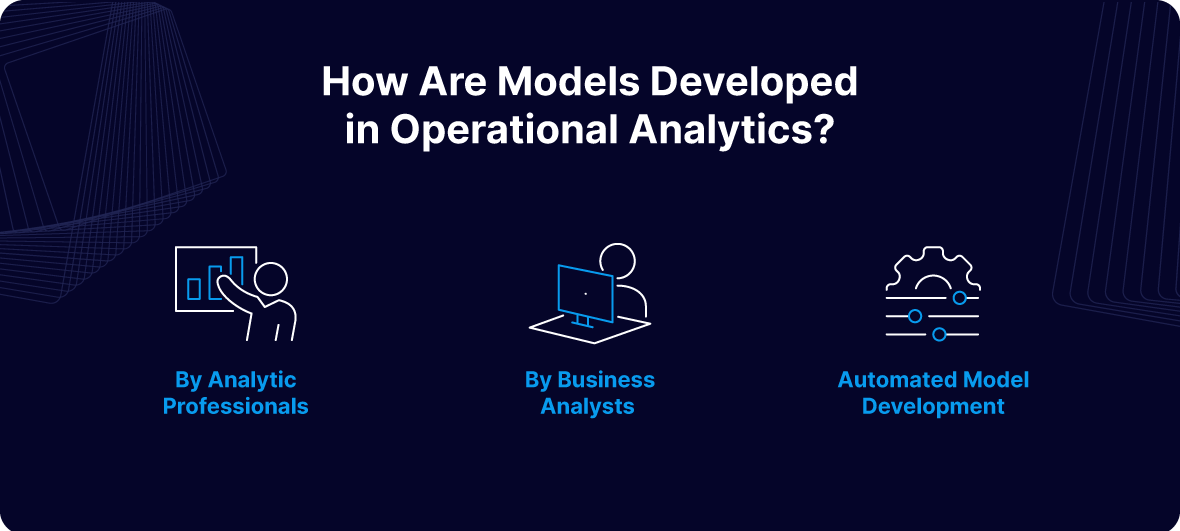
How Are Models Developed in Operational Analytics?

Analytic models are the backbone of operational analytics, helping organizations understand data, generate predictions, and make informed business decisions. There are three primary approaches to building models in operational analytics:

1. Model Development by Analytic Professionals

Analytic specialists, such as data scientists or statisticians, frequently lead the development of sophisticated models. They utilize advanced techniques including cluster analysis, cohort analysis, and regression analysis to uncover patterns and insights.

Models developed by these professionals generally follow one of the following approaches:

  • Specialized Modeling Tools: Tools designed for tasks like data access, cleaning, aggregation, and analysis.
  • Scripting Languages: Languages like Python and R that provide robust libraries for statistical and quantitative analysis.

As a result, this approach delivers highly customized and precise models but requires significant expertise in both statistics and programming.

2. Model Development by Business Analysts

For organizations with limited needs, hiring an analytic specialist may not be feasible. Instead, these teams can leverage business analysts who bring a combination of business understanding and familiarity with data.

Typically a business analyst:

  • Understands operational workflows and data collection processes.
  • Leverages BI tools for reporting and basic analytics.

While they may lack the technical depth of data scientists, business analysts use tools like Power BI and Tableau, which provide built-in functionalities and automation for model building. These tools allow them to extract and analyze data without the need for advanced programming knowledge, striking a balance between ease of use and analytical capability. Therefore, this is a great option for businesses that don’t have the resources to tap analytic professionals.

3. Automated Model Development

Automated model development leverages software to build models with minimal human intervention. This approach involves:

  • Defining decision constraints and objectives.
  • Using the software to experiment with different approaches for various customer scenarios.
  • Allowing the software to learn from results over time to refine and optimize the model.

Through experimentation, the software identifies the most effective strategies, ultimately creating a model that adapts to customer preferences and operational needs. This method is particularly valuable for scaling analytics and reducing reliance on specialized skills.

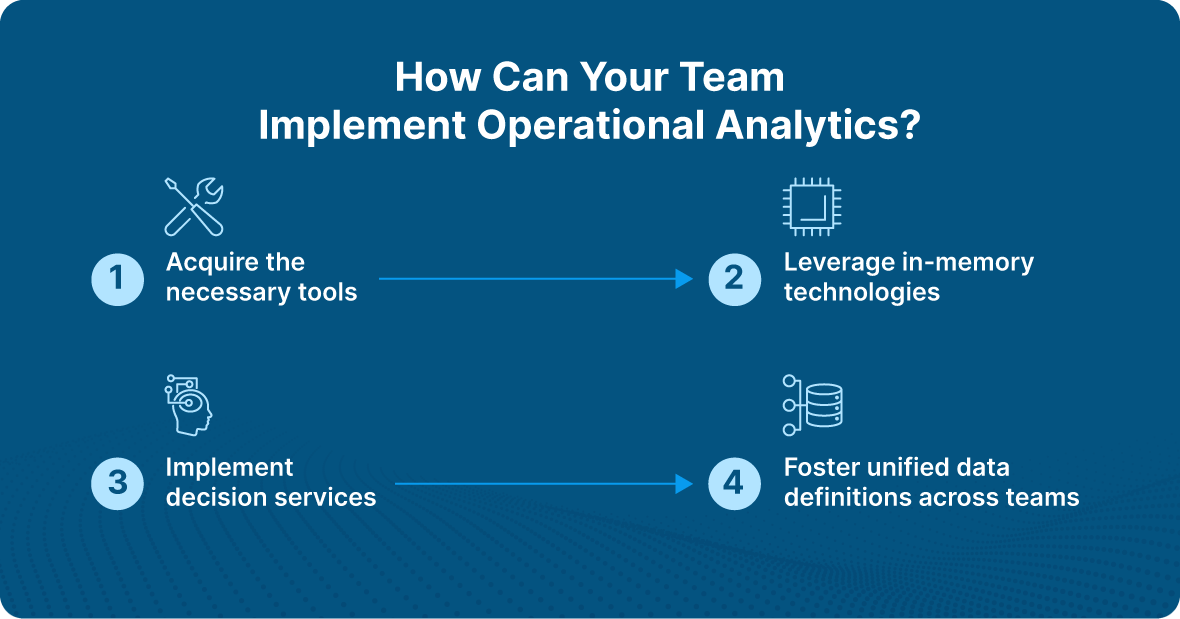
How Can Your Team Implement Operational Analytics?

Implementing operational analytics requires leveraging the right technologies, processes, and collaboration to ensure real-time, actionable insights drive efficiency and decision-making. Here’s how to do so effectively:

1. Acquire the Necessary Tools

The foundation of operational analytics lies in having the right tools to handle diverse data sources and deliver real-time insights. Key components include:

  • ETL Tools: To extract, transform, and load data from systems such as enterprise resource planning (ERP) software, customer relationship management (CRM) platforms, and other operational systems.
  • BI Platforms: For data visualization and reporting.
  • Data Repositories: Data lakes or warehouses to store and manage vast datasets.
  • Specialized Tools for Data Modeling: These tools help create and refine analytics models to fit operational needs.

Real-time data processing capabilities are crucial for operational analytics, as they enable organizations to respond to changes immediately, improving agility and effectiveness.

2. Leverage In-Memory Technologies

Traditional BI tasks often rely on disk-stored database tables, which can cause latency. With the reduced cost of memory, in-memory technologies provide a faster alternative.

  • How It Works: By loading data into a large memory pool, organizations can run entire algorithms directly within memory, reducing latency and accelerating insights.
  • Use Cases: Financial institutions, for instance, use in-memory technologies to update risk models daily for thousands of securities and scenarios, enabling rapid investment and hedging decisions.

In-memory technologies are particularly valuable for real-time operational analytics, where speed and performance are critical to decision-making.

3. Implement Decision Services

Decision services are callable services designed to automate decision-making by combining predictive analytics, optimization technologies, and business rules.

  • Key Benefits: They isolate business logic from processes, enabling reuse across multiple applications and improving efficiency.
  • Example: An insurance company can use decision services to help customers determine the validity of a claim before filing.

To ensure effective implementation, decision services must access all existing data infrastructure components, such as data warehouses, BI tools, and real-time data pipelines. This access ensures decisions are based on the most current and relevant information.

4. Foster Unified Data Definitions Across Teams

A shared understanding of data is essential to avoid delays and inconsistencies in operational analytics implementation. Ensure alignment across your analytics, IT, and business teams by:

  • Standardizing Data Definitions: Consistency in modeling, testing, and reporting processes ensures smooth collaboration.
  • Prioritizing Real-Time Alignment: Unified data definitions help ensure that real-time insights are actionable and reliable for all stakeholders.

Which Industries Benefit from Operational Analytics?

Operational analytics has the potential to transform a variety of industries by enabling real-time insights, improving efficiency, and enhancing decision-making.

Sales

Many organizations focus on collecting new data but overlook the untapped potential in their existing sales tools like Intercom, Salesforce, and HubSpot. This lack of insight can hinder their ability to optimize sales strategies.

Operational analytics helps businesses better utilize their existing data by creating seamless data flows within operational systems. With more contextual data:

  • Sales representatives can improve lead scoring, targeting prospects with greater accuracy to boost conversions.
  • Real-time, enriched data enables segmentation of customers into distinct categories, allowing tailored messaging that addresses specific pain points.

These improvements empower sales teams to act on high-quality data, driving better outcomes.

Industrial Production

Operational analytics supports predictive maintenance, enabling businesses to detect potential machine failures before they occur. Here’s how it works:

  1. Identify machines that frequently disrupt production.
  2. Analyze machine history and failure patterns (e.g., overheating motors).
  3. Develop a model to predict failure probabilities.
  4. Feed sensor data, such as temperature and vibration metrics, into the model.

Over time, the model learns from historical and real-time data to provide accurate failure estimates. Benefits include:

  • Advanced planning of maintenance schedules to minimize downtime.
  • Improved inventory management by identifying spare parts needed in advance.

These predictive capabilities enhance operational efficiency and reduce costly disruptions.

Supply Chain

Operational analytics can optimize supply chain processes by extracting insights from the vast data generated across procurement, processing, and distribution.

For example, a point-of-sale (PoS) terminal connected to a demand signal repository can use operational analytics to:

  • Enable real-time ETL processes, sending live data to a central repository.
  • Anticipate consumer demand with greater precision.

Additionally, prescriptive analytics within operational analytics helps manufacturers evaluate their supply chain partners. For instance:

  • Identify suppliers with recurring delays due to diminished capacity or economic instability.
  • Use this insight to address performance issues with suppliers or explore alternative partnerships.

By uncovering inefficiencies and enabling proactive decision-making, operational analytics strengthens supply chain reliability and responsiveness.

Real-World Operational Analytics Example

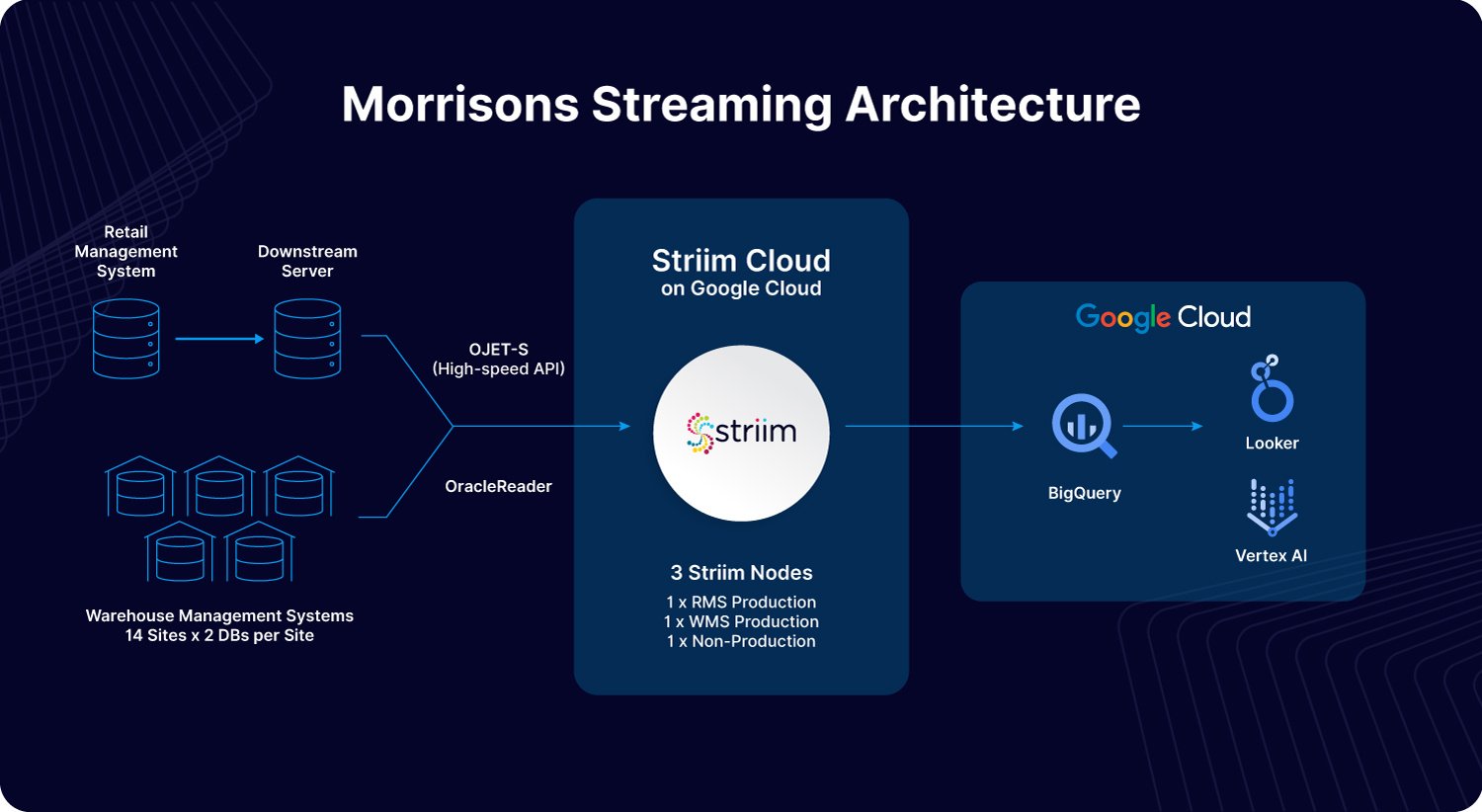
Morrisons, one of the UK’s largest supermarket chains, demonstrates how operational analytics can drive real-time decision-making and operational efficiency. By leveraging Striim’s real-time data integration platform, Morrisons modernized its data infrastructure to seamlessly connect systems such as its Retail Management System (RMS) and Warehouse Management System (WMS). This integration enabled Morrisons to ingest and analyze critical datasets in Google Cloud’s BigQuery, providing immediate insights into stock levels and operational performance.

For example, operational analytics allowed Morrisons to implement “live-pick” replenishment processes, ensuring on-shelf availability while reducing waste and inefficiencies. Real-time visibility into KPIs such as inventory levels, shrinkage, and availability empowered their teams—from senior leadership to store staff—to make informed decisions instantly. By embedding analytics into daily workflows, Morrisons created a data-driven culture that improved customer satisfaction and operational agility. This transformation highlights the power of operational analytics to optimize processes and enhance outcomes in the retail industry.

What Tools Are Available for Operational Analytics?

One common challenge with operational analytics is ensuring that tools can sync and share data seamlessly. Reliable data flow between applications is essential, yet many software platforms only move data into a data warehouse, leaving the task of operationalizing that data unresolved. Data latency further complicates the issue, making it difficult to display up-to-date insights on dashboards. This is where Striim stands out, offering powerful capabilities to address these challenges.

Striim provides real-time integrations for virtually any type of data pipeline. Whether you need to move data into or out of a data warehouse, Striim ensures that operational systems receive data quickly and reliably. Additionally, Striim allows users to build customized dashboards for operational analytics, providing actionable insights in real time.

Gaining Employee Buy-In for Operational Analytics

Adopting operational analytics often involves organizational changes that may challenge existing workflows. Decisions based on analytics can shift responsibilities, empowering junior staff to make decisions they previously deferred to senior colleagues. This shift can create unease among employees used to manual decision-making processes.

To ensure a smooth transition, organizations should involve employees from the start, demonstrating how operational analytics can enhance their work. Automation can free up time for more meaningful tasks, improving overall productivity and reducing repetitive workloads. By gaining employee confidence and highlighting the benefits, organizations can foster acceptance and ensure a successful rollout of operational analytics.

Improve Efficiency with Operational Analytics

Operational analytics empowers organizations to optimize daily operations by transforming raw data into actionable, real-time insights. Unlike traditional business intelligence, which focuses on long-term strategies, operational analytics hones in on immediate, tactical decisions, enhancing efficiency and agility.

Industries like retail, industrial production, and supply chain management use operational analytics to drive predictive maintenance, improve customer segmentation, and ensure real-time decision-making. Tools like Striim facilitate seamless data integration, real-time dashboards, and reduced latency, enabling businesses to respond proactively to operational challenges. By aligning technology, processes, and employee buy-in, operational analytics fosters a data-driven culture that enhances performance and drives success.

Ready to unlock the power of real-time insights with Striim? Get a demo today.

Maximizing Fuel Efficiency with Real-Time Data: A New Era in Airline Operations

In 2024, the global airline industry is projected to spend $291 billion on fuel, making it one of the most significant expenses for airlines. Inefficient fuel management not only drives up operational costs but also hampers environmental targets. 

However, optimizing fuel usage is complex, often hindered by limited real-time monitoring, which can lead to unnecessary waste due to inefficient routes, weather adjustments, excess weight, and outdated practices. Now, real-time data is empowering airlines to address these challenges directly, unlocking impressive gains in both efficiency and sustainability.

Elevating Fuel Efficiency with Real-Time Data

For airlines, fuel efficiency isn’t just about cutting costs—it’s a pivotal factor in reducing environmental impact and maintaining competitive operations. Real-time data integration shifts the industry from reactive to proactive, enabling airlines to make precise adjustments that enable performance across every flight. Despite advancements, fuel inefficiency persists due to operational and logistical hurdles:

  • Limited Access to Live Data: Reactive decision-making often results from a lack of real-time visibility into key metrics.
  • Suboptimal Flight Paths: Without dynamic integration of weather and air traffic data, inefficient routing becomes inevitable.
  • Excessive Weight Management: Ineffective load balancing and outdated cargo handling unnecessarily increase fuel burn.

Addressing these issues requires a comprehensive approach, where real-time insights translate directly into action, driving operational efficiency and sustainability.

Real-Time Data Applications Driving Fuel Optimization

By tapping into real-time data, airlines are able to optimize fuel usage, reducing costs. This is made possible due to: 

1. Live Fuel Consumption Tracking

Real-time monitoring enables airlines to actively track fuel use and adjust operations dynamically. This leads to optimized routing, reduced fuel burn, and on-time arrivals—key factors in lowering costs and enhancing operational precision.

2. Route Optimization with Real-Time Insights

By incorporating live weather data and traffic conditions into flight planning, airlines can proactively adjust paths to avoid adverse conditions and capitalize on fuel-efficient routes. This minimizes unnecessary fuel consumption and most importantly, improves safety. 

3. Weight and Balance Optimization

Real-time analysis of passenger and cargo loads helps reduce excess weight, ensuring more efficient fuel burn. This practice not only cuts costs but also enhances the aircraft’s performance and range.

4. Anomaly Detection for Reliability

Real-time data analytics are essential for airlines to maintain operational efficiency and safety. By continuously monitoring aircraft performance metrics, airlines can promptly detect anomalies such as fuel leaks or irregular engine behavior, allowing for immediate corrective actions that prevent larger disruptions and ensure aircraft reliability.

5. Compliance with Fuel Efficiency Standards

Airlines must adhere to stringent fuel management regulations. Real-time insights simplify this process by providing detailed metrics, ensuring compliance while reducing overall consumption and waste.

Unlocking Operational Efficiency and Sustainability with Striim

Striim enhances these capabilities by providing a platform that integrates and processes real-time data from various sources. This enables airlines to implement predictive maintenance strategies, identifying potential issues before they escalate and optimizing overall performance.

Beyond maintenance, Striim’s real-time data processing also supports key initiatives like fuel optimization through live fuel tracking, route optimization using real-time insights, and weight and balance analysis, helping airlines reduce costs, improve safety, and enhance operational precision.

For instance, Striim’s real-time data integration has been instrumental in American Airlines’ operations, allowing them to monitor aircraft telemetry and proactively manage maintenance needs, while simultaneously ensuring compliance with fuel efficiency standards and delivering superior performance.

In an industry where margins are tight, real-time data is a powerful enabler of efficiency and sustainability. With Striim, airlines can evolve beyond reactive decision-making and embrace a proactive approach to fuel management, ensuring long-term success in a competitive and environmentally conscious landscape

How Striim Equips Airlines with Real-Time Insights for Efficiency and Sustainability

Striim’s platform provides airlines with advanced capabilities to achieve operational excellence and sustainability thanks to: 

  • Comprehensive Data Integration: Striim aggregates data from diverse sources—including weather systems, air traffic control, and aircraft sensors—into a unified, real-time view of operations. This centralized approach empowers teams with immediate insights across all facets of aviation operations.
  • Predictive Analytics with Machine Learning: Machine learning-driven insights help airlines forecast inefficiencies, such as engine anomalies or suboptimal routing, before they escalate. This ensures not only operational reliability but also cost-effective and environmentally friendly decision-making.
  • Robust Security: Advanced security measures protect sensitive operational data, ensuring compliance with industry standards while enabling seamless, secure data sharing across teams.

These capabilities empower airlines to proactively address inefficiencies across operations—from predictive maintenance to real-time delay management—while enhancing the passenger experience and advancing sustainable practices. Striim enables airlines to harness the full potential of real-time data, driving both operational excellence and a sustainable future in aviation.

Ready to experience the difference Striim can make? Get a demo today

Mirroring SQL Server Database to Microsoft Fabric

SQL2Fabric Mirroring is a new fully managed service offered by Striim to mirror on premise SQL Databases.  

It’s a collaborative service between Striim and Microsoft based on Fabric Open Mirroring that enables real-time data replication from on-premise SQL Server databases to Azure Fabric OneLake. This fully managed service leverages Striim Cloud’s integration with the Microsoft Fabric stack for seamless data mirroring to Fabric Data Warehouse and Lake House.

Microsoft Azure Fabric is an end-to-end analytics and data platform designed for enterprises that require a unified solution. It offers a comprehensive suite of services including Data Engineering, Data Factory, Data Science, Real-Time Analytics, Data Warehouse, and Databases. Operating on a Software as a Service (SaaS) model, Fabric brings simplicity and integration to your solutions. Striim Cloud is fully integrated with the Fabric stack and runs natively in Azure next to Fabric services making it a simple, secure, fast solution to replicate data to enable Data engineering, Data science, Real-time Intelligence and Data insights through PowerBI etc.

Key Benefits

  • Simplified Setup: Quick and easy deployment with a user-friendly interface.
  • Real-Time Data Replication: Seamlessly transfer data from SQL Server to Fabric for immediate insights.
  • Automated Data Pipelines: Benefit from automated initial load and real-time CDC pipelines, ensuring efficient data transfer.
  • Automated Schema Management: Simplify data migration with automatic schema mapping and evolution.
  • Robust Security: Protect your data with advanced security measures and compliance standards.
  • High Performance and Scalability: Handle large volumes of data with ease and ensure optimal performance.

SQL2Fabric-Mirroring

Getting Started

Striim’s SQL2Fabric-Mirroring is a purpose-built solution for replicating on-premises SQL Server data to Microsoft Fabric. With a few simple steps, you can automate the entire process, from initial data load to continuous replication in a few minutes.

Step 1: Signup to SQL2Fabric-Mirroring service 30-day trial

Signup for SQL2 Fabric-Mirroring service through Azure Marketplace or Striim’s product page to avail 30 days free trial. Lets you create an Striim Cloud account and login

Step 2: Create a Striim Cloud service

To get started, create a Striim Cloud service in a region close to your SQL Server. Establish a secure connection (e.g., VPN or Azure Private Link) between your on-premises environment and Striim Cloud. Then, use the intuitive interface to configure your data pipeline, specifying source and target details. Striim automates the rest.

Step 3: Create a Data pipeline

Striim’s user-friendly interface allows you to easily connect your SQL Server source and Microsoft Fabric target. The platform automatically creates an optimized data pipeline with smart defaults for SQL Server and handling initial load, continuous replication, and schema mapping using SQL server reader and Fabric Mirroring writer that is integrated with Fabric Mirroring service to offer end to end experience. This streamlined approach eliminates the need for managing multiple solutions, complex configurations and enables you to quickly start leveraging your data for real-time analytics and insights.

Step 4: Monitor high throughput data streaming 

Simply monitor real-time and continuous streaming of data from SQL Server to Fabric on Striim’s intuitive monitor screen or directly on Fabric Mirroring monitor. While Striim does the heavy lifting of ingesting Initial load (Historical data) and seamlessly switching to CDC mode (Change data capture) with low latency and high throughput data performance. Striim enables users to just focus on building business decisions by consuming real-time PowerBI dashboard insights


Easily access and create Power BI Reports on the data mirrored by Striim in Fabric.

Unlocking Operational Efficiency: A Major Home Improvement Retailer’s Path to Data Modernization with Striim

Organizations across various industries require real-time access to data to drive decisions, enhance customer experiences, and streamline operations. A leading home improvement retailer recognized the need to modernize its data infrastructure in order to move data from legacy systems to the cloud and improve operational efficiency. To achieve these goals, the retailer partnered with Striim to support its data modernization and real-time integration efforts.

About the Retailer 

A leading home improvement retailer with thousands of stores across North America generates annual revenue exceeding $150 billion. Serving both DIY customers and professional contractors, the retailer offers a vast range of products for home improvement, construction, and gardening. Known for its customer-centric approach and expansive product offerings, the company has maintained its leadership position in the industry for decades.

Challenges 

The retailer’s legacy data infrastructure presented significant hurdles, preventing the company from achieving its modernization goals. These challenges stemmed from a complex and fragmented data environment, which included:

  • Siloed Data Sources: The retailer’s on-premise databases were spread across various locations, creating silos that made it difficult to consolidate and manage data effectively.
  • In-House and Third-Party Solutions: The retailer relied on a combination of in-house developed tools and third-party software. This patchwork of solutions led to inefficiencies, as different systems were not always compatible or easy to integrate.
  • Complexity in Data Replication: Moving data between platforms, particularly from legacy systems to newer ones, was a time-consuming and resource-intensive process. This made it difficult for the company to support critical initiatives like supply chain optimization and migration to the cloud.
  • Real-Time Data Limitations: The existing infrastructure lacked the ability to ingest and process data in real-time, making it hard for the retailer to stay agile and responsive to market demands.
  • Scalability Challenges: As the company grew, its data volumes increased dramatically. The legacy systems were not built to handle this scale, creating bottlenecks and limiting the company’s ability to manage data efficiently.
  • Multiple Teams Using Different Tools: Various departments, including migration and supply chain teams, used different tools and processes to manage their data. This lack of standardization added complexity and slowed down decision-making processes.

These issues underscored the need for a more efficient, scalable, and unified approach to managing the retailer’s data infrastructure.

Solution

To address the complexity and inefficiencies of its legacy data infrastructure, the retailer sought a robust platform that could simplify the migration process and provide real-time data integration across its operations. 

The goal was to consolidate data replication efforts and improve supply chain efficiency by utilizing modern cloud infrastructure. After evaluating options, the retailer partnered with Striim to leverage its real-time data streaming and low-code/no-code integration capabilities.

  • Striim’s platform enabled the migration of data from legacy Oracle and PostgreSQL databases to Google BigQuery.
  • Using Striim’s low-code/no-code capabilities, the retailer streamlined the migration process, reducing the burden on internal resources and cutting costs.
  • Striim’s real-time data integration capabilities played a vital role in optimizing supply chain operations.
  • Timely, pre-processed data delivered by Striim ensured that reporting and logistics systems could optimize operations, such as configuring truckloads based on store orders.
  • The platform met real-time SLAs and performed data transformations and validations on the fly, further simplifying processes.

Outcome

After facing significant challenges with its legacy data infrastructure, the retailer partnered with Striim to completely transform its approach to data management and integration. By migrating critical on-premise databases to Google Cloud and unifying its replication and migration efforts into a single platform, the retailer achieved substantial improvements in operational efficiency, scalability, and agility. These enhancements have allowed the company to optimize its data infrastructure, enabling it to better respond to evolving market demands and maintain a competitive edge in the retail industry.

Key results include:

  • Unified Data Platform: Through Striim, the retailer successfully consolidated its fragmented migration and replication processes into a single, unified platform. This eliminated the need for multiple tools and reduced the complexity of managing data across various systems, improving overall operational efficiency.
  • Migration to Google Cloud: Critical on-premise databases were seamlessly migrated to Google Cloud, enhancing the retailer’s ability to scale operations and support large volumes of data with greater ease. The migration to the cloud infrastructure enabled the retailer to benefit from more flexible, scalable computing resources.
  • Improved Scalability: The modernization effort significantly enhanced the retailer’s ability to handle growing data volumes. With improved scalability, the company can now manage and process vast amounts of data more efficiently, which is essential for its expanding operations and growing customer base.
  • Real-Time Data Integration: Striim’s real-time data streaming capabilities allowed the retailer to ingest and process data in real time. This empowered the company to make quicker, data-driven decisions, enabling faster responses to market dynamics and customer demands.
  • Operational Efficiency: By modernizing its data infrastructure and integrating real-time data streaming, the retailer was able to reduce operational costs. The transition to a microservices architecture also improved system performance and reliability, resulting in smoother workflows and a more streamlined supply chain.
  • Cost-Effectiveness: By moving to a cloud-based infrastructure and consolidating its migration efforts, the retailer reduced its reliance on legacy systems and lowered resource allocation for maintenance, which resulted in significant cost savings.
  • Positioned for Future Success: The retailer’s newly modernized, agile, and cost-effective data infrastructure positions the company for continued growth and success. With its scalable cloud environment and real-time data capabilities, the company is well-prepared to adapt to future industry changes and remain competitive.

Enabling Seamless Cloud Migration and Real-Time Data Integration for a Nonprofit Educational Healthcare Organization with Striim

A nonprofit educational healthcare organization is faced with the challenge of modernizing its critical systems while ensuring uninterrupted access to essential services. With Striim’s real-time data integration solution, the institution successfully transitioned to a cloud infrastructure, maintaining seamless operations and paving the way for future advancements.

About the Nonprofit Educational Healthcare Organization

This nonprofit educational healthcare organization is committed to providing students with the knowledge and skills needed to succeed in the medical field. Serving thousands of students, it offers a variety of programs designed to prepare individuals for careers in allied health. The institution prioritizes student success by delivering high-quality education, supported by a robust infrastructure that ensures access to essential resources and services. Through its mission-driven approach, the institution plays a vital role in meeting the growing demand for healthcare professionals.

Challenge

This non-profit educational healthcare organization is navigating a dual challenge: migrating its core Student Information System (SIS) to a modern Azure SQL Server infrastructure while maintaining seamless data integration with their on-premise SQL Server databases. With student data central to daily operations and long-term outcomes, real-time data replication between the cloud and legacy systems ensures continuity and accessibility across platforms.

However, while the SIS migration was a significant step forward, the institution’s on-premise SQL Server systems remained vital. These legacy systems were deeply embedded into the institution’s infrastructure, supporting critical applications for student services. The challenge was not just migrating to the cloud but ensuring that the on-premise systems, still housing essential services, could continue to operate seamlessly and in real time with the cloud-based SIS.

This setup presented several technical hurdles. The reliance on SQL-based integrations had already caused performance bottlenecks, particularly around the API-driven data capture required for student inquiries and real-time updates. 

Without a solution to ensure uninterrupted access to both systems, the institution risked compromising student satisfaction, potentially leading to operational delays, downtime, and an overall negative student experience. Thus, the migration needed to ensure minimal disruption while maintaining the integrity and availability of critical data.

Solution 

In response to this challenge, the institution sought a partner that could help them achieve their dual goals: enabling cloud migration while supporting continued access to legacy on-premise systems. After evaluating various options, they selected Striim for its real-time data integration and streaming capabilities.

Striim’s solution was particularly suited to address the institution’s unique needs. Through Striim’s platform, real-time data capture and integration between the cloud-based Azure SQL Server and on-premise SQL Server systems were facilitated with minimal latency, ensuring that both systems remained in sync at all times. This was crucial for guaranteeing uninterrupted access to student records, class schedules, and other key services.

A key component of the solution was Striim’s in-memory processing capability. By leveraging this technology, Striim was able to efficiently capture, process, and transform data in real-time, reducing the reliance on custom-built integration solutions. This not only reduced the institution’s costs but also simplified the entire process, minimizing the need for ongoing development and maintenance efforts. With Striim, the organization could confidently migrate its SIS to the cloud while maintaining seamless data flow between the cloud and legacy on-premise systems.

Moreover, the integration allowed the institution to maintain critical student-facing applications, such as portals for class registration and transcript requests, without experiencing downtime. This real-time synchronization provided a stable environment that improved the student experience during a period of significant technological transition.

Results 

The partnership between Striim and the nonprofit educational healthcare organization resulted in several tangible benefits that went beyond ensuring a smooth cloud migration. Striim’s real-time data integration not only ensured operational continuity but also created opportunities for future growth, enhancing the institution’s ability to leverage data for more advanced use cases.

Real-Time Data Access:
Striim’s platform enabled immediate access to student, faculty, scheduling information, eliminating delays that had previously hindered the institution’s ability to serve its students. This real-time access provided more responsive services, allowing students to receive up-to-date information at any time, enhancing their overall experience.

Improved Response Time:
The seamless integration of real-time data also improved the institution’s ability to respond quickly to inquiries from prospective students. As a result, response times to student inquiries were significantly shortened. This quicker response fostered better communication between prospective students and admissions staff, creating a more positive experience for applicants.

Increased Conversion Rates:
The operational efficiency gained through Striim’s data integration helped the institution streamline its processes, and can result in improved conversion rates for prospective students. With faster access to accurate, up-to-date information, administrative staff were better equipped to assist prospective students in their decision-making process, ultimately increasing enrollment rates.

Seamless Integration of Systems:
Striim’s real-time data streaming and in-memory processing ensured that critical systems across both the cloud and on-premise environments remained fully synchronized. This seamless integration was particularly important for student-facing and administrative functions. By maintaining up-to-date, synchronized data, the institution ensured that students and staff had continuous access to the information they needed without disruption.

Foundation for Future Initiatives:
Perhaps most importantly, the nonprofit educational healthcare organization’s new cloud-based infrastructure, empowered by Striim’s real-time data integration, provided a strong foundation for future innovations. With the flexibility of real-time data streaming and a scalable cloud environment, the institution is now well-positioned to explore advanced analytics and AI-driven insights. This can lead to further improvements in student services, operational efficiencies, and decision-making.


Morrisons Updates Data Infrastructure to Drive Real-Time Insights and Improve Customer Experience

Morrisons, a leading UK-based supermarket chain, is modernizing its data infrastructure to support real-time insights and operational efficiency. By embracing advanced data integration capabilities, Morrisons is transitioning to a more agile, data-driven approach. This shift allows the company to optimize processes, enhance decision-making, and ultimately improve the overall customer experience across its stores and online platforms.

About Morrisons

Morrisons is one of the UK’s largest supermarket chains, with over 100 years of experience in the food retail industry. Proudly based in Yorkshire, it serves customers across the UK through a network of nearly 500 conveniently located supermarkets and various online home delivery channels. With a commitment to quality, Morrisons sources fresh produce directly from over 2,700 farmers and growers, ensuring customers receive the best products. Dedicated to sustainability and community engagement, Morrisons continually invests in innovative solutions to enhance operations and improve the shopping experience.

Challenge 

Morrisons set out to modernize its data infrastructure to achieve five key goals:

  1. Elevating Customer Experience: Creating a better shopping experience for customers.
  2. Loading to Google Cloud: Transitioning to Google Cloud and leveraging Looker for enhanced reporting capabilities.
  3. Accessing Real-Time Data: Shifting from batch processing to real-time data access, enabling faster decision-making and improved operational efficiency.
  4. Enhancing Picking Efficiency: Morrisons sought to streamline their online picking process by improving stock visibility across depots and warehouses. 
  5. Improving On-Shelf Availability: Ensuring products are consistently in stock and accessible to customers.

To meet these goals, the team needed to move away from their legacy Oracle Exadata data warehouse and strategically align on Google Cloud. This involved transitioning their data to Google BigQuery as the new centralized data warehouse, which required not only propagating data but also ensuring real-time access for better decision-making and operational efficiency. Moreover, prior to this transition, Morrisons never had a centralized repository of real-time data, and only ever had batch snapshots delivered from its disparate systems.

“Retail is real-time. We have our online shop open 24/7, and we have products moving around our distribution network every minute of every day. It’s really important that we have a real-time view of how our business is operating,” shares Peter Laflin, Chief Data Officer at Morrisons. 

In order to accomplish this, Morrisons needed a tool that could connect their separate systems and seamlessly move data into Google Cloud. Striim was selected to ingest critical datasets, including the Retail Management System (RMS), which holds vast store transaction data and key reference tables, and the Warehouse Management Systems (WMS), which oversee operations across 14 distribution depots. The integration of these systems into BigQuery in real time provided critical visibility into product availability, stock levels, and core business metrics such as waste and shrinkage. Most importantly, Morrisons needed this mission-critical data delivered in real time. 

“We’ve moved from a world where we have batch-processing to a world where, within two minutes, we know what we sold and where we sold it,” shares Laflin. “That empowers senior leaders, colleagues in stores, colleagues across our logistics and manufacturing sites to understand where we are as a business right now. Real-time data is not a nice to have, real-time data is an absolute essential to run a business the scale and size of ours.” 

Morrisons sought to move away from their existing analytics suite and leverage Google Looker for their reporting and analytics needs. This meant they had to regenerate all existing reports that previously ran on the Exadata platform, aligning them with the new Google Cloud infrastructure. Striim played a critical role in centralizing their data in BigQuery and delivering it in real time, enabling Morrisons to power their reporting with fresh insights. This transformation is key to achieving their goal of a more agile, data-driven operation and supporting future business initiatives.

Solution 

Morrisons now leverages Striim to connect disparate systems and ingest critical datasets from their Oracle databases into Google Cloud, using BigQuery as their new centralized data warehouse. They required a solution that could seamlessly load data from multiple sources while providing real-time access through BigQuery, and Striim provides this. 

Striim plays a pivotal role in ingesting two core databases: the Retail Management System (RMS) and the Warehouse Management System (WMS). The RMS, a vast dataset containing store transaction tables and key reference data, requires efficient data transfer to minimize latency, and Striim ensures that this high volume of data is processed seamlessly.

Striim also ingests data from all 14 distribution depots, which are connected through 28 sources in the WMS. This integration provides real-time visibility into stock levels, enabling ‘live-pick’ decision-making by revealing what stock is available, where it is located, and at what time. Backed by real-time intelligence, this capability accelerates business processes that were previously reliant on periodic batch updates. As a result, Morrisons can optimize the replenishment process and ensure that shelves remain well-stocked, ultimately improving overall efficiency and increasing customer satisfaction.

Striim’s real-time data delivery powers Morrisons’ reporting transformation as they rebuild all reporting within Google Looker. By centralizing and accelerating the flow of data into BigQuery in real time, Striim enables faster, actionable insights that drive operational excellence and future business initiatives. “My team felt that Striim was the only tool that could deliver the requirements that we have,” shares Laflin.

Outcome 

By leveraging Striim to transition from batch processing to real-time data access, Morrisons has significantly enhanced their ability to track and manage three critical key performance indicators (KPIs): availability, waste, and shrinkage. With access to faster, real-time insights, executives can more effectively identify risks and implement strategies to mitigate them, ultimately leading to improved operational decision-making and better performance across the organization. This shift allows Morrisons to optimize their processes and drive positive outcomes related to these key metrics.

“Without Striim, we couldn’t create the real-time data that we then use to run the business,” shares Laflin. “It’s a very fundamental part of our architecture.”

The move towards real-time data has allowed Morrisons to identify that their shelf availability has notably improved, ensuring that products are consistently in stock and accessible to customers. Best-ever on-shelf availability in December 2024 boosted customer satisfaction, marking a significant milestone for Morrisons. As a result, they are beginning to uncover the full range of benefits that this transformation can bring, including enhanced inventory management and reduced waste.

From the customer perspective, better shelf availability translates into happier shoppers, as they can find the products they want when they visit stores. This improvement not only fosters customer loyalty but also positions Morrisons to compete more effectively in the marketplace, ultimately driving growth and enhancing overall customer satisfaction.


View Case Study

Striim’s Multi-Node Deployments: Ensuring Scalability, High Availability, and Disaster Recovery

In today’s enterprise landscape, ensuring high availability, scalability, and disaster recovery is paramount for businesses relying on continuous data flow and analytics. Striim, a leading platform for real-time data integration and streaming analytics, offers multi-node deployments that significantly enhance redundancy while delivering enterprise-grade capabilities for mission-critical workloads. This blog explores how Striim’s multi-node architecture supports these objectives, providing enterprises with a robust solution for high availability, scalability, and disaster recovery both as a fully managed cloud service, or platform that can be deployed in your private cloud and on-premises environments.

Multi-Node Deployments

This blog explores how Striim’s multi-node architecture supports these objectives, providing enterprises with a robust solution for high availability, scalability, and disaster recovery.

Multi-Node Architecture: A Foundation for Enterprise Resilience

At the heart of Striim’s mission-critical platform is its multi-node architecture. Multi-node deployments allow Striim to operate across several interconnected servers or nodes, each handling data processing, streaming, and analytics in tandem. This distributed architecture introduces redundancy, ensuring that even if one node fails, other nodes can continue operations seamlessly. This approach is essential for disaster recovery, high availability, and fault tolerance.

Multi-Node Architecture

1. Increasing Redundancy and Supporting Scalability

Redundancy is vital in distributed systems because it ensures that multiple copies of data and processing capabilities exist across nodes. Striim’s multi-node deployment increases redundancy by replicating workloads and data across several nodes. This means that in the event of a failure, another node can immediately take over, minimizing downtime and preventing data loss.

Additionally, Striim supports horizontal scalability. As data volumes grow—whether due to business expansion, increasing IoT devices, or heightened customer interactions—additional nodes can be added to the cluster to distribute the processing load. This ensures that the system can handle increasing demand without performance degradation, maintaining the ability to process millions of events per second across a distributed cluster.

2. High Availability Through Node Redundancy and Failover Mechanisms

For business-critical workloads, any downtime or data loss can have serious consequences. Striim addresses this concern by delivering high availability (HA) through node redundancy and automatic failover mechanisms. In a multi-node deployment, each node holds redundant copies of data and processing logic, ensuring that if one node fails, another can take over instantly without interrupting data flow.

Striim’s built-in failover automatically shifts workloads from a failed node to a functioning one, maintaining continuous service for real-time applications. This is critical for systems that demand high uptime, such as financial transactions, customer-facing dashboards, or logistics monitoring. Furthermore, Striim guarantees exactly-once processing, ensuring data integrity during node transitions and preventing duplicate or missed data events.

To provide a simple, declarative construct for node management and failover, Striim offers Deployment Groups which represent a group of one or more nodes with its own application and resource configurations. You can deploy Striim Apps to a Deployment Group, and that Deployment Group governs the runtime and resilience of the application. 

High Availability Through Node Redundancy and Failover Mechanisms

3. Disaster Recovery with Multi-Region and Cross-Cloud Support

In addition to failover, Striim’s multi-node deployment enhances disaster recovery (DR) by replicating data and services across geographically distributed nodes or across clouds. Enterprises can configure active-active or active-passive DR setups to quickly recover from catastrophic failures. By distributing nodes across multiple regions or clouds, Striim ensures that if one region experiences an outage, another can take over seamlessly, ensuring business continuity.

Striim’s cross-cloud capabilities offer additional flexibility, allowing organizations to distribute their infrastructure across different cloud providers. This architecture ensures resilience even in the face of regional outages, ensuring rapid recovery and reducing the risk of data loss. Additionally, Striim’s Change Data Capture (CDC) ensures that data is continuously synchronized between nodes, keeping all data consistent and up-to-date across the entire system.

Integrating Multi-Node Capabilities with In-Memory Technology

To provide real-time data streaming and analytics efficiently, Striim relies heavily on in-memory technology. Striim’s architecture allows for data to be cached in an in-memory data grid, enabling rapid data access without the latency of disk I/O. However, ensuring all nodes can process this data without time-consuming remote calls requires a tightly integrated design.

Striim’s multi-node deployment ensures that all system components—data streaming, in-memory storage, and real-time analytics—operate in the same memory space. This eliminates the need for costly remote calls, allowing for rapid joins and analytics on streaming data. By leveraging in-memory processing across a distributed cluster, Striim ensures that the system remains both highly performant and scalable, even under high data loads.

Security Across Nodes and Clusters

As enterprises scale their data processing across multiple nodes and regions, maintaining security becomes increasingly important. Striim addresses this need by employing a holistic, role-based security model that spans the entire architecture. Whether it’s securing individual data streams, protecting sensitive data in motion, or managing access to management dashboards, Striim provides comprehensive security across all nodes and processes in both Striim Cloud and Striim’s on-premise Striim Platform.

This centralized approach to security simplifies the task of managing access controls, especially in distributed systems where data and processes are spread across multiple locations. Striim’s role-based model ensures that all security policies are consistently applied across the entire system, reducing the risk of vulnerabilities while maintaining compliance with industry regulations.

Conclusion: Simplifying Enterprise-Grade Data Streaming

Striim’s multi-node deployments provide enterprises with a powerful, scalable, and resilient platform for real-time data streaming and analytics. By increasing redundancy, ensuring high availability through failover mechanisms, and supporting disaster recovery with multi-region and cross-cloud configurations, Striim enables businesses to maintain continuous operations even in the face of unexpected failures.

With Striim, enterprises can focus on deriving insights from their data without the need to invest in complex infrastructures or develop intricate disaster recovery strategies. Striim’s platform takes care of the complexities of distributed processing, in-memory analytics, and security, ensuring that business-critical workloads run smoothly and efficiently at scale.

By offering a unified solution for real-time data integration and streaming analytics, Striim empowers businesses to meet the demands of today’s data-driven world while maintaining the resilience and agility necessary to thrive in a competitive environment.


Back to top