Accelerate AI Innovation: Build the Right Real-Time Data Architecture

Real-time data has become a non-negotiable foundation for powering machine learning (ML) and generative AI (GenAI). From delivering event-driven predictions to powering live recommendations and dynamic chatbot conversations, AI/ML initiatives depend on the continuous movement, transformation, and synchronization of diverse datasets across clouds, applications, and databases.

But complexity stands in the way: incompatible platforms, brittle pipelines, fragmented architectures, and the growing pressure of data privacy and compliance risks make it challenging for teams to deliver trusted, real-time data to models and applications.

In this webinar with BARC, a leading analyst firm for data & analytics and enterprise software, you’ll learn how to overcome these challenges and build the data backbone for AI/ML success.

Join us to:

Break down the key elements of modern data streaming architectures and their impact on AI/ML.
Define the must-have characteristics of a data streaming architecture.
Explore real-world use cases, including streaming ELT for experimentation, real-time ML, and retrieval-augmented generation (RAG) for GenAI.
Gain actionable guidance to build scalable, resilient streaming pipelines that drive continuous innovation and measurable value.

Executives and practitioners leading data and AI transformation — learn what it takes to stay competitive. Register today!

The Challenge of Data Quality and Availability—And Why It’s Holding Back AI and Analytics

AI and analytics have the potential to transform decision-making, streamline operations, and drive innovation. But they’re only as good as the data they rely on. If the underlying data is incomplete, inconsistent, or delayed, even the most advanced AI models and business intelligence systems will produce unreliable insights.

Many organizations struggle with:

  • Inconsistent data formats: Different systems store data in varied structures, requiring extensive preprocessing before analysis.
  • Data silos: Critical business data is often locked away in disconnected databases, preventing a unified view.
  • Incomplete records: Missing values or partial datasets lead to inaccurate AI predictions and poor business decisions.
  • Delayed data ingestion: Batch processing delays insights, making real-time decision-making impossible.

These issues don’t just affect technical teams—they impact every aspect of the business, from customer experience to operational efficiency. Without high-quality, available data, companies risk misinformed decisions, compliance violations, and missed opportunities.

Why AI and Analytics Require Real-Time, High-Quality Data

To extract meaningful value from AI and analytics, organizations need data that is continuously updated, accurate, and accessible. Here’s why:

  • AI Models Require Clean Data: Machine learning models are only as good as their training data. If they rely on outdated or inconsistent data, predictions will be inaccurate. Ensuring data quality means fewer biases and better outcomes.
  • Business Intelligence Needs Fresh Insights: Data-driven organizations make strategic decisions based on dashboards, reports, and real-time analytics. If data is delayed, outdated, or missing key details, leaders may act on the wrong assumptions.
  • Regulatory Compliance Demands Data Governance: Data privacy laws such as GDPR and CCPA require organizations to track, secure, and audit sensitive information. Poor data management can lead to compliance risks, legal issues, and reputational damage.
  • Operational Efficiency Relies on Automation: AI-powered automation depends on high-quality, real-time data to optimize workflows. If data is incomplete or arrives too late, automation tools can’t function effectively.
  • Real-Time Decision-Making Requires Instant Insights: Businesses in industries like finance, retail, and logistics need up-to-the-minute data to adjust pricing, manage inventory, or detect fraud. Delays of even minutes can lead to lost revenue, such as in the airline industry.

Eliminating Data Silos with Unified Integration

How Organizations Can Overcome Data Quality and Availability Challenges

Many businesses are shifting toward real-time data pipelines to ensure their AI and analytics strategies are built on reliable information. Here’s how they are tackling these issues:

1. Eliminating Data Silos with Unified Integration

Rather than storing data in isolated systems, organizations are adopting real-time data integration strategies to unify structured and unstructured data across databases, applications, and cloud environments.

2. Ensuring Continuous Data Quality Management

Modern data architectures incorporate automated validation, cleansing, and enrichment techniques to detect missing values, inconsistencies, and errors before they reach AI and analytics platforms.

3. Adopting Low-Latency Processing for Instant Insights

To avoid delays, businesses are implementing streaming data platforms that allow information to be processed as soon as it is generated, rather than relying on batch updates.

4. Strengthening Governance for Compliance and Security

With growing regulations around data privacy, organizations must enforce real-time lineage tracking, access controls, and encryption to ensure sensitive data remains secure.

5. Enabling AI & ML with Adaptive Data Pipelines

AI models require ongoing updates to stay relevant. Leading companies are using continuous learning techniques to keep AI applications accurate by feeding them real-time, high-quality data.

How Striim Enables High-Quality, AI-Ready Data

Striim helps organizations solve these challenges by ensuring real-time, clean, and continuously available data for AI and analytics. With low-latency streaming, automated data validation, and AI-powered transformations, Striim enables businesses to:

  • Unify data from multiple sources in real time—eliminating silos and ensuring consistency.
  • Process and clean data as it moves—so AI and analytics work with trusted, high-quality inputs.
  • Ensure governance and security—detecting and protecting sensitive data automatically.
  • Deliver instant insights—enabling organizations to act in the moment instead of waiting for stale reports.

By solving the data quality and availability problem, Striim helps businesses unlock AI’s full potential—ensuring that decisions are driven by accurate, real-time intelligence.

Building a Future-Proof Data Strategy

The success of AI and analytics depends on how well businesses manage data quality and availability. Companies that fail to address these challenges risk acting on faulty insights, missing market trends, and losing their competitive edge.

By investing in real-time, high-quality data pipelines, organizations can ensure that AI and analytics initiatives deliver accurate, timely, and actionable intelligence.

Start Your Free Trial | Schedule a Demo


Managing Hallucinations in Real-Time AI: Leveraging Advanced Data Integration and Continuous Learning

Artificial intelligence (AI) and machine learning (ML) are transforming the way the world works by enabling smarter, faster, and more automated decision-making. However, one of the challenges that have emerged as AI systems evolve is the issue of AI/ML hallucinations—outputs generated by models that are plausible but incorrect, which can undermine the reliability of AI systems. 

Addressing these hallucinations head-on is essential for ensuring that AI systems continue to provide accurate and actionable insights, especially in environments where real-time decisions are imperative to success. 

As the volume of data continues to grow at an exponential rate, the need for scalable AI and ML solutions becomes even more significant. Real-time AI solutions are no longer a luxury but a necessity for businesses looking to stay ahead in a data-driven world. To combat hallucinations and ensure accurate decision-making, businesses will need to develop robust systems that include rigorous validation, enhanced interpretability, and continuous monitoring. These advancements ensure that the AI systems powering business operations remain reliable, trustworthy, and capable of making data-driven decisions in dynamic conditions.

The Benefits of Real-Time AI for Business

First, let’s dive into the benefits associated with your business leveraging real-time AI. 

Cost Reduction

By automating processes and improving resource allocation, companies can significantly reduce operational costs and enhance efficiency. Real-time insights allow businesses to quickly identify inefficiencies and take corrective actions, driving cost savings across the organization.

Improved Operational Efficiency

Striim’s real-time ML analytics streamline operations, enabling businesses to identify bottlenecks and optimize workflows. By acting on these insights promptly, businesses can enhance productivity and reduce delays, improving their overall operational efficiency. 

Gain a Competitive Advantage

Real-time AI enables businesses to stay ahead of the competition by providing the agility to capitalize on emerging opportunities and respond to market changes faster than competitors. By leveraging real-time insights, businesses can improve customer experiences, adjust pricing strategies, and optimize their supply chains on the fly. However, if your business isn’t able to manage hallucinations, it won’t gain a competitive advantage, but a setback. 

Business Agility in a Rapidly Evolving Marketplace 

With the help of real-time AI, your organization is able to react quickly to changing market conditions with up-to-the-moment insights from streaming data sources. Whether it’s personalizing customer experiences, adjusting pricing strategies, or optimizing operations, the ability to make decisions based on real-time insights provides businesses with a critical competitive advantage in today’s fast-paced digital economy.

How Striim Helps Manage Hallucinations and Boost Real-Time Decision-Making

Of course, these benefits are only feasible if your organization manages hallucinations successfully. 

The good news is that you don’t have to do it alone. Here’s how Striim empowers your business to manage hallucationas and gain confidence in real time AI

Real-time Anomaly Detection and Automated Predictions

Striim powers AI analytics over inflight data, enabling precise anomaly detection and automated predictions. This ability allows businesses to detect and act on anomalies as they occur, helping to prevent costly disruptions. By integrating these insights into the decision-making process, businesses can mitigate the risks of hallucinations and other data inconsistencies, ensuring reliable AI outputs.

Continuous Learning Algorithms for Dynamic Model Evolution

Continuous learning algorithms ensure that AI models evolve dynamically in response to changing data patterns. As new data streams in, these algorithms update model parameters in real time, ensuring that AI predictions stay relevant and accurate. With this adaptive approach, Striim helps maintain the accuracy and effectiveness of AI systems, reducing the likelihood of hallucinations while enhancing decision-making.

Low-Latency Processing for Real-Time Insights

Striim’s processing engine is optimized for low-latency data processing, using techniques like in-memory computing, parallelization, and pipeline execution to maximize throughput and minimize delays. By providing near-instant access to insights, Striim enables businesses to make timely, data-driven decisions that account for the most current data—reducing the risk of acting on outdated or inaccurate information.

The Path Forward: Real-Time AI and Continuous Learning

As AI systems continue to grow and evolve, the importance of managing hallucinations and maintaining the accuracy of models in real time environments will only increase. Striim’s advanced real-time data integration, low-latency processing, and continuous learning algorithms provide businesses with the tools they need to navigate this challenge. By ensuring that AI models remain adaptable and accurate in the face of evolving data, Striim is helping businesses not only mitigate the risks of AI hallucinations but also unlock the true potential of real-time AI decision-making.

By integrating these advanced technologies, organizations can make smarter, faster decisions that propel them forward, improving their bottom line while minimizing the risks associated with AI-based systems. Real-time data analytics, powered by Striim, is the key to navigating the future of AI in business and driving sustainable success.

Start Your Free Trial | Schedule a Demo

Protect Hackable Data, Protect Revenue: The Business Case for AI-Driven Sensitive Data Security

Organizations face a vast challenge: To protect sensitive data from breaches, cyber threats, and compliance failures. With increasing regulatory pressure and ever-evolving cyberattacks, securing hackable data isn’t about just mitigating risk—it’s integral to protect not only trust, but revenue. 

The great news is that we don’t have to rely on yesterday’s tools anymore. AI-driven sensitive data security brings a proactive approach to the table. Here’s why your business can’t afford to miss out on leveraging it, and how it can drive better business outcomes.

Why Leverage AI-Driven Sensitive Data Security?

Protecting hackable data with AI-driven sensitive data security empowers your business to: 

Reduce Risk & Prevent Costly Breaches

The main reason for enacting security is to reduce risk, and AI-driven hackable data security is not an exception. Cyberattacks and data breaches extend beyond an IT issue—they are business risks with far-reaching financial and reputational consequences.

AI-driven security solutions continuously monitor data flows, detect anomalies in real time, and respond proactively to threats before they escalate. By leveraging AI for security, organizations can:

  • Identify and neutralize risks faster than traditional security approaches
  • Reduce human error and eliminate vulnerabilities before they are exploited
  • Protect sensitive customer and business data from unauthorized access

By doing so, your business is able to maintain trust, and therefore, customers. 

Build Customer Trust & Strengthen Brand Reputation

At its core, data security is about trust. Customers expect businesses to protect their personal and financial information, and any lapse will erode confidence and loyalty. AI-driven security frameworks help organizations:

  • Ensure end-to-end encryption and real-time monitoring for sensitive data
  • Proactively secure customer interactions, transactions, and records
  • Demonstrate a commitment to data privacy, reinforcing brand credibility

Accelerate AI & Data-Driven Innovation Without Risk

Innovation requires data, and using AI, analytics, and automation requires security measures that don’t impede on progress. The best way to accelerate AI innovation and slash the risk associated with leveragint this data is by using AI-driven sensitive data security. 

By doing so, your business is equipped to: 

  • Enable secure data sharing and collaboration without exposing sensitive information
  • Maintain full data utility for AI and analytics while applying intelligent access controls
  • Prevent security concerns from becoming a bottleneck to digital transformation

Support Compliance & Dynamically Adapt to Evolving Regulations

With data privacy laws like GDPR, CCPA, and industry-specific regulations evolving rapidly, businesses are tasked with maintaining compliance without manual overhead. AI-powered security solutions can help your business on their journey towards compliance by:

  • Automating monitoring and reporting
  • Dynamically adjust security policies based on new regulatory requirements

Reduce Security Costs & Boost Operational Efficiency

Traditional security models rely on costly manual oversight, rule-based monitoring, and static policies that are now outdated. AI-driven security optimizes operational efficiency by:

  • Reducing false positives and minimizing manual investigation efforts
  • Automating threat detection and response to lower security management costs
  • Enhancing security posture without increasing overhead or complexity

Meet Sentinel and Sherlock: Your Data Governance AI Agents 

With Striim 5.0, you’re invited to meet Sentinel and Sherlock, Striim’s AI agents which redefine real-time data governance by effectively integrating advanced AI capabilities into your data pipelines. These intelligent agents enact robust security and never sacrifice your system performance.

Sherlock AI: Proactive Source-Level Protection

  • Early Identification: Sherlock detects sensitive data at the point of origin, even within third-party or SaaS-managed databases, before it enters your pipeline.

  • Eliminate Preemptive Risk: Sherlock finds and flags sensitive information before it’s in motion, reducing exposure risks from the outset.
  • Holistic Coverage: Operates flawlessly across SaaS, cloud, and external systems, providing complete visibility into your data environment.
  • Efficient Scanning: Uses lightweight processes that avoid impacting database performance.
  • Automated Categorization: Instantly classifies financial, healthcare, and personal identity information, delivering real-time insights into data security.
  • Quality Oversight: Monitors data integrity continuously, alerting teams when sensitive data appears where it shouldn’t.

Sentinel AI: Dynamic In-Motion Defense

  • Real-Time Protection: Surveils and secures hackable data as it traverses your systems, ensuring constant vigilance.
  • Precision Detection: Identifies hackable data, including Personally Identifiable Information (PII) anywhere within a record—even if it’s incorrectly labeled—surpassing the limitations of traditional rule-based methods.

  • Exposure Mitigation: Blocks unauthorized data transfers when moving information from internal systems to external analytics or sharing platforms.
  • Compliance Support: Supports over 25 sensitive data types across multiple regions—including the USA, Canada, the UK, and India—to support various regulatory needs.
  • Automated Response: Implements policy-driven actions such as encryption and various forms of masking (partial, full, regex-based) without manual intervention.
  • Seamless Integration: Offers a plug-and-play user experience that allows for swift integration into existing data pipelines.
  • Regulatory Alignment: Assists organizations in navigating compliance requirements such as GDPR, CCPA, HIPAA, and beyond.

Bring Your Business into the 21st Century with AI-Driven Sensitive Data Security

AI-driven sensitive data security isn’t just a defensive measure, it’s a competitive advantage. By integrating intelligent security solutions, businesses can protect their revenue, build customer trust, and accelerate innovation without compromise. As threats evolve, companies that embrace AI-powered security will be better positioned to thrive in the data-driven future.

Is your organization ready to secure its sensitive data with AI-driven protection? Get a demo to learn more about how Striim can help. 

Scaling Strategic Governance of AI-Driven Data Across Your Organization

Join us to explore how addressing ethical considerations like bias and fairness can enhance your company’s reputation, while robust privacy measures help ensure regulatory compliance. Our expert panel will discuss strategies to improve transparency in AI processes, enabling informed decision-making, and how collaboration across industries can strengthen governance frameworks.

Key takeaways:

  • Ethical AI: How to mitigate bias and fairness issues to improve brand perception and public trust.
  • Privacy & Compliance: How to implement privacy measures that align with regulations and reduce legal risks.
  • Transparency: How clear communication about AI systems enhances decision-making and business agility.
  • Security: How to safeguard sensitive information to build customer trust and ensure business continuity.
  • Adaptability: How flexible governance frameworks enable businesses to stay ahead of emerging technologies.

Don’t miss this opportunity to discover how business leaders, data professionals, and strategists can build a comprehensive governance framework for AI-driven data and elevate their data strategy to drive business success.

Real-Time Streaming Sentiment Analysis with Striim, OpenAI, and LangChain

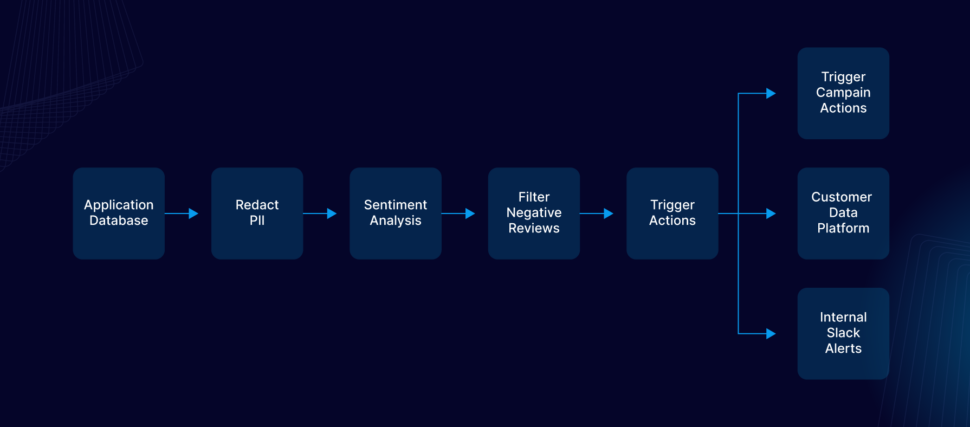
In this post, we’ll walk through how to build a real-time AI-powered sentiment analysis pipeline using Striim, OpenAI, and LangChain with a simple, high performance pipeline.
Real-time sentiment analysis is essential for applications such as monitoring and responding to customer feedback, detecting market sentiment shifts, and automating responses in conversational AI. However, implementing it often requires setting up Kafka and Spark clusters, infrastructure, message brokers, third-party data integration tools, and complex event processing frameworks, which add significant overhead, operational costs, and engineering complexity. Similarly, traditional machine learning approaches require large labeled datasets, manual feature engineering, and frequent model retraining, making them difficult to implement in real-time environments.

Striim eliminates these challenges by providing a fully integrated streaming, transformation, and AI processing platform that ingests, processes, and analyzes sentiment in real-time with minimal setup.

We’ll walk you through the design covering the following,

  1. Building the AI Agent using Striim’s open processor
  2. Using Change Data Capture (CDC) technology to capture the review contents in real time using Striim Oracle CDC Reader.
  3. Group the negative reviews in Striim partitioned windows
  4. Generate real time notifications using Striim Alert manager if the number of negative reviews exceeds the threshold values and transform them into actions for the business.
Why Sentiment Analysis using Foundation Models? How is it different from traditional Machine Learning Based Approaches?

Sentiment analysis has traditionally relied on supervised machine learning models trained on labeled datasets, where each text sample is explicitly categorized as positive, negative, or neutral. These models typically require significant pre-processing, feature engineering, and domain-specific training to perform effectively. However, foundation models, such as large language models (LLMs), simplify sentiment analysis by leveraging their vast pretraining on diverse text corpora.

One of the key differentiators of foundation models is their unsupervised learning approach. Unlike traditional models that require labeled sentiment datasets, foundation models learn patterns, relationships, and contextual meanings from large-scale, unstructured text data without explicit supervision. This enables them to generalize sentiment understanding across multiple domains without additional training.

Why Real-Time Streaming Instead of Batch Jobs?

Real-time sentiment analysis enables businesses to make swift, data-driven decisions by transforming customer feedback, social media discussions, and other textual data into actionable insights as they occur. Unlike batch-based analysis, which processes data in scheduled intervals, real-time analysis ensures that organizations can respond immediately when sentiment changes.

  • Instant Decision-Making – Businesses can act on customer feedback, social media trends, and emerging issues in the moment, rather than waiting for delayed batch processing. This allows proactive engagement rather than reactive damage control.
  • Crisis Management – In cases of negative publicity, brand reputation issues, or product complaints, real-time sentiment analysis enables companies to intervene quickly, mitigating risks before they escalate.
  • Enhanced Customer Experience – Organizations can integrate real-time sentiment analysis with tools like Slack, Salesforce, and Microsoft Dynamics, allowing automated alerts and instant responses to customer feedback. This improves customer satisfaction and fosters stronger relationships.
  • Competitive Advantage – Companies that react faster to market sentiment gain a strategic edge over competitors who rely on delayed batch analysis, enabling them to pivot business strategies and marketing efforts in real time.
  • Dynamic Trend Monitoring – Social media sentiment and public opinion shift rapidly. Real-time analysis ensures businesses stay updated on trending topics, emerging concerns, and viral events, helping them adjust messaging and engagement strategies on the fly.
  • Fraud and Risk Detection – In industries like finance and cybersecurity, real-time sentiment analysis can detect anomalies and suspicious activities (e.g., sudden spikes in negative sentiment around a stock or service) and trigger automated responses to mitigate risks proactively.

By integrating real-time sentiment analysis into business communication and CRM platforms like Slack, Salesforce, and Microsoft Dynamics, organizations can automate workflows, trigger alerts, and enable teams to respond instantly to sentiment shifts—leading to smarter decision-making, better customer experiences, and greater operational efficiency.

Problem statements

A centralized Oracle database is used by the feedback systems.

The business analytics team has been collecting the feedback in batches, manually process and coming up with insights to improve the customer experience at the stores with negative feedback. 

  1. Real-time data synchronization : The submitted feedback must be captured in real-time without impacting the performance of the centralised Oracle database
  2. Real-time analysis of the feedback : The captured feedback must be immediately analysed to figure out the sentiment.
  3. Real-time windowing and notification : The negative feedback should be grouped by stores, notifications should be generated upon hitting threshold and sent to the external system for converting the data to action.

Solution

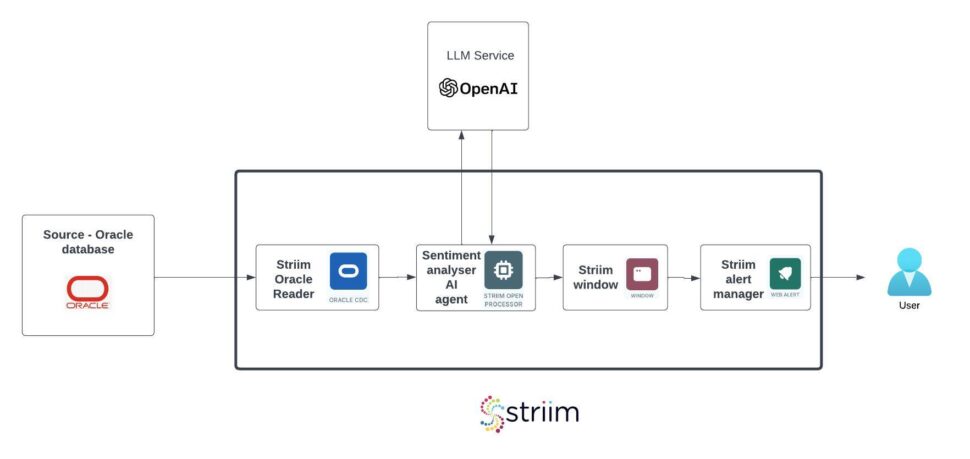
Striim has all the necessary features for the use case and the problem statements described.

  1. Reader : Capture real-time changes from Oracle database.
  2. Open processor : Extended program used to analyse the real time events carrying the content of the feedback using AI.
  3. Continuous query : Filter the negative review and send downstream
  4. Partitioned window : Group the negative reviews for each store and send downstream upon hitting threshold.
  5. Alert subscription : Send web alert notification to the user whenever the partitioned window sends down an event.
Step by step instructions

Set up Striim Developer 5.0

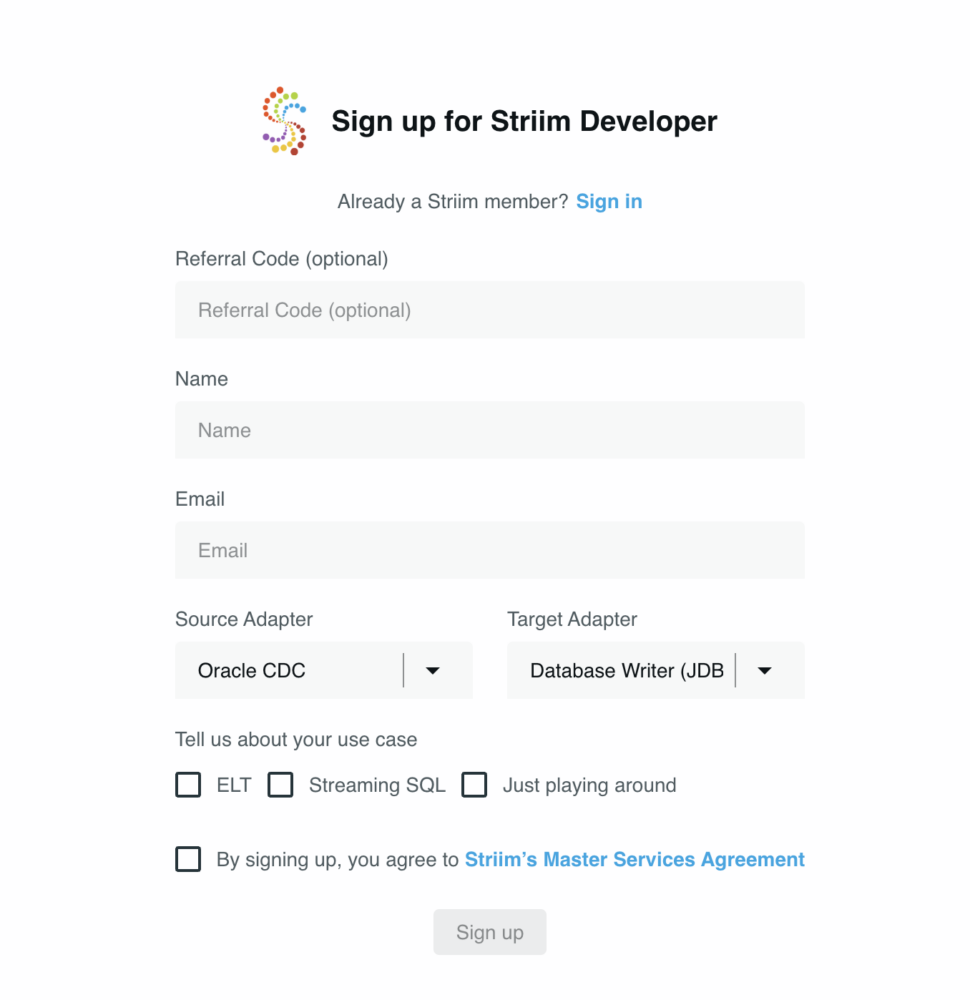
  1. Sign up for Striim developer edition for free at https://signup-developer.striim.com/.
  2. Select Oracle CDC as the source and Database Writer as the target in the sign-up form.
Prepare the table in Oracle

A simple table is created in the Oracle database and is used for the demo :

				
					CREATE TABLE STORE_REVIEWS(
REVIEW_ID VARCHAR(1024),
STORE_ID VARCHAR(1024),
REVIEW_CONTENT varchar(1024))


Create the Striim application

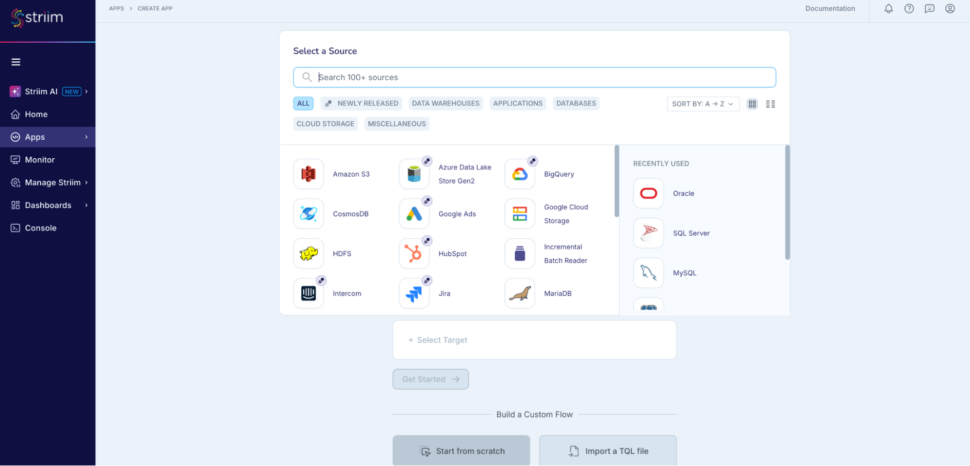
Step 1: Go to Apps -> Create An App -> Start from scratch -> name the app
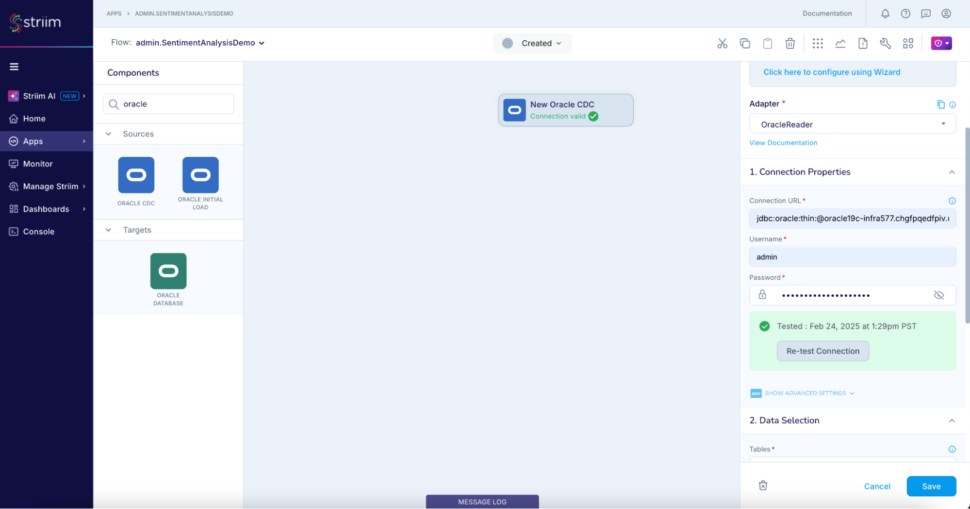
Step 2: Add an Oracle CDC reader to read the live reviews from the oracle database
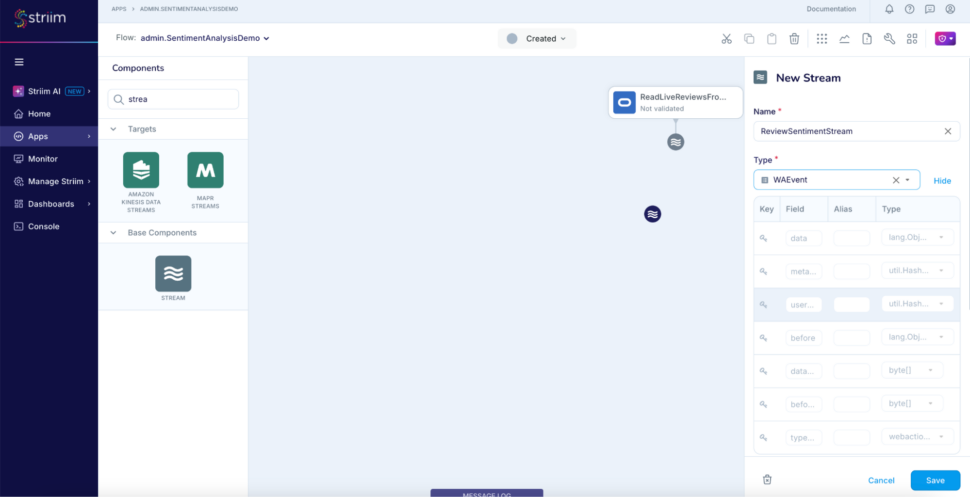
Step 3: Add another stream to use as output for the analyser AI agent
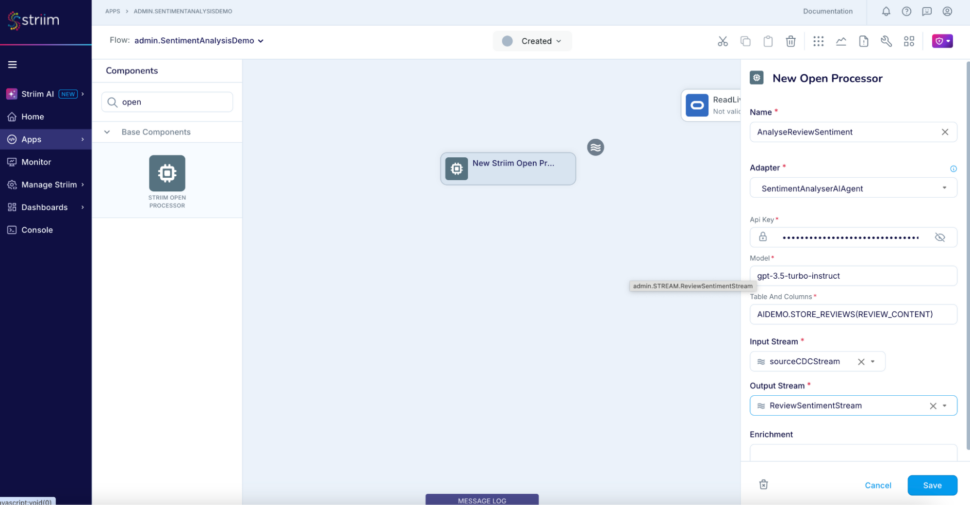
Step 4: Add an open processor  using SentimentAnalyser AIAgent to analyse the sentiment of the value of column REVIEW_CONTENT

				
					code here;


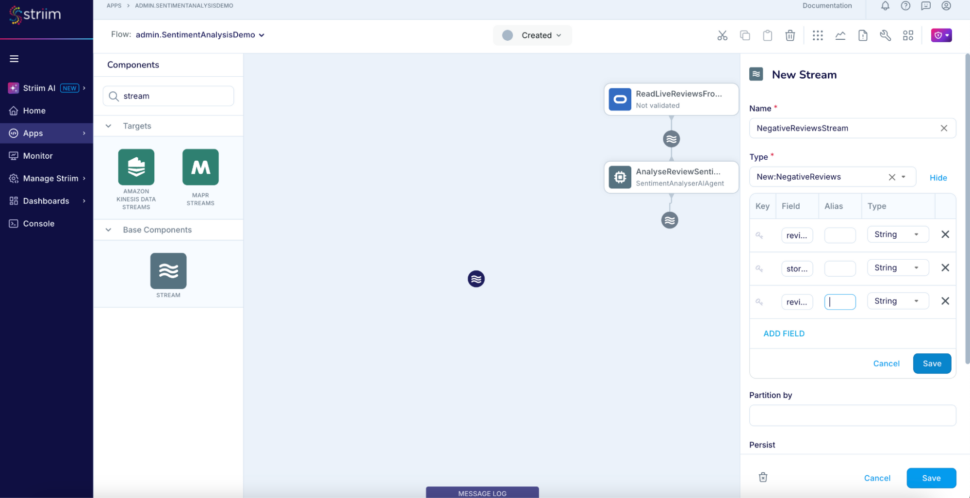
Step 5: Add another stream named NegativeReviewsStream to use a typed stream as output for the Continuous Query component which filters the negative reviews. Add a new type while defining the stream with three fields review_id. store_id, review_sentiment.
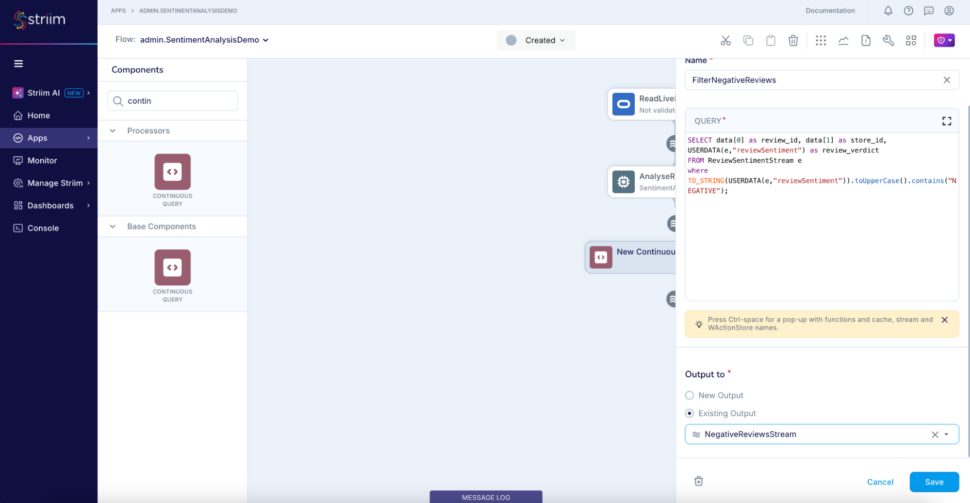
Step 6: Add a CQ that takes input from the ReviewSentimentStream, filters and outputs only the negative reviews to the stream we just created – NegativeReviewsStream.

				
					SELECT data[0] as review_id, data[1] as store_id, USERDATA(e,"reviewSentiment") as review_verdict
FROM ReviewSentimentStream e
where TO_STRING(USERDATA(e,"reviewSentiment")).toUpperCase().contains("NEGATIVE")


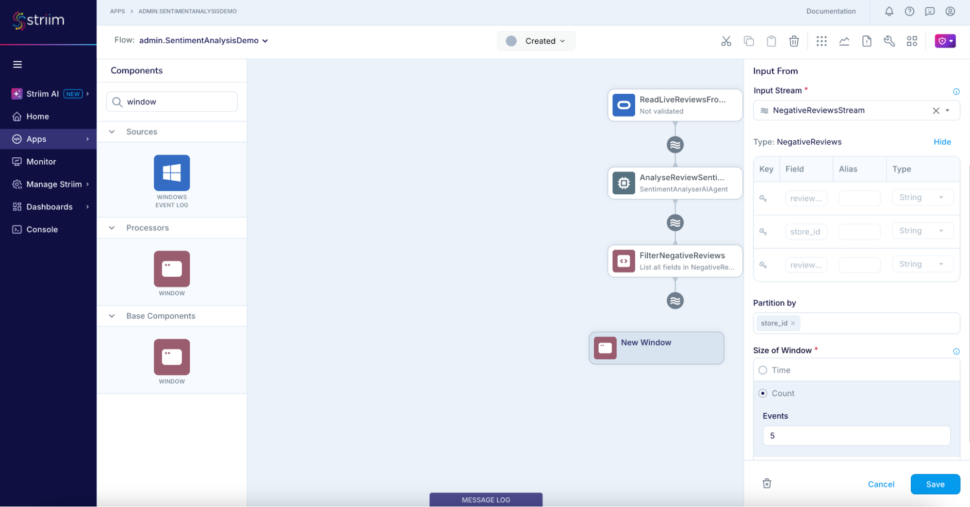
Step 7: Add a jumping window to partition the negative reviews based on the store_id which will be consumed downstream for generating the alert below.
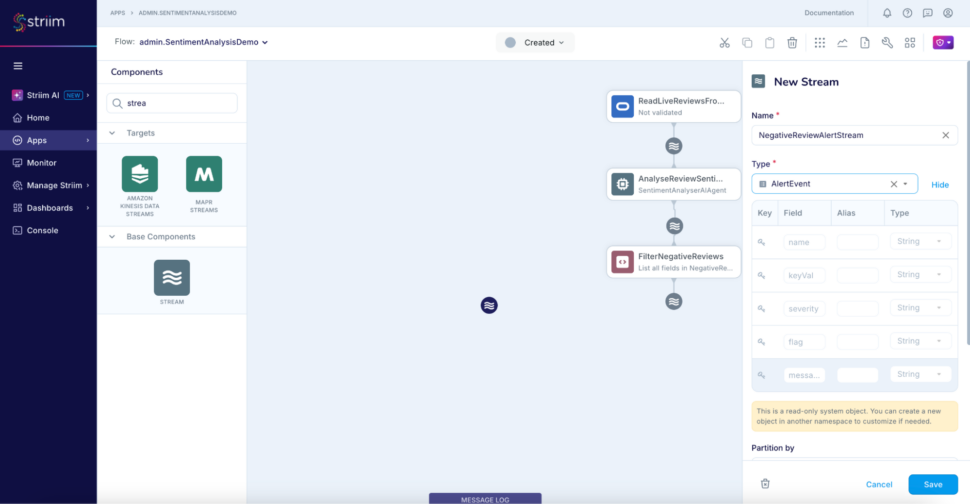
Step 8: Add another stream NegativeReviewAlertStream of type AlertEvent to use for the alert subscription.
Step 9: Add the final CQ to construct the alerts whenever the window releases an event

				
					SELECT 'Negative Review for storeID ' + store_id,  store_id + '_' + DNOW(), 'warning', 'raise',
        'Five negative Review received for store with ID : ' + store_id
FROM NegativeReviewsWindow
GROUP BY store_id
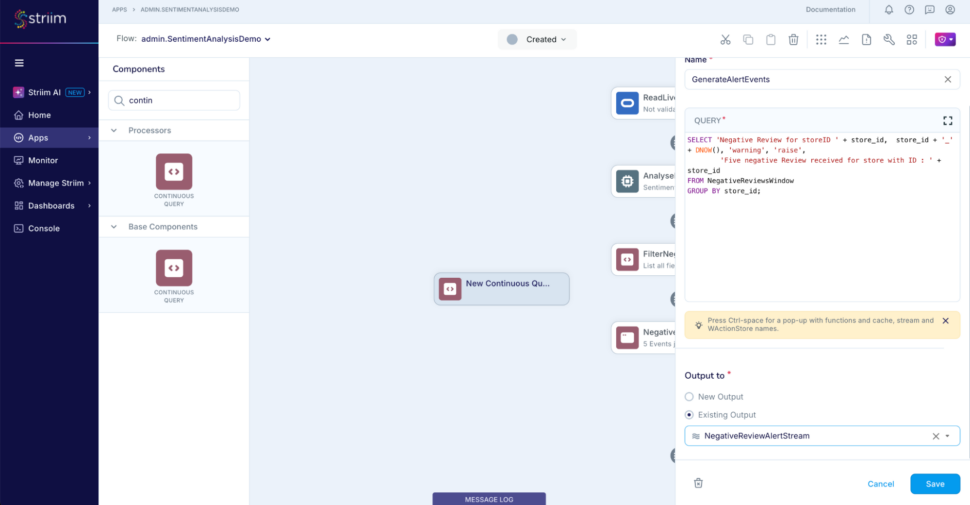


Step 10: Add a web alert subscription and use the stream NegativeReviewAlertStream as input
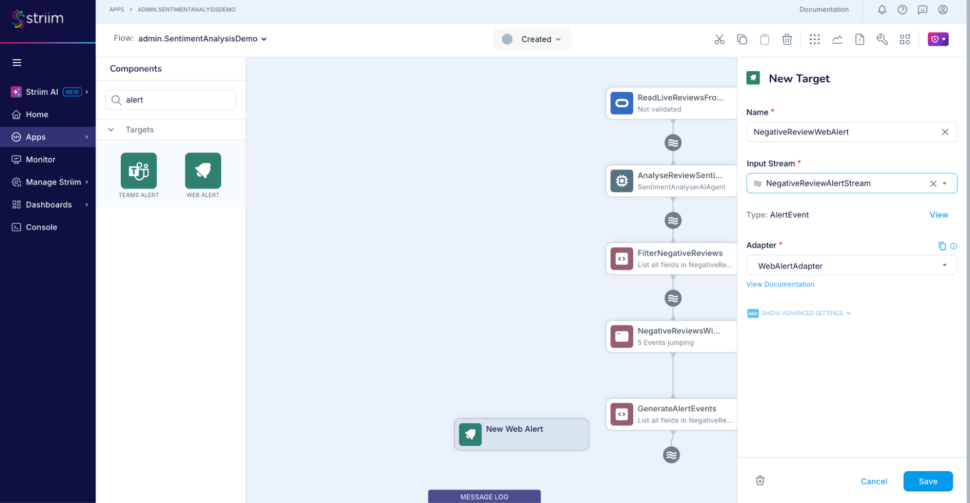
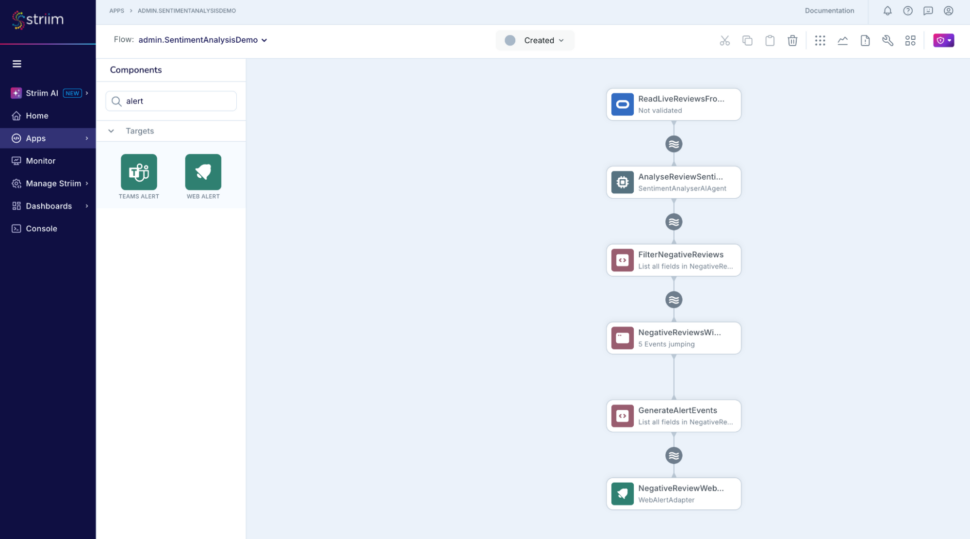
Finally the application should look like this :
(please note that you can alternatively import this TQL and modify the connection details and credentials as necessary as well : RealtimeSentimentAnalysisDemo.tql
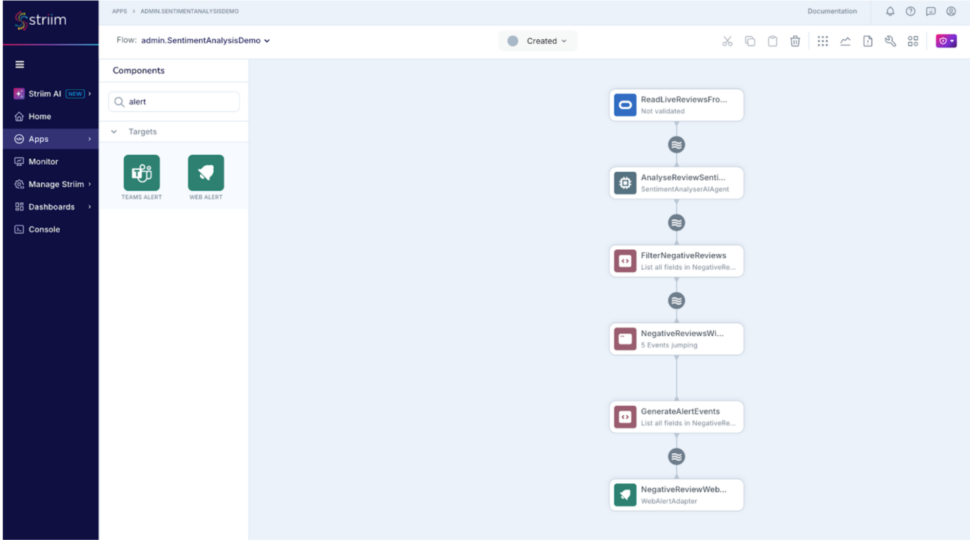
Run the Streaming application with AI Agent

Following DMLs are used for demonstration purposes : 

				
					-- A positive review for store 1	
INSERT INTO STORE_REVIEWS values(1001,'0e26a9e92e4036bfaa68eb2040a8ec97','Great in-store customer service and helpful staff. Found exactly what I was looking for!');
-- A neutral review for store 1
INSERT INTO STORE_REVIEWS values(1002,'0e26a9e92e4036bfaa68eb2040a8ec97','The store was fine, but nothing stood out. Average shopping experience.');
-- A negative reviews for store 2
INSERT INTO STORE_REVIEWS values(1003, 'ed85bf829a36c67042503ffd9b6ab475', 'The store is understaffed. The products are not organised well.')
-- 5 negative reviews for store 1
INSERT INTO STORE_REVIEWS values(1004,'0e26a9e92e4036bfaa68eb2040a8ec97','The store was messy and disorganized. Hard to find what I needed.');
INSERT INTO STORE_REVIEWS values(1005,'0e26a9e92e4036bfaa68eb2040a8ec97','Terrible experience, long lines, and the staff was rude. Wont be coming back.');
INSERT INTO STORE_REVIEWS values(1006,'0e26a9e92e4036bfaa68eb2040a8ec97',' waited too long to check out, and the cashier was unhelpful.');
INSERT INTO STORE_REVIEWS values(1007,'0e26a9e92e4036bfaa68eb2040a8ec97','The store was out of stock for many items. Very frustrating.');
INSERT INTO STORE_REVIEWS values(1008,'0e26a9e92e4036bfaa68eb2040a8ec97','The return policy is terrible, and I had to wait forever to get help.');


A combination of 5 reviews are generated for one store in this example, this would mean that the AI agent would categorise these and the jumping window will release an event downstream for the store and the web alert adapter would publish a web alert.

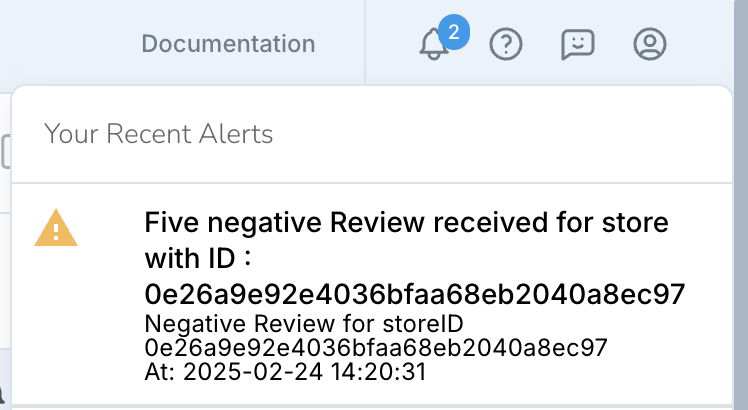
The can also be configured as a slack or a teams alert using Striim’s other alert subscription components. More here – https://www.striim.com/docs/platform/en/configuring-alerts.html

There we go! Data to decisions and AI in real-time.

SentimentAnalyser AI Agent Implementation

Please follow the instructions in Striim docs to build and load the open processor – https://www.striim.com/docs/platform/en/using-striim-open-processors.html

Download the java class SentimentAnalyserAIAgent from this location and the modified pom.xml file from this location.

Conclusion

Experience the power of real-time sentiment analysis with Striim. Get a demo or start your free trial today to see how you can convert real time data to decision coupled with AI techniques to deliver better, faster, and more responsive customer experiences.

Senstive Data Detection and Data Masking Enhances Data Security in Striim Applications

Protecting sensitive information is critical for organizations to maintain trust and comply with regulations. Striim’s Sentinel AI Agent and Sherlock AI Agent provide robust solutions for detecting and safeguarding sensitive data within real-time data streams and pipelines. This blog post will explore what these tools do, how they are used, and how Striim adds value to data protection efforts.

What do the features do? 

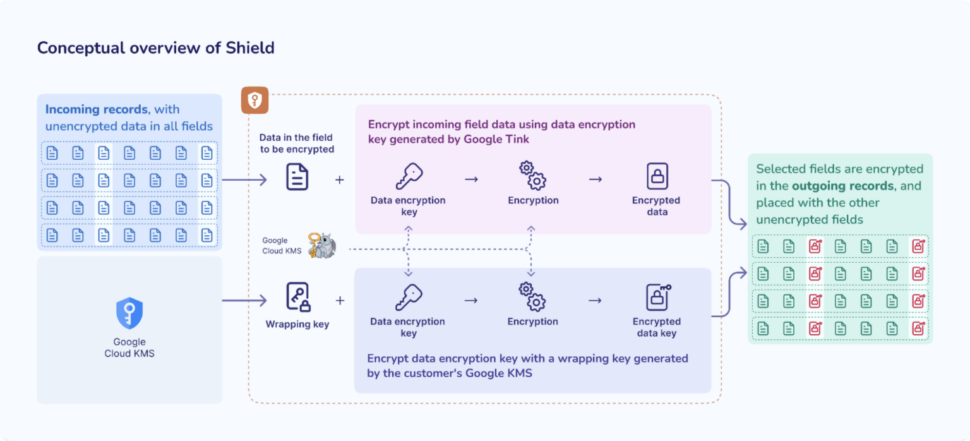
Sherlock AI and Sentinel AI utilize large language models (LLMs) for real-time sensitive data management. Sherlock AI is an on-demand discovery feature that helps users proactively identify sensitive data across their environment. Sentinel AI, powered by Striim AI, Vertex AI, or OpenAI, provides real-time detection and protection by monitoring data streams for sensitive information such as emails, Social Security Numbers (SSNs), and other personally identifiable information (PII). Once detected, Sentinel can automatically apply specified protection measures, such as masking or encryption, based on predefined criteria. Striim’s Sentinel AI, detects each event with PII information and tags the record to apply one or more protection options while the data is moving in real-time through the data pipeline.

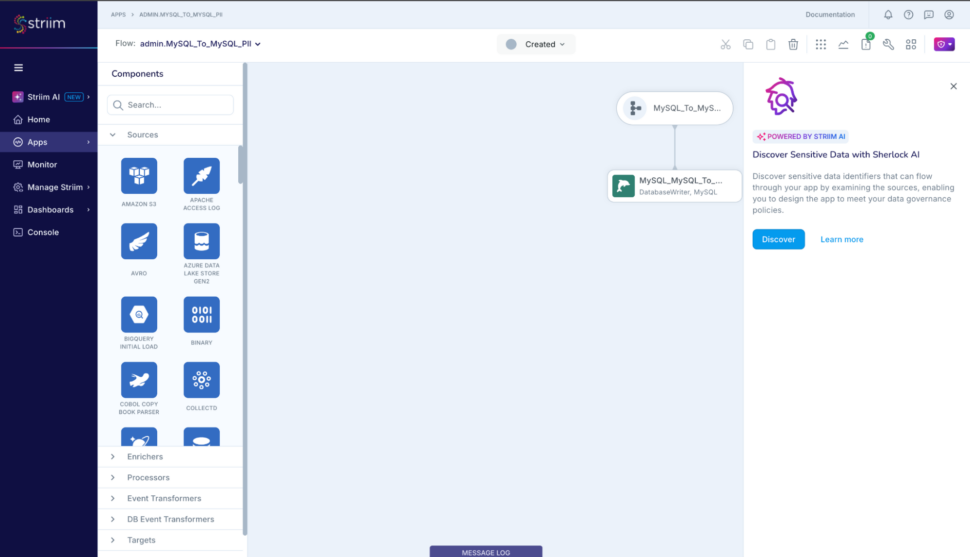
Sherlock, on the other hand, is designed for data discovery. It samples source data from configured sources and uses Striim’s AI capabilities to detect sensitive data within the sampled dataset. This discovery process is conducted by the Striim server, ensuring there is no impact on the source database server. Sherlock AI allows organizations to pre-identify sensitive data and design desensitization processing with in their Striim pipeline with a variety of real-time streaming processing techniques or with Striim’s Sentinel AI

How do you use them? 

Using Sentinel and Sherlock is straightforward and integrated within the Striim Flow Designer. Sentinel operates by detecting sensitive data through data identifiers—like emails and SSNs—using the power of Striim AI. It then applies necessary protections, such as masking or encryption, to safeguard this information. Alternatively, Sentinel can directly mask or encrypt user-specified fields, offering flexibility in how sensitive data is protected.

Sherlock complements Sentinel by performing data discovery tasks. It runs jobs using Striim’s AI, OpenAI, or Vertex AI, to sample source data to detect for sensitive data identification and produce a report for end-user design decisions with Striim Application development. The results are reported back, allowing teams to take appropriate actions to protect data. Both Sentinel and Sherlock work seamlessly within Striim’s ecosystem, providing an automated solution for sensitive data protection that reduces manual effort and the risk of exposure.

Want to dive deeper? Check out the doc and explore more.

How does Striim add value? 

Striim’s Sentinel and Sherlock agents provide significant value by automating the detection and protection of sensitive data, enhancing data security measures, and ensuring compliance with industry regulations. These tools help organizations maintain the integrity of their data by minimizing the risk of data breaches and simplifying the complex process of managing sensitive data protection across data pipelines. By leveraging AI, Sentinel and Sherlock automate the process of identifying and securing sensitive information, enabling real-time monitoring and response to potential security threats. Incorporating these advanced security measures into your Striim applications ensures that sensitive data remains protected and compliant with today’s industry standards.

Ready to power your business with real-time data? Try Striim today with a free trial or book a demo to see it in action.

Start Your Free Trial | Schedule a Demo

Beyond Legacy Detection: How AI-Driven Data Governance Surpasses Traditional Methods

Have you ever wondered how the biggest brands in the world falter when it comes to data security? Consider how AT&T, trusted by millions, experienced a breach that exposed 73 million records—sensitive details like Social Security numbers, account info, and even passwords. Then there’s Ticketmaster, where over 560 million records were compromised, triggering a cascade of issues including an antitrust lawsuit from the Justice Department.

That’s not all: a single vulnerability in MOVEit led to 49 million records being compromised—impacting government agencies, financial institutions, and healthcare organizations alike, with damages soaring into the billions. And Dell? Their breach transformed personal customer data into a commodity traded on dark web forums.

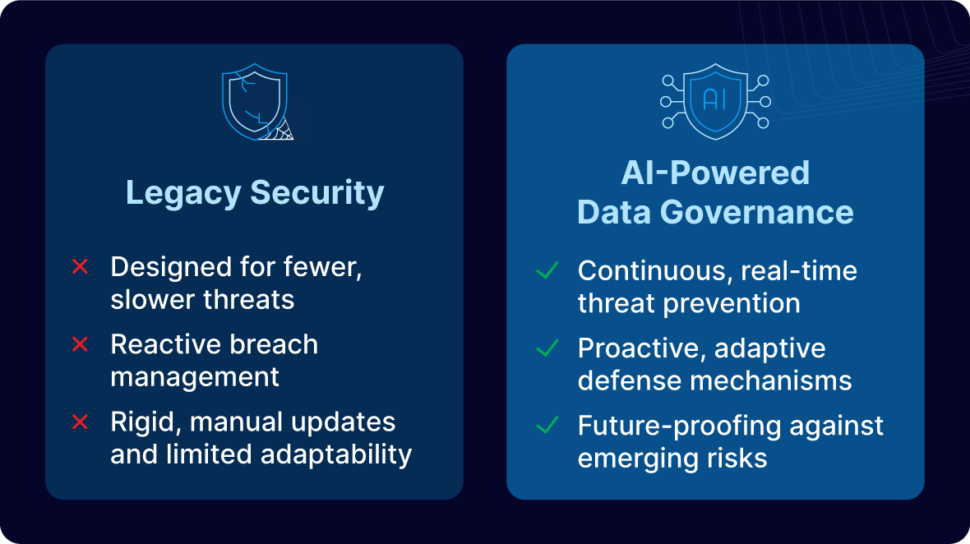
These incidents serve as a stark reminder that legacy data governance systems, built for a bygone era, are struggling to fend off modern cyber threats. They react too slowly, too rigidly, and can’t keep pace with the dynamic, sophisticated attacks occurring today, leaving hackable data exposed. That’s where AI-powered data governance comes into play. 

In this blog post, we’re going to unpack the critical differences between legacy systems and AI-driven approaches, demonstrating why when it comes to hackable data, AI-driven data governance is the only way to go.

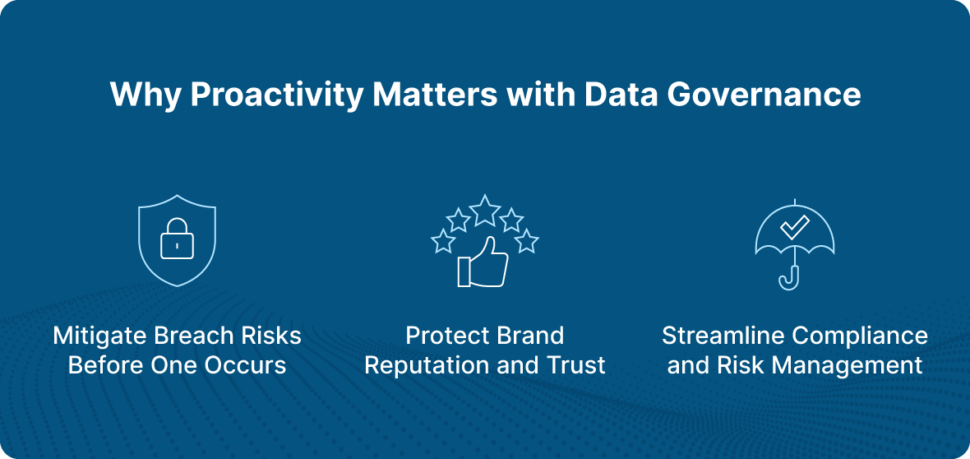
Why Proactivity Matters with Data Governance 

When it comes to data governance, being proactive can mean the difference between keeping sensitive data secure or exposing it to the world. Cybercriminals target businesses that fail to act in advance. Proactivity enables businesses to: 

Mitigate Breach Risks Before One Occurs

Every moment that hackable data remains unprotected, the risk of a breach increases. Legacy systems leave critical gaps between data creation and risk detection—gaps that cybercriminals can and do exploit. By contrast, Striim’s AI-powered data governance detects and classifies sensitive data in motion before it reaches storage. Additionally, Striim can encrypt, mask, or redact sensitive data all in real time, effectively preventing exposure.

Protect Brand Reputation and Trust

A data breach is more than just a technical failure—it can inflict irreparable harm on your brand reputation. Trust, once lost, is incredibly difficult to regain. Consumers expect their data to be handled with care, and any lapse in security can lead to significant financial and reputational damage. By implementing AI-powered governance, companies can demonstrate a commitment to real-time security, bolstering consumer trust and positioning themselves as leaders in data protection.

Streamline Compliance and Risk Management

Regulatory compliance isn’t just about avoiding fines—it’s about safeguarding trust. Legacy systems often struggle to meet evolving standards due to their reactive nature. In contrast, AI-driven solutions deliver continuous oversight, empowering organizations to adapt swiftly to regulatory changes and uphold rigorous risk management practices. 

Striim’s platform serves as an ally on your path toward compliance, equipping your team with the tools needed to navigate an ever-evolving regulatory landscape.

The Future of Data Governance: Embracing the AI Revolution

The digital world is growing more complex every day, and so are the threats targeting hackable data. Legacy systems were designed for a different era—one with fewer threats and slower attack speeds. Today’s cyber threats are sophisticated, dynamic, and relentless. AI-powered data governance offers the agility and foresight necessary to stay ahead of these evolving risks, continuously learning and adapting to new attack vectors.

The move from legacy to AI-driven data governance represents more than just a technological upgrade; it’s a fundamental shift in how we protect our digital assets. Instead of reacting to breaches after they occur, AI-powered systems are designed to prevent them from happening in the first place. This shift not only enhances security but also supports a more robust, resilient infrastructure capable of withstanding the pressures of a digital-first world.

As data volumes explode and regulatory environments become stricter, the need for proactive data governance becomes ever more critical. Embracing an AI-powered approach is not just about addressing current challenges—it’s about future-proofing your organization against threats that have yet to emerge. By investing in continuous, real-time protection, businesses can secure their data, work towards compliance, and ultimately, preserve the trust of their customers.

Reimagine Data Governance with Sentinel and Sherlock: Striim’s AI Agents 

Striim 5.0 introduces Sentinel and Sherlock, which redefine real-time data governance by seamlessly integrating advanced AI capabilities into your data pipelines. These intelligent agents ensure robust security without sacrificing system performance.

Sherlock AI: Proactive Source-Level Protection

  • Early Identification: Detects sensitive data at the point of origin, even within third-party or SaaS-managed databases, before it enters your pipeline.
  • Preemptive Risk Elimination: Finds and flags sensitive information before it’s in motion, reducing exposure risks from the outset.
  • Holistic Coverage: Operates flawlessly across SaaS, cloud, and external systems, providing complete visibility into your data environment.
  • Efficient Scanning: Uses lightweight processes that avoid impacting database performance.
  • Automated Categorization: Instantly classifies financial, healthcare, and personal identity information, delivering real-time insights into data security.
  • Quality Oversight: Monitors data integrity continuously, alerting teams when sensitive data appears where it shouldn’t.

Sentinel AI: Dynamic In-Motion Defense

  • Real-Time Protection: Monitors and secures sensitive data as it traverses your systems, ensuring constant vigilance.
  • Precision Detection: Identifies personally identifiable information (PII) anywhere within a record—even if it’s incorrectly labeled—surpassing the limitations of traditional rule-based methods.
  • Exposure Mitigation: Blocks unauthorized data transfers when moving information from internal systems to external analytics or sharing platforms.
  • Compliance Coverage: Supports over 25 sensitive data types across multiple regions—including the USA, Canada, the UK, and India—to meet diverse regulatory needs.
  • Automated Response: Implements policy-driven actions such as encryption and various forms of masking (partial, full, regex-based) without manual intervention.
  • Seamless Integration: Offers a plug-and-play user experience that allows for swift integration into existing data pipelines.
  • Regulatory Alignment: Assists organizations in navigating compliance requirements such as GDPR, CCPA, HIPAA, and beyond.

Sentinel and Sherlock’s Unified Approach to Data Governance

The process kicks off with Sherlock AI, which scans both structured and unstructured data across SQL, NoSQL, SaaS, and cloud databases. It pinpoints and classifies sensitive financial, health, and identity-related data—helping to preempt issues before they occur.

Once the data is on the move, Sentinel AI steps in. Using sophisticated pattern recognition and natural language processing, it validates data in real time, catching errors traditional systems might miss. Based on predefined business rules, Sentinel automatically encrypts, masks, or blocks data transfers, ensuring that regulated information remains secure as it shifts between systems.

With continuous, real-time dashboards, Sentinel offers live reporting on data exposure, security interventions, and compliance status. It logs each event with AI-enhanced metadata for effective tracking and auditing, while its adaptive design accommodates evolving data sources through schema evolution.

This integrated, AI-driven framework not only keeps your organization audit-ready but also ensures full transparency into data protection measures. Furthermore, Sentinel’s compatibility with enterprise security tools like SIEM, DLP, Datadog, and Snowflake Security reinforces a comprehensive and unified security strategy.

Ready to take your data governance efforts to the next level? Try Striim today with a free trial or book a demo to see it in action.


Start Your Free Trial | Schedule a Demo


Striim 5.0 Release: Introducing Striim Copilot for AI-Driven Pipeline Creation and Troubleshooting

In Striim’s latest release, version 5.0, Striim Copilot takes the stage as an AI-powered assistant designed to streamline the process of building, managing, and troubleshooting streaming data pipelines. Striim Copilot brings intelligent guidance and support directly into the Striim platform, enhancing productivity and reducing the time it takes to bring data projects from concept to reality.

What Does Striim Copilot Do?

Striim Copilot leverages AI to assist users at every stage of the data pipeline journey. By interpreting user inputs and making recommendations, it helps design, build, and troubleshoot streaming data pipelines in real time. Whether you’re configuring new data flows or diagnosing an issue in an existing one, Striim Copilot provides step-by-step support, guiding users through complex setups and adjustments.

This AI-driven copilot makes it simpler to manage sophisticated pipeline configurations, troubleshoot data flow issues, and optimize pipeline performance with minimal effort. It’s like having a dedicated data engineer on hand to help navigate the intricacies of streaming data solutions.

How Do You Use It?

Using Striim Copilot is as easy as having a conversation. Users can chat directly with the copilot through the Striim user interface, asking questions or describing tasks they want to accomplish. For example:

  • Building a Pipeline: Users can specify the data sources and targets, and Striim Copilot will guide them in setting up the pipeline, selecting transformations, and configuring the necessary settings.
  • Design Assistance: Copilot can suggest optimizations, propose transformations, or even recommend best practices for scaling and handling data workloads effectively.
  • Troubleshooting: For existing pipelines, users can describe issues, and Copilot will assist with diagnostics and offer actionable solutions to improve data flow, error handling, and latency.

This conversational AI support provides an intuitive, interactive experience, allowing both novice and experienced users to create, monitor, and refine their data pipelines with ease.

Want to dive deeper? Check out the doc and explore more.

How Does Striim Add Value?

Striim Copilot brings significant value by accelerating time-to-value for data projects. Instead of spending hours on configuration, troubleshooting, or performance optimization, users get real-time assistance that helps them reach their goals faster. By simplifying complex tasks and reducing the need for extensive technical expertise, Striim Copilot allows organizations to unlock the power of real-time data more quickly and efficiently.

With Striim Copilot, Striim is setting a new standard for usability and productivity in streaming data management. By putting AI-driven assistance at the forefront of pipeline creation and maintenance, Striim is empowering organizations to make data projects faster, more accessible, and more reliable, driving a substantial boost in productivity and operational agility.

Discover how Striim Copilot can transform your data performance—contact us today for a demo or to connect with a Striim expert.


Back to top