John Kutay

49 Posts

Three Real-world Examples of Companies Using Striim for Real-Time Data Analytics

According to a recent study by KX, US businesses could see a total revenue uplift of $2.6 trillion through investment in real-time data analytics. From telecommunication to retail, businesses are harnessing the power of data analytics to optimize operations and drive growth. 

Striim is a data integration platform that connects data from different applications and services to deliver real-time data analytics. These three companies successfully harnessed data analytics through Striim and serve as excellent examples of the practical applications of this valuable tool across industries and use cases.

1. Ciena: Enabling Fast Real-time Insights to Telecommunication Network Changes 

Ciena is an American telecommunications networking equipment and software services supplier. It provides networking solutions to support the world’s largest telecommunications service providers, submarine network operators, data and cloud operators, and large enterprises. 

How Ciena uses Striim for real-time data analytics

Use cases

Ciena’s data team wanted to build a modern, self-serve data and analytics ecosystem that:

  • Improves the customer experience by enabling real-time insights and intelligent automation to network changes as they occur.
  • Facilitates data access across the enterprise by removing silos and empowering every team to make data-driven decisions quickly.

To meet its goals, Ciena chose Snowflake as its data warehousing platform for operational reporting and analytics and Striim as its data integration and streaming solution to replicate changes from its Oracle database to Snowflake. The company used Striim to collect, filter, aggregate, and update (in real time) 40-90 million business events to Snowflake daily across systems that manage manufacturing, sales, and dozens of other crucial business functions to enable advanced real-time analytics.

 With its real-time analytics platform, Ciena has offered customers up-to-date insights as changes occurred in its network, thus improving the customer experience. Additionally, operators can begin experimenting with machine learning by using real-time analytics to identify network events that could impact performance.

Finally, with its self-serve analytics platform, everyone in the organization can now access the data they need to make faster data-driven decisions. With real-time analytics, Ciena’s customers no longer have to wait to see their updated data because it is displayed instantly after any changes are made in the source platforms.

“Because of Striim, we have so much customer and operational data at our fingertips. We can build all kinds of solutions without worrying about how we’ll provide them with timely data,” Rajesh Raju, director of data engineering at Ciena, explains.

2. Macy’s: Improving Digital and Mobile Shopping Experiences 

Macy’s, Inc. is one of America’s largest retailers, delivering quality fashion to customers in more than 100 international destinations through the leading e-commerce site macys.com. Macy’s, Inc. sells a wide range of products, including men’s, women’s, and children’s clothes and accessories, cosmetics, home furnishings, and more. 

Use cases

Macy’s real-time analytics use cases were to:

  • Achieve real-time visibility into customer and inventory orders to maximize operational cost, especially during the peak holiday events like Black Friday and Cyber Monday
  • Leverage artificial intelligence and machine learning to personalize customer shopping experiences.
  • Quickly turn data into actionable insights that help Macy’s deliver quality digital customer experiences and improve operational efficiencies.

Macy’s migrated its on-premise inventory and order data to Google Cloud storage to reach its objectives. The company decided to move to the cloud based on the benefits of cost efficiency, flexibility, and improved data management. To facilitate the data integration process, it used Striim, which allowed it to:

  • Import historical and real-time on-premise data from its Oracle and DB2 mainframe databases.
  • Process the data in flight, including detecting and transforming mismatched timestamp fields.
  • Continuously deliver data to its Big Query data warehouse for scalable analysis of petabytes of information.

Real-time data analytics has been a critical factor in Macy’s ability to understand customer behaviors and improve the shopping experience for its customers. Data analytics has enabled the company to increase customer purchases and loyalty and optimize its operations to minimize costs. As a result, Macy’s has been able to offer its customers a seamless and personalized shopping experience.

3. MineralTree: Facilitating Real-time Customer Invoice Reporting

MineralTree, formerly Inspyrus, is a fintech SaaS company specializing in automating the accounts payable (AP) process of invoice capture, invoice approval, payment authorization, and payment completion. To do this, the company connects with hundreds of different ERP and accounting systems companies and streamlines the entire AP process into a unified system.

How Inspyrus uses Striim for real-time data analytics

Use cases

MineralTree wanted to build a real-time data analytics system to:

  • Provide customers with a real-time view of all their invoicing reports as they occur. 
  • Help customers visualize their data using a business intelligence tool.

MineralTree used Striim to seamlessly integrate customer data from various ERP and accounting systems into its Snowflake cloud data warehouse. Striim’s data integration connector enabled the company to generate real-time operational data from Snowflake and use it to power the business intelligence reports it provides to customers through Looker.

MineralTree updated data stack, consisting of Striim, Snowflake, dbt, and Looker, has enhanced the invoicing operations of its customers through rich, value-added reports. 

According to Prashant Soral, CTO, the real-time data integration provided by Striim from operational systems to Snowflake has been particularly beneficial in generating detailed, live reports for its customers.

Transform How Your Company Operates Using Real-time Analytics With Striim

Real-time analytics transforms how your business operates by providing accurate, up-to-date information that can help you make better decisions and optimize your operations. 

Striim offers an enterprise-grade platform that allows you to easily build continuous, streaming data pipelines to support real-time cloud integration, log correlation, edge processing, and analytics. Request a demo today.

A Guide to Data Contracts

Companies need to analyze large volumes of datasets, leading to an increase in data producers and consumers within their IT infrastructures. These companies collect data from production applications and B2B SaaS tools (e.g., Mailchimp). This data makes its way into a data repository, like a data warehouse (e.g., Redshift), and is shown to users via a dashboard for decision-making.  

This entire data ecosystem can be wobbly at times due to a number of assumptions. The dashboard users may assume that data is being transformed the same way as when the service was initially launched. Similarly, an engineer might change something in the schema of the source system. Although it might not affect production, it might break something in other cases.

Data contracts tackle this uncertainty and end assumptions by creating a formal agreement. This agreement contains a schema that describes and documents data, which determines who can expose data from your service, who can consume your data, and how you can manage your data. 

What are data contracts?

A data contract is a formal agreement between the users of a source system and the data engineering team that is extracting data for a data pipeline. This data is loaded into a data repository — such as a data warehouse — where it can be transformed for end users. 

As per James Densmore in Data Pipelines Pocket Reference, the contract must include a number of things, such as:

  • What data are you extracting?
  • What method are you using to extract data (e.g., change data capture)?
  • At what frequency are you ingesting data? 
  • Who are the points of contact for the source system and ingestion?

You can write a data contract in a text document. However, it’s better to use a configuration file to standardize it. For example, if you are ingesting data from a table in Postgres, your data contract could look like the following in JSON format:

“{
  ingestion_jobid: "customers_postgres",
  source_host: "ABC_host.com",
  source_db: "bank",
  source_table: "customers",
  ingestion_type: "full",
  ingestion_frequency_minutes: "15",
  source_owner: "developmentteam@ABC.com",
  ingestion_owner: "datateam@ABC.com"
};”

How to implement data contracts

When your architecture becomes distributed or large enough, it’s increasingly difficult to track changes, and that’s where a data contract brings value to the table. 

When your applications access data from each other, it can cause high coupling, i.e., applications are highly interdependent on each other. If you make any changes in the data structure, such as dropping a table from the database, it can affect the applications that are ingesting or using data from it. Therefore, you need data contracts to implement versioning to track and handle these changes. 

To ensure your data contracts fulfill their purpose, you must:

  • Enforce data contracts at the data producer level. You need someone on the data producer side to manage data contracts. That’s because you don’t know how many target environments can be used to ingest data from your operational systems. Maybe, you first load data into a data warehouse and later go on to load data into a data lake. 
  • Cover schemas in data contracts. On a technical level, data contracts handle schemas of entities and events. They also prevent changes that are not backward-compatible, such as dropping a column. 
  • Cover semantics in data contracts. If you alter the underlying meaning of the data being generated, it should break the contract. For instance, if your entity has distance as a numeric field, and you start collecting distance in kilometers instead of miles, this alteration is a breaking change. This means that your contract should include metadata about your schema, which you can use to describe your data and add value constraints for certain fields (e.g., temperature).
  • Ensure data contracts don’t affect iteration speed for software developers. Provide developers with familiar tools to define and implement data contracts and add them to your CI/CD pipeline. Implementing data contracts can minimize tech debt, which can positively impact iteration speed. 

In their recent article, Chad Sanderson and Adrian Kreuziger shared an example of a CDC-based implementation of data contracts. According to them, a data contract implementation consists of the following components, as depicted below:

  1. Defining data contracts as code using open-source projects (e.g. Apache Avro) to serialize and deserialize structured data.
  2. Data contract enforcement using integration tests to verify that the data contract is correctly implemented, and ensuring schema compatibility so that changes in the producers won’t break downstream consumers. In their example, they use Docker compose to spin up a test instance of their database, a CDC pipeline (using Debezium), Kafka, and the Confluent Schema Registry.
  3. Data contract fulfillment using stream processing jobs (using KSQL, for example) to process CDC events and output a schema that matches the previously-defined data contract.
  4. Data contract monitoring to catch changes in the semantics of your data.
A data contract implementation,
A data contract implementation, from Chad Sanderson and Adrian Kreuziger’s “An Engineer’s Guide to Data Contracts – Part 1

Data contract use cases

Data contracts can be useful in different stages, such as production and development, by acting as a validation tool, as well as supporting your data assets like data catalogs to improve data quality. 

Assess how data behaves on the fly

During production, you can use data contracts as a data validation tool to see how data needs to behave in real time. For example, let’s say your application is collecting data for equipment in a manufacturing plant. Your data contract says that the pressure for your equipment should not exceed the specified limit. You can monitor the data in the table and send out a warning if the pressure is getting too high.  

Avoid breaking changes 

During software development, you can use data contracts to avoid breaking changes that can cause any of your components to fail since data contracts can validate the latest version of data. 

Improve discoverability and data understanding

Like data contracts, data catalogs accumulate and show various types of information about data assets. However, data catalogs only define the data, whereas data contracts define the data and specify how your data should look. Moreover, data catalogs are made for humans, whereas data contracts are made for computers. Data contracts can be used with data catalogs by acting as a reliable source of information for the latter to help people discover and understand data through additional context (e.g., tags). 

Striim helps you manage breaking changes

Striim Cloud enables you to launch fully-managed streaming Change Data Capture pipelines, greatly simplifying and streamlining data contract implementation and management. With Striim, you can easily define, enforce, fulfil, and monitor your data contracts, without having to wrangle with various open-source tools.

For example, using Striim, you can set parameters for Schema Evolution based on internal data contracts. This allows you to pass schema changes to data consumers on an independent table-specific basis. If your data contract is broken, you can use Striim to automate sending alerts on Slack.. Consider the workflow in this following diagram:

Data contracts with schema evolution parameters

You can use Striim to move data from a database (PostgreSQL) to a data warehouse (BigQuery). Striim is using Streaming SQL to filter tables in your PostgreSQL based on data contracts. If a schema change breaks your contract, Striim will stop the application and send you an alert through Slack, allowing your engineers to stop the changes in your source schema. If the schema change is in line with your contract, Striim will automatically propagate all the changes in your BigQuery. 

Learn more about how Striim helps you manage data contracts here.


Real-Time Healthcare Analytics: How Leveraging It Improves Patient Care

On a Tuesday night, a nurse in the emergency department receives a real-time alert on her smartphone: the department will be overcrowded within 1.5 hours. This alert, powered by real-time healthcare analytics, projects bed occupancy and anticipated care needs, allowing the nurse to coordinate with transport, radiology, and lab teams to prepare for the surge.

Historically, data silos limited information access, but real-time analytics now makes healthcare processes more connected. By aggregating and analyzing data, these insights boost operational efficiency and enhance patient care. In this post, we’ll explore how leveraging real-time healthcare analytics ensures seamless patient care and a smoother workflow for your team.

Why Leverage Real-Time Healthcare Analytics? 

There are several compelling reasons why real-time healthcare analytics is essential for healthcare institutions. These include: 

To Analyze EHR Data and Improve Patient Care

An electronic health record (EHR) digitally stores patient information, such as medical history, prescriptions, lab results, and treatments. While EHRs collect and display data, they lack real-time analysis capabilities — a gap filled by real-time healthcare analytics.

With real-time analytics, medical professionals can instantly access insights and recommendations based on current EHR data. This system ingests relevant data points, like progress and nursing notes, identifies diagnostic patterns, detects minor condition changes, and prioritizes patients with deteriorating health, enabling swift and proactive care.

Leveraging real-time healthcare analytics is essential in early sepsis detection. According to the CDC, sepsis claims 350,000 adult lives annually in the U.S. Early detection is vital yet challenging due to symptom overlap with other conditions. However, real-time analytics combined with AI can improve sepsis detection rates by up to 32%, according to one report. 

The Medical University of South Carolina (MUSC)  uses this technology to monitor patient health continuously, drawing on EHR data and machine learning to classify signs of sepsis onset. This proactive approach enables timely intervention, potentially saving lives, due to real-time data

To Encourage People to Take a Proactive Approach to their Health

Another popular use case of real-time analytics in healthcare includes smartwatches and fitness trackers. Devices from the likes of Apple, Samsung, Fitbit, and others have exploded in popularity in recent years, enabling people to monitor their own health and adopt healthier habits. 

They help people walk more by tracking their daily step count via in-app challenges, calculate the calories they lose during workouts and sports activities, and monitor their daily caloric intake. These wearables collect data from their sensors and use real-time analytics to provide useful insights. 

While these devices are far from replacements for a doctor visit, they might alert the user to potential health risks. If someone notices their heart rate is often too high/too low, they may be more likely to visit their physician to check in. 

For instance, a 12-year-old girl was alerted by her Apple Watch that she had an unusually high heart rate, and promptly sought medical attention. She was taken to a healthcare facility where doctors found her suffering from a rare condition in children: a neuroendocrine tumor on her appendix.

To Manage the Spread of Disease 

Real-time analytics in healthcare can also help healthcare institutions and doctors identify trends in regards to the spread of illness. For instance, in 2020 during the Covid-19 pandemic, healthcare institutions leveraged real-time analytics to identify the growing disease. Healthcare organizations used machine learning algorithms fueled by data to analyze trends from 50 countries with the highest rates of Covid-19 and predict what would happen in the next several days. 

Healthcare providers also leveraged real-time analytics in healthcare to determine how fast the virus was spreading in real time and how it mutated under various conditions. For example, the EU launched a software in 2020, InferRead, that collected image data from a CT scanner to analyze whether lungs were damaged due to a COVID infection. This analysis was generated within a few seconds, allowing a doctor to study it and diagnose the patient quickly. 

Real-time analytics can also help to manage resources in the case of an outbreak. In the US, the Kinetica Active Analytics Platform was used to create a real-time analytics program for aggregating and tracking data. The purpose of this program was to aid emergency responders by collecting information on test kit quantities, personal protective equipment (PPE) availability, and hospital capacity. This allowed decision-makers to determine whether they could redirect patients to a hospital with capacity or set up alternative triage centers. Similarly, these insights also helped to distribute PPE to the locations where it was needed most, especially when a shortage made access more difficult. 

To Optimize Hospital Staff Allocation 

Healthcare institutions often face the critical challenge of maintaining optimal staffing levels. Leveraging real-time healthcare analytics can transform how hospitals predict staffing needs by analyzing historical data and identifying patterns in staffing operations. By continuously examining how nurses and other staff operated under varying circumstances, real-time analytics generates recommendations for each hour, considering potential unforeseen scenarios. This ensures that patients receive an appropriate level of care, minimizing resource gaps and elevating the standard of patient care.

Intel’s recent paper highlights how real-time healthcare analytics enables four hospitals to use data from diverse sources to forecast admissions accurately. By applying time series analysis — a statistical technique designed to identify patterns within admission records — these hospitals can predict patient arrivals hour by hour, optimizing preparation and resource allocation. 

Additionally, data insights from real-time analytics empower healthcare institutions to enhance job satisfaction and reduce turnover. By identifying the percentage of experienced staff open to emergency shifts or overtime with incentives, healthcare providers can better manage workloads and redistribute tasks to prevent burnout.

Improve Patient Care and Operational Efficiency with Striim 

For healthcare organizations aiming to optimize real-time healthcare analytics, Striim 5.0 offers a robust, secure solution. The platform not only ingests and analyzes high volumes of data in real-time but also introduces AI agents Sentinel and Sherlock to protect sensitive patient information. This feature automates authentication and connection processes, reducing overhead, enhancing data security, and ensuring compliance by masking personally identifiable information.

Discovery Health achieved a remarkable transformation with Striim, slashing data processing times from 24 hours to seconds. By replacing daily ETL processes with Striim’s Change Data Capture (CDC) technology, the organization seamlessly integrated disparate systems, eliminating delays and enabling faster, more responsive decisions. This innovation improved efficiency, reduced costs, and fostered personalized engagement by leveraging predictive analytics to encourage healthier member choices.

Backed by Oracle, Striim delivered unmatched reliability and scalability, utilizing advanced logical database replication expertise. The platform’s real-time insights empowered Discovery Health to promote wellness, enhance health outcomes, and streamline workflows. Through ongoing optimization, Discovery Health revolutionized its data infrastructure, driving informed decision-making and elevating customer experiences on a global scale.

Another healthcare organization that leverages Striim is Boston Children’s Hospital. In addition to enhancing patient outcomes, improving operational efficiency is critical to success in healthcare organizations. By consolidating data from multiple systems, including patient, billing, scheduling, clinical, and financial information, hospitals can streamline their operations and make faster, data-driven decisions.

Striim’s platform enables near real-time and batch-style processing of data from diverse sources like MS SQL Server, Google BigQuery, and Oracle, all feeding into a centralized Snowflake data warehouse. This seamless integration reduces the need for various scripts and disparate source systems, providing a single, cohesive view of the data pipelines. The hospital has not only saved time and money on support resources but has also significantly reduced the time it takes to deliver actionable insights to business users, a crucial factor in the fast-paced healthcare industry.

Ready to see for yourself how Striim can streamline operations and improve patient outcomes? Get started with a demo today.

Use Cases of Real-Time Analytics in the Supply Chain

real time analytics for supply chainThe supply chain industry is the backbone on which many industries rely, such as manufacturing and retail. It produces large amounts of valuable business data daily, but according to a McKinsey study, only 2% of companies have visibility into their supply base beyond the second tier (e.g. chip fabrication in the semiconductor supply chain). 

66% of supply chain companies believe using data analytics is of critical importance for their future operations, but extracting value from supply chain data isn’t easy. Since the industry is split into various areas — such as procurement, logistics, and warehouses — data silos are common, with data scattered across legacy systems and spreadsheets. This makes it challenging to collect and analyze supply chain data.

Smart data pipelines unify data from multiple sources and enable real-time analytics of supply chain data. This gives managers the ability to make decisions based on a summary of accurate and timely data in the form of charts, graphs, and dashboards — or respond to real-time alerts generated automatically. Real-time analytics in the supply chain helps to avoid stockouts, protect drivers, tackle supply and demand issues, and increase the overall efficiency and profitability. 

Boosts Decision-Making for Procurement 

Real-time analytics can help you collect and analyze procurement data for better decision-making. Procurement managers can pull and analyze different sets of data, including supplier and buyer information, benchmark price, price variance and fulfillment, and invoice unit. This data can be collected from an operational system like an enterprise resource planning (ERP) system. 

Spend analysis

You can use descriptive analytics to consolidate purchasing-related data and get insights to minimize costs without compromising efficiency. For example, you can use descriptive analytics to collect historical data for creating visualizations (e.g., reports) on spend analysis to work on budgeting. This can help to answer questions, such as:

  • What is the organization buying?
  • From where and for whom is the organization buying?
  • Which categories have the largest spend?

Supplier negotiation 

One way real-time analytics can save money is by monitoring the organization’s purchasing history and providing real-time insights via prescriptive analytics to compare supplier pricing. When this information is presented in real time in the form of detailed reports, sourcing teams can use it to negotiate with suppliers on pricing if it’s higher than competitors. This also benefits your relationship with the supplier; they can identify missed opportunities in sales that were lost to lower-priced alternatives.  

Introduces Better Visibility in Warehouses

According to a survey, around 70% of supply chain leaders said that they want better visibility into their warehouse. Real-time analytics can help manage warehouse operations and give visibility into inventory, fulfillment, labor, and production.

Automation

You can identify functions that take a lot of time, or where manual errors are recurrent (e.g., clerical errors), and incorporate automation to improve efficiency and save costs. 

Take picking products for order in warehouse operations, which can take a lot of time when done manually. Real-time analytics can use artificial intelligence for automated picking systems to streamline the process. These systems can use machine learning to analyze routes for picking and find the most efficient route for each item by reducing walking and sorting time. 

Inventory management 

Real-time analytics can help you to view, manage, and optimize inventory levels in real time. You can view top-selling, on-hand, and out-of-stock items on a dashboard. With a single view, you can adjust inventory in all warehouses. 

Your dashboard can show that your warehouse has plenty of products that aren’t in demand at the moment, whereas there’s not enough stock for in-demand products. This is done by analyzing data, such as seasonal influence (e.g., Black Friday), trend forecasts, and historical sales. 

Before you are out of stock, predictive analytics can be used for demand forecasting. It can balance your purchasing to get sufficient stock for the right products on time. These products can then be placed in pick-up and staging areas in the warehouse to improve the delivery time and enhance the customer experience. 

On a similar note, your dashboard can show dead stock — items stuck on the shelf for too long — and recommend ways to deal with it. For instance, you can get rid of dead stock by putting up a clearance sale on your e-commerce website or bundling it with other products at a discount price. 

Tracks Logistics Operations

You can use real-time analytics to improve your operational efficiency and reduce accidents. 

On-time and reliable delivery of goods

Real-time insights can make predictions on estimated transit times and improve planning for shipments. This is done by feeding real-time data to route planning algorithms that can map out the best possible route, helping your drivers avoid disruptions such as traffic jams and weather issues.

With smart sensors and the internet of things (IoT), you can notify key personnel about the status and condition of in-transit goods throughout the supply chain. For this purpose, sensors are used to monitor factors such as shock, humidity, light, temperature, and location. This can be especially useful to identify the likelihood of a food item going bad or a fragile product getting broken in real time, where the system generates an alert and sends it to the supply chain management. 

Accident prevention 

According to a study, every year, more than 20% of all fleet vehicles get into accidents. Most of these issues are traced to bad driver behaviors, which cause employers in the US a lot of direct and indirect damage. Poor driver behavior includes the following:

  • Driving when drowsy
  • Risky driving
  • Speeding
  • Harsh braking 

You can use real-time analytics with smart cams and electronic logging devices to assess driving behavior. For instance, you can capture data, such as when a driver accelerates quickly without keeping a safe distance between themselves and other vehicles or when a driver is often involved in harsh braking while changing lanes. With real-time analytics, you can get a single daily view that can detect drivers with recurrent driving patterns and enroll them in a driver safety awareness program.

Adopt Real-time Supply Chain Analytics With Striim

Now that you know about the different ways in which real-time analytics can improve supply chain performance, you need to look for a reliable tool that can help you to implement it on an enterprise level. For this purpose, consider looking into Striim for advanced analytics capabilities. 

Striim is a real-time data integration and streaming platform that supports streaming analytics and delivery of fresh data to analytics systems. It acts as a real-time connector between your data sources (e.g. a warehouse management system) and destinations, like a cloud data warehouse that feeds into a business intelligence (BI) reporting tool like Tableau. No matter where your data resides, Striim can connect it — in real time — and provide actionable insights throughout your supply chain. 

Striim has supported several organizations with their supply chain operations. For example, Striim has helped Macy’s, a leading retail chain, to adopt real-time inventory visibility. Below is a diagram that shows how Macy’s uses Striim to send real-time order and inventory data from its on-premise mainframe systems to business applications and dashboards in Google Cloud. This way, Macy’s has streamlined its inventory and has been able to adjust stock levels easily. 

how macy's uses striim

If you’re looking to modernize your supply chain to get a competitive advantage, learn more about Striim’s real-time analytics solution and request a free trial or sign up for a demo today. 

Technical Considerations for Selecting a Data Integration Tool

Modern organizations collect vast amounts of data from different systems, such as application servers, CRM and ERP systems, and databases. Getting access to this data and analyzing it can be a challenge. You can use data integration to resolve this challenge and generate a unified view of your company’s data. That’s why around 80% of business operations executives say that data integration is crucial to their current operations. For this purpose, you can use a data integration tool — a type of software that can move data from your source systems to destination systems.

With so many options in the market, choosing a data integration tool isn’t a straightforward process. If you select the wrong tool, it can affect how your data infrastructure works, which can have a direct impact on your business operations. That’s why you need to have a checklist of key technical considerations that can help you to pick the right data integration tool.

  1. Data Connectors to Move Data From Sources to Destinations
  2. Automation for Ease of Use
  3. Flexible Replication Support to Copy Data in Multiple Ways
  4. User Documentation to Get the Most Out of the Tool
  5. Security Features for Data Protection
  6. Compliance With Data Regulations

1- Data Connectors to Move Data From Sources to Destinations

The first step is to consider what data sources and destinations you have so you can look for data connectors that can move data between them.

Generally, data sources in an organization can include data sets in spreadsheets, accounting software, marketing tools, web tracking, customer relationship management systems (CRMs), enterprise resource planning systems (ERPs), databases, and so on. If you’re planning to aggregate data from different sources and load them into data repositories for storage or analysis, you need to look for destination coverage. This includes coverage for relational databases (e.g., Oracle), data warehouses (e.g., Snowflake), and data lakes (e.g., AWS S3).

List all your current and future potential sources and destination systems, and make sure your prospective tool offers coverage for all of them. These tools have different willingness to add new connectors.

Do keep in mind that data connectors vary from tool to tool. Just because a tool comes with a data connector of your preference doesn’t necessarily mean it’ll be user-friendly. Some data connectors are difficult to set up, which can make it hard for end users to move data. Therefore, compare the user-friendliness of connectors before deciding on a data integration tool.

2- Automation for Ease of Use

A data integration tool should minimize manual efforts that are required during data integration. Some things your tool should automate include:

  • Management of data types: Changes in schema can alter the type of a specific value, i.e., from float to integer. A data integration tool shouldn’t need manual intervention to reconcile data between the source and target system.
  • Automatic schema evolution: As applications change, they can alter the underlying schemas (e.g. adding/dropping columns, changing names). Your tool’s connectors should accommodate these changes automatically without deleting fields or tables. This ensures that your data engineers don’t have to perform fixes after the data integration process. Look for a tool that supports automatic schema evolution.
  • Continuous sync scheduling: Based on how often your organization needs data to be updated, choose a tool that offers continuous sync scheduling. This feature allows you to set fixed intervals to sync data at regular and short intervals. For instance, you can set your CRM system to sync data with your data warehouse every hour. If you want more convenience, you can look for a data integration tool that supports real-time integration, allowing you to move data within a few seconds.

3- Flexible Replication Support to Copy Data in Multiple Ways

Based on your needs, you might need to replicate data in more ways than one. That’s why your data integration should have flexible support on how you can replicate your data.

For example, full data replication copies all data — whether it’s new, updated, or existing — from source to destination. It’s a good option for small tables or tables that don’t have a primary key. However, it’s not efficient, as it can take more time and resources.

Alternatively, log-based incremental replication copies data by reading the data logs, tracking changes, and updating the target system accordingly. It’s more efficient as it minimizes load from the source since it only streams changes unlike full data replication, which streams all data.

Even if you feel you only need a specific type of replication right now, consider getting a tool that offers more flexibility, so you can adapt as your organization scales up.

4- User Documentation to Get the Most Out of the Tool

One thing that is often overlooked while choosing a data integration tool is the depth and quality of user documentation. Once you start using a data integration tool, you’ll need a guide that can explain how to install and use the tool as well as provide resources, such as tutorials, knowledge bases, user guides, and release notes.

Poor or incomplete documentation can lead to your team wasting time if they get stuck on a particular task. Therefore, make sure your prospective tool offers comprehensive documentation, enabling your users to get maximum value from their tool.

5- Security Features for Data Protection

On average, a cyber incident costs more than $9.05 million to U.S. companies. That’s why you need to prioritize data security and look for features in your tool that can help you protect sensitive data. Over the last few years, cyber-attacks have wreaked havoc across industries and compromised data security for many organizations. These attacks include ransomware, phishing, spyware, etc.

Not all users in your organization should have the authorization to create, edit, or remove data connectors, data transformations, or data warehouses or perform any other sensitive action. Get a tool that allows you to grant different access levels to your team members. For example, you can use read-only mode to ensure that an intern can only read information. Or you can grant administrative mode to a senior data architect, so they can use the features to transform data.

Your tool also needs to support encryption so you can mask data as it travels from one system to another. Some of the supported encryption algorithms that you need to be looking at for these tools include AES and RSA.

6- Compliance With Data Regulations

Regulatory compliance for data is getting stricter all the time, which means you need a tool that’s certified with the relevant regulatory bodies (e.g., SOC 2). You might have to meet a lot of requirements for compliance based on your company’s or user’s location. For example, if your customers live in the EU, then you need to adhere to GDPR requirements. Failure to do so can result in hefty penalties or damage to brand image.

There will be a greater need to prioritize compliance if you belong to an industry with strict regulatory requirements, such as healthcare (e.g., HIPAA). That’s why a data integration tool should also support column blocking and hashing — a feature that helps to omit or obscure private information from the synced tables.

Trial Your Preferred Data Integration Tool Before Making the Final Decision

Once you’ve narrowed down your search to the data integration tools that have the right features for your needs, you should test them for yourself. Most vendors provide a free trial that can last a week or more — enough time for you to connect it with your systems and assess it. Link data connectors with your operational sources and data repositories like a data lake or data warehouse and see for yourself how much time it takes to synchronize your data or how convenient your in-house users find your tool to be.

For starters, you can sign up for Striim’s demo, where our experts will engage you for 30 minutes and explain how Striim can improve real-time data integration in your organization.

6 Key Considerations for Selecting a Real-Time Analytics Tool 

In today’s world, analyzing data as it’s generated is a key commercial requirement. A survey by Oxford Economics found that only 42% of executives can use data for decision-making. The lack of data availability impedes an organization’s ability to use data to improve customer experiences and internal operations. 

A modern real-time analytics tool can empower businesses to make faster, well-informed, and more accurate decisions. By acting immediately on the information your data sources generate, these tools can improve the efficiency of your business operations. According to McKinsey, organizations adopting data analytics can improve their operating margins by 60%. However, choosing a real-time analytics tool can be tricky because one might not know what type of criteria to use while looking for a tool.

Your decision-making has a major impact on your organization’s operations for a long time, so you need a reliable real-time analytics tool to support it. Here are some considerations that can help in that regard. 

Non-intrusive collection of data from operational sources

Modern businesses often deal with data streams — the continuous flow of data generated by a wide range of operational data systems. For example, a retailer can analyze transactions in real time to see if there’s any insight that indicates credit card fraud.

An operational data system generates data related to a business’ day-to-day operations. This can simply be inventory data for a manufacturing plant or customer purchase data for a retailer. A real-time analytics solution needs to support the collection of these streams from their sources. 

For most businesses, data isn’t collected from a single source. Data are split into different sources based on different departments and their teams. Before performing real-time analytics on these data, you have to consolidate them into a single source of data. 

It’s also important to look into the change data capture (CDC) approach your tool uses to collect and update data. If it uses triggers, then it can affect the performance of the source system by requiring multiple write operations to the source system. This interference to the system’s performance can be removed by using a tool that supports log-based CDC

Unlike other CDC approaches, log-based CDC doesn’t affect the source system’s performance as it doesn’t scan operational tables. For this reason, you need a real-time analytics solution that provides non-intrusive data collection from multiple operational sources. 

Pre-built data connectors to get real-time data from multiple sources

A data connector is a software or process that can transfer data from a data source to a destination. For example, if you are looking to collect real-time data about customer metrics (e.g., customer effort score) and analyze them to improve your customer experiences, then you need a data connector to collect that data from your CRM and send them to a data warehouse. Over time, your data engineers can spend a lot of their time working on custom data connectors. 

As an organization scales up, there comes a time when it becomes hard to manage data extraction from sources to the data warehouse. That’s because it also exponentially increases the number of required custom connectors, which increases the burden on the data engineering team. A real-time analytics solution that comes with pre-built data connectors can solve this problem. 

Building connectors by yourself can take considerable time. Things don’t end with the development of connectors; you also have to maintain them. A tool with pre-built connectors can eliminate this burden. Pre-built connectors are designed to ensure that end-users can add or remove data sources with a few clicks without requiring help from specialists. Your development team can then focus their time on other critical tasks, such as creating dashboards or building machine learning algorithms.

Data freshness SLAs to build trust among business users

A service level agreement (SLA) is a contract between two parties that defines the standard of service that a vendor will deliver. SLAs are used to set realistic and measurable expectations for customers.

Similarly, you need an SLA that can set clear expectations regarding your tool’s data freshness. Data freshness is necessary because business users need to know that the data they are using to make reports or decisions aren’t outdated. A data freshness SLA is a guarantee that can help to build that trust. 

Data freshness means how up-to-date or recent the data are. Data can be updated every day, every hour, or every few seconds. A data freshness SLA is a contract that an organization signs with the vendor. It describes how recent data are being delivered by the tool to the target users.

In-flight data transformations to organize information

Around 90% of the data produced every day are unstructured. To make this data organized and meaningful, organizations need to apply data transformations. For this purpose, you need to look for a tool that can transform data in motion. 

Data transformation converts data from one format to another format that is compatible with the target application or system. Companies perform data transformation for different reasons, such as changing the formatting. The basic data transformations include: 

  • Joining: Combining data from two or more tables. 
  • Cleaning: Removing duplicate or incomplete values. 
  • Correlating: Showing a meaningful relationship between metrics. 
  • Filtering: Only selecting specific columns to load. 
  • Enriching: Enhancing information by adding context. 

Often businesses fail to derive value from raw data. Data transformation can help you to extract this value by doing the following:

  • Adding contextual information to your data, such as timestamps. 
  • Performing aggregations, such as comparing sales from two branches. 
  • Making your data usable while sending it to a data warehouse by changing its data types, so the latter’s users can view it in a usable format. 

Streaming analytics and delivery to get real-time insights

Streaming analytics refers to analyzing data in motion in real time, which can be used to derive business insights. It relies on continuous queries for analyzing data from different sources. Examples of this streaming data include web activity logs, financial transactions, and health monitoring systems. 

Streaming analytics are important because they help you to predict and identify key business events as soon as they happen, enabling you to maximize gain and minimize risk. For example, streaming analytics can be used in advertising campaigns where it can analyze user interest and clicks in real time and show sponsored ads accordingly. 

Once your tool is done performing analytics, it needs to send fresh data to your target systems, which can be a CRM, ERP, or any other operational system. 

Choose a real-time analytics tool that delivers all of these features

It’s no longer good enough to have a real-time analytics tool that performs some of these operations. As data increases in volume and speed across different industries, you need all the features above to get maximum value out of analytics. One of the tools that is equipped with all these features is Striim.   

Build smart data pipelines with Striim
Striim is a unified real-time data streaming and integration platform that makes it easy to build Smart Data Pipelines connecting clouds, data, and applications.

Striim supports real-time data enrichment, which other tools like Fivetran and Hevo Data don’t offer. Similarly, tools like Qlik Replicate only support a few predefined data transformations, whereas Striim allows you to not only build complex in-flight data transformations but also filter logic with SQL. Sign up for a demo right now to learn more about how Striim can help you generate valuable business insights. 


Kafka Stream Processing with Striim

Apache Kafka has proven itself as a fast, scalable, fault-tolerant messaging system, chosen by many leading organizations as the standard for moving data around in a reliable way.

However, Kafka was created by developers, for developers. This means that you’ll need a team of developers to build, deploy, and maintain any stream processing or analytics applications that use Kafka.

Striim is designed to make it easy to get the most out of Kafka, so you can create business solutions without writing Java code. Striim simplifies and enhances Kafka stream processing by providing:

  1. Continuous ingestion into Kafka and a range of other targets from a wide variety of sources (including Kafka) via built-in connectors
  2. UI for data formatting
  3. In-memory, SQL-based stream processing for Kafka
  4. Multi-thread delivery for better performance
  5. Enterprise-grade Kafka applications with built-in high availability, scalability, recovery, failover, security, and exactly-once processing guarantees

5 Key Areas Where Striim Simplifies and Enhances Kafka Stream Processing

1. Ingestion from a wide range of data sources with Change Data Capture support

Striim has over 150 out-of-the-box connectors to ingest real-time data from a variety of sources, including databases, files, message queues, and devices. It also provides wizards to automate developing data flows between popular sources to Kafka. These sources include MySQL, Oracle, SQL Server, and others. Striim can also read from Kafka as a source.

Striim uses change data capture (CDC) — a modern replication mechanism — to track changes from a database for Kafka. This can help Kafka to receive real-time updates of database operations (e.g., inserts, updates).

2. UI for data formatting

Kafka handles data at the byte level, so it doesn’t know the data format. However, Kafka consumers have varying requirements. They want data in JSON, structured XML, delimited data (e.g., CSVs), plain text, or other formats. Striim provides a UI — known as Flow Designer — that includes a drop-down menu, that lets users customize data formats. This way, you don’t have to do any coding for data formatting.

3. TQL for flexible and fast in-memory queries

Once data has landed in Kafka, enterprises want to derive value out of that data. In 2014, Striim introduced its streaming SQL engine, TQL (Tungsten Query Language)  for data engineers and business analysts to write SQL-style declarative queries over streaming data including data in Kafka topics. Users can access, manage, and manipulate data residing in Kafka with Striim’s TQL. In 2017, Confluent announced the release of KSQL, an open-source, streaming SQL engine that enables real-time data processing against Apache Kafka. However, there are some significant performance differences between TQL and KSQL.

TQL-vs-KSQL
Execution time for different types of queries using Striim’s TQL vs KSQL

In a benchmarking study, TQL was observed to be 2–3 times faster than KSQL using the TCPH benchmark (as shown in the execution time chart above). This is because Striim’s computation pipeline can be run in memory, while KSQL relies on disk-based Kafka topics. In addition to speed, TQL offers additional features including:

  • Windows: You cannot make attribute-based time windows with KSQL. It also doesn’t support writing multiple queries for the same window. TQL supports all forms of windows and lets you write multiple queries for the same window.
  • Queries: KSQL comes with limited aggregate support, and you can’t use inner joins in it. Meanwhile, TQL supports all types of aggregate queries and joins (including inner join).

4. Multi-thread delivery for better performance

Striim has features that can improve performance while handling large amounts of data in real time. It uses multi-threaded delivery with automated thread management and data distribution. This is done through Kafka Writer in Striim, which can be used to write to topics in Kafka. When your target system struggles to keep up with incoming streams, you can use the Parallel Threads property in Kafka Writer to create multiple instances for better performance. This helps you to handle large volumes of data.

5. Support for mission-critical applications

​​Striim delivers built-in, exactly-once processing (E1P) in addition to the security, high availability and scalability required of an enterprise-grade solution. Using Striim’s Kafka Writer, if recovery is enabled, events are written in order with no duplicates (E1P). This means that in the event of cluster failure, Striim applications can be recovered with no loss of data.

Take Kafka to the Next Level: Try Striim

If you want to make the most of Kafka, you shouldn’t have to architect and build a massive infrastructure, nor should you need an army of developers to craft your required processing and analytics. Striim enables Data Scientists, Business Analysts and other IT and data professionals to get the most value out of Kafka without having to learn, and code to APIs.

See for yourself how Striim can help you take Kafka to the next level. Start a free trial today!


What Is Batch Processing? Understanding Key Differences Between Batch Processing vs Stream Processing

Before stream processing became essential for businesses, batch processing was the standard. Today, batch processing can feel outdated—can you imagine having to book a ride-share hours in advance or playing online multiplayer games with significant delays? What about trading stocks based on prices that are minutes or hours old?

Fortunately, stream processing has transformed how we handle real-time data, eliminating these inefficiencies. To fully grasp why stream processing is crucial for modern businesses, it’s important to first understand batch processing. In this guide, we’ll explore the fundamentals of batch processing, compare batch processing vs stream processing, and provide a clear batch processing definition for your reference. 

Batch Processing Definition: What is Batch Processing? 

Batch processing involves collecting data over time and processing it in large, discrete chunks, or “batches.” This data is moved at scheduled intervals or once a specific amount has been gathered. In a batch processing system, data is accumulated, stored, and processed in bulk, typically during off-peak hours to reduce system impact and optimize resource usage.

Batch processing does still have various uses, including: 

  • Credit card transaction processing 
  • Maintaining an index of company files 
  • Processing electric consumption for billing purposes once monthly 

“Batch will always have its place,” shares Benjamin Kennady, a Cloud Solutions Architect at Striim. “There are many situations and data sources where batch processing is the only technical option. This doesn’t negate the value that streaming can provide … but to say it’s outdated compared to streaming would be incorrect. Most organizations are going to require both.” 

Batch processing, however, isn’t ideal for businesses that need to respond to real-time events—hence why its use cases are fairly limited. For immediate data handling, stream processing is the solution. Stream processing processes and transfers data as soon as it is collected, allowing businesses to act on current information without delay.

“There are many use cases where the current pipeline built using batch processing could be upgraded into a streaming process,” says Kennady. “Real time streaming unlocks potential use cases that aren’t available when using batch, but batch is relatively simpler to manage is one way to view the tradeoff.” 

Batch Processing and Batch-Based Data Integration 

When discussing batch processing, you’ll often hear the term batch-based data integration. While related, they differ slightly. Batch processing involves executing tasks on large volumes of data at scheduled intervals, such as generating reports or processing payroll. Batch-based data integration, however, specifically focuses on moving and consolidating data from various sources into a target system in batches. In short, batch-based data integration is a subset of batch processing, with its primary focus on unifying data across systems.

How does Batch Processing Work? 

Logistically speaking, here’s how batch processing works. 

1. Data collection occurs. 

Batch processing begins with the collection of data over time from several sources. This data is stored in a staging area, and may include transactional records, logs, sensor data, inventory data, and more.

2. Batches are created. 

Once you collect a predefined quantity of data, it gets assembled to form a batch. This batch could be made based on specific triggers, such as the end of a day’s transactions or reaching a certain data volume.

3. Batch processing occurs. 

Your batches are processed as a singular unit. Processing includes executing data transformation tasks including aggregations, calculations, and conversions, which are required to produce the final output.

4. Results are transferred and stored. 

After processing, the results are typically stored in a database or data warehouse. The processed data may be used for reporting, analysis, or other business functions.

The most important thing to remember about this process is that it is performed only at scheduled intervals. Depending on your business requirements and data volume, you can determine if you’d like this to occur daily, weekly, monthly, or as necessary.

Let’s dive deeper and compare batch processing vs stream processing to get a clearer understanding of key differences. 

Batch Processing vs Stream Processing: What’s the Difference? 

While batch processing and stream processing aim to achieve the same result—data processing and analysis—the way they go about doing so differs tremendously.

Batch processing: 

  • Processes data in bulk: Data is collected over time and processed in large, discrete batches, often at scheduled intervals (e.g., hourly, daily, or weekly).
  • Latency is higher: Since data is processed in batches, there is an inherent delay between when data is collected and when it is analyzed or acted upon. This makes it suitable for tasks where real-time response isn’t critical.
  • Inefficient for real-time needs: While batch processing can handle large volumes of data, it delays action by processing data in bulk at scheduled times, making it unsuitable for businesses that need real-time insights. This lag can lead to outdated information and missed opportunities.

Batch processing isn’t inherently bad; it’s effective for tasks like large-scale data aggregation or historical reporting where real-time updates aren’t critical. However, stream processing is a better fit in certain scenarios. For example, technologies like Change Data Capture (CDC) capture real-time data changes, while stream processing immediately processes and analyzes those changes. This makes stream processing ideal for use cases such as operational analytics and customer-facing applications, where stale data can lead to missed insights or a poor user experience.
Stream processing’s use cases include: 

  • Processes data in real-time: Stream processing continuously processes data as it’s collected, enabling immediate analysis and action. This capability is crucial for businesses that rely on up-to-the-minute insights to stay competitive, such as in fraud detection, stock trading, or personalized customer interactions.
  • Low latency: Stream processing delivers results with minimal delay, providing businesses with real-time information to make timely and informed decisions. “Real time streaming and processing of data is most crucial for dynamic environments where low-latency data handling is required,” says Kennady. “This is vital for dynamic datasets that are continuously changing. Anywhere you have databases or datasets changing and you need a low latency replication solution is where you should consider a data streaming solution like Striim.” This speed is essential for applications where every second counts, ensuring rapid responses to critical events.
  • Maximized system performance: While stream processing requires continuous system operation, this investment ensures that data is always up-to-date, empowering real-time decision-making and giving businesses a competitive edge in fast-paced industries. The always-on nature of stream processing ensures no opportunity is missed.

That being said, modern data streaming platforms, such as Striim, can still support batch processing should you choose to use it. “Batch still has its role in the modern world and Striim fully supports it via its initial load capabilities,” says Dmitriy Rudakov, Director of Solution Architecture at Striim

Batch Processing Example 

Let’s walk through a batch processing example, using a bank for example. In a traditional banking setup, batch processing is often used to generate monthly credit card statements. It usually works like this: 

  1. Data Accumulation: Throughout the month, the bank collects all credit card transactions from customers. These transactions include purchases, payments, and fees, which are stored in a staging area.
  2. Batch Processing: At the end of the month, the bank processes all collected transactions in one large batch. This involves calculating totals, applying interest rates, and preparing the statements for each customer.
  3. Statement Generation: After processing the batch, the bank generates and sends out the statements to customers.
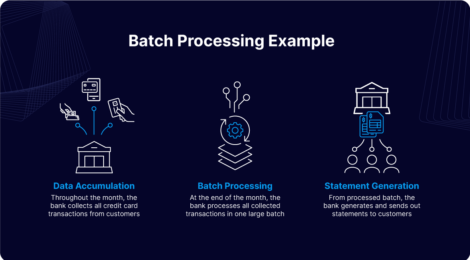
Batch processing is well-suited for tasks like statement generation, where the process only needs to occur periodically, such as once a month. In this case, there’s no need for real-time updates, and the focus is on processing large volumes of data at scheduled intervals. 

If we tried to use the same batch processing pipeline for a more operational use case like fraud detection, we’d face several challenges, including:

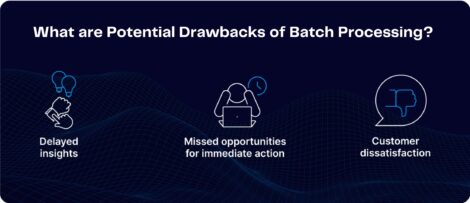
  • Delayed Insights: Because transactions are processed in bulk at the end of the month, any discrepancies or issues, such as fraudulent charges, are only identified after the batch processing is complete. This delay means that customers or the bank may not detect and address issues until after they’ve had a significant impact.
  • Missed Opportunities for Immediate Action: If a customer reports a suspicious transaction shortly after it occurs, the bank might not be able to take immediate action due to the delay inherent in batch processing. Real-time fraud detection and response are not possible, potentially allowing fraudulent activity to continue for weeks.
  • Customer Dissatisfaction: Customers who experience issues with their transactions or statements must wait until the end of the month for resolution, leading to potential dissatisfaction and erosion of trust.

However, by leveraging stream processing instead, the bank gains the ability to analyze transactions as they occur, enabling real-time fraud detection, immediate customer notifications, and quicker resolution of issues. “In any use case where latency or speed is important, data engineers want to use steaming instead of batch processing,” shares Dmitriy Rudakov. “For example if you have a bank withdrawal and simultaneously there’s an audit check or some other need to see an accurate account balance.”

This approach ensures that both the bank and its customers can respond to and manage transactions in real-time, avoiding the delays and missed opportunities associated with batch processing. Through this batch processing example, you see why stream processing is imperative for modern businesses to utilize. 

Stream Processing and Real-Time Data Integration 

Often when discussing stream processing, real-time data integration is also a key topic—similar to how batch processing and batch-based data integration go hand-in-hand. These two concepts are closely related and work together to provide immediate insights and ensure synchronized data across systems.

Stream processing involves the continuous analysis of data as it flows in, allowing businesses to respond to events and trends in real time. It handles data streams instantaneously to deliver up-to-the-minute information and actions. Stream processing platforms are essential for businesses aiming to harness real-time data effectively. According to Dmitriy Rudakov, “Striim supports real-time streaming from all popular data sources such as files, messaging, and databases. It also provides an SQL like language that allows you to enhance your streaming pipelines with any transformations.”

Real-time data integration, on the other hand, ensures that the processed data is accurately and consistently updated across various systems and platforms. By integrating data in real-time, organizations synchronize their databases, applications, and data warehouses, ensuring that all components operate with the most current information. Together, stream processing and real-time data integration offer a unified approach to dynamic data management, significantly enhancing operational efficiency and decision-making capabilities.

Four Reasons You Need Real-Time Data Integration

Now that you understand why batch processing falls short for modern businesses seeking to gain real-time insights, respond swiftly to critical events, and optimize operational efficiency, it’s clear that adopting stream processing is essential for meeting these needs effectively. Here are four reasons real-time data integration is a must-have. 
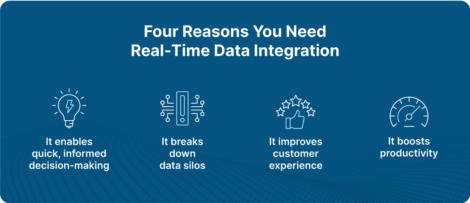
It enables quick, informed decision-making. 

According to Statista, in July 2024, 67% of the global population were internet users, each producing ever-larger amounts of data. Real-time integration enables businesses to act on this information quickly. 

Data from on-premises and cloud-based sources can easily be fed, in real-time, into cloud-based analytics built on, for instance, Kafka (including cloud-hosted versions such as Google PubSub, AWS Kinesis, Azure EventHub), Snowflake, or BigQuery, providing timely insights and allowing fast decision making.

The importance of speed can’t be understated. Detecting and blocking fraudulent credit card usage requires matching payment details with a set of predefined parameters in real time. If, in this case, data processing took hours or even minutes, fraudsters could get away with stolen funds. But real-time data integration allows banks to collect and analyze information rapidly and cancel suspicious transactions.

Companies that ship their products also need to make decisions quickly. They require up-to-date information on inventory levels so that customers don’t order out-of-stock products. Real-time data integration prevents this problem because all departments have access to continuously updated information, and customers are notified about sold-out goods.

Cumulatively, the result is enhanced operational efficiency. By ensuring timely and accurate data, businesses can not only respond to immediate issues but also optimize their operations for improved service delivery and strategic decision-making.

It breaks down data silos. 

When dealing with data silos, real-time data integration is crucial. It connects data from disparate sources—such as Enterprise Resource Planning (ERP) software, Customer Relationship Management (CRM) software, Internet of Things (IoT) sensors, and log files—into a unified system with sub-second latency. This consolidation eliminates isolation, providing a comprehensive view of operations.

For example, in hospitals, real-time data integration links radiology units with other departments, ensuring that patient imaging data is instantly accessible to all relevant stakeholders. This improves visibility, enhances decision-making, and optimizes operational efficiency by breaking down data silos and delivering timely, accurate information.

It improves customer experience. 

The best way to give customer experience a boost is by leveraging real-time data integration. 

Your support reps can better serve customers by having data from various sources readily available. Agents with real-time access to purchase history, inventory levels, or account balances will delight customers with an up-to-the-minute understanding of their problems. Rapid data flows also allow companies to be creative with customer engagement. They can program their order management system to inform a CRM system to immediately engage customers who purchased products or services.

Better customer experiences translate into increased revenue, profits, and brand loyalty. Almost 75% of consumers say a good experience is critical for brand loyalties, while most businesses consider customer experience as a competitive differentiator vital for their survival and growth.

It boosts productivity. 

Spotting inefficiencies and taking corrective actions is crucial for modern companies. Having access to real-time data and continuously updated dashboards is essential for this purpose. Relying on periodically refreshed data can slow progress, causing delays in problem identification and leading to unnecessary costs and increased waste.

Optimizing business productivity hinges on the ability to collect, transfer, and analyze data in real time. Many companies recognize this need. According to an IBM study, businesses expect that rapid data access will lead to better-informed decisions (44%). 

Real-Time Data Integration Requires New Technology: Try Striim

Real-time data integration involves processing and transferring data as soon as it’s collected, utilizing advanced technologies such as Change Data Capture (CDC), and in-flight transformations. Luckily, Striim can help. Striim’s CDC tracks changes in a database’s logs, converting inserts, updates, and other events into a continuous data stream that updates a target database. This ensures that the most current data is always available for analysis and action. Transform-in-flight is another key feature of Striim’s that enables data to be formatted and enriched as it moves through the system. This capability ensures that data is delivered in a ready-to-use format, incorporating inputs from various sources and preparing it for immediate processing.

Striim leverages these technologies to provide seamless real-time data integration. By capturing data changes and transforming data in-flight, Striim delivers accurate, up-to-date information that supports efficient decision-making and operational excellence. Ready to ditch batch processing and experience the difference of stream processing and real-time data integration? Book a demo today and see for yourself how Striim can fuel better decision-making, enhanced customer experience, and beyond. 

Three Benefits of Azure Cosmos DB

More than a decade ago, Microsoft launched Project Florence. This was a research wing created to resolve issues developers faced while building large-scale applications within Microsoft. After some time, Microsoft realized developers around the world also faced these challenges while creating globally distributed applications. This led to the release of Azure DocumentDB in 2015. Over the years, it received more features and updates and evolved into Azure Cosmos DB. Thanks to the countless benefits of Cosmos DB, it’s one of the most popular NoSQL databases today.

Cosmos DB is a NoSQL database designed to handle large workloads on a global level. It offers a plethora of features that can make database creation and management easier, and it also ensures that your database is scalable, reliable, and available.

1. You can use APIs to store data in different models

A relational database is only required when you need a normalized data structure — comprised of rows and columns. Otherwise, you can take advantage of Cosmos DB’s multi-model capabilities. A multi-model database enables you to store data in multiple ways — relational, document, key-value, and column-family — in a single and integrated environment. When it comes to Cosmos DB, you can use APIs of different databases natively and use them to store data.

  • SQL API: SQL API is the default Cosmos DB API. You can use it to write SQL to search within JSON documents. Unlike other Cosmos DB APIs, it also supports server-side programming, allowing you to write triggers, stored procedures, and user-defined functions via JavaScript.
  • MongoDB API: MongoDB is one of the most popular NoSQL databases, and you can integrate with Cosmos DB by using MongoDB’s wire protocol via MongoDB API. This way, you can use MongoDB’s existing client drivers. Moreover, you can use this API to migrate your current MongoDB applications to Cosmos DB with some basic and quick changes.
  • Cassandra API: Apache Cassandra is an open-source NoSQL wide column store database, which can be queried with a SQL-like language — Cassandra Query Language (CQL). Cosmos DB’s Cassandra API allows you to use CQL and Cassandra’s drivers and tools, such as cqlsh.
  • Gremlin API: Cosmos DB Gremlin API uses Gremlin — a functional query language — to offer a graph database service. You can also use Gremlin to implement graph algorithms.
  • Table API: Azure Table Storage is a NoSQL datastore used for storing a large amount of non-relational and structured data. You can use Table API to store and query data from Azure Table Storage.

2. You can replicate data globally for multiple regions

Typically, when you’re looking to create a large-scale globally distributed application, it’s accompanied by considerable work. Building such applications requires you to spend plenty of time planning a multi-center data environment configuration that can smoothly support your application.

Cosmos DB has been built as a globally distributed database, which means you don’t have to waste time planning your multi-center environment. You can configure Cosmos DB to replicate your data to all of your targeted regions. To minimize latency, look into where your users live and place the data closer to them. Cosmos DB will then deliver a single system image of your global database and containers, which are read and written locally by your application.

All global applications aim for high availability, so users of that data can access it without interruption. With Cosmos DB, you can run a database in several regions at once, which can improve your database’s availability. Even if a region is unavailable, Cosmos DB automates the handling of application requests by assigning them to other regions. This global distribution of data is turnkey — you can add or remove one or more geographical regions with a brief API call or a few clicks.

For instance, if you manage a SaaS application, it’s likely to get customer requests from around the world. Formats that store and track user experiences, such as session states, product catalogs, and JSON require accessibility with low latency. Cosmos DB’s globally distributed storage can help you store this data.

3. You can create social media applications

Social media is one of the niches where developers use Cosmos DB to store and query user generated content (UGC) — content users generate in the form of text, reviews, images, and videos. For instance, you can store the data of your social media network’s user ratings and comments in Cosmos DB. Blog posts, tweets, and chat sessions are also part of UGC.

UGC is a combination of free-form text, relationships, tags, and properties that are not governed by an inflexible structure. That’s why UGC is categorized as unstructured data. A relational database can’t store UGC due to its strict schema limitations. A NoSQL database like Cosmos DB can store UGC data more easily because it’s schema-free. Developers have more control to adapt their database to different types of data. In addition, this form of database also requires fewer transformations for data storage and retrieval than a relational database.

Since Cosmos DB is schema-free, you can use it to store documents with different and dynamic structures. For instance, what if you want your social media posts to contain a list of hashtags and categories? Cosmos DB can manage this by adding them as attributes without requiring any additional work. Unlike relational databases, you can make object mapping simple by setting comments under a social media post with a parent property in JSON. Here’s what it would look like:

{
“id”:”4322-bte4-65ut-200b”,
“title”:”My first post!”,
“date”:”2022-05-08″,
“createdBy”:User5,
“parent”:”dv13-sft3-353d-655g”
}

You have to enable your users to search and find content easily. For that, you can use Azure Cognitive Search to implement a search engine. This process doesn’t require you to write any code and is completed within a few minutes.

For storing social media followers, you can use the Gremlin API to use vertexes for each store. Similarly, you can set edges to create the relation of user A following user B. You can also make suggestions to users with common interests by adding a graph.

Use Striim’s native integration to unlock all the benefits of Cosmos DB

For all the benefits of Cosmos DB, there are some minor issues that plague its users. These users struggle to find native integration that supports document, relational, and non-relational databases as sources, hampering data movement into Cosmos DB. Another issue that plagues Cosmos DB users is the use of Batch ETL methods, which are unsuitable for a few use cases. Batch ETL methods read periodically from source data and write to target data repositories after a fixed time. That means all the data-driven decisions that are made after performing analytics on the target data repository are based on relatively old data.

real-time data integration and data replication platform

As a unified data integration and streaming platform, Striim connects data, clouds, and applications with real-time streaming data pipelines.

Striim has come up with a solution for both problems. It offers native integration with Cosmos DB, which means you can use Striim to move data from a wide range of data sources, including Salesforce, PostgreSQL, and Oracle to Cosmos DB. Striim also supports real-time data movement, allowing you to replace your batch ETL methods in applications that need real-time analytics.


Key Factors Driving Growth in Real-Time Analytics

According to IDC, by 2025 nearly 30% of data generated will be real time. Storing data and waiting minutes, days, or hours will no longer be sufficient (or practical) in a world that expects instantaneous responses. Companies need to ensure that they invest in technology solutions that enable real-time analytics so they can respond to key business events within seconds or milliseconds.

And responding in real time gives businesses an edge over companies that don’t. For example, instead of missing a key social media trend, an eCommerce store can jump on the trend and catch a wave of sales that it would have otherwise missed. Or a manufacturer can be alerted to a slowdown on a specific piece of equipment, and initiate repairs before it causes devastating cascading effects.

Real-Time Analytics Business Drivers

What are the business drivers behind the growth in real-time analytics? We’ve identified four key themes: customer experience, continuous innovation, business optimization, and 24/7 operations.

Growth-in-real-time-analytics

Customer Experience

Customer experience encompasses various facets of a customer’s interactions with an organization. First of all, customers expect accurate and up-to-date information at all times. According to Qualtrics research, customers are 80% more likely to be loyal to a company that communicates proactively about supply chain or labor shortage issues.

Furthermore, providing a good customer experience means that an organization understands what customers need (sometimes better than they do), and provides goods and services to meet those needs. Using real-time analytics, companies can provide personalized experiences that feel as though they’re tailored to each customer, in real time. For example, an online makeup retailer can recommend specific cosmetics brands based on a shopper’s purchase history, current trends, and inventory status. Instead of being a one-size-fits-all experience, online shopping becomes a 1:1 experience at scale.

Continuous Innovation

Continuous innovation refers to the data-driven introduction of new services and features based on an ongoing evaluation of available information. New services or features should be quantifiable to ensure that their success and bottom-line impact can be measured. Success should be assessed holistically based on overall impact, not solely on individual impact. For example, a company may add a new service or feature that doesn’t make money directly, but leads to a better customer experience that can in turn improve their bottom line. Organizations should be willing to fail fast and discontinue things that aren’t improving customer experience or providing a benefit to customers.

Customer problems are a key source of innovation. By observing their own customers, organizations have access to a wealth of data to inspire innovation. Furthermore, companies can glean insights by observing the problems experienced by customers of other organizations in their industry. Companies can also innovate based on problems they experience internally that could affect the bottom line.

Business Optimization

Adding, growing, and retaining customers requires well thought out investments in technology. Companies need to be able to scale and optimize their infrastructure and technology on an ongoing basis. Furthermore, in order to retain and grow their customer base, companies have to continuously improve the performance of their products or services, their response times, the freshness of their data, and more. To do this they need to quantify and measure insights relating to their online presence, productivity, and internal processes. This enables them to make much better decisions on how to optimize their business.

Many companies are also faced with the challenges associated with using legacy systems to manage their data. These systems may be prohibitively expensive to replace, or have very long replacement timescales, but the data that’s contained within those systems may be crucial for analytics. It’s essential that companies look at all the data they have – no matter where it is – and make use of that in order to optimize their business.

Reputation cost has to be factored into investments as well. Customer experience, security, and up-to-date data all factor into a company’s reputation. Organizations have to improve how they look to their customers and to the market in general, while managing with the challenges posed by their legacy systems.

Global 24/7 Operations

In the not-so-distant past, banks were open just for a few hours in the middle of the day. There was no online presence and organizations had the luxury of running batch ETL jobs overnight and they could even take down pieces of infrastructure or pause databases.

However, in today’s world global organizations need to operate 24/7. Taking down systems is no longer an option. Furthermore, services also need to be scalable and on-demand to match daily and seasonal seasonal trends. For example, in the retail industry, Black Friday has expanded from a single day to almost an entire month where companies expect much higher demand on their services. The same goes for financial services companies during tax season. And companies in the travel industry typically have to scale up around the holidays and summer.

Companies need to be able to scale up all of the services they provide; not only their core services, but also their analytics services to deal with the increased data volumes during peak times. Organizations can’t afford downtime. Customers want to get things done on their schedule. If a company is going to have any downtime, they need to at least notify customers ahead of time and give them a maintenance window. But in general, customers expect all businesses to operate 24/7 so they can access their information whenever they want.

Furthermore, if an organization has siloed or globally distributed information, it needs to be centrally available for analytics and holistic decision making.

Distilling the Key Business Requirements Driving Real-Time Analytics

In summary, there are a number of different requirements that are driving the growth in demand for real-time analytics:

  • All Information: Analytics must be available across all sources of information, including new services and legacy systems
  • Current Information: The data used for analytics must be as close to real-time as possible to provide customers and the business with timely insights
  • Scalable on-demand: ​​Systems need to grow as the business does, and be able to handle seasonal and daily changes in demand
  • Globally Available: Analytics and access to data in general must be available wherever the business’s customers and employees reside
  • No Downtime: Access to source systems should not be impacted by the need for analytics on the data in those systems
  • Rapid Integration: New systems should be able to be added rapidly as sources for analytics as the business innovates
  • Justifiable ROI: The investment in analytics and integration must be offset by improvements in the business

Next Steps: How to Choose the Correct Technology for Real-Time Analytics

Real-time analytics is a key component of digital transformation initiatives as companies strive to stay ahead of the competition. But there are many challenges in the journey to real-time, including how to leverage existing investments, and how to prevent or reduce downtime during the adoption of new systems.

Learn more about how to choose the correct technology for real-time analytics in our on-demand webinar “How to Build Streaming Data Pipelines for Real-Time Analytics”.

How to build streaming data pipelines for real time analytics webinar

The webinar covers topics including:

  • How to build real-time data streaming pipelines quickly, reliably, and at unlimited scale
  • Why real-time data integration is an essential component of a streaming data pipeline
  • Customer examples showing how streaming data pipelines enable companies to make informed decisions in real time

Watch the webinar here.


Back to top