Data Replication for MongoDB: Guide to Real-Time CDC

If your application goes down, your customers go elsewhere. That’s the harsh reality for enterprise companies operating at a global scale. In distributed architectures, relying on a single database node leads to a single point of failure. You need continuous, reliable copies of your data distributed across servers to ensure high availability, disaster recovery, and low-latency access for users around the world.

MongoDB is a leading NoSQL database because it makes data replication central to its architecture. It handles the basics of keeping multiple copies of your data for durability natively. But for modern enterprises, simply having a backup copy of your operational data is no longer sufficient.

As they scale, enterprises need continuous, decision-ready data streams. They need to feed cloud data warehouses, power real-time analytics, and supply AI agents with fresh context. While MongoDB’s native replication is a strong foundation for operational health, it wasn’t designed to deliver data in motion across your entire enterprise ecosystem.

In this guide, we will explore the core modes of MongoDB data replication, the limitations of relying solely on native tools at the enterprise level, and how Change Data Capture (CDC) turns your operational data into a continuous, real-time asset. (If you’re looking for a broader industry overview across multiple databases, check out our guide to modern database replication).

What is Data Replication in MongoDB?

Data replication is the process of keeping multiple, synchronized copies of your data across different servers or environments. In distributed systems, this is a foundational requirement. If your infrastructure relies on a single database server, a hardware failure or network outage will take your entire application offline. MongoDB, as a leading NoSQL database built for scale and flexibility, makes replication a central pillar of its architecture. Rather than treating replication as an afterthought or a bolt-on feature, MongoDB natively distributes copies of your data across multiple nodes. This ensures that if the primary node goes down, a secondary node is standing by, holding an identical copy of the data, ready to take over. It provides the durability and availability required to keep modern applications running smoothly.

Why Data Replication Matters for Enterprises

While basic replication is helpful for any MongoDB user, the stakes are exponentially higher in enterprise environments. A minute of downtime for a small startup might be an inconvenience; for a global enterprise, it means lost revenue, damaged brand reputation, and potential compliance violations.

For enterprises, replicating MongoDB data is a business-critical operation that drives continuity, intelligence, and customer satisfaction.

Business Continuity and Disaster Recovery

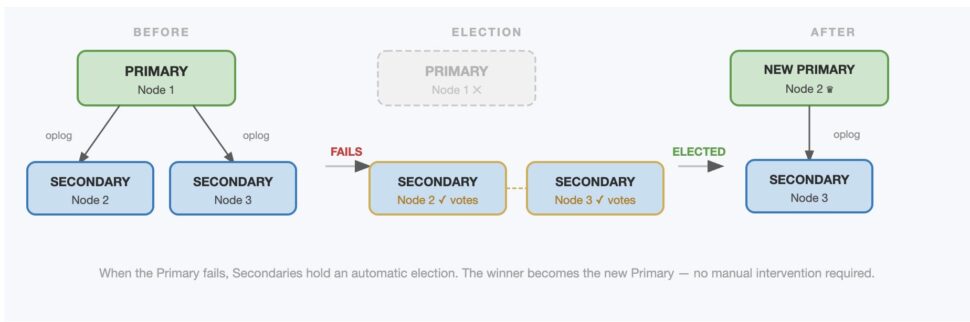
Data center outages, natural disasters, and unexpected server crashes are inevitable. When they happen, enterprises must ensure minimal disruption, making proactive infrastructure planning a top enterprise risk management trend. By replicating MongoDB data across different physical locations or cloud regions, you create a robust disaster recovery strategy. If a primary node fails, automated failover mechanisms promote a secondary node to take its place, ensuring your applications stay online and your data remains intact.
Real-Time Analytics and Faster Decision-Making

Operational data is most valuable the instant it’s created. However, running heavy analytics queries directly on your primary operational database can degrade performance and slow down your application. Replication solves this by moving a continuous copy of your operational data into dedicated analytics systems or cloud data warehouses. This reduces the latency between a transaction occurring and a business leader gaining insights from it, enabling faster, more accurate decision-making and powering true real-time analytics.

Supporting Global Scale and Customer Experience

Modern enterprises serve global user bases that demand instantaneous interactions. If a user in Tokyo has to query a database located in New York, anything other than low latency will degrade their experience. By replicating MongoDB data to regions closer to your users, you enable faster local read operations. This ensures that regardless of where your customers are located, they receive the high-speed, low-latency experience they expect from a top-tier brand.

The Two Primary Modes of MongoDB Replication

When architecting a MongoDB deployment, database administrators and data architects have two core architectural choices for managing scale and redundancy. (While we focus on MongoDB’s native tools here, there are several broader data replication strategies you can deploy across a sprawling enterprise stack).

Replica Sets

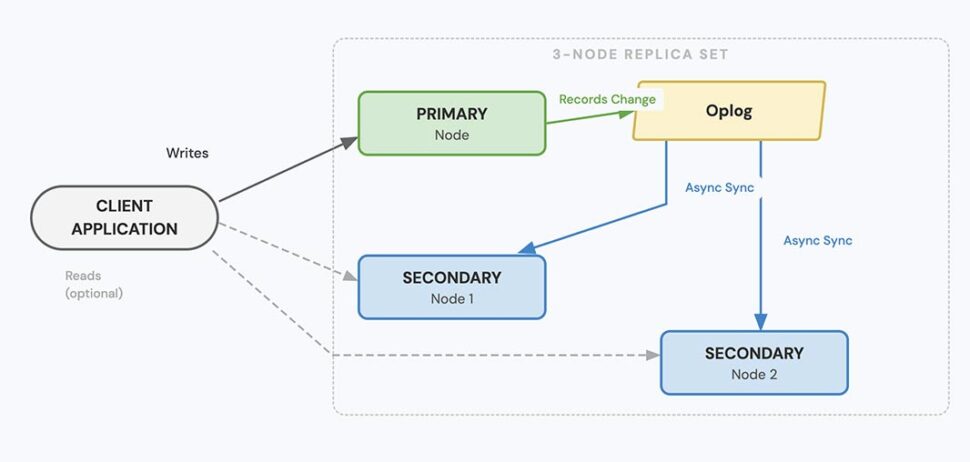
A replica set is the foundation of MongoDB’s replication strategy. It relies on a “leader-follower” model: a group of MongoDB instances that maintain the same data set.

In a standard configuration, one node is designated as the Primary (leader), which receives all write operations from the application. The other nodes act as Secondaries (followers). The secondaries continuously replicate the primary’s oplog (operations log) and apply the changes to their own data sets, ensuring they stay synchronized.

If the primary node crashes or becomes unavailable due to a network partition, the replica set automatically holds an election. The remaining secondary nodes vote to promote one of themselves to become the new primary, resulting in automatic failover without manual intervention.
 

Sharding

As your application grows, you may reach a point where a single server (or replica set) can no longer handle the sheer volume of read/write throughput or store the massive amount of data required. This is where sharding comes in.

While replica sets are primarily about durability and availability, sharding is about scaling writes and storage capacity. Sharding distributes your data horizontally across multiple independent machines.

However, sharding and replication are not mutually exclusive—in fact, they work together. In a production MongoDB sharded cluster, each individual shard is deployed as its own replica set. This guarantees that not only is your data distributed for high performance, but each distributed chunk of data is also highly available and protected against server failure.

Replica Sets vs. Sharding: Key Differences

To clarify when to rely on each architectural component, here is a quick breakdown of their core differences:

Feature

Replica Sets

Sharding

Primary Purpose High availability, data durability, and disaster recovery. Horizontal scaling for massive data volume and high write throughput.
Scaling Type Scales reads (by directing read operations to secondary nodes). Scales writes and storage (by distributing data across multiple servers).
Complexity Moderate. Easier to set up and manage. High. Requires config servers, query routers (mongos), and careful shard key selection.
Complexity Cannot scale write operations beyond the capacity of the single primary node. Complex to maintain, and choosing the wrong shard key can lead to uneven data distribution (hotspots).

Challenges with Native MongoDB Replication

While replica sets and sharding are powerful tools for keeping your database online, they were designed specifically for operational durability. But as your data strategy matures, keeping the database alive becomes the baseline, not the end destination.

Today’s businesses need more than just identical copies of a database sitting on a secondary server. When evaluating data replication software, enterprises must look for tools capable of pushing data into analytics platforms, personalized marketing engines, compliance systems, and AI models.

When organizations try to use native MongoDB replication to power these broader enterprise initiatives, they quickly run into roadblocks.

Replication Lag and Performance Bottlenecks

Under heavy write loads or network strain, secondary nodes can struggle to apply oplog changes as fast as the primary node generates them. This creates replication lag. If your global applications are directing read traffic to these secondary nodes, users may experience stale data. In an enterprise context—like a financial trading app or a live inventory system—even a few seconds of latency can quietly break enterprise AI at scale and lead to costly customer experience errors.

Cross-Region and Multi-Cloud Limitations

Modern enterprises rarely operate in a single, homogenous environment. You might have MongoDB running on-premises while your analytics team relies on Snowflake in AWS, or you might be migrating from MongoDB Atlas to Google Cloud. Native MongoDB replication is designed to work within the MongoDB ecosystem. It struggles to support the complex, hybrid, or multi-cloud replication pipelines that enterprises rely on to prevent vendor lock-in and optimize infrastructure costs.

Complexity in Scaling and Managing Clusters

Managing a globally distributed replica set or a massive sharded cluster introduces significant operational headaches. Database administrators (DBAs) must constantly monitor oplog sizing, balance shards to avoid data “hotspots,” and oversee election protocols during failovers. As your data footprint grows, the operational overhead of managing these native replication mechanics becomes a drain on engineering resources.

Gaps in Analytics, Transformation, and Observability

Perhaps the most significant limitation: native replication is not streaming analytics. Replicating data to a secondary MongoDB node simply gives you another MongoDB node.

Native replication does not allow you to filter out Personally Identifiable Information (PII) before the data lands in a new region for compliance. It doesn’t transform JSON documents into a relational format for your data warehouse. And it doesn’t offer the enterprise-grade observability required to track data lineage or monitor pipeline health. To truly activate your data, you need capabilities that go far beyond what native MongoDB replication provides.

Real-Time Change Data Capture (CDC) for MongoDB

To bridge the gap between operational durability and enterprise-wide data activation, modern organizations are turning to streaming solutions.

At a high level, log-based Change Data Capture (CDC) is a data integration methodology that identifies and captures changes made to a database in real time. For MongoDB, CDC tools listen directly to the operations log (oplog): the very same log MongoDB uses for its native replica sets. As soon as a document is inserted, updated, or deleted in your primary database, CDC captures that exact event.

This shift in methodology changes the entire paradigm of data replication. Instead of just maintaining a static backup on a secondary server, CDC turns your operational database into a live data producer. It empowers organizations to route streams of change events into analytical platforms, cloud data warehouses, or message brokers like Kafka the instant they happen.

By adopting CDC, stakeholders no longer view data replication as a mandatory IT checkbox for disaster recovery. Instead, it becomes a unified foundation for customer experience, product innovation, and measurable revenue impact.

Real-Time CDC vs. Batch-Based Replication

Historically, moving data out of an operational database for analytics or replication meant relying on batch processing (traditional ETL). A script would run periodically—perhaps every few hours or overnight—taking a snapshot of the database and moving it to a warehouse.

Batch replication is fundamentally flawed for modern enterprises. Periodic data dumps introduce hours of latency, meaning your analytics and AI models are always looking at the past.

Furthermore, running heavy batch queries against your operational database can severely degrade performance, sometimes requiring “maintenance windows” or risking application downtime.

CDC eliminates these risks. Because it reads directly from the oplog rather than querying the database engine itself, CDC has virtually zero impact on your primary database’s performance. It is continuous, low-latency, and highly efficient. Here is how the two approaches compare:

Feature

Batch-Based Replication (ETL)

Real-Time CDC

Data Freshness (Latency) High (Hours to days). Data reflects a historical snapshot. Low (Sub-second). Data reflects the current operational state immediately.
Performance Impact High. Large, resource-intensive queries can degrade primary database performance. Minimal. Reads seamlessly from the oplog, preventing strain on production systems.
Operation Type Periodic bulk dumps or scheduled snapshots. Continuous, event-driven streaming of document-level changes (inserts, updates, deletes).
Ideal Use Cases End-of-month reporting, historical trend analysis. Real-time analytics, continuous AI context, live personalization, and zero-downtime migrations.


Use Cases for MongoDB Data Replication with CDC

For today’s data-driven enterprises, robust data replication is far more than a “nice to have”. By pairing MongoDB with an enterprise-grade CDC streaming platform like Striim, organizations unlock powerful use cases that natively replicate systems simply cannot support.

Zero-Downtime Cloud Migration

Moving large MongoDB workloads from on-premises servers to the cloud—or migrating between different cloud providers—often requires taking applications offline. For a global enterprise, even planned downtime is costly.

Real-time CDC replication eliminates this hurdle. Striim continuously streams oplog changes during the migration process, seamlessly syncing the source and target databases. This means your applications stay live and operational while the migration happens in the background. Once the target is fully synchronized, you simply execute a cutover with zero downtime and zero data loss.

Real-Time Analytics and AI Pipelines

To make accurate decisions or feed context to generative AI applications, businesses need data that is milliseconds old, not days old.

With CDC, you can replicate MongoDB data and feed it into downstream systems like Snowflake, Google BigQuery, Databricks, or Kafka in real time. But the true value lies in what happens in transit. Striim doesn’t just move the data; it transforms and enriches it in-flight. You can flatten complex JSON documents, join data streams, or generate vector embeddings on the fly, ensuring your data is instantly analytics- and AI-ready the moment it lands. Enterprises gain actionable insights seconds after events occur.

Global Applications with Low-Latency Data Access

Customer experience is intrinsically linked to speed. When users interact with a global application, they expect instantaneous responses regardless of their geographic location.

Native MongoDB replication can struggle with cross-region lag, especially over unreliable network connections. Striim helps solve this by optimizing real-time replication pipelines across distributed regions and hybrid clouds. By actively streaming fresh data to localized read-replicas or regional data centers with sub-second latency, you ensure a frictionless, high-speed experience for your end users globally.

Regulatory Compliance and Disaster Recovery

Strict data sovereignty laws, such as GDPR in Europe or state-specific regulations in the US, mandate exactly where and how customer data is stored.

Striim enables intelligent replication into compliant environments. Utilizing features like in-stream masking and filtering, you can ensure Personally Identifiable Information (PII) is obfuscated or removed before it ever crosses regional borders. Additionally, if disaster strikes, Striim’s continuous CDC replication ensures your standby systems possess the exact, up-to-the-second state of your primary database. Failover happens with minimal disruption, high auditability, and zero lost data.

Extend MongoDB Replication with Striim

MongoDB’s native replication is incredibly powerful for foundational operational health. It ensures your database stays online and your transactions are safe. But as enterprise data architectures evolve, keeping the database alive is only half the battle.

To truly activate your data—powering real-time analytics, executing zero-downtime migrations, maintaining global compliance, and feeding next-generation AI agents—real-time CDC is the proven path forward.

Striim is the world’s leading Unified Integration & Intelligence Platform, designed to pick up where native replication leaves off. With Striim, enterprises gain:

  • Log-based CDC: Seamless, zero-impact capture of inserts, updates, and deletes directly from MongoDB’s oplog.
  • Diverse Targets: Replicate your MongoDB data anywhere via our dedicated MongoDB connector—including Snowflake, BigQuery, Databricks, Kafka, and a wide array of other databases.
  • In-Flight Transformation: Filter, join, mask, and convert complex JSON formats on the fly before they reach your target destination.
  • Cross-Cloud Architecture: Build resilient, multi-directional replication pipelines that span hybrid and multi-cloud environments.
  • Enterprise-Grade Observability: Maintain total control with exactly-once processing (E1P), latency metrics, automated recovery, and real-time monitoring dashboards.

Stop settling for static backups and start building a real-time data foundation. Book a demo today to see how Striim can modernize your MongoDB replication, or get started for free to test your first pipeline.

FAQs

What are the key challenges enterprises face with MongoDB replication at scale?

As data volumes grow, natively scaling MongoDB clusters becomes operationally complex. Enterprises often run into replication lag under heavy write loads, which causes stale data for downstream applications. Additionally, native tools struggle with cross-cloud replication and lack the built-in transformation capabilities needed to feed modern cloud data warehouses effectively.

How does Change Data Capture (CDC) improve MongoDB replication compared to native tools?

Native replication is primarily designed for high availability and disaster recovery strictly within the database ecosystem. Log-based CDC, on the other hand, reads directly from the MongoDB oplog to capture document-level changes in real time. This allows enterprises to stream data to diverse, external targets—like Snowflake or Kafka—without impacting the primary database’s performance.

What’s the best way to replicate MongoDB data into a cloud data warehouse or lakehouse?

The most efficient approach is using a real-time streaming platform equipped with log-based CDC. Instead of relying on periodic batch ETL jobs that introduce hours of latency, CDC continuously streams changes as they happen. Tools like Striim also allow you to flatten complex JSON documents in-flight, ensuring the data is relational and query-ready the moment it lands in platforms like BigQuery or Databricks.

How can organizations ensure low-latency replication across multiple regions or cloud providers?

While native MongoDB replica sets can span regions, they can suffer from network strain and lag in complex hybrid environments. By leveraging a unified integration platform, enterprises can optimize real-time replication pipelines across distributed architectures. This approach actively pushes fresh data to regional read-replicas or secondary clouds with sub-second latency, ensuring global users experience instantaneous performance.

What features should enterprises look for in a MongoDB data replication solution?

When evaluating replication software, prioritize log-based CDC to minimize source database impact and guarantee low latency. The solution must offer in-flight data transformation (like filtering, masking, and JSON flattening) to prepare data for analytics instantly. Finally, demand enterprise-grade observability—including exactly-once processing (E1P) guarantees and real-time latency monitoring—to ensure data integrity at scale.

How does Striim’s approach to MongoDB replication differ from other third-party tools?

Striim combines continuous CDC with a powerful, in-memory streaming SQL engine, meaning data isn’t just moved, it’s intelligently transformed in-flight. Recent industry studies show that 61% of leaders cite a lack of integration between systems as a major blocker to AI adoption. Striim solves this by enabling complex joins, PII masking, and vector embedding generation before the data reaches its target, providing an enterprise-ready architecture that scales horizontally to process billions of events daily.

Can Striim support compliance and security requirements when replicating MongoDB data?

Absolutely. Striim supports teams to meet compliance regulations like GDPR or HIPAA by applying in-stream data masking and filtering. This means sensitive Personally Identifiable Information (PII) can be obfuscated or entirely removed from the data pipeline before it is stored in a secondary region or cloud. Furthermore, Striim’s comprehensive auditability and secure connections ensure your data movement remains fully governed.

Data Driven Strategy: Make Smarter, Faster Business Decisions

Every enterprise has more data than it knows what to do with: from customer transactions, supply chain signals, to operational logs and market indicators. The raw material for better decisions is already there. But most of it arrives too late to matter.

This article breaks down what a data-driven strategy actually requires: the core components, the technologies that power it, the challenges you’ll face, and a practical game plan for making it work.

Whether you’re building from scratch or modernizing what you already have, the goal is the same: decisions that are smarter, faster, and backed by data you can trust.

What’s at the Heart of a Data-Driven Strategy?

A data-driven strategy is the systematic practice of using quantitative evidence—rather than assumptions—to guide business planning and execution. But it’s not simply “use more data.” It’s an operating model that touches people, process, and technology across the enterprise.

At its core, a data-driven strategy has six essential components.

Data Collection and Integration

You can’t act on data you can’t access. The foundation of any data-driven strategy is the ability to collect data from every relevant source—operational databases, SaaS applications, IoT devices, third-party feeds—and integrate it into a unified view. When data lives in disconnected systems, decisions are based on incomplete pictures.

The most effective enterprises stream data continuously, so information becomes available to decision-makers reflects what’s happening now, not what happened hours or days ago.

Data Governance and Quality Management

More data doesn’t always mean better decisions. Especially if the data is inconsistent, duplicated, or unreliable. Robust data governance defines who owns the data, how it’s validated, and what standards it must meet before it informs a decision.

Strong governance also means clear lineage: knowing where every data point originated, how it was transformed, and who accessed it. Without this, you’re building strategy on a foundation you can’t verify.

Data Storage and Accessibility

Siloed data is a liability that holds back even the best data strategies. Enterprises need storage architectures that make data accessible across departments without compromising security or performance.

Modern approaches—cloud data warehouses, data lakes, and data lakehouses—offer the scalability and flexibility to store structured and unstructured data at scale. But accessibility is just as important as storage. If your marketing team can’t query the same customer data your operations team relies on, alignment breaks down.

Analysis and Insight Generation

Raw data becomes useful when it’s transformed and understood. This component covers everything from basic reporting and dashboarding to advanced analytics, machine learning, and predictive modeling.

The key distinction: analysis should be oriented toward action, not just understanding. The question isn’t just “what happened?” It’s “what should we do next?”

Operationalization of Insights

Operationalization means embedding data-driven decision-making into daily workflows: automating alerts, feeding models into production systems, and building processes where teams act on data as a default, not an exception.

This is where many enterprises stall. They invest in analytics but fail to close the loop between insight and execution. The most effective strategies treat operationalization as a first-class requirement.

Measurement and Optimization

A data-driven strategy is a process of constant iteration. You need clear KPIs, feedback loops, and the discipline to measure whether data-informed decisions are actually producing better outcomes than the old way.

Continuous measurement also means continuous refinement. As your data infrastructure matures and your teams get sharper, the strategy itself should evolve, expanding into new use cases, incorporating new data sources, and raising the bar on what “data-driven” means for your enterprise.

Why Go Data-Driven with Decisions?

Data-driven decision making has been proven to deliver better outcomes and stronger revenue. Enterprises that ground decisions in evidence rather than intuition alone gain tangible advantages across every part of the organization: from the C-suite to front-line operations.

According to IBM’s 2025 CEO Study, executives are increasingly prioritizing data-informed strategies to supercharge growth in volatile markets.

Here’s what changes when data drives the strategy:

  • Improved operational efficiency. When you can see where time, money, and resources are being wasted—in real time—you can cut waste before it compounds. Data exposes bottlenecks that intuition misses.
  • Faster decision-making across departments. Teams spend less time debating assumptions and more time acting on evidence. When everyone works from the same trusted data, alignment happens faster.
  • Reduced risk through predictive analytics. Instead of reacting to problems after they surface, data-driven enterprises anticipate them. Fraud detection, equipment maintenance, supply chain disruptions—predictive models turn lagging indicators into leading ones.
  • Better customer experiences via personalization. Customers expect relevance. Data-driven strategies enable enterprises to tailor offers, communications, and services based on actual behavior, not broad segments.
  • Increased cross-functional alignment. A shared data foundation eliminates the “different numbers in different meetings” problem. When finance, marketing, and operations reference the same datasets, the enterprise moves as one.
  • Enhanced agility in responding to market trends. Markets shift fast. Enterprises that monitor real-time signals can adjust pricing, inventory, and go-to-market strategies in hours instead of weeks.

The bottom line: data-driven enterprises build an organizational muscle that compounds over time, where better data leads to better outcomes, which generates more data, which leads to even better decisions.

Real-World Wins with Data-Driven Strategies

Data-driven strategies are applicable across a range of industries and functions. From logistics, retail, healthcare, and beyond, enterprises are using real-time data to solve problems that once seemed intractable. Here are four examples that illustrate the breadth of what’s possible.

UPS: AI-Powered Risk Scoring for Smarter Deliveries

United Parcel Service (UPS), with over $91 billion in revenue and 5.7 billion packages delivered annually, uses real-time data to protect both its operations and its merchants. By streaming high-velocity data into Google BigQuery and Vertex AI, UPS built its AI-Powered Delivery Defense™ system—a real-time risk scoring engine that evaluates address confidence and flags risky deliveries before they happen.

The result: reduced fraudulent claims, better merchant protection, and delivery decisions powered by live behavioral data rather than stale batch reports. For UPS, a data-driven strategy isn’t a planning exercise. It’s an operational advantage embedded into every package.

Morrisons: Real-Time Shelf Management at Scale

Morrisons, a leading UK supermarket chain with over 500 stores, faced a familiar retail challenge: batch-based data systems couldn’t keep up with the pace of in-store operations. Shelf availability suffered. Decisions about replenishment lagged behind actual sales activity.

By implementing real-time data streaming from its Retail Management System and Warehouse Management System into Google BigQuery, Morrisons transformed its operations. Within two minutes of a sale, the data was available for analysis. This enabled AI-driven shelf replenishment, reduced waste, and gave teams—from store colleagues to senior leaders—the real-time visibility they needed to act decisively.

Macy’s: Unified Inventory for Omnichannel Retail

Macy’s, one of America’s largest retailers, struggled with fragmented data spread across mainframes, Oracle databases, and disconnected systems. As a result, the company faced inventory discrepancies between online and in-store channels, high costs, and a disjointed customer experience, especially during peak events like Black Friday.

By replicating data from legacy systems to Google Cloud Platform in real time, Macy’s created a single, reliable source of truth for inventory. Real-time synchronization eliminated costly out-of-stock situations, reduced surpluses, and gave teams the unified visibility needed to deliver a seamless omnichannel experience.

Tech That Powers Data-Driven Strategies

A data-driven strategy is only as strong as the technology underneath it. The right stack makes data accessible, actionable, and timely across the enterprise.

Big Data and Analytics Platforms

Platforms like Apache Spark, Databricks, Snowflake, and Google BigQuery provide the compute power to run large-scale analytics, machine learning workflows, and interactive dashboards. These systems are designed for volume: handling terabytes or petabytes of data without compromising query performance.

The shift toward cloud-native analytics platforms has also lowered the barrier to entry. Teams that once needed dedicated infrastructure can now spin up analytical workloads on demand, scaling compute independently from storage.

Cloud Infrastructure and Data Lakes

Cloud providers—AWS, Microsoft Azure, and Google Cloud Platform—offer the scalable storage and compute that underpin modern data strategies. Services like Amazon S3, Azure Data Lake, and Google Cloud Storage give enterprises flexible, cost-effective ways to store both structured and unstructured data.

Data lakes and data lakehouses combine the best of both worlds: the flexibility of a data lake with the governance and query performance of a data warehouse. For enterprises managing diverse data types—from transaction logs to unstructured documents—this flexibility is essential.

AI and ML Tools and Frameworks

Frameworks like TensorFlow, PyTorch, and managed platforms like AWS SageMaker and DataRobot make it possible to build, train, and deploy machine learning models at scale. Enterprises use these for forecasting, personalization, anomaly detection, and increasingly, real-time decision support.

But models are only as effective as the data they consume. Stale or inconsistent inputs produce unreliable outputs. The most effective AI strategies pair powerful modeling frameworks with infrastructure that delivers fresh, governed data streams, so models train on accurate information and infer on current conditions.

Business Intelligence and Visualization Tools

Tools like Tableau, Power BI, Looker, and Qlik turn raw data into visual dashboards and reports that inform day-to-day decision-making. They’re the interface where data strategy meets business users, helping teams track KPIs, identify trends, and surface anomalies without writing SQL.

The best BI implementations connect directly to live or near-live data sources, so dashboards reflect current reality rather than yesterday’s snapshot.

Real-Time Data Integration and Streaming

This is where the gap between “having data” and “using data” gets closed. Real-time data integration continuously moves and processes data across systems as events happen.

Change Data Capture (CDC) is a core technique: it reads a database’s transaction log and streams every insert, update, and delete to target systems in real time. Think of it as a live feed of everything happening in your source systems, delivered the instant it occurs.

Striim’s platform is purpose-built for this. It provides non-intrusive CDC, low-latency streaming, in-flight transformation, and AI-ready pipelines that deliver data to hundreds of supported sources and targets—including Snowflake, Databricks, and Google BigQuery—continuously and at scale. For enterprises building data-driven strategies on real-time foundations, this layer is what makes speed and freshness possible.

Tackling Challenges in Data Strategies

Adopting a data-driven strategy is an ongoing process fraught with challenges. Enterprise teams consistently run into two categories of challenges: keeping data trustworthy and keeping data safe.

Maintaining Data Quality

Poor data quality has the potential to erode trust. When dashboards show conflicting numbers or models make predictions based on stale inputs, teams revert to gut instinct. The whole strategy unravels.

Common culprits include inconsistent formats across source systems, duplicate records, undocumented transformations, and the inevitable schema changes that come with evolving applications. Addressing these requires automated governance: validation rules applied continuously, lineage tracking from source to destination, and anomaly detection that catches quality issues before they reach decision-makers.

Data quality is a cultural challenge as much as a technological one. Enterprises that succeed assign clear ownership: someone accountable for each dataset’s accuracy and completeness. Without ownership, data quality degrades by default.

Staying Secure and Private

Every data-driven initiative expands the attack surface. More integrations mean more access points. More analytics users mean more potential exposure. And regulations like GDPR, HIPAA, and SOC 2 prioritize compliance over your timeline.

The most effective approach builds security and privacy into the data pipeline itself, not as an afterthought. That means detecting and masking sensitive data in motion, before it reaches analytics platforms or AI models. It means enforcing access controls consistently across every environment, whether on-premises or in the cloud.

For enterprises operating under strict regulatory requirements, continuous data verification and audit-ready lineage are non-negotiable. Your data strategy must account for these from day one, not bolt them on after the first compliance review.

Crafting Your Data-Driven Business Game Plan

Even the best strategy is useless without robust execution. Here’s how to turn data-driven ambition into operational reality.

Start by Managing Real-Time Data Effectively

The foundation of any data-driven game plan is getting the right data to the right place at the right time. For most enterprises, this means moving beyond scheduled batch processes toward continuous data integration.

Change Data Capture (CDC) is a practical starting point. Non-intrusive CDC reads changes directly from database transaction logs and streams them to target systems without impacting source performance. This ensures your analytical platforms and AI models always reflect current operational reality, not a snapshot from last night’s ETL run.

Striim’s platform makes this accessible at enterprise scale, providing real-time data streaming with in-flight transformation so data arrives at its destination already cleansed, enriched, and ready for analysis. The impact is immediate: fraud detection systems catch issues as they happen, inventory updates propagate in seconds, and customer-facing systems reflect the latest information.

Analyze Your Data to Uncover Actionable Insights

With reliable, real-time data in place, the next step is turning that data into decisions. This is where artificial intelligence (AI) and machine learning (ML) shift from buzzwords to practical instruments.

Predictive analytics can forecast demand, flag equipment failures before they happen, and identify customers likely to churn, all based on patterns in your streaming data. Anomaly detection surfaces the unexpected: a sudden spike in transactions, an unusual drop in sensor readings, a deviation from normal supply chain patterns.

The key is that analysis must be continuous, not episodic. When your data arrives in real time, your analytics should operate in real time too. Platforms like Databricks and BigQuery—fed by streaming pipelines—make it possible to run complex analytical workloads on live data without waiting for batch windows. Striim transforms raw, streaming data into AI-ready inputs, enabling real-time model monitoring and predictive analytics that keep pace with the operation itself.

Apply Insights Directly to Strategic Initiatives

The final step—and the one where most enterprises stall—is closing the gap between insight and action. It’s not enough to know that a customer segment is underperforming or that a supply chain route is inefficient. The insight has to reach the team or system that can act on it.

Consider how UPS applies real-time risk assessments to delivery routing decisions. Data flows from operational systems into AI models, the models score each delivery for risk, and the result feeds directly back into operational workflows—without a human having to pull a report and interpret it.

Striim’s low-code and no-code interface supports this kind of operationalization by enabling business users and data teams to create and modify data pipelines without deep technical expertise. This accelerates time-to-value and supports data democratization—ensuring that insights don’t stay locked in the data engineering team but flow to the people who can act on them.

Why a Unified Data Platform Is a Game Changer

Enterprises that try to build a data-driven strategy on top of fragmented infrastructure eventually hit a ceiling. Point solutions for ingestion, transformation, governance, and delivery create integration overhead that slows everything down. A unified platform changes the equation.

Enhance Business Agility

When your data infrastructure operates as a single, connected system, you can respond to market changes in hours instead of weeks. New data sources can be integrated without rebuilding pipelines. New analytical workloads can tap into existing streams without duplicating infrastructure.

American Airlines demonstrated this when it deployed a real-time data hub to support its TechOps operations. By streaming data from MongoDB into a centralized platform, the airline gave maintenance crews and business teams instant access to aircraft telemetry and operational data, and went from concept to production at global scale in just 12 weeks.

Break Down Silos and Improve Collaboration

Data silos are one of the most persistent obstacles to a data-driven strategy. When marketing, finance, and operations each maintain their own data stores, the enterprise can’t align on a single version of truth.

A unified platform eliminates this by making data accessible across teams through consistent pipelines and shared governance. Marketing can work with the same customer data that operations uses for fulfillment. Finance can reconcile numbers against the same source systems that feed the executive dashboard.

Data democratization isn’t about giving everyone unrestricted access. It’s about ensuring that every team works from the same trusted, governed data.

Ensure Scalability and Business Continuity

A data-driven strategy has to scale alongside the enterprise. As data volumes grow, as new cloud environments come online, and as AI workloads increase in complexity, the underlying platform needs to handle the load without manual intervention.

Hybrid and multi-cloud architectures provide the flexibility to deploy where it makes sense: on-premises for sensitive workloads, in the cloud for elastic compute, across multiple clouds for resilience. Features like Active-Active failover ensure business continuity even during infrastructure disruptions.

The enterprises that scale their data infrastructure ahead of demand are the ones best positioned to capitalize on new opportunities as they emerge.

What’s Next for Data-Driven Strategies?

The foundations of data-driven strategy—collection, integration, analysis, action—aren’t changing. But the tools, techniques, and expectations around them are evolving fast.

Generative AI for real-time decision support. Large language models and generative AI are moving beyond content creation into operational decision-making. Enterprises are beginning to deploy AI agents that reason over live data, generate recommendations, and take autonomous action—but only when the underlying data is fresh, governed, and trustworthy.

Stricter global data privacy regulations. GDPR was just the beginning. New state-level privacy laws in the U.S., evolving EU regulations, and emerging global frameworks are raising the bar for how enterprises collect, store, and process data. Baking compliance into your data pipelines—rather than auditing after the fact—is becoming essential.

AI governance and responsible AI frameworks. As AI plays a larger role in strategic decisions, enterprises face growing pressure to explain how those decisions are made. Transparency, auditability, and ethical guardrails are shifting from nice-to-haves to requirements.

Edge computing for real-time processing. Not all data can—or should—travel to a central cloud before it’s useful. Edge computing pushes processing closer to the source, enabling real-time decisions at the point of data creation. For industries like manufacturing, logistics, and IoT-heavy operations, this is a major step forward.

Composable data infrastructure. The era of monolithic data platforms is giving way to composable architectures—modular, interoperable components that enterprises can assemble and reconfigure as needs evolve. The most effective data-driven strategies will be built on infrastructure that adapts, not infrastructure that locks you in.

Unlock the Power of Data-Driven Strategies with Striim

Building a data-driven strategy is a commitment to making decisions grounded in evidence, executed with speed, and refined through continuous measurement. It requires the right culture, the right processes, and critically, the right technology.

Striim supports this at every stage. From real-time Change Data Capture that keeps your cloud targets continuously synchronized, to in-flight transformation that delivers decision-ready data to platforms like Snowflake, Databricks, and BigQuery, to AI-powered governance that detects and protects sensitive data before it enters the stream—Striim provides the real-time data integration layer that makes data-driven strategy operational.

Enterprises like UPS, CVS Health, Morrisons, Macy’s, and American Airlines already rely on Striim to power their data-driven operations. The question isn’t whether your enterprise needs a real-time data foundation. It’s how quickly you can build one.

Book a demo to see how Striim can accelerate your data-driven strategy—or start a free trial to explore the platform on your own terms.

Change Data Capture Postgres: Real-Time Integration Guide

Modern systems don’t break because data is wrong. They break because data is late.

When a transaction commits in PostgreSQL, something downstream depends on it. A fraud detection model. A real-time dashboard. A supply chain optimizer. An AI agent making autonomous decisions. If that change takes hours to propagate, the business operates on stale context.

For most enterprise companies, the answer is still “too long.” Batch pipelines run overnight. Analysts reconcile yesterday’s numbers against this morning’s reports. By the time the data lands, the moment it mattered most has already passed. When your fraud model runs on data that’s six hours old, you aren’t preventing fraud. You’re just documenting it.

Change Data Capture (CDC) changes the paradigm. Rather than waiting for a nightly batch job to catch up, CDC reads a database’s transaction log—the record of every insert, update, and delete—and streams those changes to downstream systems the instant they occur.

For PostgreSQL, one of the most widely adopted relational databases for mission-critical workloads, CDC is essential infrastructure.

This guide covers how CDC works in PostgreSQL, the implementation methods available, real-world enterprise use cases, and the technical challenges you should plan for.

Whether you’re evaluating logical decoding, trigger-based approaches, or a fully managed integration platform, you’ll find actionable guidance to help you move from batch to real-time.

Change Data Capture in PostgreSQL 101

Change Data Capture identifies row-level changes—insert, update, and delete operations—and delivers those changes to downstream systems in real time.

In PostgreSQL, CDC typically works by reading the Write-Ahead Log (WAL). The WAL is PostgreSQL’s transaction log. Every committed change is recorded there before being applied to the database tables. By reading the WAL, CDC tools can stream changes efficiently without re-querying entire tables or impacting application workloads. This approach:

  • Minimizes load on production systems
  • Eliminates full-table batch scans
  • Delivers near real-time propagation
  • Enables continuous synchronization across systems

For modern enterprises, especially those running PostgreSQL in hybrid or multi-cloud environments—or migrating to AlloyDB—this is essential.

In PostgreSQL environments, this matters for a specific reason: Postgres is increasingly the database of choice for mission-critical applications. Companies like Apple, Instagram, Spotify, and Twitch rely on PostgreSQL to power massive production workloads. When data in those systems changes, the rest of the enterprise needs to know immediately.

CDC in PostgreSQL breaks down data silos by enabling real-time integration across hybrid and multi-cloud environments. It keeps analytical systems, cloud data warehouses, and AI pipelines in perfect sync with live application data.

Without it, you’re making decisions on stale information, and in domains like dynamic pricing, supply chain logistics, or personalized marketing, stale data is costly.

Key Features and How CDC Is Used in PostgreSQL

PostgreSQL CDC captures row-level changes and propagates them with sub-second latency. Here’s what that enables in practice:

  • Real-time data propagation. Changes are delivered as they occur, closing the gap between when data is written and when it becomes actionable for downstream consumers.
  • Low-impact processing. By reading the database’s Write-Ahead Log (WAL) rather than querying production tables directly, CDC minimizes the performance impact on the source database.
  • Broad integration support. A single PostgreSQL source can simultaneously feed cloud warehouses (Snowflake, BigQuery), lakehouses (Databricks), and streaming platforms (Apache Kafka).

When enterprises move from batch processing to PostgreSQL CDC, they typically apply it to three core areas:

  1. Modernizing ETL/ELT pipelines. CDC replaces the heavy “extract” phase of traditional ETL with a continuous, low-impact feed of changes, enabling real-time transformation and loading. Instead of waiting on nightly jobs, data moves as it’s created, reducing latency and infrastructure strain.
  2. Real-time analytics and warehousing. CDC keeps dashboards and reporting systems in sync without running resource-heavy full table scans or waiting for batch windows. Analytics environments stay current, which improves decision-making and operational visibility.
  3. Event-driven architectures. CDC turns database commits into actionable events. You can trigger downstream workflows like order fulfillment, inventory alerts, fraud checks, or customer notifications without building custom polling logic into your applications.
  4. AI adoption. With real-time data flowing through CDC, organizations can operationalize AI more effectively. Machine learning models, anomaly detection systems, fraud scoring engines, and predictive forecasting tools can operate on continuously updated data rather than stale snapshots. This enables faster decisions, higher model accuracy, and intelligent automation embedded directly into business processes.

Real-World Examples of CDC in PostgreSQL

CDC is not a conceptual architecture pattern reserved for whiteboard discussions. It is production infrastructure used by enterprises in high-risk, high-volume environments where data latency directly impacts revenue, compliance, and customer trust.

How Financial Services Use CDC for Fraud Detection

In financial services, latency is risk. The time between when a transaction is committed and when it is analyzed determines the potential financial and reputational impact. Batch processes that execute hourly or nightly create exposure windows that fraudsters can exploit.

With PostgreSQL-based CDC, transaction data is streamed immediately after commit into fraud detection systems. Instead of waiting for scheduled extracts, scoring models receive events in near real time, enabling institutions to detect anomalies as they occur and intervene before funds are transferred or losses escalate.

CDC also plays a critical role beyond fraud detection. Financial institutions operate under strict regulatory requirements that demand accurate, timely reporting and clear audit trails. Because CDC captures ordered, transaction-level changes directly from the database log, it provides a reliable record of data movement and system state over time. This strengthens internal controls and supports compliance with regulatory frameworks such as SOX and PCI DSS.

In environments where milliseconds matter and oversight is non-negotiable, PostgreSQL CDC becomes foundational, not optional.

Improving Manufacturing and Supply Chains with CDC

Manufacturing and logistics environments depend on precise coordination across systems, facilities, and partners. When inventory counts, production metrics, or shipment statuses fall out of sync—even briefly—the impact cascades quickly: missed deliveries, excess working capital tied up in stock, delayed production runs, and strained supplier relationships.

PostgreSQL CDC enables real-time operational visibility by streaming changes from production databases as soon as they are committed. Inventory updates propagate immediately to planning and ERP systems. Equipment readings and production metrics surface in monitoring dashboards without delay. Shipment status changes synchronize across distribution and customer-facing platforms in near real time.

This continuous flow of operational data reduces reconciliation cycles and shortens response times when disruptions occur. Instead of reacting at the end of a shift or after a nightly batch run, teams can intervene the moment anomalies appear.

As a result, teams can achieve fewer bottlenecks, more accurate inventory positioning, improved service levels, and stronger resilience across the supply chain. According to Deloitte’s 2025 Manufacturing Outlook, real-time data visibility is no longer a competitive differentiator—it is a baseline requirement for operational resilience in modern manufacturing environments.

Using CDC to Supercharge AI and ML

CDC and AI are tightly coupled at the systems level because machine learning pipelines are only as good as the freshness and integrity of the data they consume. A model can be well-architected and properly trained, but if inference runs against stale features, performance degrades. Feature drift accelerates, predictions lose calibration, recommendation relevance drops, and anomaly detection shifts from proactive to post-incident analysis.

When PostgreSQL is the system of record for transactional workloads, Change Data Capture provides a log-based, commit-ordered stream of row-level mutations directly from the WAL. Instead of relying on periodic snapshots or bulk extracts, every insert, update, and delete is propagated downstream in near real time. This allows feature stores, streaming processors, and model inference services to consume a continuously synchronized representation of operational state.

From an architectural perspective, CDC enables:

  • Low-latency feature pipelines. Transactional updates are transformed into feature vectors as they occur, keeping online and offline feature stores aligned and reducing training-serving skew.
  • Continuous inference. Models score events or entities immediately after state transitions, rather than waiting for batch windows.
  • Incremental retraining workflows. Data drift detection and model retraining pipelines can trigger automatically based on streaming deltas instead of scheduled jobs.

This foundation unlocks several high-impact use cases:

  • Predictive maintenance. Operational metrics, maintenance logs, and device telemetry updates flow into forecasting models as state changes occur. Risk scoring and failure probability calculations are recomputed continuously, enabling condition-based interventions instead of fixed maintenance intervals.
  • Dynamic pricing. Pricing engines respond to live transaction streams, inventory adjustments, and demand fluctuations. Instead of recalculating prices from prior-day aggregates, models adapt in near real time, improving margin optimization and market responsiveness.
  • Anomaly detection at scale. Fraud signals, transaction irregularities, healthcare metrics, or infrastructure deviations are evaluated against streaming baselines. Detection models operate on current behavioral patterns, reducing false positives and shrinking mean time to detection.

Beyond traditional ML, CDC is increasingly foundational for agent-driven architectures. Autonomous AI agents depend on accurate, synchronized context to execute decisions safely.

Whether the agent is approving a transaction, escalating a fraud alert, adjusting supply chain workflows, or personalizing a customer interaction, it must reason over the current state of the system. Streaming PostgreSQL changes into vector pipelines, retrieval layers, and orchestration frameworks ensures that agents act on authoritative data rather than lagging replicas.

By propagating committed database changes directly into feature engineering layers, inference services, and agent runtimes, CDC aligns operational systems with AI systems at the data plane. The result is tighter feedback loops, reduced model drift, and intelligent systems that operate on real-time truth rather than delayed approximations.

CDC Implementation Methods for PostgreSQL

PostgreSQL provides multiple ways to implement Change Data Capture (CDC). The right approach depends on performance requirements, operational tolerance, architectural complexity, and how much engineering ownership teams are prepared to assume.

Broadly, CDC in PostgreSQL is implemented using:

  • Logical decoding (native WAL-based capture)
  • Trigger-based CDC
  • Third-party platforms that leverage logical decoding

Each option comes with trade-offs in scalability, maintainability, and operational overhead.

Logical Decoding: The Native Approach

Logical decoding is PostgreSQL’s built-in mechanism for streaming row-level changes. It works by reading from the Write-Ahead Log (WAL) — the transaction log that records every committed INSERT, UPDATE, and DELETE before those changes are written to the actual data files.

Instead of polling tables or adding write-time triggers, logical decoding converts WAL entries into structured change events that downstream systems can consume.

To enable logical decoding, PostgreSQL requires:

  • wal_level = logical
  • Configured replication slots
  • A logical replication output plugin

How It Works Under the Hood

Replication slots

Replication slots track how far a consumer has progressed through the WAL stream. PostgreSQL retains WAL segments needed by each slot until the consumer confirms they’ve been processed. This ensures changes are not lost — even if the downstream system disconnects temporarily.

However, replication slots must be monitored. If a consumer becomes unavailable or falls too far behind, WAL files continue accumulating. Without safeguards, this can consume disk space and eventually affect database availability. PostgreSQL 13 introduced max_slot_wal_keep_size to help limit retained WAL per slot, but monitoring replication lag remains essential.

Output plugins

Output plugins define how decoded changes are formatted. Common options include:

  • pgoutput — PostgreSQL’s native logical replication plugin
  • wal2json — a widely used plugin that formats changes as JSON

Logical decoding captures row-level DML operations (INSERT, UPDATE, DELETE). It does not automatically provide a standardized stream of DDL events (such as ALTER TABLE), so schema changes must be managed carefully.

Why Logical Decoding Scales

Because logical decoding reads directly from the WAL instead of executing SELECT queries:

  • It avoids full-table scans
  • It does not introduce table locks
  • It minimizes interference with transactional workloads

For high-volume production systems, this makes it significantly more efficient than polling or trigger-based alternatives.

That said, logical decoding introduces operational responsibility. Replication slot monitoring, WAL retention management, failover planning, and schema evolution handling all become part of your production posture.

Trigger-Based CDC: Custom but Costly

Trigger-based CDC uses PostgreSQL triggers to capture changes at write time. When a row is inserted, updated, or deleted, a trigger fires and typically writes the change into a separate audit or changelog table. Downstream systems then read from that table.

This approach offers flexibility but comes with trade-offs.

Benefits

  • Fine-grained control over what gets captured
  • Works on older PostgreSQL versions that predate logical replication
  • Allows embedded transformation logic during the write operation

Drawbacks

  • Performance overhead. Triggers execute synchronously inside transactions, adding latency to every write.
  • Scalability limits. High-throughput systems can experience measurable degradation.
  • Maintenance burden. Changelog tables must be pruned, indexed, and monitored to prevent growth and bloat.
  • Operational complexity. Managing triggers across large schemas becomes difficult and error-prone.

Trigger-based CDC is typically reserved for low-volume systems or legacy environments where logical decoding is not an option.

Third-Party Platforms: Moving from Build to Buy

Logical decoding provides the raw change stream. Running it reliably at scale is a separate challenge. Production-grade CDC requires:

  • Monitoring replication slot lag
  • Managing WAL retention
  • Handling schema changes
  • Coordinating consumer failover
  • Delivering to multiple downstream systems
  • Centralized visibility and alerting

Open-source tools such as Debezium build on logical decoding and publish changes into Kafka. They are powerful and widely used, but they require Kafka infrastructure, configuration management, and operational ownership.

Striim for PostgreSQL CDC: Enterprise-Grade Change Data Capture with Schema Evolution

Capturing changes from PostgreSQL is only half the battle. Running CDC reliably at scale — across cloud-managed services, hybrid deployments, and evolving schemas — requires more than basic replication. Striim’s PostgreSQL change capture capabilities are built to handle these challenges for production environments.

Striim reads change data from PostgreSQL using logical decoding, providing real-time, WAL-based capture without polling or heavy load on production systems. In Striim’s architecture, CDC pipelines typically consist of an initial load (snapshot) followed by continuous change capture using CDC readers.

Broad Support for PostgreSQL and PostgreSQL-Compatible Services

Striim supports real-time CDC from an extensive set of PostgreSQL environments, including:

  • Self-managed PostgreSQL (9.4 and later)
  • Amazon Aurora with PostgreSQL compatibility
  • Amazon RDS for PostgreSQL
  • Azure Database for PostgreSQL
  • Azure Database for PostgreSQL – Flexible Server
  • Google Cloud SQL for PostgreSQL
  • Google AlloyDB for PostgreSQL

This means you can standardize CDC across on-premises and cloud platforms without changing tools, processes, or integration logic.

For detailed setup and prerequisites for reading from PostgreSQL, see the official Striim PostgreSQL Reader documentation.

WAL-Based Logical Decoding for Real-Time Capture

Striim leverages PostgreSQL’s native logical replication framework. Change events are extracted directly from the Write-Ahead Log (WAL) — the same transaction log PostgreSQL uses for replication — and streamed into Striim CDC pipelines. This ensures:

  • Capture of row-level DML operations (INSERT, UPDATE, DELETE)
  • Ordered, commit-consistent change events
  • Minimal impact on production workloads (no table scans or polling)
  • Near real-time delivery for downstream systems

Because Striim uses replication slots, change data is retained until it has been successfully consumed, protecting against temporary downstream outages and ensuring no data is lost.

Initial Load + Continuous CDC

Many CDC use cases require building an initial consistent snapshot before streaming new changes. Striim supports this pattern by combining:

  1. Database Reader for an initial point-in-time load
  2. PostgreSQL CDC Reader for continuous WAL-based change capture

This dual-phase approach avoids downtime and ensures a consistent starting state before real-time replication begins.

Built-In Schema Evolution (DDL) Support

One of the most common causes of pipeline failures in CDC is schema change. Native PostgreSQL logical decoding captures DML, but schema changes like adding or dropping columns don’t appear in the WAL stream in a simple “event” format.

Striim addresses this with automated schema evolution. When source schemas change, Striim detects those changes and adapts the CDC pipeline accordingly. This reduces the need for manual updates and prevents silent errors or pipeline breakage due to schema drift. Automatic schema evolution is especially valuable in agile environments with frequent development cycles or ongoing database enhancements.

In-Motion Processing with Streaming SQL

Striim’s CDC capabilities are more than just change capture. Its Streaming SQL engine lets you apply logic in real time while data flows through the pipeline, including:

This in-flight processing ensures downstream systems receive data that is not only fresh, but also clean, compliant, and ready for analytics or operational use.

Production Observability and Control

Running CDC at scale requires visibility and control. Striim provides:

  • Visualization dashboards for pipeline health and status
  • Replication lag and throughput monitoring
  • Alerts for failures or lag spikes
  • Centralized management across all CDC streams

This turns PostgreSQL CDC from a low-level technical task into a manageable, observable data service suitable for enterprise environments.

Powering Agentic AI with Striim and Postgres

Agentic AI systems don’t just analyze data, they act on it. But autonomous agents are only as effective as the data they act on. If they operate on stale or inconsistent inputs, decisions degrade quickly. Striim connects real-time PostgreSQL CDC directly to AI-driven pipelines, ensuring agents operate on live, commit-consistent data streamed from the WAL. Every insert, update, and delete becomes part of a continuously synchronized context layer for inference and decision-making. Striim also embeds AI capabilities directly into streaming pipelines through built-in agents:

  • Sherlock AI for sensitive data discovery
  • Sentinel AI for real-time protection and masking
  • Euclid for vector embeddings and semantic enrichment
  • Foreseer for anomaly detection and forecasting

This allows enterprises to classify, enrich, secure, and score data in motion — before it reaches downstream systems or AI services. By combining real-time CDC, in-flight processing, schema evolution handling, and AI agents within a single platform, Striim enables organizations to move from passive analytics to production-ready, agentic AI systems that operate on trusted, real-time data.

Frequently Asked Questions

What is Change Data Capture (CDC) in PostgreSQL?

Change Data Capture (CDC) in PostgreSQL is the process of capturing row-level changes — INSERT, UPDATE, and DELETE operations — and streaming those changes to downstream systems in near real time.

In modern PostgreSQL environments, CDC is typically implemented using logical decoding, which reads changes directly from the Write-Ahead Log (WAL). This allows systems to process incremental updates without scanning entire tables or relying on batch jobs.

How does PostgreSQL logical decoding work?

Logical decoding reads committed changes from the WAL and converts them into structured change events. It uses:

  • Replication slots to track consumer progress and prevent data loss
  • Output plugins (such as pgoutput or wal2json) to format change events

This approach avoids table polling and minimizes impact on transactional workloads, making it suitable for high-throughput production systems when properly monitored.

What are the main ways to implement CDC in PostgreSQL?

There are three common approaches:

  1. Logical decoding (native WAL-based capture)
  2. Trigger-based CDC, where database triggers write changes to audit tables
  3. CDC platforms that build on logical decoding and provide additional monitoring, transformation, and management capabilities

Logical decoding is the modern standard for scalable CDC implementations.

Does CDC affect PostgreSQL performance?

Yes, CDC introduces overhead — but the impact depends on how it’s implemented.

Logical decoding consumes CPU and I/O resources to read and decode WAL entries, but it does not add locks to tables or require full-table scans. Trigger-based approaches, by contrast, add overhead directly to write transactions.

Proper configuration, infrastructure sizing, and replication lag monitoring are essential to maintaining performance stability.

Can CDC handle schema changes in PostgreSQL?

Schema changes — such as adding columns or modifying data types — are a common operational challenge.

PostgreSQL logical decoding captures row-level DML events but does not automatically standardize DDL changes for downstream systems. As a result, native CDC implementations often require manual updates when schemas evolve.

Enterprise platforms such as Striim provide automated schema evolution handling, allowing pipelines to adapt to source changes without breaking or requiring downtime.

How does Striim capture CDC from PostgreSQL?

Striim captures PostgreSQL changes using native logical decoding. It reads directly from the WAL via replication slots and streams ordered, commit-consistent change events in real time.

Striim supports CDC from:

  • Self-managed PostgreSQL
  • Amazon RDS and Aurora PostgreSQL
  • Azure Database for PostgreSQL
  • Google Cloud SQL for PostgreSQL
  • Google AlloyDB for PostgreSQL

This enables consistent CDC across hybrid and multi-cloud environments.

Can Striim write to PostgreSQL and AlloyDB?

Yes. Striim can write to both PostgreSQL and PostgreSQL-compatible systems, including Google AlloyDB.

This supports use cases such as:

  • PostgreSQL-to-PostgreSQL replication
  • Migration from PostgreSQL to AlloyDB
  • Continuous synchronization across environments
  • Hybrid and multi-cloud architectures

Striim supports DML replication and handles schema evolution during streaming, making it suitable for production-grade database modernization.

Can Striim perform an initial load and continuous CDC?

Yes. Striim supports a two-phase approach:

  1. An initial bulk snapshot of source tables
  2. Seamless transition into continuous WAL-based change streaming

This allows organizations to migrate or synchronize databases without downtime while maintaining transactional consistency.

Why would a company choose Striim instead of managing logical decoding directly?

Native logical decoding is powerful, but running it reliably at scale requires:

  • Monitoring replication slot lag
  • Managing WAL retention
  • Handling schema drift
  • Building monitoring and alerting systems
  • Coordinating failover and recovery

Striim builds on PostgreSQL’s native capabilities while abstracting operational complexity. It provides centralized monitoring, in-stream transformations, automated schema handling, and enterprise-grade reliability — reducing operational risk and accelerating time to production.

Unlock the Full Potential of CDC in PostgreSQL with Striim

PostgreSQL CDC is the foundational infrastructure for any enterprise that needs its analytical, operational, and AI systems to reflect reality—not yesterday’s static snapshot. From native logical decoding to fully managed platforms, the implementation path you choose determines how much value you extract and how much engineering effort you waste.

The core takeaway: CDC isn’t just about data replication. It’s about making PostgreSQL data instantly useful across every system that depends on it.

Striim makes this straightforward. With real-time CDC from PostgreSQL, in-stream transformations via Streaming SQL, automated schema evolution, and built-in continuous data validation, Striim delivers enterprise-grade intelligence without the burden of a DIY approach. Our Active-Active architecture ensures zero downtime, guaranteeing that your data flows reliably at scale.

Whether you’re streaming PostgreSQL changes to Snowflake, feeding real-time context into Databricks, or powering autonomous AI agents with Model Context Protocol (MCP), Striim provides the processing engine and operational reliability to do it flawlessly.

Ready to see it in action? Book a demo to explore how Striim handles PostgreSQL CDC in production, or start a free trial and build your first real-time pipeline today.

Data Infrastructure: Definition, Importance & Key Components

Data used to be like a library. You collected it, shelved it in a warehouse, and occasionally sent someone to check the stacks when you needed an answer. This was the era of “data at rest.”

But today, that model is breaking.

Between the surge of multi-cloud environments, the demand for instant AI insights, and the complexity of hybrid architectures, your data can no longer afford to sit still. The stakes have changed. Whether you’re aiming for real-time customer personalization or trying to get a production-grade AI agent off the ground, the bottleneck is almost always the same: stale, siloed data trapped in infrastructure that wasn’t built for speed.

Data infrastructure is the hidden foundation behind every modern business success story. It’s the plumbing that ensures information doesn’t just exist, but moves to where it is needed most, exactly when it is needed.

If you’re trying to make sense of your current stack or planning a modernization effort, you’re not just looking for a list of tools: you’re looking for a blueprint. This guide will walk you through what modern data infrastructure actually looks like, why the shift to “data in motion” is non-negotiable, and how to bridge the gap between your legacy systems and the real-time future.

Key Takeaways

  • The Foundation of Innovation: Data infrastructure is the unseen framework that powers analytics, AI, and decision-making. If this foundation is siloed or slow, your high-level initiatives will stall.
  • From Batch to Stream: Modern infrastructure solves legacy latency issues by connecting systems through real-time streaming and integration. This moves the needle from “what happened yesterday” to “what is happening now.”
  • Modernization Without Rip-and-Replace: You don’t have to start from scratch. Platforms like Striim allow you to bridge legacy on-prem databases with modern cloud environments, enabling continuous data flow and a hybrid-ready foundation for innovation.

What is Data Infrastructure?

Data infrastructure refers to the set of systems, tools, and processes that enable an organization to collect, store, move, and manage data effectively.

However, thinking of it as a “set of tools” is often where enterprises go wrong. A better way to visualize it is as the circulatory system of your business. In this metaphor:

  • Data Sources (like your CRM, ERP, or production databases) are the organs.
  • Storage (warehouses and lakes) are the reservoirs.
  • The Integration Layer is the network of veins and arteries that keeps everything oxygenated and moving.

When this system works, your business is agile. Decisions are made using fresh data, AI models have the context they need to be accurate, and customer experiences feel seamless. When it fails—when data gets “stuck” in a silo or delayed by a 24-hour batch window—the business loses its ability to react to the market in real time.

The Shift to Continuous Infrastructure

As businesses move toward multi-cloud, hybrid, and edge environments, the definition of infrastructure is evolving. It is no longer just about having a big enough “bucket” to hold your data. Modern data infrastructure must be:

  1. Dynamic: Able to scale up and down as workloads change.
  2. Distributed: Spanning across on-premises servers, public clouds, and edge devices.
  3. Integrated: Ensuring that a change in a local SQL database is reflected in your cloud analytics platform in sub-second latency.

Today, data infrastructure has become a primary competitive differentiator. Organizations with modern, real-time systems can pivot instantly to meet customer needs, while those tethered to legacy, static systems are left waiting for yesterday’s reports to run.

Why Data Infrastructure Matters More Than Ever

Building a modern data stack has evolved from a technical challenge into a strategic imperative. Your infrastructure directly influences your innovation velocity, your customer experience, and your ability to meet regulatory standards for compliance.

Here’s why data infrastructure has moved from the back office to the boardroom:

Faster, Smarter Decision-Making

Traditional business intelligence often relies on “stale” data, i.e. reports based on what happened 24 hours ago. In a modern infrastructure, real-time streaming eliminates these latency bottlenecks. When your teams have instant access to reliable, current data, they can act on insights as they happen, rather than reacting to outdated information.

Real-Time Customer Experiences

Today’s consumers want immediacy. Whether it’s a hyper-personalized recommendation while they shop or an instant fraud alert for a suspicious transaction, these experiences depend on real-time data infrastructure that moves information continuously. If your data is stuck in a batch job, your customer is already gone.

Reducing Operational Costs and Inefficiencies

Fragmented systems often lead to technical debt. Modernizing your infrastructure with unified, automated pipelines reduces the need for manual data transfers and custom “brittle” scripts. By moving to cloud-native, scalable architectures, enterprises can also optimize storage costs and reduce the redundancy that plagues siloed environments.

Supporting Innovation and AI Adoption

You can’t build a “smart” business on “dumb” data infrastructure. Generative AI and Machine Learning models are only as good as the data they are fed. To move AI from pilot to production, you need a real-time data foundation that provides the fresh, trustworthy, and well-governed context these systems require to function.

Compliance and Risk Management

As data privacy regulations like GDPR and CCPA evolve, “bolting on” security isn’t enough. Modern data infrastructure builds governance and lineage directly into the flow of data. This provides total visibility into where data came from and who accessed it, significantly reducing your risk profile.

The Anatomy of Modern Data Infrastructure

One way to conceptualize data infrastructure is to picture a mix of interdependent components. For the system to be effective, every piece has to work in harmony. While storage and compute usually get the most headlines, it’s the integration and movement layer that actually brings the system to life.

Here’s a look at the core components you’ll find in a mature environment:

Data Storage and Compute

This is where your data lives and where the heavy lifting happens. Modern stacks use a mix of cloud data warehouses (like Snowflake or BigQuery), data lakes, and “lakehouses.” The key here is scalability: you need to be able to spin up compute power when you need it and dial it back when you don’t.

Data Integration and Movement

If storage is the “reservoir”, this is like the connective tissue. This layer determines how fast data flows from your legacy on-prem databases to your cloud analytics platforms. Striim specializes here, using Change Data Capture (CDC) and real-time streaming to ensure your data is always fresh and synchronized across every environment.

Networking and Connectivity

You can have the best tools in the world, but they’ll fail without a solid foundation for data transfer. In distributed, hybrid-cloud environments, reliable and low-latency connections are table stakes. You need to ensure your pipelines can handle high-volume traffic through robust connectors without dropping packets or creating bottlenecks.

Data Security and Governance

Security shouldn’t be an afterthought you “bolt on” later. In modern infrastructure, protection and privacy are built directly into the pipeline. This includes everything from encryption and access controls to data lineage: tracking where data came from, how it was transformed, and where it’s going.

Monitoring and Observability

You can’t manage what you can’t see. Monitoring tools provide a window into your pipelines, tracking performance and identifying issues before they break your downstream apps. Observability goes a step further, helping you understand the “why” behind system behavior so you can maintain a high level of trust in your data.

Legacy vs. Modern Data Infrastructure

If you’re still relying on nightly batch updates and point-to-point integrations, you’re operating on a legacy foundation. While these systems were once the gold standard, they weren’t designed for the velocity, volume, or sheer complexity of today’s data landscape.

Here’s how the two approaches stack up:

Trait

Legacy Infrastructure

Modern Infrastructure

Performance Batch-based (high latency) Event-driven (sub-second latency)
Integration Rigid, siloed, point-to-point Unified, continuous, hybrid-ready
Governance Manual, “bolted-on” Automated, “built-in”
Scalability Tied to physical hardware Elastic, cloud-native
Cost High maintenance, predictable Optimized, consumption-based


Legacy Data Infrastructure: Siloed, Batch-Based, and Rigid

Legacy infrastructure is typically built around on-premises systems and “store-then-process” architectures. Data moves in large chunks—usually at night when traffic is low—meaning your analytics are always reflecting the past. Common symptoms include:

  • Disconnected systems that don’t talk to each other.
  • Massive manual effort to maintain custom ETL scripts.
  • Scalability limits tied to how much hardware you can physically buy and rack.

Real-world examples:

  • Retail: A department store relies on nightly syncs to update inventory. By noon the next day, the “in-stock” status on their website is wrong, leading to frustrated customers.
  • Banking: A bank runs end-of-day reconciliations. They can’t detect a fraudulent transaction pattern until the damage is already done.
  • Manufacturing: A factory stores data in three different ERPs. Getting a single view of the supply chain requires a week of manual data pulling and cleanup.

Modern Data Infrastructure: Real-Time, Hybrid, and AI-Ready

Modern infrastructure turns the old model on its head. It’s cloud-native (or hybrid) and designed for continuous flow. Instead of waiting for a batch window, data is treated as a stream of events that are processed, enriched, and delivered the moment they’re created. How it changes the game:

  • Automation-First: Governance and security are enforced as data moves, not after it lands.
  • API-Centric: Connecting new sources or destinations doesn’t require a six-month project.
  • Hybrid by Design: It bridges the gap between your legacy “systems of record” and your modern cloud-based “systems of insight.”

Real-world examples:

  • Retail: A global brand streams point-of-sale data through Striim into Snowflake. They have live inventory updates across all stores, enabling “buy online, pick up in-store” with 100% accuracy.
  • Finance: An institution uses real-time streaming to flag suspicious behavior the second a card is swiped, stopping fraud before the transaction even completes.
  • Healthcare: A provider integrates IoT device data with patient records in real time, allowing doctors to monitor critical vitals across multiple facilities from a single dashboard.

How to Build Modern Data Infrastructure

Modernizing isn’t about throwing away everything you’ve built and starting from scratch. It’s about creating a path that allows your data to flow more freely while maintaining the reliability your business depends on.

Here is a high-level roadmap to help you navigate the shift:

Step 1: Assess Your Current Gaps

You can’t fix what you can’t see. Start with a thorough audit of where your data lives and how it currently moves. Look for the “latency pain points” i.e. the places where data sits waiting for a batch job or a manual transfer. Mapping out your data lineage end-to-end will often reveal silos you didn’t even know existed.

Step 2: Align on Business Objectives

Infrastructure is a means to an end. Are you modernizing to support a new AI initiative? To reduce cloud spend? To provide faster reporting to your executive team? Defining these outcomes early ensures that your technical choices remain aligned with business value.

Step 3: Choose a Flexible Architecture

Most enterprises don’t live in a 100% cloud-native world; they operate in a hybrid reality. When choosing your architecture, prioritize flexibility and interoperability. Avoid vendor lock-in by looking for tools that play well with both your legacy on-prem databases and your future-state cloud warehouses.

Step 4: Implement Real-Time Integration

This is often the “aha” moment for most modernization efforts. To move from batch to real-time, you need a streaming-first integration layer. By implementing Change Data Capture (CDC), you can continuously stream updates from your production systems into your analytics layer without putting a heavy load on your source databases. This is where you’ll see the biggest jump in agility.

Step 5: Embed Governance and Observability

Don’t wait until the end to think about security. Embed governance directly into your pipelines from day one. Automated data quality checks, encryption, and real-time observability ensure that the data flowing through your system is not just fast, but trustworthy and compliant.

Step 6: Optimize and Evolve

Modern data infrastructure isn’t a “set it and forget it” project. It’s a living system. Regularly review your pipeline performance, storage costs, and data usage. A platform like Striim is designed to scale with you, allowing you to add new sources or targets as your business needs evolve without having to rebuild the foundation.

Power the Future of Data Infrastructure with Striim

We’re rapidly moving from a world of static “data at rest” to a world of dynamic “data in motion.” To thrive in this environment, your business needs an integration backbone that can handle the volume, variety, and velocity of modern enterprise data.

Striim is the world’s leading unified integration and intelligence platform, designed to sit at the heart of your modern data infrastructure. We help you bridge the gap between your legacy systems and your cloud-native future without the risks of downtime or data loss. With Striim, you get:

  • Change Data Capture (CDC): Continuously capture and replicate database changes in real time, keeping your warehouses and lakes perfectly synchronized.
  • Streaming Integration: Move data instantly across on-prem, cloud, and edge environments, eliminating the latency of batch processing.
  • Schema Evolution: Don’t let source changes break your pipelines. Striim automatically detects and adapts to schema updates in real time.
  • Exactly-Once Processing (E1P): Ensure your data is delivered reliably and accurately, with no duplicates and no missing records.
  • End-to-End Observability: Get full visibility into your data flows, so you can monitor health, troubleshoot issues, and maintain governance with ease.

Ready to see how Striim can modernize your infrastructure? Get started for free or book a demo to see the platform in action.

FAQs

How do I know if my current data infrastructure is holding my business back?

If you’re hearing complaints about “stale data” in reports, or if it takes weeks to connect a new data source to your cloud warehouse, your infrastructure is likely a bottleneck. Other signs include high maintenance costs for custom ETL scripts and an inability to support real-time initiatives like live fraud detection or personalization.

What’s the ROI of investing in modern data infrastructure?

The ROI often shows up in three areas: increased innovation velocity (shipping data-driven products faster), reduced operational costs (less manual maintenance and optimized cloud spend), and improved risk management (better governance and fewer compliance gaps). For many enterprises, the ability to act on real-time data also opens up entirely new revenue streams.

How does data infrastructure support AI and machine learning initiatives?

AI models require fresh, high-quality data to be effective. Modern infrastructure provides the “connective tissue” that feeds these models with real-time context. Without a streaming foundation, your AI is essentially making decisions based on old news, leading to hallucinations or inaccurate outputs in production.

How can organizations ensure security and compliance in modern data infrastructure?

The key is to embed security directly into the data pipelines. By using tools that offer real-time masking, encryption, and data lineage tracking, you can enforce compliance policies as data moves across your hybrid environment, rather than trying to audit it after it has already landed in a warehouse.

What are the most common challenges in hybrid or multi-cloud data environments?

The biggest challenges are usually latency and fragmentation. When data is spread across multiple clouds and on-prem servers, keeping everything in sync without creating a “data mess” is difficult. Modern platforms solve this by providing a unified integration layer that treats the entire distributed environment as a single, continuous stream.

What’s the difference between a data infrastructure platform and a data integration tool?

A data integration tool is a specific component (like a screwdriver), whereas a data infrastructure platform is the whole framework (the toolbox and the blueprint). While integration is the most critical part of that framework, the “infrastructure” also encompasses your storage, security, and monitoring strategies.

How does Striim enable real-time data movement across hybrid and cloud systems?

Striim uses non-intrusive Change Data Capture (CDC) to “listen” to your source databases and stream updates the millisecond they occur. It then transforms and enriches that data in flight before delivering it to your target systems, ensuring your hybrid architecture stays synchronized with sub-second latency.

Why do enterprises choose Striim over traditional ETL or replication tools?

Traditional ETL is built for a batch-based world. Enterprises choose Striim because they need a platform that can handle real-time velocity, support complex hybrid environments, and provide built-in intelligence and observability—all while maintaining the “exactly-once” reliability required for mission-critical operations.

7 Best Fivetran HVR Alternatives for Real-Time Data Replication

It usually starts as a safe bet. You need to replicate data from Oracle or SQL Server, so you reach for Fivetran HVR. It’s a well-known name, and for good reason, it has historically handled high-volume Change Data Capture (CDC) and hybrid deployments well.

But as your data volumes grow, the cracks often start to show. Whether it’s the pricing model based on Monthly Active Rows (MAR) that makes forecasting your budget a nightmare. Or the “micro-batch” architecture isn’t fast enough for your new real-time AI use cases. Or perhaps you simply need more control over your deployment than a managed black box allows.

When you hit that ceiling, it’s time to evaluate the landscape.

In this guide, we’ll walk through seven leading alternatives to Fivetran HVR. We’ll compare their strengths in log-based CDC, true real-time streaming, deployment flexibility, and pricing: so you can choose the right platform for your stack.

The alternatives we’ll examine include:

Fivetran HVR: The Baseline

Before we look at the alternatives, it is worth establishing what Fivetran HVR is—and isn’t.

Fivetran HVR is a log-based CDC engine designed for high-volume replication. It captures changes from transaction logs and replays them to targets. Since Fivetran acquired HVR, the tool has been positioned as the “high-volume” engine within the broader Fivetran ecosystem.

However, the integration has shifted the focus toward a fully managed, “set-it-and-forget-it” model. While this is convenient for small teams, it often introduces friction for enterprises. The reliance on Monthly Active Rows (MAR) pricing means costs can spike unpredictably during high-volume events or full resyncs.

Furthermore, the move toward a vertically integrated stack (especially with the recent dbt Labs merger news) means adopting HVR increasingly ties you into the Fivetran ecosystem.

If flexibility, real-time performance, or avoiding vendor lock-in are your priorities, you’ll want to weigh the following options carefully.

1. Striim

If Fivetran is about moving data in efficient batches, Striim is about moving data the instant it’s born.

Striim is a unified data integration and streaming intelligence platform. While many tools focus solely on getting data from point A to point B, Striim processes, analyzes, and transforms that data in-flight. This means you aren’t just replicating raw data; you are delivering analysis-ready data to your warehouse, lakehouse, or AI models with sub-second latency.

For teams outgrowing Fivetran HVR (or evaluating Striim vs. Fivetran), Striim solves the two biggest pain points: latency and flexibility. Because Striim uses an in-memory streaming engine rather than micro-batches, it delivers true real-time performance critical for fraud detection, customer personalization, and AI. And unlike the black-box SaaS model, Striim offers full deployment flexibility: run it fully managed in the cloud, self-hosted on-prem, or in a hybrid architecture that suits your security needs.

Key Products and Features

  • Real-time Data Integration with CDC: Captures and replicates data changes from enterprise databases (Oracle, SQL Server, PostgreSQL, etc.) in real-time using log-based Change Data Capture.
  • Streaming SQL: A unique feature that lets you use standard SQL to filter, mask, transform, and enrich data while it is moving, reducing the load on your destination warehouse.
  • Enterprise-Grade Connectors: Over 150 pre-built connectors for databases, messaging systems (Kafka), and clouds (Snowflake, Databricks, BigQuery).
  • Built-in Intelligence: Unlike simple pipes, Striim can run correlation and pattern detection on the stream, making it ideal for anomaly detection and real-time alerts.

Key Use Cases

  • Real-Time Generative AI: Feed vector databases and LLMs with live data to prevent hallucinations and ensure context is always current.
  • Hybrid Cloud Integration: Move data seamlessly between legacy on-prem mainframes/databases and modern cloud environments without downtime.
  • Financial Services & Fraud: Detect fraudulent transactions in milliseconds by analyzing patterns in the data stream before it even lands in a database.
  • Customer 360: Instantly sync customer interactions across CRM, billing, and support systems to give agents a live view of the customer.

Pricing

Striim’s pricing is designed for predictability, avoiding the “sticker shock” of row-based metering.

  • Striim Developer (Free): For learning and prototyping with up to 25M events/month.
  • Striim Cloud: A fully managed SaaS model with transparent, consumption-based pricing (pay for what you move, but with predictable metering).
  • Striim Platform (Self-Hosted/Enterprise): Custom pricing based on throughput and connectors, ideal for mission-critical deployments where cost predictability is paramount.

Who It’s Ideal For

Enterprises that have graduated beyond simple “daily syncs” and need mission-critical reliability. It is the top choice for industries like finance, retail, and healthcare where sub-second latency and data integrity are non-negotiable, and for technical teams who want the power to transform data in-flight using SQL.

Pros & Cons

Pros

  • True Real-Time: Sub-second latency (milliseconds) vs. minutes.
  • In-Flight Transformation: Filter and enrich data before it hits the target, saving storage and compute costs downstream.
  • Deployment Choice: Full control to run on-prem, in the cloud, or as a managed service.
  • Zero Downtime Migration: Proven capabilities for complex, high-stakes database migrations.

Cons

  • Learning Curve: It’s a powerful platform, not just a connector. While the UI is drag-and-drop, streaming at enterprise scale takes time to master.
  • Overkill for Simple Batch Jobs: If you only need to update a spreadsheet once a day, Striim is more power than you need.

2. Qlik Replicate

Qlik Replicate (formerly Attunity) is a “universal” data replication platform that specializes in moving data across heterogeneous environments. It is often the go-to choice for organizations that have a heavy footprint in legacy systems—think mainframes and SAP—and need to move that data into modern cloud platforms like Snowflake or Databricks.

Unlike Fivetran HVR, which feels like a modern SaaS tool, Qlik Replicate feels more like traditional enterprise middleware. It excels at the “heavy lifting” of massive, complex datasets.

Key Products and Features

  • Universal Data Connectivity: One of the broadest sets of connectors on the market, covering everything from DB2 on Mainframe to modern NoSQL stores.
  • Log-Based CDC: Like Striim and HVR, Qlik uses log-based capture to minimize impact on source systems.
  • No-Code GUI: A visual interface that allows administrators to set up replication tasks without writing code, appealing to teams with fewer developer resources.
  • SAP Integration: Deep, specialized capabilities for decoding complex SAP application data structures.

Key Use Cases

  • Mainframe Offloading: Moving DB2 or IMS data to the cloud to reduce MIPS costs.
  • SAP Analytics: Unlocking data from SAP ERP systems for analysis in modern data lakes.
  • Cloud Migration: Lifting and shifting large on-prem databases to the cloud with minimal downtime.

Pricing

Qlik typically operates on a traditional enterprise licensing model. Pricing is not public and is usually based on cores or source/target combinations. This can make it expensive for smaller deployments, though it offers predictable annual contracts for large enterprises.

Who It’s Ideal For

Large legacy enterprises. If your data stack includes Mainframes, SAP, or legacy IBM systems, Qlik Replicate is a strong contender because of its specialized connectors for those older technologies.

Pros & Cons

Pros

  • Legacy Support: Unmatched connectivity for Mainframe and SAP environments.
  • Ease of Use: The “click-to-replicate” interface is intuitive for administrators.
  • Broad Platform Support: Works with many sources and targets.

Cons

  • Cost: High licensing fees can be a barrier for mid-market companies.
  • “Black Box” Troubleshooting: The no-code nature can make it difficult to debug when replication breaks or performance lags.
  • Separate Automation: Full data warehouse automation requires buying a separate product (Qlik Compose).

3. Oracle GoldenGate

For decades, Oracle GoldenGate was the gold standard for high-availability replication in Oracle environments. It is the tool of choice for mission-critical banking systems and global enterprises where “down” is not an option.

Compared to Fivetran HVR, GoldenGate is less of a “connector” and more of a deeply integrated infrastructure component. It provides the lowest possible latency for Oracle databases because it reads directly from the Redo Logs at a native level that few other tools can match.

Key Products and Features

  • Deep Oracle Integration: As an Oracle product, it offers native, highly optimized access to Oracle Redo Logs, often outperforming third-party CDC tools in pure Oracle-to-Oracle scenarios.
  • Active-Active Replication: Supports complex bi-directional and multi-master replication topologies, ensuring data consistency across geographically distributed systems.
  • Zero Downtime Migration (ZDM): Allows massive databases to be migrated to the cloud without interrupting business operations.
  • Veridata: A specialized tool for verifying data consistency between source and target, ensuring 100% accuracy.

Key Use Cases

  • Disaster Recovery: Creating exact, real-time replicas of production databases for failover.
  • High-Frequency Trading: Environments where microseconds matter and data loss is unacceptable.
  • Oracle-to-Cloud Migration: Moving mission-critical Oracle workloads to OCI (Oracle Cloud Infrastructure) or other clouds with near-zero downtime.

Pricing

GoldenGate is known for its premium price tag.

  • Core-Based Licensing: Traditionally priced per core (CPU), which can become extremely expensive for large multi-core servers.
  • OCI GoldenGate: A fully managed cloud service on Oracle Cloud Infrastructure that offers a more flexible, pay-as-you-go model (priced per OCPU/hour).

Who It’s Ideal For

“Oracle shops.” If your organization runs its core business on Oracle databases and has a dedicated team of DBAs, GoldenGate is the default choice. It is overkill for simple replication needs but indispensable for complex, high-stakes Oracle environments.

Pros & Cons

Pros

  • Reliability: Battle-tested in the world’s most demanding environments.
  • Complex Topologies: Handles active-active and bi-directional replication well.

Cons

  • Cost: Licensing can be prohibitively expensive, especially for non-Oracle targets.
  • Complexity: Requires specialized skills to configure and maintain; definitely not a “low-code” tool.
  • Oracle-Centric: While it supports other databases, its primary strength and tooling are heavily skewed toward the Oracle ecosystem.

4. AWS Database Migration Service (DMS)

If you are already deep in the AWS ecosystem, AWS Database Migration Service (DMS) is the utility player you likely already have access to. It is a fully managed service designed primarily to help you migrate databases to AWS quickly and securely.

Unlike Fivetran HVR or Striim, which act as independent data platforms, AWS DMS is a purpose-built tool for moving data into the AWS cloud. It’s effective for one-time migrations (lift-and-shift) but can struggle with the low latency and complex transformations required for long-running, continuous replication.

Key Products and Features

  • DMS Schema Conversion (SCT): An automated tool that assesses and converts your source database schema (e.g., Oracle) to be compatible with your target (e.g., Aurora PostgreSQL). This is a massive time-saver for modernization projects.
  • Serverless Option: Automatically provisions and scales resources based on demand, meaning you don’t have to manually guess how many instances you need.
  • Heterogeneous Migration: Supports moving data between different database engines, such as from Microsoft SQL Server to Amazon Aurora.
  • Continuous Replication (CDC): Offers ongoing replication to keep source and target databases in sync, though often with higher latency than log-based tools like GoldenGate or Striim.

Key Use Cases

  • Lift and Shift: Moving on-premise databases to RDS or EC2 with minimal downtime.
  • Database Modernization: Converting expensive commercial databases (Oracle, SQL Server) to open-source engines (PostgreSQL, MySQL) on AWS.
  • Archiving: Replicating old data from production transactional databases to S3 for long-term storage and analysis.

Pricing

AWS DMS is budget-friendly, especially compared to enterprise alternatives.

  • On-Demand Instances: You pay hourly for the replication instances you use.
  • Free Tier: AWS often offers a free tier for DMS, covering a certain amount of usage for specific instance types.
  • DMS Schema Conversion: Free to use (you only pay for the S3 storage used).

Who It’s Ideal For

Teams fully committed to AWS who need a cost-effective way to migrate databases. It is perfect for “one-and-done” migrations where you move the data and then shut off the service.

Pros & Cons

Pros

  • AWS Integration: Seamlessly works with RDS, Redshift, S3, and Kinesis.
  • Schema Conversion: The SCT tool is excellent for heterogeneous migrations (e.g., Oracle to Postgres).

Cons

  • Latency: “Real-time” in DMS can often mean seconds or minutes of lag, which may not be fast enough for modern operational use cases.
  • Limited Transformations: Basic mapping and filtering are supported, but you cannot perform complex in-flight enrichment or stream processing.
  • Operational Overhead: Troubleshooting errors often involves digging through obscure CloudWatch logs, and “resyncs” can be frequent and painful.

5. Debezium

Debezium is the open-source standard for Change Data Capture. If you have a strong engineering team and are building an event-driven architecture on top of Apache Kafka, Debezium is likely already on your radar.

Unlike Fivetran HVR, which is a complete, managed platform, Debezium is a set of distributed services. It sits on top of Kafka Connect, monitoring your databases and streaming row-level changes as events. It’s powerful and free to license, but it shifts the cost from “software” to “engineering hours.”

Key Products and Features

  • Kafka Native: Built explicitly for the Kafka ecosystem, making it the natural choice if you are already using Kafka Connect.
  • Debezium Server: A configurable, ready-to-use application that streams change events to messaging infrastructure (like Google Pub/Sub or Kinesis) without needing a full Kafka cluster.
  • Embedded Engine: A library that allows you to embed CDC directly into your Java applications, removing the need for external clusters entirely.
  • Snapshotting: Capable of taking an initial snapshot of a database and then seamlessly switching to streaming changes, ensuring no data is lost.

Key Use Cases

  • Microservices Data Exchange: Streaming data changes from a monolith database to decouple microservices.
  • Cache Invalidation: Automatically updating a Redis or Elasticsearch cache whenever the primary database changes.
  • Audit Logging: creating a permanent, queryable log of every change made to your data for compliance.

Pricing

Debezium is open-source (Apache 2.0) and free to use. However, the Total Cost of Ownership (TCO) can be high. You are responsible for the infrastructure (Kafka brokers, Zookeeper, Connect workers) and the engineering time required to configure, monitor, and scale it.

Who It’s Ideal For

Engineering-led organizations. If you have a team of Kafka experts who prefer “do-it-yourself” flexibility over managed ease-of-use, Debezium offers incredible power without vendor lock-in.

Pros & Cons

Pros

  • Open Source: No licensing fees and a vibrant community.
  • Log-Based Precision: Captures every single insert, update, and delete in the exact order they happened.
  • Flexibility: Deploy it as a connector, a server, or an embedded library.

Cons

  • Operational Complexity: Running Debezium at scale requires managing a full Kafka stack, which is no small feat.
  • No Built-in Transformations: It captures raw data. If you need to filter, mask, or join that data, you have to build that logic yourself (often in Kafka Streams or Flink).
  • Scaling Pain: High-velocity workloads can create backlogs that require manual tuning of partitions and resources to resolve.

6. Airbyte

If Fivetran represents the “Managed ELT” standard, Airbyte is the open-source challenger that disrupted the market.

Unlike Fivetran HVR’s proprietary black box, Airbyte is built on the premise that data integration should be a commodity. If you need to move data from a niche SaaS API to Snowflake and then transform it with dbt, Airbyte is a sought-after tool for engineers.

Key Products and Features

  • Long-Tail Connectivity: With 600+ connectors (and counting), if a data source exists, Airbyte likely connects to it.
  • ELT Focus: Designed to extract data and load it into a warehouse (Snowflake, BigQuery, Redshift) where it can be transformed later using tools like dbt.
  • Connector Development Kit (CDK): Allows teams to build custom connectors in Python or Java quickly, solving the “missing connector” problem that plagues closed platforms.
  • PyAirbyte: An open-source Python library that lets you run Airbyte pipelines directly within your code, offering immense flexibility for developers.

Key Use Cases

  • Marketing Analytics: Consolidating data from dozens of ad platforms (Facebook, Google, TikTok) into a single warehouse for reporting.
  • Modern Data Stack (MDS): Serving as the default ingestion layer for teams using the “dbt + Snowflake” architecture.
  • Custom API Integration: Quickly building pipelines for internal or niche tools that big vendors don’t support.

Pricing

Airbyte offers a flexible model that appeals to startups and scale-ups.

  • Open Source: Free to use if you self-host (you pay for your own infrastructure).
  • Airbyte Cloud: A consumption-based model using “credits.” You pay for the compute time and volume processed.

Who It’s Ideal For

Data Engineering teams and startups. If you are comfortable managing some infrastructure and love the flexibility of open source—or if you need to connect to a very specific long-tail data source—Airbyte is unmatched.

Pros & Cons

Pros

  • Massive Library: The largest catalog of connectors in the industry.
  • No Vendor Lock-in: The open-source core means you can always take your data and code with you.
  • Customizability: If a connector breaks or is missing features, you can fix it yourself.

Cons

  • Batch Latency: Airbyte is fundamentally an ELT tool. While it has CDC, it is typically scheduled (e.g., every 5 or 15 minutes), not true sub-second streaming like Striim.
  • Reliability at Scale: Users often report that connectors for high-volume sources can be “flaky” or require frequent maintenance compared to enterprise-grade tools like HVR or GoldenGate.
  • Limited Transformations: It moves data; it doesn’t really transform it in-flight. You need a separate tool (like dbt) to clean and model the data after it lands.

7. Hevo Data

Hevo Data is one of the most user-friendly alternatives on this list. It is a no-code platform designed to make data pipelines accessible to everyone, not just data engineers.

If Fivetran HVR feels too “heavy” or complex for your needs, Hevo is the opposite. It’s designed to get you from zero to a populated warehouse in minutes, making it a favorite for marketing agencies and smaller analytics teams.

Key Products and Features

  • No-Code UI: An exceptionally simple interface that allows non-technical users to set up data pipelines in clicks.
  • Automated Schema Mapping: Automatically detects schema changes in the source (e.g., a new column in Salesforce) and updates the destination warehouse without breaking the pipeline.
  • Real-Time Replication: Uses log-based CDC for databases, offering near real-time latency (though not typically sub-second like Striim).
  • dbt Integration: Like Airbyte and Fivetran, it integrates with dbt for post-load transformations.

Key Use Cases

  • Marketing 360: Quickly pulling data from Facebook Ads, Google Ads, and HubSpot into BigQuery for analysis.
  • Startup Analytics: Small teams that need to centralize data but don’t have a dedicated data engineer.
  • SaaS Reporting: Aggregating data from various SaaS tools for operational reporting.

Pricing

Hevo offers a straightforward, volume-based pricing model.

  • Free Plan: A generous free tier for small volumes (up to 1M events).
  • Starter/Professional: Monthly subscription based on the number of events (rows) you sync.

Who It’s Ideal For

Marketing teams, agencies, and lean startups. If you don’t have a data engineer and need to get data flowing now, Hevo is an excellent choice.

Pros & Cons

Pros

  • Usability: Simple setup for basic use cases.
  • Maintenance-Free: Fully managed SaaS; no infrastructure to worry about.
  • Cost: Often cheaper than Fivetran for small-to-medium volumes.

Cons

  • Limited Control: It’s a “black box” by design. If you need complex filtering or custom network configurations, you might hit a wall.
  • Scale Limitations: While great for mid-market, it may struggle with the massive throughput and complex topologies that tools like HVR, GoldenGate, or Striim handle easily.

The Verdict: Which Alternative is Right for You?

Choosing an alternative to Fivetran HVR isn’t just about picking a tool; it’s about choosing your architecture.

  • Choose Striim, Airbyte or Hevo if your priority is Simplicity & ELT. These are intuitive solutions for teams that need to centralize marketing or SaaS data into a warehouse for daily reporting and don’t mind the latency of batch processing.
  • Choose Striim, Oracle GoldenGate or Qlik Replicate if your priority is Legacy Connectivity. If your world revolves around Mainframes, SAP, or mission-critical Oracle-to-Oracle replication, these options offer the stability you need.
  • Choose Debezium if you are building an open source, event-driven architecture. For engineering teams that want to build microservices on Kafka and have the resources to manage the infrastructure, Debezium is the go-to solution for open-source CDC.

Why Striim Stands Out

Integration isn’t just about moving data; it’s about making it useful the instant it’s born.

Striim is the only alternative that unifies real-time log-based CDC with in-flight streaming SQL and AI integration. It is built for enterprises that have outgrown the limitations of batch processing and need to power the next generation of real-time applications.

Striim supports this shift with:

  • Zero-Lag CDC for sub-second data delivery across hybrid clouds.
  • Streaming SQL to enrich, filter, and mask data in motion, reducing compliance risk and storage costs.
  • Unified Intelligence that turns raw data streams into actionable insights for AI and analytics.

Curious to learn more? Book a demo to explore how Striim helps enterprises break free from batch processing and power real-time AI.

Oracle to BigQuery Made Simple: Challenges and Solutions

When it comes to enterprise data speed isn’t just a nice-to-have, it’s the price of admission. For years, organizations relied on Oracle as the bedrock of your operations, and for good reason. It’s a proven solution for handling order processing and financial records. But legacy Oracle apps weren’t built for the era of real-time streaming or real-time analytics. They were built to be the “system of record,” not the “system of insight.”

As your data volumes explode, that gap between “what’s happening now” and “what’s in my report” is getting wider. If you’re looking to leverage real-time use cases, you can’t afford to wait for overnight batch windows, and you definitely can’t settle for stale analytics. 

By moving your operational data from Oracle into Google BigQuery, you can run robust analytics without putting strain on the production systems that keep your business running. Think of BigQuery as a scalable, cloud-native engine that lets you unlock the value of your data the second it’s created.

In this guide, we’re going to look at why this move is so critical right now, the common roadblocks, and how you can build a pipeline that actually keeps pace with your business while modernizing your data integration.

Key Takeaways:

  • The Why: You’re bridging the gap between Oracle’s transactional reliability and BigQuery’s robust analytical power. It’s about keeping your system of record safe while you innovate in the cloud.
  • The How: It boils down to three main choices: batch ETL, incremental loads, or real-time streaming via Change Data Capture (CDC). If you want zero downtime and data that’s actually fresh, CDC is the way to go.
  • The Solution: Modernization isn’t just about moving data; it’s about doing so reliably. You need native connectors, automatic schema handling, and clear observability so you aren’t constantly chasing infrastructure fixes.

Why Replicate Your Oracle Data into BigQuery?

The objective isn’t to replace Oracle altogether; rather, it’s to complement your transactional core with a high-performance analytical partner. Most enterprises we work with are moving toward a hybrid architecture where Oracle handles the heavy lifting of transactions, while BigQuery becomes the “intelligence hub.”

This setup lets you innovate—like running complex ML models or massive queries—without risking the performance of operational systems. It lets you take rigid, schema-heavy operational data and make it fluid, searchable, and ready for AI.

Here’s why most teams are making the jump:

  • Stop Slowing Down Your OLTP: Running heavy analytics on your production Oracle database is a great way to frustrate your users. Replication moves that load to BigQuery, keeping your core systems fast.
  • Let Your Data Scientists Run Wild: By separating these environments, your data team can experiment and scale without needing to ask the DBA for permission every time they run a big query.
  • Scalability on Demand: You keep Oracle for what it does best (integrity), while leveraging Google’s elastic, serverless infrastructure to handle your biggest data spikes.

Use Cases: What Can You Actually Do With It?

When you can query your Oracle data in BigQuery seconds after a transaction happens, you can do things that were impossible with batch processing.

Use Case What You Get Why BigQuery?
Real-Time Reporting Instant visibility into sales. Handles large joins across datasets in seconds.
Fraud & Risk Catching “bad actors” as they strike. Built-in ML to spot patterns in streaming data.
Supply Chain Inventory tracking that actually keeps up. Joins your ERP data with external weather or traffic info.
Customer Experience Personalization that feels like magic. Combines transaction history with live app engagement.

Operational Dashboards and Real-Time Reporting

Streaming replication turns static reports into living dashboards. Your leadership team can track KPIs as they happen. Imagine a retailer monitoring sales across thousands of stores in real time: they can adjust pricing or staffing on the fly instead of waiting for a “next-day” post-mortem.

Fraud Detection and Risk Monitoring

In finance, every second you wait is money lost. By streaming transactions from Oracle to BigQuery, you can run anomaly detection models instantly. If anomalies hit your database, you can flag them immediately, saving your company’s bottom line and its reputation.

Supply Chain and Inventory Optimization

If your inventory data is “stale,” you’re either overstocking or running out of product. Real-time replication lets you track shipments and warehouse levels continuously. When your Oracle ERP data hits BigQuery, you can combine it with live traffic or shipping updates to predict delays before your customer even knows there’s a problem.

Customer Insights and Personalization

By unifying your Oracle transaction history with live engagement data in BigQuery, your marketing team can trigger the right offer at the exact moment a customer interacts with your brand. Striim makes this easy by streaming data from multiple sources at once to give you that full context.

Machine Learning and Predictive Analytics

The biggest killer of AI is stale data. Real-time replication feeds fresh, high-quality data into your BigQuery ML models. Without timely data, your models are just guessing about the past; with it, they’re predicting your future: anticipating churn or market shifts before they happen.

How to Replicate Oracle Data to BigQuery: 3 Options

There’s more than one way to handle database replication, but the method you choose will lead to different levels of data freshness, maintenance effort, and risk to production systems.

Here’s how the three main approaches stack up:

Method Data Freshness Maintenance Effort Downtime Risk
Batch ETL Hours or Days (Stale) Medium High (during large loads)
Incremental Loads Minutes or Hours (Lagging) High (complex logic) Low to Medium
Real-Time CDC Seconds (Instant) Low (automated) Zero

1. Batch ETL Jobs (Extract, Transform, Load)

Traditional ETL tools take a snapshot of your Oracle data, transform it, and then dump it into BigQuery in one move. It’s relatively simple to set up if you’re just starting out, but it has a major drawback: your data is already out of date the moment it lands.

2. Lift-and-Load with Scheduled Incremental Updates

To fix the “stale data” problem, many teams try to run smaller updates more often: say, every 15 or 30 minutes. While this reduces latency, it adds a whole new layer of complexity. You have to write custom logic to track “delta” changes (what’s changed since the last run?), and you’re still stuck with small downtime windows or performance dips every time the update triggers. It’s a “patch” solution that often creates more maintenance headaches than it solves.

3. Real-Time Streaming Pipelines Using Change Data Capture (CDC)

If you want to move at the speed of modern business, Oracle CDC is the gold standard. Instead of taking snapshots, CDC listens to the Oracle database’s redo logs in real time. Every time an insert, update, or delete happens, it’s immediately captured and streamed to BigQuery.

A key advantage of CDC is that it has almost zero impact on your production database’s performance and ensures that BigQuery is always in sync with Oracle. It’s the only way to achieve true zero-downtime replication while keeping your analytics fresh enough for real-world decision-making.

Major Roadblocks in Migrating Oracle Data to Google BigQuery

While the benefits of moving your Oracle data to BigQuery are significant, the process is rarely a “set it and forget” scenario. If you’ve tried to build these pipelines yourself, you’re familiar with the engineering overhead involved. Here are some of the biggest hurdles that threaten to derail modernization projects:

High Latency and Downtime Risks

Traditional batch methods or simple lift-and-load approaches often leave BigQuery data lagging hours or even days behind your Oracle source. This poses a significant risk. Outdated insights lead to failed SLAs and poor decisions, and loading vast amounts of data at once can cause significant downtime on your source systems: a potential disaster for a mission-critical Oracle app.

Schema Drift and Data Type Incompatibilities

Oracle is famous for its complex data types—think NUMBER, DATE, CLOB, or BLOB. These don’t always have a direct, clean equivalent in BigQuery. Even worse is “schema drift”: when a developer changes a table structure in Oracle, it can instantly break downstream analytics. Striim solves this by handling automatic schema evolution and mapping, ensuring your pipelines keep running even when the source changes.

Maintaining Transactional Consistency at Scale

Ensuring that data arrives in BigQuery in the exact order it was created in Oracle is not a simple exercise. If you lose the sequence of events, your financial reports or inventory counts will be wrong. You need Oracle change data capture architecture that supports “exactly-once” delivery and automatic replay to ensure data integrity.

Lack of Observability and Error Recovery

If a pipeline fails at 2 AM, how long until someone on the team finds out? Most custom or open-source tools give you very little visibility into replication lag or dropped events. Without real-time monitoring and a clear way to recover from errors, you can’t truly trust the data sitting in BigQuery.

Performance Bottlenecks and Scaling Limitations

When your transaction volume spikes—say, during a holiday sale or a market shift—your replication pipeline needs to keep up. Throughput issues often cause data to fall behind, creating a bottleneck. Striim’s architecture is built to handle these spikes with built-in buffering and backpressure management, so your performance stays steady no matter the load.

Security and Compliance Gaps

Moving sensitive data like PII (Personally Identifiable Information) between systems brings up major governance questions. You have to worry about GDPR, HIPAA, and general data privacy. Your replication pipeline can’t be a weak link in your security chain; it needs to support encryption, masking, and fine-grained access control out of the box.

How to Build Reliable Oracle to BigQuery Streaming Architecture

Understanding the “how” is just as important as the “why.” If you want to move away from batch processing and into the world of real-time insights, you need architecture that is resilient by design. Here’s what a reliable Oracle-to-BigQuery pipeline looks like under the hood:

Step 1: Capture Via Log-Based CDC

Instead of querying the tables directly (which puts a load on your production CPU), we use log-based Change Data Capture. This reads the Oracle redo logs: the chronological record of every change made to the database. By capturing inserts, updates, and deletes as they happen, you can ensure transactional accuracy without slowing down your core applications.

Step 2: Stream Data With Resilience and Ordering

Once the data is captured, it’s pushed into a streaming pipeline. Effective integration requires more than simple data transfer; it must guarantee events are delivered in the precise sequence they occurred. Striim uses built-in buffering and backpressure control to handle traffic spikes safely. If your network hiccups or BigQuery reaches a quota limit, our checkpointing capabilities ensure no data is lost and nothing is duplicated once the connection returns.

Step 3: Transform and Map for Schema Compatibility

This is where the “translation” happens. Your system must map Oracle’s specific data types (like NUMBER or DATE) into BigQuery-friendly formats. Striim handles this mapping automatically and allows you to apply in-flight transformations—like filtering out sensitive PII or enriching a record with data from another source—before it ever touches your cloud warehouse.

Step 4: Deliver to BigQuery for Instant Availability

The final stage is the actual ingestion. Whether through streaming inserts or micro-batching, the goal is to make the data available for querying as quickly as possible. Because the architecture is built for low latency, you’re looking at seconds—not hours—from the moment a row changes in Oracle to the moment it’s ready for your BigQuery dashboards.

Simplify Oracle to BigQuery Replication With Striim

Building and maintaining custom data pipelines is a full-time job your team likely doesn’t have time for. Striim eliminates that complexity by combining real-time CDC, in-flight transformations, and enterprise-grade observability into a single, unified platform.

Instead of spending weeks putting out fires, you can have a production-ready Oracle-to-BigQuery pipeline running in minutes. Striim is the simplest, most reliable way to achieve continuous, zero-downtime replication so you can focus on the insights that actually move the needle for your business.

Key capabilities include:

  • Native Oracle CDC and BigQuery Connectors: Capture every change directly from the Oracle redo logs and stream it to BigQuery with sub-second latency.
  • Automatic Schema Evolution: As your Oracle source changes, Striim keeps your BigQuery tables in sync automatically. No more broken pipelines when a developer adds a column.
  • In-Flight Transformations: Clean, filter, mask, or enrich your data while it’s in motion. Your data lands in BigQuery ready for analytics, not buried in technical debt.
  • Exactly-Once Delivery: We guarantee data integrity with built-in checkpointing and fault tolerance. You never have to worry about missing transactions or duplicate records.
  • Unified Observability: Track throughput, latency, and pipeline health in real time through a single dashboard. You’ll know exactly how your data is moving at every step.
  • Enterprise Security: With built-in encryption and fine-grained access controls, Striim ensures your sensitive Oracle data remains compliant with GDPR, HIPAA, and other global standards.

Ready to see how intuitive real-time replication can be? 

Try Striim for free or book a demo today to start unlocking the full potential of your Oracle data in Google BigQuery.

14 Data Pipeline Tools for Faster, Smarter Data Movement

It’s a familiar scenario for many data leaders: you have more data than ever, but accessing it feels harder than it should. The sheer volume, diversity, and velocity of information generated by modern enterprises has exploded, leaving traditional architectures struggling to keep up.

If you’re here, you’re likely evaluating how to bridge that gap. But with a market flooded with tools labeled “ETL,” “ELT,” “Reverse ETL,” and “Streaming,” figuring out which pipeline architecture actually fits your needs can be daunting.

The reality is that the data landscape is shifting. Forward-thinking organizations are moving away from fragile, disjointed batches and toward unified, streaming-first platforms that combine change data capture (CDC), transformation, and delivery in real time.

In this guide to data pipelines, we’ll cut through the noise. We’ll unpack what data pipeline tools actually do, categorize the different types of solutions available, and help you determine which approach is right for your enterprise’s real-time AI and analytics goals.

What Are Data Pipeline Tools?

Data pipeline tools are the software mechanisms that move and process data from a source (like a transactional database or SaaS app) to a destination (like a data warehouse, lakehouse, or operational dashboard).

But the term “data pipeline” is often used as a catch-all. It covers everything from legacy batch scripts that run once a night to modern streaming platforms that move data in milliseconds. Most guides fail to distinguish between the two, leaving buyers comparing apples to oranges. For a deeper dive into the architecture, check out our breakdown of the must-have features of modern data pipelines.

The purpose of these tools is to ensure the right data gets to the right place—in the right format—to power business intelligence, machine learning models, and customer-facing applications.

For years, organizations relied on batch-first tools. These worked well enough when you only needed a daily sales report. But in a world that demands instant answers, batch tools introduce dangerous lag. They rely on heavy staging environments and often break when source schemas change.

Today, modern tools are evolving beyond traditional ETL. The new standard is low-latency, schema-aware, and built for hybrid-cloud environments. As we’ll explore in this guide, that’s why leading enterprises are shifting toward streaming-first, unified platforms that treat data availability as a continuous flow, not a scheduled event.

Why are Data Pipeline Tools Important?

If you ask an engineer, data pipelines are necessary to avoid endlessly writing python scripts. For the enterprise executive however, the stakes are much higher.

Modern organizations run on data, but to be useful, data must be mobile, clean, and available the moment it’s created. Managing that flow manually—relying on custom scripts or brittle point-to-point connections—is error-prone, resource-intensive, and too slow for today’s market.

Here is why investing in the right pipeline architecture is non-negotiable:

Unifying Fragmented Data Stacks

Most enterprises have data scattered across on-prem legacy systems, multiple clouds, and dozens of SaaS applications. A robust pipeline tool doesn’t just move this data; it unifies it. By decoupling sources from targets, you reduce operational overhead and prevent the “spaghetti code” architecture that makes digital transformation impossible.

Enabling Operational AI and ML

Artificial Intelligence is only as effective as the data you feed it. Traditional batch tools that update once a day are insufficient for operational ML models that need to recommend products, detect fraud, or optimize supply chains in real time. If your pipeline isn’t streaming-first, your AI strategy is already lagging. In fact, many enterprises are now building smart real-time pipelines for OpenAI to ground their models in the most current data possible.

The “Real-Time” Reality Check

A critical distinction in this market is latency. Many vendors claim to offer “real-time” capabilities but actually rely on micro-batching: processing data in small chunks every 5 to 15 minutes.

For basic reporting, that might be fine. But for mission-critical operations—like financial transaction monitoring or edge computing—micro-batching is a dealbreaker. Unified, streaming-first platforms (like the ones we will discuss shortly) move data continuously, ensuring that your analytics reflect reality now, not 15 minutes ago. For more on this, see our in-depth guide to real-time analytics.

Enterprise-Grade Reliability and Compliance

Finally, there is the issue of trust. Manual pipelines often lack the rigorous error handling, encryption, and exactly-once delivery guarantees that regulated industries require. Modern pipeline platforms ensure compliance with GDPR, HIPAA, and internal governance standards by providing end-to-end observability. You need to know not just if the data arrived, but that it arrived securely and without duplication.

Top Data Pipeline Tools to Consider

The data pipeline market is vast, and no two tools are built exactly alike. To make sense of the landscape, it’s helpful to view these solutions through the lens of their architectural philosophy. What are they for, exactly? We’ve broken these down into four distinct categories to help you identify which approach aligns with your needs.


Navigating the Data Pipeline Landscape

Understanding which architectural approach aligns with your enterprise goals—and where the hidden tradeoffs lie.


Real-Time & Streaming
Best for AI & Ops

Continuous, sub-second data movement for event-driven systems and real-time dashboards.

The Tradeoff: Many tools are developer frameworks in disguise, requiring high engineering resources to manage state.

Traditional ETL & ELT
Best for BI & Reports

Built for the data warehouse era. Excellent for moving static data on a schedule or performing massive historical bulk loads.

The Tradeoff: Relies on micro-batching or periodic polling, introducing significant lag into your analytics.

Workflow & Orchestration
The “Conductors”

Managing the logic, dependencies, and timing of complex data tasks. These tools tell other tools when to start.

The Tradeoff: These tools don’t actually process data—they just coordinate, often leading to a fragmented tech stack.

Cloud-Native Integration
Ecosystem Focused

Proprietary services from AWS, Azure, or GCP built to work seamlessly within their own single-cloud environments.

The Tradeoff: Heavy vendor lock-in. These platforms often struggle with hybrid or multi-cloud enterprise architectures.

1. Real-Time & Streaming-First Platforms

These solutions are built for the modern, event-driven enterprise. They specialize in continuous, sub-second data movement, making them the gold standard for live dashboards, fraud detection, and AI applications.

  • The Hidden Tradeoff: While powerful, many “streaming” tools are actually developer frameworks in disguise. They require engineering resources to manage state, handle complex transformations, or build connectors from scratch.
  • Key Platforms:
    • Striim: A unified platform that combines low-impact CDC, in-flight transformations, and a strong library of 100+ connectors in a single, enterprise-ready engine.
    • Confluent: A managed version of Apache Kafka that provides a robust event-streaming backbone but often requires additional tools (like ksqlDB or Flink) to handle complex logic.
    • Apache Flink: An open-source framework for powerful stream processing, though it typically demands a high level of specialized engineering talent to operate at scale.
    • Redpanda: A Kafka-compatible streaming data platform written in C++ for high performance and operational simplicity.

2. Traditional ETL & ELT Tools

These tools were born in the era of the data warehouse. They are excellent for moving static data on a schedule or performing massive bulk loads for historical reporting.

  • The Hidden Tradeoff: Most are batch-oriented by design. Even those that offer “real-time” add-ons often rely on micro-batching or periodic polling, which introduces latency and increases load on your source systems.
  • Key Platforms:
    • Informatica: The heavyweight of the enterprise ETL world, offering deep governance but often criticized for its complexity and legacy architecture.
    • Fivetran: A popular “set-and-forget” ELT tool for cloud data warehouses, though it can become prohibitively expensive at high volumes and lacks true real-time streaming capabilities.
    • Matillion: Built specifically for the cloud, it focuses on helping teams transform data directly within their warehouse (ELT).

3. Open-Source Workflow & Orchestration

These aren’t “movers” of data so much as they are “conductors.” They focus on managing the logic, dependencies, and timing of complex data tasks.

  • The Hidden Tradeoff: These tools don’t actually process the data—they just tell other tools when to start. This creates a fragmented stack where you still need separate systems for ingestion, transformation, and delivery.
  • Key Platforms:
    • Apache Airflow: The industry standard for orchestrating complex DAGs (Directed Acyclic Graphs), though it requires heavy DevOps support to manage.
    • Dagster: A modern, data-aware orchestrator that prioritizes testing and local development.
    • Prefect: A flexible, Python-native workflow engine designed for high-frequency, dynamic pipelines.

4. Cloud-Native Integration Platforms

These are the built-in services offered by the “Big Three” cloud providers. They offer seamless integration if you are fully committed to a single ecosystem.

  • The Hidden Tradeoff: Vendor lock-in. If your enterprise follows a hybrid or multi-cloud strategy (as most do), these tools often struggle to bridge the gap between your on-prem legacy databases and other cloud environments.
  • Key Platforms:
    • AWS Glue: A serverless integration service that simplifies data discovery and preparation within the AWS ecosystem.
    • Azure Data Factory: A cloud-based data integration service that orchestrates and automates data movement for Microsoft environments.
    • Google Cloud Dataflow: A managed service for executing a wide range of data processing patterns using Apache Beam.
    • Databricks Workflows: A unified orchestration service for data, analytics, and AI within the Databricks Lakehouse.

Key Features to Look for in a Data Pipeline Tool

Capabilities vary significantly across the market. Choosing one means aligning the platform’s strengths with your specific scale and environment. To ensure your stack is future-proof, consider these 9 capabilities of smart data pipelines.

However, for enterprise-grade applications, certain features act as the “connective tissue” that keeps your data strategy from falling apart. Here is what you should prioritize and the common pitfalls to watch out for.

True Real-Time (Low Latency)

In the world of AI and immediate insights, sub-second latency is the baseline. You need a platform that can capture a change the millisecond it happens in your production database. For best results, follow these 6 best practices for real-time data movement.

  • The Warning: Be wary of legacy tools that rely on periodic polling or micro-batching. If a vendor says “real-time” but their latency jumps to 5 minutes under high throughput, it isn’t built for streaming operations.

In-Flight Transformation and Enrichment

Moving data is only half the battle. You often need to mask PII, filter noise, or join streams with historical context before the data lands.

  • The Pitfall: Many platforms follow an “ELT” approach, requiring you to land the data in a warehouse and then use separate tools (like dbt) for transformation. This creates “transformation lag” and increases costs as you pay for warehouse compute twice. Look for platforms that support in-flight, SQL-based transformations.

Massive Connector Coverage (Legacy to Modern)

Your pipeline is only as effective as the systems it can integrate with. Your platform should offer pre-built, low-code connectors for everything from 40-year-old mainframe databases to modern SaaS APIs and vector databases for AI. You can explore Striim’s full connector library here.

  • The Reality: Many tools rely on generic JDBC drivers that are slow and brittle. Striim, for example, offers over 100+ specialized, high-performance connectors that allow you to configure complex flows without writing custom code.

Observability and Error Handling

Pipelines will eventually face issues: network blips, credential changes, or source outages. When they do, you need to know exactly what happened and where.

  • The Afterthought: In many open-source stacks, monitoring is an extra chore. You end up stitching together three third-party tools just to see if a job failed. Enterprise platforms provide end-to-end visibility from source to sink with automated retries and detailed logs built-in.

Schema Evolution and Compatibility

“Schema drift”—when a developer changes a column in a source database without telling the data team—is a major cause of pipeline failure.

  • The Pain Point: Many systems simply crash when they encounter a schema change, requiring manual intervention and causing hours of downtime. A modern platform tracks schema changes dynamically, ensuring your destination stays in sync or alerts you intelligently before the pipeline breaks.

Security, Compliance, and Reliability

For finance, healthcare, and retail, data integrity is everything. This means looking for features like role-based access control (RBAC), end-to-end encryption, and exactly-once delivery to ensure no data is lost or duplicated during transit.

  • The Standard: High Availability (HA) shouldn’t just be a buzzword; it should mean zero-downtime failover and transactional integrity across hybrid clouds.

How to Choose the Right Data Pipeline Tool

No one tool is a silver bullet. Choosing the “right” solution will depend on your specific architecture, your team’s expertise, and the speed at which your business needs to move.

To narrow down your shortlist, we recommend evaluating your needs against these three core pillars:

1. Identify Your Core Requirements (Latency vs. Volume)

Start by asking: how fast does this data actually need to move? If you are building a dashboard for weekly executive reviews, a batch-oriented ELT tool is likely sufficient. But if you’re powering a real-time recommendation engine or an automated fraud detection system, sub-second latency is non-negotiable.

It’s important not to overbuy for simple use cases, but neither is it a good idea to try to force real-time performance out of a tool built for scheduled batches.

2. Map Tools to Team Skills and Maintenance

Open-source frameworks offer ultimate flexibility, but they come with a “hidden tax” of high engineering overhead. If your team is small or focused on product development, managing a complex custom stack of orchestrators and processing engines can quickly become a full-time job.

Managed, unified platforms allow your engineers to focus on using the data rather than simply keeping the “pipes” from leaking.

3. Consider Total Cost of Ownership (TCO) and Scalability

Many cloud-native tools look cheap on day one but scale poorly as your data volume grows. Look beyond the initial subscription or ingestion fee. Consider the costs of:

  • Egress and Warehouse Compute: Does the tool require heavy post-load processing?
  • Integration Effort: How long does it take to build and test a new connector?
  • Downtime: What is the cost to the business if a pipeline breaks for four hours due to schema drift?

By choosing a unified solution that handles ingestion, transformation, and delivery in one place, you significantly reduce the “sprawl” that drives up long-term costs and maintenance burdens.

Build Modern Data Pipelines Faster and Easier with Striim

Data pipelines are the foundational plumbing of the modern enterprise. But as we’ve explored, the “pipes” are getting more complex, and the demands for speed are only increasing. Choosing a tool that treats data as a static batch is no longer enough to stay competitive in the era of real-time AI and analytics.

At Striim, we believe that data should be useful the instant it’s born. Our platform is purpose-built to replace fragmented stacks with a single, high-performance engine that handles streaming-first, hybrid, and enterprise-scale requirements out of the box. Whether you are migrating legacy systems to the cloud, powering real-time fraud detection, or feeding fresh context to your AI models, Striim helps you build faster and operate easier.

Why global brands trust Striim:

  • Unified CDC & Streaming: High-performance, low-impact Change Data Capture and streaming integration in one platform.
  • 100+ Pre-built Connectors: Instant integration with legacy databases, modern clouds, and SaaS apps.
  • In-Flight Intelligence: Transform, filter, and enrich your data with SQL-based logic before it reaches the target.
  • Hybrid & Multi-Cloud Native: Designed to bridge the gap between on-prem systems and any cloud environment.
  • Enterprise Reliability: Built-in observability, schema evolution tracking, and exactly-once delivery guarantees.
  • Visual Development: Build complex pipelines in minutes with a visual builder and SQL-like language.

Ready to see how a unified streaming platform can simplify your data stack?

Try Striim for free or book a demo with our team today to explore how we can help you power your real-time enterprise.

Azure and MongoDB: Integration and Deployment Guide

Azure and MongoDB: Integration and Deployment Guide

Azure and MongoDB make for a powerful pairing: MongoDB handles the high-velocity operational workloads that power your applications, while Microsoft Azure provides the heavy lifting for analytics, long-term storage, and AI.

However, synchronizing these environments for real-time performance is where organizations often encounter significant architectural hurdles.

While native Atlas integrations and standard connectors exist, they often hit a wall when faced with the messy reality of enterprise data. When you need sub-second latency for a fraud detection model, in-flight governance for GDPR compliance, or resilience across a hybrid environment, standard “batch-and-load” approaches introduce unacceptable risks. Stale data kills AI accuracy, and ungoverned pipelines invite compliance nightmares.

To actually unlock the value of your data, specifically for AI and advanced analytics, you need a real-time, trusted pipeline. In this post, we’ll look at why bridging the gap between MongoDB and Azure is critical for future-proofing your data architecture, the pros and cons of common deployment options, and how to build a pipeline that is fast enough for AI and safe enough for the enterprise.

Why Integrate MongoDB with Microsoft Azure?

For many enterprises, MongoDB is the engine for operational apps—handling user profiles, product catalogs, and high-speed transactions—while Azure is the destination for deep analytics, data warehousing, and AI model training.

When operational data flows seamlessly into Azure services like Synapse, Cosmos DB, or Azure AI, you transform static records into actionable insights.

$$Diagram: Visualizing how MongoDB powers operational workloads while Azure supports analytics, AI, and data warehousing. Show the before-and-after of disconnected vs. integrated systems.$$ Here is why top-tier organizations are prioritizing integrating MongoDB with their cloud stack:

  • Accelerate Time-to-Insight: Shift from overnight batch processing to real-time streaming. Your dashboards, alerts, and executive reports reflect what’s happening right now — enabling faster decisions, quicker response to customer behavior, and more agile operations.
  • Optimize Infrastructure Costs: Offload heavy analytical workloads from your MongoDB operational clusters to Azure analytics services. This protects application performance, reduces strain on production systems, and eliminates costly over-provisioning.
  • Eliminate Data Silos Across Teams: Unify operational and analytical data. Product teams working in MongoDB and data teams operating in Azure Synapse or Fabric can finally leverage a synchronized, trusted dataset — improving collaboration and accelerating innovation.
  • Power AI, Personalization & Automation: Modern AI systems require fresh, contextual data. Real-time pipelines feed Azure OpenAI and machine learning models with continuously updated information — enabling smarter recommendations, dynamic personalization, and automated decisioning.
  • Strengthen Governance & Compliance: A modern integration strategy enforces data controls in motion. Sensitive fields can be masked, filtered, or tokenized before landing in shared Azure environments — supporting GDPR, CCPA, and internal governance standards without slowing innovation.

Popular Deployment Options for MongoDB on Azure

Your approach for integrating Azure and MongoDB depends heavily on how your MongoDB instance is deployed. There is no “one size fits all” here; the right choice depends on your team’s appetite for infrastructure management versus their need for native cloud agility.

Here are the three primary deployment models we see in the enterprise, along with the strategic implications of each.

1. Self-Managed MongoDB on Azure VMs (IaaS)

Some organizations, particularly those with deep roots in traditional infrastructure or specific compliance requirements, choose to host MongoDB Community or Enterprise Advanced directly on Azure Virtual Machines.

The Appeal:

  • Full control over OS, storage, binaries, and configuration
  • Custom security hardening and network topology
  • Often the simplest lift-and-shift option for legacy migrations

The Trade-off:

  • You own everything: patching, upgrades, backups, monitoring
  • Replica set and sharding design is your responsibility
  • Scaling requires planning and operational effort
  • High availability and DR must be architected and tested manually

This model delivers maximum flexibility but also maximum operational burden.

The Integration Angle: Extracting real-time data from self-managed clusters can be resource-intensive. Striim simplifies this by using log-based Change Data Capture (CDC) to read directly from the Oplog, ensuring you get real-time streams without impacting the performance of the production database.

This minimizes impact on application performance while enabling streaming analytics.

2. MongoDB Atlas on Azure (PaaS)

Increasingly the default choice for modern applications, MongoDB Atlas is a fully managed service operated by MongoDB, Inc., running on Azure infrastructure.

The Appeal:

  • Automated backups and patching
  • Built-in high availability
  • Global cluster deployment
  • Auto-scaling (with configurable limits)
  • Reduced operational overhead

Atlas removes most of the undifferentiated database maintenance work.

The Trade-off: Although Atlas runs on Azure, it operates within MongoDB’s managed control plane. Secure connectivity to other Azure resources typically requires:

  • Private Endpoint / Private Link configuration
  • VNet peering
  • Careful IAM and network policy design

It’s not “native Azure” in the same way Cosmos DB is.

The Integration Angle: Striim enables secure, real-time data movement from MongoDB Atlas using private connectivity options such as Private Endpoints and VPC/VNet peering.

It continuously streams changes with low impact on the source system, delivering reliable, production-grade pipelines into Azure analytics services. This ensures downstream platforms like Synapse, Fabric, or Databricks remain consistently populated and ready for analytics, AI, and reporting — without introducing latency or operational overhead.

3. Azure Cosmos DB for MongoDB (PaaS)

Azure Cosmos DB offers an API for MongoDB, enabling applications to use MongoDB drivers while running on Microsoft’s globally distributed database engine.

The Appeal:

  • Native Azure service with deep IAM integration
  • Multi-region distribution with configurable consistency levels
  • Serverless and provisioned throughput options
  • Tight integration with the Azure ecosystem

For Microsoft-centric organizations, this simplifies governance and identity management.

The Trade-off: Cosmos DB is wire-protocol compatible, but it is not the MongoDB engine.

Key considerations:

  • Feature support varies by API version
  • Some MongoDB operators, aggregation features, or behaviors may differ
  • Application refactoring may be required
  • Performance characteristics are tied to RU (Request Unit) consumption

Compatibility is strong, but not identical.

The Integration Angle: Striim plays a strategic role in Cosmos DB (API for MongoDB) architectures by enabling near zero-downtime migrations from on-premises MongoDB environments into Cosmos DB, while also establishing continuous, real-time streaming pipelines into Azure analytics services.

By leveraging log-based CDC, Striim keeps operational and analytical environments synchronized without interrupting application availability — supporting phased modernization, coexistence strategies, and real-time data availability across the Azure ecosystem.For detailed technical guidance on how Striim integrates with Azure Cosmos DB, see the official documentation here: https://www.striim.com/docs/en/cosmos-db.html

Challenges with Traditional MongoDB-to-Azure Data Pipelines

While the MongoDB and Azure ecosystem is powerful, the data integration layer often lets it down. Many legacy ETL tools and homegrown pipelines were built for batch processing — not for real-time analytics, hybrid cloud architectures, or AI-driven workloads. As scale, governance, and performance expectations increase, limitations become more visible.

Here is where the cracks typically form:

Latency and Stale Data Undermine Analytics and AI

If your data takes hours to move from MongoDB to Azure, your “real-time” dashboard is effectively a historical snapshot. Batch pipelines introduce delays that reduce the relevance of analytics and slow operational decision-making.

  • The Problem: Rapidly changing operational data in MongoDB can be difficult to synchronize efficiently using query-based extraction. Frequent polling or full-table reads increase load on the source system and still fail to provide low-latency updates.
  • The Solution: Striim’s MongoDB connectors use log-based Change Data Capture (CDC), leveraging the replication Oplog (or Change Streams built on it) to capture changes as they occur. This approach minimizes impact on the production database while delivering low-latency streaming into Azure analytics, AI, and reporting platforms.

Governance and Compliance Risks During Data Movement

Moving sensitive customer or regulated data from a secured MongoDB cluster into broader Azure environments increases compliance exposure if not handled properly.

  • The Problem: Traditional ETL tools often extract and load raw data without applying controls during transit. Masking and filtering are frequently deferred to downstream systems, reducing visibility into how sensitive data is handled along the way.
  • The Solution: Striim enables in-flight transformations such as field-level masking, filtering, and enrichment before data lands in Azure. This allows organizations to enforce governance policies during data movement and support compliance initiatives (e.g., GDPR, HIPAA, internal security standards) without introducing batch latency.

Operational Complexity in Hybrid and Multi-Cloud Setups

Most enterprises do not operate a single MongoDB deployment. It is common to see MongoDB running on-premises, Atlas across one or more clouds, and downstream analytics services in Azure.

  • The Problem: Integrating these environments often leads to tool sprawl — separate solutions for different environments, custom scripts for edge cases, and fragmented monitoring. Over time, this increases operational overhead and complicates troubleshooting and recovery.
  • The Solution: Striim provides a unified streaming platform that connects heterogeneous sources and targets across environments. With centralized monitoring, checkpointing, and recovery mechanisms, teams gain consistent visibility and operational control regardless of where the data originates or lands.

Scaling Challenges with Manual or Batch-Based Tools

Custom scripts and traditional batch-based integration approaches may work at small scale but frequently struggle under sustained enterprise workloads.

  • The Problem: As throughput increases, teams encounter pipeline backlogs, manual recovery steps, and limited fault tolerance. Schema evolution in flexible MongoDB documents can also require frequent downstream adjustments, increasing maintenance burden.
  • The Solution: Striim’s distributed architecture supports horizontal scalability, high-throughput streaming, and built-in checkpointing for recovery. This enables resilient, production-grade pipelines capable of adapting to evolving workloads without constant re-engineering.

Strategic Benefits of Real-Time MongoDB-to-Azure Integration

It’s tempting to view data integration merely as plumbing: a technical task to be checked off. But done right, real-time integration becomes a driver of digital transformation. It directly shapes your ability to deliver AI, comply with regulations, and modernize without disruption.

Support AI/ML and Advanced Analytics with Live Operational Data

Timeliness materially impacts the effectiveness of many AI and analytics workloads. Fraud detection, personalization engines, operational forecasting, and real-time recommendations all benefit from continuously updated data rather than periodic batch snapshots.

By streaming MongoDB data into Azure services such as Azure OpenAI, Synapse, and Databricks, organizations can enable use cases like Retrieval-Augmented Generation (RAG), feature store enrichment, and dynamic personalization.

In production environments, log-based streaming architectures have reduced data movement latency from batch-level intervals (hours) to near real-time (seconds or minutes), enabling more responsive and trustworthy analytics.

Improve Agility with Always-Current Data Across Cloud Services

Product teams, analytics teams, and executives often rely on different data refresh cycles. Batch-based integration can create misalignment between operational systems and analytical platforms.

Real-time synchronization ensures Azure services reflect the current state of MongoDB operational data. This reduces reconciliation cycles, minimizes sync-related discrepancies, and accelerates experimentation and reporting. Teams make decisions based on up-to-date operational signals rather than delayed aggregates.

Reduce Infrastructure Costs and Risk with Governed Streaming

Analytical workloads running directly against operational MongoDB clusters can increase resource consumption and impact application performance.

Streaming data into Azure analytics platforms creates governed downstream data stores optimized for reporting, machine learning, and large-scale processing. This offloads heavy analytical queries from operational clusters and shifts them to services purpose-built for scale and elasticity.

With in-flight transformations such as masking and filtering, organizations can enforce governance controls during data movement — reducing compliance risk while maintaining performance.

Enable Continuous Modernization Without Disruption

Modernization rarely happens as a single cutover event. Most enterprises adopt phased migration and coexistence strategies.

Real-time replication enables gradual workload transitions — whether migrating MongoDB deployments, re-platforming to managed services, or introducing new analytical architectures. Continuous synchronization reduces downtime risk and allows cutovers to occur when the business is ready.

Case in Point:  Large enterprises in transportation, financial services, retail, and other industries have implemented real-time data hubs combining MongoDB, Azure services, and streaming integration platforms to maintain synchronized operational data at scale.

American Airlines built a real-time hub with MongoDB, Striim, and Azure to manage operational data across 5,800+ flights daily. This architecture allowed them to ensure business continuity and keep massive volumes of flight and passenger data synchronized in real time, even during peak travel disruptions.

Best Practices for Building MongoDB-to-Azure Data Pipelines

We have covered the why, but it’s equally worth considering the how. These architectural principles separate fragile, high-maintenance pipelines from robust, enterprise-grade data meshes.

Choose the Right Deployment Model

As outlined earlier, your choice between Self-Managed MongoDB, MongoDB Atlas, or Azure Cosmos DB (API for MongoDB) influences your operational model and integration architecture.

  • Align with Goals:If your priority is reduced operational overhead and managed scalability, Atlas or Cosmos DB may be appropriate. If you require granular infrastructure control, custom configurations, or specific compliance postures, a self-managed deployment may be the better fit.
  • Stay Flexible: Avoid tightly coupling your data integration strategy to a single deployment model. Deployment-agnostic streaming platforms allow you to transition between self-managed, Atlas, or Cosmos DB environments without redesigning your entire data movement architecture.

Plan for Compliance and Security From the Start

Security and governance should be designed into the architecture, not layered on after implementation — especially when moving data between operational and analytical environments.

It’s not enough to encrypt data in transit. You must also consider how sensitive data is handled during movement and at rest.

  • In-Flight Governance: Apply masking, filtering, or tokenization to sensitive fields (e.g., PII, financial data) before data lands in shared analytics environments.
  • Auditability: Ensure data movement is logged, traceable, and recoverable. Checkpointing and lineage visibility are critical for regulated industries.
  • The UPS Capital Example: Public case studies describe how  UPS Capital used real-time streaming into Google BigQuery to support fraud detection workflows. By validating and governing data before it reached analytical systems, they maintained compliance while enabling near real-time fraud analysis.The same architectural principles apply when streaming into Azure services such as Synapse or Fabric: governance controls should be enforced during movement, not retroactively.

Prioritize Real-Time Readiness Over Batch ETL

Customer expectations and operational demands increasingly require timely data availability.

  • Reevaluate Batch Dependencies:
  • : Batch windows are shrinking as businesses demand fresher insights. Hourly or nightly ETL cycles can introduce blind spots where decisions are made on incomplete or outdated data.
  • Adopt Log-Based CDC: Log-based Change Data Capture (CDC) is widely regarded as a low-impact method for capturing database changes. By reading from MongoDB’s replication Oplog (or Change Streams), CDC captures changes as they occur without requiring repeated collection scans — preserving performance for operational workloads.

Align Architecture with Future AI and Analytics Goals

Design your integration strategy with future use cases in mind — not just current reporting needs.

  • Future-Proofing: Today’s requirement may be dashboards and reporting. Tomorrow’s may include semantic search, RAG (Retrieval-Augmented Generation), predictive modeling, or agent-driven automation.
  • Enrichment and Extensibility:Look for platforms, such as Striim, that support real-time data transformation and enrichment within the streaming pipeline. Architectures that can integrate with vector databases and AI services — including the ability to generate embeddings during processing and write them to downstream vector stores or back into MongoDB when required — position your organization for emerging Generative AI and semantic search use cases without redesigning your data flows.

Treat your data pipeline as a strategic capability, not a tactical implementation detail. The architectural decisions made today will directly influence how quickly and confidently you can adopt new technologies tomorrow.

Deliver Smarter, Safer, and Faster MongoDB-to-Azure Integration with Striim

To maximize your investment in both MongoDB and Azure, you need an integration platform built for real-time workloads, enterprise governance, and hybrid architectures. Striim is not just a connector — it is a unified streaming data platform designed to support mission-critical data movement at scale.

Here is how Striim helps you build a future-ready pipeline:

Low-Latency Streaming Pipelines

Striim enables low-latency streaming from MongoDB into Azure destinations such as Synapse, ADLS, Cosmos DB, Event Hubs, and more.

Streaming CDC architectures commonly reduce traditional batch delays (hours) to near real-time data movement — supporting operational analytics and AI use cases.

Log-Based Change Data Capture (CDC)

Striim leverages MongoDB’s replication Oplog (or Change Streams) to capture inserts, updates, and deletes as they occur.

This log-based approach avoids repetitive collection scans and minimizes performance impact on production systems while ensuring downstream platforms receive complete and ordered change events.

Built-In Data Transformation and Masking

Striim supports in-flight transformations, filtering, and field-level masking within the streaming pipeline. This enables organizations to enforce governance controls — such as protecting PII — before data lands in Azure analytics environments, helping align with regulatory and internal security standards.

AI-Powered Streaming Intelligence with AI Agents

Striim extends traditional data integration with AI Agents that embed intelligence directly into streaming workflows, enabling enterprises to do more than move data — they can intelligently act on it.

Key AI capabilities available in Striim’s Flow Designer include:

  • Euclid (Vector Embeddings): Generates vector representations to support semantic search, content categorization, and AI-ready feature enrichment directly in the data pipeline.
  • Foreseer (Anomaly Detection & Forecasting): Applies predictive modeling to detect unusual patterns and forecast trends in real time.
  • Sentinel (Sensitive Data Detection): Detects and protects sensitive data as it flows through the pipeline, enabling governance at the source rather than after the fact.
  • Sherlock AI: Examines source data to classify and tag sensitive fields using large language models.
  • Striim CoPilot: A generative AI assistant that helps reduce design time and resolve operational issues within the Striim UI (complements AI Agents).

These AI features bring real-time analytics and intelligence directly into data movement — helping you not only stream fresh data but also make it actionable and safer for AI workflows across Azure.

MCP AgentLink for Simplified Hybrid Connectivity

Striim’s AgentLink technology simplifies secure connectivity across distributed environments by reducing network configuration complexity and improving centralized observability.

This is particularly valuable in hybrid or multi-cloud architectures where firewall and routing configurations can otherwise delay deployments.

Enterprise-Ready Security

Striim supports features such as Role-Based Access Control (RBAC), encryption in transit, and audit logging. These capabilities allow the platform to integrate into enterprise security frameworks commonly required in regulated industries such as financial services and healthcare.

Hybrid and Deployment Flexibility

Striim can be deployed self-managed or consumed as a fully managed cloud service. Whether operating on-premises, in Azure, or across multiple clouds, organizations can align deployment with their architectural, compliance, and operational requirements.

Trusted at Enterprise Scale

Striim is used by global enterprises across industries including financial services, retail, transportation, and logistics to support real-time operational analytics, modernization initiatives, and AI-driven workloads.

Frequently Asked Questions

What is the best way to move real-time MongoDB data to Azure services like Synapse or Fabric?

The most efficient method for low-latency replication is log-based Change Data Capture (CDC) — and Striim implements this natively.

Striim reads from MongoDB’s replication Oplog (or Change Streams) to capture inserts, updates, and deletes as they occur. Unlike batch extraction, which repeatedly queries collections and increases database load, Striim streams only incremental changes.

When architected properly, this enables near real-time delivery into Azure services such as Synapse, Fabric, ADLS, and Event Hubs — while minimizing performance impact on production systems.

Can I replicate MongoDB Atlas data to Azure without exposing sensitive information?

Yes — and Striim addresses both the network and data security layers. At the network level, Striim supports secure connectivity patterns including:

At the data layer, Striim enables in-flight masking, filtering, and transformation, allowing sensitive fields (such as PII) to be redacted, tokenized, or excluded before data leaves MongoDB.

This combination helps organizations move data securely while aligning with regulatory and internal governance requirements.

What is the difference between using Cosmos DB’s MongoDB API vs. native MongoDB on Azure — and how does Striim fit in?

Native MongoDB (self-managed or Atlas) runs the actual MongoDB engine. Azure Cosmos DB (API for MongoDB):

  • Implements the MongoDB wire protocol
  • Runs on Microsoft’s Cosmos DB engine
  • Uses a Request Unit (RU) throughput model
  • Integrates tightly with Azure IAM

While compatibility is strong, feature support can vary by API version. Striim supports streaming from and writing to both MongoDB and Cosmos DB environments, enabling:

  • Migration with minimal downtime
  • Hybrid coexistence strategies
  • Continuous synchronization between systems

This allows organizations to transition between engines without rebuilding integration pipelines.

Is Change Data Capture (CDC) required for low-latency MongoDB replication to Azure?

For near real-time replication, Striim’s log-based CDC is the most efficient and scalable approach. Polling-based alternatives:

  • Introduce latency (changes detected only at poll intervals)
  • Increase database load
  • Do not scale efficiently under high write throughput

Striim’s CDC captures changes as they are committed, enabling continuous synchronization into Azure without repeatedly querying collections.

Does Striim support writing data back into MongoDB?

Yes. Striim includes a MongoDB Writer. This allows organizations to:

  • Replicate data into MongoDB collections
  • Write enriched or AI-processed data back into MongoDB
  • Enable phased migrations or coexistence architectures

This flexibility is valuable when building hybrid systems or AI-driven applications that require enriched data to return to operational systems.

How do Striim AI Agents enhance MongoDB-to-Azure pipelines?

Striim embeds intelligence directly into streaming workflows through built-in AI Agents. These include:

  • Sentinel – Detects and classifies sensitive data within streaming flows
  • Sherlock – Uses large language models to analyze and tag fields
  • Euclid – Generates vector embeddings to support semantic search and RAG use cases
  • Foreseer – Enables real-time anomaly detection and forecasting
  • CoPilot – Assists with pipeline design and troubleshooting inside the platform

Rather than simply transporting data, Striim enables enrichment, classification, and AI-readiness during movement.

When should I use Striim AI Agents in a MongoDB-Azure architecture?

You should consider Striim AI Agents when:

Q: Do I need to detect or protect sensitive data before it lands in Azure?

A: Use Sentinel or Sherlock within Striim to classify and govern data in-flight.


Q: Am I building RAG, semantic search, or personalization use cases?

A: Use Euclid within Striim to generate vector embeddings during streaming and send them to Azure vector-enabled systems.


Q: Do I need anomaly detection on operational data?

A: Use Foreseer to analyze patterns directly in the stream.


Q: Do I want to accelerate pipeline development?

A: Striim CoPilot assists in building and managing flows.


AI Agents transform Striim from a data movement layer into a real-time intelligence layer.

What challenges should I expect when building a hybrid MongoDB-Azure architecture — and how does Striim help?

Common challenges include:

  • Network latency and firewall traversal
  • Secure connectivity configuration
  • Monitoring across distributed systems
  • Tool sprawl across environments

Striim simplifies this by providing:

  • Unified connectivity across on-prem and cloud
  • Centralized monitoring and checkpointing
  • Secure agent-based deployment models
  • Built-in recovery and fault tolerance

This reduces operational complexity compared to stitching together multiple tools.

How can I future-proof my MongoDB data pipelines for AI and advanced analytics on Azure?

Striim helps future-proof architectures by combining:

  • Real-time CDC
  • In-flight transformation and governance
  • AI-driven enrichment
  • MongoDB source and writer capabilities
  • Hybrid deployment flexibility

By embedding streaming, enrichment, and intelligence into a single platform, Striim positions your MongoDB-Azure ecosystem to support evolving AI, analytics, and modernization initiatives without re-architecting pipelines.

What makes Striim different from traditional ETL or open-source CDC tools?

Traditional ETL tools are typically batch-based and not optimized for low-latency workloads. Open-source CDC tools (e.g., Debezium) are powerful but often require:

  • Infrastructure management
  • Custom monitoring and scaling
  • Security hardening
  • Ongoing engineering investment

Striim delivers an enterprise-grade streaming platform that integrates:

  • Log-based CDC for MongoDB
  • Native Azure integrations
  • In-flight transformation and masking
  • AI Agents
  • MongoDB Writer support
  • Managed and self-hosted deployment options

This reduces operational overhead while accelerating time to production.

Data Democratization: Unlocking Real-Time Intelligence for Everyone

Data democratization is having a moment. It’s one of those buzzwords dominating boardroom conversations, right alongside “AI readiness” and “digital transformation.” But if we look past the hype, the driver behind this trend is a simple truth: for most organizations, data is still too hard to reach.

For years, access to insights has been gated: locked behind technical barriers, complex query languages, and the inevitable bottleneck of “submitting a ticket” to IT. But in a market where speed is everything, that legacy model is a liability. To stay competitive, modern businesses need to unlock data not just for a handful of analysts, but for everyone—from executives tracking real-time KPIs to AI/ML teams hungry for fresh inputs.

In this post, we’re going to unpack what data democratization actually means in the age of streaming (hint: it’s more than just buying a BI tool).

We’ll cover the tangible benefits, the common infrastructure roadblocks, and how you can build a strategy that delivers trusted, real-time data to every corner of your business.

What is Data Democratization?

Data democratization is the practice of making data accessible, understandable, and usable across the entire organization. It’s about removing the gatekeepers so that everyone—from the C-suite to the customer support frontline—can make decisions based on facts, rather than hunches.

But the concept has evolved significantly. A decade ago, “democratizing data” usually just meant giving a business analyst a login to a self-service BI tool like Tableau or Looker. While this is still valuable in practice, that version of democratization often relied on stale data extracts or rigid, pre-built dashboards.

Today, the bar for what we mean by “democratization” is higher. In the age of AI and automation, data democratization isn’t just about human-readable dashboards; it encompasses opening up real-time pipelines and streaming data for machine learning models and operational applications.

Crucially, successful democratization means moving beyond a slick user interface. It requires robust infrastructure. You can give everyone a dashboard, but if the underlying data is old, untrusted, or poorly governed, you haven’t democratized intelligence—you’ve democratized confusion. True access depends on a foundation that delivers fresh, trusted data the moment it’s created.

Why Data Democratization Matters More Than Ever

Most companies today are under immense pressure to operate faster, personalize customer experiences instantly, and integrate AI into their workflows. Yet, the vast majority are still limited by infrastructure designed for a slower era.

When data’s siloed or trapped in batch processing cycles, your teams are effectively driving while looking in the rearview mirror. Democratizing access to real-time, trusted data isn’t just a “nice-to-have” cultural initiative; it’s a critical operational requirement.

Here’s how the approach to data access is shifting:

Feature

Legacy Data Access

Modern Data Democratization

Speed Batch updates (Daily/Weekly) Real-time streaming (Sub-second)
Access Method IT tickets & rigid reports Self-service & API-driven
Primary Users Data Analysts & IT Business Users, Apps, & AI Models
Data Quality Often stale or inconsistent Fresh, governed, and validated
Integration Point-to-point spaghetti code Unified, scalable pipelines

Organizations Run On Data (But Can’t Always Access It)

It’s a strange paradox: organizations are collecting more data than ever before, yet they still struggle to get it into the hands of the people who need it most.

Often, the culprits are legacy systems (mainframes, on-prem databases) and fragile point-to-point integrations. These setups might work for end-of-month reporting, but they block the fluid access required for daily decision-making. True democratization requires a unified approach that unlocks data from all systems—not just the modern cloud apps—and makes it available without an IT bottleneck.

AI/ML, Personalization, and Automation Require Real-Time Access

We often talk about democratization in terms of people, but machines need democratized data access too. AI models and recommendation engines are only as good as the data feeding them.

If your personalization engine is relying on customer data that’s 24 hours old, you’re missing the moment. Whether it’s financial services detecting fraud, retailers offering instant discounts, or logistics companies rerouting shipments, these automated systems require a continuous, democratized flow of fresh data to function.

Data Democratization Builds More Resilient Organizations

When only a few people hold the keys to the data kingdom, your organization becomes fragile. If the data team is overwhelmed (and they usually are), the rest of the business stalls.

Democratization builds resilience by distributing knowledge. When operations teams, marketing squads, and product managers can access streaming insights directly, they can react to market changes, solve problems, and spot opportunities without waiting for a centralized team to run a query. It fosters a culture of ownership and agility that rigid hierarchies just can’t match.

Key Benefits of Data Democratization

When done right, data democratization isn’t just a productivity booster or a way to reduce IT tickets. It’s a competitive advantage that drives speed, revenue, and innovation. It transforms data from a guarded asset into a shared utility.

Accelerated Decision-Making Across The Business

The most immediate impact is speed. When you democratize data, you remove the reporting bottlenecks that slow business down. Instead of waiting days for a requested report, teams can access near-real-time insights on their own terms.

Imagine a sales leader who can adjust territory strategies mid-quarter because they have live visibility into pipeline health, or a support team that can proactively address service outages because they’re seeing operational data as it happens. When data flows freely, decisions happen faster.

Better ROI From Data, Analytics, and Cloud Investments

Organizations spend a fortune on modern cloud platforms—Snowflake, Databricks, BigQuery—but often fail to utilize them fully because the data feeding them is stale or difficult to query.

Democratization ensures these investments actually pay off. By ensuring that data warehouses and analytics tools are constantly fed with fresh, usable data, you increase adoption. If users trust that the data in their BI tool is up-to-the-minute, they’ll use it. If it’s always a day late, they’ll go back to their spreadsheets.

Increased Innovation and Organizational Agility

Innovation thrives on experimentation, and experimentation requires data. When you lower the barrier to entry, you enable cross-functional teams to test new ideas without a massive IT project.

Accessible, self-service data allows a marketing team to spin up a new personalization campaign, or a logistics manager to simulate a new route, all without waiting on a data engineer to build a custom pipeline. It creates an agile environment where curiosity is rewarded and teams can solve problems directly.

The Biggest Challenges to Data Democratization

If data democratization were easy, every company would have done it by now. The reality is that while most leaders want open data access, execution gets bogged down by technical limitations, governance fears, and outdated infrastructure.

To solve the problem, we first have to admit what’s blocking us.

Data Silos and Integration Complexity

You can’t democratize what you can’t see. In most enterprises, critical data is scattered across dozens—sometimes hundreds—of disconnected systems. Customer data lives in Salesforce, transaction logs in an on-prem Oracle database, and web telemetry in Google Analytics.

Legacy approaches, like point-to-point integrations or custom scripts, create a tangled web that’s impossible to maintain. This complexity is the primary enemy of democratization. When systems don’t talk to each other, teams end up with fragmented views of the business, forcing them to piece together spreadsheets manually.

Latency and Stale Data From Batch Pipelines

Democratization is useless if the data arrives too late to matter. Many organizations rely on batch ETL (Extract, Transform, Load) processes that run once a night. That might be fine for a monthly financial report, but it’s a disaster for operational use cases.

If a fraud detection team is looking at yesterday’s transaction data, the damage is already done. If a marketing team tries to personalize an offer based on a purchase that hasn’t hit the warehouse yet, the opportunity is lost. True democratization requires shifting from “historical reporting” to “real-time awareness.”

Governance, Compliance, and Security Concerns

This is often the biggest hesitation for IT leaders: “If we open the floodgates, how do we prevent a data leak?” It’s a valid concern. Democratization cannot be the Wild West.

Wider access inevitably increases the surface area for risk. Without proper guardrails, you risk exposing PII (Personally Identifiable Information) or violating GDPR/CCPA regulations. The challenge isn’t just giving access; it’s providing governed access—ensuring that lineage is tracked, sensitive data is masked automatically, and role-based controls are enforced without slowing everyone down.

How to Achieve Data Democratization

Modern democratization relies on a streaming-first approach that captures data the moment it changes, refines it in flight, and delivers it instantly to the people and systems that need it. At Striim, we break this down into three steps.

Capture Real-Time Data From Across The Business

The first step is moving from “pulling” data (batch extracts) to “capturing” it continuously. This means ingesting data from all your sources—legacy mainframes, Oracle databases, Salesforce, Kafka logs, and IoT devices—in real-time.

To do this effectively, you need Change Data Capture (CDC). CDC is a method that reads transaction logs directly, capturing inserts, updates, and deletes as they happen. Because it’s log-based, it’s non-intrusive; you get the fresh data you need without slowing down your production databases. Striim connects to hundreds of sources out of the box, ensuring no data is left behind.

Transform and Enrich Data in Motion

Raw data is rarely ready for consumption. It’s often messy, cryptic, or filled with sensitive information that shouldn’t be widely accessible.

In a traditional setup, you’d dump that raw mess into a data lake and clean it up later. In a democratized, real-time world, you clean it in motion. This involves applying business logic, filtering out noise, masking PII for compliance, and joining streams (like combining customer IDs with real-time clickstreams) before the data ever hits its destination. Striim allows you to do this using simple Streaming SQL, turning raw chaos into trusted, usable assets instantly.

Deliver Clean, Trusted Data to the Right Destinations

Finally, democratization depends on getting the right data to the right place. For your data scientists, that might be a Databricks notebook. For your finance team, it’s a Snowflake dashboard. For your logistics app, it’s a Google BigQuery table.

The delivery mechanism must be low-latency and reliable. If the pipeline breaks, trust evaporates. That’s why end-to-end observability is critical. You need to know exactly where your data is, who is accessing it, and that it’s fresh. Striim handles this delivery with full lineage and monitoring, ensuring that “self-service” never means “unsupervised.”

Technologies That Power Data Democratization

Strategy is important, but infrastructure is what actually delivers the data. You can’t build a real-time culture on 1990s plumbing. True democratization requires a stack designed for speed, flexibility, and safety.

Real-Time Data Streaming and Change Data Capture (CDC)

At the heart of the modern stack is Change Data Capture (CDC). Unlike legacy tools that run heavy “SELECT *” queries against your production databases every night, CDC listens passively to database transaction logs.

It captures every insert, update, and delete the moment it happens, with near-zero impact on the source system. This is the difference between seeing what happened yesterday and seeing what’s happening now. If you want democratized access without crashing your primary databases, CDC is non-negotiable.

Low-Code Tools and Pipeline Builders

To scale access, you need tools that lower the barrier to entry. Modern low-code platforms allow data engineers and developers to build complex streaming logic using familiar drag-and-drop interfaces or SQL. For instance, Striim Developer provides a local sandbox environment where teams can prototype pipelines, test transformations, and experiment with data flows on their laptop before pushing to production. It empowers more people to solve their own data problems.

Cloud-Native Platforms with Built-In Governance

Democratization at enterprise scale creates massive volume. You need a platform that can handle unpredictable spikes without falling over.

Cloud-native architectures provide the elasticity to scale up when demand is high and scale down when it’s not. But speed means nothing without safety. Leading platforms like Striim Cloud come with governance baked in—encrypting data in transit, managing role-based access, and providing full audit trails. This ensures that while access is “democratic,” it’s never uncontrolled.

Why Leading Enterprises Choose Striim For Data Democratization

Building a culture of data access is hard work. Your infrastructure shouldn’t make it harder.

Successful democratization relies on a specific set of capabilities: real-time streaming to kill latency, broad integration to break silos, and built-in governance to keep security teams happy. Leading enterprises choose Striim because it delivers all of these in a single, unified platform.

Whether you are connecting a 30-year-old mainframe to a modern data mesh, or feeding a high-speed AI model with live customer events, Striim provides the plumbing to make it happen. We enable you to capture, transform, and deliver data across any environment—on-prem, hybrid, or multi-cloud—with unmatched speed and reliability.

Ready to unlock your data? Don’t let your most valuable asset sit in the dark. Experience the power of real-time data democratization today.

Try Striim for Free | Book a Demo

Audit Confidence Starts with Validated Data

Enterprise leaders know the costs are high when data compliance fails.

When US bank Citigroup was found to have “ongoing deficiencies” in its data quality management and handling of customer data, it was fined $136m in 2024 (Reuters, 2024).

Regulatory pressure notwithstanding, enterprises face significant losses due to poor data quality. According to recent research, organizations lose more than USD 5 million annually due to poor data quality (Forrester, 2024). 

With revenue and reputation on the line, companies need more than spreadsheets and spot checks. They need systems built for audit readiness.

The Challenges of Regulatory Scrutiny

  • Regulator Expectations: Regulators expect organizations clear evidence of data integrity.
  • Lack of Audit Readiness: Many teams cannot produce multi-year validation history,  clear records of corrective actions.
  • Manual Processes: Evidence collection during audits is often slow, error-prone, and expensive.
  • Regulatory Scrutiny: Regulators increase pressure when evidence of data integrity is weak or missing.
  • Compliance Fire Drills: Last minute efforts drain resources and increase the risk of errors.

How Validata Supports Data Integrity for Compliance 

Validata provides long-term retention of validation run metadata and reports, stored in its Historian or an external PostgreSQL database, so teams can align retention to business policy and reference historical runs during audits. 

Fast-record and interval validations can be scheduled on regulated datasets to provide frequent, lightweight integrity checks, and reconciliation script outputs can be attached to audit records as proof that detected issues were addressed. 

Validata helps teams build a continuous record of data integrity, so when auditors come knocking, evidence is already in place and ready to prove compliance.

With Audit-Ready Evidence, Enterprises Can

  • Produce detailed, historical validation reports that turn Source→Target checks into auditable controls aligned with ISO/IEC 25012.
  • Schedule validations on a recurring cadence so quality checks run continuously, not just during migrations or spot checks.
  • Maintain control as pipelines, schemas, and business processes change.
  • Run vector, key, record-level, and custom SQL validations so teams can match validation depth and cost to each dataset’s risk and criticality.

What This Means for Your Team: Compliance Without Manual Processes 

Regulatory compliance should be about processes, not panic. With Validata, business leaders and compliance teams can rest assured they’re ready with clear evidence, time-stamped records, and robust data quality for when audits take place. 

  • Generate actionable reports: that teams can use to correct data discrepancies to ensure adherence to regulatory and other compliance measures.
  • Build predictable audit cycles: fewer surprises and remediation projects triggered by data issues.
  • Reduce time and resources in audit preparation: with fewer people needed to achieve audit readiness, teams are freed up to focus on strategic work.
  • Self-serve integrity evidence: reducing the need for back-and-forth and ad hoc engineering requests.
  • Share clear evidence: Provide auditors clear, structured artifacts (reports, scripts, timestamps) instead of loosely documented procedures.
  • Restore trust across the organization: From the data team to the C-suite, employees can speak credibly about data quality and integrity in regulatory and investor forums.

Three Ways to Get Started with Validata

Regulatory compliance starts with proven data integrity. Here are a few ways to get started.

  • Dive deeper into the technical details. Learn more about Validata’s architecture, the systems it supports, and the best ways to deploy Validata in your environment, via our documentation.
  • Book a demo. Get acquainted with Validata’s UI, see Validata’s intuitive configuration engine, and experience firsthand how Validata delivers source-target parity with a personalized demo.  
  • Meet the team. Book time with our engineers to discover how Validata will build trust in your data and AI initiatives. 


Back to top