What Is a Data Strategy? Components, Tips, and Use Cases for the Age of AI

The pressure to deliver value from data is on. Across every industry, the volume of data is exploding while the window for making critical decisions is shrinking. This pressure, intensified by the rise of artificial intelligence, has catalyzed business leaders to rethink their data strategy. Increasingly, they’re seeing legacy data architectures, once a source of strength, have become a significant obstacle to growth.

The traditional approach—relying on siloed systems and periodic, batch processing for business intelligence—no longer suffices. An AI model that needs to detect fraud or optimize a customer experience in milliseconds can’t wait for a weekly report.

This gap between the potential use of data and outdated data infrastructure risks putting the business at a competitive disadvantage, slowing down innovation and hindering AI-readiness.

That’s why having a coherent “data strategy” has become critical. But the term is often misunderstood. It’s not just a technical roadmap or an investment in new dashboards; it’s a blueprint that aligns your data initiatives with your core business goals.

This article will break down what a modern data strategy entails, helping you build a practical plan for a faster, more intelligent future.

What is a Data Strategy?

A data strategy is a cohesive plan that defines how you will capture, store, manage, share, and use your data to achieve your business objectives. 

It’s not just a technical document or a roadmap written by your CDO. A strong data strategy connects your data-related activities directly to measurable outcomes, like increasing revenue, improving operational efficiency, or creating better customer experiences.

Historically, data was used for periodic business intelligence—essentially a rear-view mirror look at what had already happened. Now, the focus has shifted to the future: a continuous flow of data insights that enables agile, forward-looking decision-making. In this environment, a robust data strategy has become essential. Without it, you simply cannot implement advanced, real-time data use cases like personalization or predictive analytics.

However, creating and executing a successful data strategy is fraught with challenges. Many companies struggle with:

  • Data silos: Information trapped in disconnected systems across different departments.
  • Outdated data infrastructure: Legacy, batch-based infrastructure that introduces costly delays.
  • Data volume and diversity: The sheer scale and variety of data from countless sources, from IoT sensors to customer applications.
  • Data governance and security: Ensuring data is accurate, compliant, and secure without creating bottlenecks.

Why You Need a Data Strategy (Even If You Think You Have One)

You might think you already have a data strategy. You’ve invested in dashboards, built reporting tools, or set up data pipelines. But without a central strategy, these efforts are at risk of becoming fragmented, reactive, or built on outdated assumptions. 

Today’s data landscape has fundamentally changed. The rise of AI, exploding data volumes, and the demand for real-time responsiveness require a more integrated, forward-looking approach. 

In other words, you’re not building a data strategy for now; you’re building for five years from now when real-time, AI-powered applications will be the expected norm from your customers. 

A modern data strategy brings clarity to your vision for data in a few key ways:

  • Faster, more confident decision-making by dramatically reducing data latency.
  • A unified view of the business that breaks down silos and creates a single source of truth.
  • AI and machine learning readiness powered by clean, timely, and trustworthy data.
  • Streamlined compliance and security with governance embedded directly into data flows.
  • Improved customer experiences through real-time personalization and responsiveness.

Without a strong strategy, you’ll run the risk of slow insights, duplicated efforts, and shadow IT processes. More importantly, you miss critical opportunities that depend on real-time action.

What to Build: The Key Components of a Data Strategy

While every company’s data strategy will look different, the most effective plans share common traits. Think of these as the essential pillars that provide the structure for execution and growth.

  • Data Architecture and Infrastructure: This is the foundation of your strategy. It defines the systems, tools, and technologies you will use to store, move, and process data. This includes your databases, data warehouses, data lakes, and the pipelines that connect them.
  • Data Governance and Security: These are the policies, rules, and standards that ensure your data is accurate, consistent, and secure. It answers critical questions: Who owns the data? Who can access it? How is it protected?
  • Data Integration and Interoperability: This component focuses on breaking down silos. It outlines how you will connect disparate data sources—from legacy systems to modern cloud apps—to create a unified view and enable seamless data flow.
  • Analytics and Insight Delivery: Data is only valuable if it leads to action. This part of your strategy defines how you will analyze data and deliver data insights to decision-makers, whether through dashboards, reports, or directly into AI-powered applications.
  • People and Process Enablement: Technology alone isn’t enough. This component addresses the human side of your data strategy, including upskilling your teams, fostering a thriving data culture, and defining the processes for data management.
  • Performance and Success Metrics: To ensure your strategy is delivering value, you must define how you will measure success. This involves setting clear KPIs that align with your business objectives, such as reducing data latency, improving decision speed, or increasing revenue from data-driven products.

How to Build it: The Core Pillars of a Future-Ready Data Strategy

The components represent what you need to build, but the pillars below illustrate how you need to think. They are the principles that ensure your data strategy is not only relevant today but resilient and adaptable for the future.

Strategic Alignment: Drive Tangible Business Value

Think of this pillar like a “so what” test for your data. Your data initiatives should tie directly to business outcomes. Instead of collecting data for its own sake, every project should answer the question: “How will this help us drive revenue, reduce costs, or improve our customer experience?” This alignment ensures that your investments in data return measurable returns.

Unified Data Ecosystems: Break Down Data Silos

A fragmented data landscape leads to a fragmented view of your business. The goal is to create a unified ecosystem where data flows seamlessly between systems. This doesn’t necessarily mean storing everything in one place, but it does require a real-time integration layer that connects your databases, cloud applications, and analytics tools into a cohesive whole.

AI and ML Readiness: Fuel Intelligent Operations with High-Quality Data

AI and machine learning models are only as strong as the data they’re fed. A future-ready strategy prioritizes the delivery of clean, timely, and well-structured data to power these intelligent systems. This means moving beyond slow, batch-based processes and architecting for data quality, ensuring a continuous flow of reliable data that can fuel real-time use cases.

Robust Governance and Trust: Balance Innovation with Security

Data governance isn’t a roadblock; it’s an enabler of trust. A modern approach embeds security, compliance, and ethical considerations directly into your data pipelines. By automating data governance, you can empower your teams to innovate with confidence, knowing that robust guardrails are in place to protect sensitive information and ensure regulatory compliance.

Data Culture and Literacy: Empower All Teams with Accessible Data

The most powerful data strategy is one that is embraced by all business units, not just the data team. This requires a cultural shift toward democratizing data, making it accessible and understandable for employees across all functions. Investing in data literacy programs and self-service analytics tools empowers your entire organization to make smarter, data-informed decisions.

How to Activate Your Data Strategy (Tips and Best Practices)

Creating the data strategy is the (relatively) easy part. The real work, and subsequent value, comes when you put it into practice. But activating your data strategy is no easy feat. Companies often get stalled at this stage by data access delays, persistent silos, and difficulty getting buy-in from stakeholders.

Here are some best practices to help you move from blueprint to real-world impact.

Break Down Data Silos with Real-Time Integration

Integration isn’t just about connecting systems—it’s about letting them communicate continuously. Use real-time data integration to ensure that when data is updated in one system (like a CRM), it’s instantly available and reflected in others (like your analytics platform or marketing automation tool). This creates a single, consistent view of your operations.

Architect for Continuous Data Flow and Scalability

Remember: Your data strategy isn’t for now, it’s for (at least) five years from now. Instead of relying on brittle, point-to-point connections that break under pressure, look to build scalable pipelines that can handle growing data volumes and support new use cases without constant re-engineering. Think of it as building a connected data superhighway, not a series of country roads.

Prioritize Seamless Connectivity Across Systems

Your data strategy should make it easy to connect new tools and data sources. By using a flexible integration platform with a wide range of pre-built connectors, you can reduce the timelines and effort involved in bringing new data online, allowing your teams to focus on building a strategic asset, not on building custom code.

Define KPIs That Reflect Real-Time Value

Measure what matters. While historical data analysis is important, focus on analytics that track real-time performance, such as customer engagement in the last hour, current inventory levels, or the immediate success of a marketing campaign. This shifts the focus from “what happened?” to “what is happening right now?” to influence current business decisions.

Apply Real-Time Data to Drive Tangible Business Outcomes

The ultimate goal is to use fresh data to make an impact, so your data strategy reflects your wider business strategy. You can start small, perhaps with just one high-value use case or business process, such as dynamic pricing in e-commerce, fraud detection in financial services, or predictive maintenance in manufacturing. A successful pilot project can demonstrate the power of real-time data and build momentum for broader adoption across the organization.

How Continuous Data Intelligence is Reshaping Strategic Possibilities

A strong data strategy doesn’t just improve current processes. It unlocks entirely new strategic possibilities. When you move from batch-based data collection to continuous, real-time intelligence, you fundamentally change how your business can innovate, and what you can deliver for your customers.

Immediate data availability transforms raw data into actionable, AI-ready insights the moment it’s created. This is the engine behind the next generation of intelligent applications. Consider its potential impact across different industries:

  • Dynamic Pricing in E-commerce: Instead of setting prices based on historical sales data, you can adjust them in real time based on current demand, competitor pricing, and even local weather patterns, maximizing revenue and inventory turnover.
  • Fraud Detection in Financial Services: By analyzing transaction data as it happens, you can identify and block fraudulent activity in milliseconds, protecting your customers and your bottom line before the damage is done.
  • Predictive Maintenance in Manufacturing: IoT sensors on machinery can stream operational data continuously. By analyzing this data in real time, you can predict equipment failures before they occur, scheduling maintenance proactively to avoid costly downtime.

Build Smarter, Faster, Real-Time Data Strategies with Striim

Activating a modern data strategy requires a platform built for real-time intelligence at scale. Striim helps leading organizations turn their strategic vision into an operational reality.

With Striim, you can:

  • Process data continuously and in-flight to reduce latency and power instant insights.
  • Integrate data seamlessly with 100+ out-of-the-box connectors for clouds, databases, applications, and more.
  • Build flexible, low-latency pipelines with streaming SQL for powerful and resilient data transformation.
  • Scale with confidence on an enterprise-grade, distributed architecture designed for high availability.
  • Maintain full control of your data with no vendor lock-in and complete cloud optionality.


Ready to put your data strategy in motion? Book a demo with our team or start your free trial today.

Top Confluent Alternatives

Confluent

Confluent has established itself as a prominent name in the world of real-time data. Built by the original creators of Apache Kafka, Confluent provides a data streaming platform designed to help businesses harness the continuous flow of information from their applications, websites, and systems.

The primary appeal of Confluent lies in its promise to tame the complexity of Apache Kafka. Raw Kafka is a powerful, open-source technology, but it demands deep technical expertise to deploy effectively.

While Confluent provides a path to adopting data streaming, it is not a one-size-fits-all solution. Many organizations find that the operational overhead, opaque pricing models, and a fragmented ecosystem of necessary add-ons create significant challenges down the line. As the need for real-time data becomes more critical, businesses are increasingly looking for more user-friendly and cost-effective alternatives for their enterprise.

Where Confluent Falls Short as a Data Streaming Solution

Despite its market position, Confluent’s platform presents several challenges that can hinder an organization’s ability to implement a truly seamless and cost-effective data streaming strategy. These shortcomings often lead businesses to seek out more integrated and transparent alternatives.

  • Requires deep Kafka expertise and complex setup: Operating and scaling Confluent, particularly in on-premise or non-cloud-native environments, demands significant technical know-how of Kafka’s intricate architecture.
  • Lacks native CDC and advanced transformation capabilities: Users must integrate separate tools like Debezium for Change Data Capture (CDC) and Apache Flink for complex transformations, which increases latency, cost, and operational overhead.
  • Opaque, usage-based pricing can drive up costs: The resource-based pricing model often leads to unexpectedly high costs, especially for high-throughput workloads or use cases requiring long-term data retention.
  • Limited out-of-the-box observability: Confluent’s built-in monitoring features are minimal. Achieving real-time, end-to-end visibility across data pipelines requires custom development or dedicated, third-party observability tools.
  • Connector access may be restricted or costly: Many essential connectors for popular enterprise systems are gated behind premium tiers, making full integration more difficult and expensive to achieve.

Alternative Solutions to Confluent for Data Streaming

Striim

Striim

Striim is a unified, real-time data integration and streaming platform that offers an all-in-one alternative to the fragmented Confluent ecosystem. Recognized on platforms like Gartner Peer Insights, businesses choose Striim to simplify the creation of smart data pipelines. It enables them to stream, process, and deliver data from enterprise databases, cloud applications, and log files to virtually any target in real time. This allows for rapid development of real-time analytics, AI and ML applications, and cloud integration initiatives without the steep learning curve of raw Kafka.

Ready to see Striim in action? Book a demo or start a free trial.

Striim’s Pros and Cons

Pros:

  • All-in-One Platform: Combines data integration, streaming, and processing in a single solution.
  • Native, Low-Impact CDC: Built-in Change Data Capture from enterprise databases without requiring third-party tools.
  • Powerful In-Flight Processing: Enables complex transformations and enrichments on data in motion—before it lands in its destination.
  • Performance and Scale: Engineered for high-throughput, low-latency workloads.
  • Broad Connectivity: Offers hundreds of pre-built connectors for a wide range of data sources and targets.
  • Enterprise-Ready: Includes built-in high availability, security, and governance features.
  • Hybrid/Multi-Cloud Native: Deploys consistently across on-premises, cloud, and edge environments.

Cons:

  • Advanced Feature Learning Curve: While the platform is overwhelmingly user-friendly, mastering its most advanced transformation and deployment capabilities requires some learning. To help, Striim offers an expansive academy where users can get to grips with the platform and its core capabilities, with videos, quizzes, and interactive learning modules. 
  • Not a pure message broker: While Striims powers real-time streaming to and from Kafka, its primary focus is on end-to-end integration and processing data, not just queuing like raw Kafka.

Top Features of Striim

  • Built-in Change Data Capture (CDC): Enables real-time data replication from enterprise databases without third-party tools—unlike Confluent’s reliance on Debezium.
  • Prebuilt connectors for enterprise and cloud systems: Simplifies integration with databases, warehouses, cloud storage, and messaging platforms—reducing setup time and complexity.
  • Hybrid and multi-cloud support: Deploys easily across on-prem, cloud, or edge environments, making it ideal for organizations with complex infrastructure.
  • Intuitive UI and visual pipeline designer: Lowers the barrier to entry for data teams by eliminating the need to manage Kafka internals directly.
  • Sub-second latency with built-in monitoring: Ensures fast, reliable data delivery with end-to-end visibility—no need to stitch together external monitoring tools.

Striim: A Unified Platform for Real-Time Data Integration

  • Confluent relies on third-party tools like Debezium for CDC, adding setup time and operational overhead. Striim includes native CDC connectors as part of an all-in-one platform, making it faster and easier to stream data from enterprise databases.
  • Kafka-based pipelines often require custom code or external systems for transformation and filtering. Striim handles in-flight transformations natively, enabling real-time processing without added complexity.
  • Achieving reliable, lossless delivery in Confluent often demands deep tuning and custom monitoring. Striim offers built-in delivery guarantees, observability, and alerting, giving teams end-to-end visibility and control from a single interface.

How Striim Simplifies Deployment Across Multi-Cloud Environments

  • Deploying and managing Confluent outside of Confluent Cloud can be resource-intensive and complex. Striim is designed for multi-cloud environments, offering a consistent, low-overhead experience everywhere.
  • Confluent often demands deep Kafka expertise to manage topics, brokers, and schema registries. Striim offers a visual UI, integrated monitoring, and fewer moving parts, so data teams can move faster without needing deep knowledge of Kafka.
  • Many key Confluent connectors are gated behind premium tiers or require manual setup. Striim includes a wide range of prebuilt, production-ready connectors, accelerating integration with critical systems.
For a deeper dive into modern data integration, download the eBook: How to Choose the Right CDC Solution.

Kafka

Apache Kafka

Apache Kafka is the open-source distributed event streaming platform that Confluent is built upon. It is a mature, highly scalable, and durable publish-subscribe messaging system. Businesses choose raw Apache Kafka when they have deep engineering expertise and require maximum control over their infrastructure. You can find community and professional reviews on sites like G2.

Pros and Cons

  • Pros: Highly scalable and fault-tolerant, massive open-source community, unparalleled performance for high-throughput scenarios, and complete vendor neutrality.
  • Cons: Extremely complex to set up, manage, and scale without a dedicated team; lacks built-in tools for management, monitoring, and security; requires integrating other systems for schema management and connectors.

Top Features

  • High-throughput, low-latency message delivery.
  • Durable and replicated storage of event streams.
  • A rich ecosystem of client libraries for various programming languages.
  • Scalable, distributed architecture that can handle trillions of events per day.
  • The Kafka Connect framework for building and running reusable connectors.

Redpanda

Redpanda

Redpanda is a modern streaming data platform that is API-compatible with Kafka. It positions itself as a simpler, more performant, and more cost-effective alternative by being written in C++ and engineered to be self-sufficient without requiring Zookeeper. Small and medium-sized businesses opt for Redpanda to get Kafka-like capabilities with lower operational overhead, reduced latency, and a smaller resource footprint. This makes it suitable for both performance-critical applications and resource-constrained environments. See user reviews on TrustRadius.

Pros and Cons

  • Pros: Kafka API compatibility, no Zookeeper dependency simplifies architecture, lower tail latencies, and improved resource efficiency.
  • Cons: Redpanda’s ecosystem is young compared to Kafka, some advanced Kafka features may not be fully mature, and being a commercial open-source product, some features are enterprise-only.

Top Features

  • A single-binary deployment model for simplicity.
  • Built-in schema registry and HTTP proxy.
  • Data-oriented architecture optimized for modern hardware (NVMe, multi-core CPUs).
  • Tiered storage for cost-effective, long-term data retention.
  • High performance with a thread-per-core model.

Amazon MSK

Amazon MSK (Managed Streaming for Apache Kafka)

Amazon MSK is a fully managed AWS service that makes it easy to build and run applications that use Apache Kafka to process streaming data. It manages the provisioning, configuration, and maintenance of Kafka clusters, including handling tasks like patching and failure recovery. Businesses choose MSK to offload the operational burden of managing Kafka to AWS, allowing them to focus on application development while leveraging deep integration with other AWS services.

Pros and Cons

  • Pros: Fully managed by AWS, simplified cluster provisioning and scaling, seamless integration with the AWS ecosystem (S3, Lambda, Kinesis), and enterprise-grade security features.
  • Cons: Can lead to cloud vendor lock-in with AWS, pricing can be complex to predict and potentially high, and offers less control over the underlying Kafka configuration compared to a self-managed setup.

Top Features

  • Automated provisioning and management of Apache Kafka clusters.
  • Multi-AZ replication for high availability.
  • Integration with AWS Identity and Access Management (IAM) for security.
  • Built-in monitoring via Amazon CloudWatch.
  • Serverless tier (MSK Serverless) that automatically provisions and scales resources.

Google Cloud Pub/Sub

Google Cloud Pub/Sub

Google Cloud Pub/Sub is a serverless, global messaging service. It allows for simple and reliable communication between independent applications. Pub/Sub is known for asynchronous workflows and event-driven architectures within the Google Cloud ecosystem. It excels at decoupling services and ingesting event data at scale.

Pros and Cons

  • Pros: Fully serverless architecture, scales automatically, provides global message delivery, and integrates deeply with Google Cloud services.
  • Cons: It is not Kafka-compatible, which can be a hurdle for teams with existing Kafka tools. It also locks into Google Cloud’s ecosystem.

Top Features

  • Push and pull message delivery.
  • At-least-once delivery guarantee.
  • Filtering messages based on attributes.
  • Global availability with low latency.
  • Integration with IAM and other Google Cloud security services.

Azure Event Hubs

Azure Event Hubs

Azure Event Hubs is a big data streaming platform and event ingestion service. Managed by Microsoft Azure, it can stream millions of events per second. Companies invested in the Azure ecosystem leverage Event Hubs to build real-time analytics pipelines, especially for application telemetry and device data from IoT.

Pros and Cons

  • Pros: Massively scalable, integrates with the Azure stack, and offers a Kafka-compatible API endpoint.
  • Cons: Primarily designed for ingestion; complex processing often requires other Azure services. It also results in Azure vendor lock-in.

Top Features

  • A premium tier offering a Kafka-compatible endpoint.
  • Dynamic scaling with Auto-inflate.
  • Capture events directly to Azure Blob Storage or Data Lake Storage.
  • Geo-disaster recovery.
  • Secure access through Azure Active Directory and Managed Service Identity.

Other Popular Confluent Alternatives

Aiven

Aiven

Aiven provides managed services for popular open-source data technologies, including a robust Apache Kafka offering. Businesses use Aiven to deploy production-grade fully-managed Kafka clusters on their preferred cloud provider (AWS, GCP, Azure) without handling the operational overhead. It’s ideal for teams who want a reliable, hosted Kafka solution with strong support.

Pros and Cons

  • Pros: Multi-cloud portability, fully managed service, and bundles other tools like PostgreSQL and OpenSearch.
  • Cons: Can be more costly than self-management and offers less granular control over Kafka configurations.

Tibco Messaging

Tibco Messaging

TIBCO Messaging offers a suite of high-performance messaging products for enterprise-level data distribution. It’s chosen by large organizations, often with existing TIBCO investments, for its mission-critical reliability and performance in complex systems. It is not a pure Kafka solution but can integrate with it.

Pros and Cons

  • Pros: Enterprise-grade security and reliability, part of a broad integration ecosystem, and includes strong commercial support.
  • Cons: Complex, can be expensive, and represents a more traditional approach to messaging compared to cloud-native platforms.

Strimzi

Strimzi

Strimzi is an open-source project that simplifies running Apache Kafka on Kubernetes. It uses Kubernetes Operators to automate the deployment, management, and configuration of a Kafka cluster. Strimzi is for organizations committed to a cloud-native, Kubernetes-first strategy that want to manage Kafka declaratively.

Pros and Cons

  • Pros: Kubernetes-native automation, strong community support, and simplifies Kafka operations on K8s.
  • Cons: Requires significant Kubernetes expertise and is a self-managed solution, meaning you are responsible for the underlying infrastructure.

Choosing the Right Streaming Platform 

The data streaming landscape is diverse with a host of powerful alternatives to Confluent. The right choice will depend on your organization’s goals, existing infrastructure, and technical expertise. Cloud-native platforms like Pub/Sub and Event Hubs offer simplicity at the cost of vendor lock-in. While managed Kafka providers like Aiven and Amazon MSK reduce operational burden, but can limit control. Modern challengers like Redpanda and WarpStream promise a more efficient Kafka experience.

For organizations seeking to move beyond simply managing a message broker, a unified platform is often the most direct path to value. Instead of stitching together separate tools for ingestion, transformation, and monitoring, an all-in-one solution like Striim accelerates the delivery of real-time, actionable insights, so you can act on your data the instant it’s born.

Ready to see how a unified approach can simplify your data architecture? Book a personalized demo of Striim today.

Data Silos: What They Are and How to Break Free of Them

It’s an all-too-familiar story. An internal team, fired up by the potential of becoming a data-driven department, invests in a new tool. Excited, they begin installing the platform and collecting data. Other departments aren’t even aware of the new venture.

Over time, the team runs into problems. They can’t integrate their data with their front-line sales teams. They’re missing key context to make the data useful. Worse, the data team (who found out about the tool six weeks after onboarding) has bad news: the platform doesn’t integrate well with the broader tech stack.

When internal teams or departments isolate data sources, it leads to “data silos”. As a result, critical business decisions get stalled; reports get delayed. All because data gets stuck—trapped across departments, disparate systems, or in new tools. 

When data isn’t accessible, it isn’t useful. That’s why data silos aren’t just a technical inconvenience—they’re a significant obstacle to any company hoping to become data-driven or build advanced data systems, such as AI applications.  

In this article, we’ll explore the root causes of data silos. We’ll explain how to spot them early, and outline what it takes—both technically and organizationally—to break down data silos at scale. 

What Are Data Silos—and Why Do They Happen?

A data silo is when an isolated collection of data, controlled by one department or system becomes less visible or inaccessible to others. When data isn’t unified or intentionally distributed, they can end up in data silos.

Common factors that lead to data silos include:

  • Departmental autonomy or misalignment
  • Lack of communication between teams or functions
  • Legacy systems that don’t connect well with modern tools
  • Mergers and acquisitions that leave behind legacy or fragmented systems
  • Security and compliance controls that restrict access too broadly

Early Warning Signs of a Data Silo

Data silos rarely appear overnight. There are often red flags you can look out for that suggest one may be forming:

  • Conflicting Dashboards: Teams relying on separate dashboards or analytics tools with conflicting metrics
  • Manual Workarounds: Analysts must turn to manual processes and time-consuming workflows to reconcile data across departments
  • Duplicate Data Sets: Multiple versions of the same data set end up stored in different data repositories, with no obvious data ownership
  • Reporting Bottlenecks: Teams face frustrating delays in cross-functional reporting or decision-making
  • Poor data quality: Through inconsistent data formats or inaccurate data
  • Integration Friction: Technical teams are hindered by lack of access or interoperability

The Business Impacts of Data Silos

Inefficiencies and Double Work

One of the most frustrating aspects of data silos are the inefficiencies they cause. Without a centralized approach to data management, teams duplicate efforts—cleaning, transforming, or analyzing the same data multiple times across departments. Teams waste valuable resources and time chasing down data owners or manually reconciling conflicting information.

These redundant processes don’t just waste valuable resources—they increase the likelihood of human error. Consider when two departments maintain similar customer datasets—each with minor discrepancies—that lead to mismatched campaign reports or billing issues. Over time, these inefficiencies compound to erode trust and limit a company’s chance at becoming truly data-driven.

Incomplete Data Leads to Guesswork

Silos distort the truth. When data is incomplete or inconsistent, key stakeholders make decisions based on faulty assumptions—forced to rely on outdated reports or fragmented insights. The impact is significant, especially in sectors such as healthcare and financial services, where incorrect or missing data can have devastating consequences for the user or customer experience. 

In healthcare, disconnected patient records delay treatment, compromise care coordination, and lead to duplicate testing. In finance, internal teams working from mismatched data sets risk inaccurate reports or unreliable forecasts. 

Increased Security and Compliance Risk

Siloed data environments increase the risk of data security gaps and compliance failures. When teams lack data access, they miss breaches, apply inconsistent access rules, and lose track of who’s handling sensitive data.

Companies subject to HIPAA, GDPR, or SOC 2 regulations, may face penalties if data governance practices are inconsistent across the business. A decentralized view of data also makes it more difficult to perform audits or protect access to sensitive records.

Breaking Down Data Silos: How to Do It

Eliminating data silos takes more than a new platform or patchwork fix. It requires a combination of modern technology, clarity on the overall data strategy, and cultural change. Let’s explore how organizations can break down silos, building a single source of truth, and turn their enterprise data into a competitive advantage.

Unify Disconnected Systems with Data Integration 

Start by centralizing fragmented data with integration tools. Data storage solutions like data warehouses, data lakes, and data lakehouses offer scalable foundations for consolidating siloed data. Data lakes, for example, are becoming increasingly popular for their flexibility at handling both structured and unstructured data in diverse formats.

But structure isn’t enough—connectivity between systems is critical. 

APIs, middleware, and data pipelines help bridge systems, enabling consistent sharing across platforms. For enterprises that require fresh, real-time data—such as financial services, logistics, or ecommerce—real-time integration is a key differentiator.

Change Data Capture (CDC) is a powerful way to transform and connect disparate platforms within cloud environments in real time, integrating systems through in-flight transformation without disrupting performance.

Build a Connected Data Fabric 

A data fabric offers a virtualized, unified view of distributed data. It connects data across hybrid environments while applying governance and metadata management behind the scenes.

By automating data discovery, enrichment, transformation, and governance, data fabrics remove the need for manual data cleaning. The result is less mundane work, more self-serve access— without compliance headaches.

From analytics platforms to machine learning pipelines, data fabrics enable consistent access and context—regardless of where data lives.

Get AI-Ready with Unified, Real-Time Streams

AI can’t run on stale data. For models to learn, predict, and personalize in real time, they need clean, unified streams of information.

Real-time data streaming delivers this by feeding fresh, enriched data directly into analytics and AI pipelines. It’s essential to work with platforms that enable SQL streaming so data teams can filter, transform, and enhance data in motion—before it lands in its destination.

When companies prepare and stream data in real time, they don’t just move faster. They give AI models the fresh inputs they need to deliver powerful outcomes, like personalization or anomaly detection at scale.

Create a Culture That Fosters Shared, Real-Time Insights

Breaking down data silos isn’t just about technology; it’s about company culture and how the organization approaches data management across different departments. Data sharing is a muscle organizations can learn to flex. Over time, internal business units can shift from guarding data to collaborating on it. 

That means creating centralized governance, aligning incentives, and promoting cross-functional collaboration. Building shared KPIs, assigning data champions, and educating departments on the risks of data silos can help to make sharing information the norm, not the exception.

Ultimately, the most successful organizations treat data as a shared resource. When data flows across different teams in real time, they make better, faster, more unified decisions.

How Real-Time Data Streaming Can Help to Break Down Data Silos

Breaking down silos requires more than data unification. The ideal data strategy focuses on making that data useful the moment it’s born. That’s where real-time data streaming comes in. By continuously moving and processing data, streaming makes it possible to integrate data across silos, make systems more responsive, and enable intelligence systems like real-time AI.

The Role of Real-Time Streaming

Real-time data streaming is the continuous flow of data from source systems into target environments—processing each event as it happens. Unlike batch pipelines, which collect and process data in scheduled intervals, streaming delivers insights in seconds.

Velocity matters. The ability to act on live data can be the difference between solving a problem in the moment or reacting after it’s already made an impact. From fraud detection to inventory management, real-time streaming keeps everyone in sync with what’s actually happening, before it’s too late to act on. 

Using Streaming to Break Down Data Silos

Real-time streaming is one of the most effective ways to unify siloed data. It connects systems in motion, pulling in data from databases, apps, cloud platforms, IoT sources, and messaging streams like Apache Kafka—making it immediately usable across the business.

Take airlines, for example. They use streaming to monitor aircraft telemetry, weather changes, and flight path data in real time—enabling dynamic rerouting and proactive maintenance

In ecommerce, real-time streaming unifies inventory updates, order forms, and customer notifications, keeping crucial information in sync for cross-functional teams.

Real-World Success: Unifying Real-Time Data for Smarter Shelf Management 

Morrisons, a leading UK supermarket chain with over 500 stores, needed to modernize its operations to improve shelf availability, reduce errors, and enhance the in-store experience. Legacy, batch-based systems delayed company data delivery and threatened to hold them back. 

By implementing Striim, Morrisons was able to deliver real-time actionable insights from its Retail Management System (RMS) and Warehouse Management System (WMS) into Google BigQuery—creating a centralized, fresh view of sales activity across the business.

As Chief Data Officer Peter Lafflin put it, Morrisons moved “from a world where we have batch-processing to a world where, within two minutes, we know what we sold and where we sold it.”

With real-time, unified insights in place, the retailer was able to:

  • Optimize shelf replenishment using AI and real-time signals
  • Improve customer experience with better availability and fewer missed sales
  • Streamline operations by reducing waste, improving inventory accuracy, and staying ahead of supply chain disruptions

This shift didn’t just improve efficiency for Morrisons. It helped them to unify data management from multiple systems and teams, enabling them to break down data silos to unlock the full power of real-time retail intelligence.

Breaking Silos Isn’t Optional—It’s Foundational

Data silos aren’t just an inconvenience. They’re a fundamental barrier to speed, scale, and data-informed decisions. 

Integration isn’t a single tool. It’s an approach—a new way of thinking about democratized data management. One that combines integrative solutions, unified architecture, and a culture shift that promotes democratized insights and data sharing. That’s how companies move from fragmented systems to enterprise-wide intelligence.

Striim supports this shift with:

  • Change Data Capture (CDC) for real-time, low-latency data—transformed mid-flight.
  • Streaming SQL to enrich and filter data in motion.
  • Striim Copilot bringing natural language interaction into the heart of your data infrastructure.
  • Real-Time AI-Powered Governance ensures your AI and analytics pipelines are governed from the start, detecting sensitive customer data before it enters the stream and enforcing compliance with regulatory requirements. 

Curious to learn more? Book a demo to explore how Striim helps enterprises break down data silos and power real-time AI—already in production at the world’s most advanced companies.

A Guide to Getting AI-Ready Part 1: Building a Modern AI stack

The AI era is upon us. For organizations at every level, it’s no longer a question of whether they should adopt an AI strategy, but how to do it. In the race for competitive advantage, building AI-enabled differentiation has become a board-level mandate. 

Getting AI-Ready

The pressure to adopt AI is mounting; the opportunities, immense. But to seize the opportunities of the new age, companies need to take steps to become AI-ready.

What it means to be “AI-ready”:

AI readiness is defined as an organization’s ability to successfully adopt and scale artificial intelligence by meeting two essential requirements: first, a modern data and compute infrastructure with the governance, tools, and architecture needed to support the full AI lifecycle; second, the organizational foundation—through upskilling, leadership alignment, and change management—to enable responsible and effective use of AI across teams. Without both, AI initiatives are likely to stall, remain siloed, or fail to generate meaningful business value.

For the purpose of this guide, we’ll explore the first part of AI-readiness: technology. We’ll uncover what’s required to build a “modern AI stack”—a layered, scalable, and modular stack that supports the full lifecycle of AI. Then in part 2, we’ll dive deeper into the data layer—argubaly the most critical element needed to power AI applications. 

But first, let’s begin by unpacking what an AI stack is, why it’s necessary, and what makes up its five core layers.

What is a Modern AI Stack?

A “modern AI stack” is a layered, flexible system designed to support the entire AI lifecycle—from collecting and transforming data, to training and serving models, to monitoring performance and ensuring compliance. 


Each layer plays a critical role, from real-time data infrastructure to machine learning operations and governance tools. Together, they form an interconnected foundation that enables scalable, trustworthy, and production-grade AI.

Let’s break down the five foundational layers of the stack and their key components.

The Five Layers of the Modern AI Stack

The Infrastructure Layer


The infrastructure layer is the foundation of any modern AI stack. It’s responsible for delivering the compute power, orchestration, and network performance required to support today’s most demanding AI workloads. It enables everything above it, from real-time data ingestion to model inference and autonomous decisioning. And it must be built with one assumption: change is constant. 

Flexibility, scalability are essential

The key considerations here are power, flexibility, and scalability. Start with power. AI workloads are compute-heavy and highly dynamic. Training large models, running inference at scale, and supporting agentic AI systems all demand significant, on-demand resources like GPUs and TPUs. This makes raw compute power a non-negotiable baseline.

Just as critical is flexibility. Data volumes surge. Inference demands spike. New models emerge quickly. A flexible infrastructure (cloud-native, containerized systems) lets teams adapt fast and offer the modularity and responsiveness required to stay agile.

Finally, infrastructure must scale seamlessly. Models evolve, pipelines shift, and teams experiment constantly. Scalable, composable infrastructure allows teams to retrain models, upgrade components, and roll out changes without risking production downtime or system instability.

Here’s a summary of what you need to know about the infrastructure layer.

  • What it is: This is the foundational layer of your entire stack— the compute, orchestration, and networking fabric that all other parts of the AI stack depend on.
  • Why it’s important: AI is computationally heavy, dynamic, and unpredictable. Your infrastructure needs to flex with it — scale up, scale down, distribute, and recover — seamlessly.
  • Core requirements: 
    • A cloud-native, modular architecture that’s designed to evolve with your business needs and technical demands.
    • Elastic compute with support for GPUs/TPUs to handle AI training and inference workloads.
    • Built-in support for agentic AI frameworks capable of multi-step, autonomous reasoning. 
    • Infrastructure resiliency, including zero-downtime upgrades and self-healing orchestration.

Data Layer


Data is the fuel. This layer governs how data is collected, moved, shaped, and stored—both in motion and at rest—ensuring it’s available when and where AI systems need it. Without high-quality, real-time data flowing through a reliable platform, even the most powerful models can’t perform.

That’s why getting real-time, AI-ready data into a reliable, central platform is so crucial. (We’ll cover more on this layer, and how to select a reliable data platform in Part 2 of this series). 

AI-ready data is timely, trusted, and accessible.

AI systems need constant access to the most current data to generate accurate and relevant outputs. Especially for real-time use cases such as models driving personalization, fraud detection, or operational intelligence. Even outside of these specific applications, fresh, real-time data is vital for all AI use cases. Stale data leads to inaccurate predictions, lost opportunities, or worse—unhappy customers. 

Just as important as timeliness is trust. You can’t rely on AI applications driven by unreliable data—data that’s either incomplete, inconsistent (not following standardized schemas), or inaccurate. This undermines outcomes, erodes confidence, and introduces risk. Robust, high-quality data is essential ensuring accurate, trustworthy AI outputs. 

Here’s a quick rundown of the key elements at the data layer. 

  • What it is: The system of record and real-time delivery that feeds data into your AI stack. It governs how data is captured, integrated, transformed, and stored across all environments. It ensures that data is available when and where AI systems need it.
  • Why it’s important: No matter how advanced the model, it’s worthless without relevant, real-time, high-quality data. An AI strategy lives or dies by the data that feeds it. 
  • Core requirements: 
    • Real-time data movement from operational systems, transformed mid-flight with Change Data Capture (CDC).
    • Open format support, capable of reading/writing in multiple formats to manage real-time integration across lakes, warehouses, and APIs.
    • Centralized, scalable storage that can manage raw and enriched data across hybrid environments.
    • Streamlined pipelines that enrich data in motion into AI-ready formats, such as vector embeddings for Retrieval-Augmented Generation (RAG), to power real-time intelligence.

AI/ML Layer


The AI/ML layer is where data is transformed into models that power intelligence—models that predict, classify, generate, or optimize. This is the engine of innovation within the AI stack, converting raw data inputs into actionable outcomes through structured experimentation and iterative refinement. 

Optimize your development environment—the training ground for AI

To build performant models, you need a development environment that can handle full-lifecycle model training at scale: from data preparation and model training to tuning, validation, and deployment. The flexibility and efficiency of your training environment determine how fast teams iterate, test new architectures, and deploy intelligent systems. 

Modern workloads demand support for both traditional ML and emerging LLMs. This includes building real-time vector embeddings, semantic representations that translate unstructured data like emails, documents, code, and tickets into usable inputs for generative and agentic systems. These embeddings provide context awareness and enable deeper reasoning, retrieval, and personalization capabilities.

Let’s summarize what to look out for:

  • What it is: This is where raw data is transformed into intelligence—where models are designed, trained, validated, and deployed to generate predictions, recommendations, or content. 
  • Why it’s important: This is where AI comes to life. Without this layer, there’s no intelligence — you have infrastructure without insight. The quality, speed, and reliability of your models depend on how effectively you manage the training and experimentation process. 
  • Core requirements: 
    • Full-lifecycle model development environments for traditional ML and modern LLMs.
    • Real-time vector embedding to support LLMs and agentic systems with semantic awareness.
    • Access to scalable compute infrastructure (e.g., GPUs, TPUs) for training complex models.
    • Integrated MLOps to streamline experimentation, deployment, and monitoring.

Inference and Decisioning Layer


The inference layer is where AI systems are put to work. This is where models are deployed to answer questions, make predictions, generate content, or trigger actions. It’s where AI begins to actively deliver business value through customer-facing experiences, operational automations, and data-driven decisions.

Empower models with real-time context 

AI must be responsive, contextual, and real-time. Especially in user-facing or operational settings—like chatbot interfaces, recommendation engines, or dynamic decisioning systems—context is everything. 

To deliver accurate, relevant results, inference pipelines should be tightly integrated with retrieval logic (like RAG) to ground outputs in real-world context. Vector databases play a critical role here, enabling semantic search alongside AI to surface the most relevant information, fast. The result: smarter, more reliable AI that adapts to the moment and drives better outcomes.

To sum up, here are the most important considerations for the inference layer:

  • What it is: This is the activation point — where trained models are deployed into production and begin interacting with real-world data and applications.
  • Why it’s important: Inference is where AI proves its worth. Whether it’s detecting fraud in real time, providing recommendations, or automating decisions, this is the layer that impacts customers and operations directly.
  • Core requirements: 
    • Model serving that hosts trained models for fast, scalable inference. 
    • The ability to embed AI directly into data streams for live decision-making.
    • RAG combines search (using vector databases) alongside AI to ground outputs in real-time context.
    • Flexible deployment interfaces (APIs, event-driven, etc.) that integrate easily into business workflows.

Governance Layer


AI is only as trustworthy as the data it’s built on. As AI scales, so do the risks. The governance layer exists to ensure your AI operates responsibly by securing sensitive data from the start, enforcing compliance, and maintaining trust across every stage of the AI lifecycle.

Observe, detect, protect

With the right governance in place, you can be confident that only clean, compliant data is entering your AI systems. Embed observability systems into your data streams to flag sensitive data early. Ideally, automated protection protocols will find and protect sensitive data before it moves downstream—masking or encrypting or tagging PII, PHI, or financial data to comply with regulatory standards. 

Effective governance extends to the behavior of the AI itself. Guardrails are needed not only for the data but for the models—monitoring for drift, hallucinations, and unintended outputs. Full traceability, explainability, and auditability must be built into the system, not bolted on after the fact.

To sum up governance:

  • What it is: This is your oversight and control center — it governs the flow of sensitive data, monitors AI performance and behavior, and ensures compliance with internal and external standards.
  • Why it’s important: You can’t operationalize AI without trust. Governance ensures your data is protected, your models are accountable, your systems are resilient in the face of scrutiny, drift, or regulation, your business is audit-ready.
  • Core requirements: 
    • Built-in observability that tracks performance, ensures data quality, and operational health.
    • Proactive detection of sensitive data (PII, financial, health) before it moves downstream.
    • Real-time classification and tagging to enforce policies automatically.
    • Full traceability and audit logs to meet internal standards and external regulations.
    • AI behavior monitoring to detect anomalies, reduce risk, and prevent unintended or non-compliant outputs.

The Foundation for AI Success

The AI era comes with a new set of demands—for speed, scale, intelligence, and trust.

While many organizations already have elements of a traditional tech stack in place: cloud infrastructure, data warehouses, ML tools, those are no longer enough. 

A modern AI stack stands apart because it’s designed from the ground up to: 

  • Operate in real time, ingesting, processing, and reacting to live data as it flows.
  • Scale elastically, handling unpredictable surges in compute demand from training, inference, and agentic workflows.
  • Enable AI-native capabilities like vector embeddings, RAG, autonomous agents that reason, plan, and act in complex environments.
  • Ensure trust and safety by embedding observability, compliance, and control at every layer. 

Without this layered, flexible, end-to-end foundation, AI initiatives will stall before they ever generate value. But with it, organizations are positioned to build smarter products, unlock new efficiencies, and deliver world-changing innovations. 

This is the moment to get your foundation right. To get AI-ready. 

That covers the five main layers in a modern AI-stack. In part 2, we’ll dive deeper into the data layer specifically, and outline how to attain AI-ready data. 

Fast Snapshot Load in Striim using Recovery and Parallelism

In this blog, we will go over the the various steps and recommended approaches for performing initial load with Striim using the newly introduced Fast Snapshot recovery and Parallelism features introduced as part of 5.x releases.

Introduction

Initial Load (referred as Fast Snapshot) is generally the first step of any data integration or migration projects. Despite it being a one-time effort, the challenge of doing Initial load revolves around the complexity of the data and the scale of data that needs to be moved. Generally, Initial Snapshot is the most resource intensive activity that any data management application performs, so the ability to optimise this is critical to maximise efficiency and minimise the time taken for the initial load from start to finish.
Some of the new features introduced in Striim as part of 5.x are specifically meant for improving the overall experience of performing Initial Load, such as

  1. Fast Snapshot using Parallel Threads
  2. Fast Snapshot Recovery support
  3. Fast Snapshot support in Wizard – Validate table compatibility

In addition to these features, in this blog we will also be going over other aspects of simplifying the initial load process and ensuring it can be completed error-free. In this blog, we will go over the step by step process to ensure that your Initial Load use-case using Striim is a success smiling face with sunglasses.

Step 1 : Initial Load Assessment & Compatibility

Just like any major logistical operation (like shifting houses, office or stocking a new warehouse), the first step for a successful Initial Load is to perform a assessment & compatibility verification.

Why do we need to do an assessment/compatibility check before Initial Load (Snapshot)?

  1. Identify any incompatible datatypes or configuration between the source and target to avoid issue later.
  2. Upfront identification of the required/expected hardware resources (even possibly scale up, ahead of time)
  3. Identify optimal distribution to maximise performance & minimise Initial Load time taken

In order to perform an assessment of the source database we will be using the standalone assessment tool, which will automatically connect to the source database and gather the required information.

The tool supports all prominent databases & data warehouses.
For this blog, we will be using oracle as our source and postgres as the target.

  1. On a machine having access to the source database, download the tool from and unzip it.
  2. Now switch to the newly unzipped directory and invoke the provided script to run the automated assessment & compatibility checks.


Example


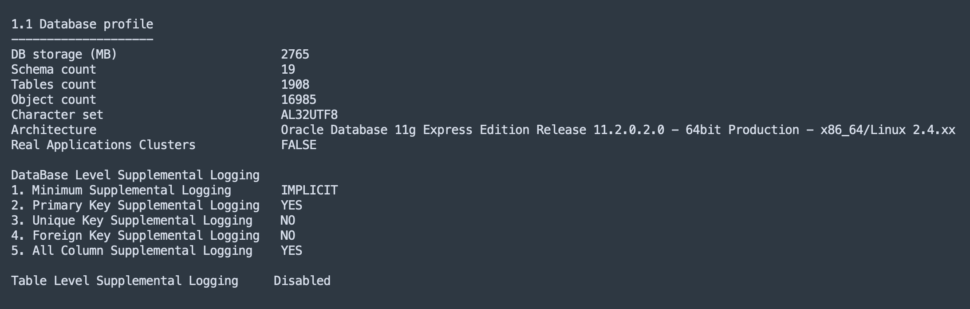
  1. After the above is run it should produce an output as below


  1. Open the above report with a text editor of your choice and the report would consist of below sections

  1. Instance Details
    1.1 Database profile

  2. Outlier Tables
    2.1 Tables With Complex Data Types
    2.2 Tables – Additional attention required for Change Data Capture
    2.3 Top 10 Tables By Index Size
    2.4 Partitioned Tables
    2.5 Virtual Column Tables

  3. Key Table Level Metrics
    3.1 Categories by keys
    3.2 Tables With No Primary Keys
    3.3 Tables with Foreign Key
    3.4 Tables with Column Count > 50
    3.5 Tables with Row Count > 100K
    3.6 Tables with size > 10 GB
    3.7 Tables with Max Row Length < 8000 bytes

  4. Integration Compatibility
    4.1 Incompatible tables
    4.2 Compatibility Scores

  1. Important considerations for Initial Load from the report

    a. DatabaseProfile

This section should be reviewed to ensure the below configuration matches with the target system

  • The charset/collation information should be reviewed with target to ensure data consistency

  • Storage space used by source would give an indication for expected storage on target system as well

b. Tables with complex types

All tables listed in this section should be analysed for row size.
Ex: Tables with LOB or large binary columns should be migrated with special memory and batch size property to avoid heap issues.

c. Table size reports
The sections covering table sizes in the report will come handy in the next step of our Initial Load journey to better optimise performance

d. Incompatible tables

This section of the reports any tables which cannot be moved to the target without transformation/custom handling. The description will help with the next action on thiese tables. but for this blog we will not go over this (you can reach striim support to help with these tables)

Step 2 : Table Distribution

The next step for our Initial Load is finding the right way to distribute your tables such that it minimises the time taken for the available hardware resources.

Luckily to help with this we have another tool, Data Distributor Tool.

  1. Download the data distributor tool,
    and run it from a machine which has access to the source db
  2. The tool provides option to specify the CPU resource available and how much should each CPu for the Striim instance be loaded. (note: it assumes 4GB memory per core)These parameter would help tune the performance of your Initial Load for your hardware.
  3. The tool will output the Total Initial Load size and the various buckets with the list of tables each.

  4. Each bucket also comes with a Parallelism Count (a.k.a Parallelism Factor) which will be helpful in further improving performance and reducing the time taken.

Step 3 : Initial Load Application Creation

Using the information now obtained from the assessment/compatibility reports & the data distribution from the previous step we are now ready to start with creating the application in Striim.

Go to the Striim UI and login. On the left hand pane click on Apps → Create An App

image-20250324-084506.png
On the create app screen, on the bottom, click on “Start from scratch”

image-20250324-084602.png
Give a name to your first IL app. and configure the source as DatabaseReader

Specify all the connection properties and in the Tables property.

image-20250324-084914.png
Important properties to configure

Tables: Copy the tables list for Bucket 1 from Data Distributor’s output and paste it.

Create Schema : Enable, If you want striim to create the target table before loading the data.

Fetch Size : if you do not have any LOB tables, then update to 10000

Quiesce On IL Completion : Enable this to allow app to automatically transition once IL completes.

ParallelThreads : Set this value to the Parallelism Count (a.k.a Parallelism Factor) for this bucket from the data distributor tool’s output from previous step.
Note: For 5.0.x releases only set this value if your target is a data warehouse (bigquery, snowflake, databricks) and not for databasewriter target.

image-20250324-090244.png
Next specify a new name for the output and save.

Add your Target: Add your target to the output Stream and configure & save it

Imp: Set the ParallelThreads for the target to the Parallelism Count (a.k.a Parallelism Factor) for this bucket from the data distributor tool’s output

Enable Application recovery
As of 5.x release Fast Snapshot applications now support Recovery. So ensure to enable recovery for the Initial Load (Snapshot) apps in the application settings.

image-20250324-090606.png
image-20250324-090624.png
Duplicate above app for all other buckets from the data tool.

Export the application tql.

Make a copy of the tql for each bucket for the previous step

Update the source databasereader tables property which the inidividual bucket’s tql

Also update the app name, source, target * stream name with _bucket<number>

Import all the tqls in Striim, so you now have 1 app per bucket.

image-20250324-091146.png
Step 4 : Initial Load Monitoring & Management
Now that we have all the initial load apps created as per our plan, we are good to start the actual data movement.

First deploy all the initial load applications, then begin to start the applications one-by-one.

Once all the apps are running your tables should start being replicated to the target.

Initial Load Monitoring: Starting 5.x, we have improved Initial load progress monitoring.

To monitor the initial load for a Initial load app, go to the app screen and click on the chart increasing chart icon on the top right hand side.

image-20250324-091408.png
This will show the new application progress screen with monitoring details for the IL progress at table level.

test.gif
The Top progress bar indicates the overall progress for the application.

The “Table Summary” section shows the individual tables, read and write counts along with progress bar.

Step 5 : Initial Load Restart Handling
With support for Fast Snapshot recovery added as part of 5.x, handling restarts for Initial load applications has been simplified with automatic handling for partially loaded tables.

DatabaseReader exposes property called RestartBehaviourOnILInteruption. The value supports the below 3 values which dictates the behaviour of the Initial load application on handling the partially loaded tables in the target in case of restarts.

Keep target table : In this option the IL application will not perform any automated action, and when tis value is set for the property the expectation is for users to manually identify and truncate/replace partially loaded target tables before restart.

Replace target table : This option makes the IL app automatically replace (drop & create) the target tables which were partially loaded before the restart. The application is able to automatically detect which tables are partially loaded and will perform the replace action automatically on restart and reloaded the tables with data.
This option is recommended for Initial load application where CreateSchema is enabled to ensure the latest schema is move to the target

Truncate target table: This option, is similar in all aspects to the previous one, except that when this option is selected the target tables are truncated instead of replace(drop/create) after restart.
This option is suitable when createSchema is not enabled on source.

Conclusion
In this blog, we went over the steps to perform Initial Load with Striim with proper planning and execution. The end goal is to ensure that our Initial load pipelines are error-free & highly performant. And also using the Fast Snapshot Recovery feature we are also able to handle any cases which requires restarting the pipeline.

Modernizing Healthcare Regulation: Inside the GMC’s Cloud Analytics Transformation with Striim and Azure

About the General Medical Council

The General Medical Council (GMC) is the independent regulator of doctors in the United Kingdom, responsible for protecting patient safety and upholding standards in medical practice. Established in 1858, the GMC maintains the official register of medical practitioners, ensures the quality of medical education and training, and investigates complaints about doctors’ conduct and performance. Its regulatory duties span the full medical career lifecycle—from medical school accreditation to post-graduate training oversight and fitness to practise tribunals—making it a cornerstone of the UK’s healthcare system.

With over 1,700 employees supporting more than 300,000 registered doctors, the GMC depends on timely, accurate, and secure data to fulfill its mission. Its work involves sensitive and complex data, including personal identifiers, legal casework, and educational records. As the organization modernizes its infrastructure, the move toward real-time, cloud-based analytics is essential for faster reporting, enhanced transparency, and future-ready capabilities like AI-driven insights. This transformation enables GMC to deliver more responsive regulation and support high-quality care across the UK.

Legacy Infrastructure Slows Progress Toward Cloud Analytics

GMC’s strategic goal was to migrate to a modern, cloud-based analytics stack built around Azure and Power BI. But there was one major obstacle: their primary data source, Siebel CRM, wasn’t ready to move to the cloud.

The organization faced several limitations:

  • Delayed access to up-to-date data, with ETLs running only once per day
  • High costs tied to legacy tools like Tableau and Oracle
  • Inefficient processes that made rerunning failed ETLs slow and resource-intensive
  • A growing need to enable self-service analytics across business teams using Power BI

Following a thorough review of how the right data was critical in the right architecture, it was shared: 

Why GMC Chose Striim for Real-Time Data Streaming

To solve this challenge, GMC needed a real-time integration layer that could stream on-prem data to Azure reliably. After evaluating several solutions—including Oracle GoldenGate and Qlik—they selected Striim for its:

  • Ease of use
  • Responsive support team
  • Built-in CDC and real-time sync

GMC’s team worked with Striim to deploy a streaming solution that connected their Siebel source data to the cloud—while simultaneously scaling up their Azure environment. The implementation helped the team build out its new architecture while laying the groundwork for broader real-time data access.

Early Wins: Cutting Costs, Saving Time, and Improving Agility

Even before completing their full migration, GMC saw significant operational benefits:

✅ Cost Savings
By retiring Tableau (an estimated £90,000/year) and planning the decommissioning of Oracle analytics and Informatica, GMC reduced analytics costs while positioning the organization for scalable growth.

✅ Faster Back-End Operations
Previously, if an ETL failed, re-running it meant uploading over 150 GB of data—a process that could take hours and disrupt business operations. With Striim’s live streaming in place, data is always current, and ETLs can be triggered on demand.

✅ Minimal Disruption
Because Striim runs in parallel with existing ETLs, GMC was able to phase in their new system gradually, minimizing risk during the transition.

✅ Strategic Flexibility
Striim enabled decoupling from legacy infrastructure, empowering GMC to scale up Power BI adoption and build out its modern cloud analytics stack with confidence.


Powering a Cloud-First, Real-Time Future for GMC

By connecting on-prem systems with Azure in real time, GMC is not only solving today’s data integration challenges but also laying the groundwork for tomorrow’s AI, analytics, and compliance initiatives. 

Looking ahead, GMC’s analytics roadmap includes:

  • Enabling near-real-time dashboards across key departments
  • Expanding Power BI adoption through Azure-based centralized reporting

Explore What’s Possible with Real-Time Data Streaming

GMC’s transformation highlights the power of real-time data integration in modernizing legacy systems and enabling a cloud-first future. Striim delivered the scalability, compliance, and speed needed to help GMC accelerate its journey while keeping costs in check and teams empowered.

Want to see what Striim can do for your organization?

Start Your Free Trial | Schedule a Demo

The Challenge of Merging Varied Real-Time Data Inputs

Today’s businesses generate and collect vast amounts of data from an ever-growing array of sources—transactional databases, customer relationship management (CRM) systems, website interactions, social media platforms, IoT devices, and more. 

However, integrating and harmonizing these disparate data streams in real time presents a formidable challenge. The complexity arises from differences in data formats, structures, latency requirements, and the need for seamless orchestration between multiple systems. Without a unified approach, businesses struggle to gain a holistic view of customer behaviors, leading to missed opportunities, disjointed experiences, and inefficiencies in decision-making.

The Core Value of Real-Time Data Integration

Real-time data streaming addresses these challenges head-on by serving as the backbone of real-time AI data pipelines. Its distributed, in-memory streaming architecture ingests, processes, and integrates unbounded and evolving data streams with unmatched efficiency and minimal latency. Striim seamlessly connects diverse data sources, applies transformation and enrichment in real time, and delivers unified, actionable insights across AI, BI, and operational platforms.

Specifically, Striim’s AI-ready architecture goes beyond traditional integration by enabling businesses to:

  • Unify Data Across Silos: Consolidate structured and unstructured data from cloud and on-premise sources into a single, real-time stream.
  • Enhance AI and BI Capabilities: Leverage real-time data to power AI-driven personalization, operational efficiencies, and intelligent automation.
  • Improve Customer Engagement: Deliver immediate insights that allow businesses to personalize experiences, optimize services, and build customer loyalty.

GenAI-Powered Customer Understanding

The integration of Generative AI (GenAI) into real-time data pipelines enables businesses to analyze and respond to customer behaviors dynamically. With GenAI, organizations can:

1. Real-Time Understanding of Customer Behaviors

By processing diverse data sources in real time, businesses gain immediate insights into customer preferences, intent, and engagement. This enables:

  • Instant recognition of trends and behavioral shifts.
  • Proactive decision-making to tailor services and offerings.
  • More accurate demand forecasting and inventory management.

2. Personalized Interactions at Scale

GenAI allows businesses to craft highly customized experiences by dynamically analyzing individual customer data. With real-time AI-driven insights, organizations can:

  • Tailor product recommendations based on live browsing behavior.
  • Customize marketing messages in response to recent interactions.
  • Enhance customer support with AI-driven responses based on historical interactions.

3. Agility and Adaptation

Consumer expectations shift rapidly, and static models quickly become obsolete. Striim enables businesses to adapt their AI models dynamically by:

  • Supporting real-time model retraining with fresh data inputs.
  • Enabling A/B testing of different AI-driven recommendations.
  • Ensuring AI models evolve in sync with market and behavioral changes.

4. Seamless AI-Driven Engagement

Businesses leveraging real-time data with GenAI achieve higher engagement levels by:

  • Delivering context-aware notifications and recommendations.
  • Optimizing call center interactions with real-time AI-assisted support.
  • Personalizing in-app and web experiences based on user activity.

The Technical Edge: How Striim Delivers Real-Time AI Insights

Striim’s platform is designed with advanced capabilities that bridge real-time data integration and AI-driven analytics. Key technical differentiators include:

1. Real-Time Data Processing at Scale

Striim ingests data from various sources—transactional systems, IoT devices, clickstreams, CRM platforms—leveraging low-latency messaging frameworks like Apache Kafka and MQTT. The distributed in-memory architecture ensures high throughput and efficient handling of real-time workloads.

2. Integrated GenAI Algorithms

Striim natively supports GenAI models, enabling real-time execution of:

  • Machine Learning Algorithms (Supervised, Unsupervised, Reinforcement Learning).
  • Natural Language Processing (NLP) for sentiment analysis and conversational AI.
  • Predictive Analytics for anomaly detection and fraud prevention.
  • Vector Embeddings to enable AI-powered hybrid search and Retrieval-Augmented Generation (RAG).

3. Agility in Model Deployment and Adaptation

With built-in support for:

  • Model versioning and dynamic retraining to keep AI models up to date.
  • A/B testing for comparing AI-driven strategies in real time.
  • Automated anomaly detection to proactively prevent disruptions.

4. Optimized Insights Delivery and Scaling

Striim ensures AI-powered insights reach the right touchpoints at the right time:

  • APIs and message queues for seamless integration with customer-facing applications.
  • Multi-cloud scaling to manage surging data volumes with optimal performance.
  • GPU-accelerated computing to support real-time AI workloads at enterprise scale.

The Business Impact: Why Striim is Essential for AI-Driven Customer Engagement

Organizations that harness real-time data and GenAI with Striim unlock transformative outcomes:

  • Higher Customer Satisfaction: Personalized, context-aware experiences lead to deeper engagement and brand loyalty. 
  • Operational Efficiency: Automated real-time decision-making streamlines workflows and reduces costs. 
  • Revenue Growth: AI-driven insights drive upsell, cross-sell, and retention strategies with precision.
  • Future-Proofed AI Pipelines: Scalable, adaptable AI models ensure businesses remain competitive in an evolving digital landscape.

Unify, Analyze, and Act in Real Time

The future of customer engagement is real-time, AI-powered, and insight-driven. Businesses can no longer afford to operate on fragmented, delayed data streams. Striim unifies diverse data sources, integrates AI seamlessly, and delivers real-time intelligence that transforms customer interactions.

By merging operational and behavioral data streams with AI-enhanced analytics, Striim empowers enterprises to stay ahead of the curve—ensuring every customer experience is timely, relevant, and impactful.

Striim is the backbone of modern AI-driven enterprises, providing the real-time data infrastructure needed to drive intelligent automation, adaptive customer engagement, and sustained business growth.

Start Your Free Trial | Schedule a Demo

The Challenge of Data Quality and Availability—And Why It’s Holding Back AI and Analytics

AI and analytics have the potential to transform decision-making, streamline operations, and drive innovation. But they’re only as good as the data they rely on. If the underlying data is incomplete, inconsistent, or delayed, even the most advanced AI models and business intelligence systems will produce unreliable insights.

Many organizations struggle with:

  • Inconsistent data formats: Different systems store data in varied structures, requiring extensive preprocessing before analysis.
  • Data silos: Critical business data is often locked away in disconnected databases, preventing a unified view.
  • Incomplete records: Missing values or partial datasets lead to inaccurate AI predictions and poor business decisions.
  • Delayed data ingestion: Batch processing delays insights, making real-time decision-making impossible.

These issues don’t just affect technical teams—they impact every aspect of the business, from customer experience to operational efficiency. Without high-quality, available data, companies risk misinformed decisions, compliance violations, and missed opportunities.

Why AI and Analytics Require Real-Time, High-Quality Data

To extract meaningful value from AI and analytics, organizations need data that is continuously updated, accurate, and accessible. Here’s why:

  • AI Models Require Clean Data: Machine learning models are only as good as their training data. If they rely on outdated or inconsistent data, predictions will be inaccurate. Ensuring data quality means fewer biases and better outcomes.
  • Business Intelligence Needs Fresh Insights: Data-driven organizations make strategic decisions based on dashboards, reports, and real-time analytics. If data is delayed, outdated, or missing key details, leaders may act on the wrong assumptions.
  • Regulatory Compliance Demands Data Governance: Data privacy laws such as GDPR and CCPA require organizations to track, secure, and audit sensitive information. Poor data management can lead to compliance risks, legal issues, and reputational damage.
  • Operational Efficiency Relies on Automation: AI-powered automation depends on high-quality, real-time data to optimize workflows. If data is incomplete or arrives too late, automation tools can’t function effectively.
  • Real-Time Decision-Making Requires Instant Insights: Businesses in industries like finance, retail, and logistics need up-to-the-minute data to adjust pricing, manage inventory, or detect fraud. Delays of even minutes can lead to lost revenue, such as in the airline industry.

Eliminating Data Silos with Unified Integration

How Organizations Can Overcome Data Quality and Availability Challenges

Many businesses are shifting toward real-time data pipelines to ensure their AI and analytics strategies are built on reliable information. Here’s how they are tackling these issues:

1. Eliminating Data Silos with Unified Integration

Rather than storing data in isolated systems, organizations are adopting real-time data integration strategies to unify structured and unstructured data across databases, applications, and cloud environments.

2. Ensuring Continuous Data Quality Management

Modern data architectures incorporate automated validation, cleansing, and enrichment techniques to detect missing values, inconsistencies, and errors before they reach AI and analytics platforms.

3. Adopting Low-Latency Processing for Instant Insights

To avoid delays, businesses are implementing streaming data platforms that allow information to be processed as soon as it is generated, rather than relying on batch updates.

4. Strengthening Governance for Compliance and Security

With growing regulations around data privacy, organizations must enforce real-time lineage tracking, access controls, and encryption to ensure sensitive data remains secure.

5. Enabling AI & ML with Adaptive Data Pipelines

AI models require ongoing updates to stay relevant. Leading companies are using continuous learning techniques to keep AI applications accurate by feeding them real-time, high-quality data.

How Striim Enables High-Quality, AI-Ready Data

Striim helps organizations solve these challenges by ensuring real-time, clean, and continuously available data for AI and analytics. With low-latency streaming, automated data validation, and AI-powered transformations, Striim enables businesses to:

  • Unify data from multiple sources in real time—eliminating silos and ensuring consistency.
  • Process and clean data as it moves—so AI and analytics work with trusted, high-quality inputs.
  • Ensure governance and security—detecting and protecting sensitive data automatically.
  • Deliver instant insights—enabling organizations to act in the moment instead of waiting for stale reports.

By solving the data quality and availability problem, Striim helps businesses unlock AI’s full potential—ensuring that decisions are driven by accurate, real-time intelligence.

Building a Future-Proof Data Strategy

The success of AI and analytics depends on how well businesses manage data quality and availability. Companies that fail to address these challenges risk acting on faulty insights, missing market trends, and losing their competitive edge.

By investing in real-time, high-quality data pipelines, organizations can ensure that AI and analytics initiatives deliver accurate, timely, and actionable intelligence.

Start Your Free Trial | Schedule a Demo


Unlocking Real-Time Decision-Making with High-Velocity Data Analytics

As data volumes surge and the need for fast, data-driven decisions intensifies, traditional data processing methods no longer suffice. This growing demand for real-time analytics, scalable infrastructures, and optimized algorithms is driven by the need to handle large volumes of high-velocity data without compromising performance or accuracy. To stay competitive, organizations must embrace technologies that enable them to process data in real time, empowering them to make intelligent, on-the-fly decisions.

With industries facing an increasing pace of change, businesses require the capability to quickly extract valuable insights from dynamic data streams. Real-time AI and machine learning (ML) models play a crucial role in ensuring both speed and precision, enabling businesses to navigate and respond to ever-changing conditions efficiently. These technologies must not only scale but also adapt to the complexity of high-velocity data.

Optimizing Operations Through High-Throughput Data Processing

Real-time analytics offer organizations the ability to enhance operational efficiency by making faster, more informed decisions. Below are key advantages of leveraging high-throughput data processing:

Real-Time Actionable Insights: By applying trained AI models to incoming data streams in real time, businesses can extract actionable insights immediately. This ensures that critical decisions—such as identifying new business opportunities or mitigating risks—are made quickly, reducing delays and increasing agility. Striim plays a key role in enabling businesses to extract these insights by seamlessly processing and integrating data in real time from various sources.

Improved Efficiency and Scalability: Real-time data processing platforms like Striim allow businesses to manage vast datasets without sacrificing performance. By using advanced algorithms and parallel processing techniques, Striim helps organizations scale their operations to accommodate increasing data volumes while maintaining low-latency performance. This scalability ensures that businesses can handle large, complex datasets efficiently, even as they grow.

Cost Savings Through Automation: High-throughput data processing allows organizations to automate decision-making tasks that would otherwise require manual intervention. This reduces reliance on human resources, minimizes errors, and lowers operational costs, enabling businesses to allocate resources more effectively. Striim’s platform supports this automation, ensuring that businesses can optimize their operations and reduce the need for manual data handling.

Enhanced Accuracy: Real-time processing utilizes sophisticated algorithms. These models improve the accuracy of insights derived from data streams, supporting more reliable, up-to-date decision-making and minimizing risks associated with outdated or incomplete data. With Striim’s advanced data integration capabilities, businesses can ensure that their decision-making is based on the most accurate and timely data available.

Seamless Integration for Instant Insight: To maximize the benefits of real-time analytics, organizations need platforms that can seamlessly integrate AI models into their data pipelines. Striim provides the architecture to apply trained models to incoming data as it flows through the system. By deploying lightweight inference agents within the streaming pipeline, Striim delivers real-time insights without delays, ensuring businesses can act on them instantly.

Flexibility Across Use Cases: Real-time data analytics can be applied across a variety of use cases, from predictive maintenance to anomaly detection, and customer behavior analysis. Whether businesses are looking to monitor equipment performance, detect fraud, or gain insights into customer trends, Striim’s platform provides the flexibility to implement AI models quickly and effectively, delivering insights tailored to specific business needs.

Key Benefits of Real-Time AI Inference with Striim

  • Cost Efficiency: Automating high-throughput inference tasks reduces manual processes, saving time and resources while minimizing errors.
  • Real-Time Actionability: Striim empowers businesses to make faster decisions by processing incoming data in real time, ensuring that opportunities are seized and risks are mitigated promptly.
  • Scalability: Striim’s platform can seamlessly handle large-scale data applications, enabling businesses to scale their operations without sacrificing speed or accuracy.
  • Accuracy: With continuous optimization of ML algorithms and integration of real-time data, Striim ensures that businesses can make decisions based on accurate, up-to-date insights.

The Future of High-Velocity Data: Agility and Intelligence at Scale

As industries continue to generate enormous volumes of data, the ability to process and manage this data at high speeds will be critical to success. Organizations that can leverage real-time analytics to extract insights from fast-moving data streams will be better equipped to make informed decisions in today’s dynamic landscape. Striim’s platform plays an integral role in enabling businesses to achieve this by delivering real-time data processing, scalable architectures, and seamless integration of advanced analytics models.

The future of high-velocity data demands agility, scalability, and precision—qualities that Striim delivers, helping businesses turn real-time insights into actionable outcomes with minimal delay.

Start Your Free Trial | Schedule a Demo

Managing Hallucinations in Real-Time AI: Leveraging Advanced Data Integration and Continuous Learning

Artificial intelligence (AI) and machine learning (ML) are transforming the way the world works by enabling smarter, faster, and more automated decision-making. However, one of the challenges that have emerged as AI systems evolve is the issue of AI/ML hallucinations—outputs generated by models that are plausible but incorrect, which can undermine the reliability of AI systems. 

Addressing these hallucinations head-on is essential for ensuring that AI systems continue to provide accurate and actionable insights, especially in environments where real-time decisions are imperative to success. 

As the volume of data continues to grow at an exponential rate, the need for scalable AI and ML solutions becomes even more significant. Real-time AI solutions are no longer a luxury but a necessity for businesses looking to stay ahead in a data-driven world. To combat hallucinations and ensure accurate decision-making, businesses will need to develop robust systems that include rigorous validation, enhanced interpretability, and continuous monitoring. These advancements ensure that the AI systems powering business operations remain reliable, trustworthy, and capable of making data-driven decisions in dynamic conditions.

The Benefits of Real-Time AI for Business

First, let’s dive into the benefits associated with your business leveraging real-time AI. 

Cost Reduction

By automating processes and improving resource allocation, companies can significantly reduce operational costs and enhance efficiency. Real-time insights allow businesses to quickly identify inefficiencies and take corrective actions, driving cost savings across the organization.

Improved Operational Efficiency

Striim’s real-time ML analytics streamline operations, enabling businesses to identify bottlenecks and optimize workflows. By acting on these insights promptly, businesses can enhance productivity and reduce delays, improving their overall operational efficiency. 

Gain a Competitive Advantage

Real-time AI enables businesses to stay ahead of the competition by providing the agility to capitalize on emerging opportunities and respond to market changes faster than competitors. By leveraging real-time insights, businesses can improve customer experiences, adjust pricing strategies, and optimize their supply chains on the fly. However, if your business isn’t able to manage hallucinations, it won’t gain a competitive advantage, but a setback. 

Business Agility in a Rapidly Evolving Marketplace 

With the help of real-time AI, your organization is able to react quickly to changing market conditions with up-to-the-moment insights from streaming data sources. Whether it’s personalizing customer experiences, adjusting pricing strategies, or optimizing operations, the ability to make decisions based on real-time insights provides businesses with a critical competitive advantage in today’s fast-paced digital economy.

How Striim Helps Manage Hallucinations and Boost Real-Time Decision-Making

Of course, these benefits are only feasible if your organization manages hallucinations successfully. 

The good news is that you don’t have to do it alone. Here’s how Striim empowers your business to manage hallucationas and gain confidence in real time AI

Real-time Anomaly Detection and Automated Predictions

Striim powers AI analytics over inflight data, enabling precise anomaly detection and automated predictions. This ability allows businesses to detect and act on anomalies as they occur, helping to prevent costly disruptions. By integrating these insights into the decision-making process, businesses can mitigate the risks of hallucinations and other data inconsistencies, ensuring reliable AI outputs.

Continuous Learning Algorithms for Dynamic Model Evolution

Continuous learning algorithms ensure that AI models evolve dynamically in response to changing data patterns. As new data streams in, these algorithms update model parameters in real time, ensuring that AI predictions stay relevant and accurate. With this adaptive approach, Striim helps maintain the accuracy and effectiveness of AI systems, reducing the likelihood of hallucinations while enhancing decision-making.

Low-Latency Processing for Real-Time Insights

Striim’s processing engine is optimized for low-latency data processing, using techniques like in-memory computing, parallelization, and pipeline execution to maximize throughput and minimize delays. By providing near-instant access to insights, Striim enables businesses to make timely, data-driven decisions that account for the most current data—reducing the risk of acting on outdated or inaccurate information.

The Path Forward: Real-Time AI and Continuous Learning

As AI systems continue to grow and evolve, the importance of managing hallucinations and maintaining the accuracy of models in real time environments will only increase. Striim’s advanced real-time data integration, low-latency processing, and continuous learning algorithms provide businesses with the tools they need to navigate this challenge. By ensuring that AI models remain adaptable and accurate in the face of evolving data, Striim is helping businesses not only mitigate the risks of AI hallucinations but also unlock the true potential of real-time AI decision-making.

By integrating these advanced technologies, organizations can make smarter, faster decisions that propel them forward, improving their bottom line while minimizing the risks associated with AI-based systems. Real-time data analytics, powered by Striim, is the key to navigating the future of AI in business and driving sustainable success.

Start Your Free Trial | Schedule a Demo

Back to top