8 Top Qlik Replicate Alternatives for CDC and Data Replication

In many modern enterprises, data infrastructure is a patchwork from different eras. You might have core mainframes running alongside heavy SAP workloads, while a fleet of cloud-native applications handles your customer-facing services. To keep these systems in sync, Change Data Capture (CDC) has likely become a central part of your strategy.

For many, Qlik Replicate (formerly Attunity) has been a reliable anchor for this work. It handles heterogeneous environments well and provides a steady foundation for moving data across the business. But as data volumes grow and the demand for real-time AI and sub-second analytics increases, even the most robust legacy solutions can start to feel restrictive.

Whether you’re looking to optimize licensing costs, find more accessible documentation, or move toward a more cloud-native architecture, you aren’t alone. Many organizations are now exploring Qlik Replicate alternatives that offer greater flexibility and more modern streaming capabilities.

In this guide, we’ll deep-dive into the top data replication platforms to help you choose the right fit for your enterprise architecture. We’ll look at:

Before we break down each platform, let’s align on what modern data replication actually looks like today.

What Are Data Replication Platforms?

Data replication refers to the process of keeping multiple data systems in sync. However, in an enterprise context, it’s much more than just copying files. Modern data replication platforms are sophisticated systems that capture, move, and synchronize data across your entire stack, often in real time. Think of it as the central nervous system of your data architecture. These platforms manage high-throughput pipelines that connect diverse sources: from legacy on-premise databases to modern cloud environments like AWS, Azure, and Google Cloud. Unlike traditional batch processing, which might only update your systems every few hours, modern replication platforms use log-based Change Data Capture (CDC). This allows them to track and move only the specific data that has changed, reducing system load and ensuring that your analytics, machine learning workflows, and customer-facing apps are always working with the freshest data available.

The Strategic Benefits of Real-Time Replication

Moving data continuously is a strategic choice that can fundamentally change how your business operates. When you shift from “stale” batch data to real-time streams, you unlock several key advantages:

  • Accelerated Decision-Making: When your data latency is measured in milliseconds rather than hours, your team can spot emerging trends and respond to operational issues as they happen.
  • Operational Excellence Through Automation: Manual batch workflows are prone to failure and require constant oversight. Modern platforms automate the data movement process, including schema evolution and data quality monitoring, freeing up your engineering team for higher-value work.
  • A Foundation for Real-Time AI: Generative AI and predictive models are only as good as the data feeding them. Real-time replication ensures your AI applications are informed by the most current state of your business, not yesterday’s reports.
  • Total Cost of Ownership (TCO) Optimization: Scaling traditional batch systems often requires massive, expensive compute resources. Modern, cloud-native replication platforms are built to scale elastically with your data volumes, often resulting in a much lower TCO.

Now that we’ve defined the landscape, let’s look at the leading solutions on the market, starting with the original platform we’re comparing against.

Qlik Replicate: The Incumbent

Qlik Replicate is a well-established name in the data integration space. Known for its ability to handle “big iron” sources like mainframes and complex SAP environments, it has long been a go-to solution for organizations needing to ingest data into data warehouses and lakes with minimal manual coding.

Key Capabilities

  • Log-Based CDC: Qlik Replicate specializes in non-invasive change data capture, tracking updates in the source logs to avoid putting unnecessary pressure on production databases.
  • Broad Connectivity: It supports a wide range of sources, including RDBMS (Oracle, SQL Server, MySQL), legacy mainframes, and modern targets like Snowflake, Azure Synapse, and Databricks.
  • No-Code Interface: The platform features a drag-and-drop UI that automates the generation of target schemas, which can significantly speed up the initial deployment of data pipelines.

Who is it for?

Qlik Replicate is typically a fit for large organizations that deal with highly heterogeneous environments. It performs well in scenarios involving complex SAP data integration, large-scale cloud migrations, or hybrid architectures where data needs to flow seamlessly between on-premise systems and the cloud.

The Trade-offs

While powerful, Qlik Replicate isn’t without its challenges.

  • Cost: It is positioned as a premium enterprise solution. Licensing costs can be substantial, especially as your data volume and source count increase.
  • Complexity: Despite the no-code interface, the initial configuration and performance tuning often require deep technical expertise.
  • Documentation Gaps: Users frequently report that the documentation can be shallow, making it difficult to troubleshoot advanced edge cases without engaging expensive professional services.

For a more detailed breakdown, you can see how Striim compares directly with Qlik Replicate. For many organizations, these friction points—combined with a growing need for sub-second streaming rather than just replication—are what drive the search for an alternative.

Top 8 Alternatives to Qlik Replicate

The following platforms offer different approaches to data replication, ranging from developer-focused open-source solutions to fully managed, real-time streaming platforms.

1. Striim: Real-Time Data Integration and Intelligence

Striim is the world’s leading Unified Integration and Intelligence Platform. Unlike many replication tools that focus solely on moving data from point A to point B, Striim is architected for the era of real-time AI. It allows enterprises to not only replicate data but also process, enrich, and analyze it while it’s still in motion.

Key Capabilities

  • Sub-Second Log-Based CDC: Striim captures changes from production databases (Oracle, SQL Server, PostgreSQL, MySQL, etc.) as they happen, ensuring your downstream systems are updated within milliseconds.
  • In-Flight Processing and Transformation: With a built-in SQL-based engine, you can filter, aggregate, and enrich data streams before they reach their destination. This is critical for data quality and for preparing data for AI models.
  • Unified Intelligence: Striim doesn’t just move data; it helps you understand it. Features like Striim Copilot bring natural language interaction to your infrastructure, making it easier for practitioners to build and manage complex pipelines.
  • Cloud-Native and Hybrid Deployment: Whether you’re running on-premise, in a private cloud, or across multiple public clouds (AWS, Google Cloud, Azure), Striim provides a consistent, high-performance experience.

Best For

Striim is the ideal choice for enterprises that cannot afford “stale” data. If you are building event-driven architectures, real-time fraud detection systems, or AI-powered customer experiences that require the most current information, Striim is designed for your needs. It’s particularly effective for companies moving away from the “data mess” of legacy batch processing toward a more agile, real-time strategy.

Pros

  • Unmatched Latency: Designed from the ground up for sub-second performance.
  • Intelligently Simple: Provides a powerful yet manageable interface that demystifies complex data flows.
  • Radically Unified: Breaks down data silos by connecting legacy systems directly to modern analytics and AI platforms.
  • Enterprise-Grade Support: A responsive, knowledgeable team that understands the pressures of mission-critical workloads.

Considerations

  • Learning Advanced Features: While the basic setup is intuitive, mastering complex in-flight SQL transformations and real-time analytics requires a dedicated effort from your data engineering team.
  • Enterprise Focus: As a high-performance solution, Striim is primarily built for enterprise-scale workloads rather than small-scale, simple migrations.

2. Fivetran HVR: High-Volume Enterprise Replication

Fivetran HVR (High Volume Replication) is a heavy-duty replication solution that Fivetran acquired to address complex, enterprise-level data movement. It is often seen as a direct alternative to Qlik Replicate due to its focus on log-based CDC and its ability to handle massive data volumes across heterogeneous environments.

Key Capabilities

  • Distributed Architecture: HVR uses a unique “hub and spoke” architecture that places light-weight agents close to the data source, optimizing performance and security for hybrid cloud environments.
  • Broad Database Support: It handles most major enterprise databases (Oracle, SAP, SQL Server) and specializes in high-speed ingestion into modern cloud data warehouses like Snowflake and BigQuery.
  • Built-in Validation: The platform includes a robust “Compare” feature that continuously verifies that the source and target remain in perfect sync.

Pros

  • Proven Performance: Replicates large datasets with high throughput and low latency.
  • Security-Focused: Highly certified (SOC 2, GDPR, HIPAA) with encrypted, secure data transfers.
  • Simplified Management: Since the Fivetran acquisition, HVR has benefited from a more modern, centralized dashboard for monitoring.

Cons

  • Cost at Scale: Usage-based pricing (Monthly Active Rows) can become difficult to predict and expensive as data volumes surge.
  • Complex Setup: Despite the newer dashboard, configuring the underlying distributed agents still requires significant technical expertise compared to SaaS-only tools.

3. Oracle GoldenGate: The Technical Powerhouse

Oracle GoldenGate is one of the most established names in the industry. It is a comprehensive suite designed for mission-critical, high-availability environments. If you are already deeply embedded in the Oracle ecosystem, GoldenGate is often the default choice for real-time data movement.

Key Capabilities

  • Multi-Directional Replication: Supports unidirectional, bidirectional, and even peer-to-peer replication, making it a favorite for disaster recovery and active-active database configurations.
  • OCI Integration: The platform is increasingly moving toward a fully managed, cloud-native experience through Oracle Cloud Infrastructure (OCI).
  • Deep Oracle Optimization: Provides the most robust support for Oracle databases, including support for complex data types and specialized features.

Pros

  • Unrivaled Reliability: Known for stability in the most demanding production environments.
  • Extensive Flexibility: Can be configured to handle almost any replication topology imaginable.
  • Rich Feature Set: Includes advanced tools for data verification and conflict resolution in multi-master setups.

Cons

  • Prohibitive Cost: The licensing model is notoriously complex and expensive, often requiring a substantial upfront investment.
  • Steep Learning Curve: Maintaining GoldenGate usually requires specialized, certified experts; it is not a “set it and forget it” solution.
  • Resource Intensive: The platform can be heavy on system resources, requiring careful performance tuning to avoid impacting source databases.

4. AWS Database Migration Service (DMS)

For organizations already operating within the Amazon ecosystem, AWS DMS is a highly accessible entry point for database replication. While it was originally conceived as a one-time migration tool, it has evolved into a persistent replication service for many cloud-native teams.

Key Capabilities

  • Zero Downtime Migration: AWS DMS keeps your source database operational during the migration process, using CDC to replicate ongoing changes until the final cutover.
  • Homogeneous and Heterogeneous Support: It works well for migrating like-for-like databases (e.g., MySQL to Aurora) or converting between different engines (e.g., Oracle to PostgreSQL) using the AWS Schema Conversion Tool (SCT).
  • Serverless Scaling: The serverless option automatically provisions and scales resources based on demand, which is excellent for handling variable migration workloads.

Pros

  • AWS Integration: Deeply integrated with the rest of the AWS console, making it easy for existing AWS users to spin up.
  • Cost-Effective for Migration: Pricing is straightforward and generally lower than premium enterprise solutions for one-off projects.
  • Managed Service: Reduces the operational overhead of managing your own replication infrastructure.

Cons

  • Latency for Persistent Sync: While it handles migrations well, it may struggle with sub-second latency for complex, ongoing replication at enterprise scale.
  • Limited Transformation: Transformation capabilities are basic compared to specialized streaming platforms; you often need to perform heavy lifting downstream.

5. Informatica PowerCenter: The Enterprise Veteran

Informatica PowerCenter is a legacy powerhouse in the ETL world. It is a comprehensive platform that focuses on high-volume batch processing and complex data transformations, making it a staple in the data warehouses of Global 2000 companies.

Key Capabilities

  • Robust Transformation Engine: PowerCenter is unmatched when it comes to complex, multi-step ETL logic and data cleansing at scale.
  • Metadata Management: It features a centralized repository for metadata, providing excellent lineage and governance—critical for highly regulated industries.
  • PowerExchange for CDC: Through its PowerExchange modules, Informatica can handle log-based CDC from mainframes and relational databases.

Pros

  • Highly Mature: Decades of development have made this one of the most stable and feature-rich ETL solutions available.
  • Enterprise Connectivity: There is almost no source or target that Informatica cannot connect to, including deep legacy systems.
  • Scalability: Built to handle the massive data volumes of the world’s largest enterprises.

Cons

  • Heavyweight Architecture: It often requires significant on-premise infrastructure and specialized consultants to maintain.
  • Not Real-Time Native: While it has CDC capabilities, PowerCenter is fundamentally built for batch. Moving toward sub-second streaming often requires a shift to Informatica’s newer cloud-native offerings (IDMC).
  • Steep Cost of Ownership: Between licensing, maintenance, and specialized labor, it remains one of the most expensive options on the market.

6. Talend Data Fabric: Unified Data Governance

Talend Data Fabric is a comprehensive platform that combines data integration, quality, and governance into a single environment. Recently acquired by Qlik, Talend offers a more holistic approach to data management that appeals to organizations needing to balance integration with strict compliance.

Key Capabilities

  • Unified Trust Score: Automatically scans and profiles datasets to assign a “Trust Score,” helping users understand the quality and reliability of their data at a glance.
  • Extensive Connector Library: Offers hundreds of pre-built connectors for cloud platforms, SaaS apps, and legacy databases.
  • Self-Service Preparation: Includes tools that empower business users to clean and prepare data without constant engineering support.

Pros

  • Strong Governance: Excellent tools for data lineage, metadata management, and compliance (PII identification).
  • Flexible Deployment: Supports on-premise, cloud, and hybrid environments with a focus on Apache Spark for high-volume processing.
  • User-Friendly for Non-Engineers: No-code options make it more accessible to analysts and business units.

Cons

  • Complexity for Simple Tasks: The platform can feel “over-engineered” for teams that only need basic replication.
  • Pricing Opacity: Like Qlik, Talend’s pricing is quote-based and can become complex across its various tiers and metrics.

If you’re looking for a wider overview of this specific space, we’ve put together a guide to the top 9 data governance tools for 2025.

7. Hevo Data: No-Code Simplicity for Mid-Market

Hevo Data is a relatively newer entrant that focuses on extreme ease of use. It is a fully managed, no-code platform designed for teams that want to set up data pipelines in minutes rather than weeks.

Key Capabilities

  • Automated Schema Mapping: Automatically detects source changes and adapts the target schema in real time, reducing pipeline maintenance.
  • Real-Time CDC: Uses log-based capture to provide near real-time synchronization with minimal impact on the source.
  • 150+ Pre-built Connectors: Strong focus on popular SaaS applications and cloud data warehouses.

Pros

  • Fast Time-to-Value: Extremely simple UI allows for very quick setup without engineering heavy lifting.
  • Responsive Support: Highly rated for its customer service and clear documentation.
  • Transparent Pricing: Offers a free tier and predictable, volume-based plans for growing teams.

Cons

  • Limited for Complex Logic: While it has built-in transformations, it may feel restrictive for advanced engineering teams needing deep, custom SQL logic.
  • Mid-Market Focus: While capable, it may lack some of the deep “big iron” connectivity (like specialized mainframe support) required by legacy enterprises.

8. Airbyte: The Open-Source Disruptor

Airbyte is an open-source data integration engine that has rapidly gained popularity for its massive connector library and developer-friendly approach. It offers a unique alternative for organizations that want to avoid vendor lock-in.

Key Capabilities

  • 600+ Connectors: The largest connector library in the industry, driven by an active open-source community.
  • Connector Development Kit (CDK): Allows technical teams to build and maintain custom connectors using any programming language (Python is a favorite).
  • Flexible Deployment: Can be self-hosted for free (Open Source), managed in the cloud (Airbyte Cloud), or deployed as an enterprise-grade solution.

Pros

  • Developer Choice: Excellent for teams that prefer configuration-as-code and want full control over their infrastructure.
  • Avoids Lock-in: The open-source core ensures you aren’t tied to a single vendor’s proprietary technology.
  • Active Community: Rapidly evolving with constant updates and new features being added by contributors.

Cons

  • Management Overhead: Self-hosting requires engineering resources for maintenance, monitoring, and scaling.
  • Variable Connector Stability: Because many connectors are community-contributed, stability can vary between “certified” and “alpha/beta” connectors.

Choosing the Right Qlik Replicate Alternative

Selecting the right platform depends entirely on your specific architectural needs and where your organization is on its data journey.

  • If sub-second latency and real-time AI are your priority: Striim is the clear choice. Its ability to process and enrich data in-flight makes it the most powerful option for modern, event-driven enterprises. For more on this, check out our guide on key considerations for selecting a real-time analytics platform.
  • If you need deep Oracle integration and multi-master replication: Oracle GoldenGate remains the technical standard, provided you have the budget and expertise to manage it.
  • If you want a balance of enterprise power and ease of use: Fivetran HVR is a strong contender, particularly for high-volume ingestion into cloud warehouses.
  • If you are a developer-centric team avoiding vendor lock-in: Airbyte offers the flexibility and community-driven scale you need.
  • If you need simple, no-code pipelines for SaaS data: Hevo Data provides the fastest path to value for mid-market teams.

Frequently Asked Questions (FAQs)

1. How long does it take to migrate from Qlik Replicate to an alternative?

Migration timelines depend on the number of pipelines and the complexity of your transformations. A targeted migration of 5-10 sources can often be completed in 2-4 weeks. Large-scale enterprise migrations involving hundreds of pipelines typically take 3-6 months.

2. Can these alternatives handle the same volume as Qlik Replicate?

Yes. Platforms like Striim, Fivetran HVR, and GoldenGate are specifically engineered for mission-critical, high-volume enterprise workloads, often processing millions of events per second with high reliability.

3. Do I need to redo all my configurations manually?

Most platforms do not have a “one-click” import for Qlik configurations. However, many modern alternatives offer configuration-as-code or automated schema mapping, which can make the recreation process much faster than the original manual setup in Qlik’s GUI.

4. Which alternative is best for real-time AI?

Striim is uniquely architected for real-time AI. Unlike tools that only move data, Striim allows you to filter, transform, and enrich data in motion, ensuring your AI models are fed with clean, high-context, sub-second data.

5. Are there free alternatives available?

Airbyte offers a robust open-source version that is free to self-host. Striim also offers a free Developer tier for prototypes and small-scale experimentation, as does Hevo with its basic free plan.

Beyond Migration: How Microsoft and Striim Are Modernizing the Future of Databases Together

https://www.youtube.com/watch?v=m9-Tr_Rf7FA

Modernizing databases in practice involves more than just moving data—it requires rethinking how systems, developers, and AI interact. In this episode, Shireesh Thota, Corporate Vice President of Azure Databases at Microsoft, joins Alok Pareek, co-founder and Executive Vice President of Product Development at Striim, to discuss the evolution of operational databases, the rise of real-time data movement, and what it really takes to modernize at scale.

Together, they discuss how Microsoft’s Unlimited Database Migration Program, powered by Striim, enables organizations to migrate heterogeneous sources—from SQL Server and Oracle to Postgres and beyond—into Azure with speed and precision, creating a modern data foundation ready for the next generation of intelligent applications.

Streaming Analytics: What It Is and How It Works

Is your business running in “real-time”? Many think they do, but if you look under the hood, you might find that your “live” data is already a few minutes or even hours old.

In fact, many teams are still wrestling with batch processes or have plastered a “speed layer” onto an old system. You’re likely collecting massive amounts of data from logs, sensors, and customer interactions, but unless you’re delivering data in real time, you can’t act on it fast enough to make a difference.

Streaming analytics brings data into the “now.” It’s a fundamental shift that helps you move from just reporting on what happened yesterday to responding to what’s happening in the moment. In a world driven by intelligent systems and real-time customer expectations, “good enough” real-time just doesn’t cut it anymore. Done right, streaming analytics becomes a strategic enabler that can give your organization a competitive advantage.

This guide breaks down what streaming analytics is, why it matters, and how it impacts your business. We’ll cover the common challenges, the key features to look for in a platform, and how solutions like Striim make it all possible.

Streaming Analytics vs. Data Analytics

Streaming analytics and data analytics are both powerful tools for extracting insights from data, but they differ in how they process and analyze information.

Streaming analytics refers to the real-time processing and analysis of data as it is generated. It focuses on analyzing continuous streams of data from sources like IoT devices, social media feeds, sensors, or transaction logs. The goal is to derive actionable insights or trigger immediate actions while the data is still in motion. Use streaming analytics when you need to act on data immediately, such as for fraud detection, monitoring IoT devices, or providing real-time recommendations.

Data analytics is the broader field of analyzing data to uncover patterns, trends, and insights. It typically involves working with static or historical datasets that are stored in databases or data warehouses. The analysis can be descriptive, diagnostic, predictive, or prescriptive, depending on the goal. Use data analytics when you need to analyze trends, make strategic decisions, or work with large historical datasets.

What Is Streaming Analytics?

Streaming analytics is the process of continuously capturing, processing, and analyzing data while it’s still moving. There’s no waiting for it to be stored in a database or for a batch job to run. It’s built for situations where every second counts and latency directly impacts your bottom line.

This stands apart from traditional BI dashboards that show snapshots of data, or event streaming platforms that just move data from point A to point B without transforming or analyzing it. Streaming analytics works with data from IoT sensors, application logs, financial transactions, and website activity. It can even handle unstructured data like chat logs, giving you a complete view of your business.

Streaming Analytics vs. Event Streaming

Event streaming focuses on the continuous movement of data from one system to another, acting as a pipeline to transport raw events without analyzing them. In contrast, streaming analytics goes a step further by also processing, analyzing, and deriving actionable insights from the data in real time, enabling immediate decision-making and responses.

Harness IoT and Data Analytics for Strategic Business Growth

How can IoT and data analytics help drive innovation? Explore real-world use cases like:

• Predictive maintenance, real-time monitoring, and efficient supply chain management in manufacturing
• Smart city initiatives that optimize resource management, track employee productivity, and enhance public safety
• Remote patient monitoring, predictive diagnostics, and personalized treatment plan

Investigate more possibilities for strategic business growth in this article.

Why Streaming Analytics Matters Today

The speed of business today demands faster decisions and immediate actions. Streaming analytics allows you to act in the moment, turning it from a nice-to-have feature into a competitive necessity. It solves some of the biggest headaches that slow organizations down.

Latency Is the New Bottleneck in AI

Your AI and intelligent systems are only as good as the data they receive. When you feed them stale information from batch jobs, their performance suffers. Streaming analytics gives your models a constant flow of fresh data, helping you generate insights and make predictions that are relevant right now, not based on what happened yesterday.

Micro-Batch Is Not Real-Time

In situations like fraud detection or supply chain management, waiting for the next batch cycle means you’ve already missed your chance to act. If a fraudulent purchase gets approved because your system was waiting for its next five-minute update, that’s real money lost. The opportunity cost of these small delays adds up quickly.

Fragmented Data Kills Operational Agility

When your data is trapped in different silos across on-premise and cloud systems, it’s nearly impossible to get a clear picture of your operations. Streaming analytics breaks down these walls. It lets you analyze data from multiple systems in real time without having to move it all to one central location first. This gives your teams the agility to respond to changes as they happen.

Discover how streaming analytics transforms raw, real-time data into actionable insights, enabling faster decisions and competitive agility. Read an In-Depth Guide to Real-Time Analytics.

How Streaming Analytics Works

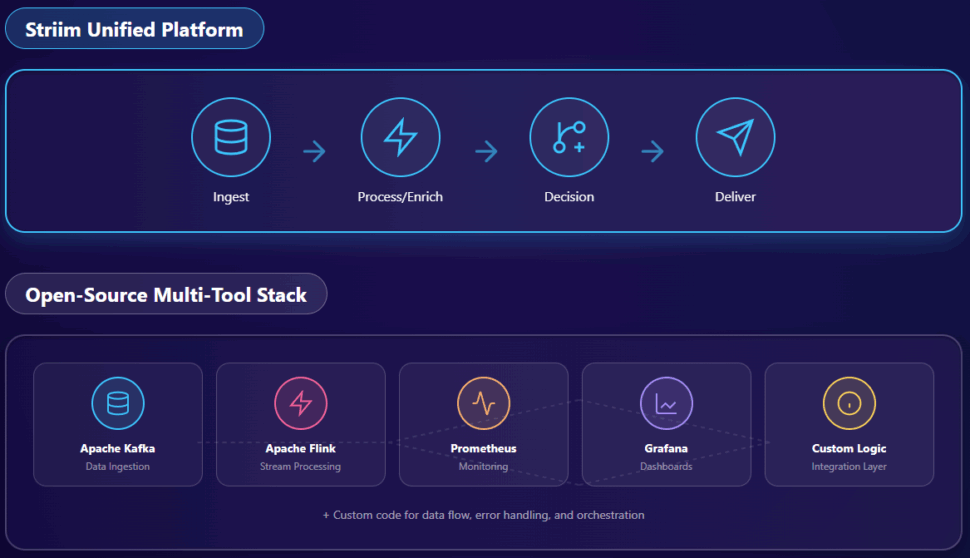
diagram contrasting Striim’s unified workflow (ingest → process/enrich → decision → deliver) with a typical open-source multi-tool stack (Kafka + Flink + separate monitoring)

Streaming analytics might sound complicated, but it follows a simple flow: ingest, process, enrich, and act. A unified platform simplifies this process, unlike fragmented approaches that require you to piece together multiple tools.

Ingest Data Continuously from Live Sources

First, you need to capture data the moment it’s created. This includes changes from databases (using Change Data Capture (CDC)), sensor readings, application logs, and more. This process needs to be fast and reliable, without slowing down your source systems. Using a platform with a wide range of connectors and strong CDC capabilities is key.

Process and Transform Data in Motion

As data flows into your pipeline, it’s filtered, transformed, or joined with other streams. This is where raw data starts to become useful. For example, you can take a customer’s website click and instantly enrich it with their purchase history from another database—all while the data is still moving.

Enrich and Apply Real-Time Logic

Next, you can apply business rules or run the data through machine learning models directly in stream. This lets you do things like score a transaction for fraud risk or spot unusual patterns in sensor data. You could even have a single stream that checks a purchase for fraud while also seeing if the customer qualifies for a special offer, all in a fraction of a second.

Deliver to Targets and Visualize Insights

Finally, the processed insights are sent where they need to go. This might be a cloud data warehouse like Snowflake, a BI tool, or a real-time dashboard. The key is to deliver the information with sub-second latency so your teams and automated systems can take immediate action.

Real-Time Data Movement and Stream Processing: 6 Best Practices 

Gain essential strategies for building reliable, scalable real-time data pipelines, emphasizing streaming-first integration, low-latency processing, and continuous data validation to enable actionable insights and operational efficiency. Read the full blog post to learn more.

Challenges in Implementing Streaming Analytics (and How to Solve Them)

While the value of streaming analytics is clear, getting it right can be challenging. Many teams struggle with the steep learning curve of open-source tools or get locked into a single cloud ecosystem. A unified platform like Striim is designed to help you sidestep these common pitfalls.

Open-source streaming stacks (Kafka/Flink/etc.): Steep learning curve, no native CDC, requires multiple tools for ingestion, processing, and monitoring.

Cloud-native tools: Strong within a single cloud but poor hybrid/multi-cloud support; risk of vendor lock-in.

Point solutions: Handle ingestion only; no in-flight transformation or decisioning.

Data Drift, Schema Evolution, and Quality Issues

Data formats and schemas can change without warning, breaking your pipelines and corrupting your analytics. With open-source tools, this often requires manual code fixes and redeployments. Striim, on the other hand, automatically detects these changes, adjusts the pipeline on the fly, and provides dashboards to help you monitor data quality.

Out-of-Order Events and Latency Spikes

Events don’t always arrive in the right order, which can throw off your analytics and trigger false alerts. Building custom logic to handle this is complicated and can break easily. Striim’s processing engine automatically handles event ordering and timing, ensuring your insights are accurate and delivered with consistent, sub-second latency.

Operational Complexity and Skill Gaps

Many streaming analytics projects fail because they require a team of experts specializing in complex systems like Kafka or Flink. Striim’s all-in-one platform makes it easier for everyone. Its low-code, SQL-based interface allows both developers and analysts to build powerful streaming pipelines without needing a PhD in distributed systems.

The Cost of False Real-Time

“Almost real-time” isn’t enough when every second matters. In some industries, a small delay in detecting fraud can result in a big financial loss. The hidden lags in micro-batch systems can have serious consequences. Striim processes data in memory to deliver true, sub-second performance across all your environments, so you can act instantly.

Striim Real-Time Analytics Quick Start

This tutorial provides a step-by-step guide to using Striim’s platform for creating real-time analytics applications. Learn how to process streaming data, build dashboards, and gain actionable insights with ease.

Must-Have Features in a Streaming Analytics Platform

Not all streaming platforms are created equal. To get the most out of your real-time data, you need a solution that does more than just move it from one place to another. Here are the features to look for.

Native Support for Real-Time Data Ingestion (including CDC)

Your platform should be able to pull in high volumes of data from all your sources—from databases and applications to IoT. It needs to offer log-based CDC to integrate with your operational databases in real time and low-impact integration with operational databases. Striim excels here with its CDC engine and support for hybrid environments.

In-Flight Data Processing and Transformation

Look for the ability to filter, join, and enrich data streams as they flow. A platform with powerful, SQL-based tools for transforming data in motion will help you turn raw information into valuable insights much faster. Look for SQL support, stateful processing, and real-time business logic. Striim’s real-time SQL (TQL) and CEP engine stands out here.

Real-Time Analytics and Decisioning Capabilities

The platform should be able to trigger alerts, update dashboards, or call other applications based on patterns it detects in the data. This includes handling everything from anomaly detection to complex fraud rules without any delay, as with Striim’s real-time alerting and monitoring workflows.

Enterprise-Grade Scale, Reliability, and Observability

You need a platform that can grow with your data volumes, support mission-critical workloads without fail, and deliver consistent sub-second latency. Strong observability tools are also essential for debugging and monitoring pipelines. With Striim, you get a distributed architecture with built-in pipeline monitoring.

Seamless Integration with Modern Data Infrastructure

A future-proof platform needs to connect easily with your existing data warehouses, like Snowflake and BigQuery, as well as messaging systems like Kafka. It must also support hybrid and multi-cloud environments, giving you the freedom to deploy your data wherever you want. Striim’s pre-built connectors and flexible deployment model stand out here.

Integrate both real-time and historical data in your ecosystem

While fresh, real-time data is crucial, ideally your platform of choice can also utilize historic data, especially for training AI and ML models. While many tools can handle either real-time updates or ingest historic data alone, the best solutions will be able to handle (and integrate) both for a rich, unified data set.

Why Choose Striim for Streaming Analytics

Trying to build a streaming analytics solution often leads to a messy collection of tools, frustrating latency issues, and complex integrations. Striim simplifies everything by combining ingestion, transformation, decisioning, and delivery into a single platform built for today’s hybrid-cloud world. The result is faster AI-driven insights, lower engineering overhead, and reliable real-time streaming at scale.

Capability Striim Open-Source Stack Cloud-Native ELT Legacy CDC
Real-Time True in-memory streaming, <1s latency Multi-tool, latency varies Often micro-batch CDC only, no transformation
CDC Native, hybrid/on-prem/cloud Requires add-on (Debezium) Limited, reloads common Yes, no enrichment
Transformation In-flight SQL + CEP Requires Flink/Spark Post-load only Not supported
Schema Evolution Auto-detect & adapt mid-stream Manual fix & redeploy Delayed handling Manual
Hybrid/Multi-Cloud Built-in, consistent SLAs Complex setup Single-cloud focus On-prem only
Ease of Use Low-code, intuitive interface High technical barrier Simple for cloud DBs DBA-focused
AI/ML AI-ready feature streams Custom to build Limited Not supported
Security Compliant with SOC 2, GDPR, HIPAA, and other major security benchmarks. Liable to security breaches and vulnerabilities. Limited Vulnerable

While there are many options out there, Striim is the leading platform that provides a complete, unified solution for streaming analytics, while other approaches only solve part of the puzzle.

Ready to stop reporting on the past and start acting in the present? Start a free trial of Striim or book a demo to see streaming analytics in action.

FAQs About Streaming Analytics

Deploying streaming analytics in hybrid or multi-cloud environments requires distributed data ingestion tools like change data capture (CDC) to collect real-time data from diverse sources without impacting performance. Regional processing nodes and edge computing reduce latency by pre-processing data closer to its source, while containerized microservices and auto-scaling ensure scalability for fluctuating workloads.

Security and compliance demand end-to-end encryption, role-based access control (RBAC), and local processing of sensitive data to meet regulations. Unified monitoring tools provide real-time observability for seamless management.

To avoid vendor lock-in, cloud-agnostic tools and open APIs ensure interoperability, while redundant nodes, multi-region replication, and self-healing pipelines enhance resilience. These adjustments enable real-time insights, scalability, and compliance across distributed systems.

Scaling streaming analytics requires in-memory processing to avoid disk I/O delays, ensuring faster throughput and lower latency. Horizontal scaling adds nodes to distribute workloads, while data partitioning and dynamic load balancing evenly distribute streams and prevent bottlenecks.

To reduce strain, stream compression minimizes bandwidth usage, and pre-aggregation at the source limits data volume. Backpressure management techniques, like buffering, maintain stability during spikes. Optimized query execution and auto-scaling dynamically adjust resources, while fault tolerance mechanisms like checkpointing ensure quick recovery from failures. These strategies enable high performance and reliability at massive scale.

Scaling streaming analytics for massive data volumes requires in-memory processing to eliminate disk I/O delays and ensure low-latency performance. Horizontal scaling adds nodes to handle growing workloads, while data partitioning and dynamic load balancing evenly distribute streams to prevent bottlenecks.

Stream compression reduces bandwidth usage, and pre-aggregation at the source minimizes the data entering the pipeline. Backpressure management, like buffering, maintains stability during spikes, while optimized query execution ensures efficient processing. Continuous monitoring and auto-scaling dynamically adjust resources, and fault tolerance mechanisms like checkpointing ensure quick recovery from failures. These strategies enable reliable, high-performance streaming at scale.

Maintaining data quality in distributed pipelines starts with real-time validation, including schema checks, anomaly detection, and automated quality controls to ensure data integrity. Data lineage tracking provides transparency, helping teams trace and resolve issues quickly, while schema evolution tools adapt to structural changes without breaking pipelines.

For consistency, event ordering and deduplication are managed using watermarking and time-windowing techniques. Fault-tolerant architectures with checkpointing and replay capabilities ensure recovery without data loss. Global data catalogs and metadata tools unify data views across environments, while real-time observability frameworks monitor performance and flag issues early. These practices ensure reliable, high-quality data for real-time decisions.

Streaming analytics supports compliance in regulated industries by embedding security, governance, and monitoring directly into the data pipeline, ensuring adherence to regulations without compromising speed. End-to-end encryption protects data both in transit and at rest, safeguarding sensitive information while maintaining low-latency processing.

Role-based access control (RBAC) and multi-factor authentication (MFA) ensure that only authorized users can access data, meeting strict access control requirements. Additionally, real-time data lineage tracking provides full visibility into how data is collected, processed, and used, which simplifies audits and ensures compliance with regulations like GDPR or HIPAA.

To address data residency requirements, streaming platforms can process sensitive data locally within specific regions while still integrating with global systems. Automated policy enforcement ensures that compliance rules, such as data retention limits or anonymization, are applied consistently across the pipeline.

Finally, real-time monitoring and alerting detect and address potential compliance violations immediately, preventing issues before they escalate. By integrating these compliance measures into the streaming architecture, organizations can meet regulatory requirements while maintaining the sub-second latency needed for real-time decision-making.

Unified streaming platforms have higher upfront costs due to licensing but offer an all-in-one solution with built-in ingestion, processing, monitoring, and visualization. This simplifies deployment, reduces maintenance, and lowers total cost of ownership (TCO) over time.

Open-source stacks like Kafka and Flink are free upfront but require significant engineering resources to integrate, configure, and maintain. Teams must manually handle challenges like schema evolution and fault tolerance, increasing complexity and operational overhead. Scaling to enterprise-grade performance often demands costly infrastructure and expertise.

Unified platforms are ideal for faster time-to-value and simplified management, while open-source stacks suit organizations with deep technical expertise and tight budgets. The choice depends on prioritizing upfront savings versus long-term efficiency.

Managing event ordering in large-scale streaming systems requires watermarking to track stream progress and time-windowing to handle late-arriving events without losing accuracy. Real-time observability tools are critical for detecting anomalies like out-of-sequence events or latency spikes, with metrics such as event lag and throughput offering early warnings.

To resolve issues, replay mechanisms can reprocess streams, while deduplication logic eliminates duplicates caused by retries. Distributed tracing provides visibility into event flow, helping pinpoint problem areas. Fault-tolerant architectures with checkpointing ensure recovery without disrupting event order. These practices ensure accurate, reliable processing at scale.

Change Data Capture (CDC) is a cornerstone of streaming analytics for operational databases, as it enables real-time data ingestion by capturing and streaming changes—such as inserts, updates, and deletes—directly from the database. This allows organizations to process and analyze data as it is generated, without waiting for batch jobs or manual exports.

CDC minimizes the impact on source systems by using log-based methods to track changes, ensuring that operational databases remain performant while still providing fresh data for analytics. It also supports low-latency pipelines, enabling real-time use cases like fraud detection, personalized recommendations, and operational monitoring.

Additionally, CDC ensures data consistency by maintaining the order of changes and handling schema evolution automatically, which is critical for accurate analytics. By integrating seamlessly with streaming platforms, CDC allows organizations to unify data from multiple operational systems into a single pipeline, breaking down silos and enabling cross-system insights.

In short, CDC bridges the gap between operational databases and real-time analytics, providing the foundation for actionable insights and faster decision-making.

To future-proof a streaming analytics system, use schema evolution tools that automatically adapt to changes like added or removed fields, ensuring pipelines remain functional. Schema registries help manage versions and maintain compatibility across components, while data abstraction layers decouple schemas from processing logic, reducing the impact of changes.

For new data sources, adopt modular architectures with pre-built connectors and APIs to simplify integration. At the ingestion stage, apply data validation and transformation to ensure new sources align with expected formats. Real-time monitoring tools can flag issues early, allowing teams to address problems quickly. These strategies create a flexible, resilient system that evolves with your data needs.

Micro-batch processing is a good choice when real-time insights are not critical, and slight delays in data processing are acceptable. It works well for use cases like periodic reporting, refreshing dashboards every few minutes, or syncing data between systems where sub-second latency isn’t required.

It’s also suitable for organizations with limited infrastructure or technical expertise, as micro-batch systems are often simpler to implement and maintain compared to true streaming analytics. Additionally, for workloads with predictable, low-frequency data updates, micro-batching can be more cost-effective by reducing the need for always-on processing.

However, it’s important to evaluate the trade-offs, as micro-batch processing may miss opportunities in scenarios like fraud detection or real-time personalization, where immediate action is essential.

Deploying streaming analytics in hybrid or multi-cloud environments requires distributed data ingestion tools like change data capture (CDC) to collect real-time data from diverse sources without impacting performance. Regional processing nodes and edge computing reduce latency by pre-processing data closer to its source, while containerized microservices and auto-scaling ensure scalability for fluctuating workloads.

Security and compliance demand end-to-end encryption, role-based access control (RBAC), and local processing of sensitive data to meet regulations. Unified monitoring tools provide real-time observability for seamless management.

To avoid vendor lock-in, cloud-agnostic tools and open APIs ensure interoperability, while redundant nodes, multi-region replication, and self-healing pipelines enhance resilience. These adjustments enable real-time insights, scalability, and compliance across distributed systems.

Scaling streaming analytics requires in-memory processing to avoid disk I/O delays, ensuring faster throughput and lower latency. Horizontal scaling adds nodes to distribute workloads, while data partitioning and dynamic load balancing evenly distribute streams and prevent bottlenecks.

To reduce strain, stream compression minimizes bandwidth usage, and pre-aggregation at the source limits data volume. Backpressure management techniques, like buffering, maintain stability during spikes. Optimized query execution and auto-scaling dynamically adjust resources, while fault tolerance mechanisms like checkpointing ensure quick recovery from failures. These strategies enable high performance and reliability at massive scale.

Scaling streaming analytics for massive data volumes requires in-memory processing to eliminate disk I/O delays and ensure low-latency performance. Horizontal scaling adds nodes to handle growing workloads, while data partitioning and dynamic load balancing evenly distribute streams to prevent bottlenecks.

Stream compression reduces bandwidth usage, and pre-aggregation at the source minimizes the data entering the pipeline. Backpressure management, like buffering, maintains stability during spikes, while optimized query execution ensures efficient processing. Continuous monitoring and auto-scaling dynamically adjust resources, and fault tolerance mechanisms like checkpointing ensure quick recovery from failures. These strategies enable reliable, high-performance streaming at scale.

Maintaining data quality in distributed pipelines starts with real-time validation, including schema checks, anomaly detection, and automated quality controls to ensure data integrity. Data lineage tracking provides transparency, helping teams trace and resolve issues quickly, while schema evolution tools adapt to structural changes without breaking pipelines.

For consistency, event ordering and deduplication are managed using watermarking and time-windowing techniques. Fault-tolerant architectures with checkpointing and replay capabilities ensure recovery without data loss. Global data catalogs and metadata tools unify data views across environments, while real-time observability frameworks monitor performance and flag issues early. These practices ensure reliable, high-quality data for real-time decisions.

Streaming analytics supports compliance in regulated industries by embedding security, governance, and monitoring directly into the data pipeline, ensuring adherence to regulations without compromising speed. End-to-end encryption protects data both in transit and at rest, safeguarding sensitive information while maintaining low-latency processing.

Role-based access control (RBAC) and multi-factor authentication (MFA) ensure that only authorized users can access data, meeting strict access control requirements. Additionally, real-time data lineage tracking provides full visibility into how data is collected, processed, and used, which simplifies audits and ensures compliance with regulations like GDPR or HIPAA.

To address data residency requirements, streaming platforms can process sensitive data locally within specific regions while still integrating with global systems. Automated policy enforcement ensures that compliance rules, such as data retention limits or anonymization, are applied consistently across the pipeline.

Finally, real-time monitoring and alerting detect and address potential compliance violations immediately, preventing issues before they escalate. By integrating these compliance measures into the streaming architecture, organizations can meet regulatory requirements while maintaining the sub-second latency needed for real-time decision-making.

Unified streaming platforms have higher upfront costs due to licensing but offer an all-in-one solution with built-in ingestion, processing, monitoring, and visualization. This simplifies deployment, reduces maintenance, and lowers total cost of ownership (TCO) over time.

Open-source stacks like Kafka and Flink are free upfront but require significant engineering resources to integrate, configure, and maintain. Teams must manually handle challenges like schema evolution and fault tolerance, increasing complexity and operational overhead. Scaling to enterprise-grade performance often demands costly infrastructure and expertise.

Unified platforms are ideal for faster time-to-value and simplified management, while open-source stacks suit organizations with deep technical expertise and tight budgets. The choice depends on prioritizing upfront savings versus long-term efficiency.

Managing event ordering in large-scale streaming systems requires watermarking to track stream progress and time-windowing to handle late-arriving events without losing accuracy. Real-time observability tools are critical for detecting anomalies like out-of-sequence events or latency spikes, with metrics such as event lag and throughput offering early warnings.

To resolve issues, replay mechanisms can reprocess streams, while deduplication logic eliminates duplicates caused by retries. Distributed tracing provides visibility into event flow, helping pinpoint problem areas. Fault-tolerant architectures with checkpointing ensure recovery without disrupting event order. These practices ensure accurate, reliable processing at scale.

Change Data Capture (CDC) is a cornerstone of streaming analytics for operational databases, as it enables real-time data ingestion by capturing and streaming changes—such as inserts, updates, and deletes—directly from the database. This allows organizations to process and analyze data as it is generated, without waiting for batch jobs or manual exports.

CDC minimizes the impact on source systems by using log-based methods to track changes, ensuring that operational databases remain performant while still providing fresh data for analytics. It also supports low-latency pipelines, enabling real-time use cases like fraud detection, personalized recommendations, and operational monitoring.

Additionally, CDC ensures data consistency by maintaining the order of changes and handling schema evolution automatically, which is critical for accurate analytics. By integrating seamlessly with streaming platforms, CDC allows organizations to unify data from multiple operational systems into a single pipeline, breaking down silos and enabling cross-system insights.

In short, CDC bridges the gap between operational databases and real-time analytics, providing the foundation for actionable insights and faster decision-making.

To future-proof a streaming analytics system, use schema evolution tools that automatically adapt to changes like added or removed fields, ensuring pipelines remain functional. Schema registries help manage versions and maintain compatibility across components, while data abstraction layers decouple schemas from processing logic, reducing the impact of changes.

For new data sources, adopt modular architectures with pre-built connectors and APIs to simplify integration. At the ingestion stage, apply data validation and transformation to ensure new sources align with expected formats. Real-time monitoring tools can flag issues early, allowing teams to address problems quickly. These strategies create a flexible, resilient system that evolves with your data needs.

Micro-batch processing is a good choice when real-time insights are not critical, and slight delays in data processing are acceptable. It works well for use cases like periodic reporting, refreshing dashboards every few minutes, or syncing data between systems where sub-second latency isn’t required.

It’s also suitable for organizations with limited infrastructure or technical expertise, as micro-batch systems are often simpler to implement and maintain compared to true streaming analytics. Additionally, for workloads with predictable, low-frequency data updates, micro-batching can be more cost-effective by reducing the need for always-on processing.

However, it’s important to evaluate the trade-offs, as micro-batch processing may miss opportunities in scenarios like fraud detection or real-time personalization, where immediate action is essential.

SQL Server Change Data Capture: How It Works & Best Practices

If you’re reading this, there’s a chance you need to send real-time data from SQL Server for cloud migration, operational reporting or agentic AI. How hard can it be?

The answer lies in the transition. Capturing changes isn’t difficult in and of itself; it’s the act of doing so at scale without destabilizing your production environment. While SQL Server provides native Change Data Capture (CDC) functionality, making it reliable, efficient, and low-impact in a modern hybrid-cloud architecture can be challenging. If you’re looking for a clear breakdown of what SQL Server CDC is, how it works, and how to build a faster, more scalable capture strategy, you’re in the right place. This guide will cover the methods, the common challenges, and the modern tooling required to get it right.

What is SQL Server Change Data Capture (CDC)?

Change Data Capture (CDC) is a technology that identifies and records row-level changes—INSERTs, UPDATEs, and DELETEs—in SQL Server tables. It captures these changes as they happen and makes them available for downstream systems, all without requiring modifications to the source application’s tables. This capability enables businesses to feed live analytics dashboards, execute zero-downtime cloud migrations, and maintain audit trails for compliance. In today’s economy, businesses can no longer tolerate the delays of nightly or even hourly batch jobs. Real-time visibility is essential for fast, data-driven decisions. At a high level, SQL Server’s native CDC works by reading the transaction log and storing change information in dedicated system tables. While this built-in functionality provides a starting point, scaling it reliably across a complex hybrid or cloud architecture requires a clear strategy and, often, specialized tooling to manage performance and operational overhead.

Where SQL Server CDC Fits in the Modern Data Stack

Change Data Capture should not be considered an isolated feature, but a critical puzzle piece within a company’s data architecture. It functions as the real-time “on-ramp” that connects transactional systems (like SQL Server) to the cloud-native and hybrid platforms that power modern business. CDC is the foundational technology for a wide range of critical use cases, including:

  • Real-time Analytics: Continuously feeding cloud data warehouses (like Snowflake, BigQuery, or Databricks) and data lakes to power live, operational dashboards.
  • Cloud & Hybrid Replication: Enabling zero-downtime migrations to the cloud or synchronizing data between on-premises systems and multiple cloud environments.
  • Data-in-Motion AI: Powering streaming applications and AI models with live data for real-time predictions, anomaly detection, and decisioning.
  • Microservices & Caching: Replicating data to distributed caches or event-driven microservices to ensure data consistency and high performance.

How SQL Server Natively Handles Change Data Capture

SQL Server provides built-in CDC features (available in Standard, Enterprise, and Developer editions) that users must enable on a per-table basis. Once enabled, the native process relies on several key components:

  1. The Transaction Log: This is where SQL Server first records all database transactions. The native CDC process asynchronously scans this log to find changes related to tracked tables.
  2. Capture Job (sys.sp_cdc_scan): A SQL Server Agent job that reads the log, identifies the changes, and writes them to…
  3. Change Tables: For each tracked source table, SQL Server creates a corresponding “shadow table” (e.g., cdc.dbo_MyTable_CT) to store the actual change data (the what, where, and when) along with metadata.
  4. Log Sequence Numbers (LSNs): These are used to mark the start and end points of transactions, ensuring changes are processed in the correct order.

Cleanup Job (sys.sp_cdc_cleanup_job): Another SQL Server Agent job that runs periodically to purge old data from the change tables based on a user-defined retention policy.Striim SQL Server CDC While this native system offers a basic form of CDC, it was not designed for the high-volume, low-latency demands of modern cloud architectures. The SQL Server Agent jobs and the constant writing to change tables introduce performance overhead (added I/O and CPU) that can directly impact your production database, especially at scale.

How Striim MSJET Handles SQL Server Change Data Capture

Striim’s MSJET provides high-performance, log-based CDC for SQL Server without relying on triggers or shadow tables. Unlike native CDC, it eliminates the overhead of SQL Server Agent jobs and intermediate change tables. The MSJET process relies on several key components:

  • The Transaction Log: MSJET reads directly from SQL Server’s transaction log—including via fn_dblog—to capture all committed INSERT, UPDATE, and DELETE operations in real time.
  • Log Sequence Numbers (LSNs): MSJET tracks LSNs to ensure changes are processed in order, preserving transactional integrity and exactly-once delivery.
  • Pipeline Processing: As changes are read from the log, MSJET can filter, transform, enrich, and mask data in-flight before writing to downstream targets.
  • Schema Change Detection: MSJET automatically handles schema modifications such as new columns or altered data types, keeping pipelines resilient without downtime.
  • Checkpointing and Retention: MSJET internally tracks log positions and manages retention, without relying on SQL Server’s capture or cleanup jobs, which consume disk space, I/O, and CPU resources.

Key Advantage: Because MSJET does not depend on shadow tables or SQL Server Agent jobs, it avoids the performance overhead, storage consumption, and complexity associated with native CDC. This enables high-throughput, low-latency CDC suitable for enterprise-scale, real-time streaming to cloud platforms such as Snowflake, BigQuery, Databricks, and Kafka.

Common Methods for Capturing Change Data from SQL Server

SQL Server provides several methods for capturing change data, each with different trade-offs in performance, latency, operational complexity, and scalability. Choosing the right approach is essential to achieve real-time data movement without overloading the source system.

Method Performance Impact Latency Operational Complexity Scalability
Polling-Based High High (Minutes) Low Low
Trigger-Based Very High Low High Low
Log-Based Very Low Low (Seconds/Sub-second) Moderate to Low High

Polling-Based Change Capture

  • How it works: The polling method periodically queries source tables to detect changes (for example, SELECT * FROM MyTable WHERE LastModified > ?). This approach is simple to implement but relies on repetitive full or incremental scans of the data.
  • The downside: Polling is highly resource-intensive, putting load on the production database with frequent, heavy queries. It introduces significant latency, is never truly real-time, and often fails to capture intermediate updates or DELETE operations without complex custom logic.
  • The Striim advantage: Striim eliminates the inefficiencies of polling by capturing changes directly from the transaction log. This log-based approach ensures every insert, update, and delete is captured in real time with minimal source impact—delivering reliable, low-latency data streaming at scale.

Trigger-Based Change Capture

  • How it works: This approach uses database triggers (DML triggers) that fire on every INSERT, UPDATE, or DELETE operation. Each trigger writes the change details into a separate “history” or “log” table for downstream processing.
  • The downside: Trigger-based CDC is intrusive and inefficient. Because triggers execute as part of the original transaction, they increase write latency and can quickly become a performance bottleneck—especially under heavy workloads. Triggers also add development and maintenance complexity, and are prone to breaking when schema changes occur.
  • The Striim advantage: Striim completely avoids trigger-based mechanisms. By capturing changes directly from the transaction log, Striim delivers a non-intrusive, high-performance solution that preserves source system performance while providing scalable, real-time data capture.

Shadow Table (Native SQL CDC)

  • How it works: SQL Server’s native Change Data Capture (CDC) feature uses background jobs to read committed transactions from the transaction log and store change information in system-managed “shadow” tables. These tables record before-and-after values for each change, allowing downstream tools to query them periodically for new data.
  • The downside: While less intrusive than triggers, native CDC still introduces overhead on the source system due to the creation and maintenance of shadow tables. Managing retention policies, cleanup jobs, and access permissions adds operational complexity. Latency is also higher compared to direct log reading, and native CDC often struggles to scale efficiently for high-volume workloads.
  • The Striim advantage: Striim supports native SQL CDC for environments where it’s already enabled, but it also offers a superior alternative through its MSJET log-based reader. MSJET delivers the same data with lower latency, higher throughput, and minimal operational overhead—ideal for real-time, large-scale data integration.

Log-Based (MSJET)

How it works:
Striim’s MSJET reader captures change data directly from SQL Server’s transaction log, bypassing the need for triggers or shadow tables. This approach reads the same committed transactions that SQL Server uses for recovery, ensuring every INSERT, UPDATE, and DELETE is captured accurately and in order.

The downside:
Implementing log-based CDC natively can be complex, as it requires a deep understanding of SQL Server’s transaction log internals and careful management of log sequence numbers and recovery processes. However, when done right, it provides the most accurate and efficient form of change data capture.

The Striim advantage:
MSJET offers high performance, low impact, and exceptional scalability—supporting CDC rates of up to 150+ GB per hour while maintaining sub-second latency. It also automatically handles DDL changes, ensuring continuous, reliable data capture without manual intervention. This makes MSJET the most efficient and enterprise-ready option for SQL Server change data streaming.

Challenges of Managing Change Data Capture at Scale

Log-based CDC is the gold standard for accuracy and performance, but managing it at enterprise scale introduces new operational challenges. As data volumes, change rates, and schema complexity grow, homegrown or basic CDC solutions often reach their limits, impacting reliability, performance, and maintainability.

Handling Schema Changes and Schema Drift

  • The pain point: Source schemas evolve constantly—new columns are added, data types change, or fields are deprecated. These “schema drift” events often break pipelines, cause ingestion errors, and lead to downtime or data inconsistency.
  • Striim’s advantage: Built with flexibility in mind, Striim’s MSJET engine automatically detects schema changes in real time and propagates them downstream without interruption. Whether the target needs a structural update or a format transformation, MSJET applies these adjustments dynamically, maintaining full data continuity with zero downtime.

Performance Overhead and System Impact

  • The pain point: Even SQL Server’s native log-based CDC introduces operational overhead. Its capture and cleanup jobs consume CPU, I/O, and storage, while writing to change tables can further slow down production workloads.
  • When it becomes critical: As transaction volumes surge or during peak business hours, this additional load can impact response times and force trade-offs between production performance and data freshness.
  • Striim’s advantage: MSJET is engineered for high performance and low impact. By reading directly from the transaction log without relying on SQL Server’s capture or cleanup jobs, it minimizes system load while sustaining throughput of 150+ GB/hour. All CDC processing occurs within Striim’s distributed, scalable runtime, protecting your production SQL Server from performance degradation.

Retention, Cleanup, and Managing CDC Metadata

  • The pain point: Native CDC requires manual maintenance of change tables, including periodic cleanup jobs to prevent unbounded growth. Misconfigured or failed jobs can lead to bloated tables, wasted storage, and degraded query performance.
  • Striim’s advantage: MSJET removes this burden entirely. It manages retention, checkpointing, and log positions internally, no SQL Server Agent jobs, no cleanup scripts, no risk of data buildup. Striim tracks its place in the transaction log independently, ensuring reliability and simplicity at scale.

Security, Governance, and Audit Considerations

  • The pain point: Change data often includes sensitive information, such as PII, financial records, or health data. Replicating this data across hybrid or multi-cloud environments can introduce significant security, compliance, and privacy risks if not properly managed.
  • Striim’s advantage: Striim provides a comprehensive, enterprise-grade data governance framework. Its Sherlock agent automatically detects sensitive data, while Sentinel masks, tags, and encrypts it in motion to enforce strict compliance. Beyond security, Striim enables role-based access control (RBAC), filtering, data enrichment, and transformation within the pipeline—ensuring only the data that is required is written to downstream targets. Combined with end-to-end audit logging, these capabilities give organizations full visibility, control, and protection over their change data streams.

Accelerate and Simplify SQL Server CDC with Striim

Relying on native SQL Server CDC tools or DIY pipelines comes with significant challenges: performance bottlenecks, brittle pipelines, schema drift, and complex maintenance. These approaches were not built for real-time, hybrid-cloud environments, and scaling them often leads to delays, errors, and operational headaches. Striim is purpose-built to overcome these challenges. It is an enterprise-grade platform that delivers high-performance, log-based CDC for SQL Server, combining reliability, simplicity, and scalability. With Striim, you can:

  • Capture data with minimal impact: MSJET reads directly from the transaction log, providing real-time change data capture without affecting production performance.
  • Handle schema evolution automatically: Detect and propagate schema changes in real time with zero downtime, eliminating a major source of pipeline failure.
  • Process data in-flight: Use a familiar SQL-based language to filter, transform, enrich, and mask sensitive data before it reaches downstream systems.
  • Enforce security and governance: Leverage Sherlock to detect sensitive data and Sentinel to mask, tag, and encrypt it in motion. Combined with RBAC, filtering, and audit logging, you maintain full control and compliance.
  • Guarantee exactly-once delivery: Ensure data integrity when streaming to cloud platforms like Snowflake, Databricks, BigQuery, and Kafka.
  • Unify integration and analytics: Combine CDC with real-time analytics to build a single, scalable platform for data streaming, processing, and insights.

Stop letting the complexity of data replication slow your business. With Striim, SQL Server CDC is faster, simpler, and fully enterprise-ready. Interested in a personalized walkthrough of Striim’s SQL Server CDC functionality? Please schedule a demo with one of our CDC experts! Alternatively you can  try Striim for free.

How to Migrate Data from MySQL to Azure Database for MySQL

For many data teams, migrating MySQL workloads to Azure Database for MySQL is a critical step in modernizing their data platform, but maintaining uptime, preserving data integrity, and validating performance during the process can be complex.

With Striim and Microsoft Azure, those challenges become manageable. Striim’s log-based Change Data Capture (CDC) continuously streams every MySQL transaction into Azure Database for MySQL, enabling zero-data-loss replication, real-time validation, and minimal impact on live applications.

As part of the Microsoft Unlimited Database Migration Program, this joint solution helps organizations accelerate and de-risk their path to Azure. By combining proven migration tooling, partner expertise, and architectural guidance, together, Striim and Microsoft simplify every stage of the move.

This tutorial walks through the key steps and configurations to successfully migrate from MySQL to Azure Database for MySQL using Striim.

Why Use Striim for Continuous Migration

Through the Unlimited Database Migration Program, Microsoft customers gain unlimited Striim licenses to migrate as many databases as they need at no additional cost. Highlights and benefits of the program include:

  • Zero-downtime, zero-data-loss migrations. Supported sources include SQL Server, MongoDB, Oracle, MySQL, PostgreSQL, Sybase, and Cosmos. Supported targets include Azure Database for MySQL, Azure Database for PostgreSQL, Azure Database for CosmosDB, and Azure Database for MariaDB.
  • Mission-critical, heterogeneous workloads supported. Applies for SQL, Oracle, NoSQL, OSS.
  • Drives faster AI adoption. Once migrated, data is ready for real-time analytics & AI.

In this case, Striim enables continuous, log-based Change Data Capture (CDC) from MySQL to Azure Database for MySQL. Instead of relying on periodic batch jobs, Striim reads directly from MySQL binary logs (binlogs) and streams transactions to Azure in real time.

Using the architecture and configuration steps outlined below, this approach minimizes impact on production systems and ensures data consistency even as new transactions occur during migration.

Architecture Overview

This specific setup includes three components:

  • Source: an existing MySQL database, hosted on-premises or in another cloud.
  • Processing layer: Striim, deployed in Azure for low-latency data movement.
  • Target: Azure Database for MySQL (Flexible Server recommended).

Data flows securely from MySQL → Striim → Azure Database for MySQL through ports 3306 and 5432. Private endpoints or Azure Private Link are recommended for production environments to avoid public internet exposure.

Preparing the MySQL Source

Before streaming can begin, enable binary logging and create a replication user with read access to those logs:


Set the binlog format to ROW and ensure logs are retained long enough to handle any temporary network interruption.

In Striim, use the MySQL Reader component to connect to the source. This reader consumes binlogs directly, so overhead on the production system remains in the low single-digit percentage range.

You can find detailed configuration guidance in Striim’s MySQL setup documentation.

Configuring the Azure MySQL Target

Before starting the pipeline, make sure target tables exist in Azure Database for MySQL. Striim supports two methods:

  • Schema Conversion Utility (CLI): automatically generates MySQL DDL statements.
  • Wizard-based creation: defines and creates tables directly through the Striim UI.

Create a MySQL user with appropriate privileges:


The Striim environment needs network access to the MySQL instance over port 5432. Using a private IP or Azure Private Endpoint helps maintain compliance and security best practices.

Building the Migration Pipeline

A complete Striim migration includes three coordinated stages:

  1. Schema Migration – creates tables and schemas in the target.
  2. Initial Load – bulk-loads historical data from MySQL to Azure Database for MySQL.
  3. Change Data Capture (CDC) – continuously streams live transactions to keep the systems in sync.

During the initial load, Striim copies historical data using a Database Reader and Database Writer. Once complete, you can start the CDC pipeline to apply real-time updates until MySQL and Azure Database for MySQL are fully synchronized. Note that Striim automatically maps compatible data types during initial load and continuous replication.

When ready, pause writes to MySQL, validate record counts, and cut over to Azure with zero data loss. Follow Striim’s switch-over guide for sequencing the transition safely.

Working in Striim

You can build pipelines in Striim using several methods:

  • Wizards: pre-built templates that guide you through setup for common source/target pairs such as MySQL → Azure Database for MySQL.
  • Visual Designer: drag-and-drop components for custom data flows.
  • TQL scripts: Striim’s language for defining applications programmatically, suitable for CI/CD automation.

Each Striim application is backed by a TQL file, which can be version-controlled and deployed via REST API for repeatable infrastructure-as-code workflows. Below is a step-by-step demo of what you can expect.

Adding Transformations and Smart Pipelines

Beyond 1:1 replication, you can apply transformations to enrich or reshape data before writing to Azure. Striim supports in-memory processing through continuous SQL queries or custom Java functions.

For example, you can append operational metadata:


These Smart Data Pipelines allow teams to incorporate auditing, deduplication, or lightweight analytics without creating separate ETL jobs—streamlining modernization into a single migration flow.

Performance Expectations

In joint Striim and Microsoft testing, results typically show:

  • 1 TB historical load: completed in 4–6 hours
  • Ongoing CDC latency: sub-second for inserts, updates, and deletes

Throughput depends on schema complexity, hardware configuration, and network performance. For best results, deploy Striim in the same Azure region as your Azure Database for MySQL target and allocate sufficient CPU and memory resources.

Support and Enablement

The Microsoft Unlimited Database Migration Program is designed specifically to provide customers direct access to Striim’s field expertise throughout the migration process.

From end-to-end, you can expect:

  • Onboarding and ongoing support, including installation kits and walkthroughs.
  • Higher-tier service packages are available as well.
  • Direct escalation paths to Striim for issue resolution and continuous assistance during migration and replication.
  • Professional services and funding flexibility, such as ECIF coverage for partner engagements, cutover or weekend go-live standby, and pre-approved service blocks to simplify SOW approvals.

Together, these resources ensure migrations from MySQL to Azure Database for MySQL are fully supported from initial enablement through post-cutover operations, backed by Microsoft and Striim’s combined field teams.

Accelerate Your Migration Journey with Microsoft’s Unlimited Database Migration Program

With Striim and Microsoft, moving from MySQL to Azure Database for MySQL is no longer a complex, high-risk process—it’s an engineered pathway to modernization. Through the Microsoft Unlimited Database Migration Program, you can access partner expertise, joint tooling, and migration credits to move data workloads to Azure quickly and securely at no extra cost to you.

Whether your goal is one-time migration or continuous hybrid replication, Striim’s CDC engine, combined with Azure’s managed MySQL service, ensures every transaction lands with integrity. Start your modernization journey today by connecting with your Microsoft representative or visiting https://go2.striim.com/demo.

5 Reasons Real-Time Data Processing is Crucial for Modern Businesses

Enterprises are drowning in data, but how much of it is arriving in time to deliver impact? Too often, critical decisions are held hostage by yesterday’s reports. Slow data is holding companies back. 

The problem lies in infrastructure: brittle, batch-based pipelines that introduce costly delays and leave AI and analytics initiatives starved for relevant context. This isn’t just a technical frustration, it’s a barrier to competing in an economy that runs in real time.

It’s time to close the gap between data creation and data action. This guide breaks down how real-time data processing works, why it matters now more than ever, and the practical steps to implement it.

What Is Real-Time Data Processing?

Real-time data processing isn’t just about making batch jobs faster. It’s a fundamentally different approach: the practice of capturing, transforming, and acting on data the instant it’s created. Instead of collecting data in batches for later, real-time systems handle a continuous, event-driven flow of information with sub-second latency.

This distinction is significant. While batch processing delivers a static snapshot of the past, real-time processing provides a live, dynamic view of the present. It’s the difference between reviewing last week’s sales figures and instantly:

  • Detecting a fraudulent transaction as it occurs.
  • Adjusting inventory the moment an item sells.
  • Personalizing a customer offer while they are still on your website.

For any organization that relies on up-to-the-minute information, real-time isn’t an upgrade, it’s a necessity.

Use Cases for Real-Time Data Processing

Across every industry, organizations use real-time data processing to drive measurable outcomes, from faster, data-informed decisions to hyper-personalized customer experiences. Here’s how it looks in practice:

Retail: Dynamic Pricing and Inventory Optimization

Real-time processing allows e-commerce and brick-and-mortar retailers to update pricing instantly based on competitor activity, demand shifts, or stock levels. It also provides an up-to-the-second view of inventory, preventing stockouts and improving the customer experience. Striim enables this with low-latency data delivery to apps and dashboards, enriched in-flight with contextual information like store location or user data.

Financial Services: Fraud Detection and Compliance

In an industry where every second counts, real-time streaming helps financial institutions detect anomalies and flag fraudulent transactions the moment they occur, not after the money is gone. This requires exceptional data consistency and auditability. Striim supports this with continuous monitoring and event stream correlation across multiple sources, ensuring fraudulent patterns are caught instantly.

Manufacturing & IoT: Predictive Maintenance and Telemetry

Sensor data from factory floors and IoT devices can be processed in real time to predict equipment failures before they cause costly downtime. By analyzing live telemetry, manufacturers can optimize asset performance and shift from reactive repairs to proactive maintenance. Striim makes this possible by enabling high-throughput data streaming from edge devices to cloud platforms for centralized intelligence.

Logistics: Real-Time Tracking and Route Optimization

GPS and shipment data can be used to dynamically update delivery routes, optimize fuel consumption, and provide customers with accurate ETAs. Real-time visibility is key to meeting SLAs and improving logistical efficiency. Striim’s support for multi-cloud and hybrid deployments ensures that data can be processed and routed effectively across distributed systems and geographies.

Feeding Real-Time Context to Intelligent Systems

As AI initiatives move from experiments to production, it creates massive demand for continuous, feature-rich data context. Real-time data pipelines enable low-latency inference for smarter recommendations, more accurate demand forecasting, and adaptive fraud models. Striim feeds these models with fresh, transformed data from enterprise sources, delivering it to warehouses, data lakes, or AI pipelines with minimal latency.

How Does Real-Time Data Processing Work?

Real-time data processing is a constant, iterative process, not a one-time event. It involves seamlessly orchestrating multiple steps to capture, enrich, and deliver fresh, actionable data the moment it’s needed. While architectures vary, the core workflow follows a clear path from source to target.

How Does Real-Time Data Processing Work?

Step 1: Capture and Ingest Data as It’s Created

Every real-time pipeline begins at the source: databases, applications, message queues, IoT sensors, or log files. The key is to capture events as they happen with minimal latency. Low-impact methods like Change Data Capture (CDC) are ideal, as they read directly from database transaction logs without adding overhead. Striim excels here, offering high-throughput, schema-aware ingestion from hundreds of sources with zero disruption.

Step 2: Stream Data Into a Processing Engine

Once captured, data flows as an event stream into a processing engine designed for continuous computation. This is where concepts like windowing become critical for analysis, such as tumbling windows for periodic reports or sliding windows for moving averages. Striim’s architecture maintains a distributed in-memory state across active-active nodes to ensure calculations are executed consistently, eliminating the “split-brain” risk and allowing for dynamic scaling while keeping latency predictable.

Step 3: Filter, Enrich, and Transform in Flight

Raw data is rarely useful in its original state. In a real-time pipeline, value is added in-flight by filtering out irrelevant events, joining data with lookup tables, or applying business rules. Striim’s in-flight SQL-based processing engine simplifies this complex task. Its schema evolution engine also automatically detects and propagates source changes (like new columns) from CDC logs downstream without requiring a pipeline restart, avoiding the downtime that plagues many open-source stacks.

Step 4: Deliver to Targets with Sub-Second Latency

After processing, the enriched data must be delivered to its destination: a data warehouse, real-time application, or API. This final handoff must be fast and reliable. Striim provides native, optimized connectors to dozens of targets like Snowflake, Databricks, and Kafka, supporting parallel, region-aware delivery. Key features include:

  • Exactly-once delivery semantics
  • Built-in retries for transient failures
  • In-transit TLS 1.3 encryption

Step 5: Monitor, Scale, and Optimize Continuously

Real-time data pipelines are dynamic systems that require constant observability to track latency, throughput, and potential bottlenecks. This means having robust error handling, replay capabilities, and the ability to scale components dynamically. Striim provides built-in monitoring dashboards, real-time metrics, and configurable alerting to keep pipelines healthy and give operators the visibility needed to optimize performance.

Tools and Technology for Real-Time Data Processing

Building a real-time data architecture requires a stack of specialized tools. Some teams choose to assemble a fragmented mix of components, while others opt for a unified platform to accelerate development and simplify operations. The right choice depends on your team’s expertise, architectural needs, and business goals.

Data Ingestion and Streaming Platforms

Tools like Apache Kafka, Apache Pulsar, and Amazon Kinesis form the foundation of many real-time systems, acting as a message bus to decouple data producers from consumers. While powerful, they require significant engineering expertise to set up, manage, and integrate. Striim’s approach simplifies this by tightly coupling ingestion with its processing engine, enabling schema-aware CDC with immediate enrichment without needing to stage data in an external bus.

Stream Processing Engines

Tools like Apache Flink or Spark Structured Streaming are often used to handle real-time transformations and aggregations. These engines are key to modern data architectures but often come with a steep learning curve, requiring advanced engineering resources to manage custom code and state. Striim abstracts this complexity with a low-code, SQL-based engine that empowers teams to define sophisticated processing logic without deep streaming expertise.

Unified Real-Time Data Platforms

Unified platforms like Striim combine ingestion, real-time processing, enrichment, and delivery into a single, cohesive solution. This stream-first architecture reduces latency, simplifies pipeline management, and eliminates the operational overhead of managing multiple components. For teams that prioritize fast time-to-value, scalable operations, and end-to-end observability, a unified platform is the clear choice.

Best Practices for Real-Time Data Processing at Scale

Successfully implementing real-time data requires an architectural approach that prioritizes simplicity, observability, and low-latency data flow. As teams scale, they often encounter challenges with brittle pipelines and high maintenance overhead. The following best practices can make a difference.

Use Change Data Capture for Accurate, Low-Latency Ingestion

The quality of your pipeline depends on how you capture data at the source. Polling-based ingestion is often slow and places unnecessary strain on source systems. Instead, use Change Data Capture (CDC) to stream events directly from transaction logs. This ensures you get clean, accurate data with minimal latency.

Enrich, Filter, and Transform In-Flight

A stream-first architecture allows you to apply business logic and enrich data before it’s written to storage. This is a significant advantage over traditional approaches where transformations happen in separate batch layers. By processing data in-flight with a SQL-based engine like Striim, you can simplify your stack and deliver data that is immediately ready for consumption.

Monitor, Tune, and Test Your Pipelines Continuously

Distributed, event-driven systems require robust observability. Challenges like latency spikes and schema drift can be difficult to debug without the right tools. Adopt a platform that provides built-in visibility across the full pipeline, from ingestion to delivery, to make it easier to maintain, tune, and optimize your operations.

Transform Your Data Strategy with Striim

The gap between data creation and business action is shrinking. In an economy where speed is a competitive advantage, real-time data processing is no longer a niche capability. It’s a foundational requirement for building smarter, faster, and more responsive organizations.

Striim provides a unified, enterprise-grade platform that simplifies the complexity of real-time data processing. With low-latency change data capture, a powerful SQL-based stream processing engine, and seamless integration with your existing cloud and on-prem systems, Striim empowers you to turn your data into a strategic asset the moment it’s created.

Ready to see it in action? Book a demo with our experts or start your free trial today.

Data Synchronization: A Guide for AI-Ready Enterprises

In a world run on AI and instant analytics, stale data is a major business risk. If you’re here, it’s likely because your teams are struggling with delayed reports, unreliable integrations, or systems that simply don’t speak the same language.

This guide breaks down how to address these challenges with a robust data synchronization strategy. We’ll cover why real-time is now non-negotiable, and walk through the methods, use cases, and best practices to get it right. While older batch methods still have their place, modern enterprises need real-time data movement, powered by change data capture (CDC), to keep up with AI, analytics, and customer expectations.

What Is Data Synchronization?

Data synchronization is the continuous process of ensuring data is consistent and updated across two or more systems. It’s the foundation of a reliable data management strategy: creating a single source of truth that every team and application can trust. In the past, this was a straightforward task handled by overnight batch jobs.

But today, enterprises rely on data synchronization to power everything from generative AI models to real-time applications. To operate at the speed and scale the market now demands, organizations must move beyond slow, periodic updates and embrace continuous, real-time data synchronization.

Types of Data Synchronization

Data synchronization will look different for every organization. The right approach depends on your goals, your tech stack, and your tolerance for latency.

Real-Time vs. Batch Synchronization

Batch synchronization used to be perfectly adequate for most use cases. Data was collected and moved on a schedule, like once a day. This method is still suitable for some reporting use cases, but it comes with significant limitations, including data latency, high processing costs, and stale insights.

Real-time synchronization is the modern approach. Enabled by platforms like Striim, it processes data the instant it’s created. It’s the express lane for your data, eliminating delays so you can act on what’s happening right now. For fraud detection or live customer personalization, that’s a game-changer.

One-Way vs. Two-Way Synchronization

One-way synchronization is when data flows from a single source out to many destinations. This is the most common setup, used for sending data to analytics dashboards or data warehouses where it can be analyzed without changing the original source.

Two-way synchronization is a conversation. Two or more systems can update each other, which is ideal for collaborative apps where everyone needs to edit the same information. This approach is more complex because you need clear rules to handle cases where changes conflict.

Full vs. Incremental Synchronization

A full data sync is the most straightforward but also the least efficient method for ongoing updates. It copies the entire dataset from the source to the target. It’s necessary the first time you set things up, but doing it over and over is slow and expensive.

Incremental synchronization is much more effective. It only moves the data that has actually changed. Powered by Change Data Capture (CDC), this approach is fast, efficient, and has minimal impact on source systems.

Why Real-Time Data Synchronization Matters More Than Ever

Data latency was once an accepted trade-off in enterprise data strategy. But the world has changed. Customers expect instant answers, your applications need live data, and your business can’t afford to make decisions based on yesterday’s numbers. Latency is no longer just a delay, it’s a competitive disadvantage.

Stale data directly impacts business outcomes. AI models generate inaccurate predictions, customer-facing applications fail to deliver value, and fraud detection systems are rendered ineffective. And as tech stacks become increasingly complex, with data distributed across on-premise and multi-cloud environments, legacy batch syncs are even more of a liability. According to McKinsey, becoming a data- and AI-driven enterprise requires a modern approach, and real-time is now a must.

Use Cases for Data Synchronization

What does real-time synchronization look like in practice? It’s the hidden engine that powers the experiences and efficiencies organizations rely on. While some business functions can get by with occasional updates, others break down completely without a live, continuous flow of data.

Real-Time AI and Machine Learning Enablement

AI and machine learning models are powerful, but they can’t see the future with outdated information. Real-time data is the foundation for autonomous AI. Real-time sync feeds them a continuous stream of fresh data, ensuring your predictions are sharp, relevant, and based on what’s happening right now, not days or hours ago.

Personalized Customer Experience at Scale

Ever seen an ad for a product you’ve already bought? That’s a sync failure. When you synchronize customer data across all your touchpoints in real time, you can deliver experiences that feel helpful and personal, not clunky and out-of-date. It’s how you build real loyalty among customers and trust in your product.

Fraud Detection and Compliance Assurance

In the race against fraud, every second counts. Batch-based systems spot theft long after the money is gone. Real-time synchronization allows you to analyze transactions and security events the moment they happen, letting you block threats instantly and stay ahead of regulatory risks.

Cloud and On-Premise System Integration

Keeping your on-premise systems aligned with your cloud applications can be challenging and complex. Data synchronization fuels hybrid workloads by acting as the central nervous system for your hybrid architecture. Whether you’re moving from SQL Server to Snowflake or just keeping apps in constant communication, it ensures your data is consistent everywhere, all the time.

Inventory Optimization and Supply Chain Visibility

When customers see an item listed as ‘in stock’ online, only to find the shelf empty at the store—that’s a data sync problem. By synchronizing inventory, supplier, and sales data in real time, you get a live view of your entire supply chain, which is key for driving supply chain resilience. This helps you prevent stockouts, forecast demand accurately, and maintain a reliable experience for customers.

How Real-Time Data Synchronization Works

To achieve the speed and scale required for AI and real-time analytics, real-time synchronization is a must. Here’s how it works.

Step 1: Capturing Data Changes with CDC

It all starts with Change Data Capture (CDC). Instead of repeatedly querying a database for updates, which is inefficient and slows down performance, CDC non-intrusively captures inserts, updates, and deletes from transaction logs the moment they happen. This means you get a continuous stream of changes with near-zero latency, from sources like Oracle, SQL Server, PostgreSQL, and MongoDB, without impacting production workloads.

Step 2: Processing Data In Motion

Once the data is captured, it’s transformed in flight. As changes stream through the data pipeline, you can filter, mask, enrich, and transform the data on the fly. With a SQL-based processing layer, like the one Striim provides, data teams can use familiar skills to shape the data for its destination, eliminating the need for separate transformation tools and reducing pipeline complexity.

Step 3: Delivering Data to Cloud and Analytics Targets

Finally, the processed, analysis-ready data is delivered in real time to its destination. This could be a cloud data warehouse like Snowflake, BigQuery, or Databricks, or an operational system like Salesforce or Kafka. With a platform like Striim, you can read from a source once and stream to multiple targets simultaneously, ensuring every system gets the fresh data it needs without redundant processing.

Key Challenges of Data Synchronization at Scale

While the concept of data synchronization is straightforward, executing it reliably at scale is not. Legacy systems and patchwork solutions often break down when faced with increasing architectural complexity, data velocity, and security requirements.

Siloed Systems and Hybrid Environments

Most enterprises operate a mix of legacy systems, modern SaaS applications, and multi-cloud environments. This fragmentation creates data silos that are notoriously difficult to bridge. Point-to-point integrations are brittle and don’t scale, leading to inconsistent data and sync delays between critical systems, like an on-premise Oracle database and a cloud data warehouse. This makes modernizing data platforms for the AI age a top priority.

Latency and Outdated Data

The business cost of latency is higher than ever. When your analytics dashboards, AI models, or fraud detection systems run on stale data, you’re operating with a blindfold on. Decisions are delayed, insights are missed, and customer-facing issues go unnoticed. Batch-based methods, by their very nature, introduce a delay that modern operations cannot afford.

Data Quality, Consistency, and Schema Drift

At scale, change is the only constant. Schemas evolve, new data fields are added, and formats are updated. Without a system designed to handle this drift, sync pipelines can break silently, leading to data loss, duplication, or corruption. Maintaining data quality and consistency requires real-time monitoring and schema evolution support.

Compliance and Auditability Gaps

Syncing sensitive data across multiple systems introduces significant compliance and governance challenges. In regulated industries, you must be able to trace data lineage, enforce encryption, and control access. Homegrown or legacy pipelines often lack the end-to-end data observability needed to prove compliance, creating risks of failed audits or data exposure.

Best Practices for Scaleable, Reliable Data Synchronization

Solving these challenges requires moving from reactive fixes to a resilient, forward-looking synchronization strategy. This means designing for scale, aligning with business goals, and building for the long term.

Design For Change

The most robust synchronization pipelines are built with the expectation of change. This means implementing solutions that offer real-time visibility into pipeline health, provide automated alerts for schema drift or failures, and include features for auto-recovery. An adaptable architecture is a resilient one.

Align Sync Strategy with AI, Analytics, and Ops Goals

Data synchronization should never be treated as a purely technical, backend task. It’s the circulatory system for your most critical business initiatives. By linking your sync strategy directly to the goals of your AI, analytics, and operations teams, you ensure that your data pipelines are purpose-built to deliver value where it matters most.

Leverage Reusable Pipelines

Avoid the trap of building custom, point-to-point pipelines for every new data need. This approach doesn’t scale and creates a mountain of technical debt. Instead, focus on building modular, reusable pipeline templates that can be quickly adapted for new sources and targets. A “build once, deliver anywhere” model reduces development effort and improves the long-term ROI of your data architecture.

How to Choose the Right Data Synchronization Solution

Not all data synchronization platforms are created equal. Teams must evaluate their options based on architecture, speed, reliability, and future-readiness. Look for a unified platform that delivers on these key criteria:

  • Real-time, event-driven sync, not just scheduled batch jobs.
  • Change Data Capture (CDC) support for low-latency, non-intrusive ingestion.
  • Wide connector support for cloud, SaaS, on-premise, and hybrid targets.
  • Built-in transformations and real-time filtering, with no need for external tools.
  • Enterprise-grade security, observability, and role-based access controls.
  • Support for cloud, hybrid, and multi-cloud deployments.
  • A no-code/low-code interface to empower more of your teams.
  • High availability and automatic failover to ensure mission-critical reliability.
  • Proven scale for global enterprise deployments.

Why Leading Enterprises Choose Striim For Real-Time Data Synchronization

Solving today’s data synchronization challenges calls for a platform built for real-time from the ground up. Striim was designed to meet the speed, scale, and reliability demands of the enterprise, with a unified, low-code platform trusted by leading brands like American Airlines, UPS, and Macy’s.

With real-time CDC, sub-second latency, and a read-once/stream-anywhere architecture, Striim provides the performance and flexibility you need to power your agentic AI, analytics, and operational systems with fresh, trustworthy data.

Ready to see it in action? Try Striim for free or book a demo with our team. 

Data Governance Tools 2025: Compare the Top 9 Solutions

Modern governance tools deliver measurable business outcomes. When you embed governance into your data strategy, you can:

Unlock hidden revenue opportunities with unified data from a single source of truth.

  • Boost efficiency by giving stakeholders real-time insights without hours of data preparation.
  • Reduce risks by supporting cloud migrations and hybrid architectures without disruption.

Most importantly, data governance is the foundation for scaling AI. Without governed, trusted data, your AI initiatives may stall or fall short of expectations.

What are Data Governance Tools?

Data governance is the discipline of ensuring enterprise data is safe, trusted and fit for its intended purpose. It establishes the policies and controls that safeguard data quality, consistency, lineage, security, access control, and compliance.

Data governance tools are the solutions that make this possible. They help manage, monitor, and enforce policies consistently throughout your enterprise. Learn more about building a modern governance framework in this post.

Because data environments are so diverse, the governance tool landscape includes multiple categories, each one solving a specific challenge.

  • Data catalog tools organize and classify data for easier discovery and self-service access
  • Data lineage tools track the journey of data across systems for transparency and impact
  • Data quality tools continuously monitor and improve data accuracy and consistency
  • Policy and compliance tools automate the enforcement of regulatory and internal data policies
  • Real-time governance and integration tools govern data in motion for AI and real-time analytics
  • All-in-one governance platforms deliver comprehensive, end-to-end governance capabilities in a single solution

Most enterprises will need a combination of these tools to create a governance ecosystem that addresses both batch and real-time data needs.

Why Do Companies Need Data Governance Tools?

Enterprise data is growing at a breakneck pace—in greater volumes, in more diverse structures and formats, and growing at unprecedented rates. IDC reports that roughly 90% of enterprise data is unstructured, which makes effective governance even more critical. The market reflects that urgency, with enterprise data management projected to reach $221.6 billion by 2030.

Without robust governance, your enterprise’s data problems can multiply fast. Data silos and inconsistent definitions leave teams arguing over which reports they can trust. A lack of trust in data quality slows decision-making and stalls AI initiatives. And compliance risks and poor visibility into data usage expose your organization to regulatory fines and reputational damage.

Governance Is a Strategic Imperative

If your teams do not trust their data, your AI initiatives are dead in the water. And that trust is hard to win back. Only 43% of C-suite leaders who see meaningful gains from generative AI are reinvesting in data quality and knowledge management, according to Google. The other 57% are not reinvesting, putting their future generative AI initiatives at risk.

These statistics underlie a harsh reality: Without rigorous governance, successful AI initiatives simply aren’t possible. They can even open your organization to risks like regulatory fines and exposure of sensitive data.

For these reasons, data governance is about more than checking all the compliance boxes. It’s about making your business more agile, scalable, and innovative.

MIT Report: 95% of all generative AI pilots are failing

Key Business Outcomes of Effective Data Governance

A modern and effective data governance framework brings benefits far beyond compliance, including: 

  • Successful AI use cases supported by trusted, governed data
  • Reduced complexity and costs by consolidating tools and automating governance to lower engineering overhead and reduce total cost of ownership (TCO)
  • Stronger compliance and less risk with built-in features such as automated PII detection and real-time data masking that close audit gaps
  • Enhanced business agility so teams can launch new data products quickly, build AI pipelines, and deliver operational insights without infrastructure bottlenecks

Despite these benefits, most enterprises still grapple with poor governance. Only about 36% of organizations say they have high-quality data, AI governance and security policies, and role-specific training in place.

Why Real-Time Governance Matters

Traditional governance tools operate on data at rest, meaning they govern data after it’s been ingested into databases or data warehouses. By then, issues like quality failures, compliance violations, or security risks have already slipped downstream.

Modern platforms like Striim work differently. Striim enforces policies while data is on the move, ensuring compliance and quality in real time. That’s precisely what today’s AI-driven enterprises need.

The 9 Best Data Governance Tools 2025

With so many options on the market, it can be difficult to know where to look. The best data governance tool is the one that fits your organization’s specific needs, whether it’s identifying fraudulent activity in real time, adhering to a strict compliance regimen, or providing a richly personalized customer experience. Below, we’ve highlighted nine leading solutions, taking a balanced look at their features, strengths, limitations, and best-fit use cases.

Alation

Alation is an enterprise-grade data governance solution that helps organizations discover, understand, and manage their data assets to drive better decision-making and collaboration.

Key features

  • Centralized data catalog and search across data lakes, data warehouses, and BI tools with natural-language querying. 
  • Governance and policy center with workflow automation, dynamic masking, row-level access, and trust markers.
  • AI-driven metadata curation to automate catalog enrichment and asset discovery.

Best fit

Companies migrating to cloud architectures with self-service goals.

Pros

  • Intuitive search and discovery.
  • Collaboration features like annotation, glossary sharing, and discussion.
  • Broad ecosystem integrations across cloud and analytics platforms.

Cons

  • Not a full-stack solution; requires integration with tools like dbt or Snowflake.
  • Complex and resource-intensive setup and configuration.
  • User interface may require training for non-technical users.

Pricing

  • Free trial available without credit card.
  • Enterprise-tiered subscriptions based on roles, with add-on costs for connectors and AI features.

Apache Atlas

Apache Atlas is an open-source metadata management and data governance platform that enables organizations to classify, catalog, and manage their data assets for improved compliance and collaboration.

Key features

  • Open-source metadata management and governance framework backed by the Apache foundation.
  • Data lineage visualization to track data flow and transformations, with OpenLineage support.
  • Dynamic classifications and tags that propagate across lineage for consistency and discovery.

Best fit

Organizations already using Hadoop or big data ecosystems.

Pros

  • Strong lineage and classification support at enterprise scale.
  • Native integration with Hadoop stack and extensibility through RESTful APIs.
  • Highly customizable for modeling entries, connectors, and workflows.

Cons

  • Complex setup and learning curve requiring engineering expertise.
  • Performance and UI can lag compared to commercial solutions.
  • Infrastructure overhead from dependencies like Kafka, Solr, and HBase.
  • No managed support; community-driven unless using third-party vendors.

Pricing

  • Free under Apache License 2.0.
  • Hidden costs in infrastructure, maintenance, and skilled resources.
  • No free trial or managed version.

Ataccama ONE

Ataccama is an AI-powered data management and governance platform centered on data quality. It’s a unified, cloud-native design that integrates quality, catalog, lineage, observability, and governance to continuously improve the reliability of enterprise data, making data quality the engine of trust that powers AI, analytics, and operations.

Key features

  • Data quality–driven platform unifying catalog, lineage, observability, and governance
  • AI-powered automation for discovery, classification, rule creation, and remediation
  • Cloud-native, modular architecture with pushdown processing and real-time scalability

Best fit

Enterprises seeking a unified, data quality-centric foundation for governance, AI, and compliance  

Pros

  • End-to-end, quality-first platform
  • GenAI-assisted rule generation and metadata enrichment accelerate productivity Reusable DQ rules and edge processing deliver scalable, secure quality across all data sources
  • Proven enterprise success in complex, hybrid environments (financial services, manufacturing, insurance)

Cons

  • Enterprise-grade deployment may demand infrastructure planning for optimal performance.
  • Broad functionality may require initial enablement and training

Pricing

  • Usage-based pricing.
  • Free trial available upon request.

Atlan

Atlan is a modern data collaboration and governance platform that helps teams discover, organize, and collaborate on data assets seamlessly across the data ecosystem.

Key features

  • Heterogeneous, real-time replication across multiple database types with exactly-once delivery
  • Log-based CDC with minimal impact on source systems
  • Flexible integration, staging databases, and evolving schema support

Best fit

Organizations seeking automation, flexibility, and a self-service data culture.

Pros

  • User-friendly, collaborative design.
  • Integrations with cloud platforms and BI tools for metadata-driven governance.
  • Governance automation with playbooks.

Cons

  • Non-transparent pricing.
  • Broad functionality creates a steep learning curve.
  • Fewer granular controls compared to compliance-heavy governance platforms.
  • Technical challenges with schema ingestion dependencies and limited containerized deployment options.

Pricing

  • Usage-based pricing.
  • Free trial typically available, although details require contact with sales.

Collibra

Collibra is a data intelligence platform that empowers organizations to discover, govern, and trust their data, enabling better decision-making and compliance.

Key features

  • Centralized platform for data and AI governance with catalog, privacy, lineage, quality, helpdesk, and policy management modules.
  • Automated governance workflows for policy enforcement, incident management, and data approvals.
  • Active metadata with AI Copilot to streamline discovery and simplify data search.

Best fit

Organizations able to invest heavily in implementation, integration, and ongoing maintenance.

Pros

  • Robust workflow automation and policy enforcement.
  • Strong data catalog with automated classification, annotations, and lineage visualization.
  • Pushdown architecture improves performance by processing jobs in data warehouses.

Cons

  • Lengthy and complex implementations often requiring six to 12 months and systems integrators.
  • Opaque pricing structure with separate licensing and connector fees.
  • Possible performance downgrades when managing very large datasets.

Pricing

  • Usage based pricing.
  • Additional ownership costs for scaling, connectors, infrastructure, and implementation resources.
  • No free trial.

Precisely Data360 Govern

Precisely Data360 is a data governance and quality platform that helps organizations ensure data accuracy, consistency, and compliance for confident decision-making.

Key features

  • Data catalog and metadata management with profiling, glossary support, and flexible metamodels.
  • 3D data lineage combining flow, impact analysis, and process diagrams.
  • Alignment of data sets to business goals with dashboards that track governance value in real time.

Best fit

Businesses with mature governance needs that can support custom vendor-driven implementations.

Pros

  • Enterprise-ready governance framework supporting strategy, operations, and tactical teams.
  • Designed for business users with intuitive context, transparency, and collaboration.
  • Highly configurable platform adaptable to organizational processes and requirements.

Cons

  • No public pricing information.
  • User interface can feel unintuitive, slowing adoption for some teams.
  • Vendor support response times may lag.

Pricing

  • Pricing not published; custom quotes required.
  • No free trial.

SAP Master Data Governance (MDG)

SAP Master Data Governance is a centralized data management solution that enables organizations to govern, consolidate, and ensure the quality of their master data across the enterprise

Key features

  • Data consolidation and MDM for domains such as customer, supplier, product, and finance.
  • Centralized governance hub with stewardship, duplicate checks, validations, workflows, and audit trails.
  • Flexible deployment via SAP S/4HANA, standalone hubs, SAP BTP cloud, or hybrid models.

Best fit

SAP-centric enterprises, especially those using S/4HANA with embedded governance requirements.

Pros

  • Strong compliance support with audit trails, standardized processes, lineage, and validation workflows.
  • Seamless integration with SAP ERP systems and industry modules (EAM, Retail, Fashion, Plant Maintenance).
  • Domain-specific templates and workflows.

Cons

  • Complex, lengthy implementations often requiring consultants and significant IT effort.
  • High total cost of ownership includes licensing, infrastructure, training, and maintenance.
  • Limited flexibility for non-SAP environments, requiring middleware or custom integrations.

Pricing

  • Baseline pricing starts around $5,000 per month, varying by domain scope and scale.
  • Licensing includes user- and domain-based models; additional costs for migration, training, and operations.
  • 30-day free trial available via SAP BTP and S/4HANA.

Talend Data Fabric

Talend Data Fabric, now part of Qlik, is a unified data integration and management platform that helps organizations collect, govern, transform, and share trusted data across their ecosystems.

Key features

  • Low-code platform with end-to-end data management.
  • Self-service governance with browser-based tools for automated checks and stewardship workflows.
  • Drag-and-drop pipeline designer for ETL, ELT, and real-time workloads.

Best fit

Businesses seeking flexible pricing tiers, from smaller projects to enterprise deployments.

Pros

  • Unified platform with streaming integration, governance, and quality.
  • Wide integration ecosystem with a low-code, visual design.
  • Flexible pricing models with options for smaller teams and enterprises.

Cons

  • Steep learning curve despite low-code features; governance workflows may require training.
  • Potential performance issues when handling very large datasets.
  • Some users report documentation inconsistencies and slower vendor support.

Pricing

  • 14-day free trial available for Qlik Talent Cloud.
  • Pricing tiers available for Starter, Standard, Premium, and Enterprise; requires custom quote from sales.

Key Features to Look for in Data Governance Tools

Before exploring the specifics, remember that for enterprises looking to drive value from their data, real-time data governance is a must-have. The best data governance tools should give your data teams visibility, control, and enforcement across the entire data lifecycle, from ingestion all the way to usage.

Metadata Management and Cataloging

Metadata management lets you organize, classify, and enrich data assets with the relevant business context and lineage. This approach makes data discoverable and trustworthy. In AI-driven enterprises, well-managed metadata is the foundation for automating workflows and ensuring that metrics and datasets are certified for reliable reuse.

Data Lineage

Data lineage helps you trace the path data takes across your ecosystem, tracking where it originated from, how it was transformed, and where it will be used next. This transparency is required for debugging issues, ensuring compliance, and reinforcing trust in data used across decision-making and AI models.

Data Quality Monitoring

Data quality monitoring continuously measures the accuracy, completeness, and freshness of your data, flagging anomalies before they snowball into bad decisions. Proactive governance lets you catch and remediate issues early and prevent costly downstream problems.

Policy and Compliance Enforcement

This capability applies internal and regulatory policies—such as data retention, PII masking, or usage rules—consistently across all environments. Automated enforcement protects you from compliance risks and builds confidence in data standards organization-wide. 

Striim’s AI governance agents, Sherlock AI and Sentinel AI, bring active detection and enforcement into streaming pipelines. Sherlock identifies sensitive data upstream. Sentinel masks or encrypts it on the fly. Together, these AI solutions reduce risk before data moves downstream.

Access Management

Access management gives you control over who can see, modify, or flow certain types of data, ensuring the right people access it at the right time. It’s critical for trust and security, reducing exposure to data misuse.

Role-based access control (RBAC) in Striim allows granular permissioning across elements like data streams, sources, and flows, making sure only authorized users receive access to sensitive data.

Integration With Cloud and Hybrid Architectures

Modern data environments span on-premises and multi-cloud systems, making interoperability essential. Tools that natively integrate with cloud services allow governance policies and metadata to move along with your data. This preserves control and context regardless of your enterprise’s architecture.

Streaming Support and Observability

In high-velocity environments, streaming support with observability lets data teams monitor and govern data in motion so they can spot anomalies, delays, or schema changes in real time. This level of visibility limits data downtime and makes real-time analytics and AI systems more reliable.

Striim provides high-throughput, low-latency streaming pipelines and embeds real-time observability over data as it flows. This lets you find potential problems while data is in motion, not after the fact.

Evaluating and Selecting the Right Data Governance Tool

Choosing the right data governance solution starts by knowing your business requirements, data architecture, and regulatory needs. Because many organizations choose multiple tools, it’s important to find ones that integrate with your current systems. Reviews on third-party sites like G2 and Gartner can provide some perspective. Then you can narrow down your options with this decision framework:

Identify Your Governance Priorities and Pain Points

Begin by clarifying the governance outcomes that matter most to your enterprise. Mapping tools against your specific pain points—such as adopting AI, improving compliance, or reducing engineering overhead—will keep you focused on your larger business goals.

Evaluate Real-Time vs. Batch Capabilities

Traditional tools govern data at rest. But AI pipelines require real-time enforcement. Evaluate whether a solution can accommodate both batch and active governance, so you’re covered across all use cases. Striim’s real-time data streaming capabilities allow data teams to enforce governance policies in motion, keeping sensitive data protected before it heads downstream.

Test for Integration and Compatibility

Your governance solution must work in sync with your databases, data warehouses, BI tools, and streaming platforms. Check for native connectors, open APIs, and hybrid deployment options to avoid costly workarounds. Striim supports real-time replication into Snowflake, BigQuery, Databricks, and Microsoft Fabric so governance travels with your data.

Consider Usability and Change Management

Governance tools should be easy to use for both technical and business users. Seek solutions with embedded collaboration features and user-friendly interfaces. Drive adoption by creating a detailed change management plan.

Calculate Total Cost of Ownership (TCO)

Licensing fees are only one part of a data governance tool’s total cost. You should consider infrastructure, implementation, training, and ongoing maintenance expenses, too. When you choose a tool that reduces complexity and brings together core functions, you can significantly lower your TCO.

Run a Proof of Concept (PoC)

It can be helpful to run a proof of concept so you can test the data compliance solution in a real-world environment. Doing so will reveal potential integration gaps and build internal confidence in the solution. 

Learn More about Striim

Striim includes a robust set of data governance features, making it an ideal complement to standalone governance tools to ensure governance happens in motion, not just at rest. While traditional governance tools step in after data has landed in warehouses or lakes, Striim embeds governance directly into your pipelines, enforcing policies as information travels across cloud, multi-cloud, and hybrid environments.

Striim’s features are especially valuable for organizations with strict compliance requirements, real-time analytics or machine learning pipelines, and operational systems that can’t afford delays in quality checks.

A major differentiator is Striim’s use of AI governance agents, Sherlock AI, which detects PII in-flight, and Sentinel AI, which delivers real-time data protection. Together, these agents automate governance workflows, giving your enterprise continuous protection and visibility and making AI-powered use cases a reality. 


Ready to modernize your approach to data governance? Book a demo or try Striim for free now.

Data Management Strategy: Tools and Best Practices

Intelligent systems demand real-time inputs. Whether it’s agentic AI, capable of handling complex, multi-step processes, or smaller scale generative AI use cases, stale information puts AI on the back foot. 

Perhaps Sridhar Ramaswamy, CEO of Snowflake and Google veteran, put it best: “Everybody knows there’s no AI without data, without the right data, without high quality data, without governed data.”

But bringing together different types of data—and preparing them for AI use cases—in real time is no small feat. Data isn’t necessarily in the right format for AI by default. Nor is it unified, integrated, and stored where it’s needed, in the cloud. Without a unified approach, insights are fragmented, decision-making is hindered, and opportunities for AI innovation are missed. 

This article offers a practical framework to help you avoid these pitfalls by exploring the critical parts of a modern data strategy, common mistakes that hurt business results, and the case for adopting a unified, real-time integration platform to tie it all together.

A Real-World Example

Consider a manufacturing company that has data scattered across systems—ERP software, production line sensors, supply chain management tools, and customer order databases—and operating in silos. 

When the COO asks for a report on how a supply chain delay is impacting production timelines and customer orders, the IT team has to scramble, manually consolidating data from multiple sources. By the time the report is ready, the disruption has already escalated, costing the company both revenue and customer trust.

What Is a Data Management Strategy?

You can think of data management as your organization’s central operating system for information. Your strategy will dictate how you collect, secure, and govern data, as well as explain why those actions matter. A well-thought-out strategy brings clarity to your approach to data, reduces risk, and transforms data from a resource into a powerful engine for growth.

It’s also important to distinguish between strategy (the rules and priorities) and execution (the tools and workflows). Strategy sets the direction; execution puts it into motion.

Key Components of a Modern Data Management Strategy

A comprehensive strategy covers the entire data lifecycle, from collection and integration to storage and access. It’s also an opportunity to bring together your teams, processes, and platforms. To build a strong foundation, focus on the following pillars:


Data Collection and Ingestion
Continuously collect data from every important source: databases, applications, and edge devices. Real-time ingestion eliminates delays and batch-processing bottlenecks.

Data Integration and Transformation
Create seamless, automated workflows that transform, enrich, and harmonize data at scale. Unify data flows to ensure higher quality and reduce manual errors.

Data Storage and Architecture

Build modular, scalable, and cost-effective architecture. Balance operational databases, data lakes, and analytical warehouses without vendor lock-in.

Data Governance and Security

Create trust with built-in security, access controls, encryption, real-time monitoring, and automated audit trails for regulatory compliance.


Data Quality and Lineage
Ensure complete, accurate data across the organization with in-flight quality measures and automated schema checks for clean, ready-to-use data.

Data Access, Sharing, and Analytics

Deliver timely, guardrailed access to data through APIs, real-time streams, and secure self-service portals while maintaining compliance and oversight.

Data Collection and Ingestion

To get a clear picture of your business, you need to continuously collect data from every important source: databases, applications, and even devices at the edge of your network. Real-time ingestion gets rid of delays and batch-processing bottlenecks, feeding your analytics, operations, and AI initiatives with live information. The result is simple: every team gets the latest data for better, faster decision-making.

Data Integration and Transformation

Raw data is almost always fragmented. Modern data integration is more than just building extract, transform, load (ETL) pipelines; it’s about creating seamless, automated workflows that transform, enrich, and harmonize data at scale. When you unify these data flows, you ensure higher quality, reduce manual errors, and help your data teams and business users move faster with less overhead.

Data Storage and Architecture

Your data architecture needs to be modular, scalable, and cost-effective. A smart strategy balances operational databases, data lakes, and analytical warehouses without locking you into a single cloud, environment, or vendor. This approach helps you maximize performance and cost efficiency while supporting innovation wherever your business needs it.

Data Governance and Security

Robust governance and built-in security create trust, improve operational efficiency, and help you ensure regulatory compliance. This demands access controls from day one, encryption in transit and at rest, real-time monitoring, and automated audit trails. The most resilient strategies operationalize governance instead of treating it as a bolt-on or an afterthought.

Data Quality and Lineage

Trust in your data hinges on its quality, and how you can demonstrate efforts that ensure complete, accurate data across the organization. With in-flight quality measures and automated schema checks, you can ensure data lands at its destination clean and ready for use.

Data Access, Sharing, and Analytics

Giving teams timely, guardrailed access to data is foundational for a data-driven organization. An enterprise-ready strategy aims to deliver data to front-line teams through APIs, real-time streams, and secure self-service portals—without losing control over compliance and oversight.

Dive into why real-time, high-quality data is essential for AI and analytics. This article from the Striim blog explains how tackling issues like data silos and delays with smart integration and fast processing can unlock better insights and decisions.

Tools and Technology to Support Your Data Management Strategy

Your technology should support your strategy, not dictate it. When you consider solutions for your organization, look for tools that reduce manual work and consolidate workflows, without requiring a heavy lift from engineers. Striim combines all of these capabilities into a single, unified, real-time solution.

Data Integration and Streaming Platforms

Old-school batch ETL is too slow and risky to support today’s needs. Striim uses real-time, log-based Change Data Capture (CDC) to sync data across your entire ecosystem the moment changes happen. This means your operational dashboards, AI models, and critical workflows run on live data, not yesterday’s information.

Data Storage and Architecture Tools

Enterprise environments need to be scalable and work well together. Platforms like Snowflake, BigQuery, and Redshift can scale on demand, while an intelligent architecture ensures data flows smoothly across on-premises, cloud, and hybrid systems. As a rule of thumb, look for solutions that support integration and cost visibility from the start.

Data Governance and Cataloging Tools

Governance is most effective when it’s automated and integrated directly into your data pipelines. This supports policy enforcement, real-time data lineage, and central oversight without creating roadblocks. Striim’s built-in observability makes compliance and auditing a seamless part of existing data workflows.

Data Quality and Observability Platforms

In an enterprise environment, you need to know what’s happening with your data at every step. Striim gives you real-time schema change detection, process monitoring, and anomaly alerts. This empowers your team to fix errors before they impact business users or your bottom line. Continuous observability is non-negotiable.

Business Intelligence and Analytics Tools

BI and analytics tools depend on fresh, trusted data. The right solutions integrate smoothly with your core data platform, making insights accessible to everyone from technical users to business leaders.

Discover how adopting a streaming-first approach to your data strategy can deliver real-time insights, improve decision-making, and drive business growth in this step-by-step article.

Best Practices for Building a Scalable Data Management Strategy

A strong data management strategy isn’t about buying more tools. It’s about tying together your data infrastructure, processes, and people with clear objectives in mind. 

Start with a Clear Business Case

Tie every technology decision to an intended business outcome, whether it’s faster time-to-insight, revenue growth, cost savings, or risk reduction. A strategy built around a clear ROI will get the support it needs and prevent wasted effort.

Prioritize Data Governance Early

Build resilience by embedding governance—including access controls, lineage, and privacy—from the beginning. Investing in governance early on protects you from costly rework and potential reputational damage down the road.

Embrace Real-Time Where It Matters

In today’s business world, even a small delay can lead to missed opportunities. Use a real-time architecture wherever it creates value. Striim’s native streaming offers sub-second latency, so you can lead your market instead of following it.

Build for Cloud and Hybrid Architectures

Look for platforms that support hybrid and multi-cloud deployments, allowing you to unite different data sources under a single system of control. This minimizes migration risk and accelerates future innovation.

Foster a Data-Driven Culture

Data only drives success when people are empowered to use it. Promote data champions within your organization, invest in training and documentation, and celebrate success stories. Make data a part of everyone’s job, not just the purview of data teams.

How can a streaming data architecture help you address the deluge of data headed our way? 

Alex Woodie, Editor-in-Chief of Datanami, and Steve Wilkes, founder and CTO of Striim, sat down for an in-depth discussion. Watch the webinar.

Bring Your Data Management Strategy to Life with Striim

Complexity holds back progress. The Striim platform is engineered to turn your ambitious real-time data goals into a daily reality.

  • Live data with sub-second latency: Striim’s log-based CDC and unified streaming power your dashboards, analytics, and AI with the freshest data available. No more lag, no more batch windows.
  • Unified, resilient infrastructure: Striim replaces a patchwork of separate tools with one complete platform for ingestion, transformation, quality, and delivery. This lowers risk, cuts costs, and helps you scale quickly.
  • Embedded security and governance: Built for compliance, Striim provides granular access controls, automated lineage, and continuous monitoring. Data trust is built-in, not bolted-on.
  • Cloud ready: Striim delivers the same reliability and simplicity no matter where your data lives, supporting on-prem, cloud, and hybrid architectures with flexibility and security.
  • Proven business impact: With a low total cost of ownership (TCO) and faster project delivery, Striim turns real-time data from a technical goal into a strategic advantage.

If you’re ready to unify your data landscape and unlock the full promise of an AI-driven business, you need a platform—and a strategy—that’s built for enterprises like yours.

Book a demo for a tailored look at how Striim can redefine your data management, or get started for free and see the impact of unified, real-time data integration for yourself.

Back to top